PART 2
The first sign was her wristband.
At Silver Pines, guests did not carry wallets in the spa wing. They wore sleek pearl-white electronic bands that opened doors, charged treatments, summoned attendants, and reminded everyone that real luxury was never needing to ask the price.
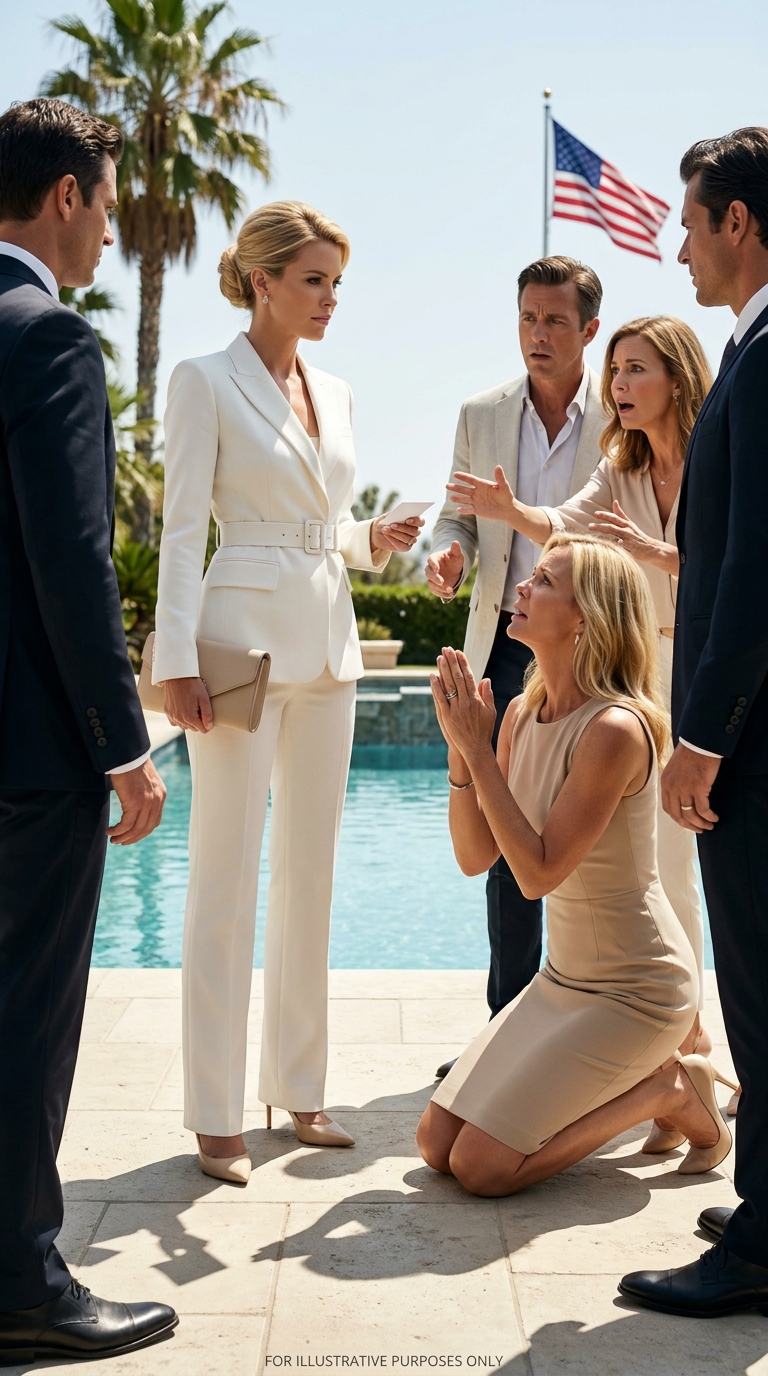
Daphne’s band blinked red.
She frowned at it like it had personally insulted her.
The therapist beside her tablet stiffened. My father sat up on the next lounger, cucumber slices sliding from his eyes.
“What is that?” Daphne snapped.
The therapist looked from the wristband to her tablet. “I’m sorry, Mrs. Whitaker. It appears your membership account has been suspended.”
Daphne laughed once. Sharp. Fake. “That’s impossible.”
My father removed the towel from his chest. “Run it again.”
The therapist tapped the screen. The tablet flashed red.
Membership inactive. Services terminated. Payment required.
In my Chicago office, Noah stood beside me, silent, watching the wall screen like he was witnessing live theater.
Daphne pulled her robe tighter. “Do you have any idea who we are?”
The therapist swallowed. “Yes, ma’am.”
“Then fix it.”
“I can call management.”
“You will call management, and you will tell them Daphne Whitaker is not paying a penny for a clerical mistake.”
I leaned back in my chair. “Noah.”
“Yes?”
“Route their call here.”
His expression did not change, but his eyes brightened. “Of course.”
Thirty seconds later, my office phone rang.
I answered on speaker.
“This is Caroline Whitaker.”
There was a pause.
Then my father’s voice came through, thin with confusion and irritation. “Caroline?”
“Hello, Dad.”
“What are you doing on this line?”
“I own the line.”
Another pause.
Daphne’s voice cut in. “This is ridiculous. Tell whoever is playing this joke to restore our account immediately.”
“No one is playing a joke,” I said. “Your family membership has been revoked.”
Daphne gave a disbelieving little laugh. “By whom?”
“By the owner.”
“You are not the owner.”
“Of Silver Pines?” I asked. “Yes, I am.”
On the security feed, Daphne went still.
My father looked toward the camera without knowing where it was. “Caroline, what are you talking about?”
“Whitaker Strategic Capital acquired Delaney Hospitality Group three months ago. Silver Pines, Hampton Crest, Blue Harbor Marina, Delaney’s eighteen golf courses, the private lending division, and every hospitality asset attached to it.”
Daphne’s mouth opened.
No sound came out.
I continued, calm and clear.
“The announcement was scheduled for next week. But since you banned me from my own resort, I thought the staff deserved updated instructions.”
My father lowered his voice. “Caroline, this is not the way to handle family matters.”
That almost made me smile.
“Family matters?” I repeated. “Daphne just informed me security had my photograph.”
Daphne found her voice. “Because you attacked us in public.”
“I presented financial records.”
“You humiliated your father.”
“No,” I said. “I embarrassed thieves.”
The word landed hard.
On the screen, my father’s face tightened. Daphne stood so quickly one of the spa slippers flew off her foot.
“How dare you,” she hissed.
“Would you like me to start with the gala expenses?” I asked. “Or the foundation credit card used for your private marina dinners? Or the five-day ‘youth leadership retreat’ where not one child was present?”
My father said, “Caroline.”
“No, Dad. Not this time.”
For years, that tone had worked on me. It was the tone he used when he wanted me to stop making Daphne uncomfortable. The tone he used when she seated me at the far end of tables. When she introduced me as “Charles’s daughter from his first marriage” but never as her stepdaughter. When she forgot my birthday but remembered the exact year of every wine bottle in the Silver Pines cellar.
The tone of a man asking the injured person to bleed more quietly.
I was done bleeding quietly.
Daphne grabbed the therapist’s tablet, scanned it, and threw it onto the lounger. “We have a contract.”
“You had a contract,” I corrected. “Section twelve, paragraph four: management may terminate membership privileges immediately for reputational risk, misuse of charitable funds, abusive conduct toward staff, or fraud.”
“That clause is never enforced.”
“It is now.”
My father’s voice changed. The anger drained, leaving calculation behind. “Let’s talk in person. We can have dinner. Quietly. No lawyers.”
“Where?” I asked. “The presidential villa?”
He exhaled. “Yes, if necessary.”
“I’m afraid that won’t be possible.”
Daphne snapped, “Why not?”
“Because as of ten minutes ago, the presidential villa has been reassigned.”
“To whom?”
“The Whitaker Scholars Program,” I said. “A legitimate charitable initiative for low-income students visiting California colleges. The villa is being converted into study housing.”
Daphne stared at nothing.
Then she whispered, “Our things are in there.”
“Yes,” I said. “Security is boxing them now.”
Her face changed.
Not from fear yet. From disbelief.
People like Daphne did not believe consequences existed until they touched her belongings.
“You cannot touch my personal property,” she said.
“I can secure resort property and release personal items after unpaid balances are settled.”
My father shot to his feet. “Unpaid balances?”
Noah tapped his tablet and pushed a number to my screen.
I read it aloud. “Between spa charges, private dining, marina use, villa staffing, helicopter transfers, and foundation-billed incidentals, your family account currently owes Delaney Hospitality two million, three hundred and nineteen thousand dollars.”
Daphne let out a sound like a laugh breaking in half.
“That is impossible,” she said.
“No,” I replied. “That is itemized.”
My father stepped away from the therapist, lowering his voice as if the cameras could not hear him. “Caroline, listen to me. Daphne may have been careless, but there is no need to destroy everything.”
Careless.
That was the word he chose.
Not cruel. Not dishonest. Not responsible.
Careless.
I looked at the live image of the man who had once taught me to ride a bike in our driveway in Bethesda, Maryland. The man who held my hand at my mother’s funeral. The man who had slowly, willingly disappeared behind Daphne’s perfume and social ambitions until all that remained was a father-shaped shadow.
“I’m not destroying anything,” I said. “I’m collecting what is owed.”
Daphne snatched the phone from him. “You bitter little girl. You think owning a company makes you powerful? You will always be the unwanted daughter standing outside the room.”
The office went quiet.
Noah looked away.
The rain hit the windows harder.
I leaned toward the phone.
“Daphne,” I said softly, “you should be careful where you stand when the room belongs to me.”
Then I ended the call.
On the wall screen, two resort security managers entered the spa suite with folded clothes, paper invoices, and deactivated platinum cards on a tray.
Daphne looked at them.
For the first time in my life, she had nothing clever to say.
PART 3
By the time Daphne and my father reached the lobby, half the resort knew.
Silver Pines had been built on cliffs overlooking the Pacific, a place where wealthy people came to pretend the world could be controlled by linen napkins, valet carts, and ocean air. Its lobby was a cathedral of privilege: white marble floors, brass railings, tall windows, orchids in glass bowls, and a grand staircase Daphne had once descended like she expected applause.
That day, she came through the spa corridor in a robe and slippers, clutching a garment bag to her chest.
My father walked beside her in wrinkled linen pants and a polo shirt the color of expensive regret.
Guests turned.
Phones lifted.
The same women who had laughed at Daphne’s jokes during tennis luncheons now watched from behind sunglasses. The men who had once competed for my father’s attention at golf tournaments suddenly found their coffee fascinating.
Daphne tried to recover dignity with posture alone.
It almost worked until her wristband flashed red at the lobby exit and the glass doors refused to open.
A young concierge stepped forward. “Mrs. Whitaker, we’ll need you to settle the outstanding balance before departure.”
Daphne froze.
My father closed his eyes.
In Chicago, I watched from my office, but the satisfaction I expected did not arrive cleanly. There was triumph, yes. There was justice. But beneath it, something older twisted inside me.
I had imagined this moment for years in ways I never admitted. Daphne embarrassed. My father forced to see her clearly. The people who ignored my humiliation finally turning their eyes on hers.
But revenge has a strange echo. It brings back the original wound.
I saw myself at seventeen, standing in the same lobby with a duffel bag. Daphne had told security I was “emotionally unstable” and not allowed upstairs. I had waited beside a potted palm while guests pretended not to hear me begging the front desk to call my father.
He had come down after twenty minutes.
Not to defend me.
To hand me cab fare.
“Just go home, Caroline,” he had said. “Daphne is upset.”
I had gone home.
Then I went to Yale. Then Stanford Business. Then Wall Street. Then Chicago. I built companies with the focus of someone who understood that money was not love, but it could be a locked door with your hand on the key.
Noah broke the silence. “The press release is live.”
The wall screen split. On the right, financial news sites began pushing alerts.
WHITAKER STRATEGIC CAPITAL CONFIRMS ACQUISITION OF DELANEY HOSPITALITY GROUP
CAROLINE WHITAKER, 34, TAKES CONTROL OF SILVER PINES RESORT PORTFOLIO
WHITAKER HOPE FOUNDATION FACES QUESTIONS AFTER GALA DISCLOSURE
My phone immediately began vibrating.
Board members. Reporters. Donors. Former family friends who had not called me in years.
Then one name appeared.
Uncle Martin.
I answered.
“Well,” he said, without greeting, “you finally did it.”
“Hello to you too.”
“I warned your father Daphne would turn that foundation into her closet.”
“You did.”
“And I warned you buying their resort would start a war.”
“You did.”
He sighed. Martin Whitaker was my father’s older brother, a retired federal judge in Virginia who had skipped every family party after Daphne arrived. “Are your documents clean?”
“Cleaner than their books.”
“Good. Because they will not fall quietly.”
“I know.”
“No, Caroline. You do not.” His voice darkened. “Daphne has survived this long because she keeps leverage. On everyone.”
I looked back to the security feed. Daphne was arguing with the concierge while my father stood helplessly behind her.
“What kind of leverage?”
“Your mother’s estate.”
Every muscle in my body tightened.
“My mother?”
“I should have told you years ago,” Martin said. “After Elizabeth died, there were questions about changes made to her trust. Your father said it was grief and paperwork. I never believed him.”
The office seemed to shrink around me.
My mother, Elizabeth Whitaker, had died when I was eleven after a sudden stroke. She had been warm, sharp, and unafraid of Daphne long before Daphne officially entered our lives as my father’s “family friend.” After her funeral, things moved quickly. Assets shifted. Old staff disappeared. My father remarried within two years.
I had been too young to understand what had been taken.
“What are you saying?” I asked.
“I’m saying Daphne may have started stealing before the charity. And if you expose her now, she may expose what your father helped bury.”
The words struck harder than I expected.
On the screen, Daphne suddenly stopped arguing and looked directly at a lobby camera. She knew she was being watched. She raised her chin, pulled out her phone, and began typing.
Seconds later, my phone buzzed.
You think I am afraid of records, Caroline? Ask your father what your mother signed three days before she died. Ask him why he never showed you the letter.
My hand went cold around the phone.
Noah saw my face. “Ms. Whitaker?”
Another message arrived.
You want war? Then let’s open every box.
I stared at those words until the letters blurred.
For years, I thought Daphne’s worst crime was making me feel unwanted.
But in that moment, standing above Chicago with a storm at my back and my father trapped in a lobby I owned, I realized the resort was only the first locked room.
There was another door behind it.
And Daphne had just dared me to open it.
PART 4
The box arrived from Washington, D.C. at 7:12 the next morning.
It came by private courier, sealed in brown evidence tape, with Judge Martin Whitaker’s signature across the flap. Noah brought it into my office without a word and placed it on the conference table.
I stood over it for almost a minute before touching it.
A person can build a billion-dollar company and still become a child when faced with her mother’s handwriting.
Inside were copies of estate documents, trust amendments, old bank statements, and one cream envelope with my name written across the front.
For Caroline, when she is old enough to know who stood beside her.
My knees weakened.
I sat down.
Noah moved toward the door. “I’ll give you privacy.”
“Stay,” I said.
He stopped.
I did not want to be alone when my mother came back to me through paper.
The letter was dated five days before her death.
My mother’s handwriting was elegant but uneven, as if written by a trembling hand.
My darling Caroline,
If you are reading this, it means something has gone wrong, or someone has decided you are old enough to hear the truth. I do not trust Daphne Ellis. I do not trust the way she has entered our family, and I do not trust your father’s weakness around her.
I pressed my hand to my mouth.
The room blurred.
Your father believes kindness is the same as avoiding conflict. It is not. Sometimes avoiding conflict means handing power to the person most willing to use it.
That was my mother. Clear. Unsparing. Loving without softness where truth was needed.
The letter continued.
I have placed separate protections around your education fund and your inheritance. If anyone tells you there is nothing for you, do not believe them. If anyone makes you feel like a guest in your own family, remember this: you were never the extra child. You were the center of my heart.
A sound escaped me before I could stop it.
Noah looked down.
I kept reading.
There is a key in the safe deposit box at Potomac Federal Bank. It opens a private archive tied to the foundation documents. If Charles has done what I fear he may do, the records there will show it. Martin knows enough to help you, but not everything. I did not tell him because I was still hoping your father would choose courage.
I folded the letter carefully and placed it on the table.
Beneath it was a copy of a trust amendment dated three days before my mother’s death.
My signature was nowhere, of course. I was eleven.
But my mother’s signature appeared at the bottom.
Except it was wrong.
Even before Noah called in the forensic document examiner, I knew.
The E in Elizabeth was too narrow. The W in Whitaker leaned the wrong way. My mother never crossed her t’s with that impatient slash.
Someone had forged her name.
By noon, we had the Potomac Federal archive opened under judicial supervision. By evening, the contents were digitized in my secure conference room.
The files told the story slowly, then all at once.
Before she died, my mother had intended the Whitaker Hope Foundation to fund scholarships for children of nurses, teachers, firefighters, and military families. She had set aside a large portion of her family assets for that purpose. She had also protected a private trust for me.
After her death, those protections were altered.
Money moved through shell accounts. Foundation funds were redirected toward “administrative lifestyle positioning.” My education trust was drained and replaced with smaller accounts my father later claimed were “generous enough.” Daphne had not merely married into wealth.
She had carved her throne out of my mother’s legacy.
My father had signed approvals.
Not all of them.
But enough.
I did not cry after that.
Something colder replaced grief.
At 9:30 p.m., Daphne called.
Noah asked, “Do you want to send it to voicemail?”
“No.”
I answered on speaker.
Daphne did not bother pretending. “You opened the box.”
“Yes.”
“Then you understand why humiliating me was foolish.”
I looked at my mother’s letter on the table. “Actually, I understand why you were afraid of me.”
She laughed. “Afraid? Caroline, you were a lonely little girl desperate for your father’s attention. Then you became a lonely woman desperate to prove she mattered.”
“Is that what you told yourself while spending my mother’s scholarship money?”
Silence.
Then her voice sharpened. “Careful.”
“No. You be careful.”
“Your father signed documents too.”
“I know.”
“Then if I fall, he falls.”
For a moment, the old reflex rose in me. Protect Dad. Don’t make it worse. Don’t break what is already cracked.
But then I saw him again in the Silver Pines lobby, handing me cab fare. I saw him at my graduation, leaving early because Daphne was tired. I saw him at the gala, whispering my name not because I was wrong, but because I was inconvenient.
“I’m not protecting him from the truth anymore,” I said.
Daphne exhaled slowly. “You think justice will love you back?”
“No,” I replied. “But neither did silence.”
I ended the call.
Then I called Judge Martin.
“I want the independent audit expanded,” I said. “Foundation records, trust records, lending records, everything.”
Martin was quiet for a moment. “That will likely expose your father.”
“Yes.”
“Are you sure?”
I looked at my mother’s letter.
You were never the extra child.
“I’m sure.”
The next morning, I flew to California.
Not to hide behind screens.
Not to send instructions through assistants.
I flew to Silver Pines because Daphne had ruled that place by making people afraid to look directly at her cruelty.
I wanted her to see me walk through the front doors.
And this time, no one would stop me.
PART 5
Silver Pines looked different when I arrived as its owner.
The Pacific was bright and brutal beneath the morning sun. Waves crashed against the cliffs below the resort, throwing white spray into the air. The driveway curved between cypress trees and fountains, past valet attendants in navy uniforms who stood straighter when my black SUV pulled in.
The general manager, Paul Reed, waited at the entrance with six department heads.
“Ms. Whitaker,” he said, extending his hand. “Welcome to Silver Pines.”
Welcome.
One word.
Seventeen years late.
I shook his hand and stepped into the lobby.
The room quieted as I entered. Not completely. Silver Pines people were too trained for open reaction. But conversations thinned. Coffee cups paused. Heads turned slightly.
I wore a white suit, not because Daphne loved white, but because my mother had. She used to say white was not innocence; it was confidence. It showed every stain and dared the world to look.
Noah walked beside me carrying a leather folder.
Paul cleared his throat. “Mrs. Daphne Whitaker is currently in the east lounge. She has been waiting since six this morning.”
“Has she settled her balance?”
“No.”
“Then why is she inside?”
His face tightened. “She refused to leave and threatened litigation.”
I turned to him. “Mr. Reed, this resort is no longer managed by fear. If a guest refuses lawful instruction, you call security. If security needs support, you call police. If the person is named Whitaker, you do the same thing.”
“Yes, ma’am.”
“Good. Take me to her.”
The east lounge overlooked the ocean through arched windows. Daphne sat alone at a table set for three, wearing a pale blue dress and pearls, every inch arranged to suggest she had chosen this meeting instead of being cornered by it.
My father sat beside her.
He looked worse than he had on camera.
Older. Smaller. Sleepless.
Daphne smiled when I entered.
“Caroline,” she said. “You’ve made your point.”
“No,” I said, taking the chair across from them. “I’ve begun.”
My father rubbed his forehead. “Please. Can we speak like a family?”
I opened the folder and placed my mother’s letter on the table.
His face changed before he read a word.
Daphne noticed.
For the first time, uncertainty flickered in her eyes.
“Where did you get that?” my father whispered.
“Uncle Martin.”
He closed his eyes.
Daphne leaned forward. “Old grief is not evidence.”
“No,” I said. “Forgery is.”
Noah placed copies of the trust amendment, the handwriting analysis, bank transfers, and foundation ledgers in neat stacks between the silverware.
Daphne did not touch them.
My father did.
His hand shook.
I watched him read the summary page. He got halfway through before pushing it away as if the paper had burned him.
“I didn’t know all of it,” he said.
That sentence nearly broke me.
Not because it was enough.
Because part of me still wanted it to be.
“You knew enough,” I replied.
Daphne turned to him sharply. “Charles.”
He stared at the table.
She grabbed his wrist. “Charles, don’t you dare.”
There she was. Not the polished hostess. Not the wounded stepmother. Not the social queen of Silver Pines.
Just a frightened woman clutching the last man willing to confuse her control for love.
My father pulled his wrist free.
“I signed what you put in front of me,” he said quietly.
Daphne’s face hardened. “Because you agreed.”
“Because you told me Elizabeth wanted Caroline raised without entitlement.”
I laughed once, but there was no humor in it.
“My mother left me a trust and a foundation for students.”
He looked at me then, and whatever defense he had built collapsed.
“I was weak,” he said.
Daphne stood. “No. You were practical. Elizabeth was emotional. She wanted to give money away to strangers and leave Caroline with enough power to challenge us before she even turned twenty-one.”
Us.
The word hung in the room.
My father flinched.
I leaned back. “Thank you.”
Daphne blinked. “For what?”
“For finally telling the truth in front of witnesses.”
She looked around.
Paul Reed stood near the doorway. Noah had his tablet open. The resort legal counsel stood behind him. Two security cameras watched from the corners.
Daphne’s mouth tightened.
“You recorded me?”
“You are in a resort lounge under standard security monitoring,” I said. “You know that. You approved the camera upgrades yourself and billed them to the foundation as donor protection.”
My father covered his face.
Daphne’s composure cracked.
“You ungrateful little parasite,” she said. “Everything you have came from the Whitaker name.”
“No,” I said. “Everything I survived came from the Whitaker name. Everything I built came from being locked out of it.”
She stepped toward me.
Security moved instantly.
I raised one hand and they stopped.
Daphne’s eyes were wet now, but not with remorse. With rage.
“You think people will choose you?” she whispered. “They smiled at me for fifteen years.”
“Because you paid for the room,” I said. “I own the building.”
My father made a broken sound.
I turned to him.
“You have one chance to do something decent,” I said. “Sign control of the Whitaker Hope Foundation to the independent board. Cooperate with the audit. Return what can be recovered. Admit what you signed.”
Daphne snapped, “He will do no such thing.”
But my father did not look at her.
He looked at my mother’s letter.
Then at me.
“What happens to Daphne?” he asked.
“That depends on Daphne.”
Daphne laughed bitterly. “I will fight you.”
“I expected that.”
“I will ruin your reputation.”
“You tried.”
“I will tell every reporter that you are punishing a grieving widower and his wife.”
I gathered the documents slowly.
“Then I’ll tell them about the mortgage.”
Daphne went still.
My father looked confused. “What mortgage?”
I almost felt sorry for him.
Almost.
“Your Georgetown townhouse. The Aspen ranch. The Nantucket property,” I said. “They were refinanced through Delaney Private Lending. Those notes were part of the acquisition.”
Daphne sat down as if her legs had failed.
“You don’t,” she whispered.
“I do.”
For the first time since I had known her, Daphne looked truly afraid.
Not embarrassed.
Not angry.
Afraid.
Because a resort ban could be spun.
A charity scandal could be blamed on accountants.
But a mortgage meant the roof over her head had a new owner.
And that owner was the girl she once left standing outside.
PART 6
The emergency board meeting took place that afternoon in the Monterey ballroom.
Daphne had hosted charity auctions there for years beneath crystal chandeliers and framed ocean views. She had stood on that stage in silk gowns, speaking about opportunity, compassion, and “the sacred duty of privilege,” while children her foundation rejected worked night shifts in diners, cleaned hotel rooms, and filled out scholarship applications that vanished into storage boxes.
Now the room had no flowers.
No champagne.
No orchestra.
Just a long table, legal folders, auditors, independent directors, and a row of former foundation employees waiting to speak.
My father sat at the end, pale and silent.
Daphne arrived fifteen minutes late with two attorneys from Los Angeles and the expression of a woman still convinced expensive men could rewrite reality.
They could not.
The first witness was a former program coordinator named Melissa Grant. She was forty, nervous, and still angry enough to speak clearly.
“I was told to deny scholarship applicants unless they had social value,” Melissa said.
Daphne rolled her eyes. “That is absurd.”
Melissa opened a folder. “This is the email you sent me about an applicant from Fresno whose mother was a hospice nurse. You wrote, ‘Strong sob story, but not our image. Decline.’”
The attorney beside Daphne whispered something.
Daphne’s jaw tightened.
The next witness was a bookkeeper. Then a driver. Then the former concierge who had arranged Daphne’s “donor wellness weekends” and billed the foundation for luxury suites.
Each story added another brick to the wall closing around her.
My father said almost nothing.
But when the auditors presented the forged trust amendment, his face crumpled.
“I knew the signature looked wrong,” he said quietly.
The room went still.
Daphne turned slowly. “Charles.”
He did not look at her.
“I knew,” he repeated, voice breaking. “I told myself Elizabeth had been ill. I told myself grief made things look different. Daphne said the lawyers had handled it.”
My hands tightened beneath the table.
Part of me had wanted a dramatic confession. A thunderclap. A shouted admission that would split the room open.
Instead, my father’s truth came out small.
Cowardice often does.
He looked at me. “I failed you.”
The words landed somewhere deep, but they did not heal what they touched.
“Yes,” I said.
He nodded as if he deserved nothing more.
Daphne stood abruptly. “This meeting is over.”
“No,” I said. “Your influence is over. The meeting continues.”
Her attorney pulled her sleeve. “Mrs. Whitaker, sit down.”
She ignored him. “You all sat at my tables. You all took my invitations. You all wanted access to Silver Pines when I gave it to you. Do not pretend morality now because Caroline bought a building.”
Nobody answered.
That silence was different from my father’s.
It was not protection.
It was abandonment.
Daphne had mistaken fear for loyalty. Now that fear had found a stronger place to stand, loyalty vanished.
The independent board voted unanimously to remove Daphne and my father from all foundation authority. My father signed cooperation documents. Daphne refused.
Then came the lending report.
Noah displayed the numbers on the ballroom screen.
The Georgetown townhouse was underwater. The Aspen ranch had missed two tax payments. The Nantucket property was leveraged against a line of credit Daphne had used to maintain social spending after donations slowed.
My father stared at the screen like he was seeing his own life translated into a language he should have learned years ago.
Daphne whispered to her attorney, “Can she call the loans?”
The attorney hesitated.
That hesitation answered for him.
I stood.
“I am not calling the notes today,” I said.
Daphne looked up quickly.
“For one reason,” I continued. “There are staff in those homes. Housekeepers, caretakers, groundskeepers. People who did honest work while you charged your lifestyle to children’s scholarships. I will not punish them for your fraud.”
My father covered his mouth.
Daphne said nothing.
“The properties will be reviewed. Staff will be paid. Personal luxury accounts are frozen. Any sale proceeds after legal obligations will go first toward restitution.”
Daphne’s laugh was hollow. “Restitution. You mean revenge.”
“No,” I said. “Revenge would be leaving you outside with cab fare.”
My father looked down.
Everyone in that room felt the history behind the sentence even if they did not know the details.
Daphne did.
Her face went white with fury.
“You were never family,” she said.
I looked at my father.
He flinched.
Then I looked back at her.
“You’re right,” I said. “Family does not steal a dead woman’s legacy and use it for spa weekends.”
Security escorted her out after she slapped the folder from the table.
She screamed once in the hallway. Not words. Just rage.
Then the ballroom doors closed.
For the first time all day, the ocean could be heard through the glass.
My father remained in his chair.
After the meeting ended, he came to me while staff collected documents.
“Caroline,” he said.
I waited.
“I don’t know how to ask forgiveness.”
“Then don’t.”
His eyes filled. “What do I do?”
“Tell the truth. All of it. To the auditors. To investigators. To the students who lost opportunities. To yourself.”
He nodded.
Then he said, “And to you?”
I looked out at the cliffs.
The girl in the staff room wanted him to beg.
The woman in the white suit wanted peace.
“I’m not ready,” I said.
He accepted that with a small nod.
Maybe that was the first honest thing he had ever given me.
PART 7
Six months later, Silver Pines opened its doors to the first class of Whitaker Scholars.
The presidential villa no longer had Daphne’s gold mirrors, velvet chaise lounges, or private champagne room. The imported marble remained, but now it reflected rows of desks, bookshelves, college banners, laptops, and a wall covered in framed letters from students who had received grants funded by recovered money.
At the entrance, a bronze plaque read:
THE ELIZABETH WHITAKER CENTER FOR SCHOLARSHIP AND PUBLIC SERVICE
I stood before it on opening morning with my hand pressed flat against my mother’s name.
The Pacific wind moved through the courtyard. Students arrived in buses from California, Oregon, Nevada, Arizona, and Washington. Some stepped down with parents carrying coolers and camera phones. Some came alone with backpacks patched at the seams. One boy from Bakersfield wore a suit two sizes too large. A girl from San Diego clutched a folder of engineering drawings like it contained her whole future.
Maybe it did.
Noah stood beside me, smiling. “Your mother would have liked this.”
“Yes,” I said. “She would have improved the seating chart.”
He laughed.
Across the courtyard, my father stood near the fountain.
He had come alone.
No Daphne. No entourage. No platinum member smile.
Just Charles Whitaker in a plain navy suit, holding a stack of program brochures he had volunteered to hand out. He looked thinner. His hair had gone almost fully gray. The federal investigation had not spared him, but his cooperation had kept him from prison. He had resigned from every board, sold the Aspen ranch, and moved into a modest condo outside Alexandria, Virginia.
Daphne had fought everything.
She gave interviews accusing me of cruelty, jealousy, and “financial elder abuse,” even though she was fifty-eight and perfectly capable of yelling at reporters. For three weeks, gossip sites loved her. Then the emails leaked. Then the invoices. Then the forged documents.
Public sympathy died quickly when people saw children’s scholarship funds billed for diamond facials and private helicopter transfers.
Her attorneys negotiated a plea on financial crimes tied to the foundation. The Georgetown townhouse was sold. Nantucket too. Daphne moved to a rental in Palm Beach under her maiden name, where, according to mutual acquaintances, she still told people she had been betrayed by “new money with old grudges.”
Maybe she believed it.
People like Daphne often survive by editing reality until they are the victim in every version.
I did not think about her as much as I expected to.
That surprised me.
For years, my hatred of Daphne had felt like proof that what she did mattered. But once the doors were unlocked, once the money was returned, once my mother’s name replaced hers on the wall, hatred became too heavy to carry.
Justice had weight too, but it was easier. It could be set down after use.
The opening ceremony began at noon.
I walked onto the small outdoor stage facing the ocean. Students sat in white chairs across the lawn. Parents shaded their eyes. Staff stood along the back. Reporters waited near the hedges.
My father sat in the third row.
I had not reserved him a front seat.
I had not hidden him behind a pillar either.
Growth, I had learned, did not always look like forgiveness. Sometimes it looked like fairness without affection.
I stepped to the microphone.
“My mother, Elizabeth Whitaker, believed education should not depend on who invited your parents to dinner,” I began.
A soft laugh moved through the crowd.
“She believed talent is everywhere, but access is guarded. She believed charity should never be a costume people wear in public while stealing in private.”
The crowd quieted.
I looked at the students.
“Some of you were told places like this were not built for you. Some of you walked into rooms where people saw your clothes before your mind, your ZIP code before your talent, your family name before your future.”
My voice tightened, but it did not break.
“I know that feeling. I know what it is to stand outside a locked door while people inside call it tradition.”
My father looked down.
I continued.
“This center exists because locked doors can be opened. Sometimes with keys. Sometimes with courage. Sometimes with evidence.”
A bigger laugh this time.
“And sometimes,” I said, “with the stubborn refusal to become as cruel as the people who hurt you.”
The applause rose slowly, then fully.
After the ceremony, students toured the villa. Parents cried in the computer lab. A mother from Phoenix hugged me so hard my sunglasses fell into the grass. A boy named Eli asked if he could sit by the ocean to call his grandmother and tell her he was really going to college.
“Yes,” I told him. “Call her from the best view we have.”
Late in the afternoon, when the crowd thinned, my father approached.
He held one of the brochures, folded carefully in half.
“Your speech was beautiful,” he said.
“Thank you.”
He looked toward the plaque. “She would be proud.”
“Yes,” I said.
He swallowed. “I found something last week while cleaning out the Georgetown house.”
I stiffened.
He reached into his jacket and handed me a small velvet pouch.
Inside was my mother’s wedding ring.
For years, Daphne had worn it on a chain at private family events, claiming my father had given it to her as a symbol of “blended love.” I had hated seeing it against her skin.
“I should have given it to you when you turned eighteen,” he said. “I should have done a lot of things.”
I closed my fingers around the ring.
This time, the grief came gently.
“Why now?” I asked.
“Because it was never mine to keep.”
I looked at him for a long moment.
Then I nodded.
It was not forgiveness.
But it was something honest.
A group of students ran past us toward the lawn, laughing as the sun lowered over the Pacific. Their voices filled the space Daphne had once filled with judgment.
My father watched them. “Can I keep volunteering?”
The question was small.
Careful.
Maybe the first truly humble thing he had ever asked me.
“You can apply through the same process as everyone else,” I said.
He smiled faintly. “Fair enough.”
As he walked away, Noah joined me by the plaque.
“Big day,” he said.
“The first of many.”
He looked toward the ocean. “Do you ever miss the idea of them being your family?”
I thought about the old dream. A father who chose me. A stepmother who softened. A family table where no one had to earn a chair.
“Yes,” I said. “But I don’t miss pretending.”
The sun touched the water, turning the cliffs gold.
I slipped my mother’s ring onto a chain around my neck.
Behind me, the Elizabeth Whitaker Center glowed with warm lights. Inside, students claimed desks, opened laptops, wrote names on notebooks, and began building lives no one had permission to steal.
Daphne had banned me from the family resort because she thought ownership meant belonging.
She was wrong.
Ownership was paperwork.
Belonging was what you built after the locks changed.
And as I watched those students walk through doors that would never be closed to them, I finally understood what my mother had left me.
Not money.
Not revenge.
A blueprint.
For a better room.