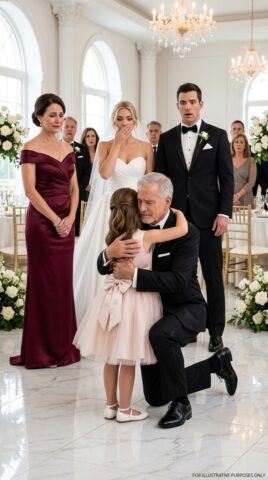
PART 2
Three years earlier, Caroline Whitaker Bennett had walked into her father’s chambers carrying a folder thick with photographs, custody violations, medical records, and text messages from her husband that made her hands shake every time she read them.
It had been a cruelly hot August afternoon in Washington, D.C., the kind where the air seemed to press against the windows like wet cloth. Outside, tourists sweated beneath monuments. Inside the courthouse, everything smelled of old paper, polished wood, and power.
Caroline had flown in from San Diego with bruised sleep under her eyes and fear sitting like a stone in her chest.
Her marriage to Graham Bennett had collapsed six months earlier. Graham was charming in public, cruel in private, and brilliant at making himself look wounded whenever anyone questioned him. He came from an old Virginia family, smiled beautifully for judges, donated to the right campaigns, and knew exactly how to make a mother look unstable without ever raising his voice.
Caroline was a pediatric oncologist. She had spent her life calming terrified parents, explaining scans, and holding children’s hands before surgery. But she had never been more afraid than she was when Graham began using Lily like a bargaining chip.
He ignored custody schedules. He withheld medication. He “forgot” to bring Lily back after weekends. He accused Caroline of being too busy, too emotional, too ambitious. When she objected, he had his attorney, Vincent Hale, send letters so aggressive they felt like threats wearing legal language.
So Caroline did what daughters do when they still carry one stubborn piece of childhood hope.
She went to her father.
Nathaniel Whitaker sat behind his desk while she spoke. He did not interrupt. He did not comfort her. He did not reach for the photographs of Lily’s rash after Graham forgot her allergy medication. He simply listened with the unreadable expression he used on defendants who had already disappointed him.
When Caroline finished, the silence between them was unbearable.
“Dad,” she said, her voice cracking, “I need help.”
He removed his glasses and folded them carefully.
“You need counsel.”
“I have counsel.”
“Then follow the process.”
She stared at him. “The process is failing my child.”
“The process is the only thing that keeps emotion from destroying fairness.”
Caroline laughed once, but there was no humor in it. “Fairness? Graham’s attorney golfs with half the judges in Virginia. He has been building a story that I’m unstable for months. He is going to take Lily from me just to punish me for leaving.”
Nathaniel’s face hardened. “You are asking me to interfere in a matter that could come before courts connected to mine.”
“I’m asking you to be my father.”
The words hung in the air.
For a moment, something moved in his eyes. It was small, almost invisible, but Caroline saw it because she had spent thirty-four years looking for tenderness in that face.
Then he buried it.
“I cannot compromise my position.”
“Your position?” she whispered.
“My integrity.”
Caroline stepped back as if he had slapped her.
“Your integrity did not show up when Mom cried herself to sleep during your campaigns for promotion,” she said. “Your integrity did not come to my school plays. Your integrity did not walk me down the aisle without checking your watch. And now your integrity is telling you to sit behind that desk while your granddaughter is used as a weapon?”
“That is enough.”
“No,” she said, tears filling her eyes. “It was enough a long time ago. I just didn’t want to admit it.”
He stood. “Caroline—”
“You taught me something today.” Her voice turned cold. “You taught me that a father can become so loyal to the law that he forgets love is not supposed to require a motion, a hearing, and a stamped order.”
She turned to leave.
“Caroline,” he said again, softer.
At the door, she looked back.
“One day,” she said, “you will have to choose between being right and being mine. I hope you understand the difference before it’s too late.”
Then she left.
For three years, silence became their only language.
Nathaniel wrote letters. They came back unopened. He called. His number was blocked. He sent gifts for Lily’s birthdays. Margaret returned them with a note that said, “A child is not a mailbox for regret.”
He told himself Caroline was stubborn. He told himself she needed time. He told himself he had acted properly.
But at night, inside his Georgetown townhouse, the silence told a different story.
There were no small shoes by the door. No childish drawings on the refrigerator. No daughter calling after difficult shifts. No granddaughter learning his face.
Only framed awards, leather-bound legal books, and a house so clean it felt unlived in.
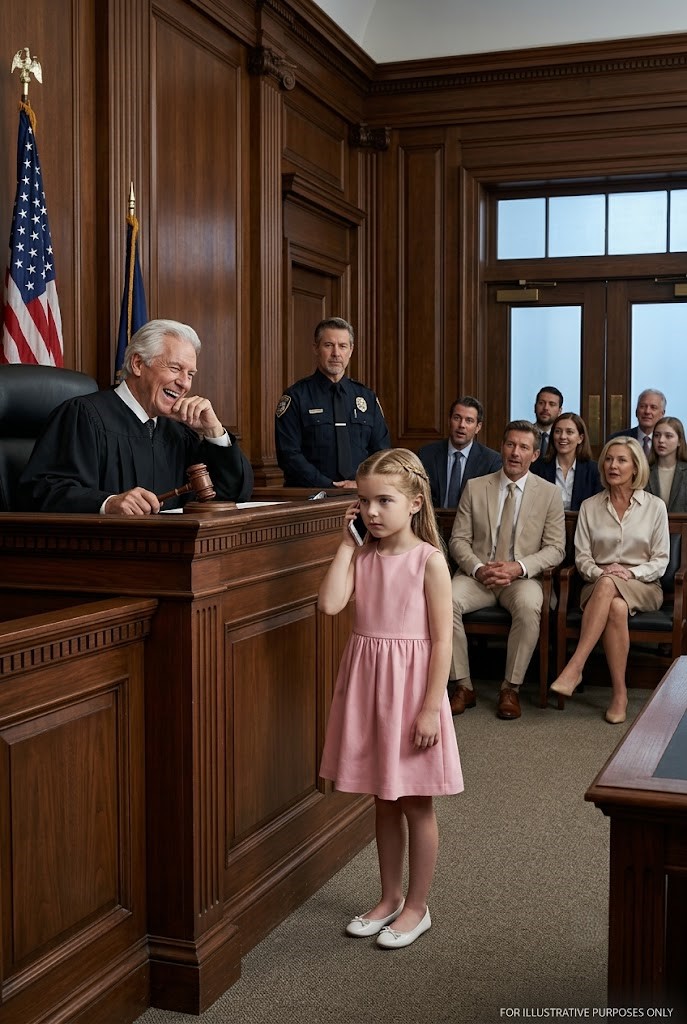
Then, one Tuesday in October, Lily walked into Courtroom 6B.
And the truth walked in behind her.
PART 3
“Why is Lily in my courtroom?” Nathaniel asked, still kneeling on the floor as if standing would make him a coward again.
Caroline’s breathing trembled through the phone.
“She was supposed to be with my mother,” she said. “Mom took her to D.C. because Graham filed an emergency petition. He’s trying to take full custody.”
Nathaniel slowly turned his head toward Vincent Hale.
The attorney stood frozen beside the counsel table, his face slick with panic.
Nathaniel’s voice dropped. “Mr. Hale.”
“Your Honor, I must object to the irregularity of this—”
“Be quiet.”
Two words. Quietly spoken.
The courtroom chilled.
Nathaniel looked back at the phone. “Caroline, why did Lily call you from Vincent Hale’s phone?”
“Because,” Caroline said, “apparently my number is saved under ‘unstable mother.’”
A sound moved through the courtroom. Not quite a gasp. Not quite outrage. Something uglier.
Vincent Hale’s face drained completely.
Nathaniel stood now, not as a judge above the room, but as a grandfather whose family had been dragged into a war he had refused to see.
Margaret rose from the gallery.
“I brought Lily because Graham’s side tried to block Caroline from appearing remotely,” she said, her voice shaking but clear. “They said she was too ill to parent, too ill to testify, too ill to make decisions. They were going to use her treatment against her.”
Nathaniel turned slowly. “Treatment?”
Nobody answered.
His daughter’s silence filled the line.
“Caroline,” he said. “What treatment?”
Her breath caught.
For the first time that morning, Lily looked scared. She took one small step toward him and placed her hand on his robe.
“Mommy’s medicine makes her tired,” she said.
Nathaniel’s knees nearly failed.
Caroline’s voice came through the phone, quieter now. “Stage two breast cancer. Diagnosed in June. I started chemotherapy in July.”
The courtroom blurred.
Nathaniel had ruled on cases involving embezzlement, murder, fraud, political corruption, and national security. He had heard mothers scream, fathers beg, CEOs lie, and witnesses collapse under cross-examination. He had trained himself to stay still while other people’s worlds burned.
But this was his child.
His Caroline.
The little girl who once fell asleep on his law books while waiting for him to finish “just one more brief.” The teenager who stopped asking him to attend debate tournaments. The bride whose hand trembled against his arm because she already knew he was leaving the reception early.
Cancer.
Four months of chemotherapy.
And he had not known.
“When,” he said, his voice barely audible, “were you going to tell me?”
Caroline’s answer was merciless because it was honest.
“When you became someone I could call.”
The words emptied him.
Lily tugged at his sleeve. “Grandpa Nate?”
He looked down.
“Can Mommy come home?”
Something inside Nathaniel broke open.
Not dramatically. Not loudly.
It broke the way ice cracks in spring—quiet, final, unstoppable.
He turned to the bailiff. “Clear the courtroom.”
The bailiff blinked. “Your Honor?”
“Clear it.”
Vincent Hale stepped forward. “Your Honor, this is highly improper. My client has a pending emergency petition—”
Nathaniel faced him.
“Mr. Hale, if you speak another word before I instruct you to, I will hold you in contempt so thoroughly that your grandchildren will feel embarrassed.”
Hale closed his mouth.
The courtroom emptied in whispers, scraping chairs, and stunned silence. Lawyers gathered papers they no longer understood. Spectators fled with the hungry eyes of people who knew they had just witnessed something that would be repeated in D.C. legal circles for years.
Soon only four people remained: Nathaniel, Lily, Margaret, and the invisible presence of Caroline on the phone.
Nathaniel held the device with both hands.
“I failed you,” he said.
Caroline did not soften. “Yes.”
“I failed Lily.”
“Yes.”
“I hid behind the bench.”
“Yes.”
The repeated word hurt. It also saved him from lying.
He looked at Margaret.
His ex-wife stood near the gallery rail, older than he wanted her to be, still elegant, still sharp-eyed, still unwilling to rescue him from the truth.
“You knew?” he asked.
“She asked me not to tell you.”
“Why?”
Margaret’s mouth trembled. “Because she wanted to know whether you would ever come down from that bench on your own.”
Nathaniel looked at Lily. She was watching him carefully, as children do when adults make a mess and pretend not to see it.
“I didn’t,” he said.
“No,” Margaret replied. “Lily did.”
The little girl lifted her chin. “I called Mommy because the mean man had her number.”
Nathaniel let out a broken laugh that turned into something closer to a sob.
Then he opened his arms.
Lily studied him for a moment. She did not rush. She did not perform forgiveness for the adults. She simply decided, in the mysterious court of a child’s heart, that he had suffered enough for one morning.
She stepped into his embrace.
Nathaniel held his granddaughter for the first time.
She smelled like vanilla soap, crayons, and rain. Her small arms circled his neck with the unbearable trust of someone too young to know all the ways people can fail each other.
The phone stayed connected.
On the other end, Caroline cried silently in a San Diego hospital room while her father wept into the blonde curls of the child he should have known from birth.
PART 4
By sunset, the story had already begun moving through Washington.
A judge laughed at a child.
A child stole a lawyer’s phone.
A daughter answered.
A courtroom fell silent.
But rumors, Nathaniel knew, were always thinner than truth.
The truth was sitting across from him that night at Margaret’s apartment in Arlington, where Lily had fallen asleep on the couch under a quilt printed with blue stars. Margaret made coffee too strong for any reasonable person and set it in front of Nathaniel without asking whether he wanted it.
He did.
He had not eaten all day.
For nearly an hour, they sat at the kitchen table in the kind of silence only divorced people understand: not empty, but crowded with every version of themselves that had once lived together.
Finally Nathaniel said, “How bad is it?”
“Caroline’s doctors are optimistic,” Margaret replied. “The tumor responded well. She has surgery scheduled after her final chemo cycle. But she’s exhausted, Nate. She’s fighting cancer, a custody war, medical bills, and Graham’s smear campaign all at once.”
Nathaniel closed his eyes.
Graham Bennett.
He had liked the man once. Everyone had. Graham knew how to enter a room as though he had been expected. He called older women “ma’am,” remembered birthdays, and made donations to children’s hospitals with photographers nearby. Nathaniel had mistaken polish for character, confidence for competence, pedigree for morality.
“What kind of father is he?” Nathaniel asked.
Margaret’s face hardened. “The kind who wants custody more than he wants the child.”
That was all she needed to say.
Nathaniel reached into his coat pocket and found the small paper Lily had slipped him before falling asleep. A drawing. Three stick figures beneath a crooked sun. One had black hair, one had silver hair, one had yellow curls.
She had labeled them in careful, uneven letters.
MOMMY.
GRANDPA NATE.
ME.
There was no Graham.
That absence said more than any affidavit.
At eleven-thirty, Caroline called again.
Nathaniel took the phone in Margaret’s kitchen with both hands, as if holding something sacred.
“I’m sorry,” he said immediately.
Caroline sighed. “Dad—”
“No. Let me say it before I start making excuses out of habit.” He swallowed. “I am sorry for the day you came to my chambers. I am sorry for making my reputation sound more important than your fear. I am sorry I made you beg for a father when I should have been one before you asked.”
There was a long silence.
Then Caroline said, “I was so scared.”
The little girl inside her voice destroyed him.
“I know,” he whispered.
“No, you don’t,” she said, and suddenly the anger was back. “You don’t know what it feels like to sit in an infusion chair while your ex-husband’s lawyer files papers claiming your illness makes you unfit. You don’t know what it feels like to vomit in a hospital bathroom and then answer emails from attorneys because if you miss one deadline, somebody might take your daughter. You don’t know what it feels like to still love your father and hate him at the same time because he trained the whole city to fear him but never used one ounce of that strength to protect you.”
Nathaniel accepted every word.
He did not interrupt.
He did not defend.
He did not explain judicial ethics, conflict rules, or the delicate separation between family and law. All of that may have been true. None of it mattered enough to heal what he had broken.
“You’re right,” he said.
Caroline’s breath hitched.
Maybe she had expected argument. Maybe she had prepared for another battle. His surrender left her with grief she had not planned to show.
“I wanted you there,” she whispered. “Not as a judge. Not as a legal weapon. Just there.”
“I know.”
“I told Lily stories about you,” Caroline said. “Even when I was angry. I told her you were serious and smart and that you used to carry me on your shoulders at the National Zoo before work swallowed you whole.”
Nathaniel pressed his fist to his mouth.
“She knew the name Grandpa Nate because I refused to make her inherit my bitterness,” Caroline continued. “But I also refused to hand her a fantasy. I didn’t know which version of you was real anymore.”
Nathaniel looked toward the living room, where Lily slept with one hand tucked beneath her cheek.
“I don’t know either,” he admitted. “But I know which version I want to become.”
“Words are easy.”
“Yes.”
“And you are very good with words.”
“Yes.”
“So don’t give me speeches.”
Nathaniel looked down at his hands. Old hands. Powerful hands. Useless hands, if they did not reach for the people he loved.
“Tell me what you need,” he said.
Caroline was quiet for a long time.
Then she answered, “I need my daughter safe. I need Graham stopped. And after that, maybe I need my dad.”
Nathaniel closed his eyes.
“Then that is where I’ll start.”
PART 5
The next morning, Nathaniel Whitaker did something Washington power players hated more than scandal.
He told the truth before anyone forced him to.
At 7:15 a.m., before reporters gathered, before clerks arrived with coffee, before courthouse gossip settled into its official version, Nathaniel filed a formal recusal from any matter involving Caroline Whitaker Bennett, Graham Bennett, Lily Bennett, Vincent Hale, or related custody proceedings.
He wrote the statement himself.
No drama. No self-protection. No elegant legal fog.
“My impartiality may reasonably be questioned due to a direct familial connection and previously undisclosed personal history. The matter must be reassigned immediately.”
Then he sent a second notice requesting review of Vincent Hale’s conduct in Courtroom 6B, specifically the labeling of Caroline’s contact information and the attempted use of medical treatment as prejudicial character evidence.
By nine o’clock, the courthouse was vibrating.
By noon, legal blogs were foaming.
By evening, three reporters had left messages at his office asking whether he intended to resign.
Nathaniel ignored them.
He was in the records division.
Not to tamper. Not to influence. Not to become the thing his enemies would accuse him of being.
He was there to read.
For decades, he had believed in files. Files were clean. Files had dates, signatures, motions, exhibits, sworn statements. Files did not cry. Files did not ask why you missed Christmas. Files did not accuse you of cowardice in your own chambers.
But that morning, the files revealed the story he had refused to see.
Graham Bennett had sued a former business partner into bankruptcy, then settled quietly.
He had been cited twice for failing to follow temporary custody provisions during an earlier dispute involving a child from a previous relationship, a fact Caroline had never known.
He had unpaid debts hidden under shell companies.
He had a pattern of charming institutions until those institutions became weapons.
Vincent Hale’s filings were even uglier. Carefully polished. Technically strategic. Morally rotten.
Caroline’s chemotherapy became “physical incapacity.”
Her missed calls during infusion became “unavailability.”
Her mother’s help became “outsourcing parental duties.”
Her medical leave became “instability.”
Nathaniel had seen thousands of cruel legal strategies. He had approved some. He had admired the elegance of others. But seeing his daughter reduced to a tactical weakness turned his stomach.
An elderly records clerk named Arthur Bell watched him from behind a cart of old case boxes.
Arthur had worked in the courthouse basement since the Reagan administration and possessed the special fearlessness of a man no judge could promote or punish anymore.
“You look like a man reading his own obituary,” Arthur said.
Nathaniel looked up. “Maybe I am.”
Arthur pushed the cart closer. “Family case?”
Nathaniel did not answer.
Arthur nodded anyway. “Worst kind. Criminal court shows you what people do when they break. Family court shows you what they do when they feel entitled.”
Nathaniel removed his glasses. “I thought I understood people.”
“No, Judge.” Arthur smiled sadly. “You understood cases. People are messier.”
Nathaniel almost laughed.
Instead, he said, “I missed my daughter’s life.”
Arthur leaned on the cart. “Work does that if you worship it long enough. It starts as duty. Then it becomes identity. Then one day you look around and realize the people you said you were working for learned how to live without you.”
The words settled into Nathaniel like dust.
That afternoon, he contacted Caroline’s attorney—not as a judge, not as a strategist, but as a father with information he was legally permitted to share. He identified public records, prior filings, and procedural inconsistencies. He refused to offer advice on how to argue them. He did not call in favors. He did not pressure anyone.
For the first time in his career, he allowed truth to travel without wearing his robe.
Three weeks later, the emergency custody hearing took place before Judge Elena Ramirez, a woman known for being impossible to flatter and dangerous to underestimate.
Caroline appeared remotely from San Diego. She wore a soft blue scarf over her hair and a blouse that made her look stronger than she felt. Nathaniel watched from the back row beside Margaret, not as counsel, not as power, just family.
Graham arrived in a charcoal suit with a grieving-husband expression that might have worked on weaker rooms.
It did not work on Judge Ramirez.
Vincent Hale tried to frame Caroline’s cancer as a limitation. Judge Ramirez stopped him before the second sentence landed.
“Counsel,” she said, “this court will not confuse medical treatment with moral failure.”
Nathaniel felt Margaret exhale beside him.
The evidence unfolded cleanly.
Graham’s missed exchanges. Lily’s allergy incident. The previous custody violations. The financial pressure. The contact label in Hale’s phone. The attempt to prevent Caroline from participating while ill.
By the end of the day, Graham’s charm had thinned to sweat.
Judge Ramirez ruled that Lily would remain in Caroline’s primary custody. Graham received supervised visitation pending further review. Hale received a warning so cold that half the courtroom lowered their eyes.
When it was over, Caroline appeared on the courtroom screen, pale and exhausted, tears shining on her face.
Lily, sitting beside Margaret, waved both hands.
“Mommy! We won!”
Caroline laughed and cried at the same time.
Nathaniel did not move until Lily grabbed his hand.
“Grandpa Nate,” she whispered, “you’re allowed to smile.”
So he did.
And for once, the smile did not feel like defeat.
PART 6
Caroline came home to Washington in December.
Not permanently at first. Just for surgery. Just for recovery. Just until the doctors said she could breathe again without planning every day around nausea, pain, court filings, and fear.
Nathaniel prepared the Georgetown townhouse as though the President were visiting.
He had the guest rooms repainted. He bought new towels, too many blankets, and an absurd number of children’s snacks. He stood in the cereal aisle for fifteen minutes because he did not know what five-year-olds ate and refused to admit to the teenage clerk that he was overwhelmed by marshmallow shapes.
Margaret walked in during this crisis, took one look at his cart, and said, “You are not feeding that child six kinds of sugar for breakfast.”
“I was comparing options.”
“You were panicking in front of Lucky Charms.”
He almost smiled. “Possibly.”
Their relationship had softened into something neither of them had expected. They were not trying to remarry. Too much history stood between them for easy romance, and neither trusted nostalgia enough to mistake it for repair. But they began to speak without knives hidden under every sentence.
Caroline’s surgery was successful.
The doctors were confident. The margins were clear. Her prognosis was strong.
Nathaniel cried in the hospital chapel where nobody could see him, except Margaret, who sat beside him and handed him tissues without comment.
During Caroline’s recovery, Lily transformed his house.
She taped drawings to the refrigerator. She left tiny socks under the couch. She built a fort in his study using two antique chairs and a cashmere throw that probably cost more than her bicycle. She renamed his formal dining room “the snack courtroom” and ruled that cookies were admissible evidence.
At first, Nathaniel did not know how to be with her.
He knew how to question hostile witnesses, evaluate legal briefs, and identify weaknesses in testimony. He did not know how to play dragon dentist or whether stuffed animals required individual voices. Lily taught him with the merciless patience of a child.
“No, Grandpa Nate,” she said one afternoon, holding up a plush rabbit. “Mr. Buttons has a squeaky voice. You made him sound like a senator.”
“I know several senators who sound like squeaky rabbits.”
“That’s not the point.”
Caroline overheard from the couch and laughed so hard she had to hold her side.
It was the first time Nathaniel had heard her laugh in his home since she was twenty.
He carried that sound for days.
Recovery was not a straight road. Some mornings Caroline woke angry at her body. Some nights she cried because fear did not disappear just because doctors used hopeful words. Sometimes she snapped at Nathaniel for hovering, and sometimes he deserved it.
Once, after he asked for the third time whether she had taken her medication, she turned on him.
“I need a father, not a warden.”
He flinched.
Then he nodded. “You’re right.”
She stared at him, almost annoyed that he had not argued.
“You keep doing that,” she said.
“What?”
“Accepting criticism.”
“I’m practicing.”
Her face softened.
“I don’t trust it yet,” she admitted.
“I don’t blame you.”
“But I notice.”
That was enough.
In January, Nathaniel announced his retirement.
The legal world reacted as though a monument had decided to resign from stone. Editorials praised his career. Former clerks wrote tributes. Reporters speculated about scandal, illness, political pressure, and secret deals.
Nathaniel let them.
At his retirement ceremony, he spoke for only six minutes.
He thanked his clerks, colleagues, staff, and the court. Then he looked at Caroline and Lily in the front row.
“For most of my life,” he said, “I believed justice meant standing above emotion. I was wrong. Justice without humanity becomes performance. Law without love becomes hiding. My greatest regret is that I learned this late. My greatest blessing is that I learned it in time.”
No one in the room knew what to do with a humble Nathaniel Whitaker.
Lily solved the problem by clapping first.
Everyone followed.
Afterward, she ran to him with a small box wrapped in crooked paper. Inside was a smooth gray stone she had painted with a yellow sun.
“For your pocket,” she said. “So you remember not to be lonely.”
He bent down and hugged her.
“I won’t forget.”
Caroline watched them, tears in her eyes.
For years, she had imagined forgiveness as a door that would either open or remain locked forever. But now she saw it was more like rebuilding a house after fire. You did not pretend nothing burned. You cleared the ash. You tested the beams. You learned where the floor was still weak.
And slowly, room by room, you made it livable again.
PART 7
Five years later, on a bright spring evening in San Diego, Nathaniel Whitaker stood in the backyard of Caroline’s coastal home holding a paper plate of barbecue ribs and wearing a party hat shaped like a crown.
He wore it because Lily had ordered him to.
At ten years old, Lily had become taller, louder, and even more convinced that adults required supervision. Her blonde curls had darkened slightly, and her serious courtroom expression still appeared whenever she suspected injustice, cheating at board games, or insufficient frosting on cupcakes.
The party was for Caroline.
Five years cancer-free.
The backyard glowed with string lights. Neighbors drifted in and out. Margaret arranged flowers on the patio table. Caroline’s friends from the hospital filled the air with laughter. Children raced across the grass with water balloons while the Pacific turned gold beyond the fence.
Caroline stood near the kitchen doors, healthy and radiant in a white summer dress, one hand resting on Lily’s shoulder.
Nathaniel watched them and felt something inside him grow quiet.
Not empty.
Quiet.
The quiet of a man who had finally stopped running from the room where love waited.
He had moved to San Diego two years earlier. Washington had been stunned. Some said retirement had softened him. Others said family scandal had humbled him. A few old colleagues sent formal notes pretending to understand.
Nathaniel did not care.
His life now contained school pickups, oncology fundraisers, Sunday dinners, library trips, piano recitals, and arguments with Lily about whether ten-year-olds were old enough for PG-13 movies.
He kept the painted stone in his pocket every day.
Not in a display case.
Not on a shelf.
In his pocket, where he could feel it.
A reminder that love was not an idea. It was weight. Presence. Proof.
Graham Bennett remained part of Lily’s life in small, supervised measures. Years of court-ordered therapy had not transformed him into a hero, but it had reduced his power to harm. Lily knew the truth in age-appropriate pieces. Caroline never poisoned her against him. Nathaniel admired that more than he could say.
Vincent Hale’s career survived, but not untouched. The disciplinary review did not destroy him, though it left a stain even money could not polish away. Nathaniel sometimes wondered whether that was justice or merely consequence. He had learned the difference mattered less than he once thought.
That evening, after dinner, Lily climbed onto a patio chair and clinked her lemonade glass with a spoon.
“Speech!” she announced.
Everyone turned.
Caroline laughed. “Lily, what are you doing?”
“Making a speech. It’s a family tradition. Grandpa used to do it professionally.”
Nathaniel groaned. “That is not what judging means.”
Lily ignored him.
She unfolded a piece of notebook paper.
“Five years ago,” she began, “Mom was sick, and I was little, and Grandpa Nate was very important but also kind of dumb.”
The backyard erupted.
Nathaniel covered his face while Caroline laughed into her hands.
“It’s true,” Lily said firmly. “He was a judge, but he didn’t know everything. Then I borrowed a phone from a mean lawyer—”
“Stole,” Caroline corrected.
“Borrowed without permission,” Lily amended. “And I called Mom. And then everybody cried. But after that, Grandpa learned how to be a grandpa, and Mom got better, and Grandma stopped being mad all the time—”
“I did not stop,” Margaret said. “I became selective.”
“And now we are here,” Lily continued, “because families can break, but sometimes they can also get glued back together if people stop pretending they don’t need glue.”
The adults went still.
Lily looked at her mother.
“Mom, I’m glad you stayed.”
Caroline’s eyes filled.
Then Lily looked at Nathaniel.
“Grandpa, I’m glad you came down from the big chair.”
Nathaniel could not speak.
Lily lifted her lemonade.
“To Mommy.”
Everyone raised their glasses.
“To Caroline,” Nathaniel said, his voice thick.
Later, after the guests left and the yard settled into a soft ocean breeze, Nathaniel found Caroline standing alone by the fence.
“You okay?” he asked.
She smiled. “I’m happy. Sometimes that still surprises me.”
He nodded. “Happiness can feel suspicious after a long war.”
She looked at him. “Do you still regret it?”
“What?”
“The years.”
Nathaniel watched Lily and Margaret inside the kitchen, arguing over leftover cake.
“Yes,” he said. “Every day.”
Caroline’s face softened.
“But regret is not where I live anymore,” he continued. “It’s just a room I visit, so I remember what not to rebuild.”
Caroline leaned her head against his shoulder.
For a while, neither spoke.
Then she said, “I forgave you before I trusted you.”
“I know.”
“Trust took longer.”
“It should have.”
She slipped her hand into his.
“I trust you now.”
Nathaniel closed his eyes.
No award, verdict, promotion, or headline had ever felt like those four words.
Inside, Lily pressed her face against the glass door. “Are you guys being emotional again?”
Caroline laughed. “Yes.”
“Gross. Come eat cake.”
They went inside.
At the table, Margaret cut uneven slices while Lily insisted the biggest one belonged to Caroline because surviving cancer meant “automatic cake priority.” Nathaniel sat between his daughter and granddaughter, listening to the ordinary music of forks, laughter, teasing, and chairs scraping against tile.
He thought of Courtroom 6B.
The polished bench.
The laughter.
The phone.
The voice that stopped his world.
For years, he had believed the most important sentence he would ever say began with, “It is the judgment of this court.”
He had been wrong.
The most important sentence was much simpler.
“I’m here.”
He said it when Caroline went into surgery.
He said it when Lily woke from nightmares.
He said it when Margaret called after a bad day.
He said it in grocery stores, school auditoriums, hospital waiting rooms, and quiet kitchens where no one applauded.
I’m here.
That was the verdict love required.
After cake, Lily curled beside him on the couch, sleepy and sugar-warm, her head resting against his arm.
“Grandpa,” she murmured.
“Yes, Lily?”
“Do you remember when you told me I could call whoever I wanted?”
He smiled into the dim light.
“I remember.”
“I picked good.”
He looked at Caroline, alive and laughing in the kitchen doorway.
Then at Margaret, humming as she washed dishes.
Then at the child who had saved them all with stolen courage and a phone call.
“Yes,” Nathaniel whispered. “You picked exactly right.”
Outside, the ocean moved in the darkness, steady and endless. Inside, the family stayed gathered around the small bright circle of home.
And Nathaniel Whitaker, once the most feared judge in Washington, finally understood that the highest bench in the world was nothing compared to a chair at the table where he was loved.