PART 2
Carter did not come back.
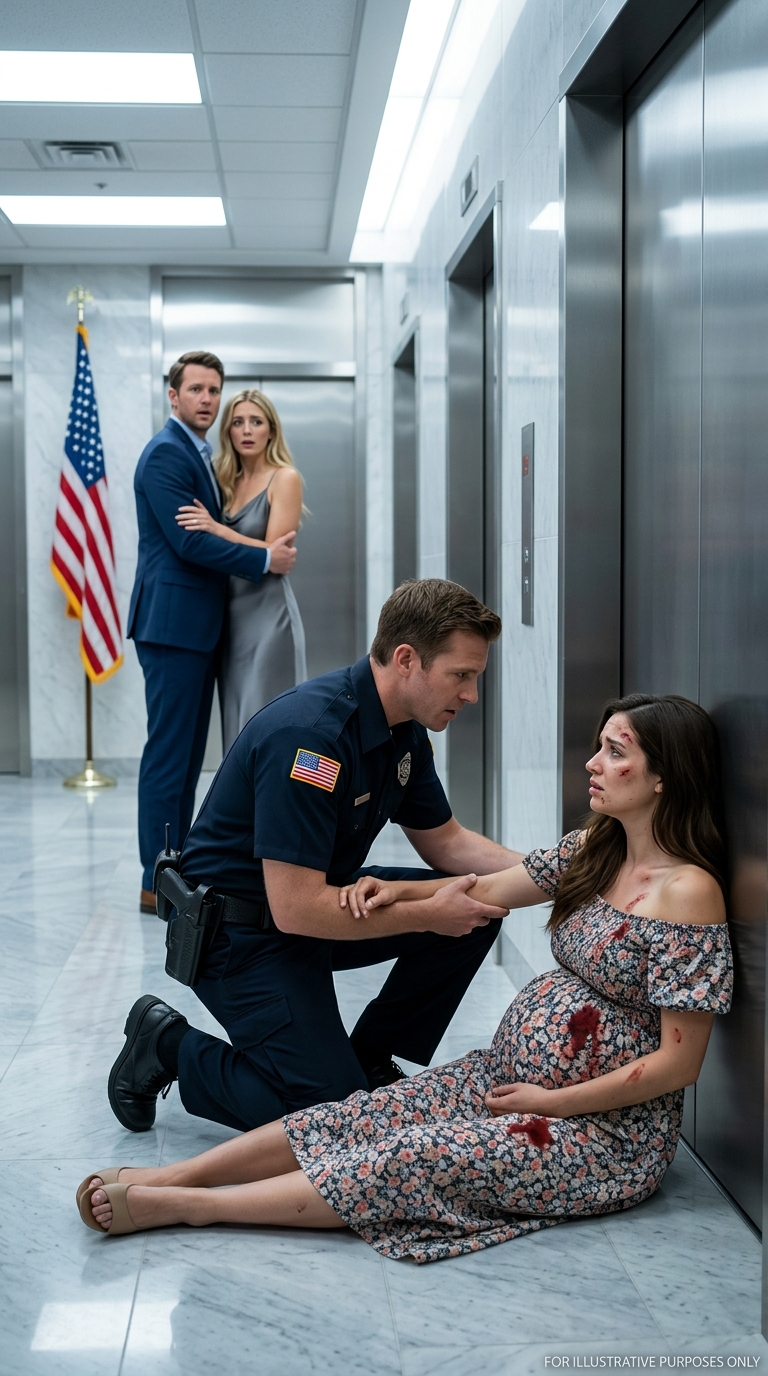
That was the fact Madison remembered most clearly afterward. Not the heat. Not the choking air. Not the metal shriek when firefighters cut through the side panel. Not even the pain in her stomach that made her count her breaths like prayers.
Carter had said, “I’ll come back.”
Then he stayed upstairs with Sienna.
Later, the official emergency timeline would show that after Sienna Hart was pulled out, Carter spent forty-one minutes in the command corridor speaking with paramedics, police, building engineers, his public relations chief, and a reporter from a business magazine. He gave a statement about remaining calm. He approved a company message saying all affected guests were receiving care. He was photographed holding Sienna’s hand while an oxygen mask covered her face.
During those forty-one minutes, Madison remained inside the elevator.
When firefighters finally opened the side panel from the fifty-second floor, they lifted her out on a rescue board. She saw faces first. Firefighters. Paramedics. Security. Reporters behind barricades.
Then she saw Noah.
He pushed through Blackwell security like a wall coming alive.
“Mrs. Blackwell.”
“The baby,” Madison whispered.
“Ambulance is ready.”
“Carter?”
Noah’s mouth tightened.
That was answer enough.
As paramedics rolled her past the emergency corridor, Madison saw Sienna sitting beneath a silver thermal blanket. Carter stood beside her, one hand on her shoulder.
When he saw Madison conscious, his face changed.
Relief came first.
Then fear.
He stepped forward. “Madison—”
Noah blocked him with one arm.
Carter’s eyes flashed. “Move.”
Noah did not move.
A paramedic snapped, “Sir, give us space.”
Carter looked around. Cameras were watching. Guests were watching. Sienna was watching.
So he lowered his hand and said, “I’ll meet you at the hospital.”
Madison did not answer. She looked at Sienna instead.
Sienna lowered her eyes.
The ambulance doors closed.
Inside, under bright white lights, Madison answered questions as best she could. Name. Age. Weeks pregnant. Pain level. Bleeding. Allergies. Noah sat beside her because he refused to leave and because no one had the energy to argue with him.
“Your mother lands in thirty minutes,” he said.
“Security feeds?”
“Copied.”
“Elevator audio?”
“Preserved.”
“Rescue corridor footage?”
“Sent to your mother’s counsel.”
Madison closed her eyes. “Good.”
“Do you want me to call Mr. Blackwell?”
For years, the correct answer would have been yes.
Call Carter. Wait for Carter. Explain Carter. Forgive Carter before he even apologized.
Madison stared at the ambulance ceiling.
“No.”
Noah nodded once.
At Northwestern Memorial, doctors moved quickly. Ultrasound. Bloodwork. Fluids. Monitoring. A maternal-fetal specialist with calm eyes and no interest in Carter Blackwell’s reputation.
At 2:23 a.m., the doctor said, “The heartbeat is strong.”
Madison turned her face into the pillow and cried.
Not quietly. Not prettily. She cried with one hand over her mouth and the other over her stomach, her whole body shaking from terror, exhaustion, and the unbearable mercy of a heartbeat she had feared would be gone.
When Carter finally arrived at 2:58 a.m., Eleanor Vale was already outside Madison’s private suite.
Eleanor was sixty-two, silver-haired, elegant, and terrifying in the way only a woman could be when she had spent a lifetime letting foolish men underestimate her. She wore a black coat, pearl earrings, and an expression so calm it made hospital lighting seem nervous.
“Eleanor,” Carter said.
“Mr. Blackwell.”
The formality hit him harder than anger.
“I need to see my wife.”
“No.”
“She is my wife.”
“Tonight you treated that as a flexible arrangement.”
Carter’s jaw tightened. “That’s not fair.”
Eleanor stepped closer. She did not raise her voice.
“Fair was the elevator. One hatch. One choice. You made it.”
“Sienna was hyperventilating.”
“Madison was pregnant.”
He flinched.
“I panicked,” he said.
“No. Sienna panicked. You prioritized it.”
Carter looked toward the closed hospital door. “The baby?”
Eleanor’s eyes hardened. “Alive. Despite your judgment.”
He closed his eyes. “I want to explain.”
“You will. To counsel.”
Inside the room, Madison heard every word.
For a moment, the old part of her wanted to save him from the humiliation of standing outside a door. That old part had been trained by six years of marriage to soften his consequences.
Then she remembered the hatch closing.
“Tell him to leave,” she said.
Her voice was weak, but Carter heard it.
The hallway went silent.
Eleanor looked at him. “You heard her.”
Carter’s mouth opened, then closed. He set a bouquet of white lilies on a side table.
“Tell her I love her.”
Madison did not move.
Eleanor picked up the lilies and handed them back to him.
“Tell yourself why that was not enough.”
PART 3
By sunrise, Blackwell Meridian Holdings released its official statement.
Blackwell Meridian deeply regrets last night’s mechanical failure during the Children’s Foundation Gala. All affected individuals received care. CEO Carter Blackwell personally assisted in the rescue response and remains grateful to first responders.
Madison read it from her hospital bed at 7:14 a.m.
Personally assisted.
She almost laughed.
Her left arm held an IV. Her right hand rested protectively over her abdomen. Her body ached, but her mind felt frighteningly clear.
Eleanor sat beside the window, reading the same statement on her tablet.
“His communications director is either stupid or loyal,” Eleanor said.
Madison stared at the ceiling. “Both can invoice.”
Eleanor’s mouth curved. “Good. You still have teeth.”
The doctor wanted rest, but rest was impossible while Carter’s team rearranged the truth. News outlets showed Carter emerging from the rescue hatch with Sienna. Clips of him holding her hand spread beneath captions about billionaire bravery and gala terror.
Madison appeared in no official footage.
Not yet.
At 8:00 a.m., Carter’s general counsel requested a “family-first communication approach.”
At 8:12 a.m., Madison’s attorney, Julian Voss, sent a preservation notice covering maintenance logs, emergency response timelines, elevator audio, surveillance footage, guest recordings, internal messages about Sienna Hart, foundation communications, and all public statement drafts.
At 8:25 a.m., Blackwell Meridian shares dipped.
Not because the public knew the truth.
Because markets hated words like preservation.
Carter returned at noon. Eleanor intercepted him outside the suite.
“No flowers,” she said.
He looked wrecked. His tuxedo had been replaced by a wrinkled suit. His eyes were red. His jaw was unshaven. The hero photographs from the night before had already begun to rot online as leaked clips emerged of Madison being carried out pale, conscious, and visibly pregnant while Carter stood beside Sienna.
“Please,” he said. “I made the wrong call.”
Eleanor looked at him. “No. You made the revealing call.”
Madison heard him through the door.
“I need to speak to her.”
“No.”
“I am her husband.”
“For now.”
His voice lowered. “She’s vulnerable. You’re influencing her.”
Madison opened her eyes.
That sentence did what even his betrayal had not fully done.
It made her cold.
She pushed herself slightly upright. “I can hear you.”
The hallway changed.
Carter’s breath caught. “Madison.”
“Do not call me vulnerable because I remember what happened.”
“I panicked.”
“You chose.”
“Sienna couldn’t breathe.”
“I was carrying your child.”
Silence.
“You knew,” Madison said.
“I thought you were stable.”
“Because that word helped you climb out.”
No one spoke.
Then Carter’s voice cracked. “How is the baby?”
Madison closed her eyes.
The question should have mattered before.
“Alive.”
“Thank God.”
“Do not involve God in a rescue you did not complete.”
Eleanor glanced down, hiding approval.
“Madison, please. Let me come in. I hate myself for what happened.”
“Good,” she said. “Start there. Somewhere far from this room.”
Julian ended the conversation through counsel.
Two days later, Madison left the hospital under strict instructions and stricter security. She did not go back to the glass penthouse she had shared with Carter. She went to Vale House, her mother’s limestone mansion on a private street near Lake Michigan.
To outsiders, Vale House looked like old Chicago money.
To insiders, it was a fortress with excellent tea.
Noah installed security protocols. Julian Voss opened a war room in the library. Eleanor called the family doctor, the trust administrators, and the chair of Vale Infrastructure Partners.
Madison slept twelve hours.
When she woke, the first thing she asked for was the elevator audio.
Eleanor looked at her. “Are you sure?”
“Yes.”
The recording was imperfect. Static. Metal groans. Distorted voices. But the important moments were clear.
Madison saying, “The cramping is worse.”
Carter saying, “Breathe, Maddie. Don’t make Sienna more scared.”
Sienna crying, “I can’t stay in here.”
The firefighter shouting, “Who is most critical?”
Carter answering, “Take Sienna.”
The firefighter asking, “The other woman is pregnant?”
Carter saying, “She’s stable.”
Then Madison saying his name after he climbed out.
Carter saying, “I’ll come back.”
Then the hatch closing.
Eleanor stopped the recording.
The room was still.
Madison looked at her hands. They were not shaking. That almost frightened her until she realized her body had already done its shaking in the elevator.
Now the rest belonged to records.
Julian removed his glasses. “This will become public.”
Madison looked at him. “I don’t want public revenge.”
Eleanor lifted one eyebrow. “A noble but inconvenient impulse.”
“I want the company reviewed. The elevator failed during a gala with two hundred people in the building. If maintenance was neglected, Carter’s affair is not the only problem.”
Julian nodded. “We have preliminary logs. Modernization was recommended twice.”
Madison’s eyes sharpened. “Deferred by whom?”
“Blackwell Capital Committee.”
“Who chaired it?”
Julian hesitated.
Eleanor did not.
“Carter.”
Madison touched her stomach.
Her husband had not only left her in the elevator.
He may have helped put her there.
PART 4
Carter Blackwell’s empire depended on three things: borrowed money, public confidence, and Madison’s silence.
The borrowed money was visible to anyone who read filings carefully. The confidence was visible to everyone else. Madison’s silence was invisible, which made it the most valuable.
Eight years earlier, Carter had inherited a respected family firm and nearly destroyed it trying to become the king of luxury development. He bought too quickly, borrowed too aggressively, and treated maintenance reserves like sleeping money.
When lenders tightened, he needed rescue capital large enough to save his buildings and discreet enough to preserve his image.
Madison had brought him Vale Infrastructure Partners.
Officially, Vale invested through a neutral urban safety fund. It refinanced Blackwell debt, stabilized key properties, and obtained protective covenants tied to safety compliance, capital discipline, and leadership misconduct.
Carter thought Vale had invested because he was brilliant.
He never understood that Vale had invested because Madison did not want thousands of tenants, employees, and retirees punished for his vanity.
He had signed every agreement.
He had called the covenants “standard.”
Now those standard covenants sat across Madison’s bed in neat stacks.
Safety compliance breach.
Failure to address critical mechanical warnings.
Misrepresentation in emergency communications.
Leadership misconduct causing material reputational harm.
Use of foundation resources for personal image repair.
Carter had left fingerprints on every trigger.
At noon, Vale Infrastructure Partners issued a formal review notice to Blackwell Meridian.
At 12:04, Carter called Madison.
She did not answer.
At 12:05, he called Eleanor.
She did not answer.
At 12:06, he called Julian.
Julian answered on speaker.
“Mr. Blackwell.”
“Where is my wife?”
Madison sat in the blue guest suite, wrapped in a cream cardigan, a legal pad in front of her. Eleanor sat beside her. Noah stood near the door.
Julian said, “All communication goes through counsel.”
“I am her husband.”
“That is under review in several ways.”
Madison almost admired the phrasing.
Carter’s voice hardened. “This Vale notice is absurd. A building accident happened during an emergency. We are cooperating fully.”
“Then the review should be efficient.”
“Do not play with me.”
Eleanor’s eyes narrowed.
Julian remained pleasant. “Threats are best preserved in writing, but if audio is your preference, continue.”
Silence.
Then Carter said, “I need to speak to Madison. She is being manipulated while emotionally unstable.”
Madison leaned toward the phone.
“I can hear you.”
The line changed. She heard his breath catch.
“Maddie.”
“Do not use my nickname while insulting my judgment.”
“I made a mistake.”
“No. You made a choice. Then you built a statement around it.”
“Sienna was having a panic attack.”
“I was pregnant.”
He said nothing.
“The company review will proceed,” Madison said. “The foundation review will proceed. The marriage review will proceed. Speak through counsel.”
“Maddie, please. I love you.”
She closed her eyes.
Memory tried to enter: Carter laughing during their honeymoon in San Diego, Carter pressing his forehead to hers during their first ultrasound, Carter promising he would protect them both.
Then the hatch closed again in her mind.
“You loved being needed,” she said. “That is not the same thing.”
She nodded to Julian.
He ended the call.
Four days later, Sienna Hart changed everything.
Her attorney delivered a sworn statement to Madison’s team, the Blackwell board, and Vale review counsel at the same time.
Sienna confirmed Carter knew Madison was pregnant. Madison had told him inside the elevator that she was cramping. The firefighter had asked whether the pregnant woman should be evacuated first. Carter insisted Sienna be taken first. Carter did not return to the hatch during the forty-one minutes before Madison’s extraction. Carter’s public relations director drafted the hero statement before Madison reached the hospital.
Then came the sentence that ruined him.
Sienna wrote that Carter had told her, before the gala, that “the crisis might finally show the world who truly needed him.”
The phrase became the headline.
Who truly needed him?
Public opinion turned fast.
People slowed the rescue footage frame by frame. They counted the minutes between Sienna’s rescue and Madison’s. They identified Carter standing beside Sienna while rescue crews worked below. They matched timestamps to the company statement.
By Monday, Blackwell Meridian had lost eighteen percent in market value.
By Tuesday, tenants in four Blackwell buildings demanded safety disclosures.
By Wednesday, the City of Chicago announced an inspection review of Blackwell elevator systems.
By Thursday, Carter’s communications director resigned for “personal reasons.”
By Friday, the board called an emergency meeting.
Carter insisted the meeting be held on the sixtieth floor of Blackwell Meridian Tower to project confidence.
That choice looked less wise when every director entered through freight elevators because inspectors had shut down the main banks.
Madison attended by video from Vale House. She wore a soft blue blouse, no dramatic makeup, and her hair pulled back. She looked less like a betrayed wife than a woman reading numbers.
Carter stared at the screen.
“You should be resting,” he said.
Madison’s expression did not change. “I am seated.”
One director coughed.
Helena Royce, the independent chair, opened the meeting.
“We are here to address the Vale review, the elevator entrapment, governance concerns, and preliminary safety findings.”
Carter leaned forward. “Before we begin, I want it noted that my wife is acting under extreme emotional distress.”
Madison looked at him through the screen.
“Noted,” she said. “I would also like it noted that emotional distress did not sign the deferred modernization approvals.”
The room went silent.
For the first time in his life, Carter Blackwell realized Madison had not been rescued from the elevator.
She had been delivered out of his reach.
PART 5
The inspection report was worse than anyone expected.
It found systemic deferrals across five Blackwell properties, three critical elevator modernization delays, incomplete emergency drills, and a pattern of money being diverted toward lobby renovations, donor events, luxury lounges, and publicity spaces while mechanical systems aged behind walls.
The report did not say Carter caused the elevator failure.
It said Blackwell leadership ignored conditions that made it more likely.
For a real estate empire, that was enough.
Tenants demanded guarantees. Lenders demanded reserves. Insurers demanded new premiums. Vale demanded enforcement.
The decisive board meeting took place three weeks after the accident.
Madison attended in person.
Her doctor disliked it. Eleanor disliked it more. Madison compromised by bringing a medical nurse, legal counsel, and Noah. This pleased no one, but it ended the argument.
She entered Blackwell Meridian Tower through the side entrance. Reporters shouted when they saw her.
“Mrs. Blackwell, do you blame your husband?”
“Is Sienna Hart cooperating?”
“Are you filing for divorce?”
“Is the baby okay?”
Madison did not answer.
She wore a navy maternity dress under a wool coat, her face pale but steady. Eleanor walked behind her like a verdict. Noah walked beside her like a locked door.
In the boardroom, Carter stood when she entered.
No one else did.
That made the gesture both private and public.
Madison sat as Vale’s representative.
Helena Royce opened the session.
Counsel presented the options.
Carter could remain CEO under heavy oversight.
Carter could step down temporarily while an independent operating chief handled restructuring.
Or Vale could trigger conversion rights and force asset sales across the most distressed properties.
Everyone knew option one was dead before discussion began.
Carter argued for option two. To his credit, he did not call the review unfair.
“The company needs continuity,” he said. “I am prepared to step back from daily capital approvals and cooperate fully.”
Helena looked at Madison. “Vale’s position?”
Madison opened her folder.
“Vale will support temporary leadership transition only if it includes binding safety reserves, independent engineering oversight, removal of Carter Blackwell from capital expenditure decisions for at least twenty-four months, and immediate divestiture of vanity assets used to support public image rather than building stability.”
Carter’s jaw tightened at vanity assets.
She continued.
“If the board rejects those terms, Vale will move toward conversion and sale.”
A director asked, “What qualifies as vanity?”
Madison listed them.
The private aviation subsidiary. The branded hotel concept. The foundation event division. The media partnership tied to Carter’s public profile. The unfinished members-only club overlooking the river.
Each item struck Carter’s pride because each one existed to make Blackwell Meridian look richer than its maintenance budget allowed.
“You want to strip the company,” Carter said.
Madison looked at him.
“I want elevators that work.”
No one spoke.
Then Helena called for a vote.
The terms passed.
Carter Blackwell was removed from day-to-day executive authority and all capital control for twenty-four months. An independent operating chief was appointed. A safety reserve was funded through asset sales. The foundation was separated from corporate publicity.
Carter did not lose everything that day.
He lost the part of everything he loved most.
Unquestioned control.
After the meeting, he approached Madison near an elevator bank wrapped in inspection tape.
“You chose the place well,” he said quietly.
Madison looked at the closed doors. “The place chose us.”
“Do you think I can come back from this?”
The old Madison would have offered him a plan. Three calls. Four apologies. A way to sound humble without sounding ruined. A way to become the man the room might forgive.
This time, she did not rescue him from the question.
“That is yours to find out.”
Sienna resigned one month after the accident. Her letter was short and painfully honest.
I participated in conduct that harmed Mrs. Blackwell, this company, and myself. I cannot remain in a role where my presence undermines the repair trust requires.
Carter called her once.
She answered.
“You didn’t need to resign,” he said.
“Yes,” Sienna replied. “I did.”
“I could have protected your role.”
She laughed softly. “Carter, you couldn’t protect your own.”
He deserved that.
“Where will you go?” he asked.
“Somewhere I’m not paid to confuse attention with purpose.”
“That sounds like something Madison would say.”
“No,” Sienna said. “It sounds like something I learned after believing you.”
There was silence.
“I did care about you,” Carter said.
“I know.”
That surprised him.
Sienna continued, “But you cared more about being needed.”
He closed his eyes. “I’m sorry.”
“For which part?”
Specificity. Everyone wanted it from him now.
“For using your fear in the elevator. For asking you to stay quiet. For telling you Madison was cold because I wanted my betrayal to feel less ordinary.”
Sienna exhaled. “Thank you.”
“Do you forgive me?”
“No,” she said. “But I might stop needing to hate you.”
The call ended.
Sienna later sent Madison one letter.
Mrs. Blackwell, I am sorry for my part in your pain. I knew enough to step away and did not. In the elevator, I let Carter choose me because I was terrified and because some part of me wanted proof that I mattered more. That truth disgusts me. I hope you and your child remain safe. I will not contact you again.
Madison read the letter once.
Then she placed it in the archive.
She did not reply.
Some apologies were not doors.
They were receipts.
PART 6
Madison moved out of the Blackwell penthouse before spring.
Carter offered to leave first. She declined. The penthouse had been his stage before it was ever her home. All glass, steel, and views designed to make men feel above weather.
Madison wanted floors that creaked. Windows that opened. A garden where her child could one day touch dirt without a property manager approving it.
She bought a townhouse three blocks from Vale House.
Eleanor called it emotionally practical.
Noah called it defensible.
Madison called it home.
The nursery was painted pale green. Not pink. Not blue. Not any color chosen for announcement. Green like new leaves. Like survival without spectacle.
Above the crib hung a mobile of wooden birds.
Eleanor declared it too whimsical.
Madison ignored her.
Grandmothers required boundaries too.
Carter came for one scheduled visit before the baby was born. Not to the nursery. To the downstairs sitting room, with counsel-approved boundaries and Noah in the front hall pretending not to listen.
Carter looked around the room with a sadness he did not try to hide.
“This suits you.”
“Yes.”
“The penthouse never did.”
“No.”
He smiled faintly. “You could have told me.”
“I did. You said the view was good for investor dinners.”
The smile disappeared. “I’m sorry.”
The phrase came easier to him now. That did not make it enough, but it made it less theatrical.
He sat across from her.
“The operating chief is good,” he said.
“Helena chose well.”
“The safety reserve is fully funded.”
“I know.”
“Of course you do.”
They sat in silence.
Carter looked at her stomach, now visibly round beneath her sweater.
“May I ask if it’s a boy or a girl?”
“A girl.”
His face changed. Wonder first. Then grief. Then fear.
“A girl,” he repeated.
“Yes.”
“Have you chosen a name?”
“Grace.”
He swallowed.
“Not because of forgiveness,” Madison said. “Because grace can mean surviving without becoming cruel.”
He looked down at his hands.
“Will I be allowed to know her?”
“If you continue doing the work.”
“I will.”
“Do not promise me. Build a record.”
He nodded.
It was not reconciliation.
It was something harder and more useful.
Accountability without reward.
Grace Vale Blackwell was born during a thunderstorm in May.
Labor lasted eighteen hours. Madison cursed three times, apologized once, then withdrew the apology because the nurse told her childbirth had flexible etiquette.
Eleanor held one hand. Noah waited in the hall with three security officers and looked more frightened than anyone.
Carter was in the hospital, not in the room. Madison had allowed him to wait on the same floor under written boundaries.
He did not argue.
That mattered.
At 4:41 a.m., Grace entered the world furious, tiny, and loud enough to make three adults cry.
Madison held her daughter against her chest and thought of the elevator.
The red light. The heat. The hatch closing. Her hand over the life she begged to stay.
Now that life screamed against her skin.
Eleanor bent close, tears shining openly on her face.
“Hello, Grace,” she whispered. “You have no idea how many lawyers were involved in your arrival.”
Madison laughed and cried at the same time.
Carter met Grace six hours later. He washed his hands carefully, as if ritual could clean more than germs.
When the nurse placed the baby in his arms, his whole face changed. The public man vanished. The disgraced CEO vanished. The ruined husband vanished.
For a moment, he was only a father holding the child he had almost lost before he knew how to deserve her.
“Hi,” he whispered. “Hi, Grace.”
Grace opened one eye, unimpressed.
Madison watched from the bed, exhausted and alert.
Carter looked at her. “Thank you.”
“For what?”
“For letting me meet her.”
“She is your daughter,” Madison said. “Access will depend on safety, not gratitude.”
He nodded. “I understand.”
Madison believed he did in that moment.
She did not assume the moment would last without structure.
That was why structure existed.
Eighteen months after the elevator, the divorce was finalized.
It was less vicious than the public expected because the worst facts had already been used where they mattered: governance, safety, custody, and public record.
The marriage itself ended in plain legal language, so calm it almost felt merciful.
Madison kept the townhouse, her Vale assets, and her oversight authority.
Carter kept a reduced personal stake, a supervised board role, and a custody schedule built slowly around Grace’s needs.
Sienna was not mentioned in the final hearing except as part of prior record.
That felt right.
The affair had revealed the marriage’s weakness.
It had not created the elevator, the deferred maintenance, the false statement, or Carter’s choice.
Outside the courthouse, reporters shouted questions.
“Mrs. Blackwell, do you feel vindicated?”
“Do you forgive your ex-husband?”
“Will Grace carry the Blackwell name?”
Madison stopped.
Carter stood a step behind her.
“This was never about vindication,” she said. “It was about safety, records, and responsibility. My daughter is healthy. The buildings are safer. The company is governed better than it was. That is enough.”
A reporter shouted, “And Carter Blackwell?”
Madison looked briefly at Carter, then back at the cameras.
“He is responsible for becoming the kind of father his daughter can trust. That work belongs to him.”
Then she walked to the car.
Carter did not follow.
That, too, was progress.
PART 7
Three years after the elevator, Blackwell Meridian Tower reopened its renovated safety training center.
There was no gala. No champagne tower. No dramatic ribbon cutting.
That was Madison’s condition.
The old investor lounge had been stripped of its marble bar and velvet seating. In its place were emergency panels, elevator control models, inspection simulators, and classrooms for engineers, building managers, tenant representatives, and city inspectors.
Eleanor arrived in excellent spirits.
“From champagne bar to compliance classroom,” she said. “Architecture can repent.”
Madison smiled. “Do not let the architects hear you.”
Carter met them near the entrance. He wore a simple dark suit, no entourage. Grace, now three, ran to him because toddlers cared little for complicated history when a father consistently arrived with snacks and patience.
“Daddy!”
Carter lifted her carefully and spun her once.
“Hello, Gracie.”
Madison watched them.
Trust, she had learned, could regrow in fenced areas. Not everywhere. Not automatically. But enough for a child to know delight without inheriting danger.
During the dedication, Priya Anand, the independent safety monitor, explained the center’s purpose. Then Carter spoke.
“I once believed buildings were judged by what people saw first,” he said. “The lobby. The view. The event. The photograph. I was wrong. A building is judged by what holds when no one is watching.”
He glanced at Madison only once.
“The same is true of leadership.”
It was a good speech because it did not ask anyone to call him good.
Afterward, Grace pressed both hands against the glass of a demonstration elevator model.
“Mama, this one is see-through.”
“Yes.”
“So nobody gets stuck?”
Madison knelt beside her. “So people learn what to fix before anyone gets stuck.”
Grace accepted that with solemn approval.
“Good.”
At the end of the day, Madison rode the renovated main elevator alone.
Grace had gone home with Eleanor and Noah, tired from asking engineers whether cables ever got sleepy. Carter had offered to wait in the lobby.
Madison had said no.
She stood before the elevator doors with her hand near the call button.
Three years earlier, those doors had closed on a life she thought she understood. They had opened onto another she had to build while afraid.
The elevator arrived.
Bright interior. Clean panel. Inspection certificate current. Emergency phone tested that morning. Camera active.
Madison stepped inside.
The doors closed.
For a second, her body remembered.
Her breath shortened. Her scarred palm tingled. The old red light flashed in memory, though the elevator was bright and smooth and moving perfectly.
She placed one hand against the wall.
“I am here,” she said quietly.
Not to Carter.
Not to the building.
To herself.
The elevator rose.
Fifty.
Fifty-one.
Fifty-two.
It passed the floor where she had been trapped.
Fifty-three.
Fifty-four.
The doors opened at the rooftop level.
Madison stepped into the cold evening air. Chicago stretched below her in glass, stone, riverlight, and winter dusk.
Once, Carter had loved this view because it made him feel above consequence.
Madison saw it differently now.
From this height, every building looked impressive.
Only records could tell which ones were safe.
Her phone buzzed.
A message from Carter.
Grace left her yellow scarf in my car. I’ll send it with Noah tomorrow.
Then another.
Also, she says the elevator skeleton was not scary, just busy.
Madison smiled.
She typed back: That sounds like her.
Carter replied: It sounds like you too.
Madison looked at the message for a moment, then put the phone away.
Below, traffic moved like thin streams of light. The tower hummed around her, no longer an empire polished over rot, but a building being forced daily to tell the truth about itself.
That was enough.
She did not need the past to become beautiful. She did not need Carter to become the man he might have been before fear and pride taught him to choose badly. She did not need Sienna punished forever, or Carter’s mother begging forgiveness, or the public remembering the story exactly right.
She needed doors that opened.
She needed records that remained.
She needed Grace to grow up knowing calm was not consent, silence was not weakness, and love without responsibility was only another locked room.
When Madison finally went back down, she did not hold her breath.
The elevator descended smoothly.
The doors opened.
No one was waiting with cameras. No one was reaching through a rescue hatch. No one had to choose who mattered most.
Madison walked out on her own.
This time, no one had to rescue her.