PART 2
Four years before Caleb and Emma died, I bought my first semi-truck.
It was not shiny. It was not new. It was dark green, stubborn, and loud enough to rattle windows in small towns. I loved it immediately.
The bank did not love me immediately.
A woman owning a trucking business still confused men who had no problem trusting me with eighty thousand pounds of freight but hesitated to trust me with paperwork. The loan officer asked twice whether my husband would be co-signing.
Caleb laughed when I told him.
“Should I wear a dress and go pretend to be you?” he asked.
I threw a dish towel at him.
The down payment had been the problem. I was short forty thousand dollars. My parents offered to help. At the time, I thought it was love. I thought they were proud of me. I thought when my father said, “A family invests in its own,” he meant it.
The bank required a gift letter.
A formal statement.
My parents signed it at their kitchen table while my mother complained that legal language made her nervous. The letter said the money was a gift. No repayment expected. Not a loan. Not a debt.
I filed it away and forgot about it.
My mother forgot something else.
She forgot the truth.
After the airport call, Brandon called me the next day.
He did not ask about Emma. Not once.
He talked about inventory problems, payroll, interest rates, and how the dealership had “hit a rough patch.” Then he lowered his voice like he was being gentle.
“Look, Bec, you’re alone now. What do you even need that much money for?”
For a second, I could not breathe.
Alone now.
As if my husband and daughter had been expenses removed from a balance sheet.
As if grief lowered the cost of living.
As if the empty bedrooms in my house meant I owed my brother a rescue.
The worst part was not even the request. It was learning from my cousin Natalie that they had already started telling the family their version.
Poor Brandon.
Selfish Rebecca.
The successful widow who would not lift a finger.
They built the courtroom before they handed me the charge.
For a week, I almost gave in.
Not because I thought they deserved it, but because exhaustion is dangerous. Grief makes silence look expensive, and sometimes you start wondering what you would pay just to stop the phone from ringing.
One night, I sat at the kitchen table with my checkbook open.
Forty thousand dollars would nearly empty my emergency account. It would delay repairs. It would weaken the little company Caleb and I had fought to keep alive.
But maybe they would stop.
Maybe my mother would stop saying family like it was a rope around my throat.
Uncle Ray found me there with the pen in my hand.
He did not yell. He did not take the checkbook away.
He just asked, “Are you really going to pay them for missing your child’s funeral?”
My hand went still.
He pulled out the chair across from me and sat down. “Rebecca, some people don’t want peace. They want proof they can still control you.”
I put the pen down.
The next morning, I woke at 4:00 a.m., put on Caleb’s old flannel, and went to work.
Work did not ask how I felt. Work did not care whether I cried in the cab before sunrise. Freight had to move. Invoices had to be sent. Tires had to be replaced. Diesel had to be paid for whether my heart was broken or not.
So I worked.
I called every shipper who had trusted Caleb. I told them the owner was still the owner. I told them Hale Transport still delivered on time.
Some men on the phone hesitated when they realized Caleb was gone and I was in charge.
I let them hesitate.
Then I gave them rates, routes, and delivery windows until hesitation had nothing to stand on.
A month later, a regional grocery chain out of Kansas City offered me a contract too big for one truck. Stable loads. Real money. A future.
To take it, I needed a second rig.
Caleb’s rig.
Cleaning out his truck was harder than burying him.
The cab still smelled like coffee, leather, and the peppermint gum he chewed on night drives. His sunglasses were clipped above the visor. A tiny plastic horse Emma had taped to the dashboard stared at me with one painted eye.
“So Daddy has a road friend,” she had told him.
I sat in that driver’s seat for an hour before I touched anything.
In the pocket of the driver’s door, I found Caleb’s paper logbook. He had kept them long after everything went digital because he said paper remembered better.
The last page was not a route.
It was a list.
Things We’re Going To Do.
Buy our own second truck, paid clean.
Put our name on the doors.
Stop building everybody else’s dream.
Teach Emma to read a map.
Hale & Daughter Freight — so she knows her mama built something.
I pressed my palm over my mouth.
Hale & Daughter.
He had named the company we had been too busy surviving to start.
Not Hale & Son. Not Hale Brothers. Not some hard-edged trucking name meant to impress men at fuel stops.
Hale & Daughter.
For the little girl who drew trucks instead of princesses.
I found one of Emma’s drawings tucked behind the sun visor. Three crooked green trucks. A stick figure with yellow hair. Big uneven letters underneath:
MOMMY’S TRUCKS.
That was the moment something inside me shifted.
Not healed.
Not hardened.
Shifted.
My parents had called Emma’s funeral unimportant.
My brother had asked what I needed money for now that I was alone.
So I decided to build something with my daughter’s name on it so visible that even strangers at truck stops would have to ask who she was.
The next week, I filed the paperwork.
Hale Transport became Hale & Daughter Freight.
I kept the “Daughter” because some names are earned by love, not by living long enough.
And while I was building a company out of ashes, my family was building a trap.
PART 3
The invitation arrived in a cream envelope with gold lettering.
Richard and Carolyn Whitaker
Forty Years of Marriage
A Celebration of Family, Faith, and Legacy
I nearly laughed when I read it.
Legacy.
My parents loved words like that. Family. Loyalty. Sacrifice. Words polished smooth from overuse, words they placed on mantels and printed on invitations but never carried into hospitals, cemeteries, or dark kitchens.
I threw the invitation into the trash.
Then Natalie called.
“Rebecca,” she said, “you need to know something.”
Her voice was low, the way people speak when the truth feels dangerous.
I sat down on the edge of my bed.
“They’re planning to call you out at the anniversary dinner,” she said. “Your dad is going to make some speech about family helping family. Brandon’s going to be there. Madison too. They’re telling everyone you took money from your parents and now refuse to help your brother.”
I looked toward the hallway, where Emma’s bedroom door had stayed closed for months.
“How many people?” I asked.
“Maybe forty. Aunts, cousins, church friends. Some of your dad’s business contacts.”
Of course.
Forty people.
Forty years.
Forty thousand dollars.
My father had always appreciated symmetry when it made him look righteous.
Natalie kept talking fast. “I think you should stay away. They want an audience. They want to embarrass you until you give in.”
For a moment, I agreed with her.
I imagined walking into that banquet room, every head turning, every whisper stopping. My mother wearing pearls and that wounded expression she used whenever someone resisted her. Brandon red-faced and loud. Madison sweet as poison.
A year earlier, I would have stayed home.
A year earlier, I would have protected myself with silence and called it peace.
But grief had burned away the part of me that still believed silence saved anyone.
“They want an audience,” I said.
Natalie went quiet.
“Then I’ll give them one.”
The next morning, I called the bank.
The loan officer who had handled my truck purchase still worked there. Her name was Denise, and when I explained what I needed, she said, “Give me two days.”
Two days later, I stood at her desk while she slid a certified copy of the gift letter toward me.
There they were.
My parents’ signatures.
Richard Whitaker.
Carolyn Whitaker.
Below them, the words were clean, legal, and impossible to twist:
The funds are a gift. No repayment is expected or required. This is not a loan.
I held that paper like it weighed more than a truck engine.
Denise looked at me over her glasses. “You okay?”
“No,” I said. “But I’m prepared.”
The night before the anniversary dinner, Uncle Ray offered to come with me.
I told him no.
“If I bring backup,” I said, “they’ll pretend it’s a fight.”
Ray studied me for a long moment, then nodded.
“Your father never had your spine.”
That night, I slept better than I had in months.
Not because I was calm.
Because I was finished being afraid.
The banquet hall was attached to an old country club on the east side of Wichita. It smelled like coffee, prime rib, and carpet cleaned too many times. A banner stretched across the wall in gold letters: FORTY YEARS OF LOVE.
My parents had placed framed wedding photos near the cake. My mother at twenty-two, beautiful and smiling. My father tall and proud. Everyone kept saying how inspiring it was, how rare, how wonderful.
I wondered how many marriages survive not because they are strong, but because both people agree never to look directly at the damage.
My mother saw me first.
Her face changed so quickly it almost fascinated me. Surprise. Relief. Triumph.
She thought I had walked into the trap.
I kissed no cheeks. Hugged no one. I took a plate with a slice of cake I did not intend to eat and sat near the end of a table where I could see every exit.
People watched me.
Some with pity.
Some with judgment.
A few with the uncomfortable curiosity of people who had heard one side of a story and were hoping for a scene.
They got one.
Just not the one they expected.
After dinner, my father stood and tapped a fork against his glass.
The room quieted.
He thanked everyone for coming. He spoke about marriage, sacrifice, commitment, and the sacred responsibility of family. My mother dabbed at her eyes though nothing sad had happened yet.
Then my father turned toward me.
Slowly.
Deliberately.
“Some of us,” he said, “have been blessed. And sometimes, when people are blessed, they forget who helped them when they had nothing.”
The room shifted.
Forks paused.
My father continued, voice trembling with manufactured pain. “Carolyn and I helped our daughter with forty thousand dollars when she needed it most. Now her own brother is facing ruin, and she refuses to help. That is not how we raised our children.”
A murmur moved through the room.
Madison leaned forward, her diamond earrings catching the chandelier light.
“It’s just sad,” she said loudly. “Especially considering we missed that funeral because we were trying to keep the family together on that trip.”
That funeral.
Not Caleb’s funeral.
Not Emma’s funeral.
That funeral.
My mother folded her hands and looked down, already wearing the face of a martyr.
Forty people turned toward me.
I stood.
No shaking. No tears.
I did not raise my voice.
That mattered most.
Because they had prepared for anger.
But silence, when everyone expects a scream, can cut a room in half.
“Dad,” I said, “you’re right about one thing. You gave me forty thousand dollars. We’ll talk about that.”
I reached into my coat.
“But first, since Madison brought up the funeral, let’s talk about that.”
PART 4
I unfolded the first page and laid it on the white tablecloth beside my parents’ anniversary cake.
It was not dramatic.
That was why it worked.
No screaming accusation. No shaking finger. Just dates. Printed clearly. Simple enough for anyone in the room to understand.
“This,” I said, pointing to the first line, “is the day Caleb and Emma were buried.”
The room was so quiet I could hear the ice machine humming behind the bar.
I moved my finger down the page.
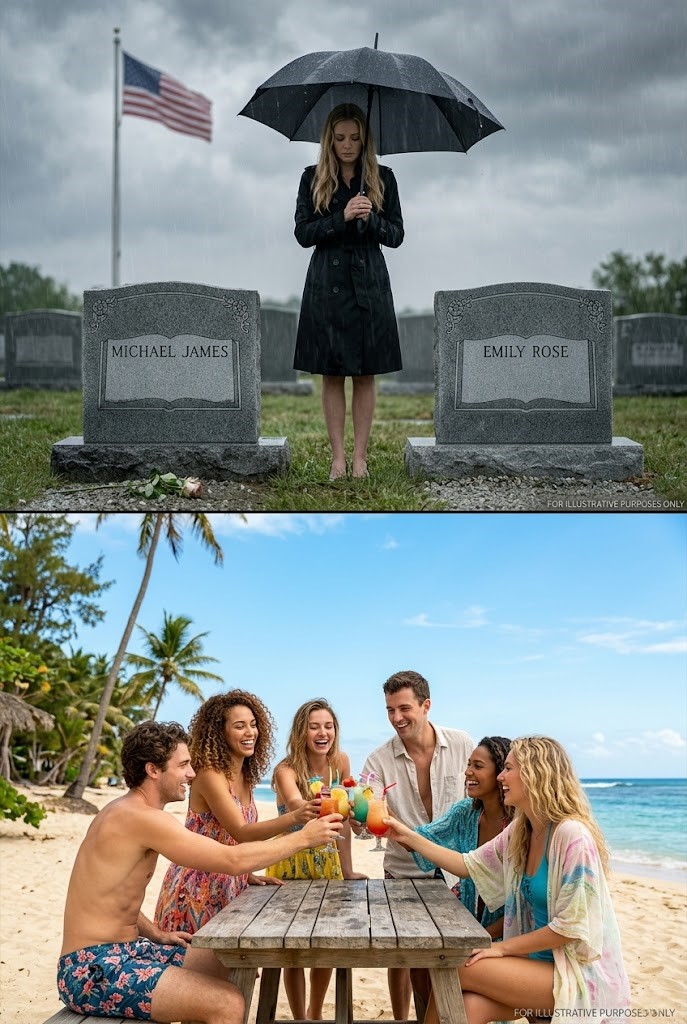
“And this is the date of the beach photo Madison posted from Maui. One day later.”
Madison’s face drained.
My father’s mouth opened, then closed.
My mother stared at the paper as if it had crawled onto the table by itself.
I looked around the room, making sure every person there saw my face.
“They did not miss the funeral because of family. They skipped the burial of a six-year-old child because they did not want to lose a vacation.”
Someone gasped.
I kept going.
“They called it an event that didn’t require everyone’s attention. My mother responded with a thumbs-up. My father wrote, ‘Agreed.’ Five days after I buried my husband and daughter, my mother called from the Honolulu airport to ask me for forty thousand dollars.”
My mother whispered, “Rebecca.”
I did not look at her.
“Then Brandon called and asked what I needed the money for now that I was alone.”
Brandon shot to his feet.
“That is not what I meant!”
His chair scraped so loudly several people flinched.
“You’re twisting everything,” he shouted. “You’ve always acted better than us. You get one little business and suddenly family means nothing? I’m your brother!”
I let him yell.
That was another thing grief had taught me: loud people think volume is proof. It is not. Sometimes it is only fear wearing a costume.
When Brandon ran out of breath, I took out the second page.
The certified copy.
I slid it across the table toward my father.
“This is the gift letter you and Mom signed four years ago at your kitchen table. The bank required it for my truck loan. It says the forty thousand dollars was a gift. No repayment expected. Not a loan in any form.”
My father stared at it.
My mother reached for the paper with trembling fingers.
Aunt Lisa, sitting beside her, leaned over and read aloud before my mother could stop her.
“The funds are a gift,” Lisa said slowly. “No repayment is expected or required. This is not a loan.”
The room changed.
You could feel it happen.
A story died in public.
It did not die loudly. It died the way a candle dies when the glass runs out of air. One second it was there, flickering and warm enough for people to gather around. The next second, smoke.
People began looking at my parents differently.
Then at Brandon.
Then at me.
Not with pity now.
With shame.
Not mine.
Theirs.
Madison tried to recover first. “That doesn’t change the fact that family helps family.”
I turned to her.
“You taught me which family events deserve attention. I’ll remember that for the rest of my life.”
Her lips parted, but no words came.
I looked at my mother.
“You told me we can’t make more family. You were right. That’s why I stopped trying to make one with you.”
My mother’s eyes filled with tears.
A year earlier, those tears would have pulled me across the room. I would have touched her shoulder. I would have apologized for making things uncomfortable.
But I had already watched her choose a boarding pass over my daughter.
There are some tears that arrive too late to be called sorrow.
Finally, I looked at Brandon.
“You asked what I needed the money for. I needed it to bury my daughter. You needed Maui.”
His face collapsed.
For one second, I saw the boy I used to make sandwiches for before school. The brother who once put a Band-Aid on my knee and told me not to cry because Dad hated crying.
Then he whispered, “I’m scared, Bec.”
I believed him.
That was the cruel part.
I believed he was scared. Scared of losing his dealership. Scared of losing face. Scared of everyone realizing he had built his rescue on my grief.
But he still had not said Emma’s name.
Not once.
Not at the funeral he missed.
Not in the calls.
Not in that room.
His fear was real.
His remorse was not.
Natalie stood at the back of the room.
Her chair scraped softly.
“I was at the funeral,” she said. “Everything Rebecca said is true. I saw the empty front row.”
That broke the last piece of the illusion.
People started murmuring—not the eager kind, but the sick kind. Aunt Lisa pushed the gift letter toward another table. Someone asked to see the dates. Someone else said, “They told us Rebecca refused to invite them.”
My mother made a sound like pain.
But I had no more room inside me to carry it.
I folded both papers and placed them back in my coat.
Then I said, “I hope you solve your problems, Brandon. I truly do. But you will solve them without me.”
My father said my name.
Hard.
Warning.
As if I were still a teenager he could send to her room.
I looked at him and realized something that almost made me laugh.
He had no power left.
Not because the room had turned against him.
Because I had.
I walked out before dessert was served.
No one stopped me.
Outside, the parking lot was cold and clean. The kind of cold that makes every breath visible. I stood beside my truck and inhaled until my lungs hurt.
For months, grief had felt like drowning.
That night, for the first time, it felt like standing on shore.
PART 5
The story that I owed my parents forty thousand dollars died in that banquet hall and never came back.
Not because they apologized.
They did not.
Not because they understood.
I doubt they ever truly did.
It died because truth had witnesses.
That was all I wanted in the end. Not revenge. Not destruction. Not my mother sobbing into her pearls or my father humiliated beside his anniversary cake.
I wanted a record.
I wanted a room full of people to know that my husband and daughter had mattered. I wanted the word family taken out of my mother’s mouth and placed under bright lights where everyone could see what she had done with it.
For people like my parents, truth feels exactly like cruelty.
Brandon’s dealership folded that fall.
I heard it from Natalie, the same way I hear everything about them now—from a distance, secondhand, without letting it enter my bloodstream.
My parents tried calling for a while. My mother left messages that began with anger, softened into wounded confusion, and eventually turned into holiday guilt.
“This has gone on long enough.”
“Your father isn’t well.”
“Emma would not want this.”
“We are still your parents.”
The last one almost made me answer.
Not because it moved me.
Because I wanted to ask her what kind of parent needed to remind her child of the title.
But I let the phone ring.
Then one day, it stopped ringing.
The silence that followed was not lonely.
It was clean.
I kept the people who showed up.
Uncle Ray comes over every Sunday evening. He sits in Caleb’s chair now, and the first time he did, I had to leave the room and cry into a dish towel. The second time, I stayed. The third time, I served him coffee in Caleb’s mug.
Grief does not vanish.
It changes rooms.
Natalie calls every Thursday. Sometimes we talk about my parents. Mostly we talk about weather, work, grocery prices, and the strange miracle of surviving families that taught us survival by failing us.
Hale & Daughter Freight grew faster than I expected.
First two trucks.
Then three.
Then five.
All dark green.
All with Emma’s drawing printed on the doors: three crooked trucks in a row, copied exactly from her crayon page. Underneath, in clean white letters:
HALE & DAUGHTER FREIGHT
WICHITA, KANSAS
At truck stops, drivers ask about the logo.
I tell them, “My daughter drew it.”
Sometimes they smile and say, “That’s sweet.”
Sometimes they hear something in my voice and simply nod.
Both are fine.
I moved Emma’s yellow rain boots.
Not far.
Just from the back door to a shelf in the mudroom where I can see them when I leave at 4:00 a.m. I used to think moving them meant admitting she was gone. Now I know leaving them in the doorway meant asking her to come back through a door she could not open.
On the first anniversary of the accident, I drove to Lake Afton before sunrise.
I brought wild daisies, Caleb’s thermos, and the tiny plastic horse from his dashboard.
The water was silver and still.
For a long time, I sat on the bank and said nothing. Then I told them about the trucks. I told Caleb the grocery contract was steady. I told Emma her drawing was famous in six states, which would have made her laugh and ask whether California counted.
I told them I was tired.
I told them I was still here.
Then I placed the daisies in the water and watched them drift.
The lake did not break me that morning.
It held the sky.
A year earlier, I had thought family was a thing you were given. A fixed point. A name. A holiday table. A front row at a funeral.
Now I know better.
Family is not the people who share your blood and vanish when your world burns.
Family is the uncle who drives four hours without being asked.
The cousin who stands up in a room full of lies.
The teacher who cries for your child like she was her own.
The drivers who show up in muddy boots because a good man deserves witnesses.
Family is who appears when there is nothing to gain.
Everything else is just biology with good marketing.
My mother once said we cannot make more family.
She was wrong.
We make family every time we choose the people who choose us back.
And we lose family every time we stop pretending a title is the same thing as love.
I still wake at 4:00 a.m. The house is quiet. The road is dark. The cab smells like diesel, old coffee, and peppermint gum because I keep a pack in the console now.
Before I pull out, I touch the little plastic horse on the dashboard.
Then I look at the name painted on the door.
Hale & Daughter.
Some mornings, it hurts.
Some mornings, it saves me.
Most mornings, it does both.
I built a company with my daughter’s name on it because my family tried to make her funeral small.
They called her burial an event that did not deserve attention.
Now her name crosses highways, state lines, weigh stations, loading docks, and sunrise after sunrise on the side of five green trucks.
And every mile says what they refused to say.
She mattered.
Caleb mattered.
I mattered.
That is not revenge.
That is the truth finally learning how to drive.