Part 2
We spent the night at the Lakeshore Inn off Sheridan Road, one of those clean, anonymous places where the coffee tasted burnt and the curtains never fully closed. Alex didn’t sleep. Neither did I.

She sat on the edge of the second bed with her knees pulled to her chest, staring at the rain sliding down the window.
“I should’ve told you sooner,” she said for the fifth time.
I leaned against the desk, a paper cup of coffee cooling in my hand. “You were protecting yourself.”
“No,” she whispered. “I was protecting her.”
That hurt worse than I expected.
Alex turned her phone in her hands. “Mom made me lie, Dad.”
I closed my eyes.
“She said if I told you, you’d lose your mind. She said you’d ruin everything. She said you’d take me away from her and make me hate her.” Alex swallowed hard. “Then she cried. And I believed her.”
I sat beside her. “What did she make you cover up?”
Alex hesitated, then unlocked her phone.
Photos. Messages. Screenshots.
Sierra walking into a downtown hotel with Eli. Sierra getting into a red convertible driven by Margo, her real estate-agent best friend. Sierra sitting in a dark booth at Rita’s Tavern with her hand on Eli’s thigh. Sierra leaving our neighborhood on nights she claimed to be at work.
Then came the video.
Alex had filmed it from the second floor of the mall in Old Orchard. Sierra and Eli stood below near a jewelry store, laughing, holding hands, looking too comfortable to be accidental. Eli kissed the inside of Sierra’s wrist. Sierra glanced around, not guilty, just careful.
“I saw them by accident,” Alex said. “I followed them because Mom told me she was buying you a birthday gift. I thought maybe she was doing something nice.”
The room felt smaller.
I had spent years teaching Alex to be honest. To notice details. To trust her instincts. And Sierra had turned those gifts into weapons against her.
At six-thirty in the morning, I called my lawyer.
David Chen answered on the third ring, his voice rough with sleep. “Nick?”
“I need to know what I can do today without getting myself arrested.”
“That’s an ominous start.”
“My wife flushed her wedding ring down the toilet last night, told me it was cheap, then her boyfriend showed up at my door with her laptop bag and a piece of her underwear in his hand.”
Silence.
Then David sighed. “I’m awake now.”
By eight, I knew three things.
I could change the locks if Sierra had somewhere else to stay and if I documented that I was securing the home after a domestic confrontation. I could protect my business accounts if I separated them legally and immediately. I could gather evidence, but I needed to stop playing angry husband and start playing careful man.
Careful I could do.
I had spent twenty years in renovation. Houses taught patience. A bad foundation didn’t collapse all at once. First came hairline cracks. Then doors that wouldn’t close. Then water stains. Then one morning the floor gave way and everyone pretended it was sudden.
My marriage had been collapsing for months.
By noon, Alex was at school, carrying grief like a backpack. I was back on Halcyon Road with a locksmith named Pete, who chewed cinnamon gum and asked no questions.
Sierra’s car wasn’t in the driveway.
Good.
Pete changed the front door, back door, garage entry, and basement walkout. I photographed every step. I set aside Sierra’s belongings in the guest room, packed neatly in boxes: clothes, shoes, makeup, work files, yoga mats, the little framed quotes about loyalty she used to buy from boutiques.
Then I found the second phone.
It was taped under the bottom drawer of her vanity, wrapped in a silk scarf.
No password.
That arrogance almost made me smile.
The messages weren’t just with Eli.
There was Kevin from her office. A consultant named Blake. A man saved only as “D.C. Thursday.” And then there were group chats with Margo and Tabitha, full of laughing emojis, cover stories, hotel names, and cruel little jokes about me.
Nick is so trusting it’s almost sad.
He thinks I’m at wine club.
Don’t worry, he’ll believe anything if you call it a work crisis.
My hands went numb reading it.
One message from Margo stopped me.
Just don’t let Alex crack. She looks guilty every time Nick walks in.
I took screenshots until the phone battery died.
At three-thirty, Sierra called.
I let it ring.
She called again.
Then came the texts.
Why are the locks changed?
Nick, open the door.
This is illegal.
You psycho, my clothes are in there.
I replied once.
Your belongings are boxed safely. You may arrange pickup through David Chen, attorney at law. Do not come onto the property without notice.
Her response came instantly.
You think you’re clever?
I looked at the toilet upstairs, scrubbed clean but still haunted by the ghost of the ring.
No, I thought.
I think I’m awake.
At five, Sierra arrived with Margo in the red convertible. I watched from the living room window as she stormed up the walkway wearing sunglasses too large for the weather.
She tried her old key.
Nothing.
She tried again harder.
Then she pounded on the door.
“Nick!” she screamed. “Open this door right now!”
Neighbors’ curtains shifted.
Mrs. Luntz from across the street appeared behind her lace drapes like a judge behind a bench.
I opened the door with the chain still on.
Sierra’s face was red with fury. “You changed the locks?”
“You flushed your ring.”
“You can’t lock me out of my own house.”
“You have access to your belongings through my attorney.”
Margo stepped forward. “Nick, this is controlling behavior.”
I looked at her. “Margo, you might want to stop talking before your texts become exhibits.”
The blood drained from her face.
Sierra noticed.
“What texts?” she snapped.
I smiled for the first time all day. “You two should coordinate better.”
Sierra lunged toward the door, but the chain caught it. “You son of a—”
“Careful,” I said softly. “Mrs. Luntz is watching.”
Sierra turned and saw half the street pretending not to look.
For nineteen years, she had relied on performance. The perfect wife. The polished mother. The PR executive who could manage any crisis.
Now she was barefoot on my porch in front of the neighbors, screaming at a locked door because she had flushed her marriage down a toilet and thought I would beg her to stay.
I closed the door.
Behind it, I heard her shout one last thing.
“You’ll pay for this, Nick!”
I looked down at the new brass lock shining under my hand.
“Not this time,” I said.
Part 3
The divorce papers arrived three days later, delivered by a courier who looked like he wanted to apologize for existing.
Sierra was asking for half the house, half my business, half my retirement, spousal support, legal fees, and temporary exclusive use of the home. Her lawyer had painted me as unstable, paranoid, emotionally abusive, and financially controlling. According to the petition, Sierra had been “forced to seek emotional connection outside the marriage due to years of neglect.”
I read that line twice.
Then I laughed so hard my eyes watered.
David Chen did not laugh.
He sat across from me in his downtown Chicago office, the skyline behind him gray and sharp through the glass. “She’s going nuclear.”
“She flushed her ring down the toilet and called it cheap.”
“She’s counting on you sounding bitter when you say that in court.”
I leaned back. “I am bitter.”
“Then be bitter with evidence, not adjectives.”
That became our rule.
Evidence, not adjectives.
Receipts, not rage.
Screenshots, not speeches.
David sent preservation letters. He subpoenaed relevant financial records. He advised me to stop contacting Sierra directly and let all communication go through him. The harder she pushed, the quieter I became.
That quiet drove her insane.
Sierra started with calls.
Then voicemails.
Then emails.
Nick, you’re humiliating yourself.
Nick, everyone knows you’re unstable.
Nick, Alex will hate you when she learns the truth.
That last one nearly broke my restraint.
Alex was applying to Northwestern, Michigan, and Georgetown. She had essays to write and finals to survive. Instead, her mother had turned our family into a courtroom before we ever saw a judge.
One night, I found Alex at the kitchen table, staring at a blank college essay prompt.
Tell us about a challenge that shaped you.
Her laptop screen glowed against her face.
“I can’t write it,” she said.
I set a mug of tea beside her. “Write something else.”
“What else is there?” She laughed once, bitterly. “My challenge is that my mom made me lie about her affairs and now my dad has changed the locks like we’re in some true crime documentary.”
“You don’t have to make pain useful right away.”
She looked at me. “Is that what you’re doing?”
I didn’t answer quickly enough.
Because yes, maybe I was.
I was turning humiliation into strategy because the alternative was sitting in the dark imagining Sierra with other men. I was labeling folders, organizing screenshots, tracking timelines, and pretending revenge was just another word for justice.
The next morning, justice knocked.
Mrs. Luntz called at 7:15.
“You should know,” she said without greeting, “your wife is outside with a television-looking woman.”
I crossed the living room and looked through the blinds.
Sierra stood on the sidewalk with a local lifestyle blogger named Cassidy Vale, who ran a popular Chicago divorce-and-wellness account. Margo hovered beside them, holding a coffee cup like a prop. Cassidy had a phone mounted on a small stabilizer.
They were filming.
I turned on the porch camera audio.
Cassidy’s voice came through the app. “So you were locked out of your own home after trying to peacefully leave a toxic marriage?”
Sierra lowered her eyes. Perfect performance.
“Yes,” she said. “I didn’t want things to become public, but I think women need to speak up when controlling men use money and intimidation to silence them.”
My hands curled.
Evidence, not adjectives.
I downloaded the footage from my porch camera as they filmed.
Then I called David.
“Do nothing publicly,” he said.
“She’s accusing me of abuse.”
“And if you respond emotionally, she wins. Let her overstate. Let her lie. Liars get confident. Confident liars get sloppy.”
He was right.
By noon, Sierra’s video had spread through local Facebook groups, school parent chats, and Instagram stories. There she was, tearful and brave, standing outside our house like a martyr. People commented with hearts and outrage.
Stay strong, Sierra.
Men can be monsters.
You deserve better.
But by evening, the cracks appeared.
Mrs. Luntz commented first.
Funny. I saw her screaming and trying to force the door while he stayed calm inside.
Then Rita from the tavern posted.
Ask her where she was on March 14th when she told her husband she was working late.
Then Joe Martinez from the gym wrote.
Security footage matters.
Sierra deleted the post.
Cassidy deleted the video.
But screenshots live forever.
Two nights later, Eli came to the house.
He parked down the street this time, maybe thinking I wouldn’t notice the Tesla with the scraped side panel from when he hit Tabitha’s mailbox. I watched him approach on the porch camera.
Alex stood behind me, arms crossed.
“What does he want?”
“To feel like a man,” I said.
Eli rang the bell.
I opened the door but stayed inside.
He looked thinner than before. His confidence had leaked out of him. “We need to talk.”
“No.”
He swallowed. “Sierra said you’re ruining her life.”
“Sierra ruined her life. I changed the locks.”
His jaw worked. “She loves me.”
I almost felt sorry for him then.
Almost.
“Eli, she loved the attention. She loved the risk. She loved having a younger man make her feel powerful. But you?” I shook my head. “You were a rented car with teeth.”
His face flushed. “You don’t know anything.”
“I know she called you ‘gym boy’ in her group chat.”
That landed.
He blinked. “What?”
I should have stopped.
I didn’t.
“She told Margo you were useful because you were easy to manage.”
He stared at me, and for the first time, I saw not the affair partner, not the smug intruder, but a fool who had mistaken being used for being chosen.
I stepped back and picked up an envelope from the entry table.
“This is from my attorney. You’re named in the divorce filing. You may want counsel.”
He took it with a shaking hand.
Behind him, a car slowed.
Margo’s red convertible.
Sierra sat in the passenger seat.
Eli turned and saw her.
For a moment, the three of us were trapped in the porch light.
Then Sierra rolled down the window and screamed, “Eli, get in the car!”
But he didn’t move.
He looked from her to me, envelope in hand.
“What did you say about me?” he called.
Sierra’s face changed.
There it was again.
Fear.
Part 4
Eli broke faster than anyone expected.
Not publicly. Not dramatically. He didn’t storm into Sierra’s office and throw papers in the air like a movie. He did something much worse for her.
He told the truth to save himself.
His statement came through his attorney one week before our first temporary hearing. It was short, carefully worded, and devastating. He admitted to a relationship with Sierra. He admitted they met during evenings she claimed to be working. He admitted Sierra had told him her marriage was “strategically useful” because I funded the lifestyle she wanted while she figured out what came next.
Strategically useful.
David read that phrase aloud in his office and winced. “That one will hurt.”
“It should.”
“There’s more.”
He slid another page across the table.
Eli had also turned over messages. Not all of them, but enough. Sierra joking that flushing the ring would “break Nick’s caveman brain.” Sierra saying she wanted me to overreact so she could use it in court. Sierra asking Margo whether changing the locks would make me look guilty.
She had planned the bathroom scene.
The ring. The toilet. The word cheap.
It had not been an emotional outburst.
It had been bait.
I stared at the paper until the words blurred.
David’s voice softened. “Nick.”
“I almost took the bait.”
“But you didn’t.”
“I wanted to.”
“But you didn’t.”
That mattered legally. It mattered morally. It did not make me feel clean.
The hearing took place at the Daley Center on a cold Wednesday morning. Sierra arrived in a cream coat and pearl earrings, looking wounded and expensive. Margo sat behind her. Tabitha sat two rows back, avoiding eye contact. Eli was not there.
Alex had asked to come.
I said no.
She had carried enough.
Sierra’s attorney argued that I had illegally forced Sierra from the marital residence and launched a campaign of intimidation. David responded with the porch footage, the text messages, the inventory of boxed belongings, and the evidence of Sierra’s separate luxury apartment paid from a credit card she had hidden.
That part surprised me.
Apparently, Sierra had leased a furnished condo in River North under her mother’s maiden name two months earlier.
So much for being homeless.
The judge was a silver-haired woman with reading glasses and the exhausted patience of someone who had heard every version of betrayal known to humankind.
She looked at Sierra over the top of the file. “Mrs. Barrett, did you have access to alternate housing at the time you claimed you were locked out with nowhere to go?”
Sierra’s lips parted.
Her attorney stood quickly. “Your Honor, my client was under extreme emotional distress—”
“That was not my question.”
The courtroom went still.
Sierra looked down. “Yes.”
“And did you flush your wedding ring down the toilet during a confrontation with your husband?”
Her attorney whispered urgently.
Sierra’s voice was barely audible. “Yes.”
“Did you describe the ring as cheap?”
Silence.
“Yes.”
The judge removed her glasses. “I am not here to referee hurt feelings. I am here to make temporary orders based on facts. Mrs. Barrett, the facts presented today do not support your request for exclusive use of the home.”
Margo stopped smiling.
The judge awarded me temporary possession of the house, ordered both parties not to disparage one another publicly, froze certain marital accounts, and warned Sierra that further social media accusations without evidence would not help her position.
Outside the courtroom, Sierra waited by the elevators.
“You think you won?” she said.
“No,” I replied. “I think we started telling the truth.”
Her eyes burned. “Alex won’t forgive you for destroying me.”
That was the one place she could still cut.
I stepped closer. “You used our daughter as a shield. Don’t speak her name like you’re protecting her.”
For a second, I thought she might slap me.
Instead, she smiled.
Cold. Thin.
“You have evidence,” she said. “I have memories.”
I frowned.
“What does that mean?”
“It means nineteen years is a long time, Nick. People will believe whatever story feels familiar.”
Then she walked away.
I understood two days later.
The email came from Alex’s school counselor.
Mr. Barrett, I wanted to make you aware that concerns have been raised regarding Alex’s home environment and emotional well-being.
My stomach dropped.
Sierra had called the school.
She had suggested I was pressuring Alex to take sides. That I was coaching her. That I was using her as a witness. That Alex’s recent distress might be caused by my “anger issues.”
I found Alex in the garage, sitting on an overturned bucket beside an unfinished oak cabinet.
“She called school?” Alex asked after I told her.
“I’m sorry.”
Alex stood slowly. “No.”
I blinked. “No?”
Her face changed in a way I had never seen before. The scared daughter disappeared. In her place stood a young woman who had inherited her mother’s backbone and my patience, and maybe something stronger than both.
“I’m done letting her write the story.”
“Alex—”
“No, Dad. She made me lie. She made me feel crazy. She made me think protecting her was love.” Alex wiped her eyes with her sleeve. “I’m telling the counselor everything.”
“You don’t have to.”
“Yes,” she said. “I do.”
That afternoon, Alex sat in the counselor’s office and told the truth. Not for court. Not for me. For herself.
She explained the lies, the threats, the guilt. She showed messages where Sierra told her to “keep your mouth shut if you care about this family.” She showed the video from the mall. She showed the night of the porch, the ring, the toilet, the moment Sierra called nineteen years cheap.
When she came home, she looked exhausted.
But lighter.
“She asked me what I wanted,” Alex said.
“What did you say?”
“I said I wanted my mother to stop using me.”
I held her while she cried.
That night, for the first time since Sierra flushed the ring, Alex slept through until morning.
I didn’t.
I sat at the kitchen table with a legal pad, a cup of coffee, and the quiet certainty that court would not be enough.
Sierra still had her image. Her circle. Her ability to cry on command and turn cruelty into victimhood.
She wanted a familiar story.
Fine.
I would give everyone a new one.
Part 5
The opportunity arrived wrapped in gold ribbon.
Every spring, the North Shore Children’s Literacy Foundation held its gala at the Montgomery Club, an old-money venue in downtown Chicago where the chandeliers looked imported from a European palace and the donors pretended not to notice each other’s diamonds.
Sierra loved that gala.
She loved the photographers, the champagne, the auction paddles, the chance to float through a ballroom while people admired her and called her generous. For years, I had bought tables, donated custom renovation packages, and stood beside her while she told people how much we believed in “community.”
That year, Sierra was co-chair.
Of course she was.
Her name was already printed on the invitations.
Her face was in the promotional posts.
She had turned a charity event into a reputation repair campaign.
David told me not to go.
“Nothing good happens when divorcing spouses attend the same gala.”
“That depends on your definition of good.”
“Nick.”
“I won’t break the order. No public accusations. No speeches about Sierra.”
He narrowed his eyes. “That sounds very specific.”
“I’m donating something.”
“Nick.”
“A house restoration package.”
He rubbed his temples. “Please tell me you’re not planning a stunt.”
“I’m planning documentation.”
“That is exactly what a stunt sounds like after law school.”
But legally, he could not stop me.
Morally, I wasn’t sure anyone could.
The Montgomery Club glittered that Saturday night like a place designed to forgive rich people. Women in satin dresses drifted beneath crystal chandeliers. Men in tuxedos laughed too loudly near the bar. An American flag stood near the stage, half-hidden behind white roses and sponsor banners.
Sierra saw me ten minutes after I arrived.
She wore a silver gown and a diamond necklace I recognized instantly.
My mother’s diamond necklace.
My breath stopped.
Mom had given it to Sierra before she died, not as jewelry, but as trust. “For family occasions,” she had said. “Pass it to Alex someday.”
Sierra wore it now like armor.
Alex, standing beside me in a navy dress, went rigid.
“She said she lost that,” Alex whispered.
I looked at the necklace flashing against Sierra’s throat.
“She lied.”
Sierra crossed the ballroom toward us with a smile built for cameras.
“Nick,” she said warmly. “Alex. I’m so glad you came.”
Alex stared at the necklace. “That was Grandma’s.”
Sierra touched it delicately. “Yes. I thought tonight deserved something meaningful.”
Alex’s face went white. “You told me it was missing.”
Sierra’s smile trembled. “Sweetheart, this isn’t the place.”
“No,” Alex said. “It never is with you.”
A photographer turned toward us.
Sierra leaned close, voice low. “Do not embarrass me tonight.”
There it was. The real prayer.
Not don’t hurt me.
Don’t expose me.
Alex stepped back.
I placed one hand gently between them. “Walk away, Sierra.”
She looked at me, fury hidden behind lip gloss. “You brought her here to attack me.”
“I brought her here because she was invited.”
“And what did you bring in that portfolio?”
I smiled. “A donation.”
The evening program began at nine. Sierra stood on stage beside the foundation director, glowing under the lights. She spoke about children, books, futures, honesty, and the importance of building homes where young people felt safe.
Alex left the table.
I followed her to the hallway outside the ballroom.
She pressed both hands against the wall and breathed like she was trying not to scream.
“She wore Grandma’s necklace while talking about honesty.”
“I know.”
“I hate her for that.”
“You’re allowed.”
Alex looked at me. “Are you going to do something?”
I thought of David. Of court. Of restraint. Of every warning that revenge could make me look as ugly as Sierra wanted me to be.
Then I thought of my mother’s necklace at Sierra’s throat.
“Yes,” I said.
But not the way Sierra expected.
During the live auction, the foundation director announced my donation: a full custom library renovation for a local school or community center. The crowd applauded politely. My company had a good reputation. Sierra clapped too, smiling like she had not spent months trying to take half of it.
Then the director added, “Mr. Barrett has also provided a short video about the importance of family literacy.”
Sierra’s head snapped toward me.
I had provided a video.
Not about her affairs.
Not about hotels.
Not about Eli.
About Alex.
The screens lit up with home videos: Alex at six, reading on the kitchen floor; Alex at ten, helping me paint shelves in her bedroom; Alex at thirteen, building a little free library for our street; Alex last year, volunteering with kids at a summer reading program.
Then came my voiceover.
“When we build spaces for children, we tell them they matter. When we tell the truth in those spaces, we teach them they are safe. This donation is made in honor of my daughter, Alexandra Barrett, and in memory of my mother, Evelyn Barrett, who believed that love is not what we say in public. It is what we protect in private.”
The final image appeared.
My mother wearing the diamond necklace, holding baby Alex.
Then a simple caption: Evelyn Barrett Family Trust Item — Intended for Alexandra Barrett.
I had not accused Sierra of theft.
I had simply shown the truth.
The ballroom shifted.
Whispers spread like wind through dry leaves.
Every eye moved from the screen to Sierra’s throat.
Her hand flew to the necklace.
The foundation director looked confused. Margo looked sick. Tabitha lifted her phone, then thought better of it.
Alex stood frozen beside the hallway entrance, tears shining on her cheeks.
Sierra walked off the stage before the applause ended.
I followed her into the side corridor.
She spun on me. “You planned that.”
“I honored my mother.”
“You humiliated me.”
“You wore something that belonged to Alex.”
“It was given to me.”
“To pass down. Not to perform in.”
Her eyes glistened, but not with remorse. With rage.
“You want it?” she hissed.
Before I could answer, she reached behind her neck, unclasped the necklace, and threw it.
It hit the marble floor between us, diamonds scattering light like broken ice.
Alex appeared behind me.
Sierra saw her daughter’s face and, for one brief second, understood what she had done.
Then the second passed.
“Take it,” Sierra said. “It’s probably cheap too.”
Alex bent, picked up the necklace, and held it against her chest.
“No,” she said quietly. “You are.”
Part 6
The gala changed everything.
Not because people suddenly believed me. Many already did. It changed everything because they stopped believing Sierra.
That was different.
Sierra could survive being disliked. She could survive whispers. She could even survive Eli’s statement if she framed him as bitter and manipulated. What she could not survive was the slow realization among her friends that she did not simply betray her husband.
She consumed whatever made her look good.
A wedding ring. A daughter’s silence. A dead woman’s necklace. A charity stage.
Within a week, the foundation asked her to step down as co-chair “until personal matters were resolved.” Her PR firm placed her on leave after screenshots from the Cassidy video and Eli’s statement reached senior management. Margo stopped appearing in public with her. Tabitha deleted three years of posts and changed her profile to private.
Sierra blamed me for all of it.
The settlement conference took place in a glass-walled room that smelled of coffee and printer toner. Sierra sat across from me with her attorney, wearing a black blazer and no jewelry. Without the performance, she looked smaller. Harder. Like a person made of corners.
David opened with a proposal.
I kept the house and my business. Sierra kept her retirement, her car, her personal accounts, and a fair cash settlement. No alimony. No claim to my tools, my company, or my mother’s trust items. We would split remaining marital assets according to Illinois law. Alex’s college fund would remain untouched.
Sierra laughed.
“You think I’ll walk away with scraps?”
David said calmly, “We think you’ll walk away with more than a judge may award after reviewing the evidence.”
Her attorney whispered to her.
Sierra ignored him. “Nick humiliated me publicly.”
I said nothing.
Evidence, not adjectives.
She pointed at me. “He changed the locks.”
David slid over the court order.
“He manipulated our daughter.”
David slid over the counselor’s report.
“He stole my phone.”
David slid over the inventory showing where it was found, plus the legal preservation notice.
Sierra’s attorney looked tired.
After three hours, she asked to speak to me alone.
David refused.
So did her attorney.
Sierra smiled thinly. “Afraid of me, Nick?”
I looked at her for a long moment.
“No,” I said. “I’m afraid of who I become when I forget what you are.”
That shut her up.
The conference ended without settlement.
Two days later, Alex received her acceptance letter from Northwestern.
She screamed so loudly I dropped a coffee mug.
For one night, the house on Halcyon Road was alive again. We ordered pizza from the place Sierra hated because the crust was “too ordinary.” We called my sister in San Diego. We watched a bad comedy Alex loved when she was twelve. Around midnight, she stepped onto the back porch with me.
The air smelled like wet grass and lake wind.
“Do you think Mom will come to graduation?” she asked.
“Probably.”
“Do you think she’ll make it about herself?”
“Probably.”
Alex nodded. “Then we’ll be ready.”
I hated that she had to think that way.
But I loved that she no longer sounded afraid.
Graduation came in June under a bright Illinois sky. The ceremony was held on the football field, rows of folding chairs packed with parents fanning themselves with programs. Sierra arrived late in a white dress and oversized sunglasses, scanning the crowd until she found us.
She sat three rows away.
When Alex crossed the stage, I stood and cheered until my throat hurt.
Sierra stood too.
For a moment, we were just two parents applauding the best thing we had ever made.
Then Alex came down from the stage, diploma in hand, glowing.
Sierra reached her first.
“My baby,” she said, arms open.
Alex let herself be hugged.
Briefly.
Sierra whispered something in her ear.
Alex stepped back.
“What?” I asked when she reached me.
Alex’s smile faded. “She said, ‘You’ll understand me one day when a man tries to control you.’”
I looked toward Sierra.
She was already posing for a photo with another parent.
Alex touched my arm. “Don’t.”
“I wasn’t going to.”
“You were thinking loudly.”
That made me laugh.
The final hearing was scheduled for August.
By then, Sierra had run out of friendly witnesses. Eli wanted nothing to do with her. Margo suddenly remembered appointments whenever David requested statements. Tabitha claimed she had no knowledge of anything despite hosting half the lies in her wine cellar.
Sierra’s mother, Dolores, flew in from Washington, D.C., to support her.
Dolores had never liked me. She thought contractors were men who owned too many boots and not enough ambition. At our wedding, she told Sierra she could have married “someone with a cleaner future.”
Now she sat in court wearing pearls and disappointment.
The judge reviewed everything.
Not the gossip. Not the neighborhood whispers. The evidence.
Financial records. Messages. Statements. The River North condo lease. The school counselor’s report. The video of Sierra at the gala throwing my mother’s necklace and calling it cheap.
That video hurt her most.
Her attorney tried to argue emotional distress.
The judge was unmoved.
“Mrs. Barrett,” she said, “you are entitled to leave a marriage. You are entitled to seek happiness elsewhere. You are not entitled to manipulate your child, misrepresent your housing status, conceal assets, or weaponize public accusations while asking this court for equitable relief.”
Sierra stared straight ahead.
The ruling did not give me everything.
Life rarely does.
But it gave me enough.
I kept the house, my business, and my tools. Sierra received a smaller settlement than she wanted and no alimony. The judge ordered the necklace and all family trust items preserved for Alex. The college fund remained protected.
When it was over, Sierra turned to me outside the courtroom.
“Was it worth it?” she asked.
I thought of the ring disappearing into water. The changed locks. Alex crying in the hotel. My mother’s necklace on the marble floor.
“No,” I said.
She looked satisfied for half a second.
Then I finished.
“But it was necessary.”
Part 7
Sierra moved to Washington, D.C., before Christmas.
She told people she had accepted a consulting opportunity. Maybe that was true. Maybe it was just another polished phrase placed over a wound. By then, I had stopped needing to know.
The house on Halcyon Road grew quiet in a different way after Alex left for Northwestern. Not dead quiet. Not haunted. Just spacious.
I kept expecting to hear her music upstairs or find cereal bowls abandoned near the sink. Instead, I found sunlight across empty chairs, laundry that stayed folded, and weekends long enough to feel strange.
For months, I worked too much.
I restored a brownstone in Lincoln Park. I built custom shelves for a school library funded by the gala donation. I repaired Mrs. Luntz’s porch again and accepted payment this time in the form of lemon bars I did not want but ate anyway.
The downstairs bathroom remained untouched.
Not because of the ring. The upstairs toilet had swallowed that.
But because Sierra’s final months in the house had made every room feel contaminated by performance. So I did what I knew how to do.
I renovated.
I stripped wallpaper. Refinished floors. Repainted the kitchen a warmer white. Replaced the vanity in the upstairs bathroom, not because it needed replacing, but because I could still see Sierra leaning against it, smiling as the water ran.
On New Year’s Day, Alex came home with a duffel bag, a Northwestern hoodie, and the kind of confidence that made me ache with pride.
She walked through the house slowly.
“It feels different,” she said.
“Good different?”
She nodded. “Like it can breathe.”
That night, we made chili and watched snow fall over the backyard. Around ten, Alex disappeared upstairs. When she came back, she carried a small velvet box.
My mother’s necklace.
“I want you to keep it here,” she said.
“It’s yours.”
“I know. But this house is safe now.”
I took the box carefully.
“She would’ve been proud of you,” I said.
“Grandma?”
“Yes.”
Alex looked down. “For what? Surviving?”
“For telling the truth when every adult around you made it expensive.”
Her eyes filled, but she smiled.
The next spring, I got a letter forwarded through David’s office.
No return address.
Inside was a photograph of the wedding ring.
Not the original. That one was gone forever. This was a cheap replacement, the kind sold online in bulk, gold-colored, hollow-looking. It had been taped to a sheet of paper.
Sierra’s handwriting slanted across the page.
You turned everyone against me over this.
I stared at it for a long time.
Then I laughed.
Not because it was funny.
Because it was finally absurd.
For months, I had thought the ring mattered because it symbolized marriage. Then I thought it mattered because flushing it had been cruel. Then because she had called it cheap. Then because the world seemed to split around that tiny circle of gold.
But standing in my kitchen with Sierra’s bitter little package in my hand, I understood something simpler.
The ring had never been the marriage.
The marriage had been the choices we made when nobody applauded.
Hers had gone down the toilet long before the gold did.
I mailed the package back to David with a note: No response needed.
In May, Alex called from campus.
“Dad,” she said breathlessly, “I got the summer fellowship.”
I nearly dropped my phone. “The D.C. one?”
“Yes.”
There was a pause.
“Oh,” I said.
“Yeah.”
Sierra lived in D.C.
Neither of us said it.
Then Alex did.
“I’m not going for her. I’m going for me.”
“That’s the best reason.”
She arrived in Washington that June with two suitcases and a careful heart. Sierra found out somehow and invited her to lunch. Alex called me before answering.
“What should I do?”
“What do you want to do?”
“I want to know if she can talk to me without turning everything into your fault.”
“Then meet her somewhere public. Leave when you need to.”
They met at a café near Dupont Circle.
Alex told me about it that night.
Sierra looked older. Still beautiful, still polished, but tired around the eyes. She apologized, then explained too much. She cried, then blamed stress. She said she missed Alex, then complained that I had poisoned her. She asked if Alex still hated her.
“What did you say?” I asked.
“I said I don’t hate her. I just don’t trust her.”
I closed my eyes.
“That’s honest.”
“She didn’t like it.”
“Truth rarely feels like a compliment.”
After the fellowship, Alex came home for two weeks before sophomore year. She seemed lighter again, as if seeing Sierra had confirmed something rather than reopened it.
On her last night, we drove to the lake. Chicago glittered behind us, all glass and steel and stubborn beauty. We sat on a bench eating fries from a paper bag while gulls screamed overhead.
“Do you ever miss her?” Alex asked.
I watched the dark water move.
“I miss who I thought she was.”
“Me too.”
That answer sat between us, sad but not dangerous.
Two years passed.
Then three.
The divorce became history. Not painless history, but history. The house filled with new memories. Alex graduated early, moved to San Diego for a job with a nonprofit literacy program, and eventually called to tell me she had met someone kind.
“Kind?” I asked.
“That’s the first thing.”
“Good.”
His name was Daniel. He had patient eyes and laughed easily. The first time he came to Halcyon Road, he helped me fix a sticking back door without being asked. I liked him immediately and tried not to show it too much.
At Alex’s wedding, held in a small garden outside San Diego, Sierra came.
She wore blue. She behaved. Mostly.
Before the ceremony, she approached me near a row of white chairs overlooking the Pacific.
“You look well, Nick.”
“So do you.”
For a moment, we were polite strangers.
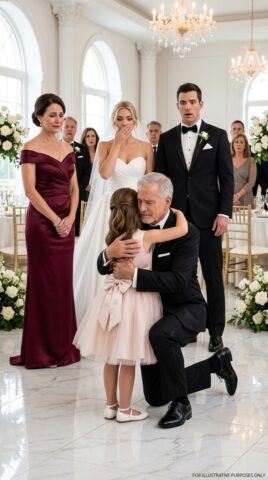
Then she looked toward Alex, radiant in her dress, my mother’s diamond necklace at her throat.
“I made so many mistakes,” Sierra said.
I waited.
“I thought admitting that would feel like dying.”
“Did it?”
She gave a small, humorless smile. “No. Living with them was worse.”
It was the closest thing to truth I had ever heard from her.
“I’m glad you came,” I said.
Her eyes flicked to mine, surprised.
“For Alex,” I added.
She nodded. “For Alex.”
During the ceremony, as Alex and Daniel exchanged rings, I felt something loosen in my chest.
Not forgiveness exactly.
Not forgetting.
Something quieter.
The knowledge that a ring could be flushed, a lock could be changed, a reputation could burn, a family could split open in front of everyone—and still, years later, love could stand under the California sun and choose itself without fear.
At the reception, Alex danced with me first.
Halfway through the song, she looked up and smiled.
“You okay, Dad?”
I glanced across the garden. Sierra stood near the edge of the crowd, watching us with tears in her eyes and no audience to perform for.
Then I looked back at my daughter.
“I’m better than okay.”
Alex squeezed my hand. “Good.”
Years earlier, the last house on Halcyon Road had sounded like a toilet running, a daughter crying, and a woman laughing while gold disappeared into darkness.
Now, under string lights in San Diego, it sounded like music, ocean wind, and my daughter’s laughter.
The ring had been cheap, Sierra said.
Maybe she was right.
But the truth cost everything.
And in the end, it bought us freedom.