PART 2
Before Rachel Mercer destroyed me, I thought I understood what family meant.
My name is Claire Whitman. I was thirty-seven years old, a dental hygienist at a pediatric practice in San Diego, California, married to Mark Whitman for twelve years, and mother to two children who were the center of my universe..
Ethan was ten when everything fell apart, quiet and observant, the kind of boy who noticed when the neighbor changed flowers in her window boxes but forgot to tell anyone he needed new sneakers. Lily was eight, stubborn, funny, fearless, and absolutely convinced that rules were only suggestions if her heart told her otherwise.
Mark worked as a regional manager for a bank downtown. He was steady, handsome in that clean-cut American way, with sandy hair, blue eyes, and a crooked smile that had made me trust him before I knew whether I should. We lived in Coronado, in a white house with blue shutters and an American flag mounted beside the porch. It was not a mansion, but to me it was everything.
Rachel, my younger sister, was three years behind me and always three steps too close.
Growing up, we were known as the Mercer girls. I was the careful one. Rachel was the dazzling one. I made honor roll; she made people laugh. I saved money; she spent it on shoes. I married Mark at twenty-five; she married a real estate broker named Dean and divorced him seven years later after he ran off with a yoga instructor from La Jolla.
After her divorce, Rachel started coming over more often.
At first, I welcomed it.
She arrived with wine on Tuesday nights, cupcakes on Saturdays, and opinions on everything. She helped Lily with spelling words, gave Ethan secret ten-dollar bills, and told Mark he was the only decent man left in California. When I worked late, she picked the kids up from school. When Mark traveled, she slept in our guest room.
“She needs us,” I told Mark whenever he said Rachel was practically living with us.
He would laugh. “I married you, Claire, but somehow I got the full Mercer package.”
Rachel always laughed at that joke.
Looking back, I realize she never threw the dish towel at him playfully because she thought it was funny.
She threw it because she wanted to be the wife in that kitchen.
The week everything happened, I had to attend a continuing education conference in Los Angeles. Our dental practice required it for license renewal, something about updated pediatric sedation protocols. It was two days of hotel ballrooms, coffee in paper cups, and presentations that would probably be outdated by next year.
I almost canceled.
Lily had a costume crisis because another girl in her class had bought the exact same witch outfit. Ethan had a science project involving a volcano that looked more like a mudslide. Mark was buried under a bank audit and eating antacids like candy.
“I can skip it,” I said Wednesday night while he wrestled with papier-mâché at the kitchen island.
“No,” Mark said. “You need the hours. Go. We’ll survive.”
Rachel appeared the next evening with lasagna, salad, and a confidence that made me grateful instead of suspicious.
“Go pack,” she said, taking over my kitchen. “I’ve got Mark and the kids covered.”
There it was again.
My kitchen.
My husband.
My kids.
Covered.
On Friday morning, I loaded my overnight bag into my Honda. Rachel stood beside the driveway in a cream blazer, her blonde hair curled perfectly. She hugged me tighter than usual.
“Drive safe,” she whispered.
“It’s Los Angeles, not a war zone.”
She smiled, but her eyes stayed flat. “A lot can happen in two days.”
She was right.
In two days, Rachel hired a woman who looked enough like me from the side.
In two days, she put that woman in a stolen dental uniform with my embroidered name.
In two days, she staged a romantic dinner at an upscale San Diego restaurant, paid an actor to play the lover, photographed them holding hands, embracing, entering a hotel room, and kissing in a doorway.
In two days, she built a fake affair so convincing that my own husband believed it before I even had the chance to unpack.
When I came home Saturday afternoon, Mark’s car was gone.
Rachel’s was in his spot.
The house was silent.
Not peaceful. Silent.
Rachel sat in my living room, in my favorite chair, holding a manila envelope like it contained a death certificate.
“Claire,” she said, rising slowly, tears on her cheeks. “I am so sorry.”
“What happened? Where are Mark and the kids?”
“I sent them to the park.” Her voice cracked beautifully. “They don’t need to see this.”
Inside the envelope were six photographs.
A woman with my hair.
A woman wearing a jacket like mine.
A woman whose face was always turned just enough away from the camera.
She leaned toward a dark-haired man at a restaurant. She held his hand outside. She wrapped herself around him in front of a hotel. She kissed him in a doorway.
The timestamps said Thursday night.
The same night I had been at a conference dinner with forty dental professionals.
“These are fake,” I said immediately.
Rachel flinched as if I had slapped her. “Claire, please don’t make this harder.”
“Where did you get these?”
“I saw you.” Her voice dropped. “I was showing a condo downtown. I saw you with him. I followed because I thought I had to be mistaken.”
“You are mistaken.”
“I wish I was.”
Mark came home twenty minutes later with Ethan and Lily. His face told me Rachel had already called him.
“Kids upstairs,” he said.
“Daddy?” Lily asked.
“Now.”
When they were gone, I turned to my husband, desperate, confused, still trusting him.
“Mark, listen to me. I was in Los Angeles. Call the hotel. Call the conference office. Call Dr. Palmer.”
“I called the hotel,” he said.
My stomach dropped.
“They said you checked in Wednesday. They have no record of your room key being used Thursday night.”
“Because I was at the dinner downstairs. I didn’t need to go back to the room.”
“The conference office won’t release attendance records until Monday.”
“Then wait until Monday.”
He looked at me then, and the love in his eyes had curdled into humiliation.
“Rachel saw you, Claire.”
“She’s lying.”
Rachel made a soft wounded sound.
Mark’s jaw tightened. “Don’t.”
That one word broke something in me.
Not because he was angry.
Because he had chosen.
PART 3
The divorce moved faster than grief should be allowed to move.
By Monday, Mark had an attorney.
By Wednesday, Rachel had given a sworn statement.
By Friday, the photographs had been submitted as evidence.
I tried to prove where I had been. I begged the conference organizers for records. I produced a printed schedule, a hotel receipt, and text messages to coworkers. But Rachel’s trap was designed around delay and doubt.
The attendance sheet was incomplete.
The hotel keycard system showed no activity.
A restaurant waiter said the woman in the photographs “looked like me.”
The hotel clerk at the Harbor Crest Inn remembered a blonde woman “about my size.”
Rachel cried on the stand.
That was what hurt most.
She cried as if testifying against me was tearing her apart.
“My sister has always been good at explaining things away,” she told the court. “I love Claire. I never wanted to hurt her. But Mark deserved the truth. The children deserved stability.”
I sat there in a navy dress I had bought for church years earlier, hands clenched in my lap, watching my sister perform devastation.
Mark sat two tables away, staring straight ahead.
Not once did he look at me.
Judge Hal Brennan was stern, tired, and clearly disgusted by domestic mess. He looked at the photographs, listened to Rachel’s testimony, weighed Mark’s stable income and my alleged infidelity, and made his ruling with the calm cruelty of a man signing paperwork before lunch.
Primary custody to Mark.
The Coronado house to Mark.
Most of our savings temporarily frozen, then divided heavily in Mark’s favor because Rachel’s testimony suggested I had used marital funds during the affair.
Supervised visitation for me.
Every other weekend.
Three hours at a family center.
I did not scream in court.
I wanted to. God, I wanted to.
But Lily was watching from the back bench beside Mark’s mother, and Ethan was staring at his shoes with his shoulders curled inward.
So I stood still while the world ended.
The first night in my new apartment, I slept on an air mattress above a dry cleaner in North Park. The place smelled like steam, detergent, and someone else’s bad choices. The kitchen was so small I could touch the refrigerator and stove at the same time. My bedroom window faced a brick wall.
I taped photographs of the children above my foldout table because the silence was too much.
For the first six months, I lived like someone recovering from a car crash no one else could see.
I worked five days a week instead of three. I took Saturday appointments. I cleaned the teeth of other people’s children while aching to ask whether mine had eaten breakfast.
Parents in the waiting room whispered. San Diego may be a big city, but the professional circles were small enough for shame to travel quickly.
There she is.
The woman who cheated on that nice bank manager.
The one whose sister caught her.
Rachel, meanwhile, became indispensable.
She moved into a townhouse ten minutes from Mark. She picked the kids up from school when he worked late. She took Lily shopping for shoes. She attended Ethan’s baseball games and posted smiling photos online with captions like, “Family shows up.”
Family.
That word became poison.
During supervised visits, Lily ran to me every time. She threw her arms around my waist and held on like someone might pry her loose.
“I know you didn’t do it,” she whispered once, while the supervisor pretended not to listen.
Ethan was different.
He hugged me, but carefully. He answered questions with yes, no, maybe. He watched everything.
“Are you mad at me?” I asked one Saturday when we were coloring with Lily.
His pencil stopped.
“No.”
“You can ask me anything.”
He swallowed. “Would you tell me if you did something bad?”
My heart split open.
“Yes,” I said. “But I didn’t do what they said.”
He nodded, but his face stayed haunted.
I hired lawyers. Three of them.
The first said the case was unfortunate but not reversible.
The second suggested I accept reality and rebuild.
The third, Angela Reed, listened.
She was a sharp-eyed family attorney in Washington, D.C. before moving back to California after her own divorce. She wore gray suits, red lipstick, and no patience for lazy conclusions.
“The photos are the problem,” she said in our first meeting. “Your sister’s testimony gave them emotion, but the photos gave them weight. We need to prove who the woman really was.”
“How?”
“Follow the money. Someone paid for the dinner, the room, the clothes, the people. Lies leave receipts.”
For eight months, Angela pushed.
Subpoenas. Motions. Private investigators I could barely pay. Nothing came fast enough.
Rachel stayed smiling.
Mark stayed distant.
And my children grew older in a house I used to call home.
Then October came again.
Two years after the conference.
Lily decided she wanted to be a detective for Halloween.
It was the first thing in years that made me laugh without effort.
“She says Aunt Rachel has old costume boxes,” Mark told me by text. “She wants to look there Saturday.”
I stared at the message longer than necessary.
Something about Rachel’s house always made my stomach tighten, but I had no legal ground to object.
So I sent back one word.
Okay.
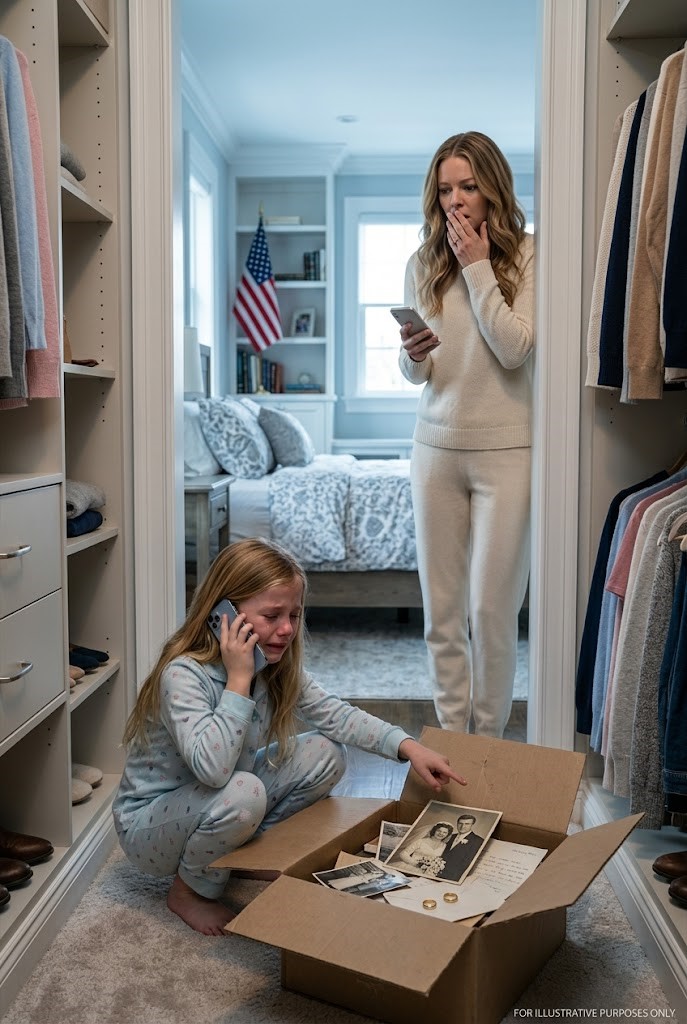
By Saturday afternoon, Lily was in Rachel’s closet.
And the lie finally opened its mouth.
PART 4
The first photograph Lily sent was blurry.
A shoebox on beige carpet.
Then a second image came through.
A blonde wig coiled like a dead animal.
My breath caught so hard it hurt.
The third photograph showed a pale blue scrub top with my name stitched above the pocket.
CLAIRE.
I knew that shirt.
It had gone missing from the backseat of my car three weeks before the conference. I remembered searching for it, irritated because embroidered uniforms were expensive and the office required them. Rachel had been with me that day. She had helped me look.
“Oh, Claire,” she had said, clicking her tongue. “You probably left it at the dry cleaner.”
The next photo showed receipts.
A wig supplier in Los Angeles.
A cash withdrawal.
A hotel booking at the Harbor Crest Inn.
A restaurant reservation.
Then came the notebook.
Lily’s small hands must have been shaking because the first page was tilted, but I could still read the title written in Rachel’s looping script.
OPERATION REPLACEMENT.
My vision blurred.
I enlarged the picture with two fingers.
Page one.
“Claire always gets chosen. Mark looks at her like she is the only woman in the room. He should have looked at me first.”
Page three.
“Need proof strong enough that Mark will never forgive her. Men can forgive neglect. They cannot forgive humiliation.”
Page eight.
“Found scrub top in Claire’s car. Perfect. If she thinks she lost it, she will never connect it.”
Page twelve.
“Briana Wells: similar height, similar body, wrong hair but fixable. Paid extra for discretion.”
Page fourteen.
“Mark must feel betrayed before Claire can explain. Emotion first. Evidence second. Rachel as savior.”
Rachel as savior.
I covered my mouth to stop a sound from escaping.
Then Lily sent a video.
It was only eleven seconds long.
The closet door was half open. The camera pointed at the box. Then it jerked up toward the bedroom door as Rachel’s voice called from downstairs.
“Lily? Honey? Where are you?”
I heard my daughter whisper, “Oh no,” and the video ended.
I called Angela Reed before I called the police.
She answered on the second ring.
“Claire?”
“I have it,” I said.
“What?”
“Proof. Rachel kept everything.”
Angela was silent for one beat. “Send it to me. Every image. Now.”
By six that evening, Angela had filed an emergency motion.
By Sunday morning, her investigator had found Briana Wells, the woman Rachel hired.
By Monday afternoon, we had a signed statement.
Briana was not proud of what she had done, but she insisted Rachel had told her it was part of a private test to prove how easy false evidence could be. Briana had worn the wig, the scrub top, and the jacket Rachel provided. She had gone to dinner with a male escort Rachel also hired. Rachel had positioned them, photographed them, and paid both in cash.
“She told me nobody would get hurt,” Briana said in her statement. “She said it was for a legal demonstration.”
Rachel had counted on shame.
She had counted on time.
She had counted on my exhaustion.
She had not counted on an eight-year-old detective.
The emergency hearing was scheduled for Thursday at the San Diego County courthouse.
I did not sleep the night before.
At 5:30 a.m., I stood in front of the mirror in my apartment wearing the same navy dress I had worn when the court took my children away. This time, I pinned my hair back, put on mascara with a steady hand, and whispered to my reflection, “You are not begging today.”
Angela met me outside the courtroom with a leather folder thick enough to change a life.
“You ready?” she asked.
“No.”
“Good. Ready is overrated.”
Mark was already inside.
He sat in the second row, shoulders hunched, face pale. When he saw me, he stood halfway, like his body wanted to come toward me and his guilt nailed him to the floor.
Rachel sat at the respondent’s table in a navy suit, pearls, and the same wounded expression she had used two years earlier.
My sister looked at me and smiled.
Not a nervous smile.
Not a guilty one.
A warning.
Judge Brennan entered at nine sharp.
He looked older than I remembered. Or maybe I had aged enough to notice.
Angela stood.
“Your Honor, we are here because the evidence used to dissolve my client’s marriage and restrict her custody was not merely unreliable. It was manufactured. We intend to prove that Rachel Mercer orchestrated a staged affair, committed perjury, manipulated two minor children, and perpetrated a fraud on this court.”
The room went still.
Judge Brennan’s gaze sharpened.
“Ms. Reed,” he said, “those are extraordinary allegations.”
Angela opened her folder.
“Yes, Your Honor. And unfortunately, the proof is extraordinary.”
Rachel’s smile vanished.
PART 5
Angela began with the notebook.
She did not read every page.
She did not have to.
She read enough.
“Page one,” Angela said, her voice calm enough to make every word more brutal. “‘Claire always gets chosen. Mark should have been mine.’”
Rachel’s attorney stood. “Objection. Foundation.”
Angela lifted a photograph. “The notebook was recovered from Ms. Mercer’s closet. The handwriting matches prior documents. We have an expert prepared to testify.”
Judge Brennan waved the objection down.
“Continue.”
Angela turned the page.
“Page fourteen. ‘Mark must feel betrayed before Claire can explain. Emotion first. Evidence second. Rachel as savior.’”
A sound moved through the courtroom.
A gasp. A whisper. A chair creaking under someone’s shifting weight.
Mark lowered his head.
Rachel stared at the table.
Angela continued.
“Page twenty-two. ‘Conference confirmed. Claire leaves Friday morning. Two days are enough.’”
My hands clenched in my lap.
Two years earlier, those two days had ruined me.
Now they were ruining her.
Then Angela presented the receipts.
A wig purchased from a theatrical supplier in Los Angeles.
The Harbor Crest Inn reservation made under Rachel Mercer’s credit card.
A dinner reservation at Lark & Stone under the initials R.M.
Cash withdrawals totaling four thousand dollars.
Payment records from a private companion service that Angela’s investigator had traced through a burner email Rachel thought was anonymous.
Then Briana Wells took the stand.
She looked younger in person than in the photographs, with dark hair pulled into a neat bun and circles under her eyes. She avoided looking at me.
Angela approached gently.
“Ms. Wells, do you recognize Rachel Mercer?”
“Yes,” Briana said.
“How do you know her?”
“She hired me two years ago.”
“For what purpose?”
Briana swallowed. “To pretend to be someone else.”
“Who?”
She looked at me then, and her face crumpled with shame.
“Her sister.”
Rachel shot to her feet. “She’s lying!”
Judge Brennan slammed his gavel.
“Ms. Mercer, sit down.”
Briana continued, voice shaking.
“She gave me a blonde wig, a scrub top, and a jacket. She told me how to turn my face away from the camera. She said she needed photographs that looked like an affair.”
“Did she explain why?”
“She said her sister was cheating and nobody believed her. She said it was the only way to get the truth out.”
“Was the man in the photographs actually involved with Claire Whitman?”
“No.”
“Did you know Claire Whitman?”
“No.”
“Had you ever met her before today?”
“No.”
The male actor testified next. His story matched Briana’s.
The waiter admitted he had never clearly seen the woman’s face and had been pressured by Rachel during the original case.
The hotel clerk testified that Rachel had checked into the room and handed the key to a blonde woman in sunglasses.
Every sentence pulled another brick from the wall that had trapped me.
But the testimony that broke the courtroom came from Ethan.
My son walked to the stand wearing a white button-down shirt and sneakers. He was twelve now, taller, thinner, older than any child should look.
He glanced at me once.
His eyes filled with tears.
Angela’s voice softened.
“Ethan, I know this is difficult. Did you see anything unusual the night your mother was at the conference?”
Ethan nodded.
“Please tell the court what you saw.”
He took a breath.
“Aunt Rachel left the house after Mom called from Los Angeles. She told me not to tell Dad because he was stressed. She had Mom’s jacket and a bag. I saw a wig inside.”
Rachel began shaking her head.
Ethan’s voice cracked, but he kept going.
“She said it was for Halloween. Later, after Mom and Dad started fighting, she told me if I said anything, Mom could get in worse trouble. She said adults were handling it and kids who interfered could destroy families.”
Mark made a sound like someone had punched him in the ribs.
Angela asked, “Why are you telling the truth now?”
Ethan looked at Rachel.
Then at his father.
Then at me.
“Because Lily was braver than I was.”
I broke then.
Not loudly. Not dramatically.
Just one hand over my mouth, tears slipping past everything I had held together.
Judge Brennan called a recess.
When we returned, Rachel’s attorney was pale. Rachel herself looked furious, no longer wounded, no longer soft. The mask had cracked, and something ugly stared through it.
Judge Brennan leaned forward.
“Ms. Mercer, based on the evidence presented, this court finds substantial grounds to believe you committed perjury, fraud, witness intimidation, and conspiracy to manufacture evidence in a custody proceeding.”
Rachel stood. “Your Honor, Claire is manipulating everyone. She always does this. She always makes people choose her.”
The courtroom went silent.
There it was.
Not innocence.
Jealousy.
Raw, rotten, finally spoken out loud.
Judge Brennan’s face hardened.
“Bailiff.”
Rachel turned as if she might run.
The bailiff reached her first.
As he placed her in handcuffs, Rachel looked straight at me.
“You think this makes you special?” she hissed. “You still lost two years.”
The words landed because they were true.
But for the first time, they did not destroy me.
I stood.
“No,” I said quietly. “You did.”
PART 6
The judge reversed everything he could reverse that day.
Full legal custody returned to me immediately.
Supervision terminated.
The prior divorce findings vacated.
A new financial hearing ordered.
A criminal referral made.
A formal statement entered into the record acknowledging that the court had relied on fraudulent evidence.
Judge Brennan looked at me from the bench, and the sternness in his face gave way to something I had never expected to see from him.
Regret.
“Mrs. Whitman,” he said, “this court failed you. I cannot restore the years you lost. But I can begin by restoring your rights.”
People think vindication feels like triumph.
It does not.
It feels like standing in the ashes of your own house while someone finally admits they smelled smoke.
Mark tried to approach me outside the courtroom.
“Claire,” he said.
I turned.
He looked terrible. His suit hung wrong. His face had gone gray around the edges. I had imagined this moment for two years. In some fantasies, he fell to his knees. In others, I slapped him. In the darkest ones, I begged him to understand what he had done to me.
But when he stood there, broken and ashamed, all I felt was tired.
“I don’t know how to apologize,” he said.
“Then don’t start today.”
He flinched.
“I believed her.”
“Yes.”
“I believed your sister over my wife.”
“Yes.”
His eyes filled. “I took the kids from you.”
“No,” I said. “The court did. Rachel caused it. But you helped by not waiting long enough to know the truth.”
He nodded like every word cut him exactly where it should.
“What happens now?” he asked.
“We focus on Ethan and Lily.”
The children came to my apartment that night.
Not for three supervised hours.
Not with a stranger watching.
They came with overnight bags.
Lily ran in first, threw herself into my arms, and sobbed into my sweater.
“I found the bad box,” she cried.
“You found the truth,” I whispered.
Ethan stood in the doorway, frozen.
I opened one arm.
He collapsed into it.
For a long time, all three of us sat on the floor of that tiny apartment, holding each other between the couch and the coffee table.
No one said much.
Some reunions are too big for words.
The next months were not easy.
That is another lie people believe about justice. They think once the truth is revealed, the pain packs its bags and leaves.
It doesn’t.
Ethan had nightmares. He blamed himself for not speaking sooner. He stopped playing baseball for a while because Rachel had attended every game and the field felt contaminated.
Lily became clingy. If I left the room, she called after me. If I missed a phone call, she panicked. She asked three times a week whether Aunt Rachel could come take her away.
Mark started therapy with the children. Then alone. Then he asked if I would attend a session focused on co-parenting.
I said yes, not because he deserved it, but because Ethan and Lily did.
In that room, with a counselor named Dr. Anne Michaels watching from a chair by the window, Mark cried harder than I had ever seen.
“I was embarrassed,” he admitted. “That’s the truth. I saw those photos and all I could feel was humiliation. Rachel knew exactly which wound to press. I wanted someone to blame. Claire was standing there, and Rachel was handing me a story that made my pain simple.”
I listened.
I did not comfort him.
Healing does not require you to rescue the person who helped break you.
Rachel’s criminal trial lasted three days.
She refused a plea deal at first, insisting she had been framed. But the notebook, payments, witness testimony, and Ethan’s statement were too strong. Halfway through, she changed her plea.
Perjury.
Fraud.
Witness intimidation.
Evidence tampering.
She received eighteen months in prison and three years probation. She lost her real estate license, her townhouse, most of her friends, and the carefully polished identity she had built around being the devoted sister.
Our mother flew in from Florida for sentencing.
She sat beside me in court, gripping my hand with both of hers.
“I should have seen it,” she whispered.
I looked at Rachel sitting at the defense table, jaw tight, eyes empty.
“No,” I said. “She made sure no one did.”
But Mom shook her head.
“She always wanted what you had. Your grades. Your friends. Your wedding. Your babies. I thought envy was just a phase.”
Rachel did not look back when they led her away.
I was grateful.
Some people want forgiveness because they cannot tolerate consequences.
Rachel wrote letters from prison.
The first one said she was sorry.
The second said Mark had encouraged her without realizing it.
The third said I had always acted superior.
The fourth said Lily had no right to go through her closet.
I stopped opening them after that.
Boundaries are not bitterness.
They are doors you lock because you finally understand what entered through them.
The civil lawsuit settled before trial. Rachel’s insurance and remaining assets paid enough for me to buy a small house in a quiet neighborhood outside San Diego, not far from the kids’ school. It had three bedrooms, a lemon tree in the backyard, and a kitchen with sunlight in the morning.
The first night we slept there, Lily taped a hand-drawn sign to her bedroom door.
DETECTIVE LILY’S OFFICE.
Ethan helped me hang the American flag by the porch.
“Like the old house,” he said.
“Better,” I answered.
He smiled for the first time in weeks.
PART 7
One year after the hearing, I hosted Sunday dinner in my new house.
The kitchen smelled like garlic bread, tomato sauce, and brownies cooling on the counter. Lily, now nine, wore a plastic detective badge clipped to her shirt and carried a notebook everywhere. Ethan, thirteen, had returned to baseball and grown confident enough to argue with Mark about batting averages.
Mark arrived at five with vanilla ice cream and hot fudge.
He knocked, even though the kids told him he did not have to.
That mattered to me.
Respect often returns in small gestures before it returns in words.
“Come in,” I said.
He stepped inside, holding up the grocery bag. “I was told dessert was my only acceptable contribution.”
Lily appeared from the hallway. “Correct. Mom’s spaghetti is better than yours.”
“Cruel but fair,” Mark said.
Ethan laughed.
It was a normal sound.
For a second, it filled the house like sunlight.
Dinner was not the old life.
Mark and I did not sit side by side as husband and wife. He did not reach for my hand under the table. I did not lean into his shoulder while the kids argued over who got the last brownie corner.
That marriage was gone.
Not because love had never existed.
Because trust, once shattered in such a violent way, does not always become what it was. Sometimes it becomes something else. A fence. A bridge. A map with certain roads permanently closed.
We learned to co-parent.
We learned to sit at school events without flinching.
We learned to put the kids’ birthdays ahead of our pain.
Sometimes Mark looked at me with regret so heavy I had to look away.
Once, while we watched Ethan pitch at a Saturday game, he said, “I still don’t understand why I didn’t wait.”
I kept my eyes on the field.
“I do.”
He turned.
“You were hurt. Rachel knew how to make your hurt louder than your love.”
He swallowed.
“That doesn’t excuse it.”
“No,” I said. “It explains it.”
That was as much forgiveness as I could give.
Rachel was released after serving fourteen months.
She moved to Arizona with a cousin who believed her version of events, at least for a while. Last I heard, she was working at a furniture showroom under her middle name and telling people California had ruined her. She sent one final email to Mark, copying me.
“You all needed someone to blame,” she wrote. “I only exposed what was already broken.”
Mark forwarded it to our attorneys without replying.
I deleted it.
The most powerful thing I ever did to Rachel was stop giving her a stage.
That Sunday dinner ended with Lily standing on a chair, tapping a spoon against her glass.
“I have an announcement,” she declared.
Ethan groaned. “Please don’t arrest anyone.”
“I might.” She pointed the spoon at him. “Depends how suspicious you act.”
Mark smiled. I laughed. Lily opened her notebook.
“One year ago, I solved the biggest case in family history.”
“That is true,” I said.
“And now I have decided when I grow up, I will be a detective, a dentist, and maybe the president.”
“Ambitious schedule,” Mark said.
Lily nodded seriously. “Thank you. Also, Aunt Rachel is not invited to my future inauguration.”
The table went quiet for half a second.
Then Ethan burst out laughing.
We all did.
Not because it was funny exactly.
Because laughter had returned, and none of us wanted to waste it.
Later, after Mark left and Ethan went upstairs to finish homework, I found Lily in the backyard under the lemon tree. She was looking at the sky.
“You okay?” I asked.
She leaned against me.
“Do you think Aunt Rachel was always bad?”
The question hurt because there was no easy answer.
“I think Aunt Rachel made bad choices for a long time,” I said. “And instead of stopping, she kept feeding the worst part of herself until it became bigger than everything good.”
Lily considered that.
“Do I have bad parts?”
“We all do.”
“Even you?”
“Even me.”
“What do we do with them?”
I brushed hair from her face.
“We tell the truth. We ask for help. We don’t let jealousy drive the car.”
She giggled. “Jealousy can’t drive. It doesn’t have a license.”
“No, it does not.”
She slipped her hand into mine.
“Mom?”
“Yes?”
“I was scared in the closet.”
“I know.”
“But I heard your voice, and then I wasn’t as scared.”
I pulled her close, looking through the kitchen window at Ethan moving around inside our warm, imperfect, repaired home.
For two years, I thought the truth had abandoned me.
But truth had not disappeared.
It had waited.
In a shoebox.
In a child’s courage.
In a courtroom where lies finally ran out of places to hide.
I lost my husband, my children, my home, and my name to my sister’s lies.
But two years later, my eight-year-old daughter called me crying from a closet and said, “Mommy, look what I found.”
And somehow, from that dark little corner of my sister’s house, the light found its way back to us.