PART 2 — THE TRUNK
Rain blew sideways under the garage overhang as I crossed the driveway. A valet called after me, but I didn’t stop. My shoes slapped through shallow puddles, cold water splashing up my pants, while Claire followed three steps behind me saying my name like a warning.
“Evan. Evan, listen to me. Please.”
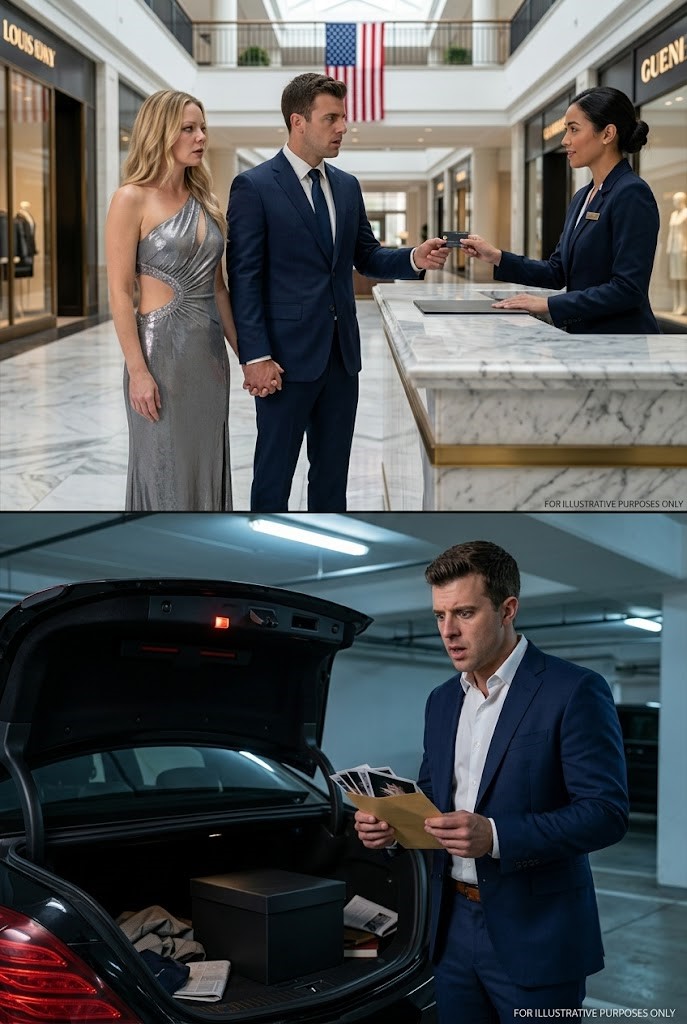
The trunk of our Audi hung open under the fluorescent lights.
Inside, beside the spare tire, was a Pacific Crown key card in a white sleeve.
No room number written on it.
No explanation.
Just a key.
I picked it up between two fingers.
Claire stopped walking.
All the color had drained from her face. Her red nails curled into her palms.
“What is this?” I asked.
She didn’t answer.
The valet, a skinny college kid with soaked hair, hurried over holding our keys. “Sir, I’m sorry. Your trunk just opened from the remote. I thought maybe you pressed it.”
I looked at Claire.
Her purse was clutched to her chest.
“My remote is in my pocket,” I said. “Where’s yours?”
She said nothing.
The valet looked trapped between his job and a crime scene. “Do you want me to call security?”
Before I could answer, Nora appeared at the garage entrance holding a small cream envelope.
“Mrs. Mercer?” she called.
Claire closed her eyes.
Nora walked toward us, already looking like she regretted every step. “Housekeeping sent this down. It was left in Suite 418 after checkout. I was told to return it to the guest before she left.”
Before Claire could move, I took the envelope.
“Evan, don’t,” she said.
I looked at her.
Her voice broke on the word.
I tore the envelope open.
Inside were two wine-stained cocktail napkins, a receipt for champagne, and a folded note written in Claire’s handwriting.
Don’t text me from work anymore.
That was it.
Six words.
Six words that made our entire marriage tilt sideways.
I stared at them, waiting for my brain to invent something innocent.
It didn’t.
Claire started crying, but quietly, as if she had no right to make noise.
I looked at Nora. “Was my wife alone in that suite?”
Nora’s face tightened. “Sir—”
“Please.”
She glanced toward Claire, then at the key in my hand.
“No,” she said softly. “A man was listed with the reservation.”
I already knew.
But knowing didn’t stop the impact.
“What man?”
Nora swallowed. “Trevor Hale.”
Claire made a sound like someone had struck her.
The valet looked at the ground.
My hand tightened around the note until the paper bent.
“How long?” I asked Claire.
She wiped her face with the heel of her hand, smearing mascara under one eye.
“It wasn’t what you think.”
“That is not an answer.”
“Evan—”
“How long?”
Her lips trembled.
“A month,” she whispered.
The rain outside seemed to grow louder, hammering the garage roof.
A month.
Thirty days of coming home to me with hotel soap on her skin. Thirty days of smiling at messages across our dinner table. Thirty days of letting me ask what was wrong and then making me feel guilty for asking.
I laughed once.
It came out hollow.
“A month,” I repeated. “You told me the charge was a mistake.”
“I panicked.”
“You told me I was paranoid.”
“I was scared.”
“You told me Denise needed you after work.”
Claire covered her mouth.
That hit.
Denise was her college friend in Carlsbad. Claire had used her name twice in one week. Wine after work. A client dinner. A late emotional emergency that somehow left Claire smelling like the same hotel shampoo now drifting from her coat.
“Was Denise ever involved?”
Claire shook her head.
I felt a strange calm spread through me. Not peace. Something worse. The kind of calm that comes when your heart stops fighting the facts.
Nora cleared her throat. “There was something else.”
She reached into her blazer pocket and handed me a smaller receipt.
Room service.
Two names printed at the bottom.
CLAIRE MERCER.
TREVOR HALE.
Under that, a note from staff:
Guest requested privacy. Do not disturb after 11:30 p.m.
I read it three times.
Claire whispered, “I was going to tell you.”
“No, you weren’t.”
“I was ending it tonight.”
“You were in a suite with him tonight.”
She looked away.
That was answer enough.
I turned toward the backseat because Trevor’s text had mentioned a bag. At first I saw only Claire’s gray wool coat folded neatly over the leather seat. Then I noticed the corner of a white paper shopping bag tucked beneath it.
Pacific Crown Hotel printed in gold letters.
Claire stepped between me and the car.
“Don’t touch that.”
I stared at her. “Move.”
“It’s not what you think.”
I almost smiled. “You should retire that sentence.”
Her hands shook as she reached for the bag, but I was faster. I pulled it out.
Inside was a black silk dress I had never seen before, a small bottle of perfume still in its tissue wrapping, and a thick manila folder sealed with a strip of tape.
My name was written across the front.
EVAN MERCER.
Not Claire’s name.
Mine.
The garage seemed to narrow around me.
I tore the tape.
The first page was a photo of our apartment building in Little Italy.
The second was a photo of me walking out of our front door carrying my laptop bag.
The third was a grainy shot through our kitchen window.
Me at the sink.
Alone.
Behind the photos were printed text messages between Claire and Trevor. Some flirtatious. Some desperate. Some unmistakable. Then a final page with one typed line:
He knows too much already. Make sure he never sees the rest.
I looked at Claire.
For the first time all night, she wasn’t just ashamed.
She was terrified.
“What is this?” I asked.
She stepped closer and lowered her voice.
“Trevor has been watching you.”
I felt the anger inside me freeze into something sharp.
“Watching me?”
“He said he had proof. Screenshots. Photos. He said if I didn’t meet him tonight, he’d send everything to you, my boss, your sister, everyone.”
I stared at the folder, then at my wife.
“You cheated on me,” I said slowly, “and now you’re telling me the man you cheated with is blackmailing you?”
Tears spilled down her face. “Yes.”
I wanted to reject it. I wanted to say she was inventing a new lie because the old one had collapsed.
But then Nora said, “Sir.”
We all turned.
At the far end of the garage, Trevor Hale stood near the elevator entrance in his wrinkled dress shirt, his hair damp, his face carefully arranged into confusion.
For one second, he looked like a man who had come to apologize.
Then he saw the folder in my hand.
And his smile vanished.
PART 3 — THE MAN FROM ROOM 418
Trevor Hale had always been the kind of man people trusted because he looked like he had never needed to steal anything.
He wore expensive watches, remembered everyone’s name, and laughed with his whole chest at parties. At Claire’s office events, he made himself useful. He refilled drinks. He opened doors. He asked husbands what they did for a living with just enough interest to seem respectful and just enough condescension to make them want to prove themselves.
I had never liked him.
But dislike is not evidence.
That was what I told myself for a year.
Now he stood in the Pacific Crown garage with rain behind him and guilt all over his face.
“Claire,” he said, not looking at me. “What did you do?”
That one sentence almost made me lose control.
“What did she do?” I asked.
Trevor finally looked at me. “Evan, this is a private matter.”
“Private?” I lifted the folder. “You took pictures of my apartment.”
His jaw tightened. “You don’t understand the context.”
Claire stepped back as if his voice had shoved her.
I saw it then. Something I had missed before. She wasn’t only afraid of being caught. She was afraid of him.
That didn’t make me forgive her.
It made everything uglier.
Because betrayal is bad enough when it is selfish.
It becomes poison when it drags danger through your front door and leaves it there for your husband to find.
Nora moved toward the lobby. “I’m calling security.”
Trevor snapped, “No need.”
“There is,” I said.
He put up both hands, palms out, performing calm for the witnesses. “Look, we had an inappropriate relationship. I’m not proud of it. But nobody was stalking anyone.”
I opened the folder again and held up the photo of me outside our apartment.
“Then explain this.”
His eyes flickered.
Just once.
But enough.
Claire whispered, “Trevor, stop lying.”
He turned on her so fast she flinched.
“Careful.”
One word.
Soft.
Threatening.
The valet looked up. Nora stopped walking.
I stepped between them.
“Say that to me.”
Trevor smiled faintly. “You’re emotional. I get it.”
“No. You don’t get anything.”
I moved closer until I could smell champagne on him.
“You came into my marriage. You slept with my wife. You collected evidence like a trophy. You watched my home. And now you’re standing here acting like I’m the unstable one?”
His expression hardened.
“There are two sides to every story.”
“Good,” I said. “Let’s hear yours with security standing here.”
Two guards entered the garage a minute later. One older, one younger, both with radios clipped to their shoulders. Nora spoke to them quietly while Trevor kept his eyes on the folder.
Claire hugged herself near the car, crying silently.
For a brief, foolish second, I remembered the woman I married.
Claire Whitmore from a small town outside Sacramento. Art history major. Bare feet on my kitchen tile. Woman who cried during dog food commercials and once drove three hours to bring me a suit when my bag got lost before a conference in Washington, D.C.
I loved that woman.
The woman standing in front of me had worn red nails to another man’s hotel room and let me walk into a trap blind.
Both were true.
That was the worst part.
The older security guard asked, “Is there a problem here?”
“Yes,” I said. “I need this room, 418, secured. I need footage preserved from tonight, and I need police if this man has been photographing my home.”
Trevor laughed under his breath. “You’re making a huge mistake.”
“No,” I said. “I’ve been making a mistake for a month. Tonight I’m correcting it.”
Claire looked at me then, her eyes swollen. “Evan, please don’t call the police. Not here. This will destroy my job.”
I stared at her.
“You should have thought about your job before you used it as an alibi.”
She lowered her face.
Trevor said, “She came willingly.”
Claire’s head snapped up.
“Don’t,” she whispered.
He shrugged. “What? You did.”
The cruelty in it was casual. Practiced.
He wasn’t defending himself anymore. He was punishing her for failing to protect him.
And suddenly I understood something that made my stomach turn.
Trevor had not only wanted my wife.
He wanted control over the story.
If I stormed upstairs and screamed, he could call me irrational. If Claire confessed privately, he could deny the details. If the hotel charge disappeared into excuses, he could keep the evidence as leverage.
But now there were witnesses.
A clerk.
A valet.
Security.
A folder.
A second key card.
And his name printed on the receipt.
I pulled out my phone and called my sister, Rachel.
She answered on the second ring. “Ev? It’s late. Everything okay?”
“No,” I said. My voice sounded strange to me. “I’m at the Pacific Crown Hotel. Claire has been having an affair with Trevor Hale from her office. There may be blackmail and surveillance involved. I’m sending you photos of everything right now in case my phone disappears.”
Claire covered her face.
Trevor said, “That’s dramatic.”
I ignored him and started photographing every page.
Rachel went silent for three seconds.
Then she said, “Send it. I’m awake. I’m calling Daniel.”
Daniel was her husband, a former prosecutor in Orange County.
Trevor heard the name and shifted.
Good.
I sent the photos.
Then I called my lawyer.
Not tomorrow.
Not after sleeping on it.
Right there, under the garage lights, while my wife cried and her lover watched the walls close in.
My lawyer, Marcy Voss, answered with the grumpy alertness of a woman who had spent twenty years hearing disasters after midnight.
“Evan?”
“I need you to listen carefully.”
I told her everything. The charge. The hotel. The clerk. Suite 418. The key. Trevor. The folder. The photos.
Marcy didn’t interrupt until I finished.
Then she said, “Do not give anyone that folder. Do not threaten anyone. Ask hotel security to preserve all records. Leave with the documents. Sleep somewhere safe. Tomorrow morning, you come to my office.”
Claire whispered, “Evan, don’t do this.”
I looked at her.
“I didn’t do this.”
Those four words landed harder than shouting would have.
She seemed to shrink inside her coat.
Trevor tried to leave while I was still on the phone.
The younger security guard blocked him.
“Sir, we need to ask you a few questions before you go.”
Trevor’s charm cracked. “I’m not being detained.”
“No,” I said. “But you are being remembered.”
He glared at me.
For the first time, I saw the real man underneath the office smile.
Small.
Angry.
Scared of exposure.
Nora handed me a copy of the room receipt. “I’m sorry,” she said.
It was such a simple sentence.
But it nearly broke me.
Because the first apology I believed that night came from a stranger.
PART 4 — CLAIRE’S VERSION
I did not take Claire home.
That was the first decision that made the rest possible.
She begged in the garage.
Then in the lobby.
Then outside under the hotel awning where the rain made silver streaks across the street and taxis rolled past like yellow ghosts.
“Evan, please. Let me explain somewhere private.”
“No.”
“I’m your wife.”
“That stopped protecting you when you used it as cover.”
She flinched.
I hated that part of me noticed.
I hated that even after everything, some instinct inside me still wanted to soften the blow.
But love can become a reflex long after trust is dead.
I called a rideshare for her and told Nora the driver’s name.
Claire stared at me. “You’re sending me away?”
“I’m sending you anywhere that isn’t our apartment.”
Her face crumpled. “Our apartment?”
“Not tonight.”
“You changed the locks?”
I hadn’t.
Not yet.
But I would.
“I’m staying with Rachel,” I said. “You can go to Denise, since you liked using her name so much.”
Claire pressed both hands over her mouth.
That one hurt her.
Good, I thought.
Then hated myself for thinking it.
Trevor was still inside with security when Claire’s car arrived. Before she got in, she turned back to me.
“He scared me,” she said. “That part is true.”
I looked at her across the wet sidewalk.
“Then why didn’t you tell me when it started?”
Her answer came in pieces.
At first, Trevor had been attention. A compliment after meetings. A message about how smart she was. A drink after a late presentation. Claire said she had felt invisible at home, which made me almost laugh because I had spent months asking what she needed, only to be told she was tired.
Then came the first kiss in a parking garage after a client dinner in Santa Monica.
Then the secret texts.
Then the guilt.
Then Trevor’s divorce turned ugly, and he started saying Claire was the only good thing in his life.
Then she tried to end it.
He sent her screenshots.
Not threats at first.
Just reminders.
You wouldn’t want Evan to see this.
Then photos.
A picture of our apartment building.
A picture of my car.
A picture of Claire and me walking into church on Easter Sunday.
“He said he just wanted to make sure I understood what I was risking,” she whispered.
I felt sick.
“You let him know enough about our life to find me.”
“I didn’t think he would do that.”
“No. You only thought about yourself.”
She recoiled like I had slapped her.
Maybe the truth feels violent when it arrives late.
Her driver pulled up.
She reached for me.
I stepped back.
That small movement destroyed her more than any insult could have.
“Evan,” she whispered.
I said, “Get in the car.”
She did.
I watched the taillights vanish into the rain.
Then I walked two blocks to a parking structure and threw up behind a concrete pillar.
After that, I called Rachel.
She didn’t ask if I was okay. She knew better.
“Come here,” she said.
By the time I reached her house in Coronado, it was after two in the morning. Rachel opened the door in sweatpants,
took one look at my face, and pulled me inside.
Her husband, Daniel, sat at the kitchen table with a legal pad.
The folder lay between us like a dead animal.
We went through every page.
Not because I wanted to.
Because I needed to know the shape of the betrayal before anyone else tried to reshape it.
The texts were worse when read in order.
Claire’s first messages were flattered and nervous.
Trevor’s were patient.
Then possessive.
Then cruel.
He called me “the accountant husband,” even though I was a structural engineer. He joked about how easy I was to fool. He told Claire, “He probably thinks you’re at Pilates.” He wrote, “Men like Evan don’t fight. They absorb.”
That sentence burned itself into me.
Men like Evan don’t fight.
They absorb.
Rachel read it and said, “He doesn’t know you.”
I wasn’t sure she was right.
For years, I had absorbed.
My father’s temper had trained me to fear conflict. I became the calm one. The reasonable one. The husband who apologized first, not always because he was wrong, but because silence after a fight felt worse than surrender.
Claire knew that.
Maybe Trevor had learned it from her.
At dawn, I texted the landlord and paid an emergency fee to change the apartment locks. Then I called the bank and froze our shared cards. Then I sent a formal message to Claire:
Do not come to the apartment without coordinating through Marcy Voss. I have preserved evidence from tonight. We will communicate about separation through counsel.
She replied thirty-seven seconds later.
Please don’t make this legal. I love you.
I stared at the words until they blurred.
Then I deleted the notification without answering.
Love without honesty is just a pretty word people use while they take what they want.
At nine that morning, I sat in Marcy’s office downtown wearing yesterday’s clothes.
Marcy was sixty, silver-haired, sharp-eyed, and allergic to nonsense.
She spread the documents across her desk.
“This is messy,” she said.
“I know.”
“No. I mean it’s messy in your favor.”
She tapped the hotel receipt. “Affair. Marital funds. Possible workplace misconduct. Threatening materials. Surveillance. We move cleanly. No revenge posts. No shouting. No dramatic emails.”
“I already called my sister.”
“That’s family. Fine. Anyone else?”
“No.”
“Good. You want divorce?”
The question hit harder than I expected.
Not because I didn’t know the answer.
Because saying it would make the old life officially dead.
I looked out her window at San Diego Bay. Morning light flashed on the water like broken glass.
“Yes,” I said.
Marcy nodded once.
“Then we file first.”
By noon, Claire had called fourteen times.
I didn’t answer.
At 12:43 p.m., an email arrived from her office account.
Subject: Please.
I didn’t open it.
At 1:10 p.m., Trevor called from an unknown number.
I let it go to voicemail.
His message was eight seconds long.
“You don’t know what you’re starting.”
I played it for Marcy.
She smiled without warmth.
“Actually,” she said, “he just helped us.”
PART 5 — WHEN THE STORY BROKE
The story broke open because Trevor underestimated paperwork.
Men like Trevor believe charm is stronger than records. They think if they speak calmly enough, people will doubt what they saw. They forget hotels have cameras, key logs, invoices, time stamps, valet scans, elevator footage, and employees who do not appreciate being dragged into rich people’s lies.
By Friday, Marcy had preservation letters delivered to the Pacific Crown, Claire’s company, and Trevor directly.
By Monday, Claire’s firm placed Trevor on administrative leave.
By Tuesday, Claire was suspended pending investigation.
Not because I wanted to ruin her career.
Because Trevor had used company time, company travel excuses, and work messages to pressure her into meetings. Claire had used the same system to lie. Their affair had crawled through office servers and expense reports like mold through drywall.
The truth did not need me to shout.
It had receipts.
Claire finally came to Rachel’s house on Wednesday evening.
Rachel did not let her inside.
I met Claire on the porch with Daniel standing behind the screen door, visible enough to remind everyone we were done performing privacy for people who had abused it.
Claire looked smaller than I remembered. No red nails now. She had cut them short and painted them clear, as if removing the color could erase the night.
“I need to talk to you,” she said.
“You can talk.”
She glanced at Daniel.
“He has to stand there?”
“Yes.”
Her eyes filled. “You hate me.”
“I don’t know what I feel.”
That was true.
Hatred would have been simpler.
What I felt was grief covered in ash.
Claire wrapped her arms around herself. “Trevor got fired today.”
I said nothing.
“He’s blaming me.”
“That sounds consistent.”
“He sent emails to people at work. He made me look like I chased him.”
I looked at her then. Really looked.
“Did you?”
She flinched.
“No.”
“Did you flirt with him?”
She closed her eyes.
“Yes.”
“Did you meet him willingly before he threatened you?”
A tear slipped down her cheek.
“Yes.”
“Did you lie to me every day after that?”
“Yes.”
“Then you don’t get to ask me to sort out which part of your disaster deserves sympathy before I decide whether I’m allowed to be hurt.”
Her mouth trembled. “I know.”
“No, you don’t.”
She took a step closer. “I loved you through all of it.”
That sentence hit something raw.
I laughed once, quiet and ugly.
“You loved me while deleting calendar entries? While changing your passcode? While washing him off before you came to bed?”
She covered her face.
“You loved me while letting me wonder if I was becoming controlling because I noticed my own wife disappearing?”
“I was ashamed.”
“You should have been honest.”
“I thought honesty would destroy us.”
I looked at her for a long time.
“No. Honesty might have hurt us. You chose the thing that destroyed us.”
The porch went quiet.
A neighbor’s sprinkler clicked on across the street. Somewhere down the block, a dog barked. Normal life continued with offensive indifference.
Claire wiped her face. “I’ll sign whatever you want. I’m not fighting the divorce.”
That should have relieved me.
It didn’t.
It made the loss feel cleaner, and somehow that made it worse.
“I don’t want to punish you,” I said.
She looked up, startled.
“I want my life back.”
“I can give you that.”
“No, Claire. You’re the reason I have to rebuild it.”
Her shoulders collapsed.
She handed me her apartment key. Then her garage remote. Then the spare mailbox key she had kept in a little blue pouch since the day we moved in.
That nearly broke me.
Not the hotel receipt.
Not the folder.
Those keys.
Because marriage is made of tiny shared access. Doors. Passwords. Calendars. Grocery lists. The unspoken permission to come home.
One by one, she placed those permissions in my palm.
“I’m sorry,” she said.
For the first time, I believed her.
For the first time, it did not matter.
Two weeks later, we met at the apartment so she could collect her things.
Marcy arranged the time. Rachel came with me. Claire brought Denise, who looked furious in the protective way only best friends can look when they love someone guilty.
The apartment felt staged. Like a museum of a marriage.
Claire packed her books from the living room shelves. She folded sweaters from the closet. She cried over a chipped mug from a road trip to Big Sur.
I did not help.
Not because I wanted to be cruel.
Because helping would have felt like pretending we were still a team.
At one point, she found an old photo under the bed: us at Mount Soledad, wind messing up her hair, my arm around her waist, both of us laughing at something I couldn’t remember.
She held it out.
“Do you want this?”
I looked at the photo.
We looked happy.
Maybe we were.
That was the thing people don’t tell you about betrayal. It doesn’t only ruin the ugly parts. It breaks the good memories too, because now you have to walk backward through your life asking where the truth ended.
“You keep it,” I said.
She nodded.
Before she left, she stood in the doorway with one box in her arms.
“I keep thinking,” she said, “that if I had told you the first night, maybe we could have survived.”
I looked at her.
“Maybe.”
That word hurt both of us.
She nodded again.
Then she walked away.
The door closed.
And for the first time in eight years, the apartment was completely mine.
I expected relief.
Instead, I sat on the kitchen floor and cried until my throat burned.
Not for the woman who lied.
For the man I had been before I knew.
PART 6 — THE COURTROOM WITHOUT DRAMA
Divorce court does not look like heartbreak.
It looks like beige walls, bad coffee, metal chairs, and people carrying folders full of evidence that used to be love.
Our first hearing was in downtown San Diego on a foggy Thursday morning. Claire sat across the aisle with her attorney, wearing a cream blouse and no makeup except mascara. I could tell because I still knew her face too well.
Trevor wasn’t there.
He had become a separate problem.
After his firing, he sent two more threatening messages from burner numbers. Daniel helped me file a police report. The hotel cooperated. Claire cooperated too, giving investigators the messages Trevor had sent her before and after the hotel.
That part complicated my anger.
Claire had betrayed me.
Trevor had exploited the betrayal.
Both truths stood side by side, neither canceling the other.
A detective named Morales called me three weeks after the hotel night and said, “Mr. Mercer, we can’t discuss everything yet, but you were right to preserve the evidence.”
It was strange how much that sentence mattered.
You were right.
After weeks of being told I was paranoid, insecure, dramatic, humiliating, cruel, and unforgiving, those three words felt like oxygen.
In court, Claire agreed to the separation terms.
No fight over the apartment.
No fight over the savings division.
No request for spousal support.
Marcy told me Claire’s cooperation was unusually clean.
“She’s trying to leave without doing more harm,” she said.
I nodded.
But part of me wanted her to fight.
That surprised me.
A fight would have let me stay angry.
Her quiet acceptance forced me to feel the grief underneath.
After the hearing, Claire approached me outside the courthouse where palm trees lined the street and traffic hummed toward the bay.
Marcy stayed close but gave us a little space.
Claire held a small envelope.
“I found something when I moved,” she said.
I didn’t take it.
“What is it?”
“A letter you wrote me before our wedding. The one you never gave me.”
I remembered it immediately.
I had written it the night before our ceremony in Santa Barbara, too nervous to sleep. I told her I wasn’t promising perfection. I was promising presence. I wrote that if life ever got dark, I wanted us to turn toward each other before we turned anywhere else.
I had tucked it into a book and forgotten it.
Claire held the envelope like it weighed ten pounds.
“I read it,” she said.
That irritated me more than it should have.
“It wasn’t yours anymore.”
“I know.” Tears filled her eyes. “I’m sorry.”
There it was again.
Sorry.
The word that can be true and still useless.
“What do you want me to do with it?” I asked.
“I thought you might want it.”
I looked at the envelope.
Then at Claire.
“Keep it.”
Her lips parted.
“Why?”
“Because maybe one day you’ll understand what you had.”
She cried then, but quietly.
No performance.
No pleading.
Just recognition arriving too late.
I walked away before she could say more.
That afternoon, I drove north without planning to. I ended up at Torrey Pines, sitting on a cliff above the Pacific, watching waves drag white lines across the sand.
For months, I had felt like my life was happening in reaction to other people’s choices. Claire lied, I discovered. Trevor threatened, I documented. Lawyers filed, I signed. Investigators called, I answered.
That day, for the first time, no one needed anything from me.
So I sat there until sunset and asked myself a question I had avoided.
Who am I when I am not someone’s husband?
The answer did not come dramatically.
No lightning.
No music.
Just a quiet thought.
I am still here.
That was enough to begin.
Over the next year, life returned in fragments.
I moved into a smaller place in North Park with brick walls and too much sunlight. I bought dishes Claire would have hated. Dark blue plates. Heavy coffee mugs. A couch no one described as “tasteful.” Rachel helped me hang shelves and threatened to label my spice jars if I didn’t learn organization.
I started running along the harbor at sunrise.
At first, I did it because sleep was unreliable.
Then because my body needed somewhere to put the anger.
Then because the mornings became beautiful.
Trevor’s case moved slowly. Eventually, he took a plea related to harassment and unlawful surveillance. Nothing as dramatic as movies teach you to expect. No screaming in court. No handcuffs at a gala. Just a man in a suit standing before a judge, looking smaller than his own ego, being ordered into probation, fines, and mandatory counseling, with a restraining order keeping him away from me and Claire.
Claire wrote me once after it ended.
Not a text.
A real letter.
She said she was in therapy. She said she understood now that Trevor’s manipulation did not erase her choices. She said she hoped I had found peace but knew she had no right to ask.
I read it twice.
Then I put it in a drawer.
Not because I was waiting to answer.
Because not every message deserves a doorway back.
PART 7 — THE LIFE AFTER THE LIE
Two years after the hotel night, I returned to the Pacific Crown.
Not because I wanted to.
Because my firm booked a charity engineering dinner there, and avoiding the building felt like letting an old wound choose my map.
The lobby looked exactly the same.
Same marble.
Same gold lamps.
Same lounge piano.
Same glass doors reflecting the city lights.
For half a second, my body remembered before my mind did. My chest tightened. My fingers curled like they were holding a key packet again.
Then someone beside me said, “You okay?”
Her name was Julia Bennett.
She was an architect from Chicago who had moved to San Diego to restore old theaters and had the unnerving habit of asking direct questions without making them feel invasive. We had been seeing each other for four months. Slowly. Carefully. Like two adults who knew attraction was easy and trust was architecture.
I looked at her.
She wore a black dress, silver earrings, and an expression that told me I didn’t have to pretend.
“I had a bad night here once,” I said.
“I remember.”
I had told her the outline weeks earlier. Not every detail. Enough.
Julia slipped her hand into mine.
Not to claim me.
Just to steady me.
“You want to leave?”
I looked across the lobby.
A different clerk stood behind the desk. A family checked in with three rolling suitcases. A little boy dropped a stuffed shark and laughed when his father picked it up.
Life had continued in the place where mine had fallen apart.
That felt offensive once.
Now it felt freeing.
“No,” I said. “I’m good.”
And I was.
During dinner, I saw Claire.
Across the ballroom.
For one electric second, everything in me went still.
She stood near the entrance, speaking to a woman from the nonprofit board. Her hair was shorter. She looked older in the way people look older when life has made them honest. Not ruined. Not radiant. Just real.
She saw me too.
Her eyes moved to Julia’s hand near mine.
Then back to my face.
Claire gave a small nod.
Not a plea.
Not an apology.
A recognition.
I returned it.
Then I turned back to Julia, who was telling a story about a collapsing balcony in Wicker Park and using a dinner roll to demonstrate structural failure.
I laughed.
A full laugh.
Real.
The kind that doesn’t ask permission from the past.
Later, near the valet stand, Claire approached me alone.
Julia had gone to get her coat.
“I won’t keep you,” Claire said.
I nodded.
She looked toward the garage, and I knew she remembered everything.
“I heard your firm won the waterfront project,” she said.
“Yeah.”
“That’s good, Evan. You deserve good things.”
I studied her face, searching for manipulation out of habit.
I found none.
“Thank you.”
She took a breath. “I’m moving to Portland next month. New job. Smaller agency.”
“That’s good.”
“I’m trying to be someone I can live with.”
I didn’t know what to say to that.
So I told the truth.
“I hope you become her.”
Her eyes shone.
“Do you hate me?”
There it was.
The question that had been waiting two years.
I looked through the glass into the garage where rain had once blown sideways and a trunk had opened like fate.
“No,” I said.
Claire closed her eyes.
“But I don’t miss being your husband.”
She nodded, and this time the hurt on her face did not ask me to fix it.
“I understand.”
Julia returned with her coat over one arm. Claire looked at her, then at me.
“She seems kind,” Claire said.
“She is.”
“Good.”
Claire walked away first.
I watched her go, not because I wanted her back, but because once you love someone deeply, a part of you will always witness their exits.
Julia stood beside me.
“You okay?” she asked again.
I smiled.
“Yeah.”
And this time, the answer came easily.
On the drive home, San Diego glittered around us. The bay reflected the city lights. Palm trees bent in the wind. The radio played some old song I half remembered from college.
Julia talked about dessert.
I listened.
Not guarded.
Not suspicious.
Just present.
When I got home that night, I opened the drawer where I kept Claire’s final letter. Beside it was the old hotel key packet from Suite 418.
I had kept it for reasons I could never fully explain. Proof, maybe. A warning. A relic from the night I stopped begging reality to be gentler than it was.
I took both outside to the small metal fire bowl on my balcony.
One by one, I burned them.
Claire’s letter curled first, the paper blackening at the edges before the words disappeared.
Then the key packet.
White turning brown.
Brown turning ash.
I watched until there was nothing left to read.
For a long time, I had believed healing meant forgetting the details. The charge. The key. The red nails. The hair tie. The folder with my name. The way Claire said “if you love me” when what she meant was “if you obey me.” The way Trevor smiled when he thought shame would belong to me.
But healing was not forgetting.
Healing was remembering without returning.
It was knowing exactly what happened and no longer needing to stand in that garage proving it to anyone.
My phone buzzed.
A message from Julia.
Home safe. Also, I still think your couch is ugly.
I laughed.
Then typed back:
It builds character.
I set the phone down and looked out over the quiet street.
Somewhere below, a couple walked their dog. A neighbor’s kitchen light glowed warm across the way. The city moved on, not cruelly, not kindly, just faithfully.
For the first time in years, I trusted the silence.
I trusted the locked door.
I trusted my own eyes.
Most of all, I trusted the man I had become after the lie.
Not the man Trevor mocked.
Not the man Claire underestimated.
Not the husband who absorbed pain until it looked like patience.
A different man.
A freer one.
The hotel charge had not been a mistake.
The suite key had not been a misunderstanding.
The affair had not been an accident.
But leaving was a choice.
And choosing myself was the first honest thing anyone had done for me in a long time.