PART 2
The black Rolls-Royce stopped in front of the Sterling Hotel just as camera flashes began exploding across the red carpet..
Chicago glittered behind the glass towers, cold and bright, the river cutting through the city like a blade. The hotel entrance was lined with reporters, investors, influencers, and security guards wearing earpieces. American flags hung from the grand marble columns, moving slightly in the night wind.
When my driver opened the door, the noise softened.
It was not silence exactly.
It was recognition trying to happen.
My silver heel touched the carpet. The white silk gown moved around me like poured moonlight. The diamond bracelet caught every flash. The onyx ring on my right hand looked almost black under the cameras.
A reporter shouted, “Who is she?”
Another answered, “I don’t know, but keep shooting.”
I walked forward without rushing. Ten years had passed, but the old rhythm returned instantly: shoulders back, chin level, eyes calm enough to make powerful people nervous. Men who thought they owned rooms always hated women who entered without asking permission.
At the doors, a guard stepped in front of me.
“Invitation, ma’am?”
My assistant, Nora, appeared at my side and handed him a black card embossed with the Whitaker crest.
The guard looked down.
His face changed.
He stepped back so quickly he almost stumbled. “My apologies, Ms. Whitaker. Mr. Sterling has been informed.”
I entered the ballroom.
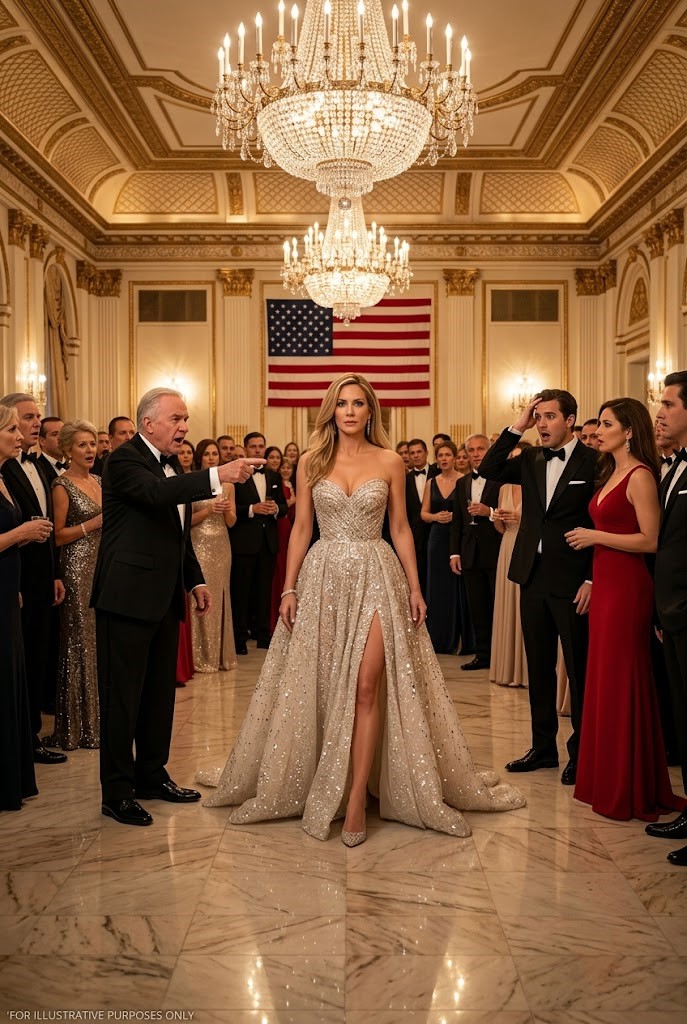
Crystal chandeliers blazed overhead. Champagne moved through the crowd on silver trays. A jazz band played near the far wall beneath an enormous American flag. The city skyline filled the windows, all steel and gold.
And there was Grant.
He stood near the center of the room with Marcus Sterling and three CEOs, laughing as if the universe had personally endorsed him. Stella Monroe stood beside him, her red dress impossible to miss, her fingers resting lightly on his sleeve.
The room noticed me before he did.
Conversations faded in layers.
First the women near the bar. Then the investors by the windows. Then the younger executives who recognized expensive danger when they saw it.
Grant finally turned.
I watched his face.
Confusion first.
Then shock.
Then anger.
He crossed the room fast, abandoning Stella mid-sentence. His smile stayed on because people were watching, but his eyes had gone hard.
“What the hell are you doing here?” he whispered.
I tilted my head. “Attending a gala.”
His hand closed around my wrist. Too tight. Just like always when he was afraid of losing control.
“Do you know what this event is?” he hissed. “Do you understand who these people are?”
“Do you?”
His grip tightened. “Don’t embarrass me. Go home. Now.”
“Home?” I looked around the ballroom. “You mean the place where I serve wine to your guests and disappear before dessert?”
His face darkened. “Evelyn.”
That name sounded wrong in his mouth tonight.
Before he could say more, Marcus Sterling arrived beside us, his face pale with panic.
“Ms. Whitaker,” he said, bowing slightly. “I had no idea you were coming personally. This is an honor.”
Grant froze.
His fingers loosened around my wrist.
He looked at Marcus. “What did you call her?”
Marcus swallowed.
Then he looked at Grant the way men look at someone standing too close to an open elevator shaft.
“Mr. Harlow,” he said carefully, “perhaps you and I should speak privately.”
“No,” Grant snapped. His eyes returned to me. “What is this?”
Stella had moved closer now, curiosity sharpening her pretty face. Patricia and Grant’s sister, Madison, stood near the buffet table, both staring. His father, Richard, looked confused and afraid.
I gently removed Grant’s hand from my wrist.
The skin beneath was red.
“You always hated it when I showed up unexpectedly,” I said. “But tonight, I thought I should finally meet the world you hid me from.”
“Ms. Whitaker?” Grant repeated, almost choking on it.
I turned away.
At the far end of the ballroom, two security guards stood near a private lounge screened by tall plants. Behind it sat the one man in America Grant should have feared more than any competitor.
My father.
I walked toward the lounge.
Grant followed two steps behind until security blocked him.
One guard saw the ring on my hand and immediately stepped aside.
Inside, Raymond Whitaker sat with three advisors, reviewing papers with a gold pen. His hair was whiter than I remembered. His shoulders were still broad, but time had carved deeper lines into his face.
He looked up.
The pen fell from his hand.
For ten years, I had imagined this moment. I had imagined anger. Judgment. Cold disappointment.
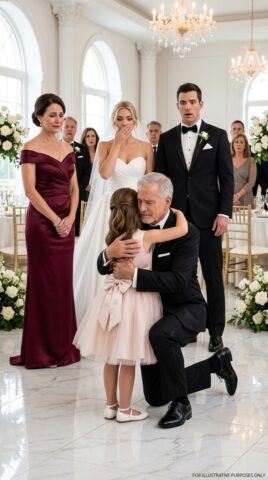
Instead, my father stood so quickly his chair scraped the floor.
“Evie?”
The word broke something in me.
Not Evelyn.
Not Mrs. Harlow.
Evie.
His little girl.
I walked to him.
For a second, neither of us moved. Then his arms came around me, fierce and shaking. He held me like he was afraid I would vanish again.
“My God,” he whispered. “My God, you came back.”
The ballroom had gone completely silent.
The screen did not hide us well enough. Everyone saw. Everyone heard.
Raymond Whitaker, billionaire titan, ruthless negotiator, man who once bought a company in the morning and fired its board by lunch, was crying into his daughter’s hair.
Behind me, I heard someone whisper, “That’s his daughter?”
Another voice answered, “Raymond Whitaker’s daughter disappeared ten years ago.”
A third voice said, “Wait. Harlow said she was his wife.”
The silence changed.
It became dangerous.
My father stepped back and saw my wrist.
The red marks.
His expression cooled so quickly the temperature in the lounge seemed to drop.
“Who did that?”
I said nothing.
He looked past me.
“Grant Harlow,” he called.
Grant stood in the ballroom like a man summoned to sentencing.
People parted for him.
He walked forward slowly, his confidence collapsing with every step. When he reached the lounge, he tried to smile.
“Mr. Whitaker—”
My father cut him off.
“No. You do not speak my name like we are equals.”
Grant’s mouth shut.
My father’s voice was quiet, but every word carried.
“For ten years, my daughter has lived in your house. Tell me, Mr. Harlow. Did you know who she was?”
Grant looked at me.
His eyes were pleading now.
I gave him nothing.
“I… she told me her family owned a small business.”
A few people gasped.
My father laughed once.
A sound with no humor in it.
“A small business,” he repeated. “Yes. That is one way to describe a global investment firm with holdings across five continents.”
Grant’s face turned gray.
Stella stepped back.
Patricia clutched Madison’s arm.
My father took a folder from his advisor and threw it onto the table.
“Three years ago, Sterling Capital nearly acquired your company. My daughter stopped it. Five years ago, Meridian chose you for a federal infrastructure contract. My daughter made the call. Your patent disputes, your emergency financing, your largest private clients—her fingerprints are on all of it.”
Grant stared at the folder.
His lips parted.
“You?”
I looked at him calmly.
“Yes.”
“You helped me?”
“No,” I said. “I saved you. There’s a difference.”
The room went still again.
Grant looked as if the floor had vanished beneath him.
I stepped closer, my voice low enough to hurt him and clear enough for everyone else.
“For ten years, you told people I was simple. For ten years, you left me at home because you said I would not fit in. You let your mother treat me like staff, your sister treat me like a nanny, and your guests mistake me for a housekeeper.”
His eyes reddened.
“Evelyn, I didn’t know.”
“That was the point,” I said. “You never cared enough to know.”
PART 3
Patricia Harlow tried to laugh.
It came out like a broken cough.
“Now, let’s not turn this into some public spectacle,” she said, stepping forward with the practiced smile of a woman who had insulted people at charity lunches for thirty years and called it honesty. “Families have misunderstandings. Evelyn never complained. She loved helping. Some women enjoy taking care of a home.”
My father turned his head slowly.
Patricia stopped smiling.
“Mrs. Harlow,” he said, “my daughter was raised in a home where she was never asked to wash a single dish unless she wanted to. She graduated from Wharton with honors. At twenty-three, she closed a deal your son would not have been allowed to observe from the hallway. And you believe she was born to scrape plates after your holiday dinners?”
Patricia’s face flushed.
“That is not fair. We didn’t know she was—”
“Rich?” I finished.
She swallowed.
I took two steps toward her.
“Finish the sentence, Patricia. You didn’t know I was rich, so you thought I was safe to disrespect.”
The ballroom absorbed the words like fire hitting paper.
Madison, Grant’s sister, lifted her chin.
“You’re twisting everything. You acted humble for ten years. What were we supposed to think?”
I looked at the diamond bracelet on her wrist.
“I bought that.”
Her eyes flicked down.
“No, Grant bought it.”
“Grant bought it with money from a bonus he received after Meridian signed. Meridian signed because I asked them to. So yes, Madison. I bought that.”
Color drained from her face.
I remembered every Saturday she had dropped her son at our house without asking. Every time she had said, “You don’t mind, right? You’re home anyway.” Every time she had criticized the food I cooked, the clothes I folded, the birthday gifts I chose for a child she barely wanted to raise.
“Do you remember last Thanksgiving?” I asked.
She said nothing.
“You arrived three hours late, handed me your son, and told me not to let him eat too much sugar. Then you sat at my table, drank my wine, complained the turkey was dry, and left before helping with a single plate.”
People began whispering again.
Madison’s eyes filled with tears—not remorse. Humiliation.
“Evelyn,” Grant said, voice hoarse. “Please.”
I turned to him.
“Please what? Stop telling the truth?”
He looked smaller than he had ten minutes earlier. That was the strange thing about public shame. It did not change a person’s height, but it revealed how little foundation they had beneath them.
Richard Harlow, Grant’s father, finally spoke.
His voice was soft. “Evelyn, we wronged you.”
That quiet sentence landed differently.
Richard had never defended me, but he had never mocked me either. In the Harlow house, cowardice had passed for kindness. Sometimes he had looked guilty when Patricia ordered me around. Sometimes he had said, “You should sit too,” after I had already served everyone else.
It was not enough.
But it was more than the others had offered.
I nodded once.
“You did,” I said. “But at least you know it.”
He lowered his head.
Grant’s breathing became uneven.
He stepped toward me, and the guards moved instantly. He stopped, hands raised.
“I made mistakes,” he said. “I know that. I should have brought you places. I should have stood up for you. But I never stopped loving you.”
Something in me went very still.
Love.
How easily men used that word when accountability stood too close.
“You loved having a wife at home,” I said. “You loved coming back to clean laundry, warm food, quiet rooms, and no questions. You loved that I never made you feel small.”
His face twisted.
“That’s not true.”
“Isn’t it?”
I moved to the table and opened the second folder Nora had brought. The one I had not planned to use unless he forced me.
He saw it and went rigid.
I removed the first page and laid it down.
“Four Seasons Chicago,” I said. “Penthouse suite. March fifteenth. Last year. Registered under your name and Stella Monroe’s.”
The ballroom exploded.
Stella’s face turned white beneath her makeup.
Grant staggered forward. “That is not what it looks like.”
“It rarely is.”
“She was delivering documents.”
“At midnight?”
“We had a crisis.”
“You deleted the messages.”
He froze.
I placed several printed screenshots beside the hotel record. Not explicit. Not enough to make tabloids call it an affair. But enough. Late-night jokes. Flirtation. Emotional dependence. Compliments he had stopped giving me years ago. Messages that began with business and ended with hearts disguised as gratitude.
Stella stepped forward, trembling.
“Nothing happened.”
I looked at her.
“I know.”
She blinked.
“That is why you are still standing here.”
The room went dead quiet.
I turned back to Grant.
“I believe you never touched her. I believe you never crossed the line you could not explain away to yourself. But do you know what I was doing on March fifteenth?”
His face crumpled.
“Our anniversary,” he whispered.
“Yes. I cooked dinner. I lit candles. I waited until two in the morning while you sat in a hotel room with a woman who made you feel admired.”
Tears gathered in his eyes.
“Evelyn—”
“No. You wanted to tell your story. Let me finish mine.”
My voice sharpened.
“You did not hide me because you were protecting me from this world. You hid me because this world was the only place you felt powerful. At home, I knew when your hands shook before board meetings. I knew when you were terrified. I knew every contract you almost lost. I knew the empire was not as steady as you pretended.”
He closed his eyes.
“So you kept me in the kitchen,” I said. “Because a woman holding a serving tray cannot outshine a man holding champagne.”
A sound moved through the crowd—shock, agreement, discomfort.
Marcus Sterling looked down at his shoes.
Stella began crying silently.
I felt nothing toward her. She was not the knife. She was just the reflection that showed me where the wound had been.
Grant wiped his face with one hand.
“I was wrong,” he said. “I was weak. I was proud. I hated feeling like I needed help. But I did love you. I still love you.”
I studied him.
For one moment, I saw the young man from our first apartment. The one who bought me soup when I worked late. The one who kissed my forehead and said he would build a life worthy of me.
He had existed once.
That was the cruelest part.
“I know,” I said softly.
Hope flickered in his eyes.
Then I killed it.
“But a little love cannot repay ten years of loneliness.”
PART 4
Grant cried in front of Chicago’s most powerful people.
Not dramatically at first. Not the way actors cry in movies, with perfect tears and trembling dignity. His face simply collapsed. His mouth tightened, his eyes filled, and then the tears spilled over as if his body had finally understood what his pride still could not accept.
“I can fix this,” he said. “Tell me what to do.”
I looked at him across the marble floor.
“There is nothing to fix.”
“No.” He shook his head. “Don’t say that. We built a life.”
“You built a reputation. I built the foundation under it.”
He flinched.
My father stood beside me, silent now. His rage had settled into something colder. That was more dangerous. Raymond Whitaker shouting was weather. Raymond Whitaker quiet was war.
Grant seemed to understand that.
“I’ll leave the company,” he said desperately. “I’ll give you the house. The accounts. Everything.”
“I don’t need your money.”
“Then what do you want?”
The question echoed.
For years, I had wanted such small things that I was ashamed to name them.
A saved seat at dinner.
A hand on my back in public.
A husband who remembered my birthday without his assistant reminding him.
A family who said thank you.
A marriage where I did not have to shrink to be loved.
“I wanted respect,” I said. “But you cannot give it to me now without fear attached.”
He pressed his palms together as if praying.
“Evie, please.”
The nickname struck the air.
My father’s eyes flashed.
“Do not call her that.”
Grant swallowed.
I lifted a hand slightly, stopping my father.
“It’s all right,” I said. Then to Grant, “You don’t get to use the name my family saved for me when you buried the woman who carried it.”
His face went pale again.
In the corner, Patricia began sobbing loudly enough for people to notice. Madison held her arm, whispering something, but her own face was ruined with mascara. Richard stood apart from them, staring at the floor like a man counting every moment he should have acted and did not.
Stella tried to slip away.
“Ms. Monroe,” my father said.
She stopped.
His voice cut cleanly across the room. “You will remain available for legal questioning regarding leaked proprietary information from Harlow Systems.”
Grant turned sharply. “What?”
I opened another file.
“Stella sent confidential product materials to Ardent Bridge six months before your patent challenge,” I said. “I knew. I contained it.”
Stella’s lips parted. “I didn’t—”
“Don’t,” I said. “You are still employed because I decided Grant’s company could not survive the scandal then. That protection ended tonight.”
Grant stared at Stella as if seeing her for the first time.
“You leaked our documents?”
She began shaking. “They pressured me. I didn’t think it mattered. The company was strong.”
“It was not strong,” I said. “I was strong.”
That sentence landed harder than I expected.
Not because it was cruel.
Because it was true.
For ten years, I had confused endurance with devotion. I had mistaken silence for grace. I had believed that if I loved enough, served enough, sacrificed enough, one day Grant would turn around and see me.
But love should not require a woman to vanish.
My father took my hand.
“Come home,” he said.
This time, it was not a question.
Grant stepped forward. “Evelyn, wait. Just tell me one thing. Were you ever happy with me?”
The ballroom held its breath.
I thought of our first apartment in San Diego before the company moved to Chicago. The tiny kitchen. The cheap scarf he bought from a street vendor. The way we ate pizza on the floor because we had no table yet. The night he stayed awake with me when I had the flu. The first year, maybe the second, when love had still been warm and human.
“Yes,” I said.
His face opened with desperate relief.
Then I finished.
“But those days are so far away now, I almost remember them as someone else’s life.”
The relief died.
I walked toward the exit.
The crowd parted.
No one stopped me. No one dared. Cameras lifted. Phones recorded. Tomorrow the headlines would feast, but tonight I moved through them untouched.
Behind me, Grant called my name once.
Then again.
By the time I reached the lobby, security was already struggling to hold back reporters. The glass doors flashed white every second from cameras outside. My driver stood by the curb. Three black cars waited beneath the American flags at the hotel entrance.
The manager rushed toward me. “Ms. Whitaker, we can take you through the private garage.”
“No,” I said. “The front door.”
I had spent ten years leaving rooms quietly.
Not tonight.
The doors opened. Cold air rushed over me. Reporters shouted questions.
“Ms. Whitaker, is Grant Harlow your husband?”
“Did Whitaker Global fund Harlow Systems?”
“Are you filing for divorce?”
I stopped at the top of the steps.
Grant burst out behind me, tie crooked, face wet, hair undone. Security blocked him, but the cameras caught everything.
“Evelyn!” he shouted. “Don’t leave like this!”
I turned.
The cameras swung between us.
He looked almost wild. “If you walk away now, don’t come back.”
A strange calm moved through me.
For years, that threat would have shattered me.
Now it freed me.
I looked at the man I had loved, the man I had served, the man who had hidden me because he could not survive being known beside me.
“I’m not coming back,” I said.
Then I walked down the steps.
My father was waiting inside the car. When I sat beside him, he did not ask if I was okay. He knew better. He simply took my hand.
“We’re going home,” he said.
The door closed.
Outside, Grant stood under the lights, surrounded by reporters, his face naked with loss.
As the car pulled away, I watched him grow smaller through the rear window. He stumbled down one step, then another. For one second, I thought he might run after us.
Instead, his knees gave out.
He collapsed on the hotel steps while cameras flashed around him like lightning.
I turned away.
For the first time in ten years, I did not ask myself whether I was cruel.
I asked myself why I had waited so long.
PART 5
By sunrise, my marriage was public property.
The first headline appeared at 5:42 a.m.
Hidden Wife Revealed as Whitaker Heiress at Chicago Gala
By seven, every business outlet in America had a version of it. Some called me the missing heiress. Some called Grant the fool of the decade. One particularly vicious headline asked how a man could marry a billionaire’s daughter and still make her serve dinner.
I did not read most of them.
I was in my old office.
Top floor, Whitaker Tower, downtown Chicago. Floor-to-ceiling windows. Lake Michigan silver in the distance. My father had kept the office untouched for ten years. The desk was polished. The shelves were dust-free. Even the framed photo from my first acquisition still stood beside the lamp.
I touched the frame.
In it, I was twenty-three, wearing a white suit and a dangerous smile. I barely recognized the girl.
My father stood in the doorway.
“I had them clean it every Monday,” he said. “Your mother said it was foolish.”
“It was.”
“Yes,” he said. “But I am a foolish man when it comes to my daughter.”
I looked away quickly.
Grief was strange. It did not arrive only for death. It came for wasted years, for former selves, for the woman I might have been if I had not confused surrender with love.
Nora entered with a stack of documents.
“Divorce petition. Share transfer draft. IP withdrawal notice. Board package for Harlow Systems.”
My father looked at me. “You do not have to handle this today.”
“Yes,” I said. “I do.”
By nine, Grant’s lawyers had received the petition.
By ten, Whitaker Global announced the termination of strategic support for Harlow Systems.
By noon, the stock began falling.
Grant called me seventeen times before lunch.
I blocked him after the third.
At two, he came to Whitaker Tower.
Security called up.
“Ms. Whitaker, Mr. Harlow is in the lobby.”
I looked down through the glass.
He stood near the security desk in yesterday’s suit, or one just as wrinkled. His face looked carved out. He held flowers. Red roses.
I almost laughed.
Ten years of marriage, and he had chosen roses on the day it no longer mattered.
“Send him away,” I said.
“He says he won’t leave.”
“Then let him learn waiting.”
He waited six hours.
I did not go down.
That evening, I returned not to the Chicago mansion but to my father’s estate outside Lake Forest. My childhood bedroom had been redecorated but not erased. There were fresh flowers on the desk. My mother’s old cashmere throw lay folded at the foot of the bed. She had died three years into my marriage. I had attended the funeral alone because Grant had been closing a deal in Washington, D.C.
I sat on the bed and finally cried.
Not beautifully.
Not silently.
I cried like a woman whose body had been holding a decade of swallowed screams.
My father sat outside the door all night.
I knew because, at dawn, when I opened it, he was asleep in a chair in the hallway.
The next week was war.
Harlow Systems lost two major clients. Marcus Sterling withdrew a credit line. Meridian suspended renewal talks. A leaked report revealed my 34 percent stake in the company, purchased quietly through a Whitaker subsidiary years earlier.
Grant’s board panicked.
He tried to fight.
For three days, he gave interviews claiming the divorce was private, that he respected me, that the company was stable. But investors had seen him collapse on hotel steps. They had heard my father. They had read enough.
Power has a scent.
So does weakness.
On the fourth day, the board removed him as CEO.
The vote was not close.
Patricia called me that night from a number I did not recognize.
I answered only because I was tired.
“Evelyn,” she said, voice trembling. “Please. This has gone far enough.”
I said nothing.
“Grant made mistakes, but destroying him? Destroying the family? Is that what you want?”
I looked at the city lights outside my office.
“No,” I said. “I wanted a clean plate at Thanksgiving.”
She inhaled sharply.
“I wanted one person to save me a chair. I wanted my husband to introduce me by name. I wanted your daughter to pick up her own child. I wanted you to stop looking at me like I was lucky to serve you.”
Silence.
Then she began crying.
“I didn’t know.”
“You knew enough.”
I hung up.
Grant appeared again two weeks later, this time in the underground garage of Whitaker Tower.
Security caught him near my car.
He looked thinner. His beard was unshaven. The arrogance that used to sit on his shoulders like a tailored jacket was gone.
“Five minutes,” he begged.
I should have kept walking.
Instead, I stopped.
“Five,” I said.
He took a breath like a drowning man.
“I lost the company.”
“I know.”
“My mother is in the hospital.”
“I know.”
“Madison sold her jewelry. Dad won’t speak to me.”
“I know.”
He looked at me, pain twisting his face.
“Do you feel nothing?”
I considered lying.
“No,” I said. “I feel many things. But none of them are reasons to return.”
He gripped the concrete pillar beside him.
“I was stupid. I was proud. I let everyone treat you like you were beneath us because I thought you were mine no matter what. I thought marriage meant you would stay.”
“That is not marriage,” I said. “That is ownership.”
He closed his eyes.
When he opened them, tears were there again.
“Tell me what to do.”
“For what?”
“For forgiveness.”
The garage hummed with fluorescent light.
I looked at the man who had once been my future and now stood like a ruined monument to every warning I had ignored.
“There is nothing you can do,” I said. “Some doors do not close because someone is angry. They close because the person who kept them open is gone.”
He shook his head.
“You’re still here.”
“No,” I said softly. “I’m not.”
Then I got into the car.
As we drove away, he chased us for several steps before security stopped him.
In the side mirror, I saw him sink to the concrete floor.
This time, I did not cry.
PART 6
Six months later, Harlow Systems no longer existed.
Whitaker Global acquired what remained of it for less than half its former value. The patents returned fully to my control. The useful engineers were offered new positions. The board was dissolved. The name was retired.
I signed the final acquisition papers in a white suit.
Not because I wanted drama.
Because I remembered the photograph in my safe, the young woman at twenty-three who believed she could conquer the world. I wore white for her.
Nora placed the last document in front of me.
“There is one more request,” she said.
I did not look up. “From Grant?”
“Yes.”
“No.”
“He says it concerns the divorce hearing.”
I signed my name. “My attorney can handle it.”
The divorce was finalized in Washington, D.C., in a quiet courtroom with wood benches and bad lighting.
Grant looked better than the last time I had seen him, though not whole. He wore a dark suit without the old shine. His hair was trimmed. His face was thinner. When I entered, he stood.
I did not sit beside him.
Our lawyers spoke. Assets were divided cleanly. I kept what was mine. He kept enough to live, not enough to pretend. The judge asked whether reconciliation was possible.
Grant looked at me.
I answered first.
“No, Your Honor.”
His eyes lowered.
Afterward, in the hallway, he approached slowly.
My father’s security moved, but I raised a hand.
Grant stopped a few feet away.
“I’m not here to beg,” he said.
“That would be new.”
He almost smiled. It vanished quickly.
“I sold the house.”
I nodded.
“I found your apron in the pantry.” His voice cracked. “The beige one. With the burn mark.”
I remembered it.
Thanksgiving. Hot pan. No one noticed.
“I threw it away,” he said. “Then I took it out of the trash. I don’t know why.”
“Because guilt is sentimental.”
He flinched, but accepted it.
“I started therapy.”
“That’s good.”
“I visited my mother. She wanted me to ask if you would ever forgive her.”
“What did you tell her?”
“That she should ask God. You were busy.”
This time, I did smile faintly.
He looked at me as if that tiny smile hurt more than anger.
“Evelyn,” he said, “I know I lost you. I know that. I’m not asking you to come back. I just wanted to say one thing without cameras, without lawyers, without everyone watching.”
I waited.
“You were the best thing that ever happened to me,” he said. “And I treated you like background noise. I will regret that for the rest of my life.”
For the first time, his apology did not feel like a rope thrown at me, asking me to pull him from consequence. It felt like a stone placed properly on a grave.
I nodded.
“I hope you become better,” I said.
His eyes filled.
“For someone else?”
“For yourself.”
I turned to leave.
“Evie,” he said.
I stopped, but did not turn.
“I’m sorry I made your home feel like a place you had to escape.”
That one reached me.
I closed my eyes for a second.
Then I walked away.
Outside the courthouse, spring had softened Washington. The cherry trees were blooming, pale pink against the hard lines of government buildings. My father waited by the car, pretending not to watch the door too closely.
When he saw me, he straightened.
“Well?”
“It’s done.”
He opened his arms.
I stepped into them.
For years, I had thought returning home meant defeat. I had thought leaving a marriage meant admitting I had failed.
But standing there in the sunlight, I understood something simple and brutal.
Some endings are not failures.
Some endings are rescues.
A year later, I stood on a stage in San Diego, facing an auditorium full of women entrepreneurs. Behind me, a massive screen read:
THE WHITAKER WOMEN’S FUND — FOUNDERS SUMMIT
I had launched the fund with my own capital, separate from my father’s empire. It supported women who had given up careers for families, women returning after divorce, widows, mothers, women told they were too late to begin again.
The first speaker was a fifty-year-old former nurse building a medical logistics startup.
The second was a mother of three who had invented a child safety device.
The third was me.
I walked to the podium in a navy suit, the onyx ring on my hand.
The room quieted.
“I disappeared for ten years,” I began. “Not because I lacked ambition. Not because I lacked ability. But because I believed love required me to become smaller.”
No one moved.
“I was wrong.”
A woman in the front row wiped her eyes.
“Love should make room for you. It should not ask you to live in the basement of someone else’s dream.”
Applause rose slowly, then thundered.
In that sound, I felt the last chain break.
That evening, I returned to my hotel room overlooking the Pacific. The sunset turned the water gold. My phone buzzed with a message from an unknown number.
For one second, my body remembered old fear.
Then I opened it.
I watched your speech. You looked happy. I’m glad. — Grant
No apology.
No plea.
No hook.
Just a sentence.
I set the phone down and looked at the ocean.
Was I happy?
Not every day.
Healing was not a movie montage. Some mornings I still woke expecting to hear Patricia calling my name from the kitchen. Some nights I dreamed of the Chicago house and woke furious at myself for missing anything about it.
But there were good days now.
Many of them.
Days when I entered rooms through the front door. Days when people saved me a seat. Days when I ate dinner while it was hot. Days when my father called just to ask whether I had slept. Days when I looked in the mirror and recognized the woman looking back.
I typed only two words.
I am.
Then I blocked the number.
Not out of hatred.
Out of peace.
PART 7
Three years after the gala, Whitaker Tower hosted its annual founders dinner in Chicago.
This time, I was not a hidden wife with a tray.
I was the host.
The ballroom glittered with chandeliers, white roses, and polished silver. American flags stood near the stage. Investors, founders, governors, reporters, and CEOs filled the room. My father sat at the front table, older now, but smiling more easily than he had in years.
Before dinner, I stood alone near the windows, looking down at the city.
Chicago had once felt like a cage.
Now it looked like a map.
Nora approached quietly. “There’s someone at the public barricade outside asking to leave a note.”
I did not turn.
“Grant?”
“Yes.”
The name no longer struck like thunder.
It was only weather far away.
“What kind of note?”
“A short one. Security checked it.”
She handed me a cream envelope.
For a moment, I simply held it.
Then I opened it.
Evelyn,
I’m leaving Chicago tomorrow. I accepted a teaching position at a small business college in Oregon. I don’t know if I’ll be good at it, but I know I have more to learn than to teach.
I wanted to say goodbye properly. Not to reopen anything. Not to ask for anything. Just goodbye.
You once told me adults pay for their choices. You were right. I am still paying. I hope someday that payment becomes growth instead of punishment.
You deserved to be seen. I’m sorry I was too small to see you.
Grant
I folded the note.
Outside, beyond the glass, police barricades held back photographers and onlookers. Near the curb stood a man in a dark coat. Smaller than memory. He was not trying to enter. Not shouting. Not begging. Just standing there beneath the streetlights, looking up at a building he no longer had any claim to.
For a second, our eyes might have met through the glass.
Or maybe I imagined it.
I raised my hand.
Not a wave of invitation.
A farewell.
He stood still.
Then he nodded once, turned, and walked into the Chicago night.
Nora watched me carefully.
“Are you all right?”
“Yes,” I said.
And I was.
Not because the past had vanished.
Because it had finally taken its proper place behind me.
The dinner began at eight.
I walked onto the stage under warm lights. The room rose in applause. My father stood too, clapping slowly, pride shining in his eyes.
I waited until the room settled.
“Three years ago,” I said, “I entered a ballroom like this one as a woman no one expected to matter.”
A ripple moved through the audience. Everyone knew the story. America loved a scandal, but it loved a comeback more.
“That night, many people called me ruthless. Some called me brave. Some called me cold. The truth is simpler. I was tired.”
Soft laughter. Knowing laughter.
“I was tired of being grateful for crumbs. Tired of being called humble by people who benefited from my silence. Tired of confusing endurance with love.”
My father’s eyes shone.
“So tonight, this fund is not about revenge. It is not about proving men wrong or families wrong or society wrong. It is about reminding every woman in this room that disappearing is not the price of devotion.”
Applause rose again.
I lifted my hand.
“Build your companies. Love your families. Choose your partners. Make sacrifices if you wish. But never sacrifice the part of you that knows your own name.”
The applause thundered this time.
At the end of the evening, after the guests left and the staff began clearing tables, I walked through the ballroom alone.
A young server hurried toward me with a tray of untouched desserts.
“Ms. Whitaker, would you like me to take these back to the kitchen?”
I looked at the tray.
Chocolate cake. Lemon tart. Strawberry mousse.
For no reason at all, I thought of all the cold leftovers I had eaten standing beside a sink.
“No,” I said. “Set them down.”
The server blinked.
I smiled. “And bring a chair for yourself.”
She looked startled. “For me?”
“Yes. You’ve been on your feet all night.”
Soon, three servers were sitting at a round table with plates of dessert, laughing nervously at first, then freely. I sat with them for ten minutes, eating cake while the chandeliers dimmed.
My father found me there.
His eyebrows lifted. “Starting a revolution with pastry?”
“Maybe.”
He sat beside me with a groan. “Good. I like cake revolutions.”
We laughed.
Later, as we left, he offered me his arm.
The night air outside was cold and clean. Cameras waited across the street, but they no longer frightened me. I had learned that being seen could be dangerous, but invisibility was worse.
At the curb, my car waited.
My father looked at me. “Home?”
I glanced up at Whitaker Tower, its glass face reflecting the stars and city lights. I thought of the mansion I had left, the safe in the closet, the ring, the girl in the photograph, the woman in the gown, the wife with the tray, the daughter returning, the leader reborn.
Then I looked at my own reflection in the car window.
Clear-eyed.
Unhidden.
Whole.
“Yes,” I said. “Home.”
But this time, I did not mean a house.
I meant myself.