PART 2 — THE BREAKING POINT
The locksmith arrived before sunset.
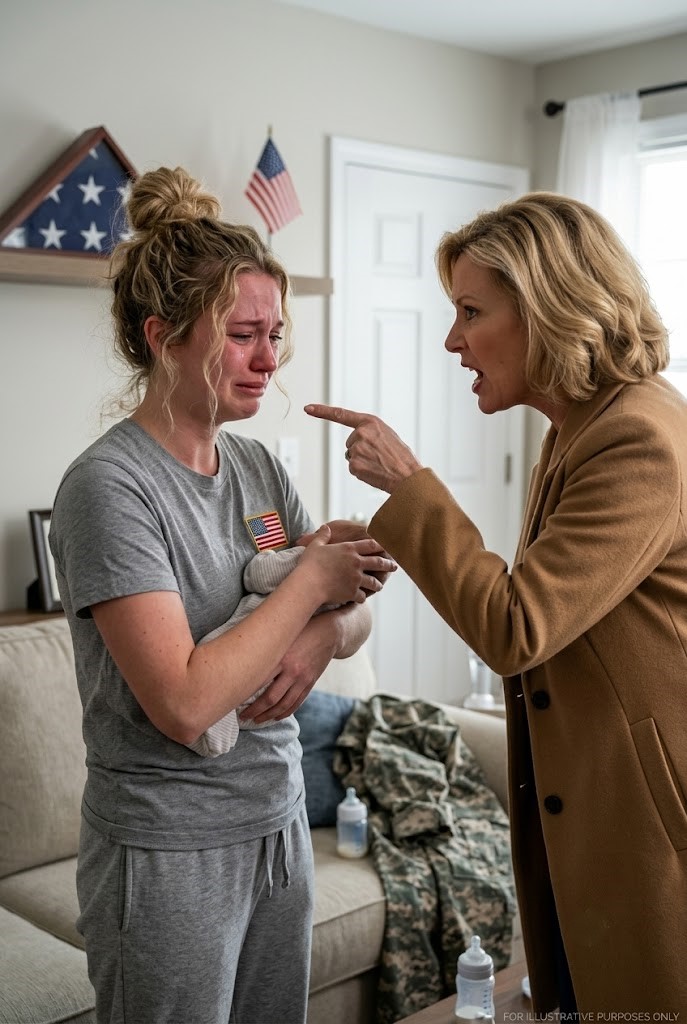
Avery stood barefoot in the doorway while he replaced the front and back locks, his tool bag open beside him, Lily sleeping against her shoulder in a soft white blanket. The man worked quietly, glancing once at Avery’s tired face but asking no questions. Maybe military housing had taught him that some doors needed changing because of storms, and some because of people.
When he handed her the new keys, Avery stared at them in her palm like they were something sacred.
Four pieces of metal.
That was all it took to keep her mother out.
That thought nearly made her laugh, and nearly made her cry.
For the next week, Diane and Brooke escalated.
They called from blocked numbers. They sent emails. They commented under old social media photos. Brooke posted vague accusations online about “people who get a little rank and suddenly forget where they came from.” Diane wrote long paragraphs about sacrifice, family loyalty, and how motherhood should have made Avery more compassionate, not less.
Avery read every word.
She saved every screenshot.
She did not answer.
Her silence seemed to drive them insane.
By the tenth day after Lily’s birth, Avery’s body began to betray her. It started with a headache sharp enough to make her grip the kitchen counter. Then came the dizziness. The room tilted, corrected itself, and tilted again. Her heart hammered so hard she could hear it in her ears.
Lily was sleeping in the bassinet near the window.
Avery tried to take one step toward her and nearly collapsed.
She called her neighbor, Marissa Cole, another military wife from three houses down. Marissa arrived in less than three minutes, took one look at Avery’s gray face, and said, “We’re going to the ER.”
At the hospital, the nurses moved fast.
Blood pressure cuff. Monitor. Questions. Medication.
Avery lay in the bed under white lights, shivering despite the blanket. The doctor told her the words “postpartum hypertension” and “stress response” and “dangerous spike.” Avery heard them as if from underwater.
Stress.
That word felt too small for what Diane and Brooke had done to her. Stress was a crowded grocery store. Stress was a missed deadline. Stress was traffic on Interstate 5.
This was siege warfare.
When Ethan finally called, Avery tried to keep her voice steady.
“I’m okay,” she lied.
“No, you’re not,” he said immediately.
He asked for the blood pressure reading. Asked for the doctor’s name. Asked what medication they had given her. His voice stayed calm, but Avery knew him well enough to hear the steel underneath.
Six hours later, he was pushing emergency leave through his command.
By the next afternoon, he walked into her hospital room wearing travel-creased clothes and a face full of controlled fury.
Avery expected him to ask what happened.
Instead, he kissed her forehead, kissed Lily’s tiny hand, and held out his palm.
“Phone,” he said.
Avery handed it over.
For almost an hour, Ethan sat in the chair beside her bed and read through every message Diane and Brooke had sent since Lily’s birth. He did not interrupt. He did not curse. He did not make the mistake of telling Avery she should have blocked them sooner.
His silence became colder with every screenshot.
At last, he looked up.
“This ends today.”
Avery swallowed. “They’re my family.”
“No,” Ethan said. “They’re people using the word family to rob you.”
The truth hit harder because he said it gently.
That evening, Ethan built a file. Not a messy emotional collection, but a timeline. Dates. Times. Screenshots. Records of calls. The demand for $2,000 sent less than an hour after Lily was born. Diane entering the home without permission. The threat about Ethan not being able to protect Avery forever.
He contacted the military legal assistance office the next morning. He spoke to base security. He made sure Diane’s spare key no longer mattered and that nobody outside their household had permission to enter.
Then he drafted one message for Avery to send.
Avery read it twice before pressing send.
“Due to my current medical condition and the continued harassment after I gave birth, I will not be responding to financial demands, insults, threats, or unannounced visits. Do not come to my home again. Any further harassment will be documented and handled through legal channels.”
Diane called twelve times in thirty minutes.
Ethan silenced the phone and placed it facedown on the table.
“You don’t have to bleed just because they keep cutting,” he said.
For three days, there was quiet.
Then Brooke sent a message that made Avery’s stomach twist.
“Fine. Keep hiding behind your husband. But Grandma knows things about Dad that you wouldn’t want coming out. Maybe ask her why Mom had to raise us the way she did.”
Avery stared at the words until they blurred.
Her father, Thomas Whitaker, had died when she was sixteen. Diane had always spoken about him in fragments: noble when she wanted sympathy, irresponsible when she wanted obedience, mysterious when she wanted control. Avery had spent years afraid of some unnamed truth hiding behind his memory.
Ethan saw her face change.
“What is it?”
She showed him.
He read it and exhaled through his nose. “That’s bait.”
“What if it’s true?”
“Then we ask someone who doesn’t profit from keeping you scared.”
So Avery called her grandmother.
Margaret Whitaker lived in a brick ranch house outside Richmond, Virginia, surrounded by rose bushes and framed photographs of dead relatives. She had never been cruel to Avery, but Diane had always kept their relationship thin, controlled, carefully supervised.
When Margaret answered, Avery almost lost her nerve.
“Grandma,” she said, “I need to ask you something about Dad.”
There was a pause.
Then Margaret’s voice softened. “I wondered when you finally would.”
Avery told her about Brooke’s message. About Diane. About the money. About the delivery room and the $2,000 demand.
For a while, Margaret said nothing.
Then she sighed.
“Oh, honey,” she said. “There is no dark secret about your father. The secret is that your mother learned a long time ago that guilt works better when people think there’s something they don’t know.”
Avery closed her eyes.
Margaret continued, her voice trembling now with anger. “Your father was not perfect. None of us are. But he loved you. He tried to put money aside for your education before he died. Diane used most of it paying Brooke’s bills.”
Avery opened her eyes.
“What?”
“She told herself it was for the family,” Margaret said. “But I think she knew exactly what she was doing. She kept you responsible because she had already spent what was meant to help you leave.”
The room seemed to shrink around Avery.
All those years. All those emergencies. All those speeches about sacrifice.
It had started before Avery even had a paycheck.
Her mother had not merely leaned on her.
She had been training her.
PART 3 — THE FAMILY MEETING
Avery did not confront Diane immediately.
That surprised everyone, including herself.
The old Avery would have called in tears. She would have demanded explanations, then apologized for demanding them. She would have gotten dragged into a three-hour argument that ended with Diane crying, Brooke yelling, and Avery somehow promising to help “just one more time.”
The new Avery waited.
Her body was still healing. Lily still needed feeding every two hours. Ethan was home only temporarily, and Avery refused to spend those precious days handing her peace back to the people who had stolen enough of it already.
Instead, she gathered facts.
Margaret mailed copies of old documents: a small life insurance payout, a savings account meant for Avery’s college expenses, withdrawals made months after Thomas died, and handwritten notes showing Diane’s excuses. Brooke’s rent. Brooke’s car. Brooke’s overdue utilities. Brooke’s “temporary crisis.”
Temporary had lasted fifteen years.
Ethan spread the papers across their dining table one night after Lily finally fell asleep.
Avery stood over them, feeling strangely detached, as if she were looking at evidence from someone else’s life.
“I thought I became the family bank when I joined the military,” she said quietly.
Ethan shook his head. “They opened the account before you even knew.”
The sentence should have broken her.
Instead, it hardened something necessary.
A week later, Margaret invited Diane and Brooke to her home in Richmond. She did not say Avery would be there. She only said the family needed to talk.
Avery almost stayed behind.
Then she looked at Lily sleeping in her car seat, tiny mouth open, fists tucked beside her cheeks, and understood that courage was not a feeling. It was a decision made while afraid.
They drove east through desert light, airport terminals, and finally the green roads of Virginia. Ethan carried the document folder. Avery carried Lily.
Margaret’s house smelled like coffee, lemon polish, and old wood. Family photographs lined the hallway. There was Thomas in a faded baseball cap. Avery at age nine holding a softball glove. Brooke in high school, smiling like trouble had not yet become a lifestyle. Diane standing beside them, beautiful and sharp-eyed.
When Diane arrived, she stopped cold in the doorway.
Brooke nearly bumped into her back.
Avery sat on the couch with Lily in her arms. Ethan stood near the fireplace. Margaret sat in her chair by the window like a judge who had grown tired of pretending she was only a grandmother.
Diane recovered first.
“So this is an ambush.”
“No,” Margaret said. “An ambush is what you did to your daughter one week after childbirth.”
Diane’s mouth tightened. “You don’t know the whole story.”
“I know enough,” Margaret replied.
Brooke crossed her arms. “Is this about the phones? Seriously? All this drama because I asked for help?”
Avery looked at her sister. Brooke’s hair was perfect, her nails fresh, her expression wounded in the practiced way of someone who had used injury as a weapon for years.
“You didn’t ask for help,” Avery said. “Mom demanded money from me while I was still in the hospital bed after giving birth.”
Brooke rolled her eyes. “You always make everything sound worse.”
Ethan took one step forward.
“Careful,” he said.
The room went still.
He did not shout. He did not threaten. That made it worse for Brooke. She looked away first.
Margaret lifted the folder from the side table and placed it in her lap.
“Before anyone says another word about family obligation,” she said, “we’re going to talk about Thomas.”
Diane’s face changed.
It was quick, but Avery saw it. Fear. Not grief. Not surprise.
Fear.
Margaret opened the folder.
“Thomas left money for Avery,” she said. “Not a fortune, but enough to help her after high school. Diane drained it. Most of it went to Brooke.”
Brooke’s mouth opened. “I didn’t know that.”
Diane snapped, “Mother, stop.”
“No,” Margaret said. “I should have stopped you years ago.”
Diane stood rigid in the center of the room. “I was a widow with two daughters.”
“You were a widow with one daughter you protected and one daughter you trained to pay for the protection.”
The words landed like a slap.
Avery felt Lily stir in her arms. She looked down, brushed one finger over her daughter’s cheek, and did not cry.
Diane turned to Avery. “You have no idea what it was like.”
“You’re right,” Avery said. “I don’t. But I know what it’s like to give birth alone and get a bill from my mother before I get a congratulations.”
Diane flinched.
For the first time in Avery’s life, her mother looked smaller.
Brooke sat down hard in the nearest chair. “Mom, is it true?”
Diane said nothing.
That silence did what years of arguments could not.
It convicted her.
Avery stood carefully, Lily tucked against her chest.
“I am done funding this family,” she said. “Not because I hate you. Not because Ethan controls me. Not because the military changed me. I am done because my daughter will never watch me confuse exploitation with love.”
Diane’s eyes filled with tears, but Avery no longer trusted tears as proof of anything.
“You would cut off your own mother?” Diane whispered.
“No,” Avery said. “You cut yourself off every time you chose my money over my well-being.”
Brooke looked down at her hands. Her voice, when it came, was quiet.
“I didn’t know about Dad’s money.”
Avery believed her.
That almost hurt more.
“Now you do,” Avery said.
She turned to Margaret. “Thank you.”
Margaret nodded, tears shining in her eyes.
Then Avery walked out of the house with Ethan beside her, Lily asleep against her heart, and the past finally burning behind her.
PART 4 — THE PRICE OF PEACE
Freedom did not arrive like fireworks.
It arrived like silence.
At first, the silence frightened Avery. She had grown so used to her phone vibrating with crises that quiet felt suspicious, almost cruel. She checked the screen too often, expecting another message, another accusation, another emergency involving Brooke’s children, Diane’s pride, or some bill that had magically become Avery’s responsibility.
But the messages slowed.
Then they stopped.
Ethan’s leave ended after three weeks. The morning he had to report back, Avery stood with him near the front door, Lily asleep in a sling against her chest. The house was still. Sunlight poured through the blinds in pale gold stripes.
“I hate leaving you,” Ethan said.
Avery reached for his hand. “I’m not alone the same way anymore.”
He studied her face. “Call me if they start again.”
“I will.”
“And call legal.”
“I will.”
“And call Marissa.”
Avery smiled for the first time that morning. “Yes, Staff Sergeant Dad.”
He laughed softly, then looked at Lily with such tenderness that Avery’s chest tightened.
“I missed the first fight,” he said. “I won’t miss the rest.”
After he left, Avery expected grief to swallow the house. It did not. She cried, yes. She was exhausted, yes. But beneath the sadness was something stronger.
Ownership.
This was her life now. Not Diane’s. Not Brooke’s. Not a family committee’s. Hers.
The official transfer orders came two months later. Ethan had been reassigned to a joint logistics post near Washington, D.C., and Avery’s command approved her transition to a support role in Northern Virginia while she recovered fully and adjusted to motherhood.
Diane found out through a cousin.
Her message came at 6:12 p.m.
“You’re really moving across the country without telling me?”
Avery stared at it for a long time.
Then she typed back:
“Yes.”
No explanation.
No apology.
No paragraph defending her right to exist.
Just yes.
Diane did not reply.
The move was chaotic, expensive, and strangely beautiful. Boxes filled the rooms. Lily outgrew her newborn clothes. Ethan labeled everything with military precision. Avery laughed when he marked one box “KITCHEN — PROBABLY IMPORTANT” and another “BABY STUFF — DO NOT LOSE UNLESS YOU WANT DIVORCE.”
Their new home in Alexandria, Virginia, was smaller than the California house but warmer somehow. The neighborhood had sidewalks shaded by old trees, brick townhomes with black shutters, and neighbors who waved without demanding anything.
In the first week, Avery woke at 3 a.m. to feed Lily and realized she was not afraid of her own phone anymore.
That was when she cried.
Not from pain.
From relief.
Three months after the move, Brooke called.
Avery almost let it go to voicemail. Then she answered, partly because curiosity was human and partly because boundaries did not require fear.
Brooke’s voice sounded different.
No drama.
No sharpness.
Just tired.
“I started working full-time,” Brooke said.
Avery said nothing.
“I know that doesn’t fix anything.”
“No, it doesn’t.”
“I also talked to Grandma.”
Avery closed her eyes.
Brooke inhaled shakily. “I didn’t know Mom used Dad’s money for me. I swear I didn’t. But I did know I was leaning on you. I knew it was easier to ask than to figure my life out.”
Avery shifted Lily against her shoulder.
“I’m sorry,” Brooke said. “Not because I want money. I know that’s over. I’m sorry because I treated you like you were built to catch me.”
The apology was imperfect.
It did not erase anything.
But it was the first thing Brooke had said in years that sounded like it cost her pride instead of Avery’s peace.
“Thank you for saying that,” Avery replied. “But I need you to understand the boundary is permanent.”
“I know.”
“No money. No guilt messages. No using your kids as emotional hostages.”
Brooke was quiet. “I know.”
Avery did not forgive her that day. Forgiveness, she had learned, was not a door people got to kick open because they finally knocked politely. But she did allow the conversation to end without hatred.
Diane took longer.
Winter arrived in Virginia with silver skies and brittle air. Lily learned to roll over on a quilt in the living room. Ethan hung a tiny American flag beside the front porch for Veterans Day. Avery returned to work part-time and discovered that she could command a room full of soldiers more easily than she had once commanded her own mother to leave.
Then Diane called.
Avery let it ring twice before answering.
“Hi, Mom.”
On the other end, Diane breathed in.
“I’m in therapy,” she said.
Avery leaned against the kitchen counter.
“That’s good.”
“I know I hurt you.”
Avery waited.
“I know I used you,” Diane continued, her voice thin. “I told myself it was family. I told myself you were stronger than Brooke, so you could handle more. But I think I made you strong because I needed someone to carry what I refused to face.”
Avery closed her eyes.
An apology from Diane had once been the thing she wanted most in the world.
Now it felt smaller than she expected.
Not meaningless.
Just not enough to rebuild a house that had burned down years ago.
“I appreciate you saying that,” Avery said. “But the rules don’t change.”
“I know.”
“No money.”
“I know.”
“No unannounced visits.”
“I know.”
“No threats. No guilt. No dragging Lily into anything.”
Diane’s voice broke. “I know.”
Avery looked into the living room where Lily was asleep in her swing, tiny hands curled near her face.
“I hope therapy helps you,” Avery said. “But I’m not going back to who I was.”
For the first time, Diane did not argue.
PART 5 — WHAT LILY WOULD NEVER LEARN
By spring, Lily had learned to laugh.
It was a bright, startled sound, as if joy kept surprising her. She laughed at Ethan’s terrible animal noises. She laughed when Avery kissed her feet. She laughed at sunlight moving across the ceiling and at the dog next door barking like he had urgent military orders.
Avery sometimes watched her daughter and felt grief rise unexpectedly.
Not for the present.
For the girl she used to be.
The child who thought love had to be earned by being useful. The teenager who missed her father and accepted her mother’s anger as weather. The young woman who gave away deployment bonuses, savings, sleep, dignity, and still wondered why nobody seemed satisfied.
Lily would not learn that.
Not in Avery’s house.
The first true test came at Thanksgiving.
Margaret invited everyone to Richmond. Avery nearly declined, but Ethan reminded her that boundaries could travel with them. They were not fragile things that only worked at home.
So they went.
Margaret’s dining room glowed with candlelight and the smell of turkey, sweet potatoes, and fresh rolls. Thomas’s photograph sat on the mantel. Lily wore a dark green dress and drooled on Ethan’s shoulder. Brooke arrived with her children, who ran straight to the baby with loud, delighted curiosity.
Diane arrived last.
For a brief second, the old tension entered the room with her.
Avery felt it touch her spine.
Then Diane stopped near the doorway and looked at Avery.
“May I hold Lily?” she asked.
The word “may” changed everything.
Avery studied her mother’s face. There was longing there, and shame, and maybe love. Real love. Complicated love. Love that had arrived late and damaged, but perhaps not dead.
“Not yet,” Avery said gently.
Diane’s eyes filled, but she nodded. “Okay.”
No argument.
No scene.
No punishment.
Just okay.
Dinner was not perfect. Brooke’s youngest spilled cranberry sauce. Ethan made Margaret laugh so hard she nearly dropped her fork. Diane was quiet, sometimes painfully so. But nobody asked Avery for money. Nobody called her selfish. Nobody used the word family like a hand around her throat.
After dinner, Avery stepped onto the back porch with Lily in her arms. The Virginia air was cold and clean. Bare branches scratched softly against the evening sky.
Margaret joined her, carrying two mugs of coffee.
“You did what your father always hoped you would,” Margaret said.
Avery looked at her. “What’s that?”
“You got free.”
Avery looked down at Lily. Her daughter’s eyes were wide open, reflecting porch light and stars.
“I used to think getting free meant losing everyone,” Avery said.
“Sometimes it does,” Margaret replied. “But sometimes it only means everyone has to meet the real you.”
Inside, through the window, Avery saw Diane helping Brooke’s oldest child with a puzzle. Brooke was washing dishes without being asked. Ethan was making Lily’s bottle with the intense focus of a man disarming a bomb.
It was not a fairy tale.
It was something better.
It was real.
Years later, when Lily was old enough to ask why they had rules about money, visits, and respect, Avery told her the truth in simple words.
“Love should never require you to disappear.”
Lily frowned, serious even at six years old. “Did someone ask you to disappear?”
Avery smiled sadly. “They didn’t use those words. But yes.”
“What did you do?”
Avery looked across the living room of their Alexandria home, at the framed photograph of Ethan holding newborn Lily, at the small flag on the mantel, at the ordinary evidence of a life that belonged to them.
“I learned how to say no.”
Lily considered that.
Then she nodded solemnly. “No is a whole sentence.”
Avery laughed, pulling her daughter into a hug. “Exactly.”
Peace, Avery discovered, was not dramatic once you had it. It was school mornings and grocery lists. It was Ethan singing off-key while making pancakes. It was Lily leaving crayons on the floor. It was a phone buzzing without making Avery’s stomach turn. It was a locked door, not because she lived in fear, but because she finally understood that access was a privilege, not a birthright.
Diane never became the mother Avery had once needed. Brooke never became the sister Avery had imagined. Some wounds healed into scars, and scars did not vanish just because people learned to behave better.
But Avery stopped measuring healing by how much she could forgive.
She measured it by what Lily would never inherit.
Lily would never believe she existed to rescue adults from their own choices.
She would never watch her mother answer cruelty with cash.
She would never hear a grandmother scream in the living room while a newborn cried.
She would never confuse guilt with loyalty.
And she would never, ever be taught that love was a debt.
On Lily’s seventh birthday, Diane sent a card. No money request. No guilt. No performance. Just a simple handwritten message.
“Happy birthday, Lily. You are loved.”
Avery read it twice.
Then she placed it on the mantel beside the family photos.
Not because everything was fixed.
Because everything was finally honest.
That evening, after the party ended and the house grew quiet, Avery stood on the porch while Ethan cleaned the kitchen and Lily slept upstairs surrounded by stuffed animals and wrapping paper.
A warm wind moved through the trees.
Avery thought of the hospital room in San Diego. The storm. The empty chair. The tiny baby on her chest. The phone lighting up with a demand instead of love.
She had once believed that moment was the loneliest of her life.
Now she understood it differently.
It was the moment her daughter arrived.
And it was the moment Avery finally began leaving behind everyone who believed she had been born to serve them.
She did not lose her family.
She ended the version of family that required her suffering.
And in the quiet that followed, she built something stronger.
A home.
A boundary.
A life.