
PART 2
The showroom looked less like a real estate office and more like a private club for people who believed consequences were for everyone else.
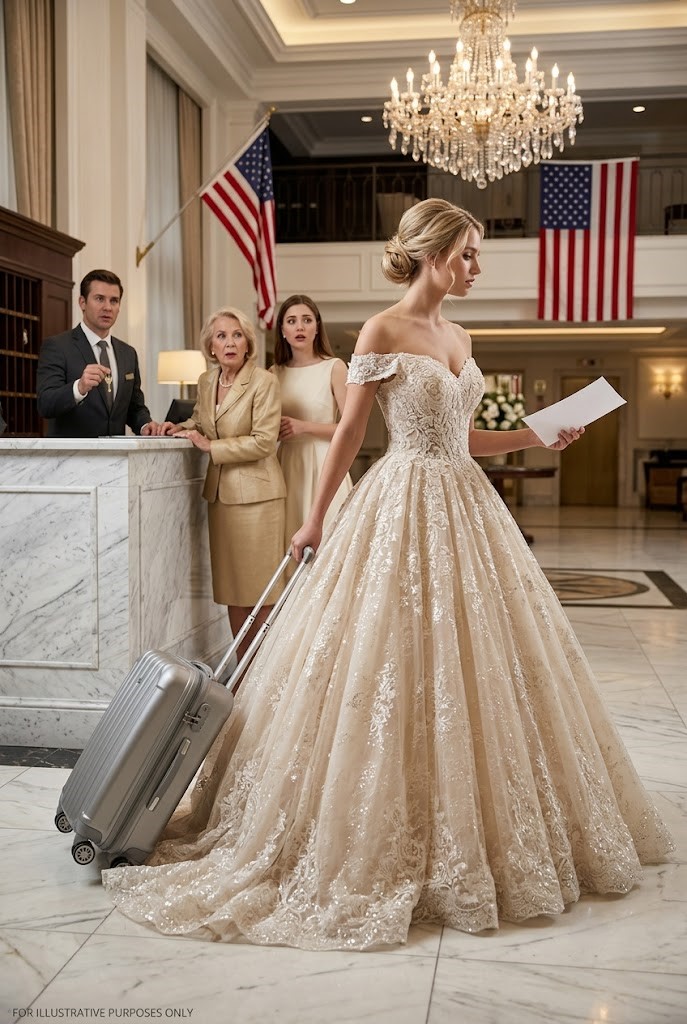
Glass walls. White marble floors. Soft gold lighting. A grand model of the condominium tower stood in the center of the room, lit from beneath like a shrine. Beyond the windows, Lake Michigan glittered gray-blue under a hard Chicago sky.
I arrived five minutes after them.
That was intentional.
I wanted Vivian to feel rich first.
I wanted Savannah to picture her closets, her balcony, her Sunday brunches with stolen money.
I wanted Grant to pull out his wallet with confidence.
The receptionist smiled when I walked in. “Do you have an appointment?”
“No,” I said, removing my sunglasses. “I’m just waiting for someone.”
She gestured toward the lounge.
I chose a seat behind a tall arrangement of white orchids. From there, I could see the closing table clearly without being seen unless someone looked carefully.
Vivian stood near the model tower with one hand on Savannah’s shoulder, presenting her like an award. Savannah wore a pale pink dress and a diamond bracelet I recognized immediately.
Grant had bought it three months earlier.
He told me it was for a client appreciation event.
Savannah laughed at something Vivian said, then leaned into Grant. “I still can’t believe this is happening.”
Grant smiled, but his smile was tight. He kept checking his phone.
Vivian noticed and slapped his arm lightly. “Stop looking nervous. You’re a divorced man now. Act like it.”
A salesman in a gray suit approached them with a leather folder. “Mr. Whitmore, Mrs. Whitmore, Miss Pierce, we have the purchase agreement ready. As discussed, the residence is listed at one point five million dollars. We can process the deposit today and prepare the wire instructions for the balance.”
Vivian waved her hand. “No need to drag it out. My son can handle it now.”
The salesman’s smile widened. “Of course.”
Grant cleared his throat. “We’ll start with the card.”
I placed my purse on the floor and rested both hands on my knees.
This was the moment.
Grant pulled out his black credit card with the little performance he always used in restaurants, the subtle flick of the wrist, the pause long enough for people to notice.
Savannah watched him like he was a prince.
Vivian watched the salesman.
I watched the machine.
The card slid in.
A beep sounded.
The salesman’s smile flickered.
He looked down, tapped the screen, then tried again.
Another beep.
This one colder.
“I’m sorry, sir,” he said carefully. “It looks like this card was declined.”
For three full seconds, nobody moved.
Then Vivian laughed.
Not because it was funny.
Because her mind refused to accept it.
“That’s impossible,” she said. “Run it again.”
Grant’s hand twitched. “It’s probably your system.”
“Of course,” the salesman said quickly.
He ran it again.
Declined.
Savannah’s smile fell apart.
Grant pulled out another card. Then another. Then another.
By the fifth card, two other sales associates had stopped pretending not to listen.
By the seventh, Vivian’s cheeks were red.
By the eighth, the salesman’s face had gone stiff with professional panic.
“I apologize, Mr. Whitmore,” he said, lowering his voice, though not enough. “All eight cards are showing as frozen.”
“Frozen?” Vivian exploded. “Frozen by whom?”
Grant stared at his phone.
I knew what he was seeing.
The bank alert.
The court notice.
The message from Marcus Reed, my attorney, informing him that all accounts tied to Bennett Whitmore Consulting were under temporary protection pending investigation of unauthorized withdrawals.
He had thought I would be too wounded to act.
He had thought divorce meant he could walk away with the money.
He had forgotten one thing.
I had built the company’s financial system.
I knew every password, every account, every shell transfer he had tried to hide beneath vendor payments and consulting fees.
I stood.
My heels clicked against the marble as I crossed the showroom.
Grant saw me first.
His face drained of blood so quickly I thought he might collapse.
“Claire,” he said. “What are you doing here?”
Vivian turned. When she saw me, her eyes narrowed into slits. “Did you follow us? How pathetic can you be?”
I stopped beside the closing table.
Savannah shrank backward, suddenly very interested in the floor.
“I came to congratulate the happy family,” I said. “But it seems there’s a payment issue.”
Vivian pointed at me. “You did this.”
“Yes,” I said.
The room went silent.
Grant whispered, “Claire, don’t.”
I looked at him. Really looked at him. The man I had loved. The man I had defended. The man whose dreams I had treated like sacred things until he used them to bury me.
“Don’t what?” I asked. “Don’t tell your mother that the money she bragged about belongs to a company I co-founded? Don’t tell Savannah that the penthouse was being purchased with funds removed without authorization? Don’t tell this showroom that the generous divorced man at their table is currently under a court-ordered asset freeze?”
Vivian’s mouth opened, then closed.
The salesman took one step backward.
Savannah’s eyes filled with tears. “Grant?”
Grant rubbed both hands over his face. “This is a misunderstanding.”
“No,” I said. “A misunderstanding is when someone forgets a dinner reservation. This is fraud.”
Vivian snapped, “How dare you accuse my son of fraud?”
I turned to her.
For five years, I had lowered my voice around Vivian. I had let her insults pass over me because arguing felt undignified. I had smiled through Thanksgiving dinners where she praised every woman in the room except me. I had let her call me barren, cold, masculine, ambitious, unfeminine.
But there, under the gold showroom lights, I no longer felt small.
“Your son removed company funds to finance his affair,” I said. “Your son used accounts that required my consent. Your son thought divorce would make me disappear before I noticed. Unfortunately for him, I noticed everything.”
Grant’s voice cracked. “Claire, we can talk.”
“We did talk,” I said. “For months. You lied every time.”
Savannah wiped her cheek with the back of her hand. “I didn’t know.”
I looked at the bracelet on her wrist.
“You knew enough.”
She pulled her hand behind her back.
Vivian’s voice trembled now, not with sorrow but rage. “You vindictive little snake.”
I smiled faintly. “No, Vivian. A snake strikes without warning. I gave your family five years.”
The manager arrived, summoned by the salesman’s silent distress. He listened, checked his tablet, and then turned to Grant.
“Mr. Whitmore, we cannot proceed with this transaction.”
Vivian grabbed her purse. “We don’t want your cheap little apartment anyway.”
The salesman blinked at the $1.5 million model behind her.
Grant did not move.
He was still staring at me.
“Claire,” he said softly, “please.”
That word.
Please.
I had begged him once.
Please come home.
Please tell me the truth.
Please stop letting your mother talk to me like that.
Please don’t make me feel crazy.
He had given me silence.
So I gave him the same.
I turned and walked back toward the door.
Behind me, Vivian’s voice cracked like breaking glass.
“Grant, fix this!”
But there are some things no man can fix with a credit card.
PART 3
By the time I stepped outside, Chicago had turned colder.
Wind rushed off the lake and slipped under my collar. I stood beneath the awning of the showroom while taxis rolled by and wealthy couples passed with shopping bags in their hands. Somewhere behind me, inside all that marble and gold, Vivian was probably still shouting.
My phone buzzed.
Nora: Marcus says the freeze is fully active. Business accounts, personal cards tied to company credit, pending transfers. All locked.
I read the message twice.
Then I exhaled.
Not a victorious breath.
A surviving one.
For years, I had confused endurance with love. I thought if I could just hold on through the hard seasons, Grant would remember who we had been before his mother’s voice became louder than mine, before Savannah’s perfume entered our marriage, before money made him reckless.
But standing outside that showroom, I understood something simple and brutal.
Some people do not change because you love them better.
They change only when consequences finally arrive.
I took a cab home to my apartment in Lincoln Park. Not the house Grant and I had shared in Hinsdale. Not the house with the white kitchen I designed and the garden I planted. That house was part of the settlement, part of the negotiation, part of the past.
My apartment was smaller, quieter, and mine.
I had barely set my purse down when my phone rang.
Grant.
I watched his name flash on the screen until it almost stopped. Then I answered.
“Claire,” he said, breathless. “Where are you?”
“Home.”
“We need to talk.”
“No, we don’t.”
“Yes, we do,” he said quickly. “My mother is losing her mind. Savannah left crying. The bank won’t explain anything to me beyond legal language. Marcus won’t take my call. What did you do?”
“What you forced me to do.”
There was a pause.
“Claire, I know this looks bad.”
“It is bad.”
“I was going to replace the money.”
I almost laughed. “With what?”
Silence.
“You moved nearly half a million dollars through fake vendor payments,” I said. “You opened a business credit line without telling me. You used company funds for hotels, jewelry, private dinners, and a down payment on a home for your mistress. You signed my initials on two internal approval forms. Did you think I wouldn’t recognize my own initials forged badly?”
His breathing grew ragged.
“I panicked,” he said. “I didn’t mean for it to go that far.”
“That is what people always say when the truth catches them.”
Then his voice changed. Softer. Familiar. Dangerous.
“Claire, we were married. Doesn’t that mean anything?”
I closed my eyes.
There it was.
The hook.
The old Grant knew exactly where to press. He knew I remembered our first office, a rented room over a print shop in Evanston. He knew I remembered eating takeout noodles at midnight while building pitch decks. He knew I remembered him holding my face after our first major contract and saying, “We did it.”
But the old Grant was gone, or maybe he had never existed the way I thought.
“Our marriage meant everything to me,” I said. “That’s why I protected it for too long.”
“Then don’t destroy me.”
“You destroyed yourself.”
He made a sound like a wounded animal. “My mother could lose her house.”
“Your mother bragged about spending stolen money ten minutes after my divorce.”
“She didn’t know.”
“She didn’t care.”
Another silence.
Then Grant said, “What do you want?”
I opened my eyes.
That was the question, wasn’t it?
For years, I had wanted love, respect, truth, loyalty. Now all those wants had burned down to something cleaner.
“I want my legal share restored,” I said. “I want the company protected. I want your name removed from operations. And I want you to stop calling me unless it goes through attorneys.”
“Claire—”
I hung up.
My hand trembled afterward. Not because I regretted it, but because boundaries are heavy the first time you carry them.
That evening, Nora came over with tomato soup, sourdough bread, and a bottle of red wine she insisted we would open only if I actually ate dinner.
She found me sitting on the floor beside a stack of company files.
“Oh, honey,” she said.
“I’m fine.”
“No one sitting on the floor with legal folders is fine.”
I gave a weak laugh, and then the tears came.
Not dramatic tears. Not cinematic tears. Just exhausted ones. Nora sat beside me and let me cry without interrupting.
When I finally spoke, my voice sounded small.
“I don’t feel happy.”
“Of course you don’t.”
“I thought I would.”
“You exposed him,” Nora said gently. “That doesn’t erase loving him.”
I wiped my face. “What if this makes me cruel?”
Nora looked at me with the fierce tenderness only an old friend can have.
“Claire, cruelty is what they did when they thought you had no power. What you did today was protection.”
I wanted to believe her.
So I tried.
The next morning, Vivian came to my building.
The doorman called first, his tone uncertain. “Miss Bennett, there’s a woman named Vivian Whitmore here asking to see you.”
I almost said no.
Then I remembered every Thanksgiving table, every sharp comment, every time she had smiled while making me bleed.
“Send her up,” I said.
Vivian looked different without an audience.
Her hair was still styled, but not perfectly. Her lipstick had bled into the lines around her mouth. Her eyes were red, not from humility, I suspected, but from rage and lack of sleep.
She stepped into my apartment and looked around as if the size of it confirmed something she had always believed about me.
“I won’t stay long,” she said.
“Good.”
Her mouth tightened. “You have made your point.”
“No,” I said. “The law has.”
She inhaled sharply. “Grant is my son.”
“And I am someone’s daughter.”
That stopped her.
For the first time in five years, Vivian Whitmore had no immediate insult ready.
I continued, “You came to my home because your son is scared. Did you ever come when I was scared? Did you ever ask why I looked tired? Did you ever wonder why the company survived every crisis while Grant took the credit?”
Vivian looked away.
I opened the door.
“We’re done.”
She stood frozen in the hallway, and for one strange second, she looked old.
Then she whispered, “You were never right for him.”
I nodded.
“You’re right,” I said. “I was too good for him.”
And I closed the door.
PART 4
The bank meeting happened on a Thursday afternoon in a conference room with gray carpet, fluorescent lights, and coffee that tasted like burned paper.
I arrived with Marcus Reed, my attorney, a calm man with silver glasses and a voice that never rose because it never needed to. Grant arrived ten minutes late. His suit was wrinkled, his eyes shadowed, his hair messy in a way that no longer looked charming.
He sat across from me and did not say hello.
A senior fraud officer from the bank opened the meeting with a stack of documents.
“Mr. Whitmore,” she said, “we are here to review a series of transactions connected to Bennett Whitmore Consulting and several personal credit accounts secured by company assets.”
Grant stared at the table.
The presentation began.
Line after line appeared on the screen.
$12,600 at a jewelry store on Oak Street.
$18,400 at a resort in Scottsdale.
$43,000 transferred to a vendor that did not exist.
$75,000 marked as “strategic consulting,” then routed to an account connected to Savannah Pierce.
With each number, the room seemed to shrink.
I listened without moving. My hands were folded in my lap. Beneath the table, my fingers pressed so tightly together that my knuckles ached.
Marcus leaned toward me once and whispered, “You’re doing fine.”
Fine.
What a strange word for watching your marriage become evidence.
Grant finally spoke when the forged authorization forms appeared.
“I didn’t forge her signature.”
The fraud officer looked at him over her glasses. “These are initials, Mr. Whitmore.”
“I had verbal approval.”
I turned to him. “You did not.”
His face flushed. “Claire, don’t do this.”
“Don’t tell the truth?”
His eyes flashed. For one second, I saw the old arrogance rise. The part of him that believed emotion could bend facts.
Then Marcus spoke.
“Mr. Whitmore, my client will not be intimidated during this meeting.”
Grant sank back in his chair.
The bank officer continued. “Given the documentation, temporary restrictions will remain in place. Further review may result in civil recovery actions and referral to authorities.”
Grant’s lips parted.
Authorities.
That word landed harder than any insult I could have thrown.
Vivian had raised him to fear embarrassment more than wrongdoing. Jail, charges, public records, business reputation—those were the things that made men like Grant suddenly discover remorse.
When the meeting ended, I stood quickly.
Grant followed me into the hallway.
“Claire.”
I kept walking.
“Claire, please.”
I stopped near the elevators.
He stood a few feet away, shoulders slumped.
“I’m not asking you to forget what happened,” he said. “I’m asking for time.”
“You had time.”
“I can pay it back.”
“You should.”
“I might lose everything.”
I looked at him then.
Really looked.
And I felt something unexpected.
Not love.
Not hatred.
Pity.
It was a terrible thing to feel for someone you once admired.
“You already lost the things that mattered,” I said. “You just didn’t notice because the accounts still had money in them.”
The elevator doors opened.
I stepped inside.
Grant whispered, “I’m sorry.”
The doors began to close.
This time, I answered.
“I know.”
And then he disappeared behind steel.
That weekend, I drove to my parents’ house in Oak Park.
It was not large. It did not have a gated driveway or a wine cellar or a dining room Vivian would approve of. But the porch light was on, and my mother had made roast chicken, and my father opened the door before I knocked because he had been watching for my car.
“Hi, sweetheart,” he said.
Two words, and I nearly broke.
At dinner, no one mentioned Grant unless I did. My mother asked if I wanted more potatoes. My father talked about the Cubs as if baseball could gently remind a person that life continued in ordinary innings.
After dessert, my mother found me standing in the kitchen, washing dishes I did not need to wash.
“Claire,” she said softly. “Come here.”
I turned, and she pulled me into her arms.
I was thirty-four years old, a business owner, a divorced woman with lawyers and frozen accounts and a spine I had only recently learned to use. But in my mother’s kitchen, I was also someone’s child.
“I thought I was being strong,” I whispered.
“You are.”
“Then why does it hurt?”
“Because strength doesn’t mean you stopped loving. It means you stopped letting love be used against you.”
I held onto her until the tears passed.
Before I left, my father walked me to the car.
“I heard some things,” he said.
“From who?”
“Chicago is big, but business circles are small.”
I sighed. “Then you know it’s ugly.”
He nodded. “Ugly things still have to be handled cleanly.”
“I’m trying.”
“I know.” He put his hand on my shoulder. “Just don’t let revenge become your new marriage.”
That sentence stayed with me on the drive home.
The city lights blurred along the Eisenhower Expressway. I thought about Vivian’s face at my door, Grant’s voice in the hallway, Savannah’s tears in the showroom.
Revenge would have been easy to feed.
But I did not want to build my next life out of their ruins.
I wanted my money back.
I wanted my company safe.
I wanted peace.
The next morning, a text came from an unknown number.
Miss Bennett, this is Savannah. I know I have no right to ask, but may I speak with you? I need to apologize.
I stared at it for a long time.
Then I typed:
10 a.m. Tomorrow. The café on Wells Street. Twenty minutes.
Because sometimes closure wears the face of someone you never wanted to meet.
PART 5
Savannah looked smaller without Vivian beside her.
She was already seated when I arrived at the café, both hands wrapped around a paper cup she had not touched. Her blonde hair was pulled into a low ponytail. She wore no diamonds, no pink dress, no victorious smile. Just a gray sweater and the hollow expression of someone realizing the fairytale had been financed with someone else’s suffering.
I sat across from her.
She stood halfway, awkward and nervous. “Thank you for coming.”
“You have twenty minutes.”
She nodded quickly. “I understand.”
For a moment, she only stared at the table.
Then she said, “When I met Grant, he told me you were separated.”
I said nothing.
“He said the marriage was over emotionally. He said you were cold. He said you cared more about the company than him.”
Of course he had.
Men like Grant rarely cheat by admitting they are betraying a good woman. They write themselves a sad little story first. Then they cast the wife as the villain so the mistress can feel like rescue instead of theft.
Savannah swallowed. “By the time I knew the truth, I was already involved. That doesn’t excuse it.”
“No,” I said. “It doesn’t.”
Her eyes filled. “Vivian told me you were cruel to him. That you controlled all the money. That you were trying to ruin his life.”
“And did you believe her?”
Savannah looked down. “I wanted to.”
That was the first honest thing she had said.
I leaned back.
“Why are you here?”
She wiped beneath one eye. “Because yesterday, Grant asked me to sign a statement saying I didn’t receive any money from him. But I did. He sent me rent. He bought things. He put money toward a condo deposit under my cousin’s LLC. I didn’t understand how serious it was until the bank called.”
My body went still.
“Did you sign anything?”
“No.”
“Good.”
She pushed a folder across the table.
Inside were copies of transfers, messages, receipts. Evidence Grant had tried to route money through her while pretending it was business-related.
“I’m giving you this,” she said. “Not because I’m good. I know I’m not. But I’m done being used.”
For the first time, I saw her not as the woman who stole my husband, but as another woman who had believed his lies because believing them felt better than standing alone.
That did not make her innocent.
But it made her human.
I took the folder.
“Leave him,” I said.
“I am.”
“Not dramatically. Not to punish him. Leave quietly and rebuild whatever part of yourself let you accept this.”
Her lips trembled. “Do you hate me?”
I thought about it.
“I did,” I said. “But hatred is expensive, and I’m done spending money on Grant Whitmore.”
A broken laugh escaped her.
I stood. “Your apology doesn’t erase what you did. But your honesty today matters.”
She nodded through tears. “I’m sorry, Claire.”
“I believe you.”
That was all I gave her.
It was more than she deserved.
It was also enough.
With Savannah’s folder, Marcus moved faster. The legal case sharpened. The bank’s investigation expanded. Grant’s access to company operations was suspended pending settlement. Vendors were notified. Passwords changed. Internal controls rebuilt.
For the first time in years, Bennett Whitmore Consulting began to feel like mine again.
My senior manager, Daniel Price, stepped into the chaos with a steadiness I had not expected. He was forty-five, practical, blunt, and allergic to drama.
One afternoon, he entered my office with three binders and said, “I found four contracts Grant neglected, two clients he offended, and one department that may start applauding if you fire him officially.”
I laughed for the first time in days.
Daniel smiled. “There she is.”
“Who?”
“The woman who used to terrify vendors into meeting deadlines with nothing but polite emails.”
I touched the edge of a binder. “I missed her.”
“She’s still here.”
He was right.
Piece by piece, I returned.
Not to who I had been before Grant.
To who I had been beneath him.
Vivian, meanwhile, began unraveling in public.
She called Marcus’s office six times in one day. She appeared at the bank demanding “family consideration.” She tried to convince one of Grant’s cousins to lend him money, then accused the cousin’s wife of poisoning the family when they refused.
Two weeks after the showroom disaster, Vivian listed her Lake Forest house.
Nora sent me the listing with no comment.
I stared at the photos.
The white kitchen. The formal staircase. The patio where Vivian had once told me, in front of guests, that ambitious women often made poor mothers.
Now the house was staged with fresh flowers and soft lighting, presented as a dream home.
Dreams, I had learned, could be foreclosed on too.
One evening, Vivian was waiting outside my office building.
No Mercedes. No driver. No diamond confidence.
Just Vivian in a beige coat, standing near the revolving doors as office workers rushed around her.
“Claire,” she said.
I stopped. “What do you want?”
Her throat moved. “To apologize.”
The city seemed to quiet around us.
“I was wrong about you,” she said. “I thought you were beneath us. I told myself Grant was the brilliant one because he was my son. But you were the one holding everything together.”
I did not help her.
I did not soften.
But I listened.
“I don’t expect forgiveness,” she continued. “I just wanted to say it before everything gets worse.”
“Why?”
“Because I have spent my whole life protecting Grant from consequences,” she whispered. “And now I think I helped make him into a man who could do this.”
There it was.
The truth.
Late, damaged, but real.
I looked at her tired face and felt the last sharp edge of my anger loosen.
“I don’t hate you, Vivian,” I said. “But I will never carry your family again.”
She nodded. Tears slipped down her cheeks.
“I know.”
Then she walked away into the Chicago evening, looking less like a queen losing her throne and more like a mother finally seeing the wreckage of her love.
PART 6
The final settlement meeting took place three months after the divorce.
By then, winter had arrived in Chicago. Snow lined the curbs in dirty ridges, and the river moved dark and slow between the buildings. I wore a charcoal coat, black gloves, and no jewelry except my mother’s small silver necklace.
Grant was already in the conference room when I arrived.
He looked thinner. Older. His hair had grown out at the sides, and his suit hung loose on his shoulders. He stood when I entered, then seemed unsure whether to speak.
I sat across from him.
Marcus sat beside me. Grant’s attorney, a sharp woman named Elise Porter, opened her folder and began.
The terms were clear.
Grant would repay the misappropriated funds through a structured settlement backed by the sale of his personal assets and Vivian’s private loan. His ownership stake in the company would be transferred to me at a reduced valuation offset by the debt. He would resign from all management duties immediately. If he missed payments, the civil case could proceed and criminal referrals would remain available.
It was not mercy.
It was not destruction.
It was a clean line.
Grant signed slowly.
When it was my turn, my hand did not tremble.
Claire Bennett.
The name looked strong in black ink.
When the lawyers stepped out to copy documents, Grant and I were alone for the first time since the courthouse.
He stared at the table.
“I’m leaving Chicago,” he said.
I felt no surprise. “Where?”
“North Carolina. My uncle has a small development firm. He said I can work there if I keep my head down.”
“That’s generous.”
“I know.”
Silence stretched between us.
Then he said, “Savannah left.”
“I know.”
“Of course you do.” He gave a faint, humorless smile. “You always knew more than I thought.”
I did not answer.
His face tightened. “I told myself you didn’t see me anymore. That you only cared about the business. That Mom was right and you made me feel small.”
I looked at him. “Did I?”
“No,” he said. His voice broke slightly. “I made myself feel small. Then I punished you for it.”
It was the closest thing to truth he had ever given me.
“I loved you,” I said.
His eyes reddened.
“I know.”
“That was not permission to destroy me.”
A tear slipped down his cheek. He wiped it quickly, embarrassed.
“I’m sorry, Claire.”
This time, the words did not feel like a hook. They felt like a stone set down at the end of a road.
“I believe you’re sorry now,” I said. “But sorry after consequences is not the same as character before them.”
He nodded.
The lawyers returned. The copies were distributed. The meeting ended.
Grant stood.
For a moment, I thought he might offer his hand.
He did not.
Good.
Some endings do not need gestures.
We walked out of the building together but turned in opposite directions on the sidewalk. Snow began to fall, light and scattered, disappearing on my coat as soon as it landed.
I did not look back.
That spring, I renamed the company Bennett Strategic Group.
The first day the new sign went up, the entire office gathered in the lobby. Daniel brought terrible grocery-store champagne. Nora came with flowers. My parents drove in and stood near the back, my mother crying before anyone even gave a speech.
I looked at the polished letters on the wall.
Bennett Strategic Group.
No Whitmore.
No ghost.
Just my name.
Daniel raised his plastic cup. “To Claire, who saved us from chaos, fraud, and Grant’s motivational Monday emails.”
Everyone laughed.
I laughed too.
And it felt real.
The company recovered faster than anyone expected. Clients who had been uneasy returned when they saw the new controls. Staff who had been quiet under Grant began bringing ideas directly to me. We hired a young finance director who built safeguards so tight even Marcus joked he would trust us with his retirement.
But success did not heal everything.
Some nights, I still woke reaching for a person who was no longer there.
Some mornings, I would smell coffee and remember Grant in our first office, smiling at me over a laptop. Grief is strange that way. It does not obey evidence. It mourns the version of someone you lost before you knew they were gone.
I let those memories come.
Then I let them leave.
Vivian wrote me one letter.
It arrived in a cream envelope, handwritten.
Claire,
I sold the house. Grant has left Illinois. I am moving into a smaller place near my sister. I know I do not deserve your kindness, and I am not asking for it. I only want you to know that I understand now. You were not the burden in our family. You were the backbone. I am sorry for every cruel word. I hope the life ahead of you is quieter than the one we gave you.
Vivian
I read it twice.
Then I placed it in a drawer.
I did not write back.
Forgiveness, I realized, did not always require access.
That summer, Nora convinced me to attend a fundraiser for women rebuilding after divorce. I went reluctantly, expecting polite speeches and overcooked salmon.
Instead, I met women with stories that sounded different from mine but carried the same bruised center. Hidden accounts. Emotional manipulation. Custody threats. Families who chose appearances over truth.
A woman named Elise—not Grant’s attorney, another Elise—stood at the microphone and said, “Financial abuse is often invisible until the woman tries to leave.”
Something in me shifted.
After the event, I called Marcus.
“I want to start something,” I said.
He chuckled. “That sentence has historically been expensive.”
“I’m serious.”
“I know. That’s why I’m worried.”
But within months, the Bennett Foundation for Financial Freedom opened its first workshop in a community center on the South Side.
We taught women how to read accounts, protect credit, understand business ownership, document suspicious transfers, and leave dangerous situations with information instead of panic.
I did not tell my story at first.
I only organized.
Then one evening, a woman with shaking hands asked, “How do you stop feeling stupid for trusting him?”
The room went quiet.
I looked at her and saw myself on the courthouse steps, holding warm paper with a frozen heart.
“You stop,” I said, “by understanding that trust is not stupidity. Betrayal is the failure. Not love.”
PART 7
A year after my divorce, I returned to the Daley Center.
Not for court.
For a meeting with a city program that wanted to partner with the foundation.
It was a bright October morning, almost exactly like the day Vivian had stepped out of the Mercedes and tried to reduce my life to an insult. The same courthouse doors turned. The same traffic moved along Washington Street. The same wind cut between the buildings.
But I was not the same woman.
After the meeting, I stood on the courthouse steps for a moment.
No divorce decree in my hand.
No husband beside me.
No mother-in-law spitting judgment into the air.
Just me.
My phone buzzed.
A message from Daniel: The San Diego contract came through. Biggest one yet. Try not to conquer California before lunch.
I smiled.
Then another message appeared.
Unknown number.
For a second, my stomach tightened.
I opened it.
Claire, this is Grant. I heard about your foundation. Uncle Lou sent me an article. I just wanted to say I’m glad you built something good out of what I broke. I’m not asking you to respond. I hope you’re well.
I stared at the message.
A year earlier, it might have pulled me into a spiral.
Now it was just words on a screen.
I typed nothing.
I deleted nothing.
I slipped the phone into my coat pocket and walked down the steps.
That evening, the foundation held its anniversary gathering in a restored brick hall overlooking the river. My parents sat at the front. Nora stood near the dessert table, pretending not to cry. Daniel and half the office had shown up, including the finance director who brought spreadsheets to a party because she thought they were “on theme.”
When it was time for me to speak, I walked to the microphone.
Rows of women looked back at me.
Some were newly divorced. Some were still deciding whether to leave. Some had left years ago but still carried the fear in their shoulders. I knew that fear. I knew its weight, its whisper, its habit of making every door feel locked.
I took a breath.
“One year ago,” I began, “I stood outside a courthouse ten minutes after my divorce, watching the people who had hurt me celebrate as if my life had been nothing more than an inconvenience.”
The room was silent.
“My ex-husband, his mother, and the woman he planned to marry went to buy a luxury home with money that had come from a company I helped build. They believed I would be too ashamed, too heartbroken, or too polite to stop them.”
I looked at my mother. She nodded through tears.
“They were wrong.”
A soft ripple moved through the room.
“But this foundation was not built because I wanted revenge. Revenge is too small for what women deserve after betrayal. We deserve knowledge. We deserve safety. We deserve legal protection. We deserve friends who answer the phone. We deserve bank accounts we understand and names on documents we can read without fear.”
Nora wiped her face openly now.
I smiled at her.
“For a long time, I thought peace would come when the people who hurt me admitted what they had done. But peace came later, when I stopped waiting for their confession to validate my pain.”
I paused.
“If you remember one thing tonight, remember this: enduring mistreatment is not proof of loyalty. Losing yourself is not the price of love. And walking away is not failure when staying means disappearing.”
When I finished, the room stood.
The applause rose slowly, then filled the hall.
I did not feel triumphant.
I felt rooted.
Afterward, a young woman approached me near the windows. She could not have been more than twenty-six. Her eyes were red, but determined.
“My husband says I’ll never survive without him,” she said.
I looked at the city lights reflected in the river, then back at her.
“What do you say?”
She swallowed. “I don’t know yet.”
“That’s okay,” I said. “We’ll help you find out.”
Later that night, after everyone left, I walked home instead of calling a car. Chicago was crisp and alive around me. Restaurants glowed. Buses sighed at curbs. Somewhere, music spilled out of a bar and vanished into the wind.
My apartment was quiet when I entered.
Not lonely.
Quiet.
There is a difference.
I made tea, changed into soft clothes, and opened the journal I had started during the divorce. The early pages were full of pain, questions, disbelief. Why wasn’t I enough? How did I miss it? What will happen to me now?
I turned to a blank page.
For a long time, I simply held the pen.
Then I wrote:
I thought the worst day of my life was the day my marriage ended. I was wrong. The worst days were all the days I stayed silent while pieces of me disappeared.
The day my marriage ended was not the end of my life.
It was the day I came back to it.
I closed the journal and placed it on the shelf.
Outside my window, the city stretched bright and endless, full of people losing things, finding things, surviving things. I thought of Grant somewhere in North Carolina, starting over with fewer lies if he was lucky. I thought of Vivian in a smaller home, maybe finally learning the difference between love and control. I thought of Savannah, who had sent one Christmas card to the foundation with no return address and a note that said, Thank you for telling me to leave.
Then I thought of myself.
Not as Grant’s ex-wife.
Not as Vivian’s former daughter-in-law.
Not as the woman abandoned on courthouse steps.
Claire Bennett.
Whole.
The next morning, I woke before sunrise. The sky was pale blue over the lake, and the first light touched the buildings like a promise. My phone was full of messages about the San Diego contract, the foundation, the speech.
But I did not answer them right away.
I stood at the window with my coffee and let the silence hold me.
For once, I was not waiting for someone to come home.
I was already home.