PART 2 — THE DEBT BENEATH THE BETRAYAL
Three years earlier, Ryan Mercer had looked at me like I was the only woman in Chicago.
I met him when I was managing a coffee shop in Lincoln Park. He came in every morning at 7:15, ordered a black coffee and a blueberry muffin, and sat near the window with his laptop open. He worked in investment sales, or so he told me. He always wore good shoes and smelled like cedarwood cologne.
At first, he was only a customer.
Then he became the customer who remembered my name.
Then the man who waited until the morning rush ended so he could ask if I had dinner plans.
My parents liked him immediately. My father said Ryan had a “firm handshake.” My mother said he had “ambition in his eyes.” I mistook both for character.
We married in a small ceremony at a hotel overlooking Lake Michigan. Madison stood beside me in a pale champagne dress, crying harder than anyone.
“I knew he was the one,” she whispered in my ear before I walked down the aisle.
For a while, I believed she was right.
Ryan and I took evening walks along the lakefront. We cooked together. We argued over which neighborhood had the best pizza. We talked about buying a bigger place one day, maybe in Evanston or Oak Park, somewhere with trees, sidewalks, and room for a stroller.
Then I got pregnant.
At first, Ryan was thrilled. He kissed my stomach every night. He downloaded a baby app and told me what size fruit our child was each week.
Then my morning sickness became severe.
Then my body changed.
Then Ryan’s hours got longer.
He began sleeping with his phone under his pillow. He took calls on the balcony in the freezing cold. He changed the passcode we had shared since our honeymoon and said his company had updated its security policy.
By my sixth month, I was eating dinner alone almost every night.
My parents became my real support system. They drove in from Oak Park with containers of beef stew, chicken soup, lasagna, and anything else my mother believed could keep a pregnant woman alive.
“Ryan working late again?” my father asked one night, glancing at the empty chair across from me.
“He’s busy,” I said.
My father didn’t answer.
My mother opened the refrigerator and stacked containers inside. “You shouldn’t be alone so much right now.”
“I’m fine,” I lied.
I lied so often that the words began to taste normal.
Madison visited sometimes, too. Too often, now that I thought about it. She came with pastries, maternity vitamins, and bright sympathy.
“You poor thing,” she would say, rubbing my shoulder. “Ryan must be exhausted, too. New babies are stressful for men.”
Men.
As if pregnancy was happening to him.
Some afternoons, Madison would stay after I went to lie down. From the bedroom, I could hear her laughing with Ryan in the kitchen. I used to feel grateful that my husband and best friend got along.
Now the memory made me sick.
The first real warning had come in the mail.
A credit card statement.
$1,180 at a luxury maternity boutique on Michigan Avenue.
$2,900 at a designer department store.
A hotel charge in River North.
I stared at the page until the numbers blurred.
At first, I let myself believe the kindest lie: maybe Ryan had bought me a surprise. Maybe he felt guilty for his distance. Maybe he had booked a hotel night for us before the baby came.
That night, I called him.
“Are you coming home early?” I asked.
“Can’t,” he said. “Work dinner.”
“Ryan, did you buy something from a maternity boutique?”
A pause.
Then he laughed. “You saw that? Don’t ruin the surprise.”
I smiled like a fool.
For two days, I walked around the condo with hope tucked inside me like a secret.
Then the second envelope arrived.
First Lake Financial.
Default notice.
Demand for payment.
$342,000.
Three months overdue.
I read the letter at the dining table while rain tapped against the window. My hands shook so badly that the paper rattled.
Ryan did not answer my calls.
He sent a text instead.
In meetings all day. Don’t wait up.
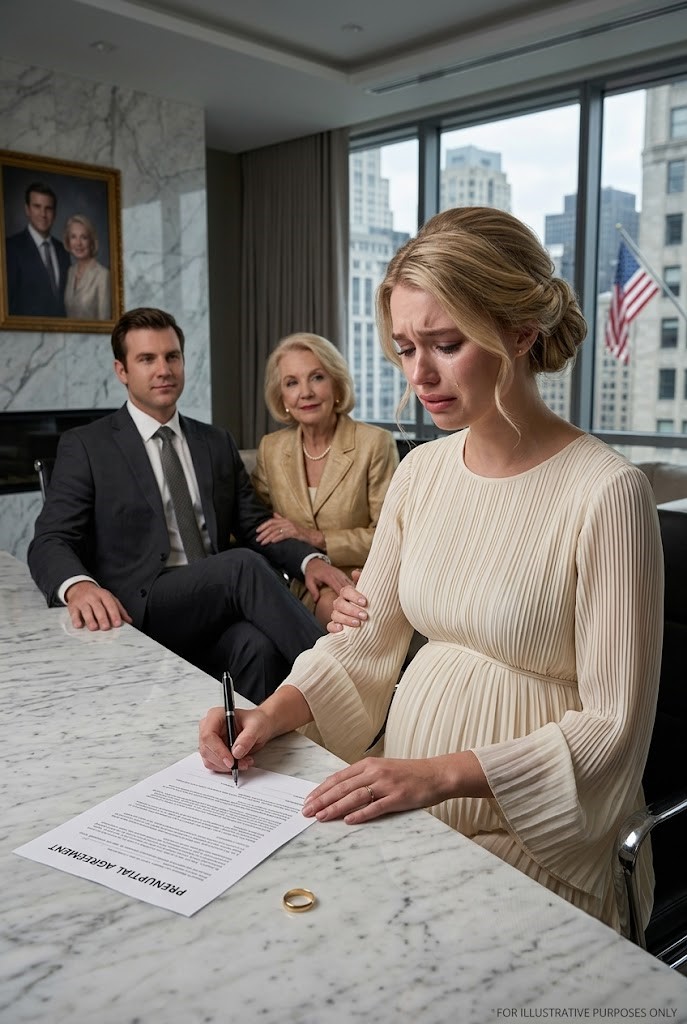
The next evening, he came home with Madison and asked for a divorce.
Now, sitting across from him and watching the blood drain from his face, I understood that the debt and the mistress were connected.
“How do you know about that?” Ryan asked.
“It came to the house.”
Madison turned to him. “What debt?”
Ryan shot her a look. A warning.
I almost smiled again.
So she didn’t know everything.
Interesting.
“Ryan,” Madison said, her voice tightening. “What is she talking about?”
“It’s business,” he snapped.
“Three hundred forty-two thousand dollars is business?”
He stood so fast his chair scraped the floor. “Claire, this is exactly why we need to separate. You always panic before you understand anything.”
I looked at him quietly.
He hated quiet.
It gave him nothing to fight.
“I’ll have my lawyer review the papers,” I said.
“You don’t have a lawyer.”
“I’ll get one.”
His jaw flexed. “Don’t make this hard.”
“You did that when you brought her here.”
Madison flinched as if I had slapped her.
Good.
After they left, I sat in the dark living room with the divorce papers on my lap. I didn’t cry until my mother called.
“Sweetheart,” she said, “did Ryan come home? Did you eat?”
The sound of her voice broke me.
I pressed one hand over my mouth so she wouldn’t hear the sob.
“I ate,” I lied.
After we hung up, I stayed awake until dawn.
By morning, I knew there was one person I had to see before I signed anything.
Ryan’s mother.
PART 3 — THE HOUSE HIS MOTHER LOST
Ryan’s mother lived in Naperville, in a neat brick house with white shutters and a porch full of flowerpots.
Or at least, it used to be neat.
When I arrived the next afternoon, the lawn was brown and overgrown. The flowerpots were dead. Mail spilled from the box, damp from the snow that had melted and frozen again overnight.
I stood at the door, one hand under my stomach, and rang the bell.
For nearly a minute, no one came.
Then the door opened.
Linda Mercer looked ten years older than she had at Thanksgiving.
Her hair, usually styled, hung loose around her face. Her eyes were swollen. She wore a cardigan with a missing button and slippers that made her seem smaller than I remembered.
“Claire,” she whispered.
“Linda, I’m sorry to come without calling.”
She looked past me, as if expecting Ryan to appear.
“He’s not with me,” I said.
Her face collapsed.
Inside, the house was cold. Papers covered the coffee table, the dining table, even the arm of the sofa. Notices. Bank letters. Legal envelopes.
I didn’t need to ask.
But I did anyway.
“What happened?”
Linda sank onto the sofa and pressed both hands to her mouth. “He told me he had an investment opportunity. Said it was guaranteed. Said if I helped him, he could double the money in six months.”
My stomach tightened.
“How much?”
She closed her eyes.
“Six hundred eighty thousand.”
The room tilted.
I gripped the back of a chair.
“He asked you for $680,000?”
“I took out a mortgage against the house.” Her voice broke. “This house was paid off, Claire. My husband worked thirty years for this house. Ryan promised he would make the payments. He did at first, then he stopped answering. Now the bank says foreclosure proceedings have started.”
I sat down slowly.
$342,000.
$680,000.
More than a million dollars.
And Ryan had been trying to rush me into divorce before I discovered the whole truth.
“Did he tell you about Madison?” I asked.
Linda looked away.
That was answer enough.
“You knew?”
“He said he was confused.”
I laughed once, without humor.
“Confused men don’t bring their pregnant mistress into their pregnant wife’s home.”
Linda started crying. “He’s my son.”
“I know.”
“And your baby is my grandson.”
I stood then.
I was too tired to be gentle.
“Ryan told me to sign away my marriage so he could build a family with Madison before her baby comes. He offered me the condo like a consolation prize. He didn’t mention the debts. He didn’t mention your house. He didn’t mention anything that could hurt him.”
Linda reached for my hand. “Claire, please. Don’t destroy him.”
I pulled my hand back.
“He already did that.”
The next morning, I went to a legal aid office near the courthouse. I waited two hours in a hard plastic chair while my back ached and my son pressed down on my bladder like he was trying to escape early.
When a gray-haired attorney named Mrs. Navarro finally called me in, I placed everything on her desk.
Divorce papers.
Loan notice.
Credit card statement.
Texts.
Pictures Madison had posted online—two hands with matching rings, a hotel lobby reflected in a glass table, a caption that read finally chosen.
Mrs. Navarro read silently.
Then she removed her glasses.
“Do not sign what he gave you.”
“I wasn’t planning to.”
“Good. You need the condo transferred fully into your name, temporary support, child support after birth, and protection from marital debt. We also need language stating you are not responsible for loans he took without your knowledge.”
“What about custody?”
Her face softened. “You are the child’s primary caregiver. Given his conduct and financial situation, you have a strong position.”
“I don’t want him using my son later when his life falls apart.”
Mrs. Navarro studied me carefully.
“You believe it will?”
“Yes.”
She nodded. “Then we build the agreement accordingly.”
Two days later, I met Ryan at a coffee shop downtown, not the one where we met. I chose a crowded place on purpose.
He looked annoyed before he even sat down.
“You got a lawyer?”
“Yes.”
He scoffed. “Of course you did.”
I placed my counterproposal in front of him.
His eyes moved over the page. His face hardened.
“You want the condo in your name, $1,800 a month in child support, medical expenses, and sole custody?”
“Yes.”
“And you want me to waive decision-making rights?”
“You said Madison’s baby needed you. Go be needed.”
His eyes flashed. “Don’t be bitter.”
“Don’t confuse consequences with bitterness.”
He leaned forward. “I’m drowning, Claire.”
“I know.”
For a second, I saw fear in him again.
“Sarah has money,” he muttered.
Sarah.
He had started calling Madison by the wrong name once, months ago, when he came home drunk. I had forgotten until then.
I wondered how many lies had tangled together in his head.
“Madison’s money won’t save you,” I said.
He looked startled. “What does that mean?”
“It means sign the agreement.”
For a long moment, he stared at me like he was meeting me for the first time.
Then he took the pen.
His signature was sharp, angry, almost carved into the paper.
Mine was steady.
When I left the coffee shop, I stepped into the cold Chicago air and breathed like I had been underwater for months.
I was still pregnant.
Still scared.
Still alone.
But I was no longer waiting for Ryan Mercer to choose me.
And that made me dangerous in a way he had never expected.
PART 4 — THE SON WHO SAVED ME
My water broke at 3:12 on a Sunday morning.
At first, I thought it was another false contraction. I had been having them for days—tight, uncomfortable waves that made me stop in the middle of the hallway and breathe through my teeth.
But this was different.
This pain had a rhythm.
It came low and deep, curling around my spine.
Then warmth ran down my legs.
I stood in the doorway of the nursery, staring at the crib my father had assembled and Ryan had never seen, and whispered, “Oh my God.”
My son was coming.
I called my mother.
She answered on the second ring, her voice thick with sleep. “Claire?”
“Mom,” I said, trying not to panic. “My water broke.”
In the background, I heard my father shout, “What? Now?”
My mother’s voice changed instantly. “Unlock the door. Get your hospital bag. Sit down. Do not try to drive. We’re coming.”
Twenty minutes later, my father pulled up outside my building wearing pajama pants under his winter coat. My mother rushed in and found me gripping the kitchen counter through a contraction.
“Oh, honey,” she whispered, putting her arm around me.
“It hurts.”
“I know. I know it does. But you can do this.”
The drive to Northwestern Memorial Hospital felt endless. Every red light made my father curse under his breath. Every contraction made me squeeze my mother’s hand until she winced.
“I’m sorry,” I gasped.
“Squeeze harder,” she said. “That’s what mothers are for.”
By the time we arrived, I was already eight centimeters dilated.
Everything after that became pain, light, voices, breath.
A nurse told me to push.
My mother counted.
My father waited outside the room, pacing so much a security guard asked if he needed water.
I thought of Ryan once.
Only once.
Not because I wanted him there.
Because I suddenly understood he had lost the right to witness the strongest version of me.
After hours that felt like both forever and one second, a cry cut through the room.
A fierce, furious, beautiful cry.
“Congratulations,” the doctor said. “You have a healthy baby boy.”
They placed him on my chest.
He was red-faced, wrinkled, tiny, perfect. His mouth trembled. His fist opened against my skin, and his fingers curled around mine with impossible strength.
“Noah,” I whispered. “Hi, baby. I’m your mom.”
His crying quieted.
My mother cried harder than I did.
Later, through the glass, I saw my father wiping his eyes with both hands like a little boy.
For the first time in months, the world felt simple.
No Ryan.
No Madison.
No debt.
Only Noah.
His breath. His warmth. His tiny body rising and falling against mine.
When I brought him home, the condo no longer felt abandoned. It was still the same place—same gray couch, same kitchen island, same framed wedding photo I had finally taken down—but everything had changed.
There were bottles by the sink.
Diapers stacked beside the couch.
A blue blanket over the rocking chair.
My mother stayed for two weeks. She cooked, cleaned, folded laundry, and took Noah at dawn so I could sleep for ninety minutes at a time.
Then she went home.
And the real loneliness began.
Single motherhood did not arrive like a dramatic storm.
It came in small hours.
At 2:00 a.m., when Noah would not stop crying and I was so tired I forgot my own name.
At 4:30 a.m., when I bounced him against my shoulder, whispering, “Please, baby, please,” while tears ran down my face.
At noon, when I realized I had not eaten anything except crackers and cold coffee.
Some days, I felt strong.
Some days, I felt like I was disappearing.
But every time I looked at Noah, I came back to myself.
His face reminded me why I had survived.
One afternoon, when he was six weeks old, my mother came over and found me sitting on the floor beside his crib with a notebook in my lap.
“What’s that?” she asked.
“A business plan.”
She raised an eyebrow.
“I want to open a coffee shop.”
“Claire.”
“I know.”
“Running a business with a newborn—”
“I know, Mom.”
She sat beside me.
I showed her the pages. Menu ideas. Start-up costs. Equipment lists. Branding. Supplier names from my old franchise days.
“I was good at it,” I said. “Before Ryan, before everything, I was good at something.”
“You still are.”
“My life cannot be waiting for child support from a man who might disappear. I need something that belongs to me. Something Noah can grow up seeing.”
My mother looked at my son sleeping in the crib.
Then she reached over and took my hand.
“Your father’s office building in Oak Park has a small storefront opening next month,” she said. “It used to be a flower shop.”
I stared at her.
“No,” I said.
“Yes.”
“Mom, I can’t take charity.”
“It’s not charity. It’s family.”
When my father came by that evening, he pretended the idea was casual.
“Rent will be cheap,” he said. “Because the landlord is handsome and generous.”
My mother rolled her eyes.
I laughed for the first time in weeks.
That night, after Noah fell asleep, I wrote a name at the top of a clean page.
Second Cup.
Because my first life had burned down.
And somehow, unbelievably, I had been given another.
PART 5 — SECOND CUP
Second Cup opened on a bright April morning with twelve tables, one espresso machine I bought used, and a hand-painted sign my father insisted looked “artisanal” instead of crooked.
I was terrified.
At 6:00 a.m., I stood behind the counter in a black apron, staring at the empty shop. Sunlight spilled through the front windows. The smell of fresh coffee filled the room. On each table sat a tiny vase with one white carnation because my mother said people remembered beautiful details.
Noah was with her that morning.
I missed him so badly my chest hurt.
At 8:00, my parents arrived with flowers.
My father took a picture of me under the sign. My smile was nervous, but real.
“My daughter,” he said, his voice thick, “the business owner.”
“Dad, don’t cry before the first customer.”
“I’m not crying. The coffee fumes are aggressive.”
The first customer was a woman from the insurance office upstairs. She ordered a latte and a lemon scone. My hands shook so badly I nearly spilled the milk.
She took one sip and smiled.
“Oh,” she said. “This is good.”
That one sentence carried me through the day.
By closing time, I had sold thirty-one coffees, nine scones, and four turkey sandwiches. Not enough to become rich. Enough to believe.
The next week, the regulars began appearing.
Teachers from the elementary school down the street.
A retired couple who sat by the window and shared one muffin.
A group of nurses from the urgent care clinic nearby.
And one quiet doctor.
He came in every weekday at 12:20.
Tall, dark-haired, early forties, always in a white coat with a hospital ID clipped to his pocket.
“Large iced Americano,” he said the first time.
His name, I learned from the badge, was Dr. Daniel Hayes.
He paid, nodded, left.
The next day, same order.
The day after, same order.
For weeks, I knew only three things about him: he liked strong coffee, he never wasted words, and he looked at people as if he actually saw them.
One afternoon, my mother brought Noah to the shop because she had a doctor’s appointment nearby. He was four months old by then, chubby-cheeked and bright-eyed.
Halfway through the lunch rush, he began crying.
Not hungry crying.
Not tired crying.
Wrong crying.
I touched his forehead.
Hot.
My breath caught.
“Mom,” I said, panic rising. “He has a fever.”
At that exact moment, Dr. Hayes walked in.
He looked once at my face, then at Noah.
“May I?” he asked.
I nodded.
He washed his hands at the sink, then gently touched Noah’s forehead and neck. His entire manner changed. The quiet, distant doctor became calm and warm.
“He’s warm, but not dangerously hot,” he said. “My clinic is two doors down. Bring him over. We’ll check him properly.”
I closed the shop for twenty minutes and followed him.
Noah had a mild virus. Nothing serious.
But to a new mother who had already lost so much, every fever felt like a cliff.
Dr. Hayes explained everything slowly. What medicine to give. What signs to watch for. When to call.
“You’re doing well,” he said as I lifted Noah back into his stroller.
I almost cried from those three words.
After that, he spoke more.
“How’s Noah?”
“Did the fever break?”
“Are you sleeping at all?”
Sometimes, he would glance at the empty tables and say, “You should eat something.”
“I own a coffee shop,” I told him once. “Coffee counts.”
“It does not.”
He brought me a sandwich the next day.
Months passed.
The shop grew.
A local moms’ group discovered Second Cup and praised the stroller space, the changing table in the restroom, and the fact that I never glared when toddlers dropped crumbs. Soon, mothers filled the morning hours, then remote workers filled the afternoons, then families came on Saturdays.
I was exhausted.
I was proud.
Then one afternoon, Madison’s name came back into my life.
My old friend Liz visited the shop after nearly a year of silence. She hugged me carefully, admired the decor, and ordered a cappuccino.
After half an hour, she looked down at her cup.
“Have you heard about Ryan and Madison?”
“No,” I said.
It was true.
I had stopped looking.
Liz took a breath. “It’s bad.”
I waited.
“Ryan lost most of the money in options trading. The debt is everywhere. His wages are being garnished. Madison had her own loans—credit cards, designer accounts, personal loans. She was pretending to have money because she thought Ryan had money.”
I looked out the window.
Two people had betrayed me because they wanted a life that didn’t exist.
“Linda lost the house,” Liz added gently.
That hurt more than I expected.
Not enough to go back.
But enough to remember that everyone connected to Ryan’s lies had paid something.
“I’m sorry,” Liz said.
“Don’t be.”
“You’re not happy about it?”
I thought about that.
“No,” I said finally. “I’m free of it. That’s better.”
That night, after closing, I carried sleeping Noah through the quiet shop. His head rested against my shoulder. His little hand clutched my collar.
Through the window, I could see my reflection.
A woman with tired eyes.
A woman with coffee stains on her apron.
A woman who had been abandoned and still built something warm.
For the first time, I liked her.
PART 6 — THE MAN ON HIS KNEES
The first anniversary of my divorce arrived on a Tuesday.
I didn’t expect to remember.
But I did.
I woke up before dawn, made coffee in my kitchen, and stood by Noah’s crib while he slept with one foot sticking out from under his blanket.
One year earlier, I had walked out of the county clerk’s office with a stamped divorce agreement and a baby moving inside me.
I thought my life had ended.
Now my son was alive, my shop was busy, and I had learned how to sleep diagonally in a bed that no longer felt empty.
At noon, Dr. Hayes came in for his usual iced Americano.
“Noah sleep through the night?” he asked.
“Almost.”
“That means no.”
“That means I’m choosing optimism.”
He smiled.
His smile had become dangerous to my peace.
Not because it threatened me.
Because it made me want things again.
Around 2:00 p.m., after the lunch rush, I stepped outside to water the planters by the entrance.
A man was sitting on the curb.
At first, I thought he was a stranger.
Then he lifted his head.
Ryan.
My body went cold.
He was thinner. Unshaven. His coat was wrinkled and too light for the weather. His eyes were bloodshot, his hair greasy, his hands trembling.
“Claire,” he rasped.
I took one step back.
“What are you doing here?”
He struggled to his feet, then dropped to his knees on the sidewalk.
People stared.
A woman pushing a stroller slowed down.
My face burned.
“Get up,” I said.
“Please,” he whispered. “Please just listen.”
“No.”
“Madison’s baby isn’t mine.”
The words landed strangely.
Like a glass dropped in another room.
I said nothing.
Ryan wiped his face with both hands. “At the hospital, there were questions. Blood type, timing, things that didn’t add up. I demanded a paternity test. He’s not mine.”
I looked at him.
No rage came.
Only exhaustion.
“She was already pregnant when we started,” he said. “She knew. She used me because she thought I had money.”
I almost smiled.
Not with joy.
With the terrible symmetry of it.
“And now?” I asked.
“She left. We’re divorcing. She took out cards in my name. I’m being sued. The bank froze accounts. I lost Mom’s house. I lost everything.”
He leaned forward until his palms touched the sidewalk.
“Claire, I made a mistake.”
A mistake.
As if he had taken the wrong exit.
As if he had forgotten to pay a bill.
As if he had not walked into my home with my best friend and asked me to erase myself.
“I was scared,” he said. “The debts, the baby, Madison pushing me—”
“Do not blame her for what you chose.”
He flinched.
Inside the shop, my mother appeared at the window. Her eyes widened.
Before I could stop her, she came outside carrying a metal pitcher of water from the counter.
“Mrs. Bennett,” Ryan began.
My mother threw the water in his face.
The splash hit him full on.
Gasps rose from the sidewalk.
My mother pointed at him with the empty pitcher. “You abandoned my daughter while she was carrying your child. You brought that woman into her house. You let her give birth without you. And now you crawl back because the other woman lied better than you did?”
“Mom,” I said softly.
She was shaking.
I took the pitcher from her hand and guided her back toward the door. “Go inside. I’ll handle it.”
When I turned around, Dr. Hayes was standing just inside the doorway, watching carefully but not interfering.
Ryan saw him.
Something in his face twisted.
“Is that him?” he asked.
“That is none of your business.”
“So you replaced me?”
I stared at him.
The audacity was almost impressive.
“You removed yourself.”
He swallowed. “Claire, Lucas—”
“Noah.”
“What?”
“My son’s name is Noah.”
He looked wounded, as if he had deserved to know.
“Noah is my son,” I said. “I carried him. I delivered him. I fed him at three in the morning when I could barely stand. I held him through fevers. I paid for diapers. I built a life around him. You signed away your rights before he was born because you wanted Madison’s baby more.”
Ryan’s eyes filled. “I didn’t understand.”
“No. You understood exactly. You just thought I would always be available when your other life collapsed.”
He tried to take my hand.
I stepped back.
“Claire, I have nowhere to go.”
“That is not my emergency.”
His mouth trembled.
For a second, I saw the man I had loved. Or maybe only the memory of him.
The man who brought me coffee in bed.
The man who cried at our first ultrasound.
The man I had thought was real.
Then he was gone, replaced by the man on his knees.
“I forgive you enough to stop carrying you,” I said. “But I will never let you near my son.”
Ryan bowed his head.
No dramatic music played. No thunder cracked. No crowd applauded.
He simply stood, soaked and shaking, and walked away down the sidewalk.
Smaller with every step.
When he turned the corner, I felt nothing.
Not hatred.
Not pity.
Nothing.
That emptiness was the final freedom.
Inside, the shop had gone silent. Customers pretended not to stare.
My mother hugged me.
Dr. Hayes set a cup of water beside me.
“You okay?” he asked.
I looked through the window at the street where Ryan had disappeared.
“Yes,” I said.
And I meant it.
PART 7 — THE LIFE AFTER THE RUINS
After Ryan came to the shop, the past stopped feeling like a shadow and became what it truly was.
A place I had left.
News reached me through other people.
Ryan and Madison’s divorce became ugly. She sued him for support. He sued her for fraud. They accused each other of forged signatures, hidden debts, stolen credit cards, and lies so tangled even their lawyers probably needed diagrams.
Linda moved in with relatives in Indiana after the foreclosure.
I thought of her sometimes.
I felt sorry for her.
But pity was not an invitation back into my life.
Second Cup kept growing. By the end of its second year, I had hired two part-time baristas. My father still came by every Saturday to “inspect operations,” which meant drinking free coffee and telling customers I was his daughter.
Noah grew into a joyful, stubborn little boy with Ryan’s dark eyes and my father’s laugh.
I never told him his father was a villain.
Children do not need poison poured into them.
When he asked, “Do I have a daddy?” I knelt in front of him and said, “You have a mommy who loves you more than the whole sky. And you have Grandma and Grandpa. Some families look different, but love is what makes them real.”
He accepted that because children understand love better than adults do.
Dr. Hayes became Daniel.
Then he became the man who fixed a loose cabinet in the shop without being asked.
The man who brought soup when I had the flu.
The man who let Noah put stickers on his medical bag.
The man who never pushed.
One evening after closing, Daniel stayed behind while I wiped down tables. Rain streaked the windows. Noah was asleep in a booth with his dinosaur blanket tucked under his chin.
Daniel sat near the counter, turning his coffee cup slowly between his hands.
“Claire,” he said.
I looked up.
His expression was serious in the way I had first known him.
“I care about you.”
My heart kicked like Noah once had.
“I care about Noah, too,” he continued. “I’m not asking for anything you’re not ready to give. But I would like to take you to dinner. A real dinner. Not leftovers behind the counter.”
I laughed because I was nervous.
Then I stopped laughing because he deserved honesty.
“I’m scared,” I said.
“I know.”
“I don’t know how to trust myself. I trusted Ryan.”
Daniel nodded. “Then don’t rush. Let trust be something I earn, not something you have to gamble.”
That sentence undid me more than any grand confession could have.
We started slowly.
Dinner once a month.
Then Sunday walks in the park.
Then Daniel at my parents’ house for Thanksgiving, where my father pretended to grill him about baseball and my mother quietly set an extra place like she had known all along.
Noah called him “Dr. Dan” until one sleepy night, after Daniel carried him from the car to the condo, Noah murmured, “Night, Daddy Dan.”
Daniel froze.
I froze.
Noah slept on, unaware that he had cracked open the room.
Daniel looked at me, his eyes shining.
“I won’t take a name he doesn’t understand,” he whispered.
“He understands love,” I said.
Three years after Ryan left, Daniel proposed in the shop after closing.
Not with a crowd.
Not with cameras.
Just me, Noah, my parents hiding badly behind the pastry case, and a small velvet box on the counter beside my first espresso machine.
Daniel knelt.
Noah gasped. “Are you tying your shoe?”
My father snorted.
Daniel laughed, then looked at me.
“Claire Bennett,” he said, “I cannot promise you a life without pain. Nobody honest can. But I can promise I will stand beside you when pain comes. I will love your son as a gift, not a burden. I will never ask you to become smaller so I can feel bigger. Will you marry me?”
For a moment, I saw every version of myself.
The pregnant woman at the dining table.
The woman signing divorce papers with swollen feet.
The woman screaming through childbirth.
The woman crying at 4:00 a.m. with a baby in her arms.
The woman opening a coffee shop with shaking hands.
The woman watching her ex-husband walk away for the last time.
They were all there.
And they had carried me here.
“Yes,” I said.
Noah shouted, “Does this mean cake?”
My mother cried.
My father claimed the coffee fumes were aggressive again.
One year later, Daniel and I married in a small garden ceremony in Oak Park. Noah walked me down the aisle, holding my hand with solemn pride. He wore a navy suit and carried the rings in a tiny wooden box.
When he handed them to Daniel, he whispered loudly, “Don’t lose Mommy.”
Daniel knelt to his level.
“Never,” he said.
I believed him.
Not blindly.
Not desperately.
But with the calm trust of a woman who had learned the difference between promises and proof.
Years later, Second Cup became three locations across Chicago. Noah grew tall and curious, forever asking questions, forever stealing muffins from the display when he thought I wasn’t looking.
Sometimes customers asked about the name.
Second Cup.
I would smile and say, “Because sometimes life gives you another chance after you think everything is over.”
They never knew the whole story.
They didn’t need to.
But I knew.
Ryan’s betrayal had not ended me.
Madison’s lies had not defined me.
Divorce had not made me less worthy.
Single motherhood had not made me weak.
The night my husband asked me for a divorce for his pregnant mistress, two months before my son was due, he believed he was leaving me with nothing.
He was wrong.
He left me with the one thing I needed most.
Myself.
And once I found her, no one ever took her from me again.