PART 2
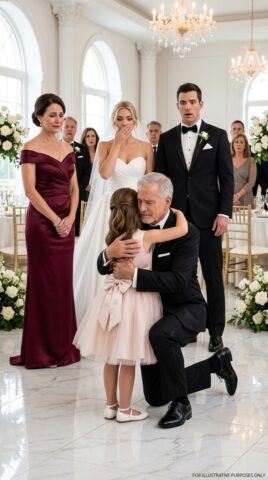
Malcolm rose only after I told him to.
The old loyalty in his face nearly broke me. I had run from the Whitaker name five years earlier, convinced that love had to be proven in poverty. My father, Harrison Whitaker, had called Carter an opportunist the first time he met him. I had called my father cruel. Then I had packed one suitcase, changed my number, and disappeared into the ordinary life I thought would make me free.
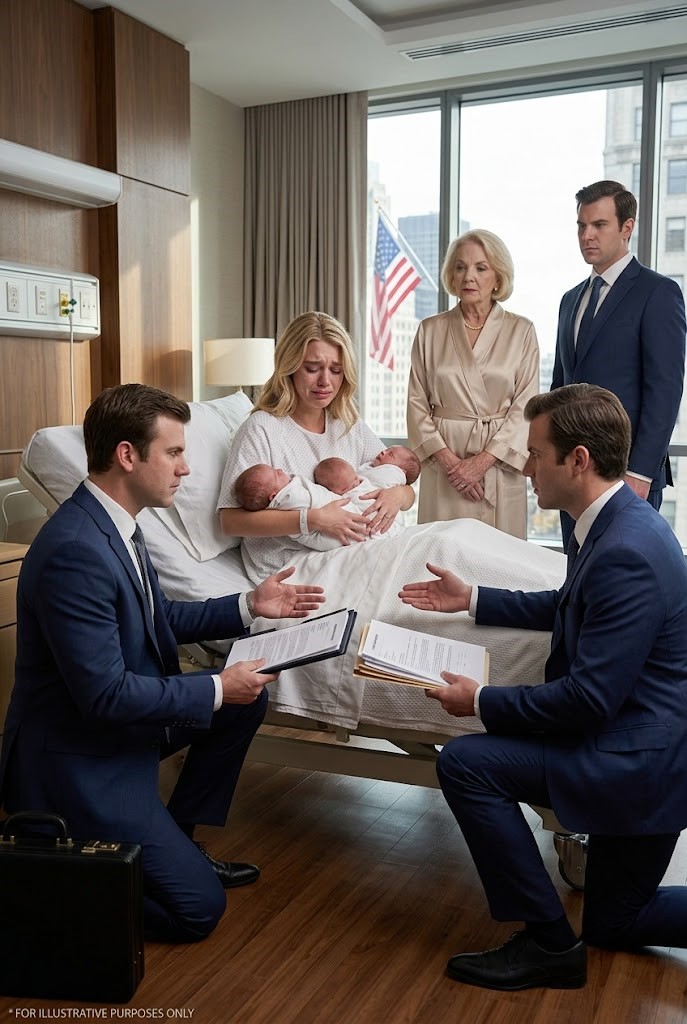
Now my father was dead, and the man I had defended had abandoned me with three newborns.
One of the attorneys stepped forward. “Miss Whitaker, the transfer documents are ready. Your father’s final instruction was that we locate you immediately and place all assets under your control.”
I looked down at the divorce papers.
Carter had offered me a rented apartment and diaper money.
My father had left me skyscrapers in Chicago, biotech holdings in California, hotels in Washington, D.C., and voting control over one of the largest private conglomerates in America.
The irony was so cruel it almost tasted like blood.
“First,” I said, my voice hoarse but steady, “my sons need the best neonatal care in the country.”
“Already arranged,” Malcolm replied. “Whitaker Medical has a private neonatal wing in La Jolla. A transport team is standing by.”
I nodded.
“Second, no one from Carter Reeves’s side is to come near me or my children.”
The lead attorney made a note.
“Third,” I said, picking up Carter’s papers, “I want the divorce handled by our legal team.”
“Of course.”
I tore the papers in half.
The sound was small, but it changed the room.
Then I tore them again.
And again.
White fragments fell across the hospital blanket like dirty snow.
“I won’t sign anything he throws at me,” I said. “If Carter wants a divorce, he can ask correctly. Through counsel. In court. With witnesses.”
Malcolm’s eyes shone with pride. “Your father would recognize that tone.”
My throat tightened, but I refused to cry again.
Within the hour, the hallway outside my room transformed. Private nurses arrived. Security appeared. A neonatal transport team moved with careful precision around my sons. Hospital administrators who had ignored me all morning suddenly spoke in hushed, respectful voices.
By sunset, a convoy of black SUVs carried us from the public hospital to Whitaker Medical’s private coastal facility overlooking the Pacific. I rode in the center vehicle, lying back against soft leather, watching San Diego blur behind tinted glass.
My babies slept in portable incubators beside me.
Malcolm sat across from us, one hand resting near the emergency call button, as if he would fight the entire world if it tried to touch them.
At the private facility, the top floor had been cleared. The suite had pale walls, ocean views, warm wood floors, and a nursery connected directly to my bedroom. Specialists examined the triplets. Nurses explained every number on every monitor. For the first time since giving birth, I felt someone was treating my children like heirs to life, not burdens.
After midnight, Malcolm brought me a sealed blue folder.
“What is it?” I asked.
“Everything related to Mr. Reeves’s company.”
Apex Meridian.
Carter’s pride.
His miracle startup.
The company he claimed he had built with brilliance, strategy, and grit.
I opened the folder and stared at the truth. Over the past three years, Carter’s company had nearly collapsed five separate times. Each collapse had been prevented by anonymous investment vehicles.
Mine.
I had authorized those investments quietly through my old trust. I had told myself I was protecting his dreams. Protecting his pride. Protecting our marriage.
Malcolm stood beside my bed in silence as I flipped through proof after proof. Emergency capital. Hidden loans. Vendor guarantees. Private bridge financing.
Carter had called me a financial burden while standing on a foundation made entirely of my money.
“When is the next funding release?” I asked.
“Tomorrow morning.”
“What happens without it?”
“Apex Meridian defaults within forty-eight hours. Payroll will fail. Vendors will freeze supply. The bank will call its line of credit.”
I looked through the glass wall at the nursery. Noah’s tiny hand twitched in sleep. Caleb’s mouth opened in a silent yawn. Henry lay perfectly still beneath a blue blanket, fragile and stubbornly alive.
My sons had been rejected before they had even opened their eyes.
“Cancel the funding,” I said.
Malcolm did not blink.
“All of it?” he asked.
“All of it.”
I placed the folder on the table.
“And notify every lender holding Apex paper that Whitaker Global will no longer provide indirect support, guarantees, or risk coverage. No favors. No delays.”
“Yes, Miss Whitaker.”
I leaned back, exhausted, but something inside me had become cold and clear.
For five years, I had confused sacrifice with love.
No more.
Across town, Carter was celebrating at a rooftop lounge with Vanessa Langford, drinking champagne bought on a credit card he could not afford. He was probably telling her how free he felt. How brilliant he was. How his future had finally begun.
He had no idea that his future had just been unplugged.
I slept for two hours that night.
When I woke, sunlight was spreading over the Pacific, and the old Abigail Reeves was gone.
PART 3
Three months later, the woman who walked into Whitaker Tower in Chicago no longer resembled the woman Carter had left in a hospital bed.
My body had healed, but not softly. I trained at dawn with a boxing coach, rebuilt my strength with doctors, and learned to stand without flinching when men raised their voices. My hair was cut into a sleek shoulder-length style. My clothes were no longer bargain dresses and loose sweaters. That morning, I wore an ivory tailored suit with sharp shoulders, pearl earrings, and heels that echoed across the marble lobby like a warning.
Employees stopped talking when I passed.
Not because I demanded fear.
Because power, when it has been hidden too long, has a sound.
The monthly board meeting was waiting on the fiftieth floor. Twelve directors sat around a long walnut table, most of them older men who had served my father and assumed his daughter would be sentimental, decorative, and easy to manage.
They learned otherwise in under twenty minutes.
A director named Warren Bell attempted to explain debt structure to me as if I were a child playing with grown-up papers.
I let him finish.
Then I opened a file and calmly listed the losses hidden in his division for the past nine quarters, the inflated consulting contracts paid to his nephew, and the three failed acquisitions he had recommended against my father’s direct orders.
His face turned the color of ash.
“If anyone in this room believes my years away from Whitaker Global made me ignorant,” I said, looking around the table, “resign before lunch. I do not have time to educate arrogance.”
No one resigned.
They were too afraid to move.
By noon, I had approved a restructuring plan, canceled six vanity projects, redirected capital into renewable infrastructure and medical technology, and removed Warren Bell from operational authority pending investigation.
By three, the story had spread through the building.
The lost Whitaker daughter had returned.
And she had teeth.
Meanwhile, Carter’s world was collapsing.
Apex Meridian’s bank froze its accounts. Suppliers demanded cash. Employees whispered in hallways. His CFO quit by email. The landlord threatened eviction from their glossy office space in downtown San Diego.
Carter called investors who used to answer on the first ring.
Now their assistants said they were unavailable.
Vanessa did not understand. She arrived at his office wearing a red designer dress, carrying shopping bags and complaining that he had not transferred money for their engagement party deposit.
“I told you,” Carter snapped, rubbing his temples, “cash is temporarily tight.”
“Tight?” Vanessa repeated, disgust curling her lip. “My father said you were promising people a Series C round you don’t have.”
Carter stared at her.
“Your father said what?”
She looked away, and that was when he realized Langford Capital was already distancing itself.
Ambitious men always think loyalty can be purchased. They never understand that purchased loyalty is the first thing to leave when the money dries up.
Two days later, Carter gambled everything on a real estate development auction outside Los Angeles. He mortgaged his parents’ house, emptied what remained of Apex Meridian, and convinced himself one major project could save him.
He sat in the auction room sweating through his shirt while a representative from an unknown company bid against him.
Carter raised his paddle for the last time.
His maximum.
His entire future.
The auctioneer looked toward the other bidder.
The representative lifted his paddle calmly and named a number just high enough to crush Carter by inches.
“Sold.”
Carter did not move.
His parents’ house was gone. His company was finished. His reputation was bleeding out in public.
Across the street, I sat inside a black limousine, watching through tinted glass.
Malcolm sat beside me. “The winning entity is now recorded under Whitaker Development West.”
“Good,” I said.
Carter stumbled out of the building, pale and hollow-eyed. For one brief second, I saw the man I had once loved. Not the cruel man in the hospital room. Not the liar. The young man who had kissed me under cheap apartment lights and promised we would build something honest.
Then I remembered my sons crying while he walked away.
My pity died before it could breathe.
That evening, I flew back to Chicago and went straight to the nursery in my lakefront residence. Noah, Caleb, and Henry were lying on a soft rug under a mobile of silver stars. Their nanny started to stand, but I waved her down.
I kicked off my heels, knelt on the floor, and gathered my sons carefully into my arms one by one.
No boardroom victory felt like this.
No revenge.
No money.
Their tiny hands grabbing my fingers were the only proof I needed that I had survived for a reason.
But revenge was not finished.
A week later, the National Entrepreneurs Gala in Washington, D.C., released its guest list.
Carter Reeves and Vanessa Langford were on it.
Not by accident.
By invitation.
Mine.
PART 4
The gala was held in a historic hotel two blocks from the White House, beneath chandeliers that made everyone’s diamonds look brighter and everyone’s lies look cleaner.
Washington society loved power more than money, and that night the ballroom held both. Senators whispered with tech founders. Defense contractors laughed beside media executives. Bankers moved through the room like sharks in tuxedos.
Carter arrived with Vanessa on his arm, trying to look confident.
But desperation has a scent.
His tuxedo was expensive but slightly too tight. His smile appeared half a second late. He shook hands too firmly, laughed too loudly, and offered business cards to people who took them with polite fingers and dead eyes.
Vanessa glittered in a silver gown, but even she could not hide her irritation.
“Why is everyone avoiding us?” she whispered.
“They’re not,” Carter lied.
“They are.”
He ignored her and scanned the ballroom. He had come for rescue. One investor. One bridge loan. One powerful person willing to believe the old version of Carter Reeves still existed.
Then the lights dimmed.
A voice filled the room.
“Ladies and gentlemen, please welcome the new chairwoman and chief executive officer of Whitaker Global Holdings, Miss Abigail Whitaker.”
The grand staircase at the far end of the ballroom glowed under a single spotlight.
The doors opened.
I stepped into the light.
The room inhaled.
I wore a black velvet gown with a gold neckline, simple diamond earrings, and no tiara. I did not need one. My father had taught me that true power never overdresses.
As I descended the staircase, applause rose like thunder.
Halfway down, I found Carter’s face in the crowd.
He looked as if he had seen a ghost.
Vanessa’s hand tightened around his arm. Her mouth opened slightly. She recognized me too—the woman she had laughed about, the poor wife, the hospital bed, the three unwanted babies.
I reached the ballroom floor and walked to the podium.
My speech lasted seven minutes.
I spoke about infrastructure, American innovation, medical access, and the responsibility of private capital in shaping the future. I watched Carter’s face while I spoke. Every sentence stripped something from him. His arrogance. His certainty. His fantasy that I had ever been beneath him.
When I finished, the applause was louder than before.
Business leaders moved toward me. A senator kissed my hand. A governor asked for a meeting. CEOs who had ignored Carter all night waited patiently for thirty seconds of my attention.
Then Carter pushed through the crowd.
“Abigail!”
His voice cracked with false warmth.
Security moved immediately, but I raised one hand. “Let him through.”
A circle formed around us. Washington loved scandal even more than power.
Carter stopped in front of me, breathing hard. He forced a smile, the same charming smile that had once convinced me to leave home.
“Abby,” he said softly. “You look incredible.”
I said nothing.
He glanced around, aware of the audience. “I’m so proud of you. I always knew you were special. I know things got complicated between us, but we’re family. We have children together.”
The word children sounded unnatural in his mouth.
He reached for my hand.
I moved mine away.
“Mr. Reeves,” I said, clearly enough for everyone nearby to hear, “do not touch me.”
His smile twitched.
“Abby, come on.”
“My name is Miss Whitaker. You lost the right to use anything else when you threw divorce papers at me thirty minutes after I gave birth.”
A murmur swept through the circle.
Vanessa turned scarlet.
Carter tried to laugh. “That was a private misunderstanding.”
“No,” I said. “It was character.”
His face hardened.
I continued calmly. “Your company submitted an investment proposal to Whitaker Global through a third party last week. I reviewed it personally.”
Hope flashed in his eyes.
“I rejected it.”
The hope died.
“Your financial controls are reckless, your debt exposure is catastrophic, and your ethical standards are beneath every threshold this company maintains.”
The murmurs grew sharper.
Carter leaned closer, desperation leaking through his voice. “Don’t mix personal issues with business.”
I looked directly into his eyes.
“The way a man treats his wife when she is weak tells me exactly how he treats partners when they are no longer useful.”
His face went red.
“And a man who abandons newborn children for access to a mistress’s father’s money,” I said, “will not manage one dollar of mine.”
Silence spread outward from us like ice cracking across a lake.
Vanessa stepped back.
Carter noticed.
For the first time that night, he looked truly afraid.
Security moved in. Carter tried to speak again, but no words came. A waiter shifted behind him, Carter bumped into the tray, and champagne glasses shattered across the marble floor.
The sound rang through the ballroom like a verdict.
I turned away.
Behind me, Carter Reeves stood in the center of Washington society, soaked in humiliation, watching the woman he had discarded become the door he could never open again.
Outside, rain began to fall.
PART 5
The next morning, Carter appeared at the gates of my Chicago estate with a cheap bouquet of white lilies and a face he had practiced in a mirror.
Security sent the live camera feed to my office.
There he was: unshaven, wearing a wrinkled white shirt, looking like a ruined husband from a Sunday movie. He spoke into the intercom with a broken voice.
“Please. Tell Abigail I need to see my children.”
My children.
He had learned the phrase overnight.
Malcolm stood beside my desk, disgust plain on his face. “Shall I have him removed?”
I sipped my coffee. “No. Let him in.”
Malcolm looked surprised, but only for a moment. “Very well.”
Carter entered the main hall like a man walking into a church he wanted to rob. His eyes moved over the paintings, the staircase, the chandeliers, the antique vases, the quiet wealth arranged in every corner. Greed warmed his face before he remembered to look sad.
When I came down the stairs in a cream silk dress, he dropped to his knees.
“Abby,” he choked. “I was sick. I was under pressure. Vanessa manipulated me. I swear I didn’t know what I was doing.”
I stopped six feet away.
He crawled forward slightly, holding out the lilies. “I love you. I love our sons. I made the worst mistake of my life.”
“That part is true,” I said.
He swallowed. “Then let me fix it.”
“Fix what?”
“Our family.”
The word sounded even uglier than children.
He began telling stories. Stress. Exhaustion. Vanessa’s influence. Business pressure. Emotional confusion. He claimed the divorce papers had been prepared by his lawyer without his full understanding. He claimed he had never meant to abandon me. He claimed his heart had always belonged to the family he had walked away from.
I listened until he finished.
Then I opened the folder Malcolm placed on the hall table.
“May 14,” I said. “You transferred fourteen thousand dollars from our household account to buy Vanessa a diamond bracelet.”
Carter froze.
“June 2. You told me you were in Denver meeting investors. You were in Miami with her.”
His mouth opened.
“July 19. I was seven months pregnant and having contractions. You ignored eleven calls from me because you were at a resort in Napa with Vanessa.”
His face drained.
I took another page.
“And here is the funding history of Apex Meridian. Every emergency investment. Every rescue. Every quiet guarantee. Mine.”
He stared at the papers.
I let him understand slowly.
“The success you bragged about,” I said, “was purchased by the woman you called a burden.”
His shame lasted only seconds.
Then came rage.
“You lied to me,” he spat, standing. “You tested me. You hid billions and watched me struggle.”
“I watched you become yourself.”
“You made me cheat.”
I laughed once.
It was not loud, but it echoed.
“No, Carter. I gave you love without money attached. You sold it for access to Vanessa’s father.”
He pointed at me. “I deserve compensation. I wasted years with you. I’m the father of those boys. I have rights.”
I nodded to Malcolm.
He stepped forward and handed me another document.
“Do you recognize this?” I asked.
Carter’s eyes flicked down.
The prenuptial agreement.
He had insisted on it before our wedding because he believed I was poor and did not want me touching his future wealth.
“You signed this eagerly,” I said. “It protects separate property, inheritances, family trusts, and premarital assets. Mine included.”
He looked trapped.
“You receive nothing,” I said. “No money. No forgiveness. No access to my sons unless a court orders it.”
His face twisted. “You can’t keep my children from me.”
“You kept yourself from them.”
Security entered.
Carter lunged one step forward, but the guards caught his arms.
“This isn’t over!” he shouted as they dragged him toward the door. “You’ll regret humiliating me!”
I watched him disappear through the front entrance.
I believed him.
Not because he was strong.
Because desperate men become dangerous when they lose the illusion of control.
Three days later, Carter met Vanessa in a dim café near Union Station. My investigator photographed them through the window. Vanessa leaned across the table, whispering with the intensity of a woman whose luxury life had started slipping away.
By evening, my attorney received notice.
Carter Reeves was filing for full custody of Noah, Caleb, and Henry.
The petition accused me of being unstable, neglectful, obsessed with business, and morally unfit to raise children in a wealthy environment.
Attached was a private settlement proposal.
If I transferred one hundred million dollars to Carter, he would withdraw the custody claim.
I read the document once.
Then I placed it on my desk and looked at the silver-framed photo of my sons.
For months, this had been revenge.
Now it was war.
PART 6
Carter made the mistake of believing public sympathy was the same as truth.
Within forty-eight hours, tabloids ran his story.
Poor father battles billionaire ex-wife for triplets.
Heartless heiress accused of choosing empire over infants.
Vanessa stood beside him in interviews, wearing pale dresses and solemn expressions, pretending to be a woman of compassion. Carter looked into cameras with wet eyes and said he only wanted to be a father.
He did not know Noah’s middle name.
He did not know Caleb’s feeding schedule.
He had never held Henry.
But America loves a crying man when the woman across from him is powerful enough to frighten them.
My PR team begged me to respond.
I refused.
“Let him talk,” I said.
Malcolm watched me carefully. “The board is nervous.”
“The board can be nervous and still profitable.”
Behind the scenes, my team worked in silence.
Private investigators followed money. Forensic accountants opened old records. Former employees of Apex Meridian came forward once they learned Carter could no longer pay for loyalty. A building inspector in Orange County admitted Carter had bribed an official to accelerate permits. A former bookkeeper provided duplicate ledgers showing tax fraud.
But the most important evidence came from Vanessa herself.
She had installed hidden cameras in her luxury apartment because she did not trust her maids. She had captured conversations she never imagined would matter.
My investigator placed a black hard drive on my desk.
I watched the recording once.
Carter sat on Vanessa’s couch, drinking whiskey.
Vanessa asked, “Do you actually want the babies?”
Carter laughed.
“Are you insane? I want leverage. Abigail will pay anything to keep them.”
Vanessa smiled. “Ask for more.”
“I don’t care if they’re raised by nannies or shipped to boarding school,” Carter said. “As long as she writes the check.”
I paused the video.
For a moment, I could not breathe.
I had known he was selfish. Cruel. Greedy.
But hearing him speak of my sons like bargaining chips turned something ancient and merciless inside me.
I did not cry.
I called my attorney.
“Schedule mediation,” I said. “Before court.”
Carter arrived at the mediation room in a borrowed suit, wearing the grin of a man who thought silence meant surrender. His attorney was the kind of man who smiled with every tooth but none of his soul. Vanessa waited outside, too vain to sit through legal details but too anxious to leave.
Carter placed a settlement document on the table.
“One hundred million,” he said. “And I disappear.”
I tilted my head. “You would withdraw the custody claim?”
“If we settle.”
“So you do not actually want full custody?”
His attorney shifted, sensing danger.
Carter did not.
“I want what’s fair,” he said.
“What is fair?”
He leaned forward. “You have billions. I gave you years. I gave you children. Pay me, and you can keep playing perfect mother.”
The diamond brooch on my jacket recorded every word.
I asked softly, “And if I refuse?”
He smiled.
“Then I make sure the whole country believes you’re a monster.”
I stood.
“That will be all.”
His grin faltered. “Wait. Are we negotiating or not?”
I looked at him one last time.
“No,” I said. “We’re documenting.”
He did not understand until I was already gone.
The morning of the hearing, rain clouds covered Chicago, but by the time my convoy reached the courthouse, the sky had opened into cold, white sunlight. Reporters crowded the steps. Carter and Vanessa arrived first, waving like celebrities.
Then my cars pulled up.
I stepped out in a white suit, flanked by twelve attorneys.
I did not speak to the press.
Inside the courtroom, Carter’s lawyer painted me as a distant billionaire mother who cared more about acquisitions than bedtime. He presented paid witnesses, edited photographs, and dramatic accusations.
I sat still.
When it was our turn, my lead attorney stood.
“Your Honor,” he said, “we will be brief. We ask permission to play a recording and submit supporting financial evidence.”
The judge allowed it.
The courtroom screen lit up.
Carter’s face appeared.
Then his voice filled the room.
“I don’t care if they’re raised by nannies or shipped to boarding school. As long as she writes the check.”
The courtroom went dead silent.
Carter turned gray.
Vanessa made a small strangled sound.
The recording continued. Their plan. Their fake custody claim. Their settlement demand. Their media strategy.
Then came the mediation audio.
“One hundred million,” Carter’s recorded voice said. “And I disappear.”
The judge’s expression hardened into disgust.
My attorney followed with the financial documents. Tax fraud. Embezzlement. Bribes. Misuse of company funds to pay Vanessa. Evidence stacked upon evidence until Carter’s lawyer stopped objecting and started sweating.
Vanessa broke first.
“He made me do it!” she shouted, pointing at Carter.
Carter turned on her instantly. “You planned it!”
Their love story ended exactly where it had begun.
In greed.
The judge struck the gavel three times.
By the time order returned, Carter looked smaller than I had ever seen him.
The judge revoked his custody and visitation rights pending further review, granted me full temporary and then permanent legal custody, and referred the evidence of extortion, fraud, and conspiracy to prosecutors.
Police entered through the side door.
Carter tried to stand. “Your Honor, please—”
The handcuffs closed around his wrists.
That sound was softer than I expected.
But it ended everything.
PART 7
As officers led Carter past my table, he stopped fighting for one second and looked at me.
His eyes held hatred, regret, fear, and something that might have been apology if he had ever learned humility. His mouth opened.
I turned away.
That hurt him more than any sentence the judge could have given.
Because men like Carter can survive hatred. They feed on it. What destroys them is irrelevance.
Vanessa was taken out next, crying hard enough to ruin her makeup. Outside, cameras flashed as police guided them into separate cars. The same reporters who had called Carter a devoted father now shouted questions about extortion and fraud.
The story changed before sunset.
By evening, every major outlet ran the footage of Carter’s downfall. His interviews were replayed beside the courtroom evidence. Commentators who had judged me harshly now called me restrained, dignified, and formidable.
I did not watch much of it.
I went home.
Malcolm met me at the door of the estate.
For the first time since my father’s death, the old man smiled without sadness.
“It is finished,” he said.
“Not finished,” I replied. “But safe.”
I went upstairs to the nursery.
Noah was awake, staring at the ceiling with solemn blue eyes. Caleb was fussing softly. Henry slept with one fist pressed to his cheek. Their world was peaceful. Warm. Protected.
They did not know what had happened in court.
They did not know their father had tried to sell them.
One day, they would ask questions. I would answer carefully, without poison. I would never teach my sons to hate the man who abandoned them. Hate is still a chain, and I had worked too hard to be free.
But I would teach them truth.
A father is not made by blood.
A family is not protected by promises.
Love is not what someone says when they need money, forgiveness, or a second chance.
Love is what remains when there is nothing to gain.
Months passed.
Carter’s criminal case moved forward. Apex Meridian declared bankruptcy. Vanessa’s social world evaporated overnight. Langford Capital denied knowledge of her scheme and quietly cut her off. Carter’s parents lost the house he had mortgaged, and though part of me pitied them, I did not repair what their son had destroyed. Mercy without boundaries is how women like me end up bleeding in hospital rooms.
Whitaker Global expanded into medical technology, and I created a neonatal care foundation in my sons’ names. The first center opened in San Diego, not far from the hospital where Carter had left us. I stood at the ribbon-cutting with Noah, Caleb, and Henry in their stroller beside me, and I felt my father’s absence like a hand on my shoulder.
A reporter asked if the foundation was personal.
“Yes,” I said. “Every child deserves to be wanted. Every mother deserves to be protected when she is vulnerable.”
That quote traveled farther than any scandal.
Years later, my sons grew into loud, curious, fearless boys who ran through the halls of the Chicago house like it was built for their laughter. Noah loved maps. Caleb loved music. Henry loved taking apart clocks and hiding the pieces in flowerpots.
They knew Malcolm as Grandpa Malcolm.
They knew my father from portraits and stories.
They knew Carter only as a man who could not be part of our lives because he had made choices that hurt people.
On their seventh birthday, we held a small party in the garden. No cameras. No society guests. Just children, cake, balloons, and the kind of happiness money can protect but never create.
That evening, after the boys fell asleep in a pile of blankets and superhero pajamas, I walked alone to the balcony overlooking Lake Michigan.
The city lights shimmered below.
My phone buzzed with a news alert. Carter Reeves had accepted a plea agreement. Prison time. Restitution. Public disgrace reduced to a paragraph beneath more important headlines.
I felt nothing.
Not joy.
Not sadness.
Just distance.
Malcolm stepped onto the balcony carrying tea.
“You should be celebrating,” he said.
“I am.”
“You look very quiet for a woman who won.”
I smiled.
“For a long time, I thought winning meant watching him fall.”
“And now?”
I looked toward the boys’ bedroom windows, glowing softly down the hall.
“Now I know winning means they sleep peacefully.”
Malcolm nodded, understanding.
Before going inside, I looked once more at the city my family had helped build, the empire I had inherited, and the future I had claimed not through revenge, but through survival.
Thirty minutes after I gave birth, Carter Reeves thought he had left me with nothing.
He had actually left me with everything that mattered.
My sons.
My name.
My power.
Myself.
And from the ashes of the woman he abandoned, Abigail Whitaker rose—not as his broken wife, not as his victim, not as a secret heiress hiding from her own blood, but as a mother who learned that the cruelest betrayal can become the doorway to the life she was born to lead.
THE END