PART 2
By sunrise, New York City had turned Lenora’s humiliation into entertainment.
The clip was everywhere.
Business channels replayed it with restrained cruelty. Gossip accounts slowed it down frame by frame. Anonymous finance blogs called Vance Sterling the “VIP Suite CEO.” Social media turned Sloan’s champagne toast into a meme before breakfast.
Lenora had not slept.
She remained in her father’s study, wearing the same cream sweater and tailored trousers from the night before, her dark hair pinned low, her eyes dry but shadowed. On the desk in front of her sat two objects: the Meridian Crest laptop and her wedding ring.
One represented duty.
The other represented a lie.
At 6:40 a.m., Beatrice entered carrying black coffee and a toasted bagel.
“You need to eat,” her mother said softly.
“I need to arrive at Rosalind’s office in one piece.”
Beatrice placed the tray down. “Being in one piece does not mean being without pain.”
Lenora touched her mother’s hand. “I know. I’m just not letting the pain drive.”
Across Manhattan, Sterling Infrastructure was already in cardiac arrest.
In the company’s Midtown headquarters, executives gathered in a glass-walled conference room under lights too bright for people who had been awake all night. Garrett Hayes, the CFO, slammed a printed email onto the table.
“Meridian Crest suspended execution.”
Callum Reeves, general counsel, snatched the paper. “Over a halftime broadcast?”
Garrett pointed at the timestamp. “Over executive misrepresentation, governance instability, and reputational exposure during final due diligence. That is not a tabloid problem, Callum. That is a vault door closing.”
Blair Ramsey, head of corporate communications, held two phones and looked ready to throw both through the window.
“Bloomberg is calling. The Journal is calling. Half the board is calling. Somebody tell me Vance was actually in Frankfurt before Vegas. Give me anything usable.”
Nobody spoke.
That silence was the company’s first confession.
Vance landed at JFK shortly after seven. His private terminal exit had never felt so public. He kept his head down, his jaw clenched, his phone vibrating nonstop.
Board members.
Reporters.
Garrett.
Blair.
Sloan.
Lenora did not call.
That scared him more than all the others combined.
If she had screamed, he could have defended himself. If she had cried, he could have apologized and blamed exhaustion. If she had begged for answers, he could have controlled the scene.
But Lenora had given him only an instruction.
Fly back to New York immediately.
That did not sound like a broken wife.
It sounded like a summons.
In the back of a black Escalade, Vance tried calling her again. Voicemail.
He stared out the window as Manhattan traffic crawled along the FDR Drive.
His driver asked, “Tribeca, sir?”
“Midtown headquarters,” Vance said.
Sloan had not been allowed on his jet.
That fact enraged her more than the public scandal. From a hotel suite in Manhattan, she watched herself trend on TikTok and tried to convince herself she had won. The camera had caught her beautiful, intimate, undeniable. For one blazing night, she had believed the whole country would force Vance to choose her.
But Vance had not claimed her.
He had not issued a statement.
He had not promised a divorce.
He had only looked at her in Las Vegas and asked, “Did you know the cameras would pan to us?”
Sloan called a friend at a crisis PR firm in Los Angeles.
“I need the narrative flipped,” she said. “I am not going down as a homewrecker. I want people to believe his marriage was already dead.”
Her friend hesitated. “Sloan, be careful. Lenora Kensington is old money. Private people usually have powerful backing.”
Sloan laughed. “Private just means irrelevant. The public sides with whoever is on camera.”
Then she leaked three behind-the-scenes photos to a gossip blogger.
Her hand on Vance’s chest.
His smile angled toward her.
Two champagne glasses touching.
A love story manufactured from someone else’s wreckage.
At 8:00 a.m., Lenora arrived at Rosalind Pierce’s Hudson Yards office. She wore a beige suit, no dramatic makeup, and no wedding ring. Rosalind, one of the most feared corporate litigators in New York, met her at the door.
“The press is sniffing around the suspension.”
“The press sniffs everything,” Lenora replied. “We give them no blood.”
Rosalind handed her a folder. “We preserved the footage, public filings, social media leaks, and preliminary expense trails. Meridian’s escrow accounts are frozen.”
Lenora opened the folder and saw a printed still from the broadcast.
Vance’s hand on Sloan’s waist.
Without the lights and noise of Las Vegas, the image looked cheap.
Rosalind watched her carefully. “Do you want the infidelity included in the official risk report?”
“No,” Lenora said. “My marriage is not an asset of the fund. His executive conduct is.”
Harrison arrived minutes later, imposing and exhausted. He kissed Lenora’s forehead and sat across from her.
“The Meridian committee is split,” he said. “Half want to use this to renegotiate valuation. Half want to withdraw completely.”
Lenora’s voice remained steady. “I will not let this look like a daughter using family capital to punish her husband.”
Harrison leaned forward. “Then don’t make it about your husband. Make it about a CEO who told investors he was overseas during a critical negotiation while he was publicly exposed in Las Vegas with a consultant tied to his own communications network.”
That word stopped her.
“Consultant?”
Rosalind looked down at her notes. “Sloan Whitmore has invoiced Sterling through a third-party agency for influencer strategy on public bids.”
Lenora’s eyes hardened.
“Find out who paid for the suite.”
At Sterling headquarters, Vance entered through the freight elevator, hoping to avoid attention. It failed. Employees watched him with the careful non-expression of people who had already seen too much.
Blair intercepted him outside his office.
“You are not speaking to reporters. You are not calling Sloan a close friend. You are not smiling. You are not improvising.”
Vance glared. “Do you work for me?”
“Today,” Blair said, “I am trying to stop you from detonating what is left of this company.”
The words hit harder than any insult because they were not personal. They were true.
Garrett entered with a laptop. “Without Meridian’s capital injection, we default next quarter.”
“Who signed the suspension order?” Vance demanded.
“We don’t know yet. It came through the blind proxy.”
“Find out.”
“We’ve been trying since three in the morning.”
At 9:20, Sloan walked into the lobby wearing oversized sunglasses and a white trench coat, with two paparazzi conveniently waiting outside the revolving doors.
At the front desk, she said loudly, “I was beside him in front of a hundred million people. Do you really think I need a visitor badge?”
An intern recorded it.
By the time Blair rushed downstairs, the video had already spread through internal Slack channels.
Sloan removed her sunglasses, eyes glossy with manufactured pain. “I just want to see the man I love.”
Blair hissed, “You cannot be here.”
“Or what?” Sloan whispered. “His company will pretend I don’t exist too?”
Upstairs, Lenora received the video from Rosalind.
She watched it once.
“Confirm all payments between Sloan Whitmore and Sterling,” she said. “And preserve that lobby footage.”
Harrison studied her. “You think she planned the broadcast?”
Lenora closed the file.
“A woman who smiles into a national camera that perfectly does not get surprised by being seen.”
Her personal phone buzzed.
Vance.
She declined the call and typed:
Have your board ready tomorrow morning at 8:00 a.m. That is where we will speak.
In his office, Vance read the message and felt the floor shift beneath him.
Blair saw his face. “What did she say?”
Vance swallowed. “She wants the boardroom.”
Blair went still.
“A hurt wife tells you to come home and pack your bags,” she said. “She does not call a corporate meeting.”
For the first time in his marriage, Vance wondered who Lenora really was.
PART 3
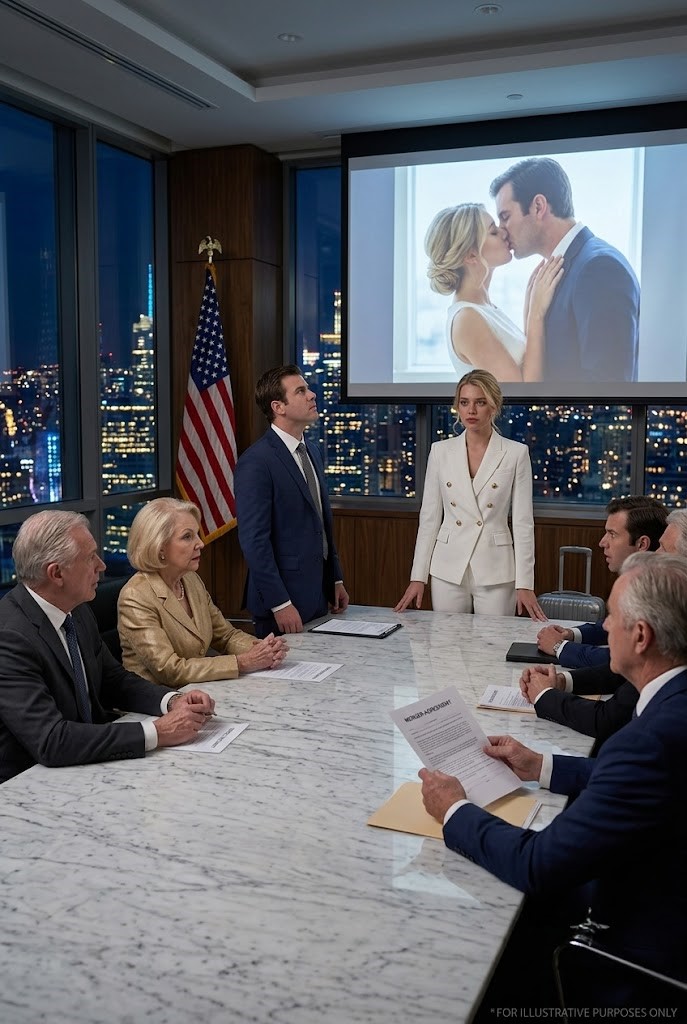
At precisely 8:00 a.m. the next morning, the Sterling Infrastructure boardroom was colder than a morgue.
The long mahogany table reflected untouched glasses of water, glowing tablets, and the pale faces of men who had spent their careers pretending panic was strategy. Vance sat at the head of the table, but for the first time, the chair felt borrowed.
Garrett shuffled documents.
Callum whispered into his phone.
Blair refreshed financial alerts.
Two legacy board members murmured in tones usually reserved for funerals.
Vance kept looking toward the frosted glass doors.
He still did not believe Lenora would come.
Not really.
His mind had spent years placing her in a convenient category: elegant wife, brilliant hostess, cultured daughter of money, graceful at galas, useful in rooms where soft power mattered. He had never thought of her as someone who could walk into his corporate fortress and take the oxygen from it.
Callum stood. “The Meridian Crest representative has arrived.”
Vance straightened. “Everyone stays aligned. We do not accept extortion based on a tabloid incident.”
Blair looked up, voice flat. “Maybe we should listen before we attack.”
“I am still CEO.”
“Then act like one.”
The doors opened.
A junior assistant stepped in first, nervous enough to look guilty. Behind him came Rosalind Pierce in a navy power suit, carrying a slim leather folder.
Then Lenora entered.
Charcoal suit. Hair pulled back. No ring. No tears. No apology.
For five seconds, nobody spoke.
The room did not simply go silent.
It changed ownership.
Vance stood too quickly, knocking his pen to the floor.
Lenora did not bend to pick it up. She walked to the seat reserved for Meridian Crest and placed her folder on the table.
Only then did she look at him.
“Good morning, Vance.”
The formality was more brutal than rage.
“What the hell are you doing here?” he whispered.
“My job.”
Callum stepped forward, confused. “Mrs. Sterling, this is a classified corporate session.”
Rosalind slid a document across the table. “Meridian Crest conducted due diligence through a blind proxy. We are unsealing the identity of the lead auditor and risk committee chair.”
Vance read the document.
Lenora Kensington.
Lead council.
Risk committee chair.
Proxy mandate.
Veto authority.
Every line destroyed a version of his marriage he had invented for his own comfort.
He remembered nights when he found Lenora working late and dismissed it as “consulting busywork.” He remembered explaining debt restructuring to her like she was a child. He remembered telling Sloan that Lenora was sweet but detached from the real world.
His humiliation turned instantly into anger.
“You spied on my company from inside my house.”
Lenora did not flinch. “I evaluated documents Sterling formally uploaded to Meridian’s data room. Your house was never a source of intelligence.”
“And was our marriage part of your due diligence?”
The words flew like a knife.
For the first time, her face shifted.
Only slightly.
Then the armor returned.
“I withheld my role to protect the integrity of the process.”
Josiah Croft, the oldest board member, cleared his throat. “Miss Kensington, are you stating that the suspension was not personal retaliation?”
“I am stating that Sunday’s broadcast exposed a material inconsistency in executive reporting,” Lenora said. “Mr. Sterling represented to investors that he was in Europe on a critical negotiation tied to this transaction. He was instead broadcast nationally in Las Vegas with a marketing consultant recently connected to this firm. That triggers governance review, reputational risk provisions, and concerns about disclosure integrity.”
Garrett closed his eyes.
Callum tried to recover. “A CEO’s private life should not contaminate a transaction.”
“I agree,” Lenora said. “His private life should not. His operational deceit during a regulated due diligence window absolutely does.”
Vance slammed his palms on the table.
“You are wrapping jealousy in corporate language.”
The room froze.
Lenora slowly turned toward him.
“If I wanted to punish you as your wife, this meeting would not have an agenda. It would have screaming, tears, and a leaked divorce filing. I brought none of the three.”
The sentence landed with elegant violence.
Blair looked down to hide her reaction.
Vance had no response.
Because she was right.
Lenora opened her folder. “Meridian Crest is not terminating today. We are suspending pending audit. We require all flight logs, corporate expense reports, vendor contracts involving communications or publicity vendors, and full disclosure of financial ties between Sterling Infrastructure and Sloan Whitmore.”
Callum stiffened. “That is invasive.”
Rosalind answered before Lenora could. “It is boilerplate compliance.”
At that moment, an assistant slipped into the room and whispered to Blair.
Blair closed her eyes. “She’s here.”
Vance turned. “Who?”
“Sloan. In reception. She says she has receipts and wants to speak to you loudly enough for the entire M&A division to hear.”
Vance’s face drained. “Do not let her in.”
Josiah snapped, “She is already inside the crisis. Ignoring her while she screams at employees is negligent.”
Rosalind looked at Lenora.
For one heartbeat, the betrayed wife inside Lenora wanted to say no. She wanted to avoid Sloan’s perfume, her voice, her false tears, her victory smile.
But the auditor knew better.
“Send her in.”
Vance stared at her. “Lenora, you don’t have to subject yourself to this.”
The hypocrisy was so large that even he heard it.
Lenora held his gaze. “I have subjected myself to many things in silence, Vance. Today, I am running the room.”
Sloan entered wearing a beige cashmere dress and the expression of a woman prepared to play victim.
But when she saw Lenora seated in the investor’s chair, her script cracked.
“I didn’t want this to become a war,” Sloan began softly. “I love Vance.”
Nobody responded.
She looked at the board. “Their marriage was already over. He told me that. I was the only person standing by him.”
Lenora folded her hands. “Miss Whitmore, have you provided marketing or communications consulting to Sterling Infrastructure in the past twelve months?”
Sloan blinked. “What?”
“It matters if your presence in that suite was facilitated by corporate vendors, especially during a sensitive transaction period.”
Sloan’s eyes sharpened. “You can talk like a judge all you want, Lenora. Everyone knows you’re only doing this because you got traded in.”
Vance stepped forward. “Sloan, enough.”
She whipped toward him. “Enough? You didn’t think it was enough Sunday night when you held me in front of the whole country. You didn’t think it was enough when you promised that after the contract closed, everything would change.”
Lenora’s blood went cold.
After the contract closed.
The boardroom went silent.
Lenora leaned forward. “What contract, Miss Whitmore?”
Sloan realized the mistake one second too late.
“I don’t know the financial details,” she said quickly. “He just said things would get easier soon.”
Rosalind wrote something down.
Garrett stared at Vance with horror.
Lenora’s voice became lethal. “Is that why you needed to be photographed publicly before the signing?”
Sloan’s mouth tightened. “I needed to stop being a secret.”
There it was.
Not love.
Not destiny.
Leverage.
Lenora stood slowly.
“No, Miss Whitmore. You wanted visibility so badly that you mistook being seen for being chosen.”
Sloan’s eyes filled with hate. “Women like you always win because you were born with the right last name.”
Lenora stepped closer. “No. I am standing here because I learned not to beg for a seat beside a man who hides me behind his lies. That is not a last name. That is a boundary.”
Sloan looked away first.
Vance understood then that Lenora had not just defeated Sloan.
She had finally named the architecture of his entire marriage.
And it was collapsing around him.
PART 4
The first audit meeting began the next morning under the kind of fluorescent lighting that made even expensive suits look guilty.
By then, the financial press had merged Vance’s affair with Sterling Infrastructure’s liquidity crisis. Headlines screamed about a CEO scandal, a frozen merger, a mistress with corporate ties, and a billionaire wife who might secretly control the rescue deal.
But none of those headlines captured the truth.
The truth was sitting at the end of the boardroom table with no wedding ring on her finger and no satisfaction in her eyes.
Lenora did not look victorious.
That was what unsettled Vance most.
If she had smiled, he could have hated her. If she had gloated, he could have called her cruel. But she simply looked tired, like a surgeon about to cut into someone she once loved because the infection had spread too far.
Garrett entered with a thick binder of flight logs, hotel receipts, and expense reports.
Before sitting, he leaned toward Vance.
“There are inconsistencies.”
Vance closed his eyes. “What kind?”
“The kind that makes a board stop protecting its CEO.”
Rosalind began with the timeline.
Monday: Vance informed Meridian Crest he was traveling to Frankfurt for emergency negotiations.
Tuesday: Sterling’s communications team confirmed his unavailability for domestic meetings.
Sunday: Vance appeared live on national television at the Super Bowl in Las Vegas with Sloan Whitmore.
Slide two moved the crisis from embarrassing to structural.
The VIP suite access had been arranged through a PR agency on Sterling’s retainer. Sloan’s hotel block had been temporarily charged to a corporate card before being moved to a personal card Monday morning. A vendor memo referenced “high-visibility placement opportunity.”
Vance looked at Garrett. “I didn’t authorize that.”
Garrett’s voice was low. “The company structure authorized it in your name.”
Slide three showed subpoenaed messages between Sloan and a PR contact.
One line made the entire room stop breathing.
When the cameras pan during halftime, he won’t be able to keep me a secret anymore.
Vance stared at the screen, sickened.
Sloan had not been protecting their love. She had been staging her promotion.
But he could not blame her completely.
He had given her the weapon. He had given her the lie, the suite, the secrecy, the promise that after the contract closed, she would become official.
Lenora watched his face but offered no rescue.
She had no interest in comforting him through the discovery of a trap he had built with his own hands.
Callum attempted a defense. “A mistress seeking attention does not invalidate executive leadership.”
Lenora spoke then.
“We are not invalidating his leadership. We are auditing his integrity.”
Integrity.
The word hung over Vance like a blade.
Lenora continued. “The conduct clause does not regulate marriage, romance, or infidelity. It regulates whether a CEO requesting capital to avoid collapse can be trusted to disclose material risks honestly.”
Vance’s voice cracked. “You’re saying I breached the deal because I cheated on you?”
She looked directly at him.
“No. You breached the deal because you lied to everyone using the same script. To me, to your board, to investors. The infidelity was simply where the lie caught fire.”
The room absorbed that in silence.
For the first time, Vance did not argue.
He looked smaller.
Lenora opened the final folder.
“Meridian Crest recommends proceeding only under three conditions. One: an independent forensic audit of all expenses tied to the Las Vegas trip, PR vendors, and Miss Whitmore. Two: installation of an emergency oversight committee with veto power over capital allocation. Three: Vance Sterling immediately steps down as CEO during restructuring.”
The boardroom exploded.
Vance shot to his feet. “You want to strip me of my own company?”
“I want to stop you from drowning it to save your pride.”
“This title is my life.”
Her voice dropped. “Then you should have respected it more.”
He looked around the table.
In another era, loyalists would have rushed to defend him. But the faces around him offered no sanctuary. Garrett looked guilty. Blair looked grim. Callum looked like he was calculating his exit package. Josiah looked like a man preparing to vote for survival, not friendship.
Rosalind spoke calmly. “If Mr. Sterling refuses, Meridian withdraws. Creditors will be notified of the breach. The board will likely face Chapter 11 filings before Friday.”
The alternative filled the room like smoke.
Bankruptcy.
Layoffs.
Liquidation.
Collapse.
Vance looked at Lenora. “Is this revenge?”
For a moment, she allowed the pain to surface.
“Revenge would be letting you lie until the company went bankrupt and watching from my penthouse while it burned. What I am offering is a second chance with a premium cost. You just are not used to paying the bill.”
Before he could respond, the doors burst open.
Sloan stormed in, trailed by her young lawyer and two security guards.
“So this is it?” she yelled. “The scorned wife gets to play judge and jury?”
Josiah stood. “This is a closed executive session.”
Sloan ignored him. “My name is in every tabloid in America, but you all sit here deciding my fate like I’m garbage?”
Vance’s face hardened. “Get out, Sloan.”
She laughed, sharp and wounded. “Now you tell me to get out? Sunday you held me in front of the entire country.”
Rosalind stepped forward. “Any grievance should be filed through counsel.”
Sloan pulled out her phone. “I have voice memos. I can prove Vance promised me everything would change after the capital injection.”
Vance went still.
Lenora did too.
Sloan pressed play.
Vance’s tired voice filled the room.
Once this Meridian deal closes, I’ll handle the lawyers. I just can’t afford the PR instability right now. Wait until the ink dries.
The silence that followed was apocalyptic.
Sloan stood there breathing hard, expecting Lenora to break.
Instead, Rosalind calmly made a note.
Garrett put his head in his hands.
Josiah stared at Vance as if he had just heard a taped confession.
Lenora closed her eyes for one second.
When she opened them, her voice was ice.
“Thank you, Miss Whitmore. That recording confirms Mr. Sterling knew his personal liabilities posed a material risk to the transaction and chose concealment.”
Sloan blinked. “No. I’m proving he manipulated me.”
Lenora looked at her without pity.
“Perhaps. But in this room, you just proved he defrauded the company.”
For the first time since the scandal began, Sloan had no performance left.
She was escorted out quietly.
The board voted within the hour.
One by one, members approved Meridian Crest’s conditions.
When it was Vance’s turn, he looked at Lenora.
She did not save him.
She did not destroy him.
She simply waited for the first honest sentence he had spoken in years.
Vance swallowed.
“I accept the temporary step-down from the chief executive role during restructuring,” he said. “And I will fully cooperate with the forensic audit.”
Blair began drafting the press release.
Garrett exhaled.
Lenora only nodded.
There was no victory in watching the man she loved lose the throne he had mistaken for a soul.
Outside the boardroom, Vance caught her near the private elevator.
“Lenora.”
She stopped but did not turn.
“I thought if I saved the company first, I could fix everything else later.”
She faced him then, and for the first time her hurt showed plainly.
“I was waiting for a partner to come home, Vance. Not a CEO to win.”
The elevator doors opened.
Before stepping inside, she added, “Tomorrow will not be about us. It will be about what you did to the truth.”
Then the doors closed, leaving him alone with his reflection.
For the first time, Vance Sterling looked like a man who could no longer afford his own lie.
PART 5
Three weeks later, New York had moved on to newer scandals, but Sterling Infrastructure still lived inside the blast radius.
The company survived, barely.
Meridian Crest released conditional capital under strict oversight. Creditors extended deadlines. Nonessential assets were sold. Executive bonuses were slashed. A temporary CEO named Elaine Porter took control with the calm authority of a woman who had never needed to raise her voice to terrify a room.
Vance was moved to a smaller office twelve floors below the executive suite.
No private elevator.
No personal assistant guarding his door.
No automatic obedience.
At first, he experienced it as humiliation.
By the tenth day, he recognized it as silence.
By the twenty-first, he understood silence was the first honest thing the company had given him in years.
People stopped laughing at jokes that were not funny. Garrett challenged his projections. Blair rejected his language for public statements. Elaine corrected him in meetings without softening the blow.
For the first time, Vance learned what the company sounded like without everyone pretending he was always right.
Sloan tried to convert her downfall into relevance.
She booked two podcast interviews, then lost both when the legal implications of her leaked recording became public. Her PR agency terminated her contract. Two fashion houses rescinded event invitations. Her lawyer requested a twenty-thousand-dollar retainer before filing the lawsuit she had threatened on television.
The internet moved on faster than her ego could process.
She was no longer the glamorous secret.
She became the woman who almost helped collapse a billion-dollar merger for camera time.
That was the cruelest punishment for Sloan Whitmore.
Not jail.
Not bankruptcy.
Irrelevance.
Lenora declined every interview.
Vanity Fair wanted her side. Forbes wanted a profile. Morning shows wanted the betrayed wife who secretly saved the company. Upper East Side women invited her to lunches so they could sip martinis and say, “I always knew he was awful,” as if her pain were a networking opportunity.
She refused all of it.
She returned to Meridian Crest and worked with surgical precision. But those closest to her saw the weight in her shoulders.
Some partners praised her for saving the transaction without appearing vindictive.
Others whispered that women could never fully separate feelings from money.
Lenora heard it all.
She kept walking.
Women in power were rarely allowed complexity. If they were firm, they were cold. If they cried, they were unstable. If they forgave, they were weak. If they left, they were bitter.
One rainy Tuesday, Beatrice waited outside Lenora’s office in a black Maybach holding two oat milk lattes.
“You are surviving entirely on spreadsheets,” her mother said.
Lenora slid into the car and gave her first real laugh in weeks. “Spreadsheets don’t tell you they’re in Frankfurt when they’re in Vegas.”
Beatrice smiled sadly and touched her daughter’s cheek.
“We don’t always cry when the wound opens. Sometimes we cry when we realize we survived the bleeding.”
Vance emailed repeatedly.
The first message was long, desperate, and full of explanations: debt pressure, fear, his father’s expectations, Sloan’s flattery, the collapsing company.
Lenora read it once and archived it.
The second email said he had signed the unredacted forensic audit.
She replied: That is a legal obligation, not a moral victory.
The third asked if he could visit her parents’ penthouse.
She answered: Do not use my parents’ home as a stage for your guilt.
That message made Vance put his phone down and stare at the skyline for an hour.
Blair forced him to see a therapist.
He called it executive leadership coaching until the therapist asked, “What did you lose?”
“My CEO title,” Vance said automatically.
Then he stopped.
The real answer arrived late and made him feel physically sick.
“I lost the only woman who saw me before I became insufferable.”
Their first real conversation happened forty days after the Super Bowl.
No lawyers.
No board members.
No cameras.
Lenora chose a quiet coffee shop in Tribeca with secluded booths and windows facing the street. Nowhere to hide, but no audience.
Vance arrived early and deliberately did not take the seat facing the door, a power position he had always preferred. He left it for her.
When Lenora entered wearing a white silk blouse and dark trousers, he stood.
“Thank you for coming.”
“I came to listen,” she said, “not to absolve.”
“I know.”
They sat with two black coffees cooling between them.
For several minutes, the only sounds were ceramic cups, espresso steam, and taxis moving outside in the rain.
Lenora spoke first. “Sloan lost most of her contracts.”
“I heard.”
“I don’t feel joy about it.”
“Neither do I.”
“But I also don’t feel enough pity to forget what she did.”
Vance nodded. “I didn’t come to defend Sloan. I came to tell you I stopped using her as an excuse.”
That was the first sentence that made Lenora truly listen.
Vance spoke without armor.
He admitted Sloan made him feel worshiped when he felt like a failure. He admitted he used the company as a shield because he was terrified of being ordinary. He admitted he mistook Lenora’s quiet dignity for emotional distance because it was easier than admitting he had stopped asking for her mind.
When he finished, Lenora placed both hands flat on the table.
“Do you know what destroyed me?”
“The broadcast,” he said.
“No. The camera only revealed reality. What destroyed me was knowing that if the camera had never found you, you would have flown home, kissed my forehead, and let me help save your empire while calculating the most convenient quarter to break my heart.”
Vance closed his eyes.
“Yes,” he whispered. “I would have done that.”
The honesty hurt more than denial would have.
Lenora looked out at the rainy street.
For weeks she had wished she could hate him cleanly. But love did not leave as neatly as pride wanted it to. It stayed in inconvenient details: his left hand around a coffee mug, his laugh from Nantucket, the old cocktail napkin in her purse where he had once written, Thank you for seeing the man behind the ambition.
“I waited a long time for that man to come back,” Lenora said. “Then I realized maybe he always had flaws I chose not to see.”
Vance accepted the verdict.
“I want to rebuild him.”
“Then rebuild him for yourself,” she replied. “For your company. For the employees whose mortgages depend on your sanity. Not for me.”
He nodded.
And for the first time in their marriage, he did not promise to fix everything by Friday.
He simply said, “I’m going to try, even if you never come back.”
Lenora did not forgive him that day.
But when she stood to leave, she did not walk away as quickly as she had planned.
And Vance, finally learning, did not ask for more than he had earned.
PART 6
The restructuring took months.
Sterling Infrastructure survived, bruised but breathing. Contracts were renegotiated. Wasteful divisions were sold. Internal reporting was rebuilt. Employees who had feared pink slips began to look less like people waiting for a storm and more like people cautiously opening windows after one.
Elaine Porter remained interim CEO longer than anyone expected.
Vance returned first as an advisor, not a king.
At an internal town hall, he stood behind a modest podium and faced employees who expected polished arrogance.
Instead, he said, “I built a culture where people were afraid to tell me I was wrong. That ego almost cost this company everything. From today forward, disagreeing with me is not treason.”
Garrett raised his hand and asked a brutal question about leverage exposure.
Everyone waited for Vance to interrupt.
He did not.
He listened until the end.
The moment did not become a headline because quiet reform lacked the clickability of scandal. But Rosalind sent Lenora the transcript, highlighting Vance’s statement.
Lenora stared at it for a long time.
She did not smile.
But something in her chest loosened.
That Sunday, Beatrice asked the question Lenora had been avoiding.
They were in the Kensington kitchen, making French press coffee while Harrison pretended to read the newspaper and absolutely listened to every word.
“Do you still love him?” Beatrice asked.
Lenora sliced a grapefruit with careful precision.
“I think I do.”
Harrison lowered the paper slightly.
Lenora continued, “But loving someone does not mean moving back into the burning house where you lost yourself.”
Harrison folded the newspaper. “If he humiliates you again, I will buy enough shares to fire him into the sun.”
Lenora laughed so unexpectedly that both her parents stared.
“Dad, that is exactly the kind of toxic corporate leverage I’m trying to avoid.”
Beatrice hugged her from behind.
“You handled this differently than I did.”
Lenora closed her eyes.
There was a whole history in that sentence. Beatrice had lived in a world where wives preserved legacies by swallowing pain. Lenora lived in one where she could suspend a billion-dollar deal before breakfast and still be called emotional by men who had never had to make power look graceful.
“You did what you could with the world you were given,” Lenora said.
Beatrice kissed her shoulder. “And you are doing what you can with yours.”
Six months after the Super Bowl, Lenora heard a football broadcast in a crowded room again.
This time, she was not in a penthouse.
She was in a Brooklyn community center gymnasium where Meridian Crest and Sterling Infrastructure had co-funded a vocational apprenticeship program for teenagers interested in construction, engineering, and skilled trades.
There were paper streamers, folding chairs, pizza boxes, donated toolkits, and a projector showing a charity playoff game.
No crystal.
No caviar.
No fake smiles.
Just noisy, imperfect life.
Lenora stood near the back in a cream sweater and jeans, her hair loose for the first time in months. Beatrice stood beside her.
When the broadcast camera swept across a stadium crowd, Lenora felt her chest tighten.
It was not panic.
It was memory.
The body remembers fire before the mind confirms there is no smoke.
Vance stood thirty feet away, helping volunteers stack boxes of donated tools. He wore a flannel shirt with the sleeves rolled up. No photographer followed him. No PR team polished his image. Blair had made it clear that Sterling would not use Lenora’s presence to repair his reputation.
Vance had agreed without argument.
That alone would have shocked the old version of him.
He noticed Lenora’s posture change when the camera panned across the crowd.
He did not rush over.
He did not perform concern.
He simply stayed where he was, present without taking control.
Beatrice handed Lenora water.
“Still catches your breath?”
“Less than it used to.”
“That is a victory.”
Lenora watched Vance lift a box while a little boy mocked his posture and corrected his form.
“People want clean endings,” Lenora said. “Either I’m the saintly wife who forgives instantly or the ruthless woman who exiles him forever.”
Beatrice smiled. “People demand simple endings because they don’t have to live inside them.”
Lenora looked toward the gym doors.
“So what kind of ending is this?”
“Yours,” Beatrice said. “And you are holding the pen.”
Lenora stepped into the hallway for air.
Vance waited a few seconds before following. He stopped five feet away.
“Is it okay if I stand here with you?”
The question was small.
That was why it mattered.
The old Vance entered every room as if existence were permission. The man in front of her now asked before sharing space.
“It’s okay,” she said.
They stood beside the wire-glass windows while Brooklyn traffic moved beyond them.
“When the camera panned,” Vance said, “I saw your face change.”
“I felt it change.”
“I am sorry I turned something as simple as watching a game into a landmine.”
Lenora looked at him. “You didn’t ruin football. You ruined trust. The screen is just the trigger.”
He absorbed it without defense.
That was the clearest measure of change.
“I need to tell you something,” he said. “Not as leverage.”
She waited.
“The final compliance audit cleared. The board offered me the CEO chair back next quarter, with oversight conditions.”
Lenora could not hide her surprise.
“And?”
“I declined.”
She stared at him.
Vance continued, “I accepted a permanent strategy role. Elaine will remain CEO. I’m going to spend the next two years helping groom internal successors. The company needs to function without my fear driving it. And I need to exist without that title as armor.”
For years, Lenora had heard him make impressive speeches.
This was different.
This was not rhetoric.
This was forfeiture.
“Did you tell your father?” she asked.
Vance gave a tired smile. “He said I was destroying the Sterling legacy.”
“What did you say?”
“I told him maybe the Sterling legacy needs to stop being an excuse for frightened men to destroy the women who love them.”
Lenora felt a sharp ache in her chest, not from betrayal this time, but recognition.
Inside the gym, a teenager took the microphone to receive his apprenticeship certificate. He said Sterling’s program had helped him stay in school.
“It wasn’t just the money,” the boy said. “It was feeling like somebody in a glass tower saw me before I messed up my life.”
Vance looked at Lenora as the boy shook his hand.
“Thank you for trusting a company still learning how to earn it,” Vance told him.
The boy did not understand the subtext.
Lenora did.
And for the first time, Sterling Infrastructure felt like more than the crime scene of her marriage.
It felt like something ugly might still be forced to produce something useful.
PART 7
When the charity event ended, rain softened the Brooklyn streets into ribbons of gold and black.
Volunteers folded chairs. Teenagers carried toolkits home like trophies. Blair argued with a photographer who tried to sneak a picture of Lenora and Vance near the exit. Harrison Kensington watched from across the gym, fighting every instinct to interfere.
Blair stood beside him.
“You look like you’re considering a hostile takeover just to manage your emotions,” she said.
Harrison gave a dry laugh. “My daughter expressly forbade that specific coping mechanism.”
“She’s usually right.”
“He dragged her through hell.”
“He did.”
“And she still would not let me crush him.”
Blair looked through the glass doors where Lenora and Vance stood near the parking lot. “Because she understood something the rest of us learn late. Annihilating someone does not automatically heal the person who was cut.”
Harrison said nothing.
For a man who had solved most problems with money, power, or intimidation, this was humiliatingly difficult to accept.
Outside, Vance held the passenger door of his Range Rover open.
“Do you want a ride back to Manhattan?” he asked.
Lenora arched an eyebrow. “Are you offering a ride, or manufacturing a cinematic reconciliation scene?”
He laughed, real and unpolished. “Just a ride. You’re directing the scenes.”
“Good answer.”
They drove over the Brooklyn Bridge in silence.
A year earlier, Vance would have filled that silence with explanations, plans, predictions, or charm. Now he let it exist. The windshield wipers moved steadily. The East River shimmered beneath them. Manhattan rose ahead, beautiful and unforgiving.
Lenora looked at his profile and realized she did not feel the old claustrophobic need to escape.
The scar was still there. Some nights, the Vegas image still returned so clearly she could smell champagne that was never in the room. There were questions she had not answered, and pain that had not fully dissolved.
But there was also space.
A terrifying new possibility of standing beside this man without shrinking herself to fit his ego.
When they pulled up outside the Kensington building, Vance put the car in park but left the engine running.
Lenora unbuckled her seat belt.
“I’m not going to ask you upstairs.”
His hands stayed on the wheel. “Why not?”
“Because I want to. And precisely because I want to, I need to respect the timeline.”
He nodded.
No protest.
No bargaining.
No wounded pride.
Lenora opened her tote and removed a small dark blue velvet box.
Vance recognized it instantly.
The Cartier ring box.
His face changed.
“Are you giving it back?” he asked.
“No.”
She placed it gently on the center console.
“I’m taking it out of the manila envelope where it has been locked away like evidence.”
He stared at the box as if it might detonate.
“I am not putting it on my finger tonight,” Lenora said. “And I am not handing it to you as a termination.”
“Then what is it?”
She opened the door, letting cold air rush in.
“I want it to stop being a symbol of my humiliation and become a question again.”
Vance looked up.
“What question?”
Lenora stepped onto the curb beneath the awning.
“Whether someday we are both grown enough to deserve what it means.”
Then she closed the door.
She did not look back as she entered the lobby.
Vance remained parked for several minutes, staring at the blue box.
A year ago, he would have treated an unworn ring as defeat. Tonight, he understood it as responsibility.
Lenora had not given him his marriage back.
But she had not buried it either.
Upstairs, she found Beatrice asleep on the sofa with a biography on her chest. Harrison dozed in an armchair, pretending he had not been waiting.
Lenora smiled and walked to the window.
Below, Vance’s Range Rover merged into downtown traffic.
She touched her bare ring finger.
It did not feel empty.
It felt spacious.
For the first time since that terrible Sunday night, the space did not feel like abandonment.
Eight months later, Sterling Infrastructure held its annual meeting in Washington, D.C., not inside a gilded hotel ballroom, but in a renovated civic auditorium where the company announced a national apprenticeship expansion. Elaine Porter stood at the podium as CEO. Vance sat in the second row, not the first, and applauded without bitterness when she received a standing ovation.
Lenora attended as Meridian Crest’s representative.
Not as Vance’s wife.
Not as his enemy.
As herself.
After the meeting, Elaine found her near the exit.
“He’s different,” Elaine said.
Lenora watched Vance speak quietly with a group of young project managers.
“He is trying to be.”
“That enough?”
Lenora took a long breath. “Not always. But it is more than he gave me before.”
Outside, Washington’s evening sky glowed lavender above the monuments. Vance walked toward her slowly, stopping at the respectful distance he had learned by practice, not instinct.
“Coffee?” he asked.
Lenora studied him.
There was no grand speech in his eyes. No demand. No desperate attempt to close the deal of forgiveness.
Just an invitation.
“Coffee,” she said.
They walked together down the steps of the auditorium.
A photographer across the street lifted a camera, then lowered it when Blair’s glare found him from twenty yards away.
Lenora noticed and laughed.
Vance looked at her, surprised. “What?”
“Nothing,” she said. “Just realizing I can be seen without being exposed.”
He absorbed that quietly.
At a small café near Dupont Circle, they sat by the window. Vance ordered black coffee. Lenora ordered tea. Outside, people hurried past with umbrellas and briefcases, carrying private storms no camera would ever capture.
“I don’t know what happens next,” Lenora said.
“I know.”
“I may never wear the ring again.”
“I know.”
“And if I do, it will not be because the company stabilized, or because the scandal faded, or because people expect a neat ending.”
Vance nodded. “It will be because we earned something honest.”
Lenora looked down at her tea.
In her purse, the blue velvet box rested beside the old cocktail napkin.
Thank you for seeing the man behind the ambition.
She once thought love meant seeing someone clearly enough to save him.
Now she understood love also meant refusing to lie about what you saw.
Vance reached into his jacket and pulled out a folded piece of paper.
“I wrote something,” he said. “Not a speech. Not an apology performance. Just something I needed to say.”
Lenora did not take it immediately.
“Read it,” she said.
He unfolded the paper with nervous hands.
“I used to think being admired was the same as being loved. I used to think power proved worth. I used to think silence meant agreement, and forgiveness meant the bill would never come due. I was wrong. You did not destroy me when you held me accountable. You introduced me to the man I had been avoiding. I am not asking you to reward that. I am only promising not to abandon him again.”
When he finished, Lenora’s eyes were wet.
She did not cry dramatically. She did not collapse into his arms. She simply allowed emotion to exist without rushing to hide it.
“That is the first thing you have written in years that sounds like you,” she said.
Vance looked down, overwhelmed.
They left the café after dark.
At the corner, beneath a streetlight shining through mist, Lenora stopped.
“I am not ready to come home,” she said.
“I know.”
“But I am willing to keep walking.”
Vance’s eyes shone. “Then I will walk at your pace.”
She took one step forward.
Then another.
He walked beside her, not leading, not pulling, not performing.
Just beside her.
And somewhere between the wet sidewalks of Washington, D.C., and the distant noise of traffic, Lenora realized the story had not ended the night the whole nation watched her husband’s lie unfold live on TV.
That was only the night the lie lost control.
The real ending was quieter.
Harder.
Less satisfying to strangers.
It was a woman choosing not to be erased by humiliation. It was a man learning that losing power might be the first honest thing he ever did. It was a marriage not magically repaired, not dramatically destroyed, but placed carefully on the table as a question only truth could answer.
Lenora did not know if she would someday wear the ring again.
But she knew this:
If she ever did, it would never again be because she was afraid to stand alone.
It would be because standing beside him no longer required disappearing.