For a few seconds, Lena couldn’t move.
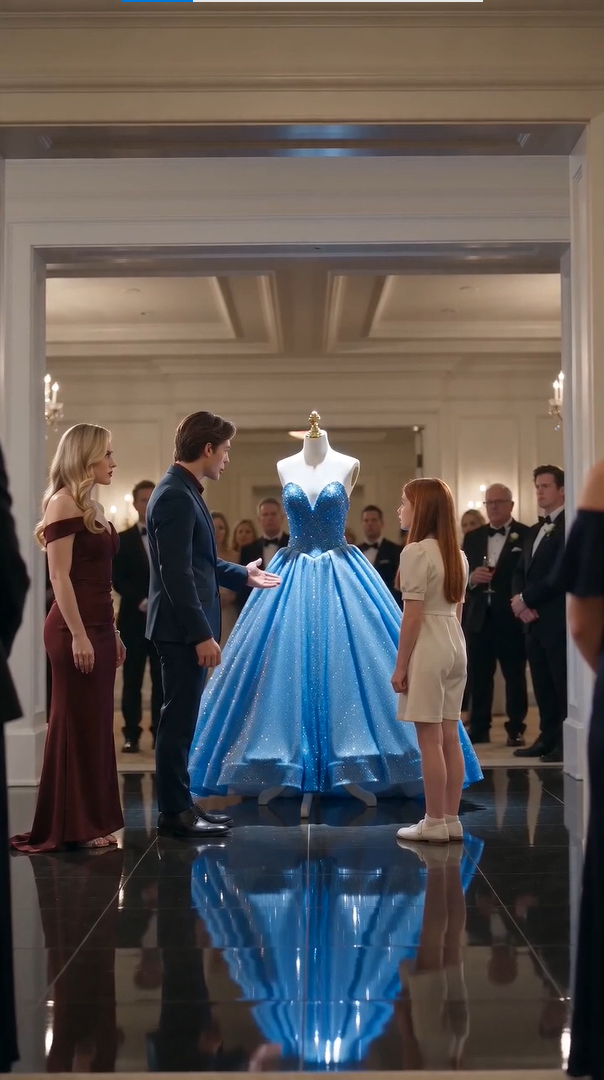
She was still half on the floor, one hand braced against the cold shine beneath her, the other trembling in the air between herself and the gown. The room around her had gone so still she could hear the tiny crackle of chandelier bulbs and the shallow, uneven rhythm of her own breathing.
No one had ever defended her in a room full of powerful people.
Certainly not like this.
The woman in red finally found her voice.
“Adrian, what are you doing?” she asked, but the sweetness was gone now. Fear had taken its place. “That gown was promised to me.”
He didn’t even look at her.
His eyes stayed on Lena.
“Take my hand,” he said softly.
There was nothing theatrical in his voice now. No performance. No display. Just something steady, almost protective.
Lena placed her shaking fingers into his, and he helped her to her feet.
A gasp moved through the ballroom.
The woman in red stepped forward, furious.
“This is insane. Do you even know who she is?”
Adrian turned then, slowly, coldly.
“Yes,” he said. “Do you?”
The question landed like a blow.
Lena looked from one face to the other, confused, frightened, still clutching the edge of her white blouse as if she needed something to hold herself together.
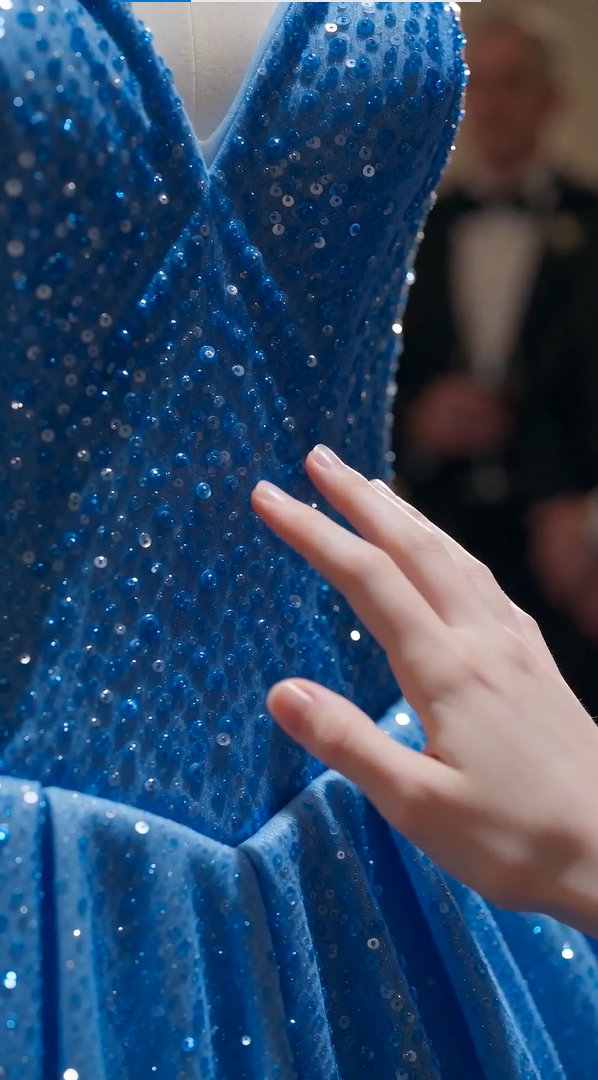
Adrian lifted the blue gown slightly.
“Do you know why this dress was made?” he asked her.
She shook her head.
He swallowed hard, and for the first time the room saw that this calm, commanding man was carrying something painful too.
“My mother designed it,” he said. “Her last design.”
The guests grew even quieter.
Lena stared at the gown, then back at him.
“She designed it for a girl she once saw crying outside a ballroom window,” he continued. “A girl who stood in the rain, looking at the lights inside like she knew she would never belong there. My mother told me that night, ‘One day, if I ever finish this dress, it will belong to the girl who has been told no her whole life and still kept her heart soft.’”
Lena’s lips parted.
The woman in red laughed once, a hard, ugly sound.
“So what? That’s just a story.”

Adrian looked at her then, and whatever was in his eyes made her take half a step back.
“No,” he said. “What’s a story is what you told everyone.”
He reached into the inner pocket of his suit jacket and pulled out a folded paper.
Lena’s brow furrowed.
The guests leaned in.
Adrian unfolded it carefully.
“This is the letter my mother left with the dress.” His voice roughened. “It was to be opened the day the gown was chosen.”
The blonde woman’s face lost color.
Adrian read aloud.
“To my son: if the woman asking for this dress humiliates another woman to feel worthy of it, she was never meant to wear it. Give it instead to the one who reaches for beauty with trembling hands, not entitlement.”
The silence that followed was brutal.
All eyes turned to the woman in red.
Her mouth opened, but nothing came out.
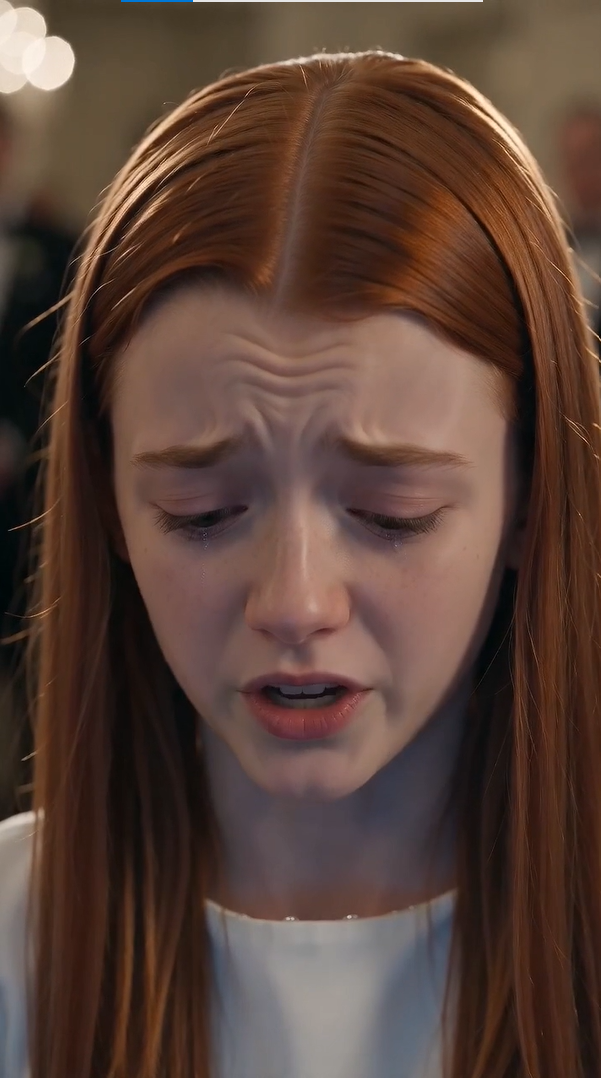
Lena felt tears gathering again, but this time it wasn’t shame.
It was something far more dangerous.
Hope.
Adrian stepped closer and lowered his voice so only she and the nearest guests could hear.
“When you touched this dress,” he said, “I recognized you.”
Lena blinked, confused.
“Me?”
He nodded slowly.
“You work downstairs in the alterations room, don’t you?”
Her eyes widened.
She hadn’t told anyone that.
Every night after the boutique closed, she secretly repaired loose hems, replaced missing beads, and mended damaged seams for almost no money, hoping if she worked hard enough, someone would one day notice.
Adrian’s expression softened.
“I found your stitching inside the damaged sleeve this morning. Invisible hand-finishing. Clean repair. Better than half the designers in this room.” A faint, broken smile touched his mouth. “You didn’t just reach for the dress, Lena. You helped save it.”
The room shifted again, this time not with cruelty, but with stunned respect.
The woman in red looked around and understood, too late, that the crowd which had stood silently for her power was no longer with her.
Lena’s hand flew to her mouth.

“You know my name?”
Adrian nodded.
“I made sure I did.”
Tears spilled freely now.
He raised the gown one last time.
“This dress was never hers,” he said, his voice carrying across the ballroom. “It was waiting for someone with grace. Someone with dignity. Someone who knows what it means to be broken in public and still remain kind.”
Lena looked at the royal blue fabric glowing between them, then at the people who had watched her fall, then at the woman in red whose face had gone pale with disbelief.
For the first time in her life, she did not feel small.
She reached out with trembling fingers and touched the gown.
Not like a beggar.
Like someone finally being seen.
And as the room watched in silence, Adrian placed the hanger gently into her hands.
The blonde woman whispered, “You can’t do this…”
But no one was looking at her anymore.
Because in that bright ballroom, on those glossy reflective floors where humiliation had nearly buried her, a poor young woman stood holding the most beautiful dress in the room, and for the first time, everyone else was the one forced to face what they truly were.
Lena stood there with the gown pressed against her chest.
She didn’t know what to say.
All her life, she had learned how to disappear.
In the back hallways.
Behind sewing machines.
Under fluorescent lights.
Inside rooms where women like the one in red threw dresses on the floor and expected someone like Lena to pick them up without being noticed.
She had been trained by life to lower her eyes.
To say sorry even when she was the one bleeding.
To accept crumbs and call them chances.
But now, every eye in that ballroom was on her.
And somehow, for once, she didn’t want to run.

Adrian looked at her gently.
“You don’t have to decide anything tonight,” he said.
The woman in red suddenly snapped out of her shock.
“You are humiliating me in front of everyone.”
Her voice cracked on the last word, not from pain, but from disbelief that the room was no longer protecting her.
Adrian turned toward her.
“No,” he said quietly. “You did that yourself.”
She looked around, desperate for someone to defend her.
No one stepped forward.
The same guests who had laughed when Lena fell now stared at the floor.
Some looked embarrassed.
Some looked ashamed.
Some looked afraid that someone might remember exactly how loudly they had laughed.
The woman in red lifted her chin.
“She works downstairs,” she hissed. “She fixes dresses. That doesn’t make her one of us.”
Lena flinched.
Only a little.
But Adrian saw it.
And the room saw it too.
His voice dropped colder.
“You’re right about one thing. She is not like you.”
The woman in red’s eyes narrowed.
Adrian stepped closer.
“She repairs what others damage. You damage what others touch.”
A quiet sound moved through the room.
Not laughter.
Not applause.
Something heavier.
Truth settling where cruelty had been sitting a moment before.
The woman in red’s face twisted.
“You’ll regret this.”
Adrian didn’t blink.
“The only thing I regret is letting you stand near my mother’s work for this long.”
Her face burned red.
She turned sharply, but before leaving, she looked at Lena one last time.
It was the same look Lena had seen so many times before.
A look meant to shrink her.
To remind her of where she came from.
To tell her this moment would end.
But this time, it didn’t work.
Lena held the gown tighter and looked back.
Not with hatred.
Not with victory.
Just with a quiet strength that made the woman in red look away first.
That was when the first clap sounded.
Small.
Slow.
From somewhere near the back of the room.
Then another.
Then another.
Soon the ballroom filled with applause.
But Lena didn’t smile.
Not yet.
Because applause from people who had watched her suffer felt strange. Almost painful.
They had clapped too late.
They had respected her only after someone powerful told them to.
And some part of her knew that mattered.
Adrian seemed to understand.
He raised one hand, and the applause slowly faded.
Lena looked down at the gown again.
“It’s too beautiful,” she whispered.
Adrian shook his head.
“No. It’s just cloth until the right person gives it meaning.”
Her eyes filled again.
“I can’t wear something like this.”
“Why not?”
She gave a broken little laugh.
“Because people like me don’t wear gowns like this. We fix them. We steam them. We carry them. We stand in the corners and make sure they don’t tear.”
Adrian’s expression softened with pain.
“My mother started in a room just like yours.”
Lena looked up.
“She did?”
He nodded.
“She sewed labels into coats when she was sixteen. She ate dinner standing up between shifts because she couldn’t afford to stop working. People told her she should be grateful just to touch expensive fabric.”
His eyes moved to the gown.
“So she promised herself that one day, she would make clothes for the women nobody saw.”
Lena’s grip tightened around the hanger.
Adrian swallowed.
“She didn’t live long enough to finish that dream.”
For the first time, the room did not feel like a place built for beauty.
It felt like a place full of ghosts.
Old sacrifices.
Hidden hands.
Women bent over needles while others took the credit.
Lena looked at the gown differently now.
Not as a prize.
As a promise.
Her voice came out barely above a whisper.
“What do you want me to do?”
Adrian’s answer was simple.
“Walk with it.”
Lena’s eyes widened.
“What?”
“Not for them,” he said. “For every person downstairs who has ever been treated like they were invisible.”
Her heart slammed against her ribs.
“I can’t.”
“You can.”
“I’ll fall.”
“Then I’ll help you stand again.”
That sentence broke something inside her.
Not in a cruel way.
In the way a locked door breaks when someone finally turns the right key.
Lena looked around the ballroom.
At the women in jewels.
At the men in black suits.
At the shining floor where she had been pushed down.
At the gown in her hands.
Then she looked at the doorway leading to the back hall.
Downstairs, under this glittering room, there were seamstresses with tired eyes. Pressers with burned fingers. Cleaners with aching backs. Assistants who knew every designer’s name but whose own names no one bothered to learn.
People like her.
People who kept beauty alive but were never invited to stand inside it.
Lena breathed in.
Then she nodded.
Not confidently.
Not proudly.
But honestly.
Adrian gave the smallest smile.
A few attendants moved toward her, but Lena stepped back.
“No,” she said softly.
They stopped.
She looked down at the gown.
“I’ll carry it myself.”
Adrian’s face changed.
Respect.
Not pity.
Respect.
The music, which had been silent since the fall, began again, low and slow.
Lena walked to the center of the ballroom.
Every step felt impossible.
The royal blue gown flowed over her arm like moonlight caught in water. Her plain white blouse was wrinkled from the fall. Her black skirt was simple. One knee still hurt. Her palm still burned from hitting the floor.
She did not look like the women who usually crossed that room.
She looked like someone who had survived it.
And that made her more powerful than all of them.
Halfway across the floor, she heard someone whisper, “That’s the girl from alterations.”
Another voice answered, “She fixed the gown.”
Then another.
“She saved it.”
The words followed her, not as mockery this time, but as proof.
Lena reached the end of the ballroom, turned, and faced them.
The lights caught the gown.
The blue fabric glowed.
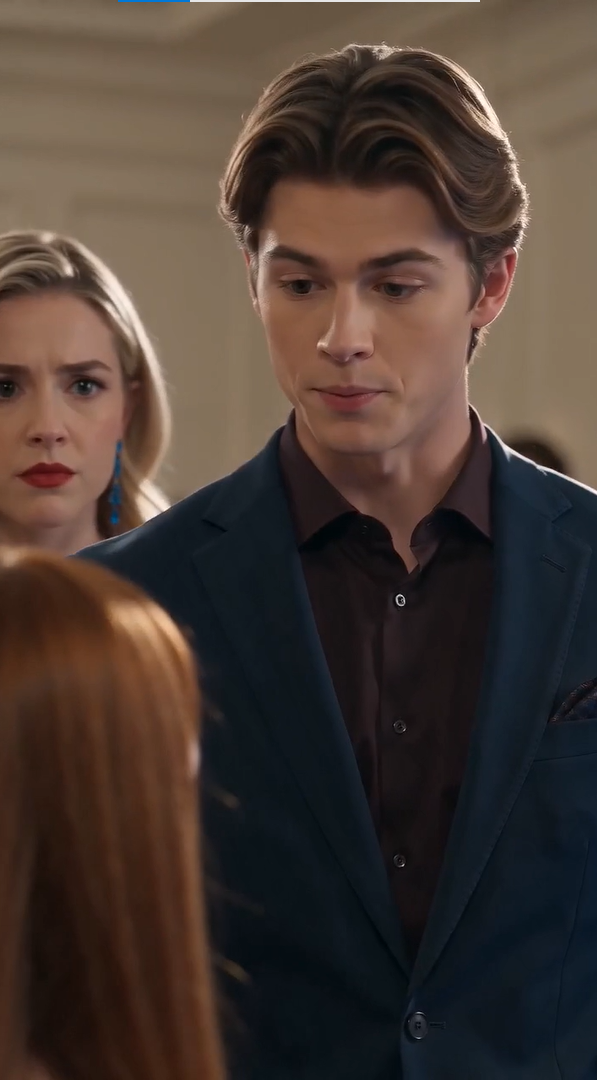
Adrian stood near the front, watching her with his mother’s letter still in his hand.
Lena’s lips trembled.
For a moment, she saw herself years ago, a little girl outside a boutique window, staring at dresses she was never allowed to touch.
She remembered her mother’s hands, rough from cleaning houses, smoothing Lena’s hair and saying, “Beauty is not for people like us, baby. But don’t let that make your heart ugly.”
Lena had hated those words.
Because they sounded like giving up.
But now she understood.
Her mother had not been telling her she was unworthy.
She had been warning her not to become cruel just because the world was.
Lena lifted her chin.
And for the first time, she let the room see her fully.
Not hidden.
Not apologizing.
Not bending.
Just standing.
The applause came again.
This time, it was slower.
Quieter.
More careful.
Lena did not need it, but she accepted it.
Then she walked back to Adrian.
Her hands were still shaking when she returned the gown.
But Adrian didn’t take it.
He looked confused.
Lena placed it gently across his arms.
“I can’t accept your mother’s dress as a gift,” she said.
The room went silent again.
Adrian frowned slightly.
“Lena…”
She shook her head.
“Please. Let me finish.”
He stayed quiet.
She touched the edge of the fabric with reverence.
“This dress means too much. It belongs to your mother’s dream. Not to me alone.”
Adrian watched her carefully.
Lena swallowed.
“I don’t want it because everyone saw me cry. I don’t want it because someone felt sorry for me. And I don’t want it because another woman was cruel.”
Her voice grew stronger.
“I want to earn my place in a room like this without becoming like the people who made me feel small.”
A tear slipped down Adrian’s face before he could stop it.
Lena continued.
“If your mother wanted this gown to belong to the girl who was told no her whole life, then let it belong to all of them.”
Adrian’s eyes searched hers.
“All of them?”
Lena nodded toward the back hall.
“The women downstairs. The girls outside the windows. The people sewing in silence. The ones who think beauty will never open the door for them.”
She looked at the gown again.
“Put it on display. Let it fund scholarships. Training. Fair wages. Real positions. Let it become the first dress in your mother’s foundation.”
The room was silent.
Not because they were shocked this time.
Because they were ashamed of how much bigger her heart was than theirs.
Adrian looked down at the gown.
For years, he had protected it like a relic.
Something too precious to touch.
Something frozen in grief.
But Lena had seen what he had not.
His mother’s dream was never about one dress.
It was about opening the door.
He looked back at her.

“What would we call it?”
Lena did not hesitate.
“The Window Fund.”
Adrian’s breath caught.
Because he understood immediately.
The girl outside the window.
The dream inside the glass.
The world that said no.
His mother would have loved it.
He nodded slowly.
“The Window Fund,” he repeated.
Then he turned to the room.
“My mother’s final gown will not be sold tonight,” he announced. “It will become the first piece in a fund for workers, seamstresses, apprentices, and young designers who have been shut out of rooms like this.”
The guests listened without moving.
Adrian’s voice hardened.
“And the first name attached to it will be Lena’s.”
Lena looked at him, stunned.
He faced her again.
“Not as charity,” he said. “As credit. You restored the sleeve. You protected the work. You understood the heart of it better than anyone here.”
Lena pressed a hand to her chest.
“I don’t know what to say.”
“Say yes to one thing,” he said.
She looked wary.
“What?”
“Come out of the basement.”
Her eyes filled.
Adrian stepped closer.
“Work with me. Not hidden. Not underpaid. Not invisible. I want you in the design room.”
The words seemed to knock the air out of her.
For years, she had imagined someone saying something like that.
Usually at night, when the building was empty.
When she sat alone with a needle in her hand, whispering ideas to dresses that would never carry her name.
But dreams feel different when they arrive in front of witnesses.
They feel dangerous.
Heavy.
Real.
“What if I’m not good enough?” she whispered.
Adrian looked at the repaired sleeve, then at her.
“You already are.”
A sob rose in her throat.
She tried to hold it back, but failed.
Adrian did not touch her this time.
He simply stood there and let her cry with dignity.
That mattered too.
Because not every tear needed to be rescued.
Some tears needed to be witnessed.
Near the back of the ballroom, the doors opened quietly.
The women from the alterations floor had gathered there.
Some still wore measuring tapes around their necks.
One had thread stuck to her sleeve.
Another had a thimble on her finger.
They must have heard everything from the hallway.
Lena turned and saw them.
Her face crumpled.
The oldest seamstress raised her hand to her mouth.
Her eyes were wet.
For a moment, Lena was no longer standing before the rich.
She was standing before the people who had known her hunger.
Her long nights.
Her careful stitches.
Her silent hope.
One of the women whispered, “Go on, girl.”
That was all it took.
Lena nodded through her tears.
“Yes,” she said.
Adrian smiled.
“Yes?”
She wiped her face.
“Yes. I’ll come out of the basement.”
The room erupted again.
But this time, Lena wasn’t listening to the wealthy guests.
She was looking at the women in the doorway.
And they were clapping like one of their own had finally broken through a wall.
Later that night, after the cameras were gone and the guests had emptied out, the ballroom looked different.
Less powerful.
Less frightening.
Just a room.
Chairs pushed back.
Champagne glasses half full.
Flowers beginning to droop.
The glossy floor still reflected the chandeliers, but it no longer reflected Lena’s humiliation.
It reflected her standing.
Adrian found her near the gown.
It had been placed carefully on a mannequin by the window, where the city lights shimmered behind it.
Lena stood in front of it quietly.
“You should go home,” he said gently. “It’s late.”
She smiled faintly.
“I know. I just wanted to look at it one more time.”
Adrian stood beside her.
For a while, neither of them spoke.
Then Lena said, “Your mother must have been kind.”
Adrian’s eyes softened.
“She tried to be.”
“That’s harder than being powerful,” Lena said.
He looked at her.
She kept her eyes on the gown.
“Power can make people loud. Kindness makes people brave.”
Adrian looked down at the letter in his hand.
“I think she would have liked you.”
Lena smiled through the last of her tears.
“I think I would have liked her too.”
He handed her the folded letter.
Lena stepped back.
“No. That’s yours.”
“I know,” he said. “But read the last line.”
Slowly, she took it.
Her fingers moved carefully over the paper.
At the bottom, beneath his mother’s written words, one final sentence waited.
A dress can be beautiful, but the right woman can make it honest.
Lena pressed the letter to her heart.
For the first time that night, she smiled.
Not a broken smile.
Not a nervous one.
A real one.
Six months later, the same ballroom opened its doors again.
But this time, the people entering were different.
There were young girls in borrowed dresses.
Mothers in simple shoes.
Seamstresses with their names printed on badges.
Students carrying sketchbooks.
Workers who had spent years entering through back doors now walked through the front.
And by the window, glowing under soft light, stood the royal blue gown.
A small gold plaque rested beside it.
The Last Design of Celeste Vale
Restored by Lena Moretti
First piece of The Window Fund
For every girl who was told beauty was not for her
Lena stood near the display, wearing a simple black dress she had designed and sewn herself.
No diamonds.
No borrowed name.
No fear.

Adrian watched from a few feet away as a little girl pressed her hand to the glass and stared at the gown with wide eyes.
Lena noticed.
She walked over and knelt beside her.
The girl quickly pulled her hand back, embarrassed.
“Sorry,” she whispered. “I didn’t mean to touch it.”
Lena’s chest tightened.
She knew that voice.
The voice of a child already learning to apologize for wanting something beautiful.
Lena smiled gently.
“What’s your name?”
“Mia.”
Lena looked at her sketchbook.
“Do you like dresses, Mia?”
The little girl nodded.
“I draw them. But they’re not good.”
Lena opened the sketchbook and looked at the uneven lines, the wild colors, the tiny notes written in the margins.
She saw mistakes.
She saw hunger.
She saw herself.
“These are not bad,” Lena said.
Mia looked up, stunned.
“They’re just waiting for you to keep going.”
The little girl’s eyes filled with wonder.
Behind them, Adrian smiled softly.
Lena handed the sketchbook back.
Then she pointed to the gown.
“Do you know why that dress is here?”
Mia shook her head.
Lena’s voice softened.
“Because once, a girl reached for something beautiful, and everyone laughed.”
Mia’s face fell.
“What happened?”
Lena looked at the blue gown.
Then at the ballroom.
Then at the open doors.
“She stood up,” Lena said. “And after that, the door stayed open.”
Mia looked toward the entrance, where more girls were walking in with their mothers, their sisters, their teachers, their dreams.
Lena stood slowly.
Across the room, the oldest seamstress from downstairs caught her eye and raised a glass.
Lena laughed quietly and raised her hand back.
For years, she had believed that being seen meant being judged.
Now she understood.
Being seen could also mean being remembered.
Being trusted.
Being given a place.
The woman in red never returned to that ballroom.
But people still spoke of her sometimes.
Not because of what she wore.
Not because of what she owned.
But because of what she revealed.
That cruelty can fill a room.
But it only takes one person with courage to empty it of power.
And Lena?
Lena never forgot the floor.
She never forgot the laughter.
She never forgot the moment her fingers trembled before touching the gown.
But she also never forgot the hand that helped her up.
Years later, when people asked how her career began, they expected a glamorous story.
A mentor.
A competition.
A famous name.
Lena would simply smile and say, “It began the night I fell in front of everyone.”
Then she would look toward the royal blue gown, still glowing by the window, and add,
“And the night I learned that falling is not the end of a story, if someone finally lets you stand.”
And from that night forward, no girl who entered that ballroom had to look through the window and wonder if beauty belonged to someone else.
The door was open now.
And Lena made sure it never closed again.