I brought my husband lunch because he said he had worked all night.
I found him in the office break room with his new secretary, whispering the same word he used to call me.
I did not scream. I recorded three minutes and seventeen seconds, uploaded it to his company’s Slack channel, and walked out before the whole seventeenth floor learned what kind of man their vice president really was.
It was late June in Chicago, the kind of hot, heavy afternoon when the air feels wet before rain even thinks about falling. The sidewalks shimmered under the noon sun. Traffic crawled between glass towers. Men in rolled-up sleeves carried iced coffees like emergency medicine. Women in linen dresses crossed intersections with sunglasses on and impatience in their steps. Everything looked alive, expensive, moving.
I stood beneath the enormous glass façade of Ryan’s office building holding a pastel-blue insulated thermos against my chest.
The thermos had two little bears printed on the front.
I bought it for our third wedding anniversary because Ryan used to forget lunch during deadline weeks, and his stomach would punish him for it at night. Back then, when I gave it to him, he laughed and said, “Sarah, this thermos is fancier than my briefcase.”
Back then, he still looked at me like I was a place he wanted to come home to.
Inside the thermos was beef and potato stew I had started at six that morning. I browned the meat carefully, simmered it low, skimmed the fat twice, added carrots only after the potatoes softened, because Ryan hated mushy carrots. I had done all of it while he slept off what he called an all-nighter. He had come home at two in the morning smelling faintly of alcohol and unfamiliar perfume, kissed my forehead without really seeing me, and said the marketing team was under impossible pressure.
“It’ll all be worth it when this project closes,” he told me, one arm around my waist. “After this, Iceland. I promise. You and me. Northern lights.”
I had believed him because I was very good at believing Ryan.
The elevator carried me up in silence. Its mirrored walls reflected a thirty-year-old woman in black slacks, a beige cardigan, and practical flats, hair twisted into a loose bun at the nape of her neck. A wife. A woman with no visible catastrophe attached to her. A woman who had spent seven years loving one man and three years married to him, arranging her days around his appetite, his sleep, his career, his parents, his stress, his favorite shirts, his preferred brand of antacid, his quiet moods, his bright ambitions.
When the elevator opened on the seventeenth floor, the receptionist looked up.
Ashley was young, red-haired, and usually warm with me. That day, her smile arrived a second too late.
“Mrs. Davis,” she said. “Bringing lunch for the VP again?”
“For the all-nighter survivor,” I said lightly, lifting the thermos. “Beef stew.”
Her eyes flicked toward the hallway.
Just once.
Small.
But enough.
“Ryan’s in a meeting right now,” she said quickly. “You can wait in the lounge if you want.”
“It’s okay. I’ll leave it in his office.”
“Mrs. Davis—”
I smiled, already walking. “I know the way.”
The hallway smelled like carpet cleaner, coffee, printer heat, expensive cologne, and the sterile ambition of a place where people spent too much of their lives trying to look calm. I had walked that hallway so many times over the years. Holiday parties. Client receptions. Forgotten files. Birthday cupcakes for Ryan’s team. Gift cards for assistant promotions. Every corner had a memory attached to it, each one small enough to seem harmless until later, when you realize how much of your life you have been carrying into someone else’s world while they kept parts of that world locked.
Ryan’s office door was slightly open.
I pushed it gently.
Empty.
His desk was immaculate. Black surface, neat file stacks, dark monitor, framed industry award, a sleek pen holder I bought him because he said executives should not use cheap pens. On the windowsill, the succulent I had given him two years earlier was thriving, plump and green in its ceramic pot. He had once joked it was the only living thing in his office that required less care than he did.
There was perfume in the air.
Not mine.
Not his cologne.
Something sweet, powdery, young.
I set the thermos on his desk and almost called him. My thumb hovered over his contact, but then I stopped. If he was truly in a meeting, I would be bothering him. That was how my mind still worked. Even with that unfamiliar scent in the room, even with Ashley’s delayed smile, even with the small hard knot forming under my ribs, I was still protecting his convenience.
Down the hall, the employee break room door was closed.
The frosted glass blurred light and shadow. I would have walked past it if I had not heard the sound.
A muffled noise.
Soft.
Wet.
Not a laugh.
Not pain.
Something intimate enough to make my body understand before my mind allowed it.
I stopped.
My hand moved to the door handle before I chose to move it. The metal was cold. I remember that clearly. The coldness of the handle saved me from opening the door too fast. It grounded me in one exact fact: if I pushed that door open, whatever waited on the other side would become real forever.
Then I heard his voice.
“Baby, don’t be scared. No one comes around at this time.”
Ryan.
My husband.
The voice I had known since college. The voice that had read wedding vows to me. The voice that had once cracked in a hospital room when we lost our son at five months. The voice that had whispered into my hair, “We still have each other.”
Baby.
The word did not belong to me anymore.
For one second, my whole body went hollow. Blood drained from my fingers, then rushed back so violently my ears rang. I wanted to believe I had misheard. That grief, suspicion, and exhaustion had distorted some ordinary office conversation into betrayal.
Then a woman laughed.
“Ryan, not here,” she said, breathy and sweet, pretending reluctance badly. “What if someone comes?”
“It’s more exciting here,” he murmured.
Then came the rustle of clothing.
A kiss.
Another.
A sound I wish I could forget, but some sounds enter the bones and stay there.
I did not open the door.
I did not scream.
I did not cry.
A different woman inside me woke up instead.
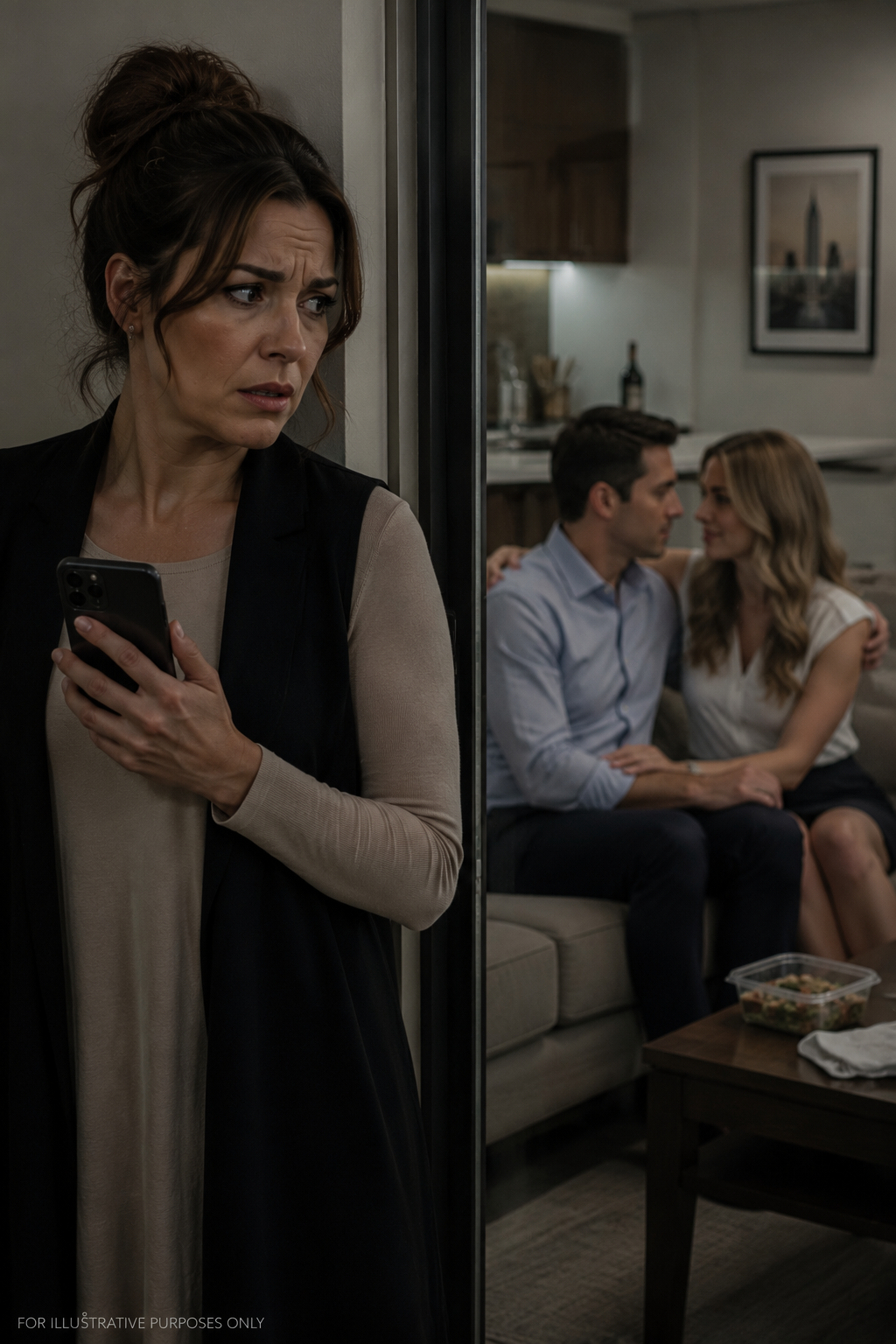
She was quiet. She was cold. She understood evidence before emotion. She gently released the handle, stepped back, took out her phone, opened the camera, switched to video, and lowered the lens toward the narrow gap beneath the frosted glass.
The lighting was dim, but not useless.
Through the lower gap, I could see the corner of the break room sofa. Dark gray dress pants around a man’s ankles. A woman’s pale calves wrapped around his waist. Black lace on the floor. Ryan had once told me lace looked cheap. He had said he preferred simple things on me.
Apparently, he had preferences reserved for women who were not his wife.
I recorded for three minutes and seventeen seconds.
My fingers did not shake.
I adjusted the angle once so the window light outlined them better. I caught his voice. Her voice. His laugh. Her name when he said it.
Chloe.
His new executive assistant.
Twenty-six, maybe. Hired two months earlier. Pretty in a sharp, eager way. I had brought cupcakes her first week because Ryan said she was nervous and trying hard.
The video saved.
Then I backed it up to iCloud.
Even then, even standing in that hallway with my marriage dying ten feet away, some practical part of me thought: the audio is clear, the date is embedded, the workplace is identifiable, their faces will be visible when they move.
Enough.
Enough to kill a lie.
The noises behind the door grew louder. Ryan whispered something obscene in the same low voice he used when he asked me to rub his neck after long meetings. My stomach turned. That morning’s toast and milk rose in my throat. I swallowed it down.
I went back to his office.
The thermos sat on the desk, absurdly cheerful, the two little bears smiling up at me as if marriage were still something soft.
I unscrewed the lid.
The steam rose, rich with beef, thyme, potatoes, carrots. I took the spoon from the side pocket, scooped a small bite, and put it in my mouth.
It was perfect.
Tender. Warm. Balanced.
For some reason, that almost broke me.
Not the bodies. Not the word baby. Not the lace.
The stew.
Because I was a good wife.
I had been such a good wife.
My phone buzzed.
A text from Ryan.
Sarah, don’t bring lunch today. Got pulled into a last-minute meeting. Grab something good for yourself.
I stared at the message.
Maybe he sent it one-handed. Maybe after. Maybe while Chloe adjusted her dress. Maybe while smiling at how easily I would believe him.
I typed back.
Okay. Make sure to get some rest.
What a considerate wife.
Footsteps sounded in the hall. I put my phone in my purse, screwed the thermos shut, and slipped into the stairwell just as Brenda from HR rounded the corner talking into her phone.
“Yeah, I think something’s off too,” Brenda was saying. “Ryan’s new EA has only been here two months, and already—”
The fire door closed behind me.
I leaned against the cold metal and finally trembled.
Not grief.
Not yet.
Something closer to electricity.
The company Slack app buzzed on my phone.
I had been added to Ryan’s workplace channel a year earlier for holiday planning and charity events. I never spoke there. I was the vice president’s wife, useful when cupcakes were needed, silent the rest of the time.
Three hundred and twenty-seven members.
Marketing. Sales. HR. Finance. Engineering. Executives. Assistants. Managers. Interns. The people Ryan led, impressed, intimidated, and lied beside.
I opened the channel.
My thumb selected the video.
The file name appeared automatically.
2026-06-16_12-23.
A date. A time. A monument.
My finger hovered over send.
I knew what pressing it meant.
My marriage would not recover.
Ryan’s career might not recover.
Chloe’s reputation would collapse.
My own life—the comfortable, pretty, carefully maintained life I had built around being Sarah Davis, good wife, supportive wife, patient wife—would shatter.
Then from behind the break room door, Chloe giggled.
“Doesn’t your wife bring lunch every day?” she asked. “Don’t you ever get tired of those same little dishes?”
Ryan laughed.
That laugh finished what the affair had started.
“My wife loves feeling needed,” he said, lazy and satisfied. “It keeps her busy.”
My finger came down.
Upload.
Ten percent.
Thirty.
Seventy.
One hundred.
Sent.
For three seconds, nothing happened.
Then Slack exploded.
What the hell is this?
Is that Ryan?
WAIT IS THAT CHLOE???
Jesus Christ.
Who posted this?
Delete this NOW.
Too late. I already downloaded it.
The screen scrolled faster than I could read. Shock. Emojis. Names. Disbelief. Someone tagged HR. Someone tagged Ryan. Someone tagged the CEO. Someone wrote, “Break room?? Are you kidding me?”
I muted the channel.
Then I walked down seventeen flights of stairs.
Each step echoed like a countdown.
By the time I reached the lobby, Ryan was calling.
I did not answer.
He called again.
Then again.
Then a text.
Sarah. Answer the phone. Something huge just happened.
Yes, Ryan.
Something huge had happened.
I walked out into the blinding June sun. The city was still moving. Taxis honked. A hot dog vendor shouted lunch specials. Two women in suits crossed the street laughing. The world did not stop for my ruined marriage.
Why would it?
I passed the corner coffee shop and saw myself in the window reflection.
Pale.
Calm.
Almost smiling.
I was still holding the thermos.
I walked to a trash can, paused, and dropped it in.
The pastel-blue bears disappeared among coffee cups and takeout wrappers. The lid came loose, and the stew spilled slowly into the garbage, rich and glossy beneath the sunlight.
“All right,” I whispered. “Now I can eat something I actually like.”
Across the street was a sushi bar I had loved in college. Ryan hated raw fish. Said it was unhealthy, overrated, unsanitary. For seven years, I had not gone.
I went in.
The host smiled. “Just one?”
“Just one,” I said.
I ordered a deluxe sashimi platter and warm sake.
By the window, I could see Ryan’s building. I imagined the seventeenth floor in chaos. People leaving desks. HR running down hallways. Someone knocking on the break room door. Ryan fumbling with his belt. Chloe crying. Ashley covering her mouth at reception.
I poured sake into a small cup and drank it in one swallow.
It burned.
Good.
The salmon arrived cold and clean, almost buttery. I put the first piece in my mouth and remembered Ryan in college, twenty-three years old, broke and bright-eyed, splitting a two-dollar pizza slice with me near campus.
“When I make real money,” he had said, “I’ll take you to high-end sushi every day.”
He did make real money.
We never went.
Maybe it was never the sushi he disliked.
Maybe it was me.
That was when the tears came.
Quietly.
One line at a time.
They slipped down my face and into the sake cup, salty, bitter, real.
Outside, the office doors burst open.
Ryan ran into the sun.
His hair was messy. His shirt was buttoned wrong. His face was red with panic. He looked around wildly, searching for me. He turned toward the street, toward taxis, toward the parking garage.
Not toward the sushi bar.
He thought I had gone home.
Of course he did.
He thought I would be waiting there, crying in the kitchen, ready to hear explanations. Ready to ask why. Ready to let him tell me Chloe meant nothing, the video was taken out of context, the marriage could still be saved, he had been stressed, lonely, seduced, confused.
He hailed a cab and disappeared in the direction of our house.
I finished my sake.
I paid the bill.
The waiter hesitated when he brought my receipt. “Miss, are you all right? Do you need me to call you a ride?”
“No, thank you,” I said. “I’m perfectly fine.”
And somehow, in that moment, I was.
Outside, I turned my phone back on.
Ninety-nine missed calls.
Messages beyond counting.
Ryan. His mother. His father. Unknown numbers. Slack DMs. Brenda from HR. Ashley. My mother. My best friend Jess.
I ignored everyone except Jess.
She answered on the third ring, voice sleepy. “Sarah? Why are you calling in the middle of the day?”
“I’m getting a divorce.”
Silence.
Then the bed-creak sound of someone sitting bolt upright.
“What did Ryan do?”
“I’m at our old coffee shop on Lincoln,” I said. “Bring whiskey.”
“I’ll be there in twenty-five.”
She arrived in twenty-three, hair wild, silver flask in hand, fury already lit behind her eyes.
She grabbed my shoulders before sitting. “Did he hit you?”
“No.”
“Cheat?”
“Yes.”
“I knew it.”
“He did it with his new EA in the office break room.”
Jess’s mouth fell open.
“I recorded it,” I said. “Then I posted it to his company Slack.”
Her mouth stayed open.
For a full five seconds.
Then she slapped the table so hard both coffees jumped.
“That,” she said, “is art.”
I laughed.
It came out broken, but it was still laughter.
We drank coffee with whiskey. Then hot chocolate with more whiskey. Then the owner, who still recognized us from college, brought a slice of cake with courage written in chocolate across the plate. I cried then. Harder. Uglier. Jess sat beside me instead of across from me and let me fall apart in public without making me feel ashamed.
“Seven years dating,” I said through tears. “Three years married. Ten years for three minutes and seventeen seconds.”
“No,” Jess said, fierce and steady. “Ten years brought you here. Those three minutes set you free.”
That night, I did not go home.
Jess took me to her apartment. I vomited once from whiskey and shock. She held my hair. I slept eighteen hours beneath her heavy blackout curtains and woke with a splitting headache, swollen eyes, and the strange realization that the worst day of my marriage was also the first day of the rest of my life.
Jess was waiting with honey water.
“Drink,” she ordered. “You threw up everything but your backbone.”
I drank.
Then she told me the damage.
Ryan’s company had detonated. The video spread beyond Slack before HR could delete it. Investors attached to his big project sent a morning email expressing concern about “leadership judgment and workplace misconduct.” Chloe tried to resign, but HR suspended the process pending investigation. Ryan had gone to our house, then my parents’ house, then Jess’s building, where he sat in his car until three in the morning.
My father’s blood pressure had spiked after Ryan showed up.
That was what made me sit up fully.
“Dad?”
“He’s okay,” Jess said quickly. “Hospital observation. Your mom called. They support you. Completely.”
I called my mother.
She answered on the first ring.
“Sarah?”
“Mom.”
She started crying before I finished the word.
My mother was a gentle woman. Soft-spoken. Polite even to telemarketers. But when she said Ryan’s name that morning, she used words I had never heard come out of her mouth.
“Trash,” she said. “That man is trash. Your father wanted to take a baseball bat to him.”
I laughed through tears.
Then I told her I was not going back.
“Good,” she said. “Come home if you need to. Your room is ready. It will always be ready.”
“I have an interview today.”
“An interview?”
“At Azure Design. Senior graphic designer.”
There was a pause.
Then my mother’s voice shifted.
Pride entered before fear could stop it.
“Then go,” she said. “Go get your life.”
I visited my father before the interview. He sat in the hospital bed reading a newspaper he was not really reading. When he saw me, he put it down and reached for my hand. His grip was hard and shaking.
“He disrespected you,” he said. “That means he disrespected me.”
“I’ll handle him.”
“I know you will.”
Those four words carried more faith than any speech.
My mother pressed five thousand dollars into my hand before I left.
I tried to refuse.
She closed my fingers around the envelope. “You are our daughter. Let us be your safety net.”
I went to the interview in Jess’s beige suit, light makeup covering evidence of the night before, lipstick sharp enough to make me feel like I had a mouth again.
The design director at Azure was named Amanda. Forty-ish, bob haircut, rimless glasses, eyes that missed nothing. She flipped through my portfolio in silence.
“You’ve been out of the workforce for three years,” she said. “Why come back now?”
Because my husband was having sex with his assistant while I brought him stew.
Because I gave ten years to a man who thought need was love.
Because I remembered I used to be more than someone’s wife.
I said, “Because design is how I express myself. I never really left the field. I freelanced, studied, kept my skills sharp. The gap taught me exactly what I want.”
“Your resume says you’re married. Any issues with overtime or travel?”
“I’m filing for divorce,” I said evenly. “So no. No family burden. I need work. I want work.”
Amanda studied me.
Then smiled.
“Very honest. I like honest.”
Forty minutes later, she walked me to the elevator.
“You’re technically stronger than I expected,” she said. “Your portfolio has depth. Can you start Monday?”
For a second, I did not understand.
“I passed?”
“What else would that mean?”
I laughed. Almost cried. Held it together.
“Monday works.”
“Good. We do overtime. Sometimes all-nighters.”
“I can handle all-nighters,” I said.
I had spent years waiting up for Ryan.
At least now, if I stayed awake, it would be for myself.
That evening, I met Ryan’s mother at a café downstairs from Jess’s apartment because she sent three messages and used the phrase one last time as your mother.
She looked older than I remembered. Deep circles under her eyes. Hair uncombed. Hands trembling around a paper napkin.
“Sarah,” she said, crying almost immediately. “Ryan was wrong. He was so wrong. But ten years… can you really throw away ten years?”
“No,” I said softly. “Ryan did that.”
She flinched.
“I know he hurt you. But he might lose everything. His job. His reputation. The whole industry knows. Please, delete the video.”
There it was.
Not Are you safe?
Not What do you need?
Delete the evidence.
I looked at the woman who had knitted me sweaters, brought soup after the miscarriage, introduced me proudly as her daughter-in-law, and I felt a sorrow deeper than anger.
“I won’t delete it.”
“Sarah—”
“It is proof of what he did. It is also protection. He made his choices in daylight, in his workplace, with another woman, while lying to me. The consequences belong to him.”
“How can you be so ruthless?”
The word settled between us.
Ruthless.
I stood.
“The ruthless person is the one who betrayed his wife and expected her to stay quiet so he could keep his future.”
I placed five dollars on the table.
“The coffee is on me. Please take care of yourself. And please don’t contact my family again.”
Outside, the night wind felt cool on my face.
My phone rang from an unknown number.
I answered.
“Sarah,” Ryan said. His voice was rough, frantic. “Please. Just listen.”
“Monday at nine,” I said. “My lawyer will send the divorce agreement.”
“You can’t be this heartless. Ten years.”
“Because of those ten years, I hate you more.”
Silence.
Then a sound like a sob.
“You destroyed my trust in love,” I said. “You destroyed my belief in marriage. But most of all, you made me feel foolish for loving you honestly. I will never forgive that.”
He whispered my name.
I hung up.
Blocked the number.
And for the first time since the video, I exhaled fully.
Jess, because she was the kind of friend women pray for and rarely deserve, had gone to my house while I was at the interview. She hired movers, packed my books, clothes, portfolio files, sketchbooks, documents, and the few things that mattered.
When I walked into her apartment, my life was stacked in labeled boxes.
SARAH—BOOKS.
SARAH—CLOTHES.
SARAH—PORTFOLIO.
SARAH—IMPORTANT.
I cried again.
She said, “Don’t make it weird. I’m accepting payment in future design work.”
By Monday morning, I was on the train to my new job.
The L rattled through the city like a metal spine. Coffee breath, perfume, sweat, newspapers, tote bags, headphones, people going somewhere because life required it. For the first time in years, I did not feel like I was orbiting Ryan’s world.
I was moving through mine.
Azure Design lived inside a renovated brick factory in the West Loop. High ceilings. Polished concrete. Plants. Espresso machine. Whiteboards full of arguments. Designers wearing headphones. Project managers moving too fast.
My desk sat by the window.
On it: a new iMac, a Wacom tablet, a succulent, and a sticky note.
Welcome to the team.
A young designer named Kevin popped his head over the divider. “So you’re Sarah. Amanda said you’re a badass.”
“I think she exaggerated.”
A pixie-cut UI designer named Emily leaned in from the other side. “You did the Voice of Nature campaign, right?”
I froze.
That was the last campaign I worked on before quitting my agency job for Ryan. A small environmental nonprofit campaign. It had won an award.
“You know that work?”
“I loved that work,” Emily said. “I can’t believe you’re here.”
The world had not forgotten me.
Ryan had.
That was different.
The first account I joined was Pure Paws, a premium pet food brand. Three months to create visual identity, packaging, and launch materials. High stakes. Tight timeline. My kind of pressure.
In the kickoff meeting, I stood at the whiteboard and outlined a direction: soft vintage palette, hand-drawn ingredient illustrations, clean typography, warm but premium. Not too cute. Not too clinical. A brand that understood pets as family without making owners feel foolish.
The room went quiet.
Then Kevin said, “Damn.”
By Friday, the client loved the concept. By the following month, the product line was in motion. I found an illustrator I had worked with years earlier, Ash, who wrote back, Sarah, it really is you. I’d wondered where you went.
I wondered that too.
Where had I gone?
Into grocery lists. Into Ryan’s calendar. Into soup, laundry, hospital visits, careful silence, a marriage where I mistook being needed for being cherished.
Now I was back.
Not unchanged.
Better armed.
Ryan fought the divorce at first.
Of course he did.
His first draft demanded the house split seventy-thirty in his favor because his parents had paid the down payment and his salary covered the mortgage. He wanted an NDA. Compensation for “career damage” caused by the video. Fifteen thousand dollars for emotional distress. A clause preventing me from working in any industry connected to his.
Attorney Sterling read the draft and smiled like a man watching a bad poker player bluff with trembling hands.
“He’s panicking,” Sterling said.
“Good.”
At the settlement meeting, Ryan looked thinner, unshaven, angry enough to be ugly. He sat across from me with a new lawyer and called me vicious.
“You ruined my career,” he said.
“No,” I replied. “I recorded the fact that you ruined it.”
He sneered. “You sat at home for three years cooking and sketching, living the easy housewife life, and now you want half?”
There it was.
The sentence behind all the others.
Cooking. Sketching. Easy.
I slid my freelance contracts across the table.
“Seventeen design projects in three years,” I said. “Forty thousand dollars. Some went into household expenses. Some I saved.”
Ryan stared at the papers.
He had not known because he had never asked.
Sterling added, “Household management is also a contribution to the marital estate. So is caring for his parents. So is subsidizing expenses with freelance income. The freeloader argument is legally useless.”
Then Sterling placed another document on the table.
“Also, if Mr. Davis insists on claiming emotional distress damages, we are prepared to enter evidence of multiple inappropriate relationships during the marriage. Chloe was not the only one.”
Ryan went pale.
That was the moment I stopped seeing him as a heartbreak and started seeing him as a pattern.
He signed.
House sold, equity split evenly. Savings split evenly. My freelance account remained mine. No spousal support either way. Clean break.
As his hand shook over the signature line, he muttered, “You changed.”
I stood.
“You forced me to.”
The house sold two months later under court supervision after Ryan threatened twice to sabotage the listing and Sterling filed motions so sharp his lawyer stopped returning calls with attitude. My parents’ realtor handled the sale. I never stepped back inside.
With my share of the equity and my savings, I rented a one-bedroom apartment in the West Loop with a south-facing balcony. Jess stood in the empty living room and said, “This is where your plants go. This is where your desk goes. This is where men who don’t deserve you do not go.”
I bought sunflower-yellow sheets.
A proper desk.
Three plants.
A framed print from a local artist.
No pastel-blue thermos.
Work became oxygen.
Pure Paws launched in the fall. The packaging appeared on shelves at Whole Foods, soft sage and cream with hand-drawn chicken, oats, carrots, and little botanical details that caught the light because of the pearlescent finish I fought for. I stood in the pet food aisle staring at bags that had once been sketches on my screen.
A woman picked one up, ran her thumb across the package, and said to her friend, “This is beautiful.”
I almost cried in the store.
Not because of Ryan.
Because of me.
Chloe came to see me once before leaving Chicago.
She looked smaller without the office makeup, wearing jeans and a white T-shirt, face pale, eyes tired. We sat in a coffee shop near Azure.
“I’m moving back to Ohio,” she said. “No one will hire me here.”
I said nothing.
“I’m sorry,” she whispered. “I know it doesn’t mean much.”
“It doesn’t.”
She nodded, accepting that.
Then she slid a flash drive across the table.
“Ryan’s files,” she said. “Chats with other women. Vendor kickback records. I was going to use them against him if he abandoned me. I don’t want them anymore.”
“Why give them to me?”
“Because he should not get to keep hurting people.”
I took it.
Not because I forgave her.
Because evidence had already saved me once.
“You’re young,” I said. “Start over and do it clean this time.”
She cried.
I left before I could comfort her.
Some comfort is not owed.
Six months after the break room video, I sat in the audience at the Chicago Design Excellence Awards wearing a black dress Jess made me buy because she said, “Your revenge era deserves tailoring.”
The host stepped up to the microphone.
“For Best Consumer Packaging Design, the award goes to Pure Paws Natural Pet Food Series. Lead designer, Sarah Davis.”
The room erupted.
For a moment, I could not stand.
Then Amanda pulled me up. Kevin and Emily screamed. Jess, from the second row, jumped so high I worried about her ankle. I walked to the stage, took the crystal trophy, and felt its weight settle into my hands.
“Thank you,” I said into the microphone.
The lights were bright. My voice shook once, then steadied.
“Thank you to my team, who trusted me when I was just beginning again. Thank you to the client for believing design can make people feel before they read a word. And thank you to myself.”
A few people laughed softly.
I smiled.
“For not giving up.”
In the back row, I saw Ryan.
He looked older. Thinner. His suit hung badly. His eyes held something complicated—regret, envy, disbelief, maybe grief. Our eyes met for one second.
Then he looked away and left.
I did not watch him go.
After the ceremony, I stood outside with the trophy in my hand while the night wind came cold off Lake Michigan. The city lights shimmered across the wet pavement. My phone rang.
Mom.
“We saw the livestream,” she said, crying openly. “Your father is crying too, but he says don’t tell you.”
“I heard that,” Dad shouted in the background.
I laughed.
“Come home,” Mom said. “I made roast chicken.”
I looked up at the skyline.
The city was vast, bright, indifferent, full of people losing and finding themselves under thousands of windows.
A year earlier, I had been a woman carrying stew to a man who thought my love was something to use until he got bored.
Now I was standing in the cold with my name engraved on an award and my future opening in front of me like a door.
People always ask if I regret sending the video.
No.
I regret the years I spent not trusting the part of me that knew something was wrong. I regret shrinking my appetite, my ambition, my voice, my work, my world, until Ryan could feel large in it. I regret believing that being useful was the same as being loved.
But I do not regret the moment I stopped protecting his lie.
Because that was the moment I chose myself.
And sometimes choosing yourself does not look gentle.
Sometimes it looks like a woman standing outside a break room door, phone in hand, heart breaking silently, gathering proof.
Sometimes it looks like one click.
One upload.
One life burning down just enough to light the way out.
I went home that night to my parents’ house. My mother hugged me too tightly. My father pretended not to be emotional and failed. Jess arrived with champagne and grocery-store cake. We ate roast chicken at the kitchen table, laughing louder than necessary, crying when we needed to, passing the trophy around like something sacred and ridiculous.
Later, alone in my apartment, I placed the award on my desk beside the metal bookmark Azure had given me on my first day.
Design changes perception.
I looked at those words for a long time.
Then I opened a blank document and wrote one sentence across the top.
The day I stopped feeding a man who starved me, I finally learned what hunger was for.
I saved it.
Closed the laptop.
And slept better than I had in years.