“You don’t,” Cassian said. “Your father did.”
“My father died in a drunk-driving accident.”
“No.”
The word fell between them like a blade.
Lydia’s breath caught.
Cassian leaned forward, elbows on his knees. For the first time since she had collided with him, his voice lost its steel.
“Thomas Reed was not an actuary. That was the name he used for the world you lived in. To everyone else, he was a ghost. He built the financial architecture of the Moretti organization. Offshore accounts, shell corporations, encrypted ledgers, cash routes. He made dirty money disappear and clean money appear where powerful people needed it.”
“You’re lying.”
“I don’t lie about the dead.”
Her throat ached. “Stop.”
“I can’t.”
“You can.”
“If I stop, you die ignorant.”
That silenced her.
The car turned, smooth and heavy.
Cassian continued. “Ten years ago, Vincent Romano discovered your father existed. He wanted the master ledger. Account numbers, passcodes, routes, names. Thomas refused. Romano sent a car after yours on I-95.”
Lydia’s fingers went numb.
“No,” she said, but the word was small.
“Your father saw it coming. He turned the wheel so the impact hit his side. The glass took your sight. His choice saved your life.”
The smell returned before the memory did.
Burning rubber.
Gasoline.
Rain on hot pavement.
Her father’s hand crushing hers.
“Lydie,” he had said, voice full of blood. “Listen to the music. Always listen.”
Then his hand had stopped squeezing.
Lydia pressed her palm over her mouth.
For ten years, she had mourned an accident. A random cruelty. A wrong turn in the universe. Now Cassian had reached into that grief and given it a name.
Romano.
“You knew,” she whispered. “All this time, you knew.”
“Yes.”
“And you watched me.”
“Yes.”
The answer came too easily.
She turned her face toward him. “The Juilliard scholarship.”
“Anonymous foundation.”
“The surgeries at Johns Hopkins.”
“Paid privately.”
“The apartment security grant after the break-ins.”
“Mine.”
Her laugh broke in the middle. “You bought pieces of my life.”
“I bought the conditions that allowed you to live it.”
“That’s a beautiful sentence for something monstrous.”
Cassian accepted that without defense.
The car slowed, then descended. Lydia felt the pressure change in her ears. A steel door opened, then closed behind them with a deep boom.
“Where are we?”
“432 Park Avenue,” Cassian said. “My residence. Safest building I control.”
“I’m your prisoner.”
“You’re under my protection.”
“You say those like they’re different.”
“They can be.”
“Can they?”
He did not answer.
For three days, Lydia lived above Manhattan in a penthouse that felt less like a home than a fortress pretending to be beautiful.
She learned it barefoot.
The two-millimeter rise where marble gave way to silk carpet. The cold breath of floor-to-ceiling windows at night. The hum of the Sub-Zero refrigerator. The exact spot near the living room where the wood floor clicked under Cassian’s right shoe.
He barely slept.
At two in the morning, she would wake to his footsteps crossing the living room. Slow. Measured. Restless. A man pacing through a life he had conquered but not survived.
During the day, he was careful with her in a way that unnerved her more than cruelty might have.
A chef described every plate before placing it in front of her. Clothes appeared in drawers arranged by fabric and texture. Her cello was handled as if it were a sleeping child.
And every afternoon, Cassian sat in the corner while she played.
He never requested a song.
He only listened.
Bach made his breathing slow. Dvorak made his fingers tap once against the armrest and then stop, as if he had caught himself feeling something. When she played the opening of Elgar’s Cello Concerto, he stood so abruptly she heard the chair shift.
“Enough?” she asked.
“No,” he said. “Again.”
So she played it again.
On the fourth night, the fragile rhythm shattered.
Lydia was seated near the windows, cello between her knees, when the penthouse doors burst open and Mateo rushed in.
“Boss,” he said. “Romano hit Teterboro. Hangar Four. Heavy weapons shipment. Our men are pinned down.”
Cassian’s glass touched a table with controlled force. “He’s desperate.”
“It could be bait.”
“It is bait,” Cassian said. “And I still have to answer it.”
His footsteps crossed to Lydia.
“I’ll be gone a few hours,” he said. “The building is locked down. Elevators require biometrics. Daniel stays with you.”
Daniel Varga.
Lydia knew him already.
Not by face, but by everything else.
Twenty-eight or thirty. Smoked cheap cigarettes and covered it with mint gum. Used drugstore cologne too heavily. Walked softly when Cassian was home and loosely when he was not. For two nights, she had smelled fear on him, sour beneath the tobacco.
“Daniel?” she asked.
“One of my most trusted captains.”
That, Lydia thought, was unfortunate.
Cassian’s gloved fingers brushed her cheek.
“My light,” he murmured.
Then he was gone.
The doors closed.
The penthouse changed.
Daniel’s breathing remained by the entrance for forty-seven seconds. Lydia counted them.
Then he laughed.
Not loudly. Not dramatically.
Just enough.
“The famous Lydia Reed,” he said. “Blind princess in the tower.”
Lydia set her bow down across the strings. “Cassian said you’re here to protect me.”
“Cassian says a lot of things when he’s distracted.”
The metallic whisper of a suppressor twisting onto a gun barrel sliced through the room.
Lydia’s heartbeat slowed.
Not sped.
Slowed.
That was what always happened when danger became real. Panic lived in the waiting. Once the shape of the threat appeared, her mind grew clean.
“Romano offered you money,” she said.
“Three million and Queens.”
“Cheap.”
Daniel paused.
Then he laughed again, harder this time. “You really are something.”
His footsteps moved closer.
“Cassian let his obsession with you rot his brain,” Daniel said. “You don’t burn half of New York over one girl. You don’t start a war because your dead accountant had a daughter.”
Lydia let her shoulders curl inward. Let her breathing shake. Let the helplessness come into her voice.
“I don’t know anything.”
“Sure you do.” Daniel stopped close enough that she could smell the gum on his breath. “Your father left the ledger with you.”
“My father left me music.”
“That’s what men like Thomas Reed do. They hide things in plain sight.”
His hand shot out and grabbed her hair.
Pain exploded across her scalp.
Lydia cried out, and that part was real.
“I’ll start with your fingers,” Daniel said. “One at a time. Musicians feel pain beautifully.”
Her right hand searched the floor beside the chair, trembling, blind, desperate.
At least, that was what he saw.
Her fingers found the rubber grip of her cane.
“Please,” she whispered. “I’ll tell you.”
Daniel’s grip loosened by half an inch.
“Good girl. Where’s the ledger?”
Lydia stopped crying.
Her voice changed so completely Daniel went still.
“It isn’t a ledger.”
“What?”
“I said,” Lydia replied, “it isn’t a ledger, you pathetic amateur.”
She moved.
Part 3
Lydia did not rise from the chair so much as detonate out of it.
Her left palm drove upward beneath Daniel’s jaw, striking the nerve cluster with vicious precision. His grip vanished. He stumbled back, gun still in hand, his vision bursting white for the two seconds she needed.
Her thumb pressed the hidden biometric release on the cane.
Click.
A titanium blade slid from the end.
Daniel heard it too late.
Lydia swung the cane in a tight upward arc. The blade cut across his right wrist, not deep enough to kill, but deep enough to sever control. The gun hit the marble and skidded away.
Daniel screamed.
Lydia stepped toward the sound.
He lurched backward.
She swept the cane low, striking behind his knees. His legs buckled. He hit the floor hard enough to knock the breath out of him.
Lydia followed him down and placed the blade against his throat.
“Don’t move,” she said.
Daniel froze.
Now his fear smelled honest.
“You’re not blind,” he gasped.
“I’m blind,” Lydia said. “Not helpless.”
Blood pattered onto marble from his wrist.
“I don’t understand,” he whispered.
“No,” she said. “You don’t.”
She leaned closer, the blade steady at his carotid. “My father didn’t leave me the ledger. He encoded it into a cello concerto he wrote when I was nine. Account numbers, routing codes, company names, offshore keys, everything. Eighteen pages of music.”
Daniel’s breathing became ragged.
“I memorized it when I was fifteen,” Lydia said. “Every note. Every rest. Every harmonic shift. I carry the financial skeleton of the Moretti and Romano empires in my head.”
“You knew?”
“I knew someone would come eventually.”
“Cassian?”
“I knew he was watching.” Her mouth curved faintly. “He thought he was protecting me. Men like him need that story. It makes the darkness feel noble.”
The penthouse doors exploded open.
Cassian entered like a storm in a bloodstained white shirt, gun raised, Mateo and three men behind him.
Then he stopped.
Lydia stood over Daniel Varga, blind eyes calm, blade at his throat, posture straight as a queen receiving tribute.
Mateo blinked.
“Boss,” he said flatly. “She neutralized him.”
Cassian lowered his gun by an inch.
For the first time since Lydia had met him, he seemed truly speechless.
Daniel tried to speak. Lydia pressed the blade closer.
“He sold you to Vincent Romano,” she said. “Three million and Queens.”
Mateo’s jaw tightened.
Cassian’s gaze moved from Daniel’s bleeding wrist to Lydia’s face. Shock gave way to something deeper. Admiration. Awe. A kind of dark joy.
“You knew,” he said.
“I suspected.”
“You let me bring you here.”
“I needed your resources.”
Mateo made a sound that might have been a laugh if he had been a braver man.
Cassian looked at him. “Take Daniel to the lower level. He lives until he tells us where Vincent is sleeping tonight.”
“And after?”
Cassian looked at Daniel.
Daniel began shaking.
“After,” Cassian said, “he becomes a lesson.”
Mateo dragged him out.
The doors closed.
Silence returned, but it was different now. Lydia pressed the button on her cane, and the blade retracted with a clean metallic snap.
Cassian crossed the room slowly.
“You manipulated me,” he said.
“Yes.”
His hands rose, careful enough to announce themselves before touching her face. His thumbs rested near her jaw, one tracing the little crescent scar he had known for a decade.
“I spent ten years thinking I was guarding a fragile girl in the dark.”
“I was never fragile.”
“No,” he murmured. “You were patient.”
Lydia tilted her face toward his voice. “My father was the smartest man your family ever employed. Did you really think he would leave his only daughter defenseless?”
Cassian let out a low breath.
Outside the windows, Manhattan glowed beneath them, all steel and glass and secrets.
“Vincent Romano dies tonight,” he said. “Every warehouse, every safe house, every remaining soldier loyal to him burns before sunrise.”
“I know.”
“And when it’s done?”
Lydia’s hand found his ruined tie. “When it’s done, we stop pretending this empire belongs only to men with guns.”
His mouth almost smiled. “Is that a threat?”
“No,” she said. “A correction.”
By dawn, New York had changed, though almost no one knew it yet.
Commuters still descended subway stairs with coffee in one hand and phones in the other. Delivery trucks still blocked crosswalks. Anchors on morning television still smiled through stories they did not fully understand.
But beneath the visible city, Vincent Romano’s empire collapsed before the sun cleared the East River.
His Red Hook safe apartment was found before four. His Bronx warehouse burned at four-seventeen. Queens went silent by five. Newark folded before breakfast.
The Romano family, which had existed for three decades as a shadow beside the Morettis, was gone before most of Manhattan finished its first cup of coffee.
High above the city, in the penthouse at 432 Park Avenue, Cassian sat near the glass and listened.
Lydia had taken out her cello.
She was not playing Bach, Dvorak, Elgar, or Vivaldi.
She was playing something older than grief and newer than revenge. A melody simple enough to sound innocent, but beneath it ran patterns Cassian could not yet read. Numbers hidden in intervals. Names hidden in rhythm. Empires folded into music.
Her father’s concerto.
Thomas Reed’s last weapon.
Cassian looked at Lydia as morning light warmed the city she could not see and understood, finally, what everyone else had missed.
The most dangerous person in New York had not arrived with an army.
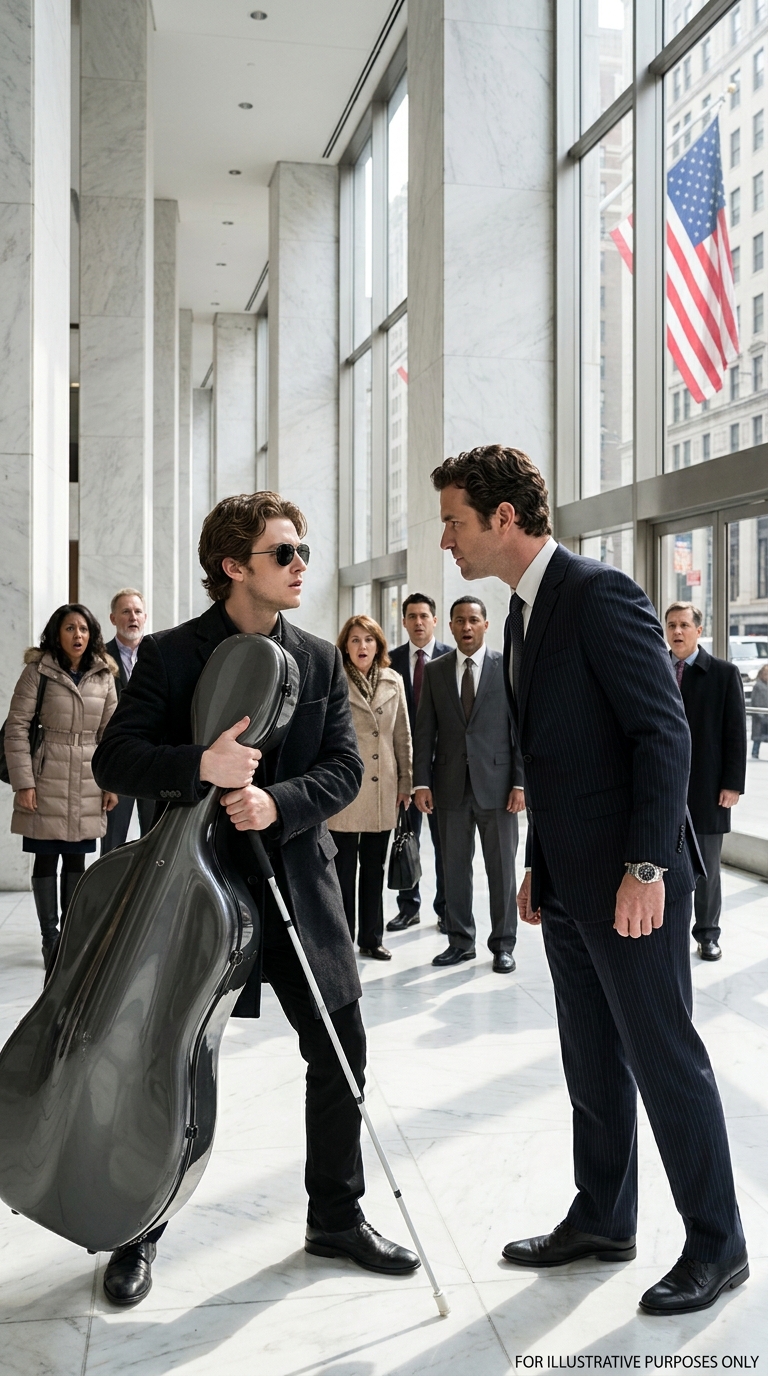
She had arrived soaked from the rain, carrying a cello, guided by a white cane, and no one had seen her coming.