Yuna blinked. “I defended myself.”
“You put your hands on Dr. Camille Reed.”
“So?”
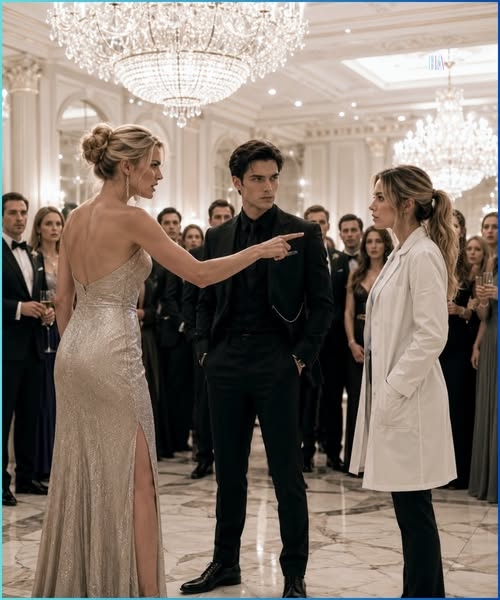
His laugh was empty. “So she is the person whose initiative half the room came to fund tonight. So she treated Jinwoo Shin privately and apparently earned his respect, which is almost impossible. So you didn’t just humiliate a doctor. You humiliated someone he decided was not to be touched.”
Yuna’s anger faltered.
“And why do I care what he decides?”
Andrew looked out the window at the Chicago lights sliding across the glass.
“Because I owe him two hundred and eighty million dollars.”
The car became very quiet.
Yuna’s hand went to her diamonds.
Andrew kept staring out the window.
“And after tonight,” he said, “I think he wants it back.”
Part 2
Camille did not sleep much that night.
Not because of the slap. She had been slapped once before, years ago, by a drunk patient in an emergency room during residency. That had been chaos, sickness, fear. This had been different. This had been social violence polished until it looked like etiquette. Yuna Cho had not lost control. She had used control like a weapon.
By morning, Camille’s cheek had faded to a faint shadow.
Her phone had not stopped buzzing.
Denise Carter, her closest colleague and the director of nursing for the outreach program, burst into Camille’s office at 8:15 with two coffees and the expression of someone who had been waiting all night to explode.
“I leave you alone for one charity gala,” Denise said, setting the coffee down, “and you get slapped by a billionaire’s wife?”
Camille continued reviewing a patient chart. “Good morning to you too.”
“Do not good-morning me. Half the hospital board is whispering about it. The other half is pretending not to whisper, which is worse.”
“Did the money clear?”
Denise stared at her.
“Camille.”
“Did it?”
“Yes,” Denise said. “The anonymous donation posted at 6:03 a.m. It’s real. The mobile units are funded. All of them.”
Camille closed her eyes for one second.
That was the part that mattered.
Not Yuna.
Not Andrew.
Not a room full of people who needed a scandal to make generosity interesting.
The clinics were funded.
Denise sat across from her, softer now. “Are you okay?”
Camille opened her eyes. “I’m angry.”
“Good.”
“I’m also tired.”
“Also good.”
“And I’m trying very hard not to think about the fact that a man people are afraid to name just solved our funding gap overnight.”
Denise leaned back. “Ah. So we’re talking about him.”
“No, we are not.”
“His name is Jinwoo Shin.”
“I know his name.”
“Do you know what people say about him?”
“People say many things when they don’t have evidence.”
“Camille.”
Camille looked up.
Denise lowered her voice. “He is not just rich. He is dangerous.”
Camille said nothing.
She knew danger. Not the kind that arrived in black cars, maybe, but the kind that sat across from her in exam rooms. Men who smiled while their wives flinched. Mothers who could not afford insulin. Teenagers with gunshot scars who joked too loudly because silence might break them. Camille had built her life around walking toward pain without pretending it was harmless.
But Jinwoo Shin was different.
He was not a patient anymore. He was a question.
Two days later, he came to her office.
No entourage. No appointment. No dramatic arrival.
Her receptionist, Marcy, appeared in the doorway looking as if she had just seen a ghost dressed in a tailored coat.
“Dr. Reed,” Marcy said carefully. “There’s a Mr. Shin here.”
Camille set down her pen.
Jinwoo stepped in behind Marcy.
He looked exactly as he had at the gala, except daylight made him seem more real and somehow less approachable. His hair was black, neat, and brushed back from a face that gave very little away. He carried no visible weapon, no obvious threat, but Camille noticed how the hallway behind him had gone quiet.
“Thank you, Marcy,” Camille said.
Marcy left immediately.
Camille did not stand. “Mr. Shin.”
“Dr. Reed.”
“If this is a medical emergency, I have forms.”
“It isn’t.”
“Then you have five minutes.”
A pause.
Then, unexpectedly, he nodded once, as if he approved of the boundary.
“What happened at the gala should not have happened in a room where I was present,” he said.
Camille folded her hands on the desk. “Interesting phrasing.”
“It was accurate.”
“You’re apologizing because she touched me in front of you?”
“I’m apologizing because she touched you at all.”
Camille studied him.
His voice was calm. No seduction. No flattery. No performance. That made it more difficult to dismiss.
“I handled myself,” she said.
“I saw.”
“Then why are you here?”
“Because handling yourself should not mean standing alone afterward.”
For the first time, Camille had no immediate answer.
Jinwoo placed a business card on the edge of her desk. It was matte black with a phone number and no title.
“I made the donation,” he said.
“I know.”
“It was not payment.”
“I know that too.”
“Good.”
Camille leaned back. “Do people usually just accept things when you say them?”
“Usually.”
“That must be convenient.”
“Not always.”
She almost smiled despite herself, then stopped because he noticed.
“What do you want from me, Mr. Shin?”
“Dinner.”
“No.”
He did not look offended.
“Because of who I am?”
“Because you appeared in my office without an appointment and asked for dinner after making a donation large enough to build a public health system.”
“That is fair.”
“It is.”
“I apologize for appearing without an appointment.”
Camille blinked.
“I am available Thursday at seven,” he said.
“I said no.”
“You said no to tonight. I’m clarifying Thursday.”
This time, she did smile, unwillingly.
“You are either very arrogant or very patient.”
“Both, when necessary.”
Camille picked up his card and turned it over. Blank.
“What if I never call?”
“Then you never call.”
“And if I do?”
“I’ll answer.”
He left after that, as quietly as he had come.
Camille stared at the card for a long time.
She did not call him that day.
Or the next.
On the third evening, after a twelve-hour clinic shift and a home visit to an elderly patient whose apartment smelled like old books and boiled cabbage, Camille sat in her parked car outside her building and looked at the number again.
Then she called.
Jinwoo answered on the second ring.
“Dr. Reed.”
“You knew it was me?”
“Yes.”
“That’s unsettling.”
“I can pretend I didn’t.”
“Don’t.”
A brief silence, almost comfortable.
“Thursday,” she said. “Seven. Somewhere public. No private rooms. No car sent for me.”
“Understood.”
“And if I feel like leaving, I leave.”
“Yes.”
“And do not donate anything else to my work without asking me first.”
This time, she heard the faintest breath that might have been amusement.
“Yes, Dr. Reed.”
The restaurant he chose was not what she expected.
No velvet rope. No celebrity photos on the wall. No absurd menu full of foam and edible gold. It was a small Korean-American place in Albany Park with warm lighting, wooden tables, and the smell of garlic, sesame oil, and grilled short ribs. Families ate there. College students shared stews. An old man near the window read a Korean newspaper while his wife corrected the way he held his spoon.
Jinwoo was already standing when Camille entered.
“Good choice,” she said.
“I hoped so.”
“You hoped?”
“I researched.”
Camille took off her coat. “That is either thoughtful or alarming.”
“Both, when necessary.”
She laughed before she could stop herself.
Dinner did not feel like dinner with a dangerous man.
That was the problem.
It felt like sitting across from someone who listened completely. Jinwoo asked about the mobile clinics and remembered every detail. He asked why she chose medicine, and she told him about growing up in a suburb outside Detroit where her mother cleaned offices at night and her father drove a city bus until his knees gave out. She told him about watching neighbors delay treatment until sickness became catastrophe. She told him she became a doctor because anger needed somewhere useful to go.
He did not interrupt.
When she asked about him, he did not soften the facts.
“My parents owned a grocery store in Los Angeles,” he said. “They were robbed twice. The third time, my father fought back and was beaten badly enough that he never fully recovered. After that, I learned there are two kinds of protection in this country. The kind people promise you and the kind you build.”
“That sounds like an explanation,” Camille said.
“It is not an excuse.”
“Good.”
He looked at her for a long moment. “You require honesty.”
“I require a lot of things. Honesty is just the beginning.”
“Then I’ll be careful not to waste your time.”
He did not tell her everything. She knew that. But he did not lie, and Camille had spent enough of her life listening to people hide things to know the difference.
Over the next month, Jinwoo appeared at the edges of her world.
Never too close. Never demanding.
He came to a community planning meeting and sat in the last row while Camille and Denise argued with city officials about parking permits for mobile units. He said nothing during the meeting, but two days later, the permit issue that had been stalled for nine weeks was suddenly resolved.
Camille called him.
“Did you do that?”
“Do what?”
“Do not insult me.”
A pause. “Yes.”
“I told you not to interfere with my work.”
“You told me not to donate without asking. This was not a donation.”
“Jinwoo.”
“I know someone in the transportation office.”
“Of course you do.”
“Would you like me to undo it?”
She closed her eyes. “No.”
“Then I’ll consider this a warning.”
“It is.”
“Understood.”
It should have annoyed her more than it did.
Instead, it forced her to admit something she had been avoiding.
She trusted him.
Not completely. Not blindly. Camille did not do anything blindly. But she trusted that if Jinwoo said he would show up, he would. She trusted that he would not make her smaller to make himself feel powerful. She trusted that when he looked at her, he saw the woman who had built the clinics, not the woman he had rescued.
That mattered.
Then Yuna Cho returned.
It happened at a private luncheon for donors hosted at the Lakeshore Women’s Club. Camille attended because one of the new mobile units needed a pediatric vaccine refrigerator, and the foundation hosting the lunch had money.
She arrived in a navy dress, hair pinned low, still tired from morning rounds but determined to be pleasant for exactly ninety minutes.
Yuna was already there.
She stood beside Andrew near the windows, wearing pale pink and pearls, smiling with the brittle perfection of a woman performing stability while her world cracked behind her.
Camille saw her.
Yuna saw Camille.
Neither woman looked away.
Andrew did.
That should have been the end of it.
But humiliation, when left untreated, often became infection.
Halfway through the luncheon, Camille stepped into the hallway to take a call from Denise about a patient transfer. When she ended the call, Yuna was waiting near the powder room door.
“You’ve done well for yourself,” Yuna said.
Camille put her phone away. “Excuse me?”
“The donations. The attention. Mr. Shin.” Yuna smiled. “You must be proud.”
“I’m busy.”
Camille tried to step around her.
Yuna moved with her.
“You know what people are saying?”
“I try not to organize my life around gossip.”
“They’re saying you found a very efficient way to fund your little charity.”
Camille went still.
There it was.
The old weapon in a new dress.
“You should be careful,” Yuna continued, voice low. “People forgive ambition in men. In women, they inspect it. Especially women like you.”
Camille’s eyes sharpened. “Women like me?”
“Women who pretend they’re above the room while using the most dangerous man in it.”
For a moment, Camille said nothing.
Then she stepped closer, not enough to threaten, just enough to make Yuna understand she was no longer speaking from across a ballroom.
“You put your hands on me once,” Camille said. “You do not get to put your shame on me too.”
Yuna’s smile faltered.
Camille continued, quiet and precise. “Your husband’s debts are not my fault. Your reputation is not my responsibility. And your fear is not evidence of my guilt.”
Color drained from Yuna’s face.
“So you do know,” Yuna whispered.
“I know enough.”
Yuna’s eyes filled suddenly, but the tears looked more angry than sad.
“You think you’re different from me,” she said. “You think because you wear sensible shoes and talk about poor people, you’re clean. But you like power too. You like that he can move rooms for you.”
Camille absorbed the blow because part of it landed near something true.
Not that she liked power.
But she liked not being alone.
And that was more dangerous than she wanted to admit.
“I like being respected,” Camille said. “You should try respecting someone who can do nothing for you. It changes the shape of your soul.”
Yuna looked away first.
Camille returned to the luncheon, but something in her had shifted.
That evening, she canceled dinner with Jinwoo.
Something came up, she texted.
His reply arrived a minute later.
Understood.
One word.
No pressure.
That made it worse.
For two days, Camille worked until exhaustion blurred the edges of her thoughts. She saw patients. She reviewed budgets. She approved supply orders. She ignored Jinwoo’s black card on her desk and the ache under her ribs whenever she looked at it.
On the third night, she called him.
“I need to say something,” she said.
“Say it.”
“I built everything I have with clean hands. My practice. My name. The initiative. I did not come from money. I did not marry it. I did not inherit it. I worked. And I will not let my life become collateral damage in a world I never chose.”
The line stayed quiet.
She could hear distant city noise on his end.
“I like you,” Camille said, and the truth cost her more than she expected. “I’m not pretending I don’t. But I need to know what I’m stepping into. Not the polished version. The real one.”
When Jinwoo spoke, his voice was low.
“My world is what it is. I won’t dress it up because you deserve a straight answer more than a comfortable one. It costs things. It demands things. There are parts of it that do not resolve cleanly.”
Camille closed her eyes.
“But you are not in that world,” he continued. “Nothing in it will reach you.”
“You can’t guarantee that.”
“No,” he said. “I can tell you what I am willing to spend to make it true.”
“That’s not the same thing.”
“No. It’s more honest.”
She hated that answer because it was the only one she could respect.
“I have kept everyone at a distance my entire life,” he said. “It was simpler. Cleaner. I am not doing that with you. Not this time.”
Camille sat in the darkness of her living room, phone pressed to her ear, city lights reflecting in the window.
“I am not choosing your world,” she said finally.
“I know.”
“I am choosing you.”
Silence.
Then Jinwoo said, softer than she had ever heard him, “I know that too.”
“Do not make me regret separating the two.”
“I won’t.”
Part 3
Andrew Cho’s empire did not collapse all at once.
It collapsed the way expensive buildings sometimes did when the foundation had been quietly failing for years.
First, a lender withdrew from a Miami hotel deal.
Then a private equity partner delayed a signature.
Then two board members resigned from one of Andrew’s development companies for “personal reasons,” which everyone in Chicago understood meant they had smelled smoke and wanted out before the fire appeared on television.
Yuna watched it happen from inside a penthouse full of white furniture and fresh flowers she no longer noticed.
Andrew stopped sleeping.
He took calls in the bathroom with the shower running. He forgot to eat. He stared at spreadsheets as if numbers might become loyal if he looked desperate enough.
One evening, Yuna found him in his study with a glass of bourbon untouched beside his laptop.
“Tell me what’s happening,” she said.
He laughed without humor. “Now you want details?”
“I am your wife.”
“You were my wife when you slapped Camille Reed.”
Yuna flinched.
He looked up at her then, and for the first time in years, she saw not anger but exhaustion.
“Jinwoo didn’t ruin me,” Andrew said. “That’s what makes it worse. He just stopped protecting the illusion that I was fine.”
Yuna stood in the doorway.
Andrew rubbed his face. “He called the debt. Quietly. Legally. Every man who was willing to pretend I still had time suddenly realized I didn’t. That’s all. He didn’t need to destroy anything. He just removed his hand from under the table, and everything fell.”
Yuna thought of Camille standing beneath the chandelier, cheek red, spine straight.
She hated her for it.
Then, slowly, she hated herself more.
Across the city, Camille’s first mobile clinic rolled into South Lawndale on a cold Saturday morning.
It was white with blue lettering, stocked with exam supplies, vaccines, blood pressure cuffs, prenatal vitamins, and the kind of hope that came in plastic bins and carefully labeled drawers. Camille stood on the sidewalk watching the staff set up folding chairs.
Denise came up beside her. “You’re crying.”
“I am not.”
“You absolutely are.”
Camille wiped one eye. “It’s the wind.”
“There is no wind.”
“Then it’s your perfume.”
“I’m not wearing perfume.”
Camille laughed, and for a moment the weight of everything lifted.
By 9 a.m., the line stretched down the block.
A mother with two children. An old man who had missed three cardiology appointments because buses did not run conveniently from his neighborhood to the hospital. A pregnant teenager who would not meet anyone’s eyes until Camille smiled and told her she was safe there.
Jinwoo arrived around noon.
No security visible, though Camille had learned visible did not mean absent. He wore a dark coat and stood across the street for several minutes before approaching, as if unwilling to interrupt something sacred.
Camille saw him and walked over.
“You came,” she said.
“You said today mattered.”
“I didn’t invite you.”
“No.”
“But you came.”
“Yes.”
She looked at him, then toward the mobile clinic. “Do you want to see it?”
“I do.”
She gave him a tour.
He listened as she explained the intake system, the vaccine storage, the telehealth connection, the portable ultrasound unit, the referral network. He asked practical questions. Good ones. Questions that proved he had read the material she once sent him at midnight during a half-angry debate about sustainability.
When they stepped out, a little boy in a puffy red jacket ran past and nearly collided with Jinwoo’s legs.
“Sorry!” the boy shouted.
Jinwoo steadied him with one hand. “Careful.”
The boy looked up. “Are you a doctor too?”
Camille waited.
Jinwoo glanced at her. “No.”
“What are you?”
A dangerous question from a child with grape juice on his sleeve.
Jinwoo considered it seriously.
“A helper,” he said.
The boy accepted this and ran off.
Camille looked at him. “A helper?”
“It seemed better than explaining commercial real estate.”
“Or organized crime.”
His expression did not change, but his eyes did.
Camille regretted the words immediately, not because they were false, but because they were careless.
“I’m sorry,” she said.
“No. You’re allowed to name what frightens you.”
She folded her arms against the cold. “You don’t frighten me.”
“That isn’t entirely true.”
“No,” she admitted. “It isn’t.”
He nodded once, as if honesty, even painful honesty, was still something to value.
Before either of them could speak again, Denise called Camille back inside.
“There’s a woman here asking for you.”
Camille frowned. “A patient?”
“No,” Denise said, face unreadable. “Yuna Cho.”
Camille turned.
Yuna stood near the registration table in a camel coat, her hair less perfect than usual, her makeup unable to hide the sleeplessness around her eyes. She looked painfully out of place among folding chairs, community flyers, and children eating granola bars.
Jinwoo’s entire body became still.
Camille noticed.
So did Yuna.
“I came alone,” Yuna said quickly.
Camille approached her. “Why are you here?”
Yuna swallowed. “To apologize.”
Denise, standing behind Camille, whispered, “Well, hell froze over.”
Camille shot her a look.
Yuna heard it but did not react.
“I was cruel to you,” Yuna said. “At the gala. At the luncheon. I treated you like you were beneath me because I needed the world to keep telling me I was above someone.”
Camille said nothing.
Yuna’s eyes flicked toward the clinic, then back. “I won’t pretend I came to this realization beautifully. I didn’t. I came to it because my life started falling apart and I had nothing left to stand on except the truth of how I had behaved.”
“That’s not usually where apologies begin,” Camille said.
“No,” Yuna whispered. “It’s where mine begins.”
Jinwoo stepped forward, but Camille lifted one hand slightly.
Not now.
He stopped.
That small obedience was not lost on Yuna.
“I can’t undo what I did,” Yuna continued. “And I don’t expect forgiveness. But I wanted to say it where you do your actual work, not in some ballroom where people perform regret for an audience.”
Camille studied her.
There was no diamond armor today. No wealthy friends behind her. No husband’s name held like a sword. Just a woman who had mistaken status for safety until both betrayed her.
“Did Andrew send you?” Camille asked.
“No.”
“Did Jinwoo?”
Yuna looked at him, then shook her head quickly. “No.”
“Then why today?”
Yuna’s mouth trembled. “Because I saw a news piece about the clinic opening. There was a woman in line who said your program meant she could finally get her son’s asthma treated before it became an emergency. And I thought about how I put my hands on the person who built that because I thought she was serving champagne.”
Camille’s expression softened, but only slightly.
“I have been angry at you,” Camille said.
“I know.”
“I’m still angry.”
“I know.”
“But I believe you are sorry.”
Yuna closed her eyes.
“That does not mean you are forgiven.”
Yuna nodded. “I understand.”
“But it means you can start becoming someone who would not do it again.”
A tear slipped down Yuna’s cheek.
Camille turned toward the registration table and picked up a clipboard. She handed it to Yuna.
Yuna stared at it.
“What is this?”
“A volunteer form.”
Denise coughed.
Camille continued, “We need people to help manage patient flow, hand out water, organize forms, carry supplies, and do whatever the staff asks without making it about themselves.”
Yuna looked stunned. “You want me to volunteer?”
“No,” Camille said. “I’m giving you the option to do something useful with your regret.”
Yuna looked down at the clipboard as if it weighed more than all her jewelry combined.
“I don’t know how to do this,” she admitted.
Camille nodded toward Denise. “She’ll teach you.”
Denise’s eyebrows shot up. “I will?”
“You will.”
Denise looked Yuna over. “Can you alphabetize?”
Yuna blinked. “Yes.”
“Can you follow instructions from people wearing sneakers?”
Yuna looked at Camille, then back at Denise. “I can learn.”
Denise took the clipboard. “Miracles happen in medicine every day.”
By the end of the afternoon, Yuna Cho had handed out thirty-seven bottles of water, mispronounced three patient names, apologized twice without being asked, and carried a box of pediatric masks from the supply van without anyone praising her for it.
It was not redemption.
Not yet.
But it was a beginning.
Andrew came two weeks later.
Not to apologize.
To ask for help.
Camille refused to meet him privately, so he came to her office during business hours and sat across from her under the same fluorescent light where Jinwoo had once sat as a patient.
He looked ten years older.
“I’m not here to ask you to intervene with Shin,” he said.
“Good,” Camille replied.
“I deserve most of what’s happening.”
Camille did not argue.
Andrew inhaled carefully. “But my company employs hundreds of people. Construction crews. Office staff. Property managers. If everything collapses at once, people who had nothing to do with my mistakes will suffer.”
That, unfortunately, was true.
Camille leaned back. “Why are you telling me?”
“Because he listens to you.”
Her face hardened.
Andrew raised a hand. “I know how that sounds. But I’m not asking you to save me. I’m asking you to ask him if there’s a way to dismantle what I built without burying everyone beneath it.”
Camille looked at him for a long time.
“You spent years building an empire on borrowed time,” she said. “Now you want mercy because consequences have employees.”
“Yes,” Andrew said quietly. “And I hate that it’s true.”
That answer, too, was honest enough to be inconvenient.
That night, Camille told Jinwoo.
They were in her kitchen, where he had learned to sit at the small table without looking absurdly out of place. She cooked pasta badly. He ate it without complaint, which she considered either devotion or poor judgment.
“Andrew came to see me,” she said.
“I know.”
“Of course you know.”
“He has three men watching him who are bad at subtlety.”
Camille set down her fork. “He asked for a structured collapse. His words were different, but that’s what he meant.”
Jinwoo waited.
“He’s right about the employees,” she said.
“Yes.”
“You already thought of that.”
“Yes.”
“Were you going to tell me?”
“I was going to handle it.”
Camille sighed.
Jinwoo looked at her. “You dislike that answer.”
“I dislike being protected from information because you think handling things silently is romantic.”
“I do not think it is romantic.”
“Good, because it’s not.”
He nodded slowly. “Then I will tell you.”
And he did.
He explained the debt restructuring, the asset sales, the protected payroll accounts, the projects that would be transferred instead of abandoned, the criminal exposure Andrew might face if investigators found what Jinwoo suspected they would find. He did not make himself sound noble. He did not make Andrew sound worse than he was.
He simply told her the truth.
When he finished, Camille sat quietly.
“You were never going to destroy the workers.”
“No.”
“You were only going to destroy Andrew’s illusion that he could escape untouched.”
“Yes.”
Camille looked at him. “There is a difference between justice and cruelty.”
“I know.”
“Do you?”
Jinwoo held her gaze. “I am learning where you draw the line.”
The answer undid something in her.
Not because it was perfect.
Because he was willing to learn.
Three months later, the city had changed in ways most people did not connect.
Andrew Cho’s company was broken apart and sold in pieces. Some projects survived under new ownership. Some did not. Andrew resigned from three boards, sold the penthouse, and moved into a smaller apartment in River North. Federal investigators opened inquiries into two financing deals. His lawyers became very busy.
Yuna continued volunteering every Saturday.
At first, patients recognized her from society pages and whispered. Then they stopped caring because Yuna learned how to tape signs to folding tables, refill coffee urns, and sit beside elderly patients filling out forms. She was not naturally humble. Humility did not arrive like a gift. It arrived like physical therapy, painful and repetitive.
One Saturday, Camille found her outside the clinic helping a mother carry a stroller down the curb.
Yuna looked up, breathless. “I think the left wheel is broken.”
Camille smiled faintly. “Then hold the frame, not the handle.”
Yuna adjusted immediately.
Progress.
At the end of that same day, Jinwoo arrived with two coffees. He handed one to Camille and stood beside her as the staff packed up the clinic.
“You’re late,” she said.
“I had a meeting.”
“Legal or illegal?”
“Boring.”
“That was not an answer.”
“It was the safest one.”
Camille laughed, tired and full.
Across the parking lot, Yuna was stacking clipboards into a plastic bin while Denise supervised like a drill sergeant. Children chased each other near the sidewalk. A grandmother hugged one of the nurses. The winter air smelled like exhaust, coffee, and the first clean edge of spring.
Jinwoo watched Camille watching all of it.
“You built this,” he said.
“So did a lot of people.”
“Yes,” he said. “But you made them believe it could exist.”
Camille looked at him.
There were still things about him she did not know. Doors inside his life that remained closed. Shadows that did not disappear because love entered the room. She was not naïve enough to think choosing him made everything simple.
But simple had never been her measure of worth.
“What are you thinking?” he asked.
“That I spent years believing strength meant never needing anyone.”
“And now?”
“Now I think strength might mean knowing exactly who you are letting stand beside you.”
Jinwoo’s face changed in that slight, almost invisible way she had come to understand.
“And am I standing beside you?”
Camille took his hand in the parking lot of a community clinic, where anyone could see them.
“Yes,” she said. “But don’t get arrogant about it.”
His fingers closed around hers.
“Too late.”
She laughed, and he looked at her the way he had at the luncheon weeks ago, not like a man assessing danger, not like a king calculating a room, but like someone who had finally found one place in the world where he did not have to be feared to be understood.
Across the lot, Yuna saw them.
For once, envy did not rise first.
Something quieter did.
Recognition.
The woman she had humiliated had not taken everything from her. She had shown her what remained after everything false was gone.
Yuna picked up the bin of clipboards and carried it inside.
Camille leaned her shoulder lightly against Jinwoo’s arm.
Behind them, the mobile clinic’s lights stayed on as the sun went down over Chicago.
Inside, a nurse called the next patient’s name.
Outside, a dangerous man held a doctor’s hand with impossible gentleness.
And the city, wounded and stubborn and still worth saving, kept breathing around them.