My name is Daniel Mercer. I am 34 years old, and I live alone on a small farm just outside Eugene, Oregon.
It is 20 acres of land my parents left me, though not the kind of place that looks good on postcards. There are a few rows of vegetables, an old greenhouse that leaks when it rains too hard, a chicken coop, 3 goats, a tractor that breaks down at the worst possible times, and a 2-story wooden house that has been patched and repainted more times than I can count.
I wake up at 5 every morning. I check the animals, fix whatever needs fixing, drive produce to the farmers market on weekends, repair fences, pay bills, and go to bed early because my body is tired in a way that has nothing to do with age and everything to do with carrying things alone for too long.
I am not the kind of man people notice in town. I do not own a big business. I do not wear suits. I am just the guy who shows up, does the work, and goes home.
Seven years ago, I had a different life.
Her name was Catherine Walsh.
She was studying graphic design in Portland. I had just taken over the farm after my father got sick. We loved each other the way people do when they are young and still believe love is enough to fix everything.
It was not.
Catherine wanted me to sell the land and move to the city with her. I could not. This place was not just dirt and wood to me. It was the only thing my parents had ever truly owned. It was the only thing that still felt like them. The fields, the greenhouse, the cracked porch steps, even the old barn door that never closed properly all seemed tied to their hands, their voices, their years of work.
The last time I saw Catherine, it was raining.
We stood in the parking lot behind the coffee shop on Fifth Street. She was crying, holding her coat closed like she was trying to keep something from falling out of her chest.
“You’re not choosing me, Daniel,” she said. “You’re choosing this farm.”
I stood there with my hands in my pockets, rain running down my face, too proud to say what I actually felt.
“I can’t just walk away from everything my parents built,” I told her.
She looked at me for a long time. The kind of look that stays with you.
“Then stay with it,” she said.
She got in her car and drove away.
I told myself I would call her in a few weeks. Then a few weeks became a few months. She sent messages. I read them and did not answer. I told myself she needed space. I told myself I needed space.
The truth was simpler.
I was a coward.
After a while, her number changed. Her social media went quiet. Life pulled us in different directions, and I let it. I thought that was the end of the story until a Monday afternoon 7 years later.
I was in the greenhouse trying to fix a broken irrigation line when my phone rang. The number was from Portland. A woman named Linda Carver introduced herself as Catherine’s family lawyer.
I wiped my hands on my jeans and stepped outside.
“Mr. Mercer,” she said, her voice careful, “I’m very sorry to have to tell you this. Catherine Walsh passed away 10 days ago. Complications from an infection after surgery.”
I stood in the middle of the yard.
The wind moved through the apple trees behind the house. A hen walked past my boots. Somewhere near the fence line, one of the goats made a low, irritated sound. Everything around me kept going as though nothing had changed.
“Catherine’s gone?” I asked.
“Yes.”
The word seemed to fall into the open air between me and the greenhouse.
Linda continued gently. “Before she died, she left a letter and some legal documents concerning you.”
My hand tightened around the phone.
“What kind of documents?”
“She had a daughter, Ivy Walsh. Seven years old. The birth certificate lists no father, but in her final letter, Catherine stated that you are the biological father.”
The ground under me felt like it shifted.
I grabbed the side of the greenhouse to stay upright.
A daughter.
Seven years old.
My daughter.
“Why didn’t she tell me?” My voice came out rough.
Linda was quiet for a moment.
“She said she tried to contact you multiple times in the first year. After that, she assumed you didn’t want to know.”
Every unanswered message came back at once. Every email I read and closed. Every time I told myself I would call tomorrow.
Tomorrow never came.
“Ivy is currently with an emergency foster family,” Linda continued. “Because Catherine had no immediate family qualified to take her, the court will decide guardianship. As the biological father, you have the right to petition for custody. However, there is a complication.”
I closed my eyes.
“What complication?”
“Since you’ve never been part of Ivy’s life, the court wants to see that you can provide a stable environment. Suitable housing, steady income, a clear plan for her care, and ideally some kind of family structure. A single man living alone on a farm, working long hours outdoors, with no experience raising a child—it will be difficult to convince them to grant you immediate guardianship.”
I looked at my house. Clean, quiet, empty. One chair at the kitchen table. One side of the bed used. A life built for 1 person who had grown used to being alone.
“What happens to her if I can’t prove that?” I asked.
“If you cannot demonstrate stability by the emergency hearing tomorrow morning, Ivy may be placed into long-term foster care. You can still fight for her later, but the process could take months. Possibly years.”
I stood there long after the call ended.
When the sun started to go down, I read the letter Catherine had left. Linda had emailed it to me. Catherine wrote that Ivy was smart, loved to draw, loved animals, hated raised voices, and had started asking what her father was like.
The last lines broke something open in me.
If any part of you is still the man I loved, please give her a home. Don’t let her think she’s been left behind again.
That night, I did not sleep.
I cleared out the spare bedroom. I dragged old boxes down to the basement. I dusted the shelves. I put my mother’s old bed frame back together, found clean sheets, set up a small desk by the window, and made the room look less like a place where forgotten things had been stored and more like a child might belong there.
I did everything I could think of.
But the more I worked, the more obvious it became.
A clean room was not enough to make a home.
The next morning, I drove into town.
There was only 1 person I could think of.
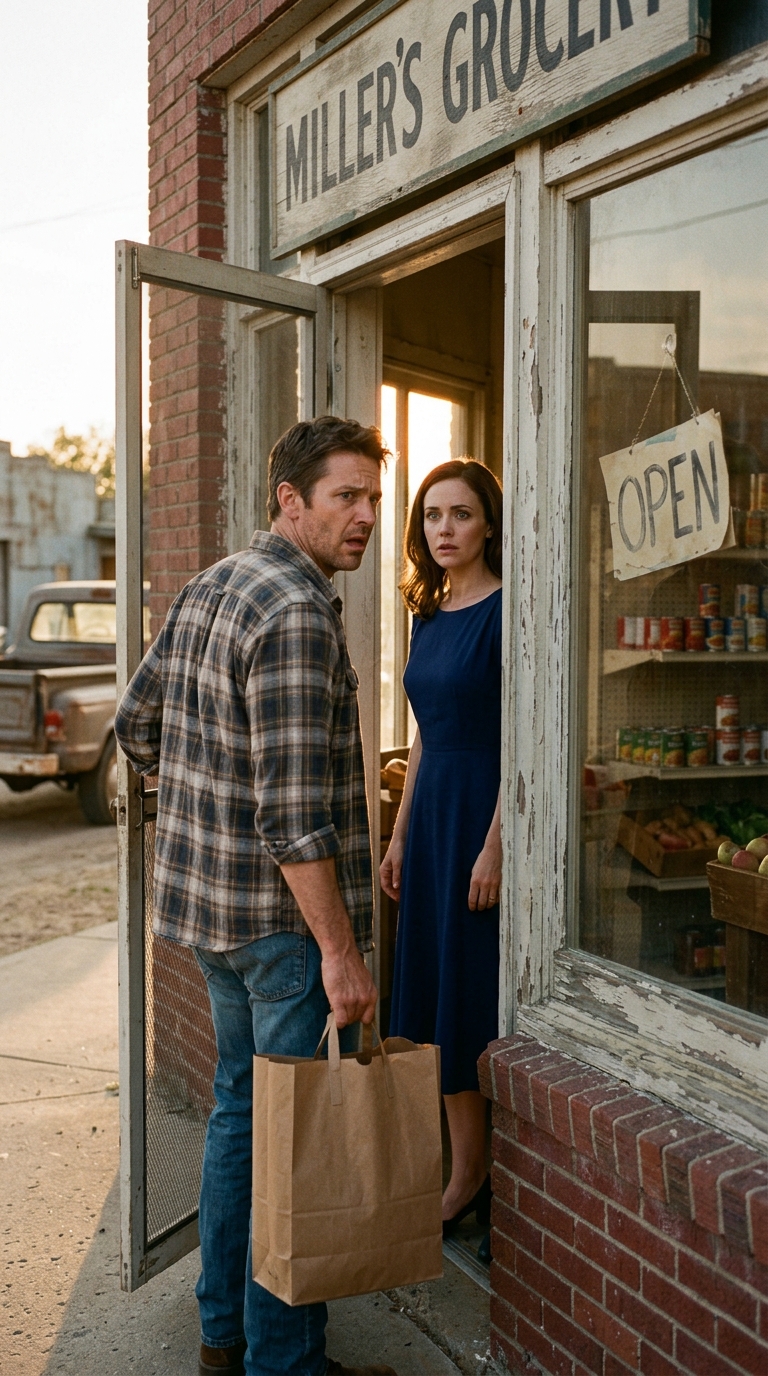
Elra Voss was 32. She ran the small grocery store and coffee shop near the farmers market and lived in the apartment above it. She used to be an elementary school teacher until something happened 6 years earlier. The whole town knew the story in pieces, but nobody talked about it out loud.
Elra was quiet and careful. She did not let people close. But I had seen her help lost kids at the market. I had seen her leave groceries at an old woman’s door without knocking. I had seen her calm a crying child in her store with a patience I did not have.
She was not soft.
She was steady.
And I was desperate.
When I walked into the store, the bell above the door rang. Elra was stacking milk on a shelf. She turned, saw my face, and stopped.
“Daniel,” she said. “What’s wrong?”
I walked straight to the counter. There were customers nearby. I knew they were watching. I did not care anymore.
I put both hands on the counter and said the only thing I could.
“I need a wife before tomorrow morning.”
The whole store went quiet.
A woman holding bread froze. An old man at the window table set his cup down slowly. Elra looked at me like she was trying to decide whether I was drunk or losing my mind.
She said, very clearly, “What did you just say?”
I looked straight at her.
For the first time in years, I did not try to keep my voice steady.
“I just found out I have a 7-year-old daughter. Her mother died. If I can’t prove I have a stable family by the hearing tomorrow, the court might put her in long-term foster care. I need to get married before then.”
Elra did not blink, but I saw her fingers tighten around the milk carton.
She set it down.
“Come into the back room,” she said.
She led me through a narrow door behind the counter into a small storage room that smelled like coffee beans, cardboard, and dried mint. She closed the door behind us. The low murmur of customers outside immediately turned into whispers, but she ignored it.
She crossed her arms and stood behind a wooden table, keeping careful distance between us.
“Start from the beginning,” she said. “Don’t leave anything out.”
So I told her.
I told her about Catherine, about how we met, how we loved each other, and how we were both too young and too stubborn to make it work. I told her about the fight in the rain, the words we threw at each other, and the way Catherine drove away. I told her about the messages I never answered, the emails I read and deleted, and how I kept telling myself I would call tomorrow.
Then I told her about the phone call from Linda Carver.
When I said Catherine had died, Elra’s face did not change much, but her shoulders tightened. When I said Ivy’s name and that she was 7 years old, Elra’s eyes narrowed slightly, as if she were already calculating something.
“Where is the child right now?” she asked.
“Portland. With an emergency foster family. Linda said if I can prove I’m stable, they’ll bring her here after the hearing tomorrow.”
“Does she know you exist?”
I looked down at my hands.
“Yes. Catherine told her before she died.”
Elra studied me.
“And what does she think of you?”
A dry, bitter sound came out of my throat.
“She thinks I abandoned her and her mother. And she’s right.”
Elra did not try to comfort me. She simply kept asking questions.
“Are you sure she’s yours?”
“Linda said Catherine left a private DNA test done with an old hair sample of mine. But the court will still order an official one. The real problem isn’t biology. It’s temporary guardianship.”
Elra pulled out a chair and sat down. She looked at me the way a teacher looks at a student who has just brought in an impossible problem.
“Daniel, do you understand what you’re asking? You’re asking a woman you barely know to marry you in less than 24 hours, move onto your farm, become the stepmother of a child who just lost her mother, and stand in front of a family court judge and lie about the nature of your relationship.”
“I understand.”
“No,” she answered, her voice harder now. “I don’t think you do.”
She leaned forward slightly.
“That little girl isn’t paperwork you can just claim. She’s a person. She’s going to be in pain. She’s going to be angry. She might hate you. She might hate me too. She’s going to test whether the adults in her life are going to leave. If I agree to this, we’re not just putting on a show for 1 morning in court. We’re stepping into her life.”
I nodded. My throat felt tight.
“I know.”
Elra looked at me sharply.
“Do you know, or are you panicking?”
I sat down in the chair across from her and clasped my hands together on the table.
“I’m panicking,” I admitted. “I’m regretting every message I ignored. I’m angry at myself. But I also know that if I let them take Ivy without fighting, I’ll never forgive myself.”
I reached into my jacket and took out a folder.
“This is the financial information for the farm. I’m not rich, but the land is paid off. I have steady income from the farmers market, contracts with 2 local restaurants, and I do equipment repair in the winter.”
I placed an envelope on the table.
“I have $18,000 in savings. If you agree, I’ll transfer $10,000 to you immediately as security. I’ll also sign paperwork giving you co-ownership of the house during the marriage so you’re not dependent on me.”
Elra looked at the envelope but did not touch it.
“You think I would do this for money?”
I shook my head.
“No. I think you wouldn’t do it unless you had a way to protect yourself.”
That made her go quiet for a moment.
I kept going.
“I’m not asking for love. I’m not asking you to be a real wife. One year. We get legally married. You help me show the court that Ivy has a stable home. After guardianship is settled and she’s had time to adjust, if you want to leave, I’ll sign the divorce with no fight. You keep the money. You don’t owe me anything.”
Elra looked at me, her voice low.
“And Ivy?”
I frowned. “What about her?”
“If after a year she’s attached to me, if she sees me as safe, are you going to tell her I was just a contract that expired?”
The question hit me harder than I expected.
I had thought about the court, the papers, the house, the money. I had not thought far enough ahead about how a child would understand any of it.
Elra leaned back in her chair.
“Adults are very good at creating stories that are convenient for them,” she said quietly. “But children know when adults are lying. They might not understand the details, but they feel the difference.”
I lowered my head.
“So what should I do?”
Elra did not answer right away. Her eyes drifted to a small framed photograph on the wall above the table. It was an old class photo, a group of children standing in front of a school building. One little girl with braided hair stood in the second row, smiling with a missing front tooth.
When Elra spoke again, her voice had changed.
“Six years ago, I was still teaching. There was a girl in my class named Clara. She came to school with bruises sometimes. She said she fell. I didn’t believe her. I wanted to report it to Child Protective Services, but I was afraid I didn’t have enough proof. I was afraid that if I was wrong, things would get worse for her.”
Elra stopped. Her jaw tightened.
“One winter night, Clara ran away from home and came to the school. She thought I could help, but the doors were locked. They found her the next morning right in front of the steps. She died from the cold.”
I did not know what to say.
Elra looked back at me. Her eyes were not wet, but they carried a kind of pain that made the small room feel even smaller.
“After that, I quit teaching. I opened the store. I lived alone. I told myself that if I didn’t let myself get too close to anyone, I couldn’t fail anyone again.”
She placed her hand flat on the table.
“So if I agree to this, it won’t be because of the money. It won’t be because of you. It will be because I’m not going to stand still again while a child needs an adult to do something.”
I felt something sting behind my eyes.
“Elra.”
She held up a hand to stop me.
“I have conditions.”
I sat up straighter.
“Tell me.”
Elra looked at me like she was signing something more serious than a marriage license.
“First, Ivy comes first. Not your pride, not your guilt, not your need to be forgiven. The child, always.”
“I agree.”
“Second, you don’t force her to call you Dad. You don’t force her to love you. You can show up. You can take care of her. You can be patient. Whether she forgives you or not is her choice.”
I swallowed.
“I agree.”
“Third, we tell her the truth at a level she can handle. We don’t need to explain every detail of this arrangement right away, but we are not going to build some fake love story either. She just lost her mother. She doesn’t need another lie.”
“I agree.”
“Fourth, if I ever believe you are putting Ivy in danger, physically or emotionally, I will report it. I will not protect you just because we signed a piece of paper.”
That last condition should have made me defensive.
Instead, it made me trust her more.
“If I ever become a danger to her,” I said, “you won’t need to report me. I’ll leave myself.”
Elra was quiet for a few seconds.
Then she asked one final question.
“Did you love Catherine?”
I closed my eyes.
The image of Catherine standing in the rain came back so clearly it hurt.
“Yes,” I answered. “I loved her. And I was too much of a coward to let her know it before she left.”
Elra watched me for a long time.
Finally, she stood.
“All right,” she said. “I’ll marry you.”
I looked up so fast I almost knocked the chair over.
She continued, her voice still steady, but with something tight underneath it.
“But before we go to court, you’re going home and fixing that room properly. Not just There’s a bed now. A child needs to see that someone thought about her. Books. Art supplies. A clean blanket. And get rid of whatever makes your house look like a storage unit for sadness.”
A short, broken laugh escaped me even though my throat felt tight.
“I can do that.”
“And you,” she added, looking at my mud-stained work clothes, “are not showing up to get married looking like you just fought with a tractor. Shower. Shave. Wear something decent. If I’m going to marry a man on an emergency basis for the sake of a child, the least he can do is look like someone who can fill out paperwork without giving the clerk a heart attack.”
For the first time in 2 days, I smiled for real.
“I’ll try not to give anyone a heart attack.”
Elra opened the storage room door. Outside, the customers immediately pretended they had not been listening.
She looked at me one last time, her voice low but firm.
“Daniel, I’m putting my life into this. Don’t make me regret it.”
I met her eyes.
“I won’t promise with words,” I said. “I’ll prove it with what I do.”
She nodded.
“Then meet me at the marriage registration office tomorrow morning. 8.”
Part 2
I arrived at the marriage registration office at 7:40 in the morning.
I wore a white button-down shirt I had not touched in years and a pair of dark trousers that still fit. I had shaved, combed my hair, and tried to look like someone who belonged in a government building instead of under a tractor. In the mirror that morning, I still saw the same tired man, only cleaner. The exhaustion sat behind my eyes like something that would not wash off.
Elra walked in at 7:55.
She wore a simple gray dress and a cream-colored coat. Her hair was pulled back neatly. She did not look like a bride. She looked like a woman walking into something difficult that still needed to be done.
I did not know what to say when I saw her.
She looked me over from head to toe.
“At least the court won’t call security,” she said, her voice dry, but carrying a trace of relief.
I let out a short laugh.
“Thanks. I think that’s the closest thing to a compliment I’m getting today.”
“Don’t get used to it.”
We signed the papers in front of a clerk named Martha, who kept glancing between us with undisguised curiosity. When it came time for the simple vows, I turned to Elra. My voice was rough but clear.
“I, Daniel Mercer, take Elra Voss to be my wife. I promise to respect her, to keep her safe, and to build a decent home for Ivy with her.”
Elra looked at me. Something moved behind her eyes, but her voice stayed steady.
“I, Elra Voss, take Daniel Mercer to be my husband. I promise to put Ivy’s safety first, to be honest in this house, and not to walk away the moment things get hard just because I’m afraid.”
Martha blinked like she had never heard wedding vows that sounded so much like a contract.
“I now pronounce you husband and wife,” she said.
There was no kiss. No music. No flowers. Just 2 signatures and 2 people carrying more damage than either of us wanted to admit.
Right after, we drove to the family court building. Linda was already waiting outside the hearing room. She looked at the marriage certificate, then at Elra, then at me.
“This might help,” she said quietly. “But the social worker will watch everything closely. Don’t overact. Just be honest. They’re good at spotting performance.”
Elra answered before I could.
“We’re not trying to sell a fairy tale. We’re trying to show that Ivy will have people who will actually take care of her.”
The hearing with Mrs. Grant lasted almost 2 hours.
She asked me about income, work hours, experience with children, the condition of the farm, the nearest school, health insurance. She asked Elra why she had agreed to marry so quickly and whether she was prepared to live on a farm.
When Mrs. Grant finally asked, “Ms. Voss, why did you agree to this so fast?” Elra sat up straighter, hands resting on her knees.
“Because a child who just lost her mother shouldn’t be moved from place to place if her biological father can give her a safe home. I don’t know Mr. Mercer well, but I’ve watched him in this town for years. He works hard. He doesn’t drink. He doesn’t cause trouble. He keeps his land stable. I believe he can learn how to be a father, and I believe I can help Ivy through the beginning.”
Mrs. Grant studied her for a long moment.
“Do you love him?”
I went still.
Elra did not flinch. She glanced at me for half a second, then looked back at Mrs. Grant.
“Not in the way people usually mean when they talk about marriage. But I respect him. I trust his reasons for doing this. And when a child is in crisis, stability and honesty matter more than a beautiful love story.”
Mrs. Grant wrote something down.
“At least you’re not lying,” she said.
That afternoon, we drove to Portland to meet Ivy.
I had imagined the moment 100 times during the night. I thought I would know what to say. But when the door opened and a small girl with dark brown hair and gray eyes that looked too much like mine walked in carrying a small backpack against her chest, every word disappeared.
Ivy was smaller than I had pictured. Thin. Her face was serious in a way no 7-year-old’s face should be. Her eyes looked older than they had any right to.
Linda crouched down a little.
“Ivy, this is Mr. Daniel Mercer.”
Ivy looked at me. Not with curiosity. Not with hope. Just a cold, guarded stare.
I lowered myself to 1 knee so I was at her eye level.
“Ivy,” I said.
My voice cracked on her name.
She spoke immediately, her voice small but sharp.
“You’re the one who left my mom.”
The words went straight through my chest.
I heard Elra draw a quiet breath behind me, but she did not interfere.
I nodded. My throat burned.
“Yes. I left. And I was wrong.”
Ivy kept looking at me, still clutching the straps of her backpack.
“Mom said you used to be a good person.”
I almost could not answer.
“Your mom was a better person than I ever was.”
Ivy tightened her grip on the backpack straps.
“Mom also said you didn’t know about me.”
I forced myself to keep looking at her. I did not let myself look away.
“I didn’t know. But that wasn’t your mom’s fault. She tried to tell me. I didn’t answer. I thought I was protecting her from more pain. The truth is, I was just a coward.”
Mrs. Grant and Linda stayed quiet. Elra stayed quiet. The only sound in the room was the low hum of the air conditioner.
Ivy asked, “If I go home with you, are you going to leave again?”
I wanted to say never right away, but I remembered what Elra had told me.
No empty promises.
“I won’t leave because I want to,” I said. “I’ll be there every day. But you don’t have to believe me right now. I’ll show you.”
Ivy turned her eyes to Elra.
“Who are you?”
Elra stepped forward and lowered herself onto 1 of the low chairs so she was not towering over Ivy. She did not try to touch her.
“I’m Elra. Daniel and I got married this morning.”
Ivy’s eyes widened.
“Because of me?”
Elra did not dodge the question.
“Partly because of you. Partly because I believe children need adults to do the right thing when it matters.”
Ivy studied her with that same sharp, too-old look.
“Do you love him?”
I froze.
Elra met Ivy’s gaze without smiling or softening the truth.
“I don’t know yet. But I know I won’t hurt you, and I know I won’t lie to you just to make things easier.”
Ivy looked at her for a long time.
Then she asked, “What if I don’t like the farm?”
Elra answered calmly.
“Then you say so. Mrs. Grant will keep coming to check. The lawyer will keep watching. You won’t be trapped. But I hope you’ll give it a real chance before you decide.”
Ivy looked down at her backpack.
“Mom had a box of things. I want to bring it.”
“You can bring everything that belonged to your mom,” I said quickly. “No one is going to take it away.”
For the first time, Ivy’s mouth trembled.
“Adults always say that and then throw things away later.”
I looked at Elra, then back at Ivy.
“Then you keep the key to your room and decide where everything goes.”
Elra added, her voice steady, “I’ll buy you a chest with a lock. Your mom’s things belong to you.”
Ivy looked at Elra longer than she had looked at me.
Finally, she nodded.
“Just for now.”
I let out a breath I did not know I was holding.
“For now is enough.”
We drove back to the farm as the sun was going down. Ivy sat in the back seat holding her backpack and a small box on her lap. She did not ask questions. She did not look out the window much. Every so often, I caught her watching me in the rearview mirror before she turned away.
When we turned onto the dirt road that led to the farm, the last light was hitting the fields. The greenhouse glowed orange. One of the goats stood near the fence, chewing slowly.
Ivy looked out the window then.
“This is your house?” she asked.
“It’s mine,” I said. “And if you want it to be, it can be yours too.”
She did not answer.
I parked in front of the porch. Elra opened the back door but did not reach for Ivy. She just waited. Ivy climbed out on her own.
Inside the house, Ivy stood in the middle of the living room and looked around. Old sofa. Bookshelves. Kitchen table. A few photos of my parents on the wall.
Then her eyes went to the stairs.
“Your room is up here,” I told her.
I led her up to the spare room I had cleared out. The bed was made with clean sheets. There was a small desk by the window that looked out over the apple trees. A stack of drawing paper and colored pencils sat on the desk. A few children’s books were lined up on the shelf. Under the bed was the wooden chest I had built the night before.
Ivy walked in slowly. She stopped in front of the chest and touched the lid with her fingertips.
“What’s this for?”
I stayed in the doorway. I did not step inside unless she let me.
“It’s for your mom’s things. Elra said you needed a place you could lock.”
Ivy opened the chest. Inside, on a folded cloth, sat a small key.
She picked it up. Her hands were shaking a little.
“You made this last night?”
Ivy turned and looked at me.
For a second, the anger in her eyes cracked, and something else slipped through. Surprise, maybe. Or confusion.
She said very quietly, “I don’t need a father.”
The words went through me like cold water, but I did not step back.
“I know,” I answered. “But if there’s ever a day you want one, I’ll be here.”
Ivy looked at me for a few more seconds, then turned away.
Elra’s voice came from behind me, gentle.
“Do you want something to eat, Ivy?”
Ivy hugged the box from her mother closer to her chest.
“I want to be alone.”
Elra nodded.
“That’s okay. We’ll be downstairs. If you need anything, just call.”
We went back down to the kitchen. When Ivy’s door closed upstairs, I sat at the table and put my hands underneath it so Elra would not see how badly they were shaking.
She set a glass of water in front of me.
“You did well,” she said.
I let out a short, bitter laugh.
“She said she doesn’t need a father.”
Elra glanced toward the stairs, then back at me.
“She just lost her mother. She doesn’t need a perfect father showing up 7 years late. She needs a man patient enough to be hated and still stay.”
I looked at her.
“Do you think I can do that?”
Elra did not answer right away, but when she finally spoke, her voice was sure.
“I think you can learn.”
The first few weeks were the hardest.
Ivy did not scream or throw things. Her anger was quieter and sharper than that. She answered in short sentences. She kept her door locked most of the time. She ate very little. She never called me Dad. She barely called me anything at all. Sometimes it was you. Most of the time she just did not say my name.
Elra moved into the small bedroom on the first floor. I stayed in my room at the end of the upstairs hallway. Ivy’s room was across from mine.
On paper, Elra and I were married.
In the house, everything stayed clear.
This arrangement was for Ivy.
Every morning, I went out to the chicken coop and the greenhouse while Elra made breakfast. Ivy usually came down last, still in her pajamas, hair messy, dark circles under her eyes. She carried her sketchbook like armor.
Elra never forced her to talk. She would simply put a plate of eggs in front of her and say, “Three bites is enough, but your body still needs something to work with.”
One morning, Ivy pushed the plate away.
“I’m not hungry.”
Elra sat down across from her, calm as always.
“I know being sad can make food taste like nothing, but your body doesn’t know that. Three bites. Then I won’t say anything else.”
Ivy stared at her like she wanted to argue, but in the end, she picked up her fork and ate exactly 3 bites.
I stood at the sink pretending to wash my hands and felt something loosen in my chest.
After breakfast, Elra would sit with Ivy at the table near the window and help her with reading and math. Ivy was good at both, but her handwriting would sometimes stop in the middle of a sentence while she stared out at the yard like she had been pulled somewhere else.
One afternoon, Elra asked, “You like drawing animals?”
Ivy did not look up from her paper.
“Mom said I draw well.”
Elra set her pen down.
“Your mom was right.”
Ivy’s hand froze.
She asked very quietly, “How would you know what my mom said?”
Elra answered without hesitation.
“I never met your mom. But I know that when a mother loves her child, she sees the good things in that child very clearly. If she said you draw well, I believe she was seeing the truth.”
Ivy did not say anything else.
But that evening, she left a drawing of 1 of the goats on the kitchen table.
I found it when I came back from the greenhouse. It was a simple pencil sketch, but the goat had personality. One ear slightly crooked, eyes a little dumb, but alive.
I wanted to say something, but I was afraid of making it worse.
Elra saw me standing there staring at it.
“Daniel,” she said loudly enough for Ivy to hear from the living room, “what do you think of Ivy’s drawing of the goat?”
I looked over at Ivy. She was pretending to read a book, but her ears had turned red.
I answered carefully.
“I think that goat looks smarter than the ones outside.”
Ivy glanced at me sideways.
“That one is Maple. She’s smarter than you think.”
It was the longest sentence she had said to me since she arrived.
I nodded seriously.
“Then I apologize to Maple.”
The corner of Ivy’s mouth twitched.
Not a real smile.
But close.
That night, I went out to the small workshop behind the house. I am not good with words, but I know how to work with my hands. I took a piece of soft wood and started carving a small goat, trying to match the one in Ivy’s drawing.
I worked until past midnight.
The next morning, I left the finished wooden goat on Ivy’s desk.
When she came down for breakfast, she saw it. She picked it up and turned it slowly in her hands.
“You made this?”
I kept my back to her, pretending to dry my hands at the sink.
“Yeah. It’s not perfect. The ears are a little off.”
Ivy rotated the small figure.
“Maple’s ears are kind of weird too.”
Then she hugged the wooden goat to her chest, quick and tight, as if she did not want anyone to see.
I saw.
So did Elra.
She looked at me, and the look in her eyes made my throat close up.
Little by little, the farm started to create a rhythm for us.
Ivy began following Elra out to the garden in the afternoons. She learned which leaves were vegetables and which were weeds. She learned how to scatter feed for the chickens, even though 1 hen named Queenie seemed to take a personal dislike to her.
The first time Queenie chased her across the yard, Ivy screamed. I came running from the greenhouse, heart pounding, thinking something was wrong.
Ivy stood behind Elra, furious and scared at the same time.
“She hates me.”
Elra was trying not to laugh.
“Queenie hates everyone. Don’t take it personally.”
I grabbed the feed bucket and lured Queenie away.
“On this farm,” I told Ivy, trying to sound serious, “Queenie is the real boss. We just pay taxes in corn.”
Ivy laughed.
It was a small sound, but it felt like the yard got brighter.
That evening, after Ivy had gone to bed, Elra and I sat on the back steps. The kitchen lights spilled out behind us. Crickets and wind through the greenhouse were the only sounds.
“She laughed today,” I said quietly.
Elra nodded, looking out at the dark garden.
“Yeah.”
“I almost forgot what a child’s laugh sounds like in this house.”
Elra turned to look at me. Her expression was softer than usual.
“You want to be a father, Daniel. That much is clear.”
I gave a tired smile.
“Wanting doesn’t mean knowing how.”
“No one knows right away. Good people are the ones willing to learn.”
I looked down at my hands, calloused, dirt still under the nails even after washing.
“I keep thinking if Catherine were still alive, she would hate me.”
Elra was quiet for a while.
Then she said, “Maybe she did hate you for a while. Maybe she also still loved you. Those 2 things don’t cancel each other out.”
I looked at her.
The words hurt.
They also made it easier to breathe.
A week later, Ivy asked if she could come into the workshop and watch me carve.
I was fixing the hinges on the chicken coop door when she said it. I thought I had misheard. She stood a few steps away, hands shoved into the front pocket of her hoodie.
“If it’s not okay, that’s fine,” she added quickly.
I put the tools down.
“It’s okay. But there are knives and saws and a grinder in there. You have to listen to instructions.”
Ivy frowned.
“I’m not a baby.”
“I know,” I said. “But knives don’t care how old you are.”
She looked at me for a second, then nodded.
Inside the workshop, I gave her a small piece of soft wood and a knife with a safe handle. I showed her how to hold the wood, how to cut away from her body, how to keep her fingers behind the blade.
Ivy listened carefully.
For about 10 minutes, she did well.
Then she tried to go faster. The wood slipped. The blade caught the side of her palm. Blood welled up.
I panicked.
I grabbed her wrist, my voice coming out sharper than I meant.
“I told you to keep your fingers behind the blade.”
Ivy flinched.
Her eyes filled with tears immediately.
“I know. I didn’t do it on purpose.”
I realized too late what I had done.
Fear had made me sound angry.
Ivy pulled her hand away and ran into the house.
Elra was in the kitchen. She took over right away, cleaning the cut and wrapping it. I stood in the doorway with Ivy’s blood on my fingers, feeling like the worst kind of person.
Elra looked at me, calm but firm.
“Daniel, go outside for a few minutes.”
I stepped back.
I sat on the porch steps and listened to Ivy crying softly inside while Elra talked to her. Every sound felt like it was cutting into me.
After a while, the door opened.
Ivy came out. Her hand was bandaged. Her eyes were red.
I stood up.
“Ivy, I’m sorry. I shouldn’t have yelled.”
She looked down at her hand.
“Are you mad at me?”
I knelt in front of her.
“No. I was scared, but I let the fear sound like anger. That was my mistake.”
Ivy studied me. The wariness was still there, but it was not completely closed anymore.
“Mom got scared when I got hurt too,” she said. “But she didn’t yell.”
I nodded.
The words landed exactly where they were supposed to.
“Then I need to do better.”
Ivy was quiet for a long time.
Then she said, almost too softly to hear, “Can you teach me again tomorrow? Slower?”
Something inside my chest cracked open.
“Yeah,” I managed. “Slower.”
The next day, I drove into town and bought the smallest pair of work gloves I could find. They were still a little big on her, but Ivy put them on and pretended she did not like them.
I knew she did.
Our relationship did not change overnight, but small cracks started appearing in the wall she had built.
She started calling me Daniel instead of you.
One afternoon, she was tired and almost said something else.
“Da—”
She stopped immediately. Her face went pale.
I froze too.
Elra, who was washing vegetables at the sink, went still but did not turn around.
Ivy looked down, her voice rushing.
“I didn’t mean to.”
“It’s okay,” I said, even though my throat felt thick.
“I’m not ready to call you that yet.”
“I know.”
“Maybe later.”
I nodded, trying to keep my voice from breaking.
“I’ll wait.”
That night, after Ivy had gone to sleep, I stood in the kitchen for a long time. Elra came and stood beside me. She did not ask if I was okay. The answer was obvious. She just placed her hand on my arm.
The touch was light.
It almost undid me.
“I don’t know if I deserve this chance,” I said quietly.
Elra looked at me.
“Maybe deserving isn’t the question. Maybe the question is what you’re going to do with the chance you have.”
I turned to her under the kitchen light. Her face looked both gentle and strong.
This woman had walked into my life because of a desperate request.
But every day she stayed felt like a choice she kept making.
For the first time, I realized I was afraid of something else now—not just losing Ivy, but of the day Elra might leave and the house might become quiet again.
Part 3
Three months after Ivy came to the farm, Mrs. Grant returned for a visit.
I woke up at 4 in the morning, not because there was work to do, but because I could not sleep. I cleaned the kitchen twice, checked Ivy’s room 3 times, and even swept the chicken coop like the social worker was going to judge my fitness as a father based on how the hens behaved.
Elra watched me pace back and forth until she finally set her coffee cup down hard on the table.
“Daniel, stop.”
I was holding a dish towel.
“What if she thinks the house isn’t clean enough?”
Elra looked around the kitchen, which was already clean enough to eat off the floor.
“She’ll think we’re making Ivy live in an agricultural museum.”
I exhaled, but my hands were still shaking.
Elra walked over and stood in front of me.
“She’s not coming here to find a perfect family,” she said quietly. “She’s coming to see if Ivy is safe. She is safe. You know that.”
I looked up the stairs.
“What if Ivy tells her she wants to leave?”
Elra did not lie to make me feel better.
“Then we listen. But you’ve done everything you can to give her a reason to stay.”
Mrs. Grant arrived at 10.
She walked through the house, checked Ivy’s room, asked about school, meals, medical care, and future plans. She noticed the locked wooden chest under Ivy’s bed, the drawings taped to the wall, and the small wooden animals lined up on the shelf.
Then she asked to speak with Ivy alone.
Elra and I waited on the porch. I paced until Elra said, “You’re going to wear a hole in the floorboards.”
I stopped.
“Sorry.”
She looked at me, her expression softer than usual.
“You’re scared because you love her.”
I stared down at my hands.
“Loving someone when you don’t know if they’ll ever love you back is harder than I thought.”
Elra gave a small smile.
“Welcome to being a parent.”
Fifteen minutes later, Mrs. Grant came out. Ivy followed behind her, holding the wooden goat I had carved.
Mrs. Grant’s face gave nothing away.
I held my breath.
“Ivy says she still misses her mother,” Mrs. Grant began. “She is still angry at you for not being there before.”
I closed my eyes for a second.
Mrs. Grant continued.
“But she also said she is being fed. She is learning. She gets to keep her mother’s things. She is taken care of when she is sad, and no one is forcing her to forgive faster than she can.”
I opened my eyes.
Mrs. Grant looked at both of us.
“She says she wants to stay.”
A strange sound came out of my throat. I was not sure whether it was a laugh or a sob. Elra reached over and squeezed my hand once, quickly, but it was enough to keep me standing.
Mrs. Grant said she would recommend continuing temporary guardianship, with Elra listed as a supporting guardian. She would return in another 3 months.
After her car drove away, Ivy stood in the yard looking at us.
“I told the truth,” she said. “I’m still mad.”
I knelt down in front of her.
“You have every right to be.”
“But I also told her I want to stay.”
I nodded, my eyes burning.
“I’m really glad you said that.”
Ivy looked at me for a long moment.
“Daniel, don’t be weird about it.”
I laughed, the sound catching in my throat.
“I’ll try.”
We did not get to keep the peace for long.
Early winter brought a bad flu.
It started with a low fever, but by midnight, Ivy’s temperature had climbed high. She was delirious, calling for her mother in her sleep, clutching the blanket as if she were afraid it would disappear.
Elra sat beside the bed, pressing cool cloths to Ivy’s forehead. I called the doctor, but the road to the farm was muddy from heavy rain and the ambulance would take too long. The doctor gave instructions over the phone and told us to bring her in if the fever crossed a certain line.
Ivy opened her eyes in her fever haze and looked at me without really seeing me.
“Mom, don’t go.”
Something inside my chest cracked.
Elra held Ivy’s hand, her voice calm but very sure.
“I’m here. Daniel’s here. You’re not alone.”
I stood there feeling completely useless and suddenly understood what Catherine must have gone through all those years. The fear. The exhaustion. The helplessness of watching your child suffer while having no one to share it with.
“This is my fault,” I said, voice breaking. “If I had been here from the beginning—”
Elra looked up at me, tired but firm.
“Not now, Daniel.”
I stopped immediately.
She spoke again, quieter, so she would not startle Ivy.
“She needs you present. She doesn’t need you drowning in guilt right now. Get more water. Call the doctor again in 10 minutes. Check the road. Do something useful.”
I did what she told me.
By early morning, Ivy’s fever finally started to break. She slept more peacefully. Elra was still sitting beside the bed, her back so stiff she could barely straighten up.
I put a hand on her shoulder.
“You should rest. I’ll sit with her.”
Elra looked at me.
It was the first time I had called her Elra without thinking, without the distance of the arrangement pressing between us.
She heard it.
I heard it.
Neither of us corrected it.
She just nodded and let me take the chair.
I sat beside Ivy until the sun came up. When she finally woke, her eyes were tired but clear. She looked at me for a long moment.
“You stayed here all night.”
“Yeah.”
“Elra too?”
“Yeah.”
Ivy stared at the ceiling.
Then she said very quietly, “I was scared you would leave.”
I stopped breathing.
It was the first time she had said something like that to me. Not as an accusation. Not as a test. As a fear she was finally letting me see.
I leaned closer, trying to keep my voice steady even though everything inside me was shaking.
“I’m not going anywhere.”
Ivy looked at me. Her eyes were wet, but she did not cry.
“I’m still not sure I want to call you that every day.”
“I know. You don’t have to rush.”
“But today it’s okay.”
I rested my hand on the edge of the bed, not daring to touch her unless she wanted it.
Ivy looked at my hand.
Then she placed her small one on top of mine.
“Today it’s okay,” she repeated.
From that moment, something shifted.
Not loudly. Not magically.
But the house started to breathe differently.
Ivy still had days when she missed Catherine. She still had moments when she was angry at me for the years I was not there. But she began to let me be her father little by little. She called me Daniel when she was annoyed. She called me Dad when she was tired or sad or when she forgot to keep her guard up.
And Elra.
I do not know exactly when I fell in love with her.
Maybe it was the day she stood in the courtroom and said stability mattered more than a pretty story. Maybe it was the way she treated Catherine’s things like they were sacred. Maybe it was the night she told me to stop drowning in guilt and go get water for our daughter.
One late winter evening, after Ivy had fallen asleep, Elra and I sat on the back porch. The fields were dark. The greenhouse reflected the moonlight. The air was cold, but not bitter.
I said, “Four more months and it’ll be a year.”
Elra looked toward the fields.
“If you want a divorce,” I continued, “I’ll keep my word.”
She stayed quiet.
I forced myself to keep speaking, even though every word felt like it was tearing something open.
“I won’t use Ivy to keep you here. I won’t use the house either. You’ve already done more than I had any right to ask.”
Elra turned to look at me. Her eyes were hard to read in the dark.
“Do you want me to go?”
I looked down at my hands.
“No.”
“Then why are you talking like you’re holding the door open for me?”
I took a breath.
“Because I’m scared that if I say I want you to stay, it won’t be fair to you.”
Elra looked at me for a long time.
Then she said, her voice low but clear, “Daniel, I lived alone above that store for 6 years. I called loneliness safety. Then you walked into my shop, panicked and clumsy, asking for the most ridiculous thing any man has ever asked for.”
I gave a weak laugh.
“I know. Not my finest moment.”
“No,” she said. “But it was the moment that made me have to act. Then I came here. I watched you learn how to be a father. I watched Ivy learn how to trust. I watched this house change from a place where 1 man was surviving into a place where a family was growing.”
She placed her hand over mine.
“I don’t want a divorce.”
I turned to her fully, heart pounding.
“Elra.”
She smiled, eyes bright, but her voice still trying to stay steady.
“Are you going to say something, or do I have to keep being the brave one in this family?”
I laughed and pulled her closer, stopping just before I kissed her, asking with my eyes.
She nodded.
I kissed her.
It was not part of any agreement. It was not gratitude. It was the first real promise between 2 people who had signed marriage papers before they even knew each other, then slowly built something real out of the hardest days.
From inside the house, Ivy’s voice called out, “Perfectly calm. I knew it.”
Elra and I broke apart.
Ivy stood in the kitchen doorway holding the wooden goat, her hair sticking up in every direction.
I asked, “How long have you been standing there?”
Ivy shrugged like it was nothing.
“Long enough to know you 2 finally figured out what I already knew last month.”
Elra covered her mouth, laughing.
I sighed.
“You’re supposed to be sleeping.”
“I’ll sleep after I’m sure Elra isn’t leaving.”
Elra stood and walked over to Ivy, kneeling in front of her.
“I’m not leaving.”
Ivy looked at her, eyes serious in that way only she could manage.
“Not because I got sick? Not because of the court?”
“No,” Elra said. “Because I want to stay.”
Ivy turned to me.
“What about you, Dad?”
The word hit me so hard I almost could not speak.
“I want her to stay too.”
Ivy thought about it like a tiny judge.
“Then we’re a real family now.”
Elra looked at me. I looked at Ivy.
“Yeah,” I said. “A real family.”
A few months later, the court granted permanent guardianship. Mrs. Grant wrote in her report that Ivy was stable, well cared for, attending school, and had a healthy attachment to both me and Elra.
When the 1-year mark came close, instead of filing for divorce, we held a small ceremony in the apple orchard behind the house.
It was not to make the marriage legal again. We were already married. But this time, Ivy stood between us, holding a small bouquet of wildflowers she had picked. Elra wore a simple blue dress Ivy had chosen. I wore the cleanest shirt I owned and still felt a little clumsy, but not like I was playing a role anymore.
In front of a few close friends, Mrs. Grant, Linda, and some neighbors, I held Elra’s hands.
“The first time I married you,” I said, my voice shaking but steady, “it was because I was afraid of losing my daughter. Today, I’m standing here because I don’t want to live a life that doesn’t have you in it. You didn’t save me by fixing me. You saved me by making me do the right thing every single day.”
Elra looked at me, eyes wet.
“The first time I married you,” she said, “it was because a child needed a home. Today, I’m choosing you because that house has become my home too.”
Ivy spoke up, completely serious.
“And because Dad needs someone to remind him not to overwater the tomato plants.”
Everyone laughed.
I looked at my daughter. The same little girl who had walked into my house with angry, guarded eyes now stood in the middle of the orchard with wind in her hair, holding flowers like it was the most natural thing in the world.
That night, after everyone had gone home, the 3 of us sat on the back porch watching fireflies drift over the fields. Ivy leaned against Elra’s side, her feet resting across my lap.
She asked, “Do you think Mom would be happy?”
I looked up at the dark sky.
For the first time in years, thinking about Catherine did not only bring guilt. It brought gratitude too.
“I think she’d be happy that you’re loved,” I said.
Ivy was quiet for a while.
Then she said, “That’s good.”
I put my arm around both of them.
I used to think the farm was the thing that had trapped me in the past. Turns out it had been waiting for me to learn how to turn it into a future.
I once needed a wife so I could qualify to keep my daughter.
In the end, what I got was not just guardianship.