Chapter 1
Amelia Hart burned the first picture of her baby in the kitchen sink while the man who had fathered that child smiled on national television beside another woman.
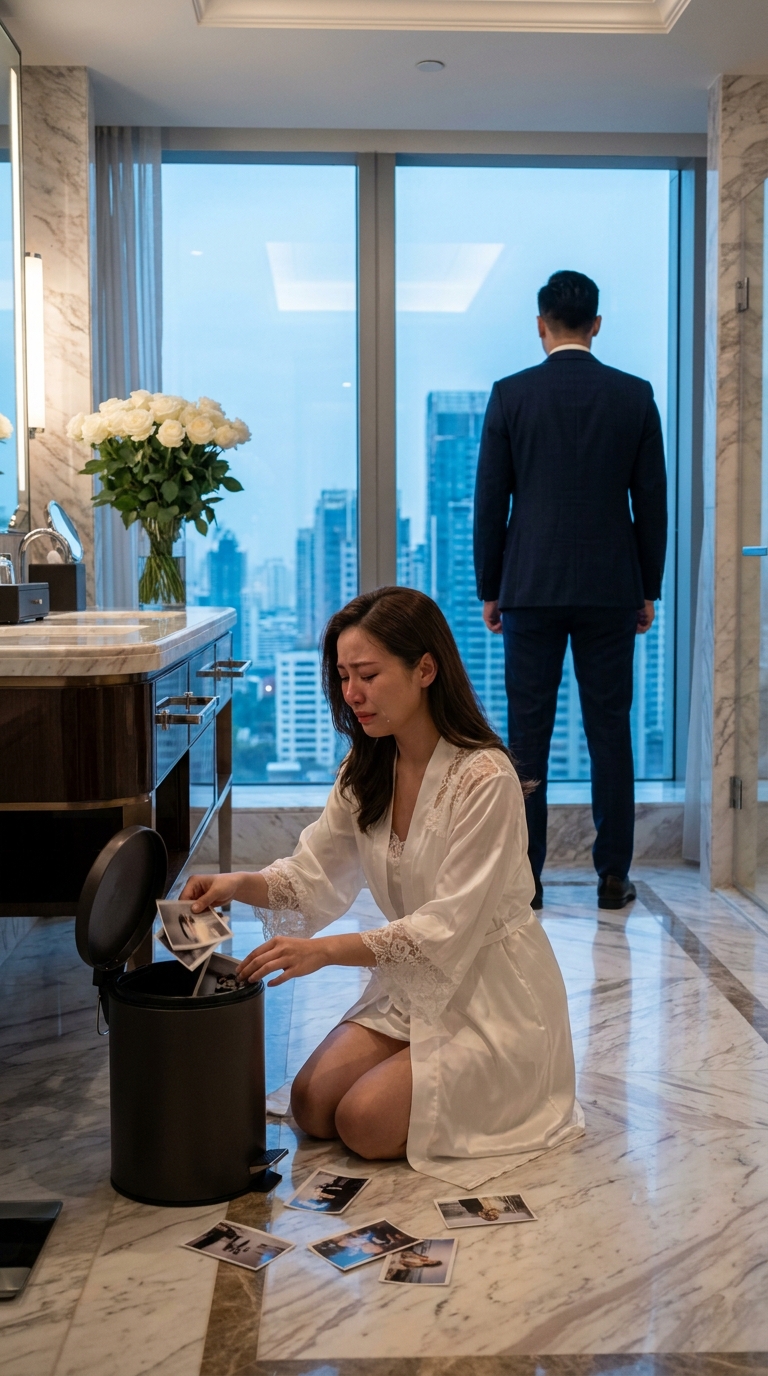
The ultrasound curled at the edges first.
Then the flame moved across the pale gray image, taking the tiny white curve the Northwestern Memorial doctor had pointed to two hours earlier.
“Six weeks and four days,” the doctor had said, turning the screen. “Strong heartbeat. That’s a very good sign.”
A good sign.
Amelia almost made a sound. It didn’t make it out.
On the television above the counter, the anchor’s polished voice moved through the apartment.
“Chicago logistics magnate Declan Voss has confirmed his engagement to Savannah Calloway, daughter of Gulf Coast shipping titan Elias Calloway, in what analysts are calling one of the most consequential private-sector alliances in American transportation.”
The screen showed Declan in a black tuxedo — tall, controlled, one hand at the waist of a woman in pearl white. Savannah Calloway had been raised inside chandeliers and polished silver, and it showed in the specific ease of her.
Declan’s eyes were the same eyes she had seen last week when he had kissed her paint-stained fingers and told her she was the only place in Chicago where he could breathe.
Those eyes were aimed at a camera now. At a future. At another woman.
The last corner of the ultrasound blackened and broke apart.
Amelia turned on the faucet and watched the ash scatter.
“I’m sorry,” she said, pressing one hand against her still-flat stomach. “But nobody is going to use you as a bargaining chip.”
Her phone buzzed.
DECLAN VOSS.
One missed call. Two. Three.
She watched his name flash until it stopped looking like a name.
She had not always been afraid of him. That was the hardest part. If he had only been cruel, she could have hated him without confusion. But he had also been the man who sat in her restoration studio for an hour while she explained the difference between age cracks and heat-forged craquelure on a seventeenth-century portrait, and had listened as if the survival of that painting mattered.
He had been the man who remembered that she hated lilies because they smelled like funeral homes.
He had been the man who shut down a private dining room because the jazz trio was playing too close to their table and Amelia had a migraine.
And he had been the man whose voice she had heard that afternoon through a wall of white marble on the sixty-second floor.
“The announcement goes out at seven,” Savannah had said.
“It has to,” Declan replied.
“My father says this marriage ends the uncertainty.”
“It ends the blood.”
Amelia had been standing in the corridor with the envelope from the hospital still in her hand.
Savannah’s laugh had been soft in the specific way of someone who had learned to make things sound softer than they were. “And what about the restoration girl? The one from Logan Square? Is she going to make a scene?”
One second of silence.
Love can die in one second if the silence has the right shape.
“Amelia is civilian,” Declan said. “She’ll be resolved quietly.”
Resolved.
Not protected. Not loved. Not I’ll handle it or that’s complicated or she doesn’t deserve this. Resolved — as if she were a scheduling conflict. A legal inconvenience. A problem on a list.
She had walked away before he could say more, because if she had stayed she might have opened the envelope and let herself hope, and she was done letting hope be used against her.
She went home. She burned the proof.
At 3:12 in the morning, Amelia Hart disappeared from Chicago.
Cash from the emergency box under the loose floorboard in her studio. Passport. Three sweaters. Prenatal vitamins. Her grandmother’s wedding ring. The photographs of her mother that still held the faint cedar smell of the storage chest.
She left behind everything Declan had given her. The key to his Lake Shore Drive apartment. The platinum card she had never used. The watch that cost more than her first year of college. The black coat he had said made her look like the kind of woman people crossed rooms to obey.
By dawn her phone was in a trash can outside a Greyhound station in Indianapolis.
By nightfall she was no longer Amelia Hart.
For fourteen weeks, a small town outside Asheville, North Carolina, hid her better than most fortifications.
She rented a room above a closed antiques shop from Mrs. June Whitaker, a widow with silver hair, sharp eyes, and a strict preference for cash, quiet tenants, and people who didn’t expect her to ask questions.
Amelia called herself Claire Mason.
The room had slanted ceilings and bad plumbing and a window that looked toward a ridge of blue mountains. Mornings, fog gathered low over the street and made the town look gentler than it was. Evenings, the old shop below creaked as if the furniture remembered every hand that had ever owned it.
Nobody there knew she could smell a forged varnish before she touched a canvas. Nobody knew the father of her child owned shipping routes, warehouse networks, private security firms, and enough political secrets to keep the news busy for months.
She lived carefully.
Cash only. Different routes to the grocery store. Oversized flannels before her body required them. Never sitting with her back to a door. Flinching at black SUVs on Main Street.
But fear, like grief, changed its shape when it had nowhere to go.
At ten weeks she heard the heartbeat again in a small clinic with peeling wallpaper and a nurse who called everyone honey.
At twelve weeks she stopped crying every night.
At fifteen weeks she bought a pair of yellow socks from a thrift store and hid them under her pillow like something contraband.
At seventeen weeks she stood at the cracked mirror in her rented room and made a vow.
“You will not be an heir to a war,” she said. “You will not be proof of anyone’s power. You will just be mine until you’re old enough to be your own.”
The promise steadied her.
It also broke her, a little, in a different place.
Because loneliness was not dramatic. It didn’t announce itself with weather or music. It sat beside her at dinner. It folded itself into secondhand baby clothes. It appeared in the space beside her at 2 a.m. when she woke wanting, despite everything, to tell Declan that the baby kicked when she ate peaches.
Sometimes she hated him with the efficiency of someone who had no energy to waste.
Sometimes she missed him badly enough that hatred was the only thing keeping her upright.
And sometimes, when the mountain rain came and the town went quiet, she remembered the night Declan had found her in her studio after a client had dismissed her work and said, “You don’t have to make yourself smaller for people who only understand size.”
That memory cost more than the others.
Because it meant the man who had reduced her to a word on a list had once known exactly where she was soft.
Back in Chicago, Declan Voss was methodically destroying his own operation.
The first week after Amelia vanished, he fired his head of security in a voice so level the man went pale before he reached the door.
The second week, he broke a board member’s jaw after the man suggested Amelia had probably run to create leverage.
The third week, he stopped sleeping.
His investigators searched airports, clinics, bus terminals, hotels, shelters, art warehouses, and every apartment she had ever rented. Traffic cameras. Transaction logs. Hospital records. Fake-name patterns. They found nothing.
Amelia had not disappeared like a civilian.
She had disappeared like a woman who had spent years working for collectors who left no paper trails, and who understood exactly how men with money made people traceable.
On the twenty-sixth day, Gavin Roarke — Declan’s closest security advisor, one of the few people permitted to speak to him without arrangement — entered the Voss Tower office with a tablet and the expression of a man transporting something unstable.
“I found something,” Gavin said.
Declan looked up from the maps and grids covering the wall.
“Where is she?”
Gavin looked at the tablet. Then at Declan.
“Before I tell you,” Gavin said, “I need to know something.”
“Ask.”
“What are you going to do when you find her?”
The office was very quiet.
Declan looked at the search grids that had consumed twenty-six days and every resource he had. He looked at the engagement ring that was still in his desk drawer, that he had never given Savannah, that he had bought for a different woman six weeks before the board had told him who he was going to marry and why.
“I’m going to tell her the truth,” he said.
Gavin did not move. In seven years he had seen Declan Voss manage situations with the specific precision of a man who had learned early that precision was a form of power. He had never heard him say anything that simple with that little surrounding it.
“What is the truth?”
Declan was quiet for a moment.
“That I didn’t handle it right,” he said. “And that I’m done handling it wrong.”
Gavin looked at him for a long time.
Then he turned the tablet around.
Chapter 2
On the tablet screen: a still from a small-town hardware store’s exterior security camera. The timestamp read fourteen days ago. The woman in the frame was wearing an oversized canvas jacket and carrying a paper grocery bag, and her dark hair was different — shorter, grown differently at the sides — but it was Amelia’s walk. The specific way she led with her left shoulder in cold weather.
And the curve of her stomach, even under the jacket, was unmistakable.
Declan looked at the screen for a very long time.
“How pregnant is she?” he asked.
“Based on the medical record from before she left,” Gavin said carefully, “somewhere around nineteen weeks.”
Declan pressed two fingers to the edge of the table. His jaw was very still.
“She’s been alone for four months,” he said.
“Yes.”
“Carrying my child alone for four months.”
“Declan—”
“Don’t manage me right now.” His voice was even, which was worse than if it hadn’t been. “Give me the address.”
Gavin hesitated.
“You said you were going to tell her the truth,” Gavin said. “I need to know what that means before I send you to a small town in the mountains where she has been hiding from everything you represent.”
“It means exactly what I said.”
“You walked out of a board meeting to stand in a hallway and your voice said words that destroyed her. You understand that. Whatever your reasons, whatever the operational logic — she stood in that corridor and heard you reduce her to a liability.”
“I know what I said.”
“Then you understand she has very good reasons not to open a door when you knock on it.”
Declan looked at the photograph on the tablet. At Amelia’s left shoulder. At the grocery bag.
“She’s buying food,” he said. “She’s alone in a town where nobody knows her name, and she’s buying food and managing and protecting that child entirely by herself because I said one sentence in a hallway without knowing she could hear it.”
He set the tablet down.
“The truth is that I was managing a board who wanted me married into the Calloway freight network to prevent a hostile acquisition that would have required laying off four thousand people at six Midwest terminals. The truth is that Savannah Calloway knew the engagement was a corporate instrument and we had a clear understanding. The truth is that I was going to dissolve it in sixty days when the acquisition closed and find a way to tell Amelia everything.” He stopped. “And the truth is that none of that matters, because she didn’t know any of it and she heard the worst possible version of the story at the worst possible moment and she was alone and pregnant and she made the only decision she trusted.”
Gavin was quiet.
“If I go to Asheville,” Declan said, “I go to explain and to ask. Not to take. Not to manage.” He looked at Gavin. “She’s carrying my child, and she’s been doing it alone for four months, and she deserves the truth I should have told her before any of this happened. That’s what I’m going to do.”
“And if she tells you to leave?”
“Then I leave,” Declan said. “And I figure out a way to be in this child’s life that doesn’t require her to trust me more than she currently can.”
Gavin picked up the tablet.
He read out an address.
Gavin wrote down the address on a piece of paper and slid it across the desk.
Declan folded it and put it in his pocket without looking at it, because he had already memorized it from the screen while Gavin was still deciding whether to share it.
“One more thing,” Gavin said.
Declan waited.
“The engagement ring. In your desk.”
“What about it.”
“Leave it there,” Gavin said. “Don’t bring it to Asheville. Don’t put it in your coat pocket as a just in case. Don’t let it be a thing you’re carrying that she might sense you carrying.”
Declan looked at him.
“If this goes the way you’re hoping,” Gavin said, “there will be a correct time for that. Asheville on day twenty-seven is not the correct time. I’m telling you this because you are better at planning than you are at the part after planning.”
Declan was quiet for a moment.
“All right,” he said.
He left the ring in the drawer.
The drive from the Asheville airport to the town of Millford took forty minutes along a two-lane road
that wound through ridges dense with bare oak and winter-stripped dogwood. Declan drove himself. He had not brought Gavin or any of his security. He had been very deliberate about this.
The town was the kind that appeared and disappeared with the light. Three streets of storefronts, a diner, a hardware store, a pharmacy with a hand-lettered sale sign in the window. The kind of town that minded its own business because everyone’s business overlapped and privacy was a courtesy extended by mutual agreement.
The antiques shop was on the second block, the sign faded to near-illegibility, the display window full of the patient accumulation of things that had outlived their original owners. The building was narrow, two stories, with a side staircase leading to the upper apartment.
Declan sat in the car for three minutes.
He was not a man who doubted his decisions in the planning stage. He was not a man who reconsidered in the driveway. But this was not an acquisition. This was not a board meeting or a negotiation or a shipping dispute.
This was Amelia.
He got out of the car.
The staircase was wooden, each step announcing itself in the cold morning air. He reached the landing. There was a narrow door with a mat that said nothing, which was consistent.
He knocked.
Silence.
He waited.
Footsteps, after a long moment. Soft. Careful. The specific quality of someone who had learned to assess a sound before responding to it.
A pause just inside the door.
“Who is it?” Her voice was different on this side of four months. Steadier. Something had been added.
Declan pressed his palm flat against the door frame. Not on the door. On the frame.
“It’s Declan.”
The silence that followed was its own kind of weather.
“I know you can hear me,” he said. “I’m not here to take anything. I’m not here to make demands. I came because I said something in a hallway that you weren’t supposed to hear the way you heard it, and you’ve been carrying that sentence for four months along with everything else, and you deserved the other half of it. The part I didn’t say.”
Nothing.
“I’m not asking you to open the door,” he said. “I’m telling you I’ll stand here until you decide. However long that is.”
On the other side of the door, Amelia stood with both hands pressed to the wall.
She had heard his car on the street. She had watched from the window — the angle of the window gave her a good view of the street without being seen from below, which she had verified in her first week, because this was the kind of thing she had started verifying. The rental car. No other vehicles. No one on the far side of the street who looked like they were there for a reason.
He had sat in the car for three minutes before he got out, which she had tracked because she tracked durations. Then he had come up the stairs and knocked without hesitating, which told her he had made a decision before he arrived.
She had been standing at the wall for two minutes and thirty seconds.
She knew the shape of her own fear very well by now. It had been her primary companion for fourteen weeks and she had gotten specific about it. The fear that was about the Calloway shipping network and the kind of power she didn’t understand and the word resolved spoken in that particular register — that fear was a different shape from the fear that was simply: I am not ready to be wrong about him again.
She was more afraid of the second one.
Because being wrong about the first one had cost her something definite — her apartment, her name, her studio, the ultrasound photograph she had burned at the kitchen sink at midnight with the news still running on the television. Those losses had a shape and a size. She had catalogued them and survived them.
Being wrong about the second one would cost something she didn’t know how to quantify yet. Something that was already there in the room with her, in the yellow socks on the nightstand and the way the baby moved when she ate peaches and the specific space beside her at 2 a.m. where she had wanted, despite everything, to tell him about it.
Her heart was doing something she was not going to call hope because hope had a very specific cost and she was currently seventeen weeks pregnant and living above a closed antiques shop in a town where nobody knew her name, and she could not afford the currency of hope right now.
But she was also a woman who had spent years looking at things that had been damaged and restored and damaged again, and she knew that the quality of a break told you more than the surface damage did.
The way he had said *I came because I said something* was not a man performing remorse. It was a man who had identified a specific error and was here to address it. Those were different things.
She didn’t know what to do with that.
She turned and looked at the room. The slanted ceiling. The window with the blue mountains. The yellow socks folded on the nightstand, which she had moved from under the pillow two weeks ago when she had decided she was allowed to stop hiding even the small hopeful things.
She pressed her hand against her stomach.
The baby moved. Slow, definite. The way it moved when she was standing still.
“You burned the medical record before you left,” Declan said through the door. “There was residue in the sink trap. Silas found it.” A pause. “I know what that means. I know what you were protecting against. I’m not here to tell you that was wrong.”
Her throat tightened.
“I’m here to tell you what I should have told you before any of this happened.”
She looked at the door for a long moment.
Then she turned the lock.
He looked worse than she had expected, which was not what she had prepared for.
She had spent some time over the past fourteen weeks constructing a version of Declan Voss that was easier to be angry at. The version that wore his certainty like armor and reduced inconvenient situations to operational categories and stood in a corridor and said things like she’ll be resolved quietly with his hand on Savannah Calloway’s back. That version was coherent and containable and she had gotten quite good at being angry at it.
The version standing on her landing was harder to categorize. He looked like a man who had stopped sleeping sometime around day three and had kept working through it on the specific fuel of someone who wasn’t ready to stop looking. There was something in the set of his shoulders that she recognized from the nights in her studio when he had been untangling something complicated — not the performance of effort but the actual texture of it, worn in rather than put on.
She was still angry. That was important to note. She was angry and she was also looking at him with the eyes she used when she was assessing something she needed to understand before she could decide what it was worth.
The anger had not gone anywhere. It was the same anger she had carried for fourteen weeks, the one that had kept her upright on the worst nights and had occasionally been the only thing between her and the kind of hope that cost more than she could afford. She intended to keep it. It was hers and it had been useful and she was not going to discard it because a man had driven himself to a small town in North Carolina and was standing on her landing looking like he had not slept since October.
But she was a woman who looked at damaged things for a living and she knew the difference between a crack and a break, and she had learned a long time ago that the most important question was not whether something was damaged but whether the structure was still sound.
Fourteen weeks of not sleeping had a particular signature on a face and Declan’s face wore it. He had also, she noticed, driven himself — no security, no second car on the street, no one waiting at the foot of the stairs. She had checked the window before she opened the door.
He stood on the landing with his hands at his sides and his coat open against the cold and he looked at her — at the curve beneath her sweater, and then at her face — and his expression did something she had not seen on Declan Voss’s face very often. It lost its architecture entirely.
“Amelia,” he said.
“You have five minutes,” she said. “Tell me what you came to tell me.”
He nodded.
He told her. All of it. The acquisition. The board. The Calloway shipping network and the four thousand jobs and the sixty-day timeline. Savannah’s understanding of the arrangement. The engagement ring that had been in his desk since before any of it, bought in a jewelry district in Antwerp on a trip where he had spent four hours in a gallery and thought about her.
He told her what he had meant when he said *resolved* — that it was operational shorthand for *insulated from the threat*, that he had been speaking in the register of a security debrief and had not accounted for what it sounded like to someone who loved him.
“That’s not an excuse,” he said. “I’m not offering it as one. You heard what you heard and it was the right set of words to make you run. I should have told you everything before it became something you could overhear in a hallway.”
Amelia stood with her arms crossed and listened.
When he finished, she was quiet for a long time.
“The engagement is dissolved,” she said.
“Legally terminated forty-eight hours after you disappeared. The acquisition closed on its own terms. It didn’t require the marriage.” He looked at her. “It never actually required the marriage. That was the board wanting a cleaner optic. I let them pressure me into a solution I shouldn’t have accepted.”
“Because it was expedient.”
“Because I was managing too many things at once and I made the mistake of treating you as something I could protect quietly rather than someone I should have trusted with the truth.”
Her jaw tightened. “You treated me like a variable in a logistics problem.”
“Yes.”
“You said I’d be resolved quietly.”
“I know what I said.”
“I burned my baby’s first photograph because of that sentence.”
The silence was very complete.
“I know,” he said. And that was all he said, because there was nothing else to say to that, and he knew it.
Amelia looked at the mountains beyond the window. The blue ridges in the cold morning light. She had spent fourteen weeks looking at those mountains and trying to figure out what she owed herself and what she owed the child she was carrying and what she owed the memory of a man she had stopped trusting.
“I’m not moving back to Chicago,” she said.
“I know.”
She looked at him. He held her gaze without adding to the sentence, without qualifying it or explaining why he understood or offering a plan for how he would accommodate it. He just knew it and said so, which was, she was finding, the correct register.
“I’m not going anywhere until the baby arrives.”
“I understand.”
“And I’m not—” She stopped. Started again. “I don’t know what I am yet. Toward you. I know what I was and I know what you broke and I don’t know what the space between those two things is yet.”
“Okay,” he said.
“That’s it? Okay?”
“You told me you needed time in Asheville. I’m not here to take you back to Chicago. I came to tell you the truth and to find out what you need from me.” He looked at her steadily. “What do you need?”
Amelia looked at him.
He was standing on a wooden landing in the cold in a small North Carolina town with no security team and no agenda she could identify and he had just told her a truth that was complicated and insufficient and also, she had to admit, consistent with everything she knew about how he operated — the way he managed information in layers, the way he kept civilian lives separate from operational ones, the way he was bad at the part where those two categories overlapped.
She was still angry.
She was also, in the specific irrational way of someone who had been lonely for fourteen weeks, relieved that he was standing there.
“I need you to go get coffee from that diner on the main street,” she said. “The one that opens at seven. Black for you. Decaf for me.”
He was quiet for one second.
“And then?” he asked.
“And then you come back and we talk,” she said. “Not about Chicago. Not about the acquisition or the engagement or any of it. About the part that comes after all of that.”
He held her gaze.
“The baby,” he said.
“And what kind of people we are going to be,” she said. “When it arrives.”
The morning Declan knocked, Amelia had been sitting at the window watching the fog.
She had woken early, as she did most days, in the particular alertness of late pregnancy that meant she was neither asleep nor fully awake but somewhere in between, conscious of the child moving and the light changing and the familiar sounds of a town beginning its morning. Mrs. Whitaker below. A delivery truck on the main street. The particular creak of the third stair, which she had learned to navigate around on nights she needed water without waking herself fully.
She had been thinking about the yellow socks.
She had been thinking about the specific question of whether she had made the right decision in hiding them under her pillow for two weeks before moving them to the nightstand. Whether that was progress. Whether progress in this particular domain meant something or whether it was just the natural consequence of time making certain fears heavier to maintain.
She had not been thinking about Declan.
She was rarely thinking about Declan when she was thinking about him, which was its own category of problem.
Then she heard the car.
He came back with the coffee.
He had been gone nineteen minutes.
She knew because she had tracked it involuntarily, the way she tracked things she had been telling herself she was not tracking. Fourteen weeks of listening for unfamiliar footsteps had made her very precise about duration.
He came up the stairs with two cups and did not comment on the door being open, which she had left open when she went back inside so that he would not have to knock again. Some gestures were too small to name and too large to pretend were nothing.
He sat in the one chair that wasn’t draped with fabric or stacked with books
and he held his cup and she sat on the bed with her back against the headboard and the yellow socks on the nightstand between them, and they talked for two hours.
Not about the business. Not about the engagement or Savannah Calloway or the acquisition or the board. About what it had been like when he heard the medical record and understood she was gone. About what it had been like in the hardware store photograph — that particular Tuesday, the fog on the street, the fact that she had bought oranges because the baby seemed to want citrus that week.
About the names she had been considering, quietly, without deciding. About the kind of studio she wanted to set up eventually, somewhere with north-facing windows and good light. About whether she thought the baby would be born with his eyes, which were a specific shade of dark gray that she had spent a long time looking at.
She told him about the hardware store photograph. How she had been buying oranges that day and fennel, because she had a craving for fennel that she couldn’t explain and didn’t try to, and the baby had been moving more than usual and she had stopped twice on the sidewalk to stand in the cold and feel it, which was the kind of thing that was very hard to be angry during.
He listened in the way she remembered — not waiting to respond but actually receiving it, which was one of the specific things about him she had spent fourteen weeks trying to forget and had not managed to.
She told him about Mrs. Whitaker, who had offered her hot soup when she had a cold in her second month and had not asked a single question about where she was from or why she had come, and who represented a kind of goodness that was not complicated by anything, which was its own rare thing.
He told her about the board meeting where they had decided she needed to disappear into a protective arrangement and he had sat through forty-five minutes of logistics before he understood what they were actually proposing, which was that the woman he intended to marry should be relocated without being told why until it was convenient to tell her.
“And you didn’t fight them on it,” she said.
“Not enough,” he said. “I thought I was protecting you by managing the situation. I was protecting myself from a conversation I didn’t know how to have.”
She absorbed that.
“Which conversation?”
“The one where I told you what my life actually was,” he said. “Not the corporate version. Not the public version. The version where men I’m associated with use words like operational to describe human beings and I’ve been using that language so long that I forgot it wasn’t normal.”
She looked at him. “You said I’d be resolved quietly.”
“I know.”
“In that register. Like I was a security protocol.”
“Yes.” He held her gaze. “I heard it again for the first time in Gavin’s office when he described what you heard. I have been hearing it since.”
“You bought a ring in Antwerp,” she said, at some point.
“Six weeks before the board meeting.”
“What does it look like?”
“Small. Not a statement. A small square-cut stone in a plain setting.”
She was quiet for a moment.
“I’m not accepting a proposal today,” she said.
“I know.”
“Or this week.”
“I know.”
“I need you to be someone I trust again before I’m someone who accepts a proposal.” She looked at him. “That takes longer than one conversation.”
“Yes,” he said.
“But I want you here,” she said. “For however long I stay in Asheville. I want you here.”
She had not planned to say that. She had been prepared for the conversation to end with a cleaner boundary — an agreement about information, about the child’s life, about his role in a future she hadn’t yet designed. Something operational. Something that didn’t require her to tell him what she wanted because she had been practicing not wanting things that could be used against her.
But she had said it. And it was true. And she was, she had decided in fourteen weeks in a room with slanted ceilings, allowed to say true things even when they cost something.
He looked at her for a moment, and something in his face resolved itself into something simpler and more honest than she had seen there in a long time.
“I can work from here,” he said.
“I know you can,” she said. “That’s why I said it.”
She looked at him for a moment. The morning light came through the window at the angle it came through at this hour, which she knew now because she had been in this room every morning for fourteen weeks and she knew exactly what the light did and when.
She thought about the yellow socks on the nightstand. About the vow she had made at seventeen weeks in the cracked mirror — you will just be mine until you’re old enough to be your own — and about what it meant that she was now sitting in this room with the person who had complicated that vow, and that the complication was not what she had expected it to be.
She had spent fourteen weeks building a particular version of this conversation in her head. The version where he arrived and said the things that would allow her to confirm she had made the right decision. The version where his certainty was intact and his competence was seamless and his world had continued moving smoothly in her absence because she had always been a peripheral thing in it.
That conversation would have been simpler. She had been, in her darker weeks, almost counting on it.
Instead he sat in a rented chair in a room he had never been in with bad coffee from a diner he had found by walking down a street he didn’t know, and he had told her about the board meeting in the voice of someone who was not managing her understanding of it — just reporting what had happened and where he had made the wrong call.
That was harder than the other version would have been.
She had expected demands. Control. The particular gravity of a man who was used to everything eventually orienting itself around him.
What she had gotten instead was a man sitting in a chair in a small room in a town where nobody knew his name, drinking coffee he had walked down the street to buy, who had told her the truth and was waiting for her to decide what to do with it.
That was harder to be angry at.
It did not resolve the anger. But it changed its shape.
Outside, the town was beginning its late morning.
Mrs. Whitaker could be heard somewhere below, moving furniture with the determined efficiency of a woman who kept a strict schedule. The mountains stayed where they were.
The baby moved again, slow and certain, and Amelia pressed her hand against her side the way she had gotten used to doing.
Then she reached across and took Declan’s hand and placed it there.
He went very still.
She watched his face.
This was what she had wanted to tell him. For four months. Not as a way of involving him or changing things or making a claim. Just because it was something that happened and the person who had always been the person she told things to had not been there to tell.
She had told Mrs. Whitaker, once, in an indirect way. She had said the baby was kicking more this week and Mrs. Whitaker had nodded and said that her own mother had said that meant a strong child, and that had been sufficient but it was not the same.
It was not the same as telling the person whose hands had the same shape as the small person who was arriving.
“There,” she said quietly.
He nodded, once. He didn’t speak.
There was a long moment where neither of them said anything, and outside the mountain fog was moving in the way it moved in the late afternoon — slowly, indifferently, exactly as it had been moving every afternoon for fourteen weeks regardless of what was happening in the room above Mrs. Whitaker’s closed antiques shop.
Amelia had not expected this to feel like relief.
But it did. Quietly. The specific relief of something that had been held in one place for too long finding the shape it was supposed to be held in.
She took her hand back. He moved his hand away.
They looked at each other in the particular way of people who have just shared something that cannot be taken back and have decided, separately and then simultaneously, that they don’t want it back.
Outside, the mountain light moved as it moved in winter — patient and cold and not particularly concerned with the specific arrangements being made inside this room. The yellow socks sat on the nightstand. The antique furniture below creaked as it always did.
Mrs. Whitaker knocked at eleven, as she did every Tuesday, to ask if anything needed fixing. Amelia called through the door that the plumbing was still making the same sound but was otherwise managing.
“There’s a car I don’t know on the street,” Mrs. Whitaker said, in the tone of someone who provided this information neutrally while meaning it as a question.
“He’s with me,” Amelia said.
A pause.
“All right then,” Mrs. Whitaker said. Her footsteps retreated down the stairs.
Declan raised his eyebrows slightly.
“She checks,” Amelia said.
“Good,” he said.
She looked at him. “You mean that.”
“You’ve been alone here for fourteen weeks. I’m glad someone has been checking.” He held her gaze. “I should have been checking.”
She didn’t say anything to that. There was nothing to say that wasn’t either too much or too little, so she let it sit, which was what you did with things that were true but not yet resolved.
The baby moved again in the slow afternoon way it had developed — less urgent than morning, more like a comment than a demand. She had started to learn its rhythms in the way that you learned anything you paid close attention to over time: not through effort but through accumulation.
Declan was still watching his hand where it rested against her side.
“What do you need between now and when the baby arrives?” he asked. Not in the logistics voice. In the other one.
Amelia thought about it honestly.
“The plumbing fixed,” she said. “And someone who doesn’t require me to explain myself every other sentence.”
“I can do both of those things,” he said.
“I know you can,” she said. “That’s why I said it.”
And Amelia Hart, who had burned the evidence and fled into the dark because she was done letting hope be used against her, found that hope had been waiting for her all along in a slanted-ceiling room in North Carolina, patient and quiet, like something that understood it could afford to take its time.