PART 2
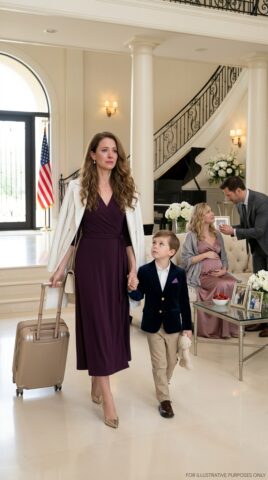
The paramedics arrived with a stretcher, oxygen, and clipped voices that made the penthouse feel suddenly smaller. Margaret Keller moved like someone half her age, gathering Eleanor’s ID, insurance card, medication bottles, and the medical folder from the table.
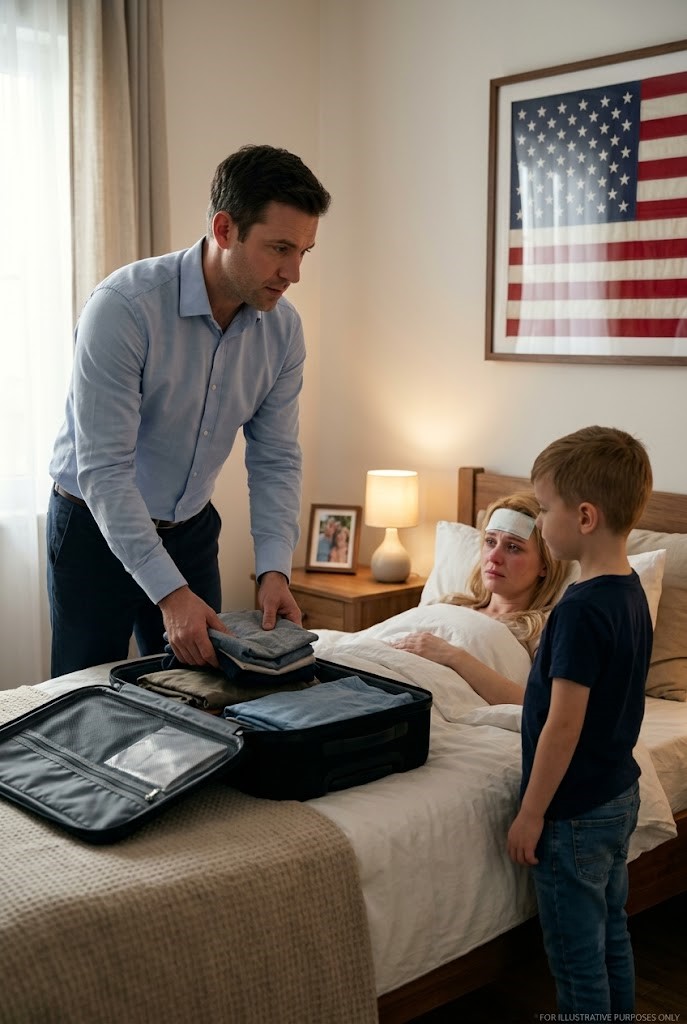
Noah followed every movement.
He was afraid that if he blinked, his mother would vanish.
One paramedic knelt beside Eleanor. “How long has she been unconscious?”
“Maybe ten minutes,” Margaret said. “She coughed blood before that.”
“Any diagnosis?”
“Rare blood disease. Her husband handled most of the treatment.”
The paramedic looked up. “Where is her husband?”
Noah answered before Margaret could protect him.
“He left with his girlfriend.”
The paramedic’s expression changed, but only for a heartbeat. Professionals knew how to hide disgust behind procedure.
As they lifted Eleanor onto the stretcher, her eyes fluttered open. “Noah?”
“I’m here.” He grabbed her fingers.
“Don’t stay alone.”
“I won’t. Mrs. Keller’s here.”
“Your father…”
“He’s gone.”
A tear slid into her hairline. She tried to say something else, but the oxygen mask covered her mouth.
At Northwestern Memorial Hospital, everything became white doors, plastic bracelets, rolling beds, and strangers asking questions Noah was too young to answer. Margaret filled out forms. Noah sat with the postcard pressed to his chest until the cardboard bent from his grip.
After nearly an hour, a doctor stepped into the waiting area. “Family for Eleanor Cole?”
Noah jumped up. “Is she alive?”
The doctor crouched to his level. “She is very sick, but she is alive. We’ve stabilized her for now. She needs specialized care.”
“Can I see her?”
“Not yet. Soon.”
When the doctor left, Margaret sat beside Noah. “Call him.”
Noah knew who she meant.
His thumb shook as he typed the number from the postcard. It rang so long he almost hung up. Then a man answered.
“Yes?”
Noah swallowed. “Is this Charles Hartwell?”
Silence.
Then the voice changed.
“This is Charles.”
“My name is Noah. I’m… I’m Eleanor’s son.”
Another silence, deeper this time.
“My grandson,” Charles said, almost to himself. “Where are you?”
“The hospital. Mom collapsed. Dad left. He said—” Noah stopped. He could not repeat it again.
“What hospital?”
Noah read the sign on the wall.
“Who is with you?”
“Mrs. Keller. Our neighbor.”
“Put her on.”
Margaret took the phone and explained everything with the calm precision of a witness: the bleeding, the collapse, Adrian leaving, the missing clinic response, the medical folder, the strange power of attorney she had found among Eleanor’s papers. She did not embellish. She did not need to.
Charles Hartwell listened.
“I’m leaving Washington now,” he said. “My attorney is coming with me. Do not let Adrian take the boy. Do not let anyone remove documents from that apartment. I’ll be there before midnight.”
When Margaret handed the phone back, Noah asked, “Are you really coming?”
Charles’s voice softened. “I should have come years ago.”
After the call, Noah remembered something.
“The blue envelope,” he said.
Margaret frowned. “What envelope?”
“Mom told me once, when she was really scared, that there was a blue envelope in her jewelry box. She said if anything bad happened, Grandpa needed it.”
Margaret checked the time. The doctors would not allow visits until after a transfer to a monitored unit. “We’ll go quickly,” she said. “Taxi there, taxi back.”
The penthouse looked different when they returned. Not like a home. Like a crime scene before anyone had named it one. A broken mug lay near the kitchen island. The blanket was still on the floor. The family photo remained cracked beside the table.
Noah ran to his mother’s bedroom and opened the jewelry box.
Old earrings. Receipts. A tiny silver key. A photograph of Eleanor at twenty-five, laughing beside a man Noah recognized from online pictures as Charles Hartwell, founder of Hartwell Infrastructure Group.
But no blue envelope.
“There was one,” Noah said. “Right here.”
A pale rectangle marked the velvet lining where the envelope had been protected from dust.
Margaret opened drawers. Nothing.
Then the front door lock clicked.
Both of them froze.
Adrian stepped inside.
He stopped when he saw the open jewelry box. His eyes moved to Noah, then to Margaret, then back to the box.
“What are you doing in my bedroom?”
“It’s Mom’s bedroom,” Noah said.
Adrian closed the door slowly. “Where is she?”
“The hospital,” Margaret said.
“And you thought you’d come here to steal?”
Noah saw the black briefcase in his father’s hand. The zipper was not fully closed. A corner of blue paper showed through.
His heartbeat kicked hard.
Adrian followed his gaze and shifted the briefcase behind his leg.
“Give me your phone,” he said.
“No.”
“I’m your father.”
“You left Mom.”
“I said give it to me.”
Margaret stepped in front of Noah. “The child is returning to the hospital. If you touch him, I’ll call the police.”
Adrian laughed. “You’re a neighbor. You’re nobody.”
“I’m the person who called the ambulance while you were packing for your mistress.”
Color rose in his face.
From the apartment across the hall, another neighbor opened his door. A man in sweatpants looked out. Adrian noticed the witness and lowered his voice.
“Noah,” he said. “Go to your room.”
“No.”
Adrian’s smile disappeared.
“I heard what you said,” Noah whispered. “You said Mom shouldn’t die too fast because you needed time to move the accounts.”
For one second, Adrian looked frightened.
Then he lunged for the briefcase as if to close it.
Noah moved first.
He darted forward, snatched the blue envelope from the zipper gap, shoved it under his hoodie, and ran behind Margaret before Adrian could grab him.
“You little thief,” Adrian hissed.
Margaret opened the front door wide. “Try saying that in front of the police.”
Adrian stood breathing hard, fists clenched. But the neighbor was still watching. Somewhere down the hall, another door opened.
“Get out,” Adrian said.
“With pleasure.”
In the elevator, Noah did not speak until the doors closed. Then he pulled the blue envelope from beneath his hoodie.
Margaret stared at him. “You could have been hurt.”
“If he destroyed it, Mom would be alone.”
The envelope was addressed in Eleanor’s handwriting.
For Dad. Personal.
Noah held it against his chest like armor.
For the first time since morning, he did not feel completely powerless.
PART 3
Charles Hartwell arrived at the hospital just after nine that night.
Noah recognized him before the man said a word. He had seen his grandfather in business magazines and old photographs hidden in his mother’s closet, but real life made Charles look less like a billionaire and more like a tired father who had driven too fast through three states. His gray hair was windblown. His expensive coat was wrinkled. His eyes went straight to Noah.
He stopped a few feet away, as if afraid the boy might reject him.
“Noah?”
“Yes.”
“I’m your grandfather.”
“I know.”
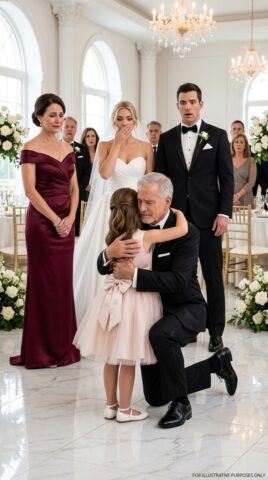
Charles knelt. For a moment neither moved. Then Noah stepped forward and let the old man wrap him in his arms.
Noah did not cry when his father left. He did not cry in the ambulance. He did not cry when doctors said words he did not understand.
But he cried then.
Charles held him until he stopped shaking.
Behind him stood a sharp-eyed woman in a navy suit. “This is Diana Cross,” Charles said. “My attorney. She’s here to protect your mother and you.”
Noah pulled the blue envelope from inside his jacket. “Mom said you needed this if something bad happened.”
Charles stared at Eleanor’s handwriting. His face tightened.
A nurse offered them a small consultation room. Margaret gave her statement while Diana recorded with permission. Then Charles opened the envelope carefully.
The first page was a letter.
Dad, if this reaches you, it means I can no longer protect Noah by myself. Forgive me for believing Adrian. He told me you disowned me. He told me you returned my letters unopened. I have started to fear that my husband is waiting for me to die. Please help my son. Please check every document.
Charles lowered the page.
“She wrote to me,” he said.
Margaret nodded. “I brought one letter myself last fall. Adrian tore it in front of me and told me not to interfere.”
“I never received it,” Charles said.
Noah whispered, “Mom thought you hated her.”
Charles closed his eyes. “No. I was proud and angry, and I let Adrian speak for both of us. But I never hated my daughter.”
Inside the envelope were bank statements, copies of contracts, screenshots of emails, a password written on a folded note, and a USB drive.
Diana put on gloves. “We copy the drive first. Original stays sealed.”
On a hospital computer disconnected from Wi-Fi, she opened the files. Folders appeared by date. Audio recordings. Photographs. Scanned documents.
The first recording was Eleanor and Adrian.
“Sign the power of attorney,” Adrian’s voice said. “I can’t keep paying for treatment if every bank asks for your confirmation.”
“Why does it include selling my shares?” Eleanor asked weakly.
“Standard language.”
“I want Dad’s lawyer to review it.”
“We don’t have time for your father’s games.”
In another recording, Vanessa’s voice floated through the speakers, impatient and cold.
“How much longer?” she asked.
“Not long,” Adrian answered.
“You said that last month.”
“She’s getting worse.”
“And if the clinic takes her?”
“They won’t. I declined the admission through her email.”
Charles stood so abruptly his chair scraped the floor.
Noah looked up. “What does that mean?”
Diana paused the recording. “It means we need to speak with the doctors, the bank, and possibly the police.”
Charles touched Noah’s shoulder. “You don’t need to hear the rest.”
“But they’re talking about Mom.”
“I’ll tell you what matters. I promise. No more secrets.”
That promise made Noah look at him differently.
The doctors confirmed what the envelope suggested: the Washington clinic had sent two admission notices. Someone using Eleanor’s email had rejected the evaluation. The hospital chart also showed canceled follow-up appointments. The cancellations had been entered by her legal representative.
Adrian.
By midnight, Diana had alerted the bank to suspicious activity, requested emergency review of corporate transactions, and prepared a police report. Charles called Hartwell Infrastructure’s board. Five directors appeared by video, sleepy and alarmed.
Charles did not shout. That made him scarier.
“My daughter is in critical care,” he said. “During her hospitalization today, a transaction was initiated to sell her company shares to an entity controlled by Vanessa Pierce. The authorization appears to rely on a power of attorney signed while she was medically vulnerable. Freeze all internal access belonging to Adrian Cole.”
One director shifted. “Adrian called earlier. He said you were exploiting Eleanor’s illness to take control.”
Charles’s eyes hardened. “I already control the company. What he wanted was my daughter’s inheritance.”
The head of security joined the call. “We have logs showing Adrian’s credentials downloading contracts from the last three years at 2:14 a.m. from the Cole residence. Someone also attempted to delete the access trail.”
Diana took notes. “Preserve everything. Do not forward materials to personal accounts. Wait for formal legal requests.”
The board voted before one in the morning. Adrian lost corporate access. His signing authority was suspended. All pending transactions involving Eleanor’s shares were frozen.
At 1:17 a.m., the bank sent confirmation: the transfer to Vanessa Pierce’s account had been flagged and temporarily blocked.
Noah was asleep in a chair when Charles read the message. Margaret had draped her cardigan over him. The blue envelope lay sealed in Diana’s evidence folder.
Charles looked through the ICU glass at his daughter, pale beneath the machines, and for the first time in ten years, he saw the full shape of his mistake.
He had not abandoned Eleanor.
But he had allowed silence to do the work of abandonment.
And silence had given Adrian a kingdom.
By morning, that kingdom was beginning to crack.
PART 4
Adrian came to the hospital at ten the next morning with Vanessa Pierce on his arm.
He looked freshly shaved, calm, and expensive. Vanessa wore a cream trench coat and carried a leather folder against her chest. To anyone passing by, they might have looked like concerned family friends arriving with paperwork and coffee.
Noah saw them from the waiting area and went cold.
Margaret rose immediately.
Adrian smiled at his son as though yesterday had been a misunderstanding. “Get your things, Noah. We’re going home.”
“I’m staying with Mom.”
“Your mother needs rest. You need your father.”
“You left.”
Vanessa touched Adrian’s elbow. “Maybe don’t pressure him.”
He flicked his eyes at her, a warning so quick most people would miss it. Noah did not.
Margaret stepped beside the boy. “This conversation can wait for Mr. Hartwell.”
Adrian’s smile thinned. “You have inserted yourself into this family enough.”
“I was there when your wife stopped breathing.”
Vanessa looked away.
Adrian ignored her and reached for Noah’s wrist. “Come here.”
Noah jerked back. “Don’t touch me.”
Two security guards moved from the nurses’ station.
“Sir,” one said, “step away from the child.”
“He’s my son.”
“He told you not to touch him.”
Vanessa placed her folder on the counter. “We’re here to arrange Eleanor’s transfer.”
“What transfer?” Margaret demanded.
Adrian spoke over her. “My wife previously consented to move to a private facility.”
Charles’s voice came from behind them. “Your wife is not furniture.”
Adrian turned.
Charles stood with Diana Cross and the head physician. The old man’s face was calm, but his eyes looked like winter over Lake Michigan.
The doctor took Vanessa’s folder and reviewed the top sheet. “This is not a valid transfer authorization. It is an outdated intake document from another clinic. A medical transfer requires current physician approval and patient consent when possible.”
“I’m her husband,” Adrian snapped.
“That does not make you her owner.”
For a moment, the waiting room froze around those words.
Adrian’s face darkened. “You people are holding her hostage.”
Charles stepped closer. “You already tried to keep her from treatment once. You won’t do it again.”
“Prove it.”
“The recordings, the bank records, the login data, and whatever Ms. Pierce is carrying in that folder should help.”
Vanessa’s head snapped up. “Recordings?”
Adrian glared at her. “He’s bluffing.”
Charles did not look away from him. “In one of them, you ask how long before Eleanor dies.”
Vanessa’s face drained.
“You told me you deleted everything,” she whispered.
The sentence escaped before she could stop it.
Adrian grabbed her arm. “Shut up.”
She pulled free. “No. You said the emails were gone. You said she would be dead before any audit mattered.”
A nurse behind the desk picked up the phone. Security closed in.
Vanessa opened the folder with shaking hands and threw papers across the counter. “He made me sign backdated contracts this morning. He said if I didn’t, we would both go to prison.”
Adrian lunged, but a guard blocked him.
Diana raised her voice. “No one touch those documents.”
The elevator doors opened.
Two Chicago police detectives stepped out.
Diana exhaled once. “Good timing.”
Adrian gave a crooked smile. “You called the police on a grieving husband?”
“The report was filed this morning,” Diana said. “Your performance was not on the schedule.”
Vanessa stepped toward the detectives. “I’ll tell you everything.”
Adrian turned on her with such hatred that Noah hid behind Charles.
“You say one word,” Adrian hissed, “and I’ll bury you too.”
A detective heard it. “Sir, step back.”
Before anyone could move, a nurse rushed from the ICU doors.
“Mr. Hartwell? We need the physician now. Eleanor’s crashing.”
The world narrowed to those doors.
Charles looked at Noah. “Stay with Margaret.”
“Grandpa—”
“I’ll come back.”
He followed the nurse, disappearing behind the white doors.
Noah stood in the waiting room while detectives questioned his father, while Vanessa cried into her hands, while papers lay scattered like pieces of a life someone had tried to sell.
His phone vibrated.
Unknown number.
The message read:
Your grandfather won’t save Eleanor in time. Ask him who canceled her surgery ten years ago.
Noah stared.
His father was standing ten feet away with both hands visible, his phone on the counter in front of a detective.
Someone else had sent it.
Noah carried the phone to Diana without touching the screen more than necessary. She read the message and went still.
“When did this arrive?”
“Just now.”
“Do not reply. Do not delete it.”
“Is it Dad?”
“We don’t guess. We preserve.”
But Noah had heard the old story. After he was born, his mother needed surgery. She told him once, in a fever, that Charles Hartwell refused to pay because she had married Adrian.
When Charles returned twenty minutes later, Noah showed him the message.
His grandfather’s expression collapsed into grief.
“I paid for that surgery,” Charles said. “The transfer was canceled after the recipient account changed. Adrian told me your mother had refused my help.”
Diana looked toward Adrian. “How would the sender know that?”
Adrian scoffed. “Because the old man lies to everyone.”
Charles turned slowly. “Noah never mentioned the clinic name out loud.”
Adrian’s mouth shut.
Vanessa stared at him. “You told me Charles abandoned her after the birth.”
“Be quiet.”
“You told me he stole the treatment money.”
“I said be quiet.”
The detective stepped between them. “That’s enough.”
Behind the ICU doors, Eleanor’s life hung between machines and medicine.
In the waiting room, the past began bleeding through the walls.
And the lie that had separated a daughter from her father for ten years finally had a name.
PART 5
The woman who arrived at the hospital that night looked like she had aged a decade in a day.
She introduced herself at the staff entrance as Margaret Pierce, Vanessa’s mother, and asked to speak to Charles Hartwell. Security called upstairs before letting her pass. She carried an old flip phone, a worn purse, and a folder thick enough to bend under its own weight.
Diana met her first.
“If you’re here to protect your daughter,” the attorney said, “choose your words carefully.”
Margaret Pierce shook her head. “I’m here because my son is missing.”
Charles stepped into the room. “Your son?”
“Owen Pierce. He worked freelance IT for your company and for Adrian Cole. He fixed Eleanor’s tablet. Managed backups. Handled remote access.”
Noah, sitting beside his grandfather, looked up. “He came to our apartment. He took old phones.”
Margaret’s eyes softened with shame. “Yes.”
She placed the flip phone on the table. “I sent the message to the boy.”
Charles’s face hardened. “You frightened my grandson during his mother’s medical crisis.”
“I know. I’m sorry. But no one listens unless there’s a fire.”
Diana folded her arms. “Talk.”
Margaret opened the folder. “Ten years ago, Adrian used a shell company called Northline Medical Services to divert money meant for Eleanor’s surgery. I thought it was a temporary tax arrangement. My late husband approved one internal document. He died in a car accident a week after he said he wanted to confess.”
“Are you accusing Adrian of causing that accident?” Diana asked.
“I’m saying I got scared enough to stay quiet for ten years.”
The room went very still.
Margaret continued. “My daughter Vanessa got involved with Adrian later. She thought he was rich, powerful, trapped in a tragic marriage. My son Owen did technical work. At first he believed Eleanor knew about the access. Then Adrian asked him to delete clinic emails, wipe login records, and destroy a hard drive with medical reports.”
She played an audio file from the flip phone.
Adrian’s voice filled the room.
“You’re going to erase the clinic emails, the access logs, and the tablet backups. Eleanor can prove they answered her. If she wakes up, nobody needs to believe her.”
A second voice, younger and frightened, replied, “This is bigger than you said.”
A thud sounded.
The recording ended.
Margaret’s hands trembled. “Owen sent me that last night. This morning Adrian told him to go to a warehouse outside Joliet and pick up cash. Then Owen texted me: ‘Mom, I understand everything. Don’t look for me at home.’ I haven’t heard from him since.”
Diana called the detectives.
No one told the family what the police would do next, only that the information had been received. But before sunrise, Owen Pierce walked into a police station with a public defender, a backpack full of drives, and the haunted face of a man who had finally realized fear was not a defense.
His statement changed everything.
Owen admitted he had forwarded Eleanor’s clinic notices to Adrian, maintained unauthorized access to her email, and helped create the appearance that she had rejected treatment. He also produced metadata showing that the attempted sale of Eleanor’s shares had been confirmed from her tablet while she was unconscious in the ambulance.
Vanessa, already terrified, gave her own statement. She admitted to backdated contracts and false invoices. She produced messages in which Adrian promised marriage “as soon as Eleanor is gone.”
Adrian denied all of it.
He claimed the recordings were edited. He claimed Eleanor signed everything willingly. He claimed Charles Hartwell was using his wealth to destroy a devoted husband. But the evidence kept arriving like stones in a flood: security footage, bank flags, email logs, courier records, old transfer documents, and the blue envelope Eleanor had hidden because some part of her had known she might not be believed.
Three days later, Eleanor woke fully.
Noah was allowed five minutes in a gown and mask.
She looked smaller in the hospital bed, but her eyes were clear.
“Hey, Mom.”
Her lips curved. “Hey, brave boy.”
He showed her a drawing: a white house with three windows, a porch, and an American flag by the steps.
“Who lives there?” she whispered.
“You, me, Grandpa. Mrs. Keller gets the little cottage next door because she’s bossy and needs her own kingdom.”
Eleanor laughed softly, then winced.
“Does Dad come there?” Noah asked.
The question hurt both of them.
Eleanor took time before answering. “I want to know what you think.”
“I’m scared of him,” Noah said. “And I’m mad.”
“You’re allowed to be both.”
“He says I betrayed him.”
Eleanor’s eyes sharpened. “No. An adult betrayed this family. You saved it.”
“I only called Grandpa.”
“Sometimes one phone call is the bravest thing a person ever does.”
Charles stood at the door, unable to speak.
Later that afternoon, a notary came to the hospital. Doctors confirmed Eleanor was alert and understood her decisions. She revoked every power of attorney granted to Adrian. She denied authorizing the share sale, the transfer to Vanessa, and the medical refusals sent from her account.
The bank reversed the blocked funds. The corporate registry froze the attempted ownership changes. Hartwell Infrastructure began a full audit.
That night, Eleanor asked Charles to stay after Noah left.
“I want a divorce,” she said.
Charles nodded. “Diana will prepare it when your doctors allow.”
“And custody.”
“We’ll fight for Noah safely.”
She looked at him for a long moment. “I believed Adrian because it was easier than believing my father could hurt me.”
Charles sat beside her bed. “I believed Adrian because it was easier than admitting I had lost you.”
They did not forgive everything in that moment.
Life did not work that way.
But for the first time in ten years, no one stood between them translating love into lies.
PART 6
Adrian’s supervised visit with Noah happened one week later in a private room at the hospital.
Eleanor agreed only after speaking to a child psychologist, and only under strict conditions. Noah could leave at any time. Adrian could not touch him. A psychologist would remain present. Charles would wait outside.
Adrian entered looking thinner, older, but still polished enough to pretend at dignity. He sat across from his son and offered a careful smile.
“You’ve grown up a lot in a few days.”
Noah said nothing.
“This has been hard for everyone.”
Still nothing.
“Your grandfather is using your anger,” Adrian said. “He wants the company. He always wanted control.”
Noah looked at him. “He’s helping Mom get better.”
“I wanted that too.”
“Then why did you hide the clinic letters?”
Adrian glanced at the psychologist. “He’s been exposed to adult accusations.”
The psychologist’s voice was neutral. “Answer his question.”
Adrian folded his hands. “The clinic gave false hope. Your mother was fragile. I made choices to protect her emotionally.”
“Why did you tell her Grandpa rejected her?”
“Families are complicated.”
“Why did you send money to Vanessa?”
“Business.”
“Why did you tell me not to let Mom die too fast?”
The room changed.
Adrian’s face lost its practiced sadness.
“I was angry,” he said quietly.
“You said you needed time to move the accounts.”
“Noah—”
“You left her bleeding.”
“I panicked.”
“You packed first.”
Adrian leaned forward. “Help me. Tell them your grandfather confused you. Tell them you misunderstood what you heard. Then maybe we can still be a family.”
Noah stood.
“You’re asking me to lie.”
“I’m asking you to save us.”
“No. Mrs. Keller and I saved Mom when we called the ambulance. Grandpa saved her when you tried to take the money. You’re trying to save yourself.”
The psychologist rose. “Noah, would you like to end the visit?”
“Yes.”
Adrian reached out. “Son—”
The psychologist stepped between them. “The visit is over.”
Charles waited in the hallway. Noah walked to him and took his hand.
“Can I see Mom?”
“Of course.”
Two months passed.
Eleanor’s treatment began to work. Not magically. Not like movies where color returns overnight and everyone dances in sunlight by the next scene. Recovery came in inches: sitting up without help, holding a mug, walking six steps, then twelve, then the length of the hallway with Noah counting under his breath.
Her hair thinned. Her hands shook. Some days she was too tired to talk.
But she was alive.
The divorce hearing took place in Cook County. Eleanor arrived with a cane, a navy dress, and her son beside her. Charles walked behind them, not in front, because Eleanor had asked him not to turn her life into one of his boardroom rescues.
Adrian sat across the aisle with his attorney. Vanessa was not beside him.
The judge granted the divorce. Temporary custody remained with Eleanor. Adrian’s visitation would continue only under supervision pending the criminal investigation and family court review.
In the courthouse hallway, Adrian approached.
Diana moved first. “Communicate through counsel.”
Adrian ignored her and looked at Eleanor. “Are you happy?”
Eleanor leaned on her cane. “I’m alive.”
“You took everything from me.”
“I recovered what was mine.”
“Vanessa betrayed me. Owen sold me out. Your father bought everyone.”
“They became afraid of the consequences of their own choices.”
Adrian looked at Noah. “Even my own son turned his back on me.”
Noah stepped closer to his mother. “A real father doesn’t wait for Mom to die so he can steal faster.”
Adrian’s mouth opened, but nothing came out.
For once, silence belonged to him.
Months later, the financial case unraveled in public filings and sealed evidence. The attempted sale of Eleanor’s shares was voided. False invoices were traced through Vanessa’s consulting company. Owen’s drives showed years of unauthorized access. Margaret Pierce’s documents connected the old surgery money to the shell company that had helped destroy Eleanor’s relationship with her father.
Adrian was charged with fraud, forgery, identity theft, and misappropriation. Vanessa faced charges for her part. Owen cooperated, but cooperation did not erase responsibility. Margaret testified about the old transfer, her fear, and the silence she had carried for ten years.
Eleanor did not attend every hearing.
She had no interest in watching Adrian shrink under fluorescent lights. She had spent enough of her life orbiting his moods. Her revenge was quieter and far more complete: she took her medication, went to therapy, helped Noah with homework, and learned to sleep without listening for footsteps in the hall.
Spring came late to Wisconsin that year.
Charles moved Eleanor and Noah to his lake house outside Madison while she recovered. Margaret Keller came too, pretending she was “only staying a weekend,” then reorganizing the pantry and criticizing the gardener until everyone accepted that she had become family.
One afternoon, Charles struggled to assemble an old porch table while Noah held the instructions upside down.
“Are you sure that leg goes there?” Eleanor asked from a chair wrapped in a blanket.
Charles frowned. “I built a national infrastructure company.”
“You’re losing a fight to patio furniture,” Noah said.
Margaret Keller called from inside, “He put the drawer on backward.”
For the first time in months, Eleanor laughed so hard she cried.
That night, after Noah went to bed, Eleanor joined her father on the porch. The lake reflected a cold moon. Somewhere in the trees, wind moved softly through new leaves.
“I used to think forgiveness meant pretending nothing happened,” she said.
Charles watched the water. “It doesn’t.”
“I’m not ready to forgive Adrian.”
“I didn’t ask.”
“I’m not sure I’m ready to forgive myself either.”
He turned. “For what?”
“For believing him. For letting Noah live in that house. For thinking weakness was peace.”
Charles took a long breath. “Then I’ll have to forgive myself for letting pride look like principle. For allowing a liar to become my messenger. For not knocking down your door.”
Eleanor smiled sadly. “We were both fooled.”
“We were both proud.”
She nodded. “No more messengers.”
“No more.”
Inside the house, Noah appeared in the doorway with the old postcard in his hand.
“I couldn’t sleep,” he said.
Eleanor opened her blanket. “Come here.”
He curled beside her, too big to be carried now but still young enough to need the shape of his mother around him.
Charles looked at the postcard. “You kept it.”
Noah nodded. “It worked.”
The old man’s eyes shone. “Yes, it did.”
Noah turned the card over. Beneath Charles’s original message, he had written something new in pencil.
Whatever happens, tell the truth.
Eleanor read it and kissed the top of his head.
The porch light glowed behind them. The lake stretched into darkness. For the first time, the future did not feel like a hallway with Adrian waiting at the end.
It felt like an open road.
PART 7
One year later, Noah stood on a small stage in a Chicago community center, gripping a paper so tightly the edges curled.
The room was full of doctors, nurses, donors, survivors, and families who had learned the hard way that illness was not only a battle of cells and medicine. Sometimes it was a battle of signatures, passwords, insurance forms, and the person who answered the phone when a patient was too weak to speak.
Behind Noah sat Eleanor, healthier now, though still careful with her energy. Her hair had grown back in soft waves. She wore a cream suit and the pearl earrings Charles had given her when she graduated college. Charles sat beside her. Margaret Keller sat on Noah’s other side like a security guard in floral print.
The Hartwell Patient Advocacy Fund had been Eleanor’s idea.
Not a monument to her suffering. Not a revenge project.
A door.
It paid for independent patient advocates, legal reviews of medical powers of attorney, emergency transportation, and secure communication support for people whose illness made them vulnerable to financial abuse.
Eleanor had insisted Noah be allowed to speak if he wanted.
He wanted.
He lifted his paper.
“My mom got sick,” he began. His voice shook, but he kept going. “Some people helped her. Some people tried to use the fact that she was sick. I learned that kids are not supposed to fix adult problems, but sometimes kids know when something is wrong.”
The room was silent.
“I had a postcard from my grandfather. It said, ‘Whatever happens, call me.’ I did. That call helped save my mom.”
He looked at Eleanor. She was crying openly now.
“So if you love somebody who is sick, don’t let one person control every message. Don’t let fear be the only voice in the room. And if someone tells you not to ask questions, that is usually when you should ask for help.”
The applause began softly, then rose.
Noah stepped down, embarrassed and relieved. Eleanor hugged him carefully.
“You were perfect,” she whispered.
“I forgot one line.”
“The best people always do.”
Across the room, Diana Cross spoke with a hospital administrator. The advocacy fund already had three cases in review. One involved an elderly man whose caretaker had changed his bank login. Another involved a woman whose husband had canceled oncology appointments without telling her. The third involved a teenager who needed emergency guardianship after discovering forged medical forms.
Eleanor listened, steady and focused.
Pain had not made her saintly. Betrayal had not made her soft. Survival had made her precise.
Adrian’s criminal trial ended that winter. He accepted a plea after prosecutors presented the email logs, the bank records, Vanessa’s testimony, Owen’s drives, and Eleanor’s hospital statement. He stood in court and apologized in the careful language of a man sorry for consequences.
Eleanor did not look at him.
When asked if she wanted to make a victim impact statement, she rose with her cane.
“You did not only steal money,” she said. “You stole messages. You stole treatment options. You stole years between a father and daughter. You tried to teach my son that love means control and truth is whatever frightens people into silence. But you failed. My son learned the opposite.”
Adrian stared at the table.
Eleanor turned slightly toward Noah. “He learned that truth can be carried by a child, protected by a neighbor, defended by a grandfather, and confirmed by anyone brave enough to stop lying.”
Adrian was sentenced. Vanessa received her own penalty. Owen, after cooperation and restitution agreements, faced consequences that followed him for years. Margaret Pierce apologized to Eleanor in person, not expecting forgiveness. Eleanor thanked her for coming forward and did not offer more than she honestly had.
That was another lesson: mercy did not require pretending the wound was small.
By the second spring, Eleanor moved back to Chicago, but not to the penthouse. That place had too many echoes. She chose a townhouse near Lincoln Park with tall windows, a small garden, and a blue front door Noah picked because, he said, blue envelopes were lucky now.
Charles visited every Sunday.
At first, he arrived with gifts too expensive for ordinary afternoons: rare books, custom bicycles, antique lamps. Eleanor finally stopped him at the door one day.
“Dad.”
He froze, holding a ridiculous imported espresso machine.
“We need you,” she said. “Not proof you’re sorry.”
He looked down at the box. “Can I still leave this here?”
“No.”
Noah appeared behind her. “Unless it makes hot chocolate.”
Charles brightened. “It does.”
Eleanor sighed. “Fine. But this is emotional manipulation through appliances.”
“It’s a family tradition,” Charles said.
They built new traditions carefully.
Sunday dinners. Direct phone calls. Shared calendars. Medical appointments where Eleanor chose who entered the room. Bank accounts with alerts she controlled. A rule that no one, not even Charles, spoke for another adult unless asked.
And every year, on the anniversary of the day Noah called his grandfather, they mailed postcards.
The first went to Margaret Keller, though she lived three blocks away.
Whatever happens, knock loudly.
The second went to Diana Cross.
Whatever happens, preserve the evidence.
The third stayed on Eleanor’s desk.
Whatever happens, believe your own fear when it tells you something is wrong.
The fourth was framed in Noah’s room.
It was the original card from Charles, worn at the corners, the ink faded from being held too many times by small frightened hands.
On Noah’s thirteenth birthday, Eleanor found him looking at it.
“Do you ever miss him?” she asked gently.
Noah did not pretend not to understand.
“Dad?”
“Yes.”
He thought for a long time. “I miss who I thought he was.”
Eleanor sat beside him. “Me too.”
“Does that count?”
“It counts.”
“He wrote me a letter.”
“I know. Diana told me.”
“I didn’t answer.”
“You don’t owe anyone a response before you’re ready.”
Noah touched the postcard frame. “Maybe someday I’ll ask him why.”
Eleanor’s heart tightened. “And if someday comes, I’ll stand outside the door if you want me there.”
He leaned against her shoulder. “I want you there.”
“You have me.”
Outside, Chicago shimmered in summer heat. Cars moved along the park. Somewhere, a neighbor’s flag stirred lazily in the wind.
Noah looked at the framed postcard one more time.
His father had told him to watch his mother die slowly.
Instead, Noah had watched her live.
He watched her relearn strength, rebuild family, reclaim her name, and turn the cruelest sentence Adrian ever spoke into the dividing line between the life they escaped and the life they chose.
Eleanor Hartwell Cole became Eleanor Hartwell again.
Noah kept his father’s last name for a while, then changed it when he was old enough to decide. Not because Charles asked. Not because Eleanor pushed. Because, as he told the judge, “I want my name to belong to the people who came when I called.”
Years later, when Noah wrote his college essay, he did not write about wealth, scandal, or the trial that newspapers had covered for three weeks.
He wrote about a postcard.
He wrote about a neighbor in slippers calling an ambulance.
He wrote about a grandfather who arrived too late to fix the past but in time to protect the future.
And he wrote about his mother, who survived not because betrayal made her stronger, but because when betrayal finally showed its face, she was no longer alone.