My Husband Left Me Sick At JFK—Seven Days Later, The Maid Told Him I Never Came Home…
My husband left me outside JFK in freezing rain because his “VIP client” mattered more than his sick wife. Seven days later, he finally came home and asked the maid where I was. Her answer didn’t just scare him. It opened the door to the ugliest truth of our marriage.
PART 1
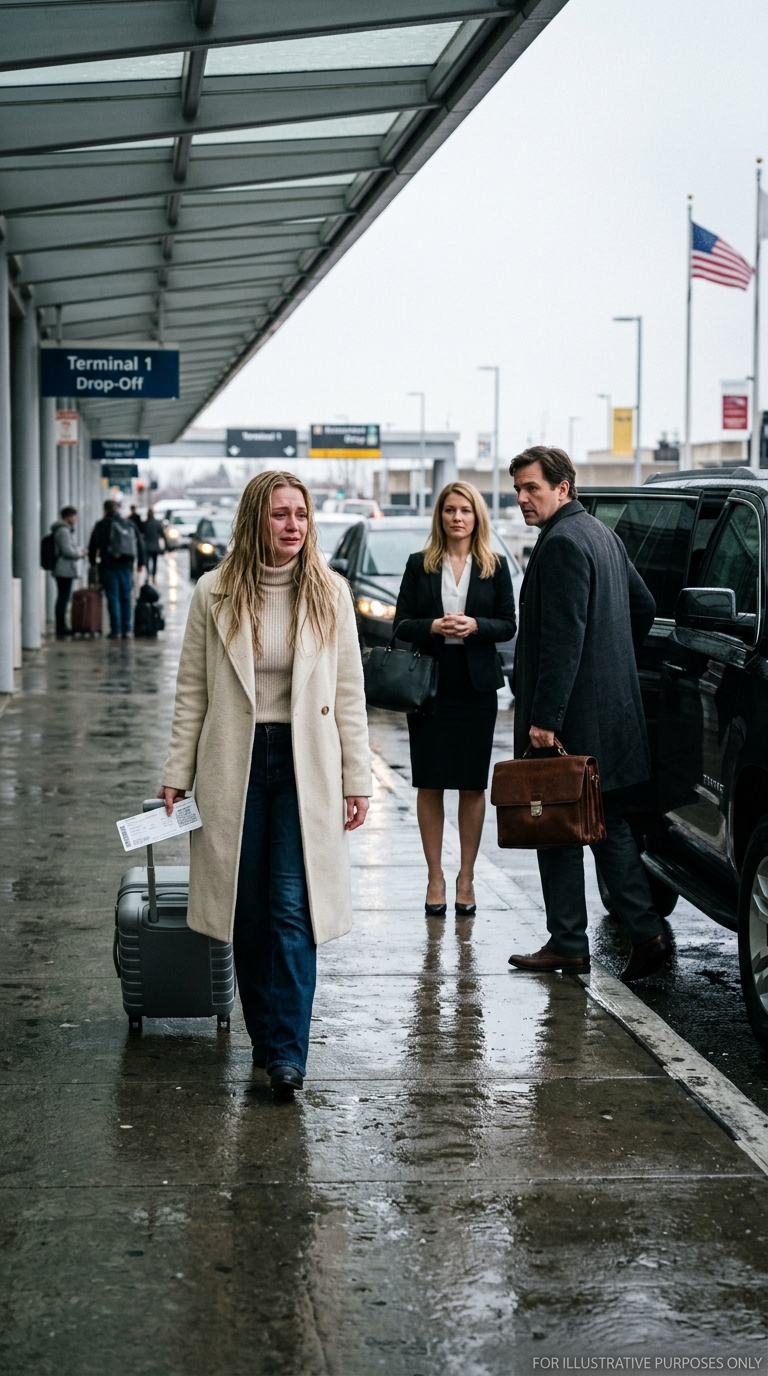
My husband locked the car door while I stood outside JFK with a fever, then told me I smelled too sick to ride in his Mercedes.
That was the sentence that ended my marriage.
Not the affair.
Not the lies.
Not even the money he stole later.
It was that one cold little click of the lock.
I had just landed at JFK after a weeklong business trip in Los Angeles. It was two days before Christmas, close to midnight, and the kind of New York cold that cuts through wool like it has a personal grudge.
My suitcase was stuffed with gifts for Luke’s family.
Cashmere scarf for his mother.
Limited-edition bourbon for his uncle.
A ridiculous $180 skincare set for his cousin who had once told me, “You look tired,” at Thanksgiving dinner while I was carrying six serving trays.
I had a fever so high the airport lights looked smeared.
My throat felt scraped raw. My knees shook every time I moved. I stood near the rideshare pickup curb, trying to open Uber with fingers so numb the screen barely recognized me.
Then I saw the black Mercedes.
Luke’s Mercedes.
For one stupid second, I smiled.
I thought my husband had checked my flight. I thought maybe, just maybe, he had decided to surprise me. Luke was not romantic. He believed flowers were “depreciating assets,” and once called Valentine’s Day “a national scam for men with weak negotiation skills.”
Still, he was there.
The car stopped beside me.
I dragged my suitcase toward the trunk, almost laughing from relief.
The passenger door did not open.
I tried again.
Locked.
The driver’s window slid down halfway.
Luke sat behind the wheel in his navy overcoat, one hand on the steering wheel, the other typing fast on his phone. His jaw was tight. His eyes flicked over me like I was a stain on expensive fabric.
“Take a cab,” he said.
I blinked. “What?”
“I have an emergency at the firm. Senior partners called. Big client. Last-minute.”
Rain hit my face. Cold drops rolled under my collar.
“Luke, I’m sick. I told you on the plane. I have a fever. It’s almost midnight. Just take me halfway home.”
He finally looked at me.
Not with worry.
With irritation.
“Sarah, look at yourself.” His voice dropped, sharp and low. “If you get in my car right now, it’s going to smell like wet dog and flu medicine. I’m meeting a VIP client.”
I stared at him.
He sighed like I had asked him to donate a kidney.
“I’ll Venmo you cab fare.”
From inside the car, his phone lit up.
VIP CLIENT ❤️
He flipped it face down too quickly.
That was when I saw it.
On the passenger seat, tucked against his leather briefcase, was a pastel pink travel pillow with bunny ears.
Luke hated anything cute. He once said baby shower decorations made him “question civilization.” That pillow did not belong to him.
It did not belong to me either.
“Whose pillow is that?” I asked.
His mouth tightened.
A car behind him honked.
Then another.
Luke waved his hand, annoyed. “I don’t have time for this.”
“Luke.”
“Sarah, don’t start drama at the airport.”
Drama.
I was shaking in freezing rain, sick enough to barely stand, and he called it drama.
The window rolled up.
The Mercedes pulled away, tires splashing filthy slush over my beige coat.
I stood there holding the suitcase handle, watching his taillights disappear into the sleet.
My phone slipped from my hand and hit a puddle.
The screen went black.
For a second, I thought, Great. Even my phone knows when to quit.
Then the terminal lights tilted.
The pavement rushed up.
And everything went dark.
When I woke up, I was not in my bedroom in Westchester.
I was in Sam’s apartment in Brooklyn.
Her tiny place smelled like eucalyptus oil, coffee, and chicken noodle soup. A humidifier hissed on the dresser. My body felt like it had been used as luggage by airport baggage handlers.
Sam sat beside the bed in sweatpants and an NYU hoodie, holding a bowl of soup like she was one second away from throwing it at someone.
“Oh, good,” she snapped. “The idiot is awake.”
My voice came out rough. “How long?”
She held up seven fingers.
I stared at her hand.
“Seven days?”
“Seven days,” she said. “Pneumonia. Viral infection. Severe exhaustion. The doctor said the freezing rain pushed your body over the edge. A passerby found you down at JFK and called the emergency contact from your broken phone.”
My first thought was not about the hospital.
It was about Luke.
“Did he call?”
Sam’s face changed.
That answered me before she said anything.
She picked up my repaired phone from the nightstand and tossed it onto the blanket.
“Check it.”
I opened the call log.
No missed calls.
No voicemails.
No texts.
Seven days.
My husband had left me outside an airport in freezing rain, and for seven days, he had not noticed I never came home.
Sam paced the room, furious.
“I wanted to call him. I wanted to drive to that Westchester mansion and drag him out by his overpriced collar. But every time your fever spiked, you grabbed my wrist and kept saying, ‘Don’t call him.’”
I looked down at the phone.
Something inside me went quiet.
Not soft quiet.
Dangerous quiet.
Sam grabbed her keys. “I’m going over there.”
“No.”
She turned. “Sarah.”
“I want to see how long it takes,” I said.
“How long what takes?”
“For my husband to realize his wife is missing.”
Sam stared at me like I had just spoken a foreign language.
Then I sat up, slow and weak, and asked for her MacBook.
Luke was arrogant, but he was careless.
He always used my birthday as his password because, in his words, “You’re the only person boring enough to remember it.”
I logged into the shared iCloud account he forgot to remove from my devices.
His Mercedes location history opened first.
The car had not been at a rural business retreat.
It had spent three nights parked outside Serenity Lofts, a luxury condo tower in Manhattan with glass balconies and a lobby that looked like a tech billionaire’s waiting room.
Then came the credit card records.
A $2,500 charge at Tiffany & Co.
A dinner for two at Le Coucou.
A weekend spa package at The Plaza.
All charged to the Amex he told me was “only for clients.”
Sam leaned over my shoulder.
“Oh, he’s dead,” she said. “He just doesn’t know the obituary is being written.”
I should have cried.
I did not.
I closed the laptop and looked out the window at the dirty Brooklyn snow piled against the curb.
“I’m going home,” I said.
Sam’s mouth fell open. “You can barely stand.”
“I don’t need to stand long.”
“What are you going to do?”
I looked at my dead phone, my hospital bracelet, and the suitcase tag from JFK.
“I’m going to let him think he still owns the room.”
Exactly seven days after he abandoned me, Luke finally drove back to our Westchester house.
He expected dinner.
He expected warm lights.
He expected me.
Instead, he walked into a dark house with dust on the glass coffee table and spoiled milk in the refrigerator.
He called Martha, our part-time housekeeper.
I found out later because Martha told me everything.
“Where is my wife?” Luke barked. “Why is the house a mess?”
Martha paused.
“Mr. Evans,” she said carefully, “Sarah hasn’t been home since her business trip.”
“What?”
“The doors have been locked for a week. I thought you two went away for Christmas.”
Luke went silent.
Then Martha added the sentence that finally broke his little performance.
“Sir… you mean you didn’t know your wife was missing?”
PART 2
By the time Luke found me, another man was feeding me soup in a hospital room, and that man was his younger brother.
Luke arrived at Mount Sinai looking expensive and terrified.
Not terrified for me.
Terrified of consequences.
His hair was damp. His coat was crooked. His face had the fake panic of a man who had rehearsed concern in the elevator.
“Sarah,” he breathed, rushing toward my bed. “Baby, what happened? I was in a rural area with no service. I came home and—”
“Seven days,” I said.
He stopped.
My voice was still hoarse, but it cut clean.
“You were worried for seven days with no missed calls?”
Luke opened his mouth.
Nothing useful came out.
Beside me, Hunter Evans set down the bowl of soup.
Hunter was Luke’s half brother. Younger. Quieter. Smarter than Luke ever admitted. In the Evans family, Luke was the golden son and Hunter was the uncomfortable footnote no one wanted to read at dinner.
Hunter stood, buttoned his jacket, and gave Luke a smile with no warmth in it.
“You’re seven days late, big brother.”
Luke’s face tightened.
“Why are you here?”
Hunter glanced at me. “Because someone should be.”
That was the first time Luke looked scared.
Not because his wife nearly died.
Because the wrong person had witnessed his failure.
On the ride home, Luke talked nonstop.
Bad cell service.
Investor emergency.
Stress.
Senior partners.
A whole buffet of lies served with corporate vocabulary.
I stared out the window at the wet city lights.
“Are you still mad about the airport?” he asked.
“I’m tired,” I said. “Drive.”
He exhaled, relieved.
He thought silence meant surrender.
Men like Luke always confuse quiet women with stupid ones.
At home, he carried my suitcase upstairs like a husband in a commercial.
Then I stepped into our bedroom.
And smelled another woman.
Not faintly.
Not maybe.
Baccarat Rouge 540.
Heavy, sweet, expensive, and smug.
On my pillow, I found a long platinum-blonde hair.
Behind the headboard, a cheap rose-gold earring glittered like evidence too lazy to hide.
Luke walked in and froze.
Then he laughed.
“That must belong to the temp maid.”
I held up the earring.
“Your maid wears $300 perfume and costume jewelry in my bed?”
His smile twitched.
I tossed the earring into the trash.
“Tell her not to leave garbage where I sleep.”
That night, while Luke snored beside me, I ordered a nanny cam, copied his laptop files, and memorized the address of Serenity Lofts.
By morning, the wife he knew was gone.
The woman beside him was evidence collection in a silk robe.
PART 3
I found my husband’s secret apartment by using the key fob he was dumb enough to leave in his old suit jacket.
Saturday morning, Luke kissed my forehead and said he had an all-day investor strategy meeting.
He wore the gray Tom Ford suit I had picked up from the dry cleaner.
I straightened his tie.
“Go impress them,” I said.
He smiled, smug as a man who thought he had trained his wife perfectly.
The second his Mercedes cleared the gate, I changed into jeans, a black coat, and sunglasses. I ordered an Uber and went straight to Serenity Lofts.
The driver tried small talk.
I gave him five stars just for giving up.
The building rose out of Manhattan like a monument to secrets. Glass walls. Marble lobby. A concierge who glanced at my key fob and waved me through without question.
Unit 1806.
The door opened with one soft beep.
Inside, the apartment looked like a Pinterest board for a mistress with a trust fund fantasy.
White sofa.
Pink throw pillows.
Fresh roses.
Gold-framed photos of Luke with a platinum-blonde woman draped over him like a luxury accessory.
Her name was Chloe.
I knew because her name was printed on the ultrasound sitting on the coffee table.
Eight weeks pregnant.
Next to it was a notebook.
Luke’s handwriting filled the margins.
Imported oak crib.
Private preschool list.
Possible names: Cooper Evans.
I stood there holding the paper.
For three years, Luke had told me children could wait.
“We need to stabilize the company first.”
“We need more capital.”
“You’re too emotional right now.”
Apparently, I was too emotional for motherhood, but Chloe was qualified after eight weeks and a Tiffany bracelet.
I photographed everything.
The ultrasound.
The pictures.
The planner.
The lease documents on the kitchen counter.
The Amex statement half-tucked under a vase.
Then the elevator chimed.
Voices came down the hall.
Chloe giggled first.
Then Luke.
“Careful, babe,” he said, warm and playful. “My son needs his mother relaxed.”
My son.
I looked around.
No back exit.
No time.
I ran into the bedroom, slipped into the walk-in closet, and pulled the door almost shut.
Through the narrow gap, I watched them enter.
Chloe kicked off her heels and dropped onto the sofa.
“You keep saying wait,” she whined. “Wait until when? Until your boring wife figures out how to use Google?”
Luke laughed.
“She still prints boarding passes. Relax.”
Chloe swatted his chest. “I’m serious. I’m not giving birth as your side project.”
Luke sat beside her and lowered his voice.
“I have it handled. I’m moving cash into my mother’s offshore accounts. I’m routing the rest through shell vendors and reporting losses. By the time Sarah gets divorce papers, the marital assets will look pathetic.”
I pressed my hand over my mouth.
My phone was recording.
Chloe smiled. “How much does little Mrs. Casserole get?”
Luke shrugged.
“Five percent. Enough to buy a sad condo in Ohio and maybe a decent coffee machine.”
They both laughed.
That was the moment I stopped being heartbroken.
Heartbreak still loves the person who hurt you.
I did not.
I watched Luke kiss her stomach, promise her my life, my house, my future, and my money.
Then I waited until they went downstairs for food and slipped out through the emergency stairs.
My knees shook all the way down eighteen floors.
But my hands never let go of the phone.
That afternoon, I walked into Vince Mercer’s law office.
Vince was Sam’s former law school classmate, the kind of divorce attorney rich men feared and rich women quietly recommended over martinis.
He played the recording twice.
The second time, he smiled.
Not kindly.
Professionally.
“This is ugly,” he said.
“I know.”
“No. I mean useful ugly.”
He leaned back in his chair. “If we file today, he panics. He’ll bury the money faster. We need him comfortable.”
“I’m supposed to sleep next to him?”
“You’re supposed to let him underestimate you.”
I stared at the Manhattan skyline through Vince’s window.
“Then what?”
Vince tapped the calendar on his desk.
“His company gala is next month. Ten-year anniversary. Investors. board members. press. His mother in pearls pretending she built America herself.”
I understood immediately.
Vince smiled.
“He needs you there as the loyal wife.”
I looked down at my hands.
They were steady now.
“Then I’ll be there.”
For the next month, I played my role.
Breakfast at seven.
Starbucks in his travel mug.
Pressed shirts.
Soft smile.
A kiss on the cheek when he came home smelling like Chloe’s perfume and expensive hotel soap.
Luke got careless.
He texted her in the bathroom.
He took calls on the patio.
He left receipts in jacket pockets.
I passed every piece to Vince.
One evening, Luke handed me a gold-embossed invitation.
“Company gala. You’re coming.”
“How flattering,” I said. “Do I get a script, or should I just smile like the furniture?”
He blinked.
Then laughed, because he thought I was joking.
“My mother wants no drama. There have been rumors. You standing next to me shuts people up.”
I looked down at the invitation.
“None of my dresses fit. I’ve been sick.”
Luke immediately pulled out his phone.
My account chimed.
$5,000.
“Buy something stunning,” he said. “The CEO’s wife needs to look the part.”
I smiled.
“Of course.”
The next morning, I wired every cent to a private investigator.
The gala took place at a five-star hotel in Midtown. Crystal chandeliers. Champagne towers. Men with Rolexes pretending not to panic about quarterly numbers. Women in gowns sharp enough to draw blood.
I walked in beside Luke wearing a black velvet dress that fit like revenge.
His eyes widened.
For a second, he remembered I was not just the woman who made his breakfast.
Then Chloe arrived in a red dress that belonged more to a nightclub than a corporate anniversary.
She touched Luke’s arm too often.
Whispered too close.
Smiled at me like she had already measured my closet.
Near the bar, she raised her voice just enough.
“Some women really let themselves go after marriage, then act surprised when their husbands get bored.”
A few employees laughed nervously.
Luke grabbed her wrist. “Chloe.”
Too late.
I set down my champagne.
Walked onto the stage.
Picked up the microphone.
The ballroom softened into silence.
“Good evening,” I said. “As Luke’s wife, I wanted to give my husband a special anniversary gift tonight.”
Luke’s face drained.
“Sarah,” he called. “Get down.”
I nodded to the AV technician Vince had hired.
The LED screen behind me lit up.
Not with revenue charts.
With photographs of Serenity Lofts.
Luke and Chloe kissing in the kitchen.
Luke holding the ultrasound.
Text messages.
Receipts.
Wire transfers.
The ballroom erupted.
Chloe’s glass slipped from her hand and shattered.
Luke lunged toward the stage.
Two security guards stepped in front of him.
I clicked again.
The next slide showed corporate funds routed through fake vendor accounts and used for jewelry, condo payments, and Chloe’s “client entertainment.”
I looked at the board members.
“This is why your company has been reporting mysterious losses.”
Luke shouted my name like it belonged to him.
I looked straight at him.
“You left me at JFK because I was inconvenient,” I said into the microphone. “Tonight, I’m returning the favor.”
His mother stood from the VIP table, white with fury.
Chloe started crying.
Luke tried to reach me, face twisted, hand raised.
Security caught him before he made it three steps.
That image went viral before midnight.
CEO restrained at gala after wife exposes mistress and fraud.
By sunrise, investors were calling emergency meetings.
By lunch, Luke’s perfect life had a crack down the middle.
But men like Luke do not apologize when exposed.
They reload.
PART 4
Luke tried to ruin my reputation because he couldn’t save his own.
Two days after I moved out, anonymous posts flooded every local business group from Westchester to Manhattan.
Gold-digging wife humiliates CEO for money.
Bitter spouse stages fake scandal.
Woman demands half after contributing nothing.
Nothing.
I stared at that word on my laptop screen.
Nothing was apparently the three years I spent doing unpaid bookkeeping, hosting investor dinners, proofreading decks at midnight, organizing Christmas parties, managing his mother’s medical appointments, and smiling at board wives who treated me like decorative lighting.
Sam sat beside me, gripping a mug so hard I worried for the ceramic.
“Let me respond,” she said. “I have a burner account and unresolved rage.”
“No.”
“They’re calling you a parasite.”
“Let them.”
She stared at me. “You’re too calm. It’s upsetting.”
“Luke wants me hysterical. I’m not auditioning for his story.”
Then he posted the photo.
Me in Paris, one year earlier, leaning close to Pierre Laurent, a French design partner, at a loud banquet.
Cropped perfectly.
Captioned viciously.
My wife cheated first.
The internet did what the internet does best.
It swallowed the lie whole and asked for dessert.
Messages filled my inbox.
Homewrecker.
Fraud.
Cheap.
Worse.
Luke texted me that night.
See what happens when you fight above your weight class? Sign my settlement. I’ll make this stop.
I laughed once.
Cold.
Then I called Vince.
“He played the Paris card.”
Vince sounded delighted. “Good. I was getting bored.”
The next morning, Vince held a livestreamed press conference.
I wore a plain white button-down and no heavy makeup. I did not sob. I did not beg. I did not perform pain for strangers who had called me names twenty-four hours earlier.
Vince played the full hotel security footage.
Pierre and I stood in a group of six people.
We shook hands.
He introduced me to his wife.
The three of us talked for four minutes while a waiter dropped a tray behind us.
That was the entire scandal.
Then Vince released the second packet.
Bank records.
Vendor invoices.
Corporate transfers.
Chloe’s condo.
Chloe’s jewelry.
Chloe’s car.
Luke’s fraud, stacked neatly in PDF form.
The internet turned around so fast it nearly gave itself whiplash.
By noon, Luke was not a betrayed husband.
He was a thief with a mistress and a PR firm.
The board removed him within forty-eight hours.
Major partners canceled contracts.
His mother called me screaming.
“You destroyed this family.”
“No,” I said. “I just stopped cleaning up after it.”
She spat, “Men make mistakes. A good wife protects the family name.”
I looked around my temporary apartment, at the cardboard boxes, the legal folders, the cheap Target lamp Sam had helped me assemble.
“Then marry him yourself.”
I hung up.
The divorce mediation happened one week later.
Luke arrived with his lawyer and Chloe.
She wore a cream maternity dress and kept rubbing her stomach like she was polishing a trophy.
Luke looked rough. Unshaven. Angry. Still arrogant enough to believe volume counted as evidence.
“My girlfriend is pregnant with my son,” he announced. “I need an expedited divorce.”
Vince slid a sealed folder across the table.
“Before we discuss the unborn child as leverage, we should clarify something.”
Chloe went still.
Luke frowned. “What is that?”
“A paternity report,” Vince said.
The mediator adjusted her glasses.
Luke laughed. “That’s impossible.”
“Not for people with subpoenas and competent investigators.”
Chloe whispered, “Luke…”
Vince opened the folder.
“The fetus has zero biological relation to Mr. Luke Evans.”
The room went silent.
Luke turned toward Chloe.
She looked at the floor.
Then the door opened.
Hunter stepped in.
Calm.
Sharp.
Unapologetic.
“Surprise,” he said.
Luke stood so fast his chair scraped the floor.
“You.”
Hunter placed photographs on the table.
Chloe with a tattooed nightclub bouncer.
Chloe taking cash.
Chloe messaging Hunter’s investigator, bragging about “locking down the rich idiot.”
Luke looked like someone had unplugged him.
Hunter leaned on the back of a chair.
“Chloe wasn’t high society. She was bait. I paid for access. You provided the stupidity.”
Chloe cried.
Luke shouted.
The mediator threatened to call security.
I sat perfectly still.
Hunter looked at me once. There was apology in his face, but no regret.
Later, outside, I asked him why.
He told me about his mother.
Cancer.
Treatment money.
Luke controlling the family accounts.
Luke refusing to help, then buying a Porsche the next week.
“I used you,” Hunter said quietly. “And I’m sorry.”
I looked at the courthouse doors.
“You handed me ammunition. I pulled the trigger.”
He nodded.
“After this, we’re even,” I said.
“Fair.”
The final hearing was swift.
The judge saw the records.
The hidden funds.
The affair.
The smear campaign.
The threats Luke sent about my parents in Ohio.
I was awarded the Westchester house, sixty percent of marital assets, and damages tied to defamation and financial misconduct.
Luke lost his CEO position.
His mother lost her social throne.
Chloe vanished with what jewelry she could pawn.
Outside the courthouse, my mother-in-law grabbed my arm.
“Sarah, please,” she begged. “Don’t take the house. It was my husband’s legacy.”
I removed her hand.
“That house became mine the night your son left me to freeze outside JFK.”
She shook her head. “You have no mercy.”
“I had mercy,” I said. “Your family mistook it for weakness.”
I sold the mansion to a retired couple who wanted quiet suburbs and a porch for morning coffee. I donated a portion to a foster care foundation and put the rest into my own accounts.
No announcement.
No press.
Peace does not need applause.
A month later, Sam drove me to JFK.
This time, I was not sick.
This time, I was not waiting for Luke.
I had one suitcase, a sharp bob haircut, and an acceptance letter to a master’s program in interior design in Paris.
Hunter met me at the terminal with a folder.
“Recommendation letter,” he said. “And partnership paperwork for our European branch. Strictly business.”
I raised an eyebrow.
“Strictly?”
He smiled.
“Painfully strict.”
I took the folder.
“Good. I charge full rates.”
He laughed.
I walked through security without looking back.
One year later, Paris gave me back the woman I had buried in Westchester.
I studied.
Designed.
Worked until midnight.
Ran along the Seine at six in the morning.
Won an international design award for a space blending New England colonial structure with European minimalism.
And Hunter kept showing up.
Not with roses.
With New York bagels, peanut butter, mac and cheese, and once, after my apartment pipe burst at midnight, a toolbox.
He fixed the sink in a dress shirt.
Then asked for grilled cheese and tomato soup.
I should have kept my distance.
He was Luke’s brother.
He had used me.
The gossip would be ugly.
But when a man crawls under your sink after a transatlantic flight and does not make you feel like a burden, your defenses start acting inconvenient.
One night, at a small restaurant near the Seine, Hunter set down his wineglass.
“I know what scares you,” he said.
I looked at him.
“The past. The gossip. Me.”
I said nothing.
“I started this because I wanted revenge,” he admitted. “I won’t clean that up to sound noble. But somewhere between watching you survive and watching you rebuild, I fell in love with you.”
I looked away.
“Hunter…”
“I’m not asking for an answer tonight. I’m asking for the right to be honest.”
For the first time in years, honesty did not feel like a trap.
“I need time,” I said.
He nodded.
“Then I’ll wait.”
And he did.
Until the past came back on its knees.
PART 5
Luke flew to Paris broke, unemployed, and desperate enough to kneel on the sidewalk in front of me.
I had just left my design office when I saw him under a bare sycamore tree.
Luke looked twenty years older.
Frayed jacket.
Dirty shoes.
Gray in his beard.
“Sarah,” he rasped. “I lost everything. Chloe ran off. The company collapsed. I have nowhere to go.”
Then he dropped to his knees.
People stared.
He reached toward my coat but stopped short.
“Can you forgive me? We can start over.”
I looked at the man who once left me at JFK because I would ruin the smell of his car.
There was no hate left.
That was how I knew I was free.
“No,” I said. “Go home, Luke. Build whatever life you can. But you will never enter mine again.”
A tourist photographed him kneeling.
The internet tried to twist it again.
This time, Hunter stood in front of every camera.
“Sarah owes that man nothing,” he said. “Her success belongs to her. Anyone who says otherwise can speak to my legal team.”
That was the day I stopped being afraid of being loved publicly.
Six months later, I married Hunter in a small garden wedding in upstate New York.
Sam cried through the vows and called it allergies.
Luke watched from across the street, thin and silent, then walked away alone.
I did not follow.
I turned back toward the music, toward my husband, toward the life I earned.
Justice was not watching Luke suffer.