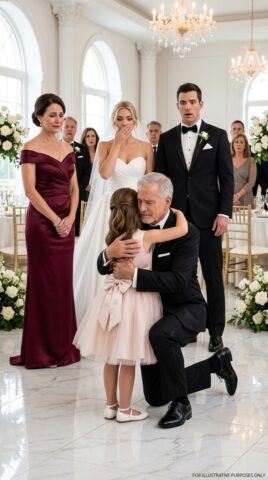
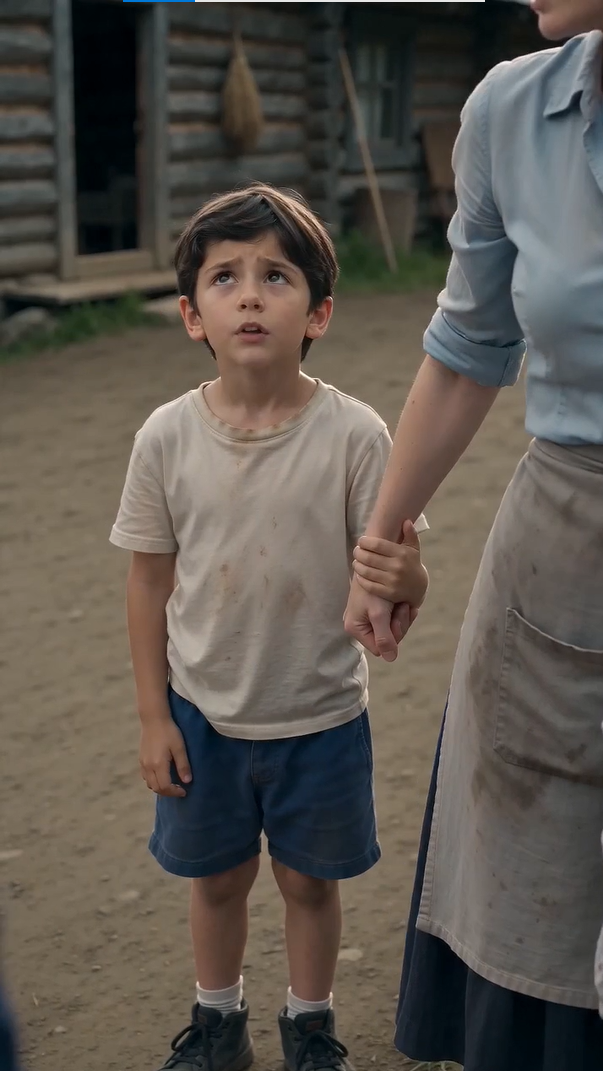
The boy frowned and tightened his little grip on his mother’s apron.
“Mom?” he whispered.
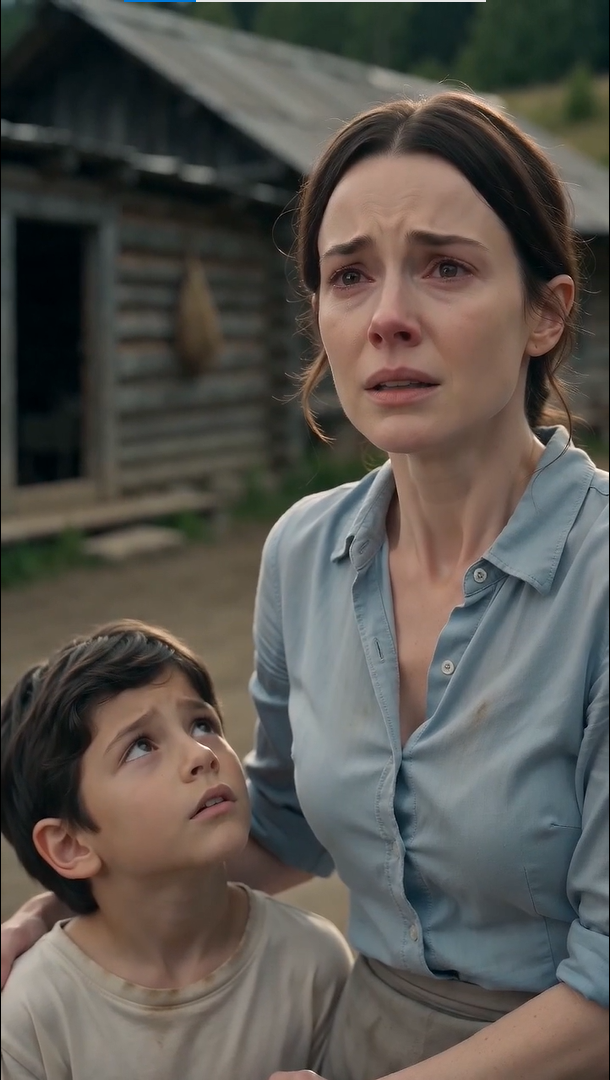
The woman shut her eyes for a second, like she had spent years preparing for this moment and still wasn’t ready for it. When she opened them again, there were tears in them.
“Yes,” she said.
The man stopped breathing.
The whole village fell silent around them. Even the wind seemed to disappear.
The little boy looked up at her, confused. “Who is he?”
She dropped to her knees beside him and touched his cheek with shaking fingers. Her voice broke as she answered.
“He’s your father.”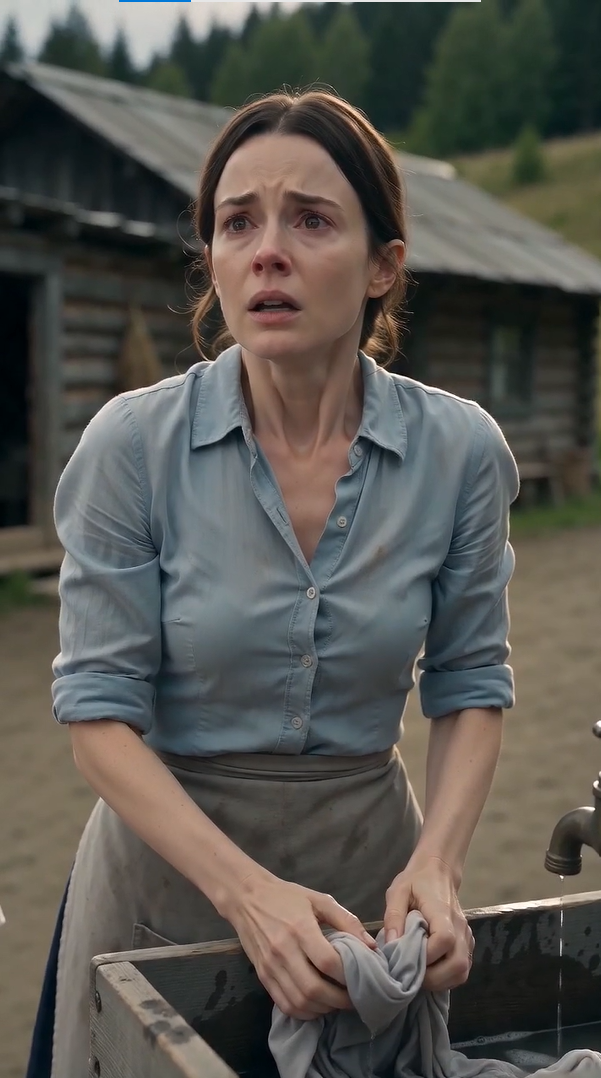
The child’s eyes widened. He slowly looked back at the man in the suit, who was now standing there like the ground had disappeared beneath him.
The man took one step closer, then another, afraid and desperate all at once.
“Why didn’t you tell me?” he asked, tears rising in his eyes. “Why did you hide him from me?”
The woman stood again, but barely. “I didn’t hide him because I wanted to,” she whispered. “I hid him because they said your family would take him away.”
He stared at her. “My family?”
She nodded. “The day I found out I was pregnant, they came to me. They offered money first. Then threats.” Her voice shook harder. “They said a village woman would destroy your future.”
Pain tore across his face.
“I never knew,” he said. “I swear to you… I never knew.”
The boy kept staring at him, uncertain, caught between fear and hope.
The man slowly bent down to the child’s level, his expensive suit pressing into the dust without him caring at all. His eyes were wet now. Completely open. No pride left.
“I’m sorry,” he whispered. “I should have been here.”
The boy looked at his mother first.
She nodded once through tears.
Very slowly, the child stepped away from her and toward the man.
The villagers watched without moving.
The wealthy man’s hands trembled as he reached out, not daring to touch the boy too fast. But the child made the choice for him. He moved close enough for the man to wrap his arms around him.
And when he did, the man broke.
He held his son like he was trying to make up for every missing year in one breath.
The woman covered her mouth and cried openly now.
The boy looked over the man’s shoulder at her and asked the question that shattered them both.
“Is he staying?”
The man lifted his head and looked at the woman with tears on his face and dust on his knees.
“If you let me,” he said, “I’m never leaving again.”
The woman looked at him for a long time.
There were a thousand answers trapped behind her lips. Anger. Pain. Fear. Love. All of them had lived inside her for years, fighting with each other every night while her son slept beside her on a thin mattress.
The boy pulled back a little and looked at the man’s face.
“What’s your name?” he asked softly.
The man let out a broken laugh through his tears, as if even that simple question hurt.
“My name is Arman,” he said. “But you can call me anything you want.”
The boy thought for a second.
Then he looked down at Arman’s dusty knees, his expensive watch, his trembling hands.
“Can I call you Papa?” he asked.
The sound that left Arman’s chest was not a word. It was something deeper than crying. Something torn out of the years he had lost.
He pressed his forehead gently against the boy’s small shoulder.
“Yes,” he whispered. “Please.”
The woman turned away, wiping her tears with the back of her hand, but there was no use hiding them now. Everyone had seen her pain. Everyone had seen the truth she had carried alone.
An old woman from the village, who had watched the boy grow up, stepped forward with tears in her own eyes.
“She raised him well,” the old woman said quietly. “With nothing. No complaint. No help from anyone.”
Arman looked up at her, then back at the woman.
“What’s his name?” he asked.
The woman swallowed hard.
“Ayaan.”
Arman repeated it like a prayer.
“Ayaan.”
The boy smiled a little for the first time.
“You didn’t know my name?” he asked.
Arman’s face twisted with guilt.
“No,” he said honestly. “But I will never forget it now.”
The woman looked at him sharply. “Words are easy, Arman.”
He stood slowly, keeping one hand on Ayaan’s shoulder.
“I know.”
“No, you don’t,” she said, and her voice suddenly carried all the strength she had used to survive. “You don’t know what it means to answer a child when he asks why other children have fathers and he doesn’t. You don’t know what it means to lie and say his father is far away because the truth would break him. You don’t know what it means to hide from cars on the road because every expensive car looks like someone coming to steal your child.”
Arman’s eyes filled again, but he did not interrupt her.
She stepped closer, trembling but standing tall.
“You don’t know what it means to work until your hands bleed, then smile at him so he doesn’t feel poor. You don’t know what it means to sit awake all night when he has fever and pray alone because there is no one else to call.”
Ayaan looked up at his mother, frightened by the pain in her voice.
She noticed and immediately softened. She reached for him, but he stayed between them, holding Arman’s fingers with one hand and her apron with the other.
That small gesture destroyed both of them.
He belonged to both.
And he had been forced to live with half a story.
Arman lowered his eyes.
“You’re right,” he said. “I don’t know. And I can’t stand here and pretend my pain is bigger than yours. You were alone. I was lied to, but you were the one who suffered.”
The villagers murmured softly.

The woman’s lips trembled.
“I waited for you,” she whispered. “At first, I waited every day.”
Arman looked at her, shattered.
“I came back,” he said. “After my father sent me away, I came back. They told me you had married someone else and left the village.”
She froze.
A few villagers exchanged shocked glances.
“They told me you had chosen money,” she said. “They said you signed papers and agreed never to see me again.”
Arman shook his head slowly.
“No.”
The truth settled between them like a stone dropped into water.
Years.
They had not been separated by weakness.
They had been separated by lies.
Ayaan looked from one face to the other. “So nobody wanted to leave?”
The question was so innocent, so simple, that the woman pressed her hand to her chest.
Arman knelt again.
“No, Ayaan,” he said. “I didn’t want to leave your mother. And I didn’t know about you.”
Ayaan looked at his mother.
“You didn’t want to leave Papa?”
She knelt too, facing both of them.
“No,” she whispered. “I loved him.”
The word came out after years of silence.
Loved.
It was not a young girl’s dream anymore. It was tired, wounded, buried under struggle, but it was still alive enough to make Arman close his eyes.
“I loved you too,” he said.
The woman shook her head as tears fell again.
“Love doesn’t fix everything.”
“I know,” he said. “So don’t forgive me today. Don’t trust me today. Don’t even let me stay inside your home today if you don’t want to. But let me prove it. Day by day. Let me be his father. Let me earn the place I should have never lost.”
Ayaan leaned closer to his mother.
“Can Papa eat with us?”
The woman looked at their small hut behind her. The cracked walls. The low roof. The little clay stove near the doorway. The pot of lentils she had stretched with water so it would be enough for two.
She looked at the black luxury car, then at Arman’s suit.
A bitter smile touched her mouth.
“You may not like our food.”
Arman wiped his face with his sleeve.
“I have eaten in houses with golden plates,” he said softly. “But I have never been this hungry for home.”
No one spoke.
The woman stared at him, and for the first time, her anger shook.
Not disappeared.
Just shook.
She turned and walked toward the hut.
Ayaan looked worried. “Mom?”
She stopped at the doorway but did not turn around.
“Wash your hands,” she said. “Both of you.”
Ayaan’s face brightened like the sun had risen inside him.
He grabbed Arman’s hand and pulled him toward the water bucket near the side of the hut.
Arman followed as if the child was leading him into heaven.
The villagers slowly began to move again, but no one truly left. They pretended to return to their work, but their eyes stayed on the small hut where a broken family had begun breathing again.
Inside, Arman sat on the floor because there was no chair.
Ayaan sat beside him, unable to stop looking at him.
The woman served food quietly.
One metal plate for Ayaan. One for Arman. One for herself.
Arman looked at the food and then at her hands. The same hands that had once worn bangles he had bought from a street market. Now they were rough, cracked, and tired.
He remembered her laughing in the rain years ago.
He remembered promising her that no one could separate them.
And then he looked at the boy beside him.
His promise had failed them both.
Ayaan picked up a small piece of bread and offered it to Arman.
“Papa, eat.”
Arman took it carefully, as if his son had handed him something sacred.
He ate.
The woman watched him.
He did not complain. He did not look uncomfortable. He did not act like a rich man sitting in a poor woman’s house.
He ate with tears in his eyes.
After a few minutes, Ayaan began to talk.
At first, small things.
He told Arman about the goat that always stole vegetables from the neighbor. He told him about the river path. He told him he could climb the mango tree faster than any boy in the village. He told him he wanted a school bag with two zippers because the other children had one.
Arman listened to every word like he was collecting pieces of a life he had missed.
“What do you want to become?” Arman asked him.
Ayaan thought seriously.
“A teacher,” he said. “Or maybe a driver.”
“A driver?” Arman asked gently.
Ayaan nodded toward the black car outside.
“So I can take Mom everywhere and she won’t have to walk when she is tired.”
The woman lowered her eyes.
Arman could not eat after that.
He looked at her.
“You walked far for work?”
She gave a small shrug, as if tiredness had become so normal it no longer deserved mention.
“People need clothes washed,” she said. “Fields need hands. Life doesn’t stop because your heart is broken.”
Arman nodded slowly.
Then he reached into his coat pocket.
The woman’s eyes hardened.
“If you take out money, leave.”
His hand stopped.
Ayaan went silent.
Arman slowly removed his hand from his pocket empty.
“I’m sorry,” he said. “I wasn’t thinking.”
She looked away.
“I don’t want payment for raising my son.”
“Our son,” he said softly.
She turned back to him.
The words hung in the room.
Our son.
For years, she had said my son because she had no choice. Saying our son felt like opening a locked door and not knowing what waited behind it.
Arman continued, careful now.

“I don’t want to buy my way into his life. I want to stand in it. Properly. With respect. With responsibility. Tell me what he needs. Tell me what you need. Not as charity. As family.”
The woman’s eyes filled, but she did not answer.
That evening, Arman did not return to the city.
His driver stood near the car for hours, confused and worried, but Arman waved him away and told him to go back.
The driver stared at him. “Sir, alone?”
Arman looked at the hut, where Ayaan was trying to show him a wooden toy he had made from scraps.
“I’m not alone anymore,” he said.
When night fell, the village became quiet.
The woman gave Arman an old mat outside the hut.
“You can sleep here,” she said.
Arman accepted it without question.
Ayaan ran out with a thin blanket.
“This one is mine,” he said proudly. “But you can use it.”
Arman took the blanket and held it against his chest.
“Thank you.”
Ayaan hesitated.
Then he asked, “Will you still be here when I wake up?”
Arman looked at the woman standing in the doorway.
“Yes,” he said. “I promise.”
Ayaan looked at his mother.
“Promises break,” he said quietly.
The woman froze.
Arman’s face crumbled.
He reached into his pocket again, but this time he pulled out his watch. Expensive, shining, completely out of place in the village dust.
He placed it in Ayaan’s small hands.
“This is not payment,” he said. “This is a promise. Keep it with you tonight. When you wake up, if I am still here, give it back to me.”
Ayaan looked at the watch, then at him.
“And if you’re gone?”
Arman swallowed hard.
“Then you keep it forever and remember that I was not worthy of being called Papa.”
The woman looked at him, stunned.
Ayaan held the watch tightly.
“Okay,” he whispered.
That night, Arman did not sleep.
He lay on the mat under the open sky, listening to the sounds of the village, staring at the roof of the hut where his son slept.
Every few minutes, guilt came like a wave.
He imagined Ayaan taking his first step.
He was not there.
His first word.
Not there.
His first fever.
Not there.
His first day asking about his father.
Not there.
Inside the hut, the woman also stayed awake.
She listened for the sound of footsteps leaving.
She had trained herself not to hope.

Hope had been dangerous for her.
But when morning came, and the first light touched the village path, Arman was still there.
Ayaan ran out barefoot, hair messy, eyes wide.
He stopped at the doorway.
Arman sat up slowly.
“Good morning,” he said.
Ayaan looked at the watch still in his hand.
Then he ran to him.
“You stayed!”
Arman caught him and held him tight.
“I stayed.”
The woman stood in the doorway, one hand over her mouth.
Something inside her broke again.
But this time, it did not break from pain.
It broke from relief.
Days passed.
Arman did not force them into his world.
He stayed in theirs first.
He learned how Ayaan liked his tea with more milk than tea. He learned that the boy was afraid of thunder but pretended not to be. He learned that the woman still sang softly while cooking, the same song she used to sing years ago.
He fixed the broken fence outside the hut, badly at first, while Ayaan laughed at him.
He carried water from the well, spilling half of it on his trousers.
He went to the school and enrolled Ayaan properly, not with arrogance, but with tears when he wrote “father’s name” on the form for the first time.
The teacher looked at him and asked, “You are his father?”
Arman looked at Ayaan.
“Yes,” he said. “I am late. But I am his father.”
The woman heard it from outside the classroom and turned away so no one would see her cry.
But not everyone accepted the truth easily.
A week later, a car arrived from the city.
This time, it was not Arman’s car.
A tall older woman stepped out, dressed in expensive clothes, her face stiff with pride.
Arman’s mother.
The same woman who had once stood before a frightened village girl with money in one hand and threats in the other.
The village went silent again.
The woman stepped out of the hut, her face pale but calm.
Arman stood in front of her and Ayaan.
His mother looked at the boy for barely a second before turning to him.
“Come home,” she said coldly. “This drama has gone far enough.”
Arman’s jaw tightened.
“This is not drama. This is my family.”
Her eyes flashed.
“Your family is in the city.”
“No,” he said. “My family is standing behind me.”
She looked at the woman with disgust.
“She trapped you then, and she is trapping you now.”
Before the woman could speak, Arman’s voice thundered through the village.
“Enough.”
Ayaan flinched.
Arman lowered his tone immediately, but his eyes stayed on his mother.
“You lied to me. You stole years from me. You left my child fatherless and the woman I loved alone. Do not come here and speak of family.”
His mother’s face changed for a moment. The pride cracked, and underneath it was fear.
“I did it for you,” she said. “You had a future.”
Arman’s eyes filled with anger and grief.
“You took my future.”
No one moved.
Even his mother had no answer.
Ayaan stepped from behind him and looked at the older woman.
“Are you my grandmother?” he asked.
The question hit her harder than Arman’s anger.
She looked at him properly for the first time.
His eyes were Arman’s eyes.
His face carried the same softness Arman had as a child.
For one second, all her pride failed.
But the woman behind Ayaan pulled him gently back. Not cruelly. Just protectively.
“You don’t get to hurt him too,” she said.
Arman’s mother swallowed.
Her voice was quieter now.
“What is his name?”
Arman answered.
“Ayaan.”
She repeated it, but Ayaan did not smile.
He held his mother’s hand.
The old woman looked at that hand. The village woman’s cracked fingers wrapped around the boy’s small ones.
And perhaps for the first time, she saw the cost of what she had done.
She looked at Arman.
“I thought I was saving you.”
Arman shook his head.
“You were saving your pride.”
His mother lowered her eyes.
The village watched the rich woman stand in the dust with nothing to say.
Finally, she looked at the woman.
“I cannot undo it,” she said.
“No,” the woman replied. “You cannot.”
“I am sorry.”
The words were stiff, unfamiliar, but real enough to make the air shift.
The woman did not forgive her.
Not that day.
Some wounds are too deep for one apology.
But she did not turn away either.
Ayaan looked up at his mother.
“Can grandmothers also learn?”
The woman closed her eyes for a second.
Then she looked at Arman’s mother.
“For his sake,” she said quietly, “everyone can learn. But slowly.”
Arman’s mother nodded.
For the first time, she did not argue.
Months passed.
The hut changed, but not all at once.
Arman asked before doing anything.
He repaired the roof before the rains came. He bought Ayaan the school bag with two zippers. He arranged a small washing machine for the woman, but only after she agreed, and only after he said it was not charity.
“It is respect for the years your hands suffered,” he told her.
She looked at him for a long time before accepting it.
Trust did not return like lightning.
It returned like sunrise.
Slowly.
Softly.
A little more each day.
One evening, after the first rain of the season, Ayaan ran through the wet courtyard, laughing as mud splashed up his legs.
Arman stood under the roof, watching him with a smile.
The woman came beside him.
For a while, neither spoke.
Then she said, “He is happy.”
Arman nodded. “Because of you.”
She looked at him.
“And now because of you too.”
He turned to her, surprised.
Her eyes were wet, but peaceful.
“I was angry for so long,” she said. “I thought if I stopped being angry, it meant what happened was okay.”
“It was never okay,” Arman said.
“I know.”
She looked at Ayaan, who was now trying to catch raindrops in his hands.
“But I don’t want him to grow up inside my pain.”
Arman’s throat tightened.
“I don’t deserve your forgiveness.”
“No,” she said softly. “But maybe I deserve peace.”
He looked down.
“And us?”
She did not answer immediately.
The rain fell gently around them.
Then she said, “Us will take time.”
Arman nodded.
“I have time.”
She looked at him, and for the first time in years, she smiled. A small smile. Tired. Careful. But real.
Ayaan suddenly ran toward them, holding something in his hand.
It was Arman’s watch.
The same watch he had given him on the first night.
“I kept it safe,” Ayaan said proudly.
Arman knelt in front of him.
“You did.”
Ayaan placed it in his father’s hand.
“You can have it back now.”
Arman smiled. “Why now?”
Ayaan looked at him like the answer was simple.
“Because now I know you won’t leave.”
Arman’s eyes filled.
He pulled his son close.
The woman watched them, her heart aching in a new way.
Not from loneliness.
From healing.
A few weeks later, the whole village gathered near the small courtyard.
There were no golden decorations. No grand stage. No expensive guests from the city.
Just marigold flowers, simple food, children running barefoot, and people who had watched a woman survive alone finally watching her stand with the man who had found his way back.
Arman stood beside her, wearing a simple white kurta instead of a suit.
Ayaan stood between them, holding both their hands.
The village elder asked the woman, “Are you ready?”
She looked at Arman.
He did not rush her.
He did not beg.
He only waited.
This time, she was not a frightened young woman being threatened into silence.
This time, she chose.
She looked down at Ayaan, then back at Arman.
“Yes,” she said.
Arman’s eyes filled instantly.
Ayaan looked confused. “Does this mean Papa is really staying forever?”
The woman laughed through her tears.
“Yes,” she said. “Forever.”
Ayaan turned to Arman.
“Promise?”
Arman knelt in front of him, right there in front of everyone.
“I promise,” he said. “But not with a watch this time.”
He placed one hand over his heart.
“I promise with my life.”
Ayaan threw his arms around him.
The villagers clapped, some wiping their eyes.
And the woman, who had once stood alone with soap on her hands and fear in her heart, finally let herself breathe.
That night, after everyone left, the three of them sat outside the hut under the stars.
Ayaan fell asleep with his head on Arman’s lap and his feet resting against his mother.
Arman gently stroked his son’s hair.
“I missed so much,” he whispered.
The woman looked at him.
“Yes,” she said. “You did.”
He closed his eyes.
“I’ll spend the rest of my life making sure he never feels that emptiness again.”
She leaned back against the wall, watching the two of them.
After a long silence, she reached over and placed her hand lightly over his.
Arman froze.
Then he looked at her.
She did not say anything.
She didn’t have to.
Some love stories do not begin again with loud promises.
Some begin with a hand held quietly in the dark.
And in that small village, under a sky full of stars, a boy slept between the mother who never gave up and the father who finally came home.
The years they lost could never be returned.
But the years ahead were waiting.
And this time, no one was leaving.