Maeve Was Traded for Two Draft Mules Before Breakfast — Then His Barefoot Twins Asked Her for More
Maeve Was Traded for Two Draft Mules Before Breakfast — Then His Barefoot Twins Asked Her for More
October wind came up through the floorboards of the Red Creek mercantile and found every thin place in Maeve’s cotton dress. It smelled of flour dust, lamp oil, and old tobacco, and it made the back of her throat taste bitter before her uncle said a single word.
Uncle Amos would not look at her while he bargained.
He stood at the counter with his fingers twitching near the coin pouch, telling the stranger she was useful. Good with chores. Strong enough for a hard winter. The kind of girl who would not ask much.
Maeve was eighteen.
All sharp elbows and hollow cheeks, with two patched shifts, ruined stockings, and her dead mother’s cracked comb tucked inside a small satchel.
Not stout. Not lucky. Not chosen.
Just one less mouth for Amos to feed before the snow came down for good.
The man who took her in trade said almost nothing. Gideon Reed filled the mercantile doorway like a piece of the mountain had come loose and walked inside, broad-shouldered in a canvas coat that smelled of pine tar, wood smoke, and raw meat. His dark beard covered most of his face, but not the part that looked as if smiling had become a language he no longer spoke.
“Wagon’s out front,” he said.
That was all.
No promise. No kindness. No pretending this was anything softer than a sale.
Maeve climbed beside him while the wagon groaned under flour sacks, salt, rifle cartridges, and kerosene. Red Creek dropped behind them in a blur of gray roofs and muddy road, and neither Gideon nor Maeve turned around to watch it go.
The climb up the mountain was mean enough to feel personal. Pines crowded the trail until the daylight came through in narrow strips. The air thinned. The cold settled under Maeve’s ribs, and her teeth started rattling so hard she had to press her tongue against them to keep from sounding weak.
Gideon did not look at her when he threw a moth-eaten wool blanket into her lap.
“Wrap up,” he grunted. “Ain’t hauling a frozen corpse up the ridge.”
Kindness sometimes arrives dressed so rough you almost miss it.
Maeve wrapped the blanket around her shoulders and hated herself a little for needing it.
His cabin was worse than she had imagined.
Not a home.
A shelter.
It clung to a rocky shelf above a drop so steep the valley seemed to fall away beneath it. Inside, stale smoke hung under the rafters. Dirty bedding sagged in one corner. Old grease, urine, and cold ash had soaked into the room until the whole place smelled neglected. The windows were filmed over. The hearth had nearly died.
Then something moved beneath the table.
Maeve stopped with one hand still on the door latch.
Two pairs of eyes stared out from the dark.
Children.
Twins, maybe five years old. Barefoot. Filthy. Hair matted close to their heads. Faces smudged with soot until only their eyes looked alive. The boy stepped in front of the girl with both fists clenched, small and shaking and furious. The girl hid behind him with her thumb in her mouth, silent as a wound.
“Toby. Tess,” Gideon said. “This is Maeve. She’s staying. She cooks. She cleans. You listen to her.”
Then he left.
The door shut behind him, and the whole cabin seemed to breathe around the three of them.
Maeve took one step toward the hearth.
Toby lunged.
His teeth sank into her wrist so hard pain flashed white behind her eyes. Blood rose under the skin. Maeve cried out, lifted her free hand by instinct, then stopped herself before that hand became the kind of hand children remember forever.
She looked at Toby’s wild eyes, his shaking mouth, the way he had put his body between her and Tess, and the truth landed colder than the mountain road.
He was not vicious.
He was terrified.
Maeve went outside and dry-heaved against the cabin wall until nothing came up but sour breath. Then she gathered wood with trembling fingers, came back in, and built the fire anyway.
By nightfall, the room had begun to thaw. Mold had been cut from the bacon. Cornmeal mush steamed in chipped bowls. Maeve set two portions on the rough table and took her own place by the hearth without calling the children over.
The twins came like starving little wolves.
They snatched the bowls and ate with their hands, heads bent low, shoulders tight, ready to run even while they swallowed.
Later, Tess looked into the empty pot, pulled her thumb from her mouth, and whispered, “More?”
Maeve’s bitten wrist throbbed under her sleeve.
“Tomorrow,” she said softly. “You’ll make yourselves sick tonight.”
When Gideon returned, snow dusted his shoulders and the clean pot sat upside down near the hearth. The floor had been swept. The fire had a steady heart. His children had scrubbed streaks across their faces where soot used to be, and Maeve lay asleep near the hearth under his old blanket, one injured wrist tucked close to her chest.
For the first time since she had seen him, Gideon closed the door softly.
Three weeks passed like that. Maeve learned where the roof leaked, which boards groaned, how Tess watched before trusting, and how Toby hated hunger more than he hated strangers. Gideon came and went from the trapline, leaving little behind except cold air, meat, and the heavy silence of a man who did not know how to live in the same room with need.
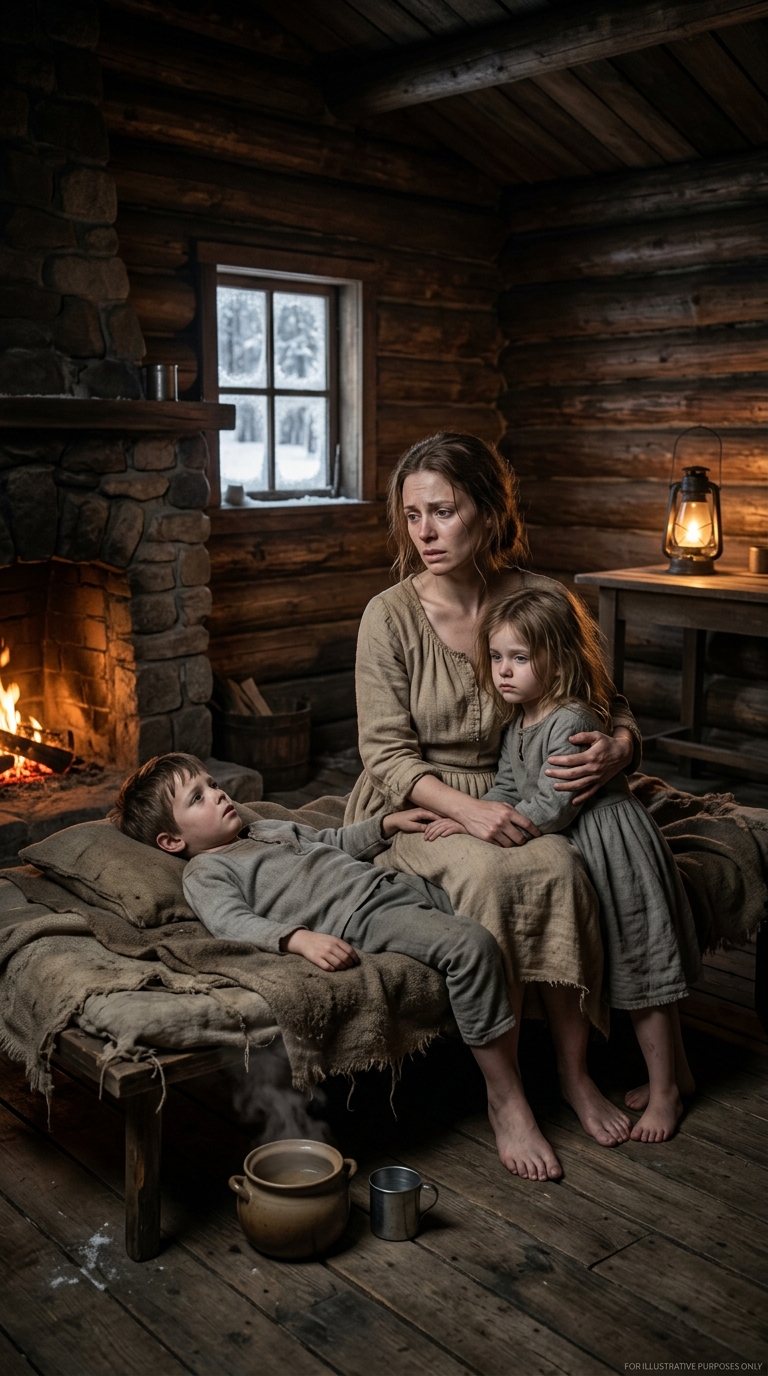
Then Toby’s fever came in the night while Gideon was gone.
Maeve had no doctor. No neighbor. No clean little sickroom with folded sheets and a woman to tell her what to do. She had pine needles, wild mint, a nearly dead fire, a chipped pot, and the rough tavern songs she had once heard drifting through saloon doors in Red Creek.
So she boiled what she had.
She dragged her cot beside the twins.
She sang until her voice went thin.