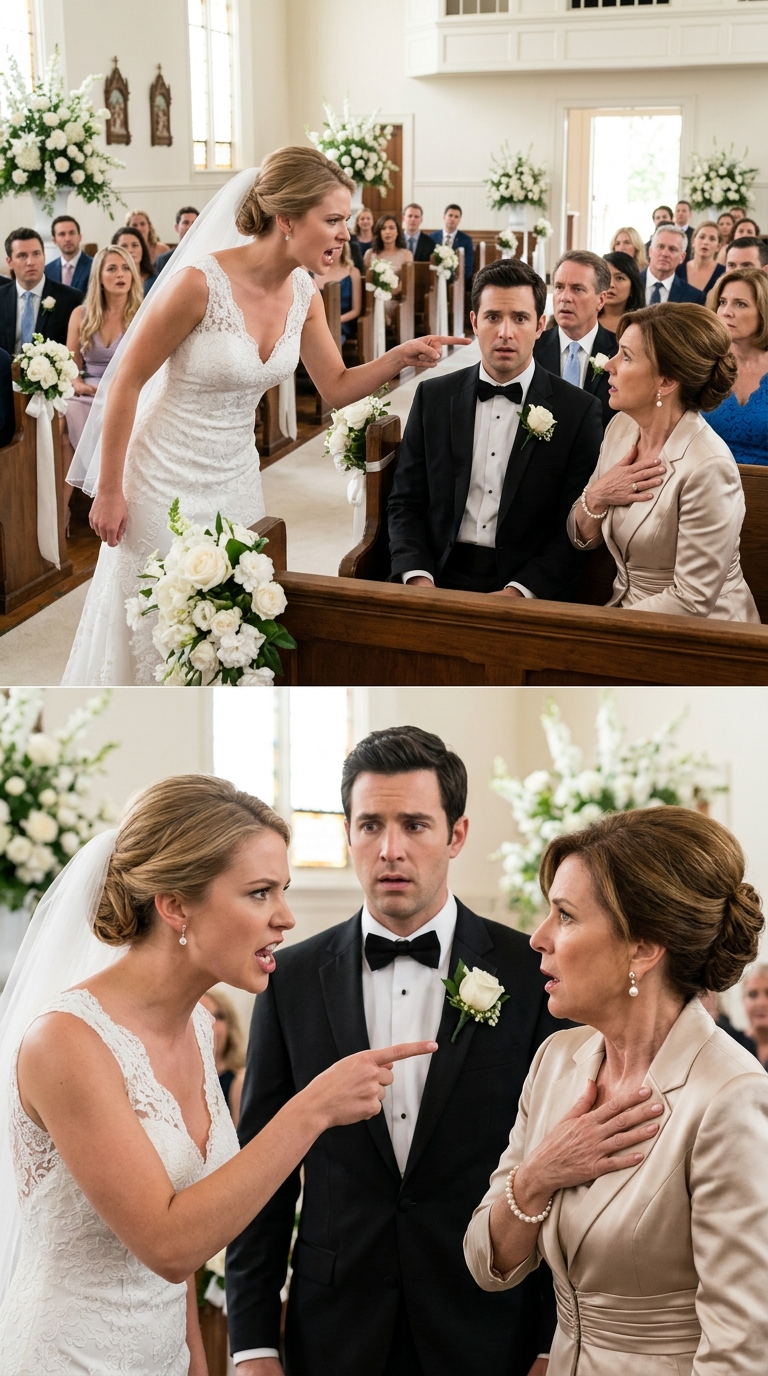
PART 3 The chapel did not empty quickly. People rarely know how to leave after watching a family’s polished history open like an old wound.
By
HoangAnh5 Mr
June 10, 2026
Some guests stood frozen in the pews.
Some whispered behind their hands.
Some looked at me with sympathy I did not want yet.
A few slipped quietly through the side doors, probably relieved to escape before anyone asked what they had heard.
The flowers still looked perfect.
The candles still burned.
The aisle runner still stretched toward an altar where my life had almost changed for a completely different reason.
Julian stood beside me, but not too close.
That mattered.
His father stood near the side exit, one hand on the door, looking at the leather folder in my arms like it was a match near dry paper.
Vivian Hart sat down slowly, as if her confession had taken the strength from her legs.
Eleanor held my mother’s bracelet in both hands after I gave it back to her for safekeeping.
My father remained in the pew, bent forward, elbows on his knees, no longer the man who had walked me toward the altar only minutes earlier.
Everything had changed.
And still, the piano bench was empty.
The cake was waiting.
The guests were hungry.
Life has a strange way of continuing while your heart is still trying to understand the first sentence of the truth.
Margaret Lane, my mother’s attorney, touched my elbow gently.
“Ava, we need somewhere private but not isolated.”
That was such a lawyer sentence.
Private but not isolated.
I almost laughed.
Instead, I nodded.
“The chapel library.”
Julian immediately said, “I’ll come if Ava wants me there.”
Again, a choice.
I looked at him.
His face was open, worried, and pale.
I loved him.
That was still true.
But love had just been pulled into a story much older than either of us.
“You can come,” I said. “But if this becomes about protecting your father, you leave.”
He nodded.
“Fair.”
Preston’s jaw tightened.
“This is absurd. You are letting an emotional scene rewrite decades of work.”
Vivian looked up at him.
“No, Preston. We are letting the truth interrupt what should have been interrupted years ago.”
He turned on her.
“You do not understand what you’re saying.”
Her voice shook, but she did not look away.
“For the first time in a long time, I think I do.”
That was when I realized Vivian had not simply confessed.
She had stepped out from behind him.
And he did not know what to do with a wife who no longer whispered.
We moved to the chapel library.
Small room.
Dark wood shelves.
A round table.
Old hymnals.
A painting of the harbor on the wall.
Brooke came with me because she had already declared herself “emotional security.”
Eleanor came.
Margaret came.
Julian came.
Vivian came after a long pause.
My father followed last.
Preston refused at first, then entered only after Julian said quietly, “If you stay outside, I’ll assume every document is true.”
That worked.
Preston sat at the far end of the table.
Not defeated.
Contained.
There is a difference.
Margaret placed the leather folder in front of me.
“These documents were placed in escrow by your mother twelve years ago. She gave instructions that they be released to you when you either turned thirty-five, or earlier if Eleanor Monroe appeared with the bracelet and at least two witnesses confirmed the family connection.”
I stared at Eleanor.
“You waited twelve years.”
Her eyes filled.
“I tried to come sooner.”
My father flinched.
I turned toward him.
“What does that mean?”
He closed his eyes.
“Eleanor came to the house three months after your mother left.”
“And?”
He did not answer.
Eleanor did.
“He told me Ava was better off believing Caroline had chosen to leave.”
I could not breathe for a moment.
My father whispered, “You were fifteen. You were barely eating. You cried every night. I thought if the truth became larger, you would break.”
I looked at him.
“You decided a lie would be easier for me.”
“I decided stability mattered.”
“No,” Eleanor said softly. “You decided your guilt mattered less if Ava blamed Caroline.”
My father’s face crumpled.
The room went silent.
I wanted to yell.
I wanted to ask how he could do that.
I wanted to be fifteen again and not know any of this.
Instead, I looked down at my mother’s letter.
My sweet Ava.
The truth waited longer than I prayed it would.
I said, “Open the folder.”
Margaret did.
Inside were copies of ledgers, bank statements, property records, letters, and one small flash drive sealed in a plastic sleeve.
My mother had been organized.
Meticulous.
Brave.
Everything I had not been allowed to know about her was suddenly on paper.
Margaret spread the first set of documents across the table.
“These show transfers from Hart Community Trust to several development partnerships controlled by shell companies.”
Julian leaned forward.
“Hart Community Trust? That’s the family foundation.”
Preston said sharply, “Which has funded hospitals, schools, and housing projects for decades.”
Margaret looked at him over her glasses.
“No one said all of it was false. That is how misdirection works. You place questionable transfers among legitimate good works and rely on reputation to discourage questions.”
Brooke whispered, “I love lawyers.”
I almost smiled.
Margaret continued.
“Caroline Monroe worked as an assistant bookkeeper for the Hart family office. She noticed recurring transfers tied to properties later purchased by Hart-adjacent entities.”
Vivian looked down.
“She came to me with one of the ledgers.”
“Why you?” I asked.
Vivian folded her hands together.
“Because we were friendly then. Not close, but friendly. Caroline used to bring you to the estate sometimes when you were little. You played in the garden with Julian.”
I turned to Julian.
He stared at me.
“We met as children?”
Vivian nodded, crying softly.
“You were maybe four. Julian was six. You chased him around the fountain with a wooden spoon from the kitchen.”
Julian looked at me through the shock.
“That sounds like you.”
Brooke said, “Honestly, yes.”
I wanted to laugh.
But grief stood too close.
“Why don’t I remember?” I asked.
My father answered, voice low.
“After Caroline left, I stopped taking you anywhere connected to the Harts.”
“Because you thought they were dangerous?”
He swallowed.
“Because I thought if we stayed away, they would leave us alone.”
Eleanor looked at him.
“And did they?”
He said nothing.
Margaret pulled another paper from the folder.
“This is a letter sent to Thomas Monroe’s clinic three weeks after Caroline left. It warned of a review into billing irregularities.”
My father’s face went gray.
“You kept that?”
Margaret nodded.
“Caroline kept everything.”
I looked at my father.
“They threatened your clinic?”
“Yes.”
“And you still let everyone think Mom simply left?”
His voice cracked.
“I was scared.”
That answer was finally honest.
Not enough.
But honest.
I looked at Preston.
“Your family threatened my father’s work?”
Preston leaned back.
“I have no knowledge of that letter.”
Margaret turned another page.
“It came from a firm retained by Hart Holdings.”
Preston’s eyes narrowed.
“Many firms send letters.”
Julian stared at him.
“Dad.”
Preston looked at his son.
“What? You want me to confess to every paper some assistant produced twelve years ago?”
“No,” Julian said. “I want you to stop sounding relieved that someone else may have held the pen.”
That landed.
Vivian covered her mouth.
Preston looked away first.
Margaret inserted the flash drive into her laptop.
“There is also a video.”
My heart stopped.
“A video of what?”
“Your mother.”
The room changed.
No one moved.
Margaret looked at me.
“Do you want to see it now?”
The question was gentle.
Choice.
So many choices had been taken from me that day.
This one felt enormous.
I looked at Eleanor.
She was crying.
My father stared at the table.
Julian reached for my hand, then stopped himself.
I noticed.
I placed my hand on the table between us.
He covered it carefully.
“I want to see it,” I said.
Margaret turned the laptop toward me and pressed play.
My mother appeared on screen sitting at a kitchen table I recognized from our old house.
She looked tired.
Younger than I remembered.
Her dark hair was pulled back.
She wore a blue sweater.
No makeup.
No performance.
Just my mother.
For a second, I could not breathe.
“Hi, Ava,” she said on the video.
Her voice.
I had forgotten how much I missed her voice.
“If you are watching this, then I failed to explain things before I had to leave. Or I was not allowed to. I am sorry for that. I am sorry for every birthday I miss, every question you carry, every person who tells you I chose myself over you.”
I covered my mouth.
Julian’s hand tightened around mine.
My mother continued.
“I want you to know something first. I love you more than any truth, any fear, any mistake. I did not leave because you were not enough to keep me. I left because staying without proof would have made me look unreliable, and speaking too soon would have put you in the center of a fight I was not sure I could win.”
The video blurred through my tears.
“I worked for the Harts. I found records I did not understand at first. Then I understood too much. When I asked questions, people changed around me. Doors closed. Smiles got thinner. Your father became frightened. Eleanor tried to help me. Vivian wanted to help but was too afraid. That is not cruelty, maybe. But fear can still do cruel things.”
Vivian began sobbing quietly.
Preston stared at the wall.
My mother looked directly into the camera.
“Eleanor has my bracelet. If she gives it to you, trust that she tried. If your father is beside you, know that he loved you, but love without courage can still leave wounds. If the Harts are in the room, do not let them make this about reputation. Make it about truth.”
I whispered, “Mom.”
The video continued.
“And Ava, if this comes to you on your wedding day, I am sorry. But maybe that means you are standing at the edge of a life where you still have time to choose what kind of love you will accept. Choose the love that tells the truth. Choose the person who stands beside you when truth costs them something. Do not marry into silence. Do not build a home where questions are treated like betrayal.”
The video ended there.
No dramatic goodbye.
No answer to where she had gone.
Just silence.
I pressed my fist to my mouth and cried.
Not because the video fixed anything.
Because it made my mother real again.
Not the unstable woman people whispered about.
Not the vanished figure in old family stories.
A woman who loved me.
A woman who tried.
A woman who had been surrounded by people who chose fear, reputation, and comfort.
Margaret closed the laptop softly.
No one spoke for a long time.
Then Julian said, “I can’t marry you today.”
I turned toward him, startled.
“What?”
His eyes were full.
“I want to. God, Ava, I want to. But your mother said not to marry into silence. And my family’s silence is all over this room.”
My heart twisted.
He continued.
“If we marry today, it becomes a romantic ending to a truth we haven’t even finished facing. That’s not fair to you.”
I stared at him.
This was not rejection.
It was respect.
Painful respect.
I hated how much it hurt.
Vivian cried harder.
Preston stood.
“You are throwing away your wedding because of an old video?”
Julian turned toward him.
“No. I’m postponing my wedding because the woman I love deserves a clean altar.”
A clean altar.
That broke something open in me.
I squeezed his hand.
“Thank you.”
His face crumpled.
“I’m sorry.”
“I know.”
Brooke wiped her eyes.
“For the record, this is emotionally mature and very inconvenient for my mascara.”
Even Eleanor laughed softly through tears.
The decision moved through the chapel slowly.
No ceremony today.
Guests could still attend the reception.
Food would be served.
Music could play if anyone felt strange enough to dance.
Some people left.
Others stayed.
It became less a wedding reception and more a gathering after a storm.
People hugged me.
Some shared memories of my mother they had never dared mention.
A woman from my father’s clinic told me Caroline used to leave flowers on the front desk.
A former Hart employee said my mother once helped her keep her job after a payroll mistake.
An older gardener from the estate said he remembered me as a little girl with “too much attitude and not enough shoes.”
That sounded true.
Every story gave me another piece.
Not enough to rebuild all the years.
But enough to begin.
My father waited until late afternoon to approach me.
I was standing near the garden fountain where I had once apparently chased Julian with a spoon.
He looked exhausted.
Older than he had that morning.
“Ava,” he said.
I did not make it easy for him.
“What?”
He took the answer like he deserved it.
“I am sorry.”
I looked at him.
“For what?”
He swallowed.
“For letting you believe your mother chose to abandon you. For keeping Eleanor away. For being afraid of the Harts. For thinking a quieter lie was better than a dangerous truth.”
The list was specific.
That mattered.
But my heart was not ready to soften fully.
“You let me be angry at her.”
His eyes filled.
“Yes.”
“You let me wonder what was wrong with me.”
“I know.”
“You let me grow up thinking love could just leave without explaining.”
Tears slipped down his face.
“Yes.”
I turned toward the fountain.
“I don’t know how to forgive that.”
“I don’t expect you to today.”
“Good.”
He nodded.
“I will answer anything you ask. Whenever you ask. No more deciding what you can handle.”
That was the first right thing he had said.
Eleanor joined us a little later.
For a moment, my father and my aunt stood side by side like two survivors of the same storm who had taken different roads out.
Eleanor looked at him.
“I hated you for years.”
He nodded.
“I know.”
“I still might.”
“I understand.”
She turned to me.
“I should have tried harder.”
I shook my head.
“I don’t know what harder would have cost you.”
Her eyes filled.
“It cost me plenty anyway.”
She told me what happened after she left Charleston.
The settlement money she did not want but finally accepted after threats became too heavy.
The small bookstore she opened in Savannah.
The letters she wrote me and never sent because my father returned the first two unopened.
The times she drove past my school and could not get out of the car.
None of it was simple.
None of it was enough.
But truth rarely arrives as enough.
It arrives as a door.
You still have to walk through slowly.
Julian found me near sunset.
His tie was gone.
His jacket too.
He looked less like a groom and more like a man standing outside his own family history.
“My father left,” he said.
I nodded.
“I saw.”
“My mother stayed.”
“I know.”
“She wants to speak with you, but I told her not today unless you ask.”
“Thank you.”
He looked at the fountain.
“I called our attorney.”
“Our?”
“The one we were going to use for the house papers.”
“And?”
“I asked him to preserve any documents tied to Hart Community Trust, Hart Holdings, my father’s development partnerships, and any settlements involving Eleanor or your mother.”
I stared at him.
“You did that?”
“Yes.”
“Before talking to your father?”
“Yes.”
“Why?”
He looked at me.
“Because if I ask him first, I’m asking permission to know the truth.”
My mother’s words echoed.
Choose the person who stands beside you when truth costs them something.
I took a shaky breath.
“Julian.”
“I’m not doing it to earn the wedding back.”
I closed my mouth.
He knew me too well.
He continued.
“I’m doing it because it should have been done before either of us stood in that chapel.”
I nodded slowly.
“Okay.”
He looked at me.
“I love you.”
“I love you too.”
The words hurt.
But they were still true.
“We need time,” I said.
“I know.”
“And answers.”
“Yes.”
“And if your father fights this?”
Julian looked toward the house.
“Then he fights me too.”
That sentence did not feel dramatic.
It felt sober.
Like a man finally understanding the price of being honest.
Weeks passed before I saw Preston Hart again.
Not socially.
Not privately.
In a conference room downtown with attorneys, documents, and a recorder on the table.
The investigation did not become a public scandal overnight.
Real truth often moves slower than rumor.
Margaret worked with another attorney, Julian’s attorney, and eventually a state investigator connected to charitable oversight.
The records showed irregularities.
Not every accusation was clean.
Some transfers were old.
Some had legal explanations.
Some did not.
My mother had been right.
She had not known everything.
But she had known enough.
Preston arrived to the first meeting with his own counsel and the same cold posture from the chapel.
He looked at me only once.
“You have your mother’s eyes,” he said.
I did not answer.
He looked away.
The process took months.
The Hart family foundation underwent review.
Several old transactions were corrected.
Funds were returned.
A public statement was issued using polished language like “administrative failures” and “renewed transparency protocols.”
Margaret called it “rich people confessing in fog.”
She was not wrong.
But one part mattered most to me.
My mother’s name was cleared.
Not dramatically.
Not with headlines.
But in the foundation’s internal record and in a letter signed by the board.
Caroline Monroe acted in good faith when raising concerns regarding financial inconsistencies.
I framed that sentence.
Not because it was beautiful.
Because it was official.
My father cried when he saw it.
Eleanor placed a copy beside my mother’s photo in her bookstore.
Vivian sent flowers with a note.
I should have said this when she was alive: Caroline was brave.
I kept that note too.
Not because it fixed her silence.
Because it named the truth.
Julian and I did not live together during those months.
We met for coffee.
Then dinner.
Then counseling.
Yes, counseling before marriage.
Everyone should try it before families collide at the altar.
Our counselor, Dr. Elaine Porter, asked why we were there.
I said, “Because I love him, but his family is tied to the biggest silence of my life.”
Julian said, “Because I love her, and I don’t want to ask her to trust me with incomplete truth.”
Dr. Porter nodded.
“That is a very honest beginning.”
Honest beginnings are not easy.
We talked about everything.
His childhood in the Hart family.
The pressure to maintain image.
My fear of being lied to by people who say they are protecting me.
His fear of losing family if he challenges them.
My anger at my father.
His anger at his father.
The strange grief of postponing a wedding because choosing truth mattered more than a perfect day.
One night after counseling, Julian walked me to my car.
Rain fell softly.
Not like the old story.
Just rain.
He said, “Do you ever wish I had stopped my mother from inviting Eleanor?”
I looked at him.
“Did your mother invite her?”
“Yes.”
That surprised me.
“Why?”
“She said after the wedding, she planned to tell me there were things I needed to know. She thought having Eleanor there might force her to be brave later. She didn’t expect the bracelet.”
I looked toward the wet street.
“Later,” I said.
“What?”
“Everyone keeps planning to be brave later.”
Julian winced.
“You’re right.”
“I don’t want later bravery.”
He nodded.
“I know.”
“What did you tell your mother?”
“That if she wanted to repair anything, she could start with Eleanor first. Not me. Not you. Eleanor.”
That was wise.
Vivian did start there.
Awkwardly.
Slowly.
She visited Eleanor’s bookstore in Savannah and apologized for letting her be sent away.
Eleanor reportedly said, “That apology is twelve years late and underdeveloped.”
Vivian replied, “I know. I brought coffee.”
Eleanor accepted the coffee.
Not forgiveness.
Coffee.
Sometimes coffee is the first inch of a bridge.
My relationship with my father was harder.
He answered questions.
All of them.
Where did Mom go?
Why didn’t she come back?
Did she call?
Did he stop her?
The answers were painful.
My mother left first for Atlanta, then Savannah, then somewhere in North Carolina.
She called several times in the first year.
My father took some calls.
Ignored others.
He admitted he told her I was “adjusting” when I was not.
He admitted he was afraid her return would bring the Harts’ pressure back.
He admitted that after a while, shame made it easier not to reach for her.
“Did she ask to see me?” I asked.
He cried before answering.
“Yes.”
That answer changed me.
I did not yell.
I did not throw anything.
I simply stood and left his house.
For three weeks, I did not speak to him.
During that time, Eleanor told me more about my mother.
Not as a symbol.
As a person.
Caroline loved lemon cake.
Hated folding laundry.
Sang loudly in the car.
Read the last page of novels first.
Kept a notebook of paint colors.
Wanted to open a design studio one day.
That last one made me cry.
I had built the life my mother never got to finish.
Or maybe she had planted it in me before leaving.
One afternoon, Eleanor handed me a box.
“She wanted you to have this.”
Inside were sketches.
Room layouts.
Fabric swatches.
Notes in my mother’s handwriting.
Ideas for restoring old houses.
I sat on the floor of Eleanor’s bookstore and wept into a stack of wallpaper samples.
Eleanor sat beside me.
“She would love your work,” she said.
“I thought she didn’t know me.”
“She knew the beginning of you,” Eleanor said. “Sometimes that’s enough for love to keep growing, even from far away.”
I did not know whether that was comforting or unbearable.
Maybe both.
Six months after the aisle stopped, Julian asked me to walk with him at Rosewood Chapel.
No guests.
No flowers.
No music.
Just us.
The chapel smelled the same.
Wood polish.
Old stone.
Faint candle wax.
I stood at the doors where my father had once held my arm.
Julian stood beside me.
“I used to think the worst thing that could happen at a wedding was someone saying no,” he said.
I looked down the aisle.
“Sometimes no is mercy.”
“Yes.”
We walked slowly.
Halfway down, I stopped at the exact spot where I had seen Eleanor’s bracelet.
The light through the stained glass fell across the floor.
“I thought my life was ending here,” I said.
Julian shook his head.
“The lie was ending.”
I looked at him.
“That’s a good answer.”
“I’ve been working on those.”
At the altar, he turned to me.
“I don’t want to ask you to reschedule yet.”
I blinked.
“You don’t?”
“I want to ask what you need before we even talk about that.”
A year earlier, he might have assumed love meant moving forward.
Now he understood that love sometimes asks where the ground still hurts.
“I need my father and Eleanor in the same room without secrets,” I said.
“Okay.”
“I need your mother to tell the whole truth in writing.”
“She’s already drafting it.”
“I need your father not at the wedding unless I choose it.”
His face changed, but he nodded.
“Okay.”
“I need us to build a life that does not depend on the Hart name.”
“I’ve stepped down from the family office.”
I stared at him.
“What?”
He smiled faintly.
“I was waiting for the right time to tell you. But now I hear your voice in my head saying later bravery is not enough.”
My throat tightened.
“What will you do?”
“I’m starting a small firm. Clean books. Transparent clients. Very boring.”
I laughed.
“Boring sounds beautiful.”
“I thought so too.”
He took my hand.
“And I need something.”
“What?”
“If we marry, I need you to promise not to silently test me forever for sins I didn’t commit.”
That landed.
Hard.
I pulled my hand back slightly.
He let me.
I wanted to argue.
Then stopped.
Because he was right.
His father had done wrong.
His mother had stayed quiet.
My father had hidden truth.
But Julian had chosen to stand in the aisle with me, postpone the wedding, and pull documents into the light.
He was not clean of family patterns.
No one is.
But he was not Preston.
And love cannot grow if every moment becomes a trial.
I nodded slowly.
“I can promise to tell you when I’m afraid instead of turning fear into a secret test.”
He exhaled.
“That’s enough.”
We did not kiss at the altar.
We hugged.
Long.
Quiet.
Two people standing where a wedding stopped, learning that sometimes the pause is the most sacred part of the story.
A year after that first wedding day, we gathered again.
Not at Rosewood Chapel.
I chose my mother’s favorite place instead.
Eleanor’s bookstore garden in Savannah.
Small.
Warm.
Imperfect.
Fifty guests.
Mismatched chairs.
String lights.
Lemon cake.
No grand aisle.
No front row reserved for family power.
My father came.
Eleanor came.
They sat beside each other.
Not comfortably.
But honestly.
Vivian came alone.
Preston was not invited.
That decision brought peace.
Julian said, “I support it.”
No hesitation.
No private pressure.
Just support.
Before the ceremony, my father asked to speak with me.
We stood beneath an oak tree behind the bookstore.
He wore a gray suit and looked nervous.
“I know I don’t deserve to walk you anywhere,” he said.
My throat tightened.
“Dad.”
“No. Let me say it. I walked you down an aisle once while holding back truth that belonged to you. I don’t want to repeat even the appearance of that.”
He handed me a small box.
Inside was my mother’s bracelet.
Eleanor had given it to him that morning.
“She said Caroline would want you to decide who gives it to you.”
My hands shook.
My father continued.
“If you want to walk alone, I understand. If you want Eleanor, I understand. If you want both of us, I would be honored. If you want neither, I’ll sit down and still be grateful to be invited.”
Choice.
Again.
The word that had slowly rebuilt my life.
I looked across the garden.
Eleanor stood near the back door, watching.
I waved her over.
When she reached us, I said, “Both.”
Eleanor cried immediately.
My father did too.
I laughed through tears.
“You two are going to ruin my makeup.”
Eleanor said, “Waterproof mascara was invented for complicated families.”
So I walked through the garden with my father on one side and my mother’s sister on the other.
Not because everything was fixed.
Because truth had made room for something better than pretending.
At the front, Julian waited under the string lights.
No tuxedo this time.
Navy suit.
Soft smile.
Clear eyes.
When he saw the bracelet on my wrist, he pressed one hand to his heart.
The vows were different from the ones we had planned a year earlier.
We wrote them after everything.
Julian said, “Ava, I promise not to ask you to marry into silence. I promise to build a home where questions are not treated as disloyalty, where truth is welcome even when it arrives inconveniently, and where love never requires you to doubt what you know.”
I cried.
Then I said, “Julian, I promise not to make you pay forever for doors you helped open. I promise to tell you when fear speaks in me. I promise to choose honesty over performance, even when performance would look prettier. And I promise to remember that the day I stopped walking was also the day we learned how to stand.”
Eleanor sobbed.
Brooke handed her tissues.
Vivian cried quietly in the second row.
My father looked up at the sky.
Maybe at my mother.
Maybe at forgiveness he was still learning how to receive.
When the officiant pronounced us husband and wife, Julian kissed me like a man grateful for a truth-shaped love.
Not easy.
Not perfect.
Real.
At the reception, we served lemon cake.
My mother’s favorite.
There was dancing in the bookstore garden.
Brooke gave a toast that began sweetly and ended with, “And if anyone here is hiding a twelve-year family secret, please take it outside and speak to Margaret first.”
Margaret, who had somehow become part of the family by legal force, raised her glass.
Everyone laughed.
Even Vivian.
Later, Vivian approached me.
She held an envelope.
“I wrote everything,” she said.
Her voice shook.
“Not for today. For your records. For Eleanor. For Caroline’s memory.”
I accepted it.
“Thank you.”
“I am still learning the difference between regret and repair.”
“That’s a good thing to learn.”
She nodded.
“I hope one day I can be part of your life without carrying the shape of what I failed to do.”
I looked at her.
“We’ll go slowly.”
Her eyes filled.
“I can do slowly.”
“Good.”
Years passed.
Not without difficulty.
That would be a lie.
My relationship with my father healed in pieces.
Some pieces never fit exactly the way they used to.
But maybe they were not supposed to.
We had Sunday dinners twice a month.
Sometimes we talked about my mother.
Sometimes we could not.
He answered every question.
Even the ones that made him cry.
Eleanor became the aunt I should have had all along.
She was funny, stubborn, and brutally honest about bad wallpaper.
She and my father learned to be in the same room.
Then to speak.
Then, eventually, to share memories of Caroline without turning every sentence into blame.
Vivian volunteered at a literacy charity in my mother’s name.
Quietly.
No press.
No Hart family branding.
When I asked why, she said, “Because public goodness was part of the problem.”
I respected that.
Preston Hart remained distant.
Julian spoke to him occasionally, mostly through careful boundaries and short meetings.
Their relationship never fully recovered.
But Julian stopped needing it to become something it could not be.
One day, after a difficult lunch with his father, he came home and said, “I think I keep hoping he’ll become honest in a way he may never choose.”
I hugged him.
“That hurts.”
“Yes.”
“What do you need?”
“To sit here and not be told to forgive faster.”
So we sat.
That was marriage.
Not the dramatic aisle.
Not the bracelet.
Not the letters.
This.
Sitting beside someone while they let go of a hope that still hurts.
My design studio grew.
I began restoring old homes with complicated histories.
That became my specialty.
People joked that I liked houses with secrets.
Maybe I did.
But I did not keep the secrets.
I opened walls.
Read old records.
Found original colors under layers of paint.
Helped families decide what to preserve, what to repair, and what to stop pretending was beautiful.
It felt like work my mother would understand.
In my office, I framed three things.
The official letter clearing Caroline Monroe’s name.
A photo of my mother wearing the pearl bracelet.
And a line from her wedding-day letter:
Choose the love that tells the truth.
Clients sometimes asked about it.
I told the shorter version.
“My mother taught me that honesty is part of design. If the foundation is hidden but weak, the whole room suffers.”
They nodded as if it was only about houses.
It was not.
Three years after our wedding in Savannah, Julian and I had a daughter.
We named her Caroline Eleanor Hart.
Carrie for short.
When I held her for the first time, I thought about my mother holding me.
About every missing year.
About the stories I would never hear from her mouth.
Then I looked at my baby and made a promise.
No family secret would ever be called protection in our home.
When Carrie was five, she found the bracelet in my jewelry box.
“Can I wear it?”
“Not yet,” I said. “It’s special.”
“Why?”
I sat on the bed and lifted her into my lap.
“It belonged to your grandmother Caroline.”
“The one in the picture?”
“Yes.”
“Did she love pearls?”
I smiled.
“She loved reminding people who they were.”
Carrie considered that.
“Can pearls do that?”
“Sometimes.”
“When can I wear it?”
“When you’re old enough to ask the whole story.”
She frowned.
“I can ask now.”
I laughed.
“You can ask now. And I’ll tell you the child-sized truth.”
So I did.
Not the full weight.
Not yet.
But enough.
I told her that Grandma Caroline was brave.
That Aunt Eleanor kept something safe.
That families sometimes make mistakes when they are afraid.
That telling the truth helps love grow straight.
Carrie listened seriously.
Then asked if the bracelet had magic.
I kissed her hair.
“No. Just memory.”
“That’s kind of magic.”
Maybe it was.
Five years after the aisle stopped, Rosewood Chapel invited me to speak at a women’s gathering.
At first, I said no.
Then I thought of the bride I had been, frozen halfway down the aisle, realizing her life was asking her to stop.
I said yes.
The chapel looked the same when I entered.
Candles.
Stained glass.
Wood pews.
But I did not feel the same.
I stood at the front, not in a wedding dress this time, but in a blue suit and my mother’s bracelet.
Women filled the pews.
Some married.
Some single.
Some divorced.
Some widowed.
Some carrying stories no one had asked about gently.
I began with the truth.
“I once stopped walking down this aisle because I recognized a bracelet.”
The room went still.
I told them about my mother.
About Eleanor.
About my father.
About the Harts.
About Julian choosing to pause the wedding instead of forcing a pretty ending.
Then I said what I had learned.
“Sometimes the bravest thing a woman can do is stop walking toward a future that suddenly feels unclear. Stopping is not failure. Asking questions is not disloyalty. Wanting the truth before making vows is not drama. It is wisdom.”
A woman in the third row wiped her eyes.
I continued.
“People may tell you the timing is wrong. The room is full. The guests are waiting. The family will be embarrassed. But truth does not become less important because the flowers are paid for.”
That line made some women laugh.
Good.
Pain needs air.
Afterward, a young bride-to-be approached me.
Her hands shook.
“My fiancé keeps saying we’ll talk about finances after the wedding,” she whispered. “But I feel uneasy.”
I took her hand.
“Talk before.”
“What if he gets upset?”
“Then you learned something important before the vows.”
She cried.
I hugged her.
Not because I had all answers.
Because someone had to honor the courage it took to ask.
That night, I returned home to Julian and Carrie making pancakes for dinner.
Badly.
Flour everywhere.
One pancake shaped like the state of Florida if Florida had melted.
Carrie shouted, “Mommy, Daddy says this is rustic!”
Julian looked guilty.
“It got away from me.”
I laughed so hard I had to lean against the counter.
This was the life waiting on the other side of the interrupted aisle.
Not perfect.
Not polished.
Pancake disasters.
Hard conversations.
Family boundaries.
Bedtime stories.
Questions answered honestly.
Love that did not ask me to keep walking when I needed to stop.
Years later, when Carrie was old enough, I told her the full story.
She sat on my bed holding the bracelet, now allowed to wear it for a few minutes.
Her eyes were wide.
“So Grandma Caroline didn’t just leave?”
“No, sweetheart.”
“And Grandpa Thomas was scared?”
“Yes.”
“And Grandpa Preston did wrong things?”
“Yes.”
“And Daddy stopped the wedding too?”
I smiled.
“Daddy helped me stop long enough to choose clearly.”
Carrie touched the blue stone near the clasp.
“What would have happened if you kept walking?”
I looked out the window at Julian in the garden, trying to fix a fence while Eleanor supervised him like a general.
“I don’t know,” I said. “But I know stopping gave truth time to catch up.”
Carrie nodded.
Then asked, “Can I have this bracelet someday?”
“Yes.”
“When?”
“When you know that jewelry does not make you important. Truth does.”
She thought about that.
“Okay. But it’s still pretty.”
I laughed.
“It is.”
On our tenth anniversary, Julian and I returned to Rosewood Chapel alone.
We stood at the same spot in the aisle.
The place where I had stopped walking.
He held my hand.
“Do you ever wish it happened differently?” he asked.
“Yes.”
He looked at me.
I continued.
“I wish my mother had been believed. I wish Eleanor had not been sent away. I wish my father had been brave sooner. I wish your mother had spoken. I wish your father had chosen integrity before reputation.”
He nodded.
“And us?”
I looked at him.
“I don’t wish our part different.”
His eyes softened.
“No?”
“No. Because you didn’t pull me forward when I stopped. You stood still too.”
He brought my hand to his lips.
“That was the easiest hard thing I ever did.”
I smiled.
“That makes no sense.”
“I know.”
But I understood.
Sometimes love is hard because it costs you something.
Easy because truth leaves no other honorable choice.
We stood there until the afternoon light shifted across the aisle.
Then I whispered, “Thank you for the clean altar.”
He knew exactly what I meant.
When people hear our story, they often ask about the woman beside the groom.
Eleanor.
The mysterious aunt.
The bracelet.
The dramatic chapel moment.
But she was never the problem.
She was the messenger.
The real story was not that a bride pointed at a woman in the front row.
The real story was that a daughter finally recognized a piece of her mother’s truth.
The real story was that a wedding paused long enough for a family to stop performing.
The real story was that love did not demand silence.
It made room for the letter.
The video.
The confession.
The questions.
The choice.
So yes, I stopped walking down the aisle.
Yes, I pointed at the woman beside the groom.
And yes, the room went silent.
But sometimes silence is not empty.
Sometimes silence is the moment before a hidden story finally speaks.
And when it does, you have a choice.
Keep walking because everyone is watching.
Or stop, turn toward the truth, and let the future wait until your heart can see clearly.
I stopped.
And stopping saved more than my wedding.
It gave me back my mother.
It gave my aunt a place in my life.
It gave my father the chance to tell the truth.
It gave Julian the chance to stand beside me before becoming my husband.
And it gave our daughter a family history built not on perfect stories, but honest ones.
That is the kind of legacy worth wearing.
Not pearls.
Not a name.
Not a beautiful wedding photograph.
Truth.
Passed from one woman to another.
Like a bracelet with a blue stone near the clasp.
Still shining after all those years.