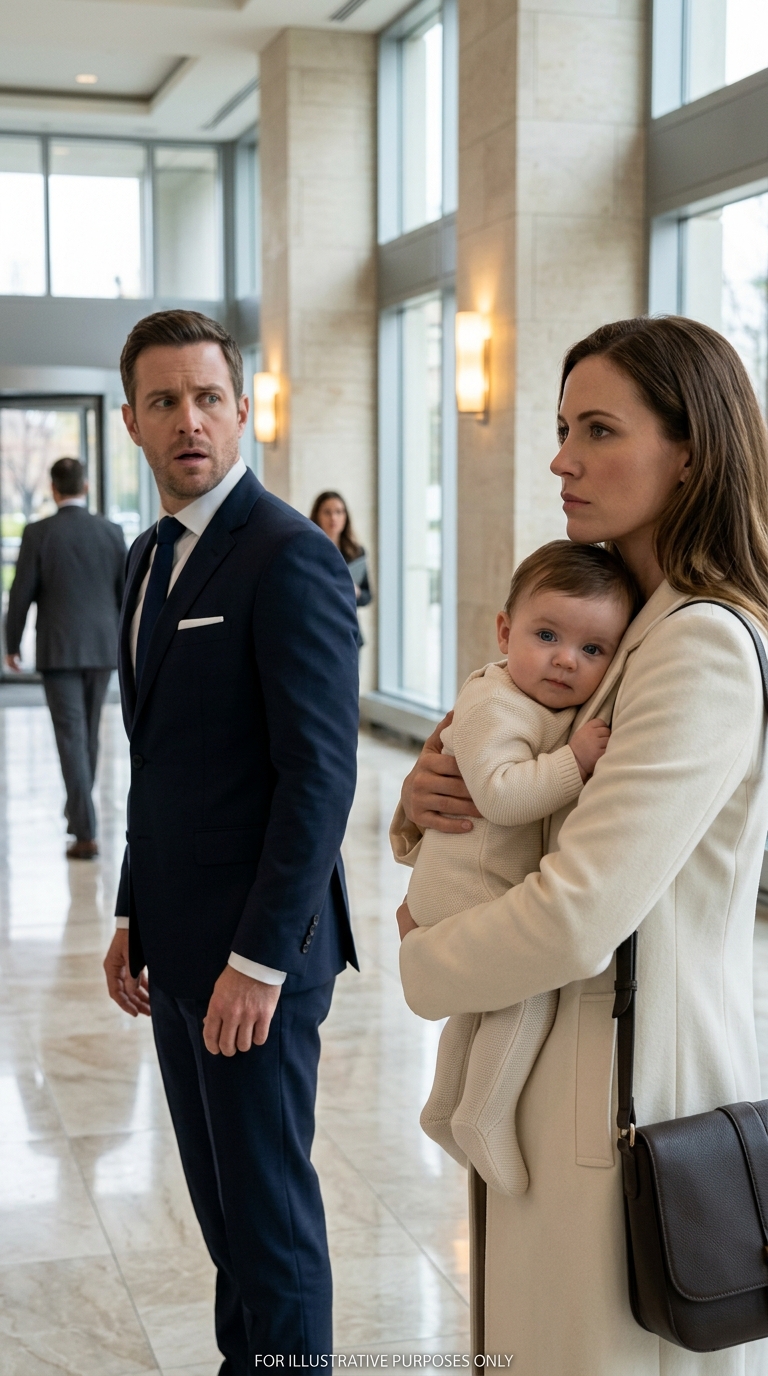
Emma looked at him as if he had asked for something dangerous.
“I won’t touch him,” he said quickly. “I won’t interfere. I just… I can sit over there.”
There was a chair against the wall. Far enough away to be harmless. Close enough to make leaving impossible.
Emma looked from him to the chair, then to Ethan.
“You can sit,” she said.
Ryan sat.
He still had his coat over one arm. His phone buzzed twice. He turned it off.
For the first time in years, Ryan Blackwell sat in a room where money, influence, and urgency meant nothing. No acquisition could fix a heart too small for its work. No lawyer could recover the months he had missed. No assistant could move grief to next Thursday.
Across the room, Emma held Ethan and counted.
Ryan watched.
At 4:07, he went to the nurses’ station and came back with two cups of coffee. The coffee was terrible. Emma took one anyway.
At 4:42, Ethan’s oxygen saturation dipped, and Emma’s hand moved toward the call button before the number stabilized. Ryan noticed the way her shoulders stayed tense for several minutes afterward.
At 5:16, a nurse named Priya came in, checked Ethan’s leads, and gave Ryan the careful look staff gave wealthy men they did not yet trust. Emma said, “It’s okay. He can stay.”
Those four words did something to Ryan that he did not deserve.
By sunrise, Ethan was sleeping in the crib, and Emma looked like she had aged ten years in one night.
“You should go,” she said. “You probably have a morning.”
“I have a board call at nine.”
“Then go.”
He stood, but he did not leave immediately.
“I’ll call you this afternoon,” he said. “If that’s all right.”
Emma leaned back in the chair and rubbed one hand over her face.
“It’s not all right,” she said. “None of this is all right.”
“I know.”
“But yes. Call.”
Ryan nodded.
At the door, he turned back.
Emma had already placed her hand on Ethan’s back again.
Ryan looked at the baby, the son he had discovered in the same hour he learned he might lose him.
Then he walked out into the corridor and understood, with terrifying clarity, that the divorce had not ended the story.
His absence had written the first half of it.
Part 2
Ryan did not go home.
He took the board call from the back of his car in the hospital parking garage, speaking in the same measured voice that had made investors trust him and competitors hate him. No one on the call knew he was sitting three floors beneath his son. No one heard the moment his voice almost broke when someone said the word “future.”
After the call ended, he sat in silence.
Ryan Blackwell was not a man who sat in silence.
He filled silence with numbers, calls, decisions, forward motion. Silence left too much room for memory. And now memory had become a room he could not escape.
Emma at the dinner table.
Emma saying, “I need to talk to you.”
His own hand turning over to check his watch.
He remembered another sentence too, one he had not thought about in years. He had come home late that night from a private dinner with investors and told her he would be relocating much of their life to Singapore.
Not asked.
Told.
Emma had sat across from him, still and pale.
He had said, “Kids would make all of this impossible. I think we both know we’re not the right people for that life.”
We both know.
The arrogance of it sickened him now.
He had spoken for her. He had spoken over a child already alive inside her. And then he had looked back down at his phone.
At four that afternoon, he returned to the hospital with coffee from the place three blocks away, because even in disaster, Ryan’s mind searched for useful tasks. Emma accepted the cup but did not thank him. A woman with copper-brown skin and tired eyes sat beside her.
“This is Dana Reyes,” Emma said. “My friend.”
Dana looked him over like a nurse assessing a wound.
“Ryan,” she said.
“Dana.”
Her handshake was firm and brief.
They moved to a family consultation room down the hall while Priya stayed with Ethan. The room had beige walls, a box of tissues no one touched, and the kind of chairs designed to look comfortable in hospital brochures.
Ryan sat across from Emma.
Dana sat beside Emma, close enough to make her position clear.
“I want to hear it from you,” Ryan said. “All of it.”
Emma looked at the coffee cup in her hands.
“I was going to tell you,” she said. “I need you to know that first.”
Ryan said nothing.
“I found out I was pregnant two weeks before that Singapore conversation. I sat with it. I panicked. I made lists. I even wrote down what I wanted to say because I knew you’d ask questions, and I wanted to be fair.”
Her voice stayed steady, but Ryan could hear the cost of that steadiness.
“That night, I was ready. Then you came home and told me we were going to Singapore six months out of the year. You said I was adaptable. You said it like my life was luggage you could move.”
Ryan looked down.
“And then you said children would make your plans impossible.”
He closed his eyes.
“I remember.”
“No,” Emma said. “You remember the sentence. I remember the room.”
He looked up.
Her eyes were shining, but she did not cry.
“I remember sitting there with your baby inside me while you told me we were not the right people to be parents. You didn’t ask what I wanted. You didn’t ask what I needed. You didn’t even look at me.”
The words landed one by one.
“I made a decision after that,” she continued. “Maybe it was wrong. Maybe part of it was selfish. I’ve had years to think about that. I know you had a right to know.”
Ryan’s jaw tightened.
“Yes,” he said quietly. “I did.”
“I know.” Her voice broke for the first time, just slightly. “But I also knew what it felt like to be loved by you when love was inconvenient. I knew what it felt like to wait for your attention like a meeting request. I would not give my child a father who treated him like something to manage.”
Dana looked at the table.
Ryan absorbed it without arguing.
That was new for him. Once, he would have defended himself with context. Pressure. Deals. His father’s expectations. The years of building something from nothing. The fact that Emma had never told him how lonely she was in language clear enough for him to understand.
All of those things might have been true.
None of them mattered.
“You should have told me anyway,” he said.
“Yes,” Emma said. “I should have.”
He had expected resistance. Blame. Anger.
Her agreement hurt more.
“I’m not proud of every part of what I did,” she said. “But I am proud of the fact that Ethan never had to wonder whether he came first.”
Ryan looked through the small window in the consultation room door, toward the hallway that led to Room 14.
“What happens now?” he asked.
Emma straightened. Practical Emma returned, the nurse and mother in one body.
“Ethan’s care goes through me. I am his primary parent. His doctors answer to me unless I say otherwise. You do not come in with lawyers, demands, or sudden plans. You do not use your ownership stake in this hospital to pressure anyone. You do not make his illness about your guilt.”
Ryan nodded.
“And you do not assume being his biological father makes you his father in practice,” she said. “Not yet.”
The words cut deep, but he knew better than to flinch.
“What can I do?”
Emma studied him.
“You can show up slowly. Consistently. Calmly. You can learn. You can ask before touching him. You can sit in the chair if I say the chair is where you belong.”
Dana leaned back slightly, as if surprised Emma had offered that much.
“And if I fail?” Ryan asked.
Emma’s face softened by one degree, not enough to be forgiveness.
“Then I protect him from that too.”
For the next twelve days, Ryan learned how little power he had.
He requested Ethan’s medical records only after Emma signed consent. He hired a pediatric cardiology consultant, Dr. Samuel Park, who confirmed everything Dr. Patricia Nguyen had already said. He read medical journals until the words blurred. He restructured his calendar until two hours appeared every afternoon without explanation. His assistant, Kira, did not ask questions. She only said, “I figured you might need room.”
Room.
That was what Ryan had never given Emma.
Now he was learning to make room after the damage was done.
At first, he sat in the hallway.
He did not enter unless Emma invited him.
Sometimes he glimpsed Ethan sleeping. Sometimes he saw Emma feeding him with a careful tilt of the bottle. Sometimes he watched doctors come and go with faces trained into neutrality.
On the fourth afternoon, Emma opened the door and said, “You can come in.”
Ryan stood too quickly.
Inside, Ethan was awake.
Awake was different.
Ryan had only seen him sleeping, a small, fragile shape attached to machines. Awake, Ethan seemed deeply unimpressed with the world. His gray-green eyes moved from the ceiling to Emma to Ryan, as if judging all three.
Ryan sat in the chair.
Ethan stared at him.
“Does he know who I am?” Ryan asked before he could stop himself.
“He’s four months old,” Emma said. “He knows voices. Smell. Patterns. He knows who holds him.”
Ryan nodded.
The wound was deserved too.
Later, Ethan began to fuss while Emma was speaking with a nurse in the corridor. Ryan froze. The baby’s small face turned red. His mouth opened with dramatic outrage.
Emma came back to find Ryan standing beside the crib, hands lifted uselessly.
“He’s hungry,” she said.
“I gathered that.”
“Do you want to try?”
Ryan looked at her as if she had handed him a live wire.
“Yes.”
She showed him how to lift Ethan, how to support his head, how to hold him slightly upright. Ryan’s arms became painfully careful.
“He’s heavier than he looks,” Ryan said.
“He weighs eleven pounds.”
“In a meaningful way,” Ryan said, looking down, “that is heavy.”
Emma almost smiled.
Almost.
Ethan latched onto the bottle and settled. Ryan stared at him with such concentration that Emma had to look away.
“I don’t know how to do this,” he said.
“No one does,” Emma replied. “You figure it out.”
So he did.
Badly at first.
He learned which blanket Ethan hated. He learned that Ethan made a small irritated sound when people spoke over him. He learned that the monitor’s alarms were not all equal, though they all made his stomach drop. He learned that Emma took her coffee with oat milk now, not cream. He learned that Dana brought food and sarcasm in equal portions. He learned that Emma’s mother, Carol Hayes, could destroy a man with one calm question.
Carol arrived from Phoenix with two bags, a cardigan, and the expression of a woman who had already decided not to slap him unless necessary.
She held Ethan first.
Then she looked at Ryan.
“So,” Carol said. “You’re here now.”
“Yes, ma’am.”
“Were you always planning to become useful after the crisis, or was that a recent development?”
“Mom,” Emma said.
“No, it’s all right,” Ryan said. He looked at Carol. “Recent. Too recent.”
Carol studied him.
“Honesty is a start. It is not a finish.”
“I know.”
“Good. Sit down. You’re making the room nervous.”
Ryan sat.
By the end of the week, Carol had not forgiven him. But once, when Ethan fussed and Ryan sang the first verse of a lullaby he only half remembered from childhood, Carol did not stop him.
Emma returned from the cafeteria and stood in the doorway.
“You sang to him?” she asked.
Ryan looked embarrassed.
“It worked.”
“What did you sing?”
“I’m not sure. There may have been a moon in it.”
“Did it have a tune?”
“Loosely.”
Carol made a sound that was almost a laugh.
For one minute, Room 14 felt less like a waiting room for disaster and more like a strange, unfinished family.
Then the monitor dipped.
The illusion vanished.
Twelve days after Ryan first saw Ethan, Dr. Nguyen called both parents into her office.
Emma knew before the doctor spoke.
She had spent too many years reading faces in rooms like this. Dr. Nguyen had turned the family photographs on her desk slightly toward the wall, a small professional gesture Emma recognized. A doctor hiding her private life before delivering news that would rearrange someone else’s.
“Ethan’s heart function has declined over the past ten days,” Dr. Nguyen said. “Medication is helping, but not enough. We need to begin formal transplant evaluation now. Not as a future possibility. As the active plan.”
Ryan’s hands went still.
Emma’s face remained composed because falling apart would have to wait.
“How long?” she asked.
“The evaluation takes one to two weeks. Once he’s listed, we depend on donor availability. It could be weeks. It could be months.”
“Can he wait months?” Ryan asked.
Dr. Nguyen paused.
One second too long.
“We are going to do everything possible to support him while he waits.”
Emma nodded once.
Ryan understood then that hospitals had their own language, and hope was often hidden inside careful refusals to promise.
“What do you need from us today?” he asked.
“Blood work. Family history. Genetic screening. Consent forms. And both of you need to understand that this process can move suddenly.”
“Whatever you need,” Ryan said. “Today.”
Emma glanced at him.
He was not performing. Not this time.
That night, after blood tests and paperwork and another long stretch of watching Ethan sleep, Ryan sat in the chair beside the crib.
“I keep trying to turn this into a project,” he said quietly.
Emma looked at him.
“That’s how I manage fear,” he continued. “I collect information. I make calls. I move things. I solve what can be solved.”
“And Ethan can’t be solved.”
“No.” Ryan looked at his son. “He can only be loved.”
Emma said nothing.
But she did not correct him.
Part 3
The crisis came on a Tuesday afternoon when sunlight filled Room 14 so brightly that, for one dangerous hour, Emma allowed herself to believe they might have a normal day.
Ethan had taken half a bottle. Ryan had learned to burp him without looking terrified. Dana had smuggled in decent soup and threatened to pour it directly into Emma if she refused to eat.
Then Ethan’s monitor screamed.
Not beeped.
Screamed.
Emma moved before anyone spoke. Nurses rushed in. Dr. Nguyen was called. Ryan stepped back against the wall because he had learned the hardest lesson of all, which was that loving someone did not make you useful in every moment.
Ethan’s skin had gone gray.
Emma’s face emptied into clinical focus.
“His sats dropped,” she said, though everyone in the room could see it.
Ryan stood beside her in the hallway while the team worked. He did not touch her. He wanted to. He wanted to put a hand at her back, take something from her, carry one ounce of it.
But he had not earned the right to comfort her by needing to comfort himself.
So he stood close enough that she could lean if she chose.
For thirty-one minutes, no one breathed normally.
When the numbers finally climbed out of the alarm range, Emma’s knees bent slightly. Ryan moved then, just enough. She did not lean into him, not exactly. But she did not move away.
Dr. Nguyen came out.
“He’s stable for now,” she said. “But his reserve is lower than we hoped. I’m escalating his transplant status today. We also need to prepare bridge support options if his function declines before a heart becomes available.”
Emma closed her eyes.
A ventricular assist device.
She knew what that meant for a baby Ethan’s size.
Ryan asked the only question that still worked.
“What do you need from us?”
Dr. Nguyen looked at him.
“I need Emma to rest when she can. That is something you can help with.”
Ryan nodded.
Later, when Emma stepped into the bathroom and locked the door, she gripped the sink with both hands and finally cried without making a sound.
When she came back, Ryan was sitting beside Ethan.
He thought he was alone.
“I know you don’t understand any of this,” he told the baby. “That’s probably good. You’ve got enough going on.”
Ethan stared at him with solemn, cloudy eyes.
“I missed the beginning,” Ryan continued. His voice broke and he stopped. “I missed more than the beginning. I missed your mother needing me. I missed you coming into the world. I missed the first time you opened your eyes. I can’t fix that.”
Emma stood in the doorway, unseen.
“But I’m here now,” Ryan said. “And I’m going to keep being here when it’s boring and hard and inconvenient and terrifying. I’m going to keep being here until you know I mean it.”
Ethan moved one tiny arm.
Ryan wiped his face quickly.
“And for the record,” he added, “the eyebrows are definitely from my side.”
Emma pressed one hand over her mouth.
Not to stop herself from crying.
To stop herself from walking in and forgiving him too quickly.
The call came twenty-six days after Ethan was placed on the active transplant list.
Emma’s phone rang at 6:18 in the morning.
She was already awake. She was always awake.
“Emma,” Dr. Nguyen said. “We have a potential match.”
The words did not make sense at first.
Emma stood so fast the chair scraped the floor.
“There is a donor heart that appears to be a strong preliminary match. We are confirming compatibility now. If it holds, we move to surgery today.”
Today.
Emma looked at Ethan asleep in the crib.
Today, someone else’s family had lost a child.
Today, her son might live because another mother somewhere was being asked to make the most impossible generous decision on earth.
“I need you to call anyone who should be here,” Dr. Nguyen said.
Emma had already dialed Ryan.
He answered on the second ring.
“Emma?”
“Come now,” she said. “Right now.”
He arrived in nineteen minutes, hair damp, coat unbuttoned, face pale.
“They found a heart,” Emma said.
Ryan looked at Ethan.
For once, he did not ask a question.
He simply nodded.
“Okay.”
“It’s not confirmed yet.”
“I know.”
“If it is, they’ll take him fast.”
“I know.”
She looked at him then, really looked.
“Ryan, I’m scared.”
He stepped closer.
This time, he touched her hand.
Not her shoulder. Not her waist. Nothing claiming. Just his fingers around hers, careful and warm.
“Me too,” he said.
The phone rang again.
Emma answered.
Dr. Nguyen’s voice was steady.
“It’s confirmed.”
They took Ethan at 10:09.
Emma kissed his forehead before they wheeled him away. Ryan bent down awkwardly, then stopped and looked at Emma for permission.
She nodded.
He placed one trembling kiss on Ethan’s tiny hand.
“Come back,” Ryan whispered. “Please come back.”
The doors closed.
The waiting room became a country with no clocks, even though clocks hung on every wall.
Carol arrived. Dana arrived. Kira sent messages Ryan did not read. Dr. Park called and left a voicemail Ryan did not answer. The board of Blackwell Capital learned, for the first time in its history, that Ryan Blackwell was unreachable for reasons no one was permitted to challenge.
Hours passed.
Emma sat with both hands clenched.
Ryan sat beside her.
At some point, Carol put a hand on Emma’s shoulder. Dana brought coffee no one drank. Ryan stood, paced five steps, caught himself, and sat down again.
“I don’t know how to wait,” he said.
Emma looked straight ahead.
“No one does.”
Surgery took seven hours and forty-three minutes.
When Dr. Nguyen finally appeared, still in surgical cap, Emma stood so quickly the room blurred.
Ryan stood beside her.
Dr. Nguyen’s eyes were tired.
“The heart is in,” she said.
Emma made a sound that was almost a sob.
“The surgery went as well as we could have hoped. He is not out of danger. The next forty-eight hours are critical. But right now, Ethan’s new heart is beating.”
Ryan covered his face with both hands.
Emma turned toward him because the sound he made did not belong to the man she had married.
It was not controlled.
It was not polished.
It was a father hearing that his son’s heart was beating.
For forty-eight hours, they lived inside machines, numbers, whispered updates, and terrible fragile hope.
Ethan was swollen. Tubes surrounded him. His chest rose and fell with support. Emma touched his foot because it was the only place she could touch without interfering.
Ryan stood on the other side of the bed.
“He looks so small,” he said.
“He’s fighting,” Emma replied.
“Yes,” Ryan said. “He gets that from you.”
She looked at him.
“From both of us,” she said.
It was the first time she had given him that.
He did not waste it by speaking.
Ethan survived the first night.
Then the second.
Then the third.
On the fifth day, Dr. Nguyen said the word “encouraging,” and Emma cried openly in the hallway while Dana held her. Ryan stood nearby with Ethan’s tiny blanket in his hands, looking like a man who had been entrusted with a flag after a war.
On the ninth day, Emma allowed Ryan to hold Ethan again.
No monitors screamed.
No nurse rushed in.
Ryan sat in the chair with his son against his chest, one hand supporting his back exactly the way Emma had taught him.
Ethan slept.
Ryan looked down at him for a long time.
“I missed so much,” he said.
Emma sat by the window.
“Yes.”
“I’m sorry.”
“I know.”
“No,” Ryan said. “Not the kind of sorry that asks you to make me feel better. I’m sorry in the way that means I will spend the rest of his life doing the opposite of what I did before.”
Emma looked at the city outside. Chicago moved beyond the glass, impatient and alive.
“I don’t know what we are now,” she said.
“We’re Ethan’s parents.”
“That part I know.”
Ryan nodded.
“I don’t expect us to go back.”
“Good,” she said, turning to him. “Because we can’t.”
“I know.”
“The woman who waited for you at dinner tables is gone.”
Ryan swallowed.
“She should be.”
Emma looked at him for a long moment.
“I don’t hate you anymore,” she said.
He closed his eyes.
“I probably would have deserved it if you did.”
“Yes,” she said. “But hate takes energy. Ethan needs mine.”
For the first time in weeks, Ryan smiled faintly.
“He’s demanding.”
“He’s a Blackwell.”
“He’s a Hayes,” Emma corrected.
Ryan looked down at the baby in his arms.
“He can be both,” he said.
Six months later, April arrived like mercy.
St. Catherine’s looked different in spring. The trees outside the entrance had small green leaves. The lobby windows filled with warm light instead of winter glare. Nurses who had once spoken to Emma in low, careful voices now smiled when they saw Ethan in his carrier.
He was bigger now. Rounder in the cheeks. Still monitored, still medically fragile in ways strangers could not see, but alive with the fierce curiosity of a baby who had decided the world owed him explanations.
Dr. Nguyen sat across from Emma and Ryan in her office.
Her family photographs were still angled slightly toward the wall, but not as much as before.
“His cardiac function is better than projected for this stage,” she said.
Emma stopped breathing.
“Meaning?” Ryan asked.
Dr. Nguyen allowed herself a small smile.
“Meaningfully better. His rejection markers are stable. His new heart is performing well. He has a long road ahead, and he will need close monitoring for years. But today, by the measurements that matter, Ethan is thriving.”
Emma covered her mouth.
Ryan looked down at the floor.
“Thank you,” he said.
His voice was rough.
Outside, they walked slowly toward the parking lot. Emma carried Ethan against her chest. Ryan carried the diaper bag without being asked.
This, somehow, had become natural.
They stopped near the hospital garden, where tulips were beginning to open.
Emma looked at Ryan.
“I’m moving to the house on Ashland,” she said.
Ryan blinked.
“The one with the yard?”
“Yes. Ethan needs more space. My lease ends next month. Mom will stay with us part of the summer.”
“That’s good,” he said. “It’s a good house.”
“I’m telling you because I want you to know where your son lives.”
He nodded.
“Not because I’m asking you to live there.”
“I understand.”
She studied him.
“But there’s a guest room,” she said. “For nights when his appointments run late. Or when I need sleep. Or when he needs both parents close.”
Ryan went very still.
Emma’s voice softened.
“This is not forgiveness as a gift, Ryan. It’s not romance. It’s not erasing what happened.”
“I know.”
“It’s a door. A small one. You can walk through it carefully, or you can lose it.”
Ryan looked at Ethan, who had grabbed one of Emma’s fingers and was examining it like a legal document.
“I’ll be careful,” he said.
Emma almost smiled.
“You’ll be you. But maybe a better version.”
“I’m working on that.”
“I know,” she said. “That’s why there’s a door.”
A year after the night Ryan saw Emma through the glass, Ethan took his first unsteady steps in the living room of the Ashland house.
Carol was there. Dana was there. Priya came off shift and brought cupcakes. Dr. Nguyen sent a small stuffed bear wearing a red felt heart.
Ryan sat on the floor in jeans and a sweater, one hand outstretched.
Emma sat across from him, laughing and crying at the same time.
Ethan stood between them, wobbling with the seriousness of a tiny king.
“Come on, buddy,” Ryan said softly. “You can do it.”
Ethan frowned.
The Blackwell eyebrows were undeniable.
Then he took one step.
Then another.
Straight into Emma’s arms.
Everyone cheered.
Ryan clapped with the rest of them, and when Ethan turned around proudly, he reached for Ryan too.
Not because blood had demanded it.
Not because money had arranged it.
Because Ryan had been there for mornings, medicines, late-night fevers, insurance forms, laundry, bottle parts, tiny socks, and the terrifying ordinary work of staying.
Emma watched him lift Ethan carefully and press a kiss to the top of his hair.
She did not know what love would become between them.
Maybe it would never be what it was. Maybe that was good. The old love had been too quiet about its wounds. This new thing, whatever it was, had been built under fluorescent lights, inside hospital corridors, beside a crib where every breath mattered.
Ryan looked at her over Ethan’s head.
“Thank you,” he said.
“For what?”
“For letting me become his father.”
Emma looked at Ethan, then back at Ryan.
“I didn’t let you,” she said. “You became one.”
Ryan’s eyes filled.
This time, he did not look away.
Ethan patted his father’s cheek with one small hand, impatient with adult emotion.
Outside, Chicago moved into evening. Cars passed. Porch lights came on. Somewhere, a hospital monitor beeped for another family holding its breath.
But in that living room, a boy with a borrowed heart laughed between the two people who had almost lost him before they ever became a family.
And Ryan Blackwell, who had once believed time could be managed, finally understood the truth.
Time could not be owned.
It could only be given.