During thirty-one years of marriage to a man who viewed my opinions as minor inconveniences, I had learned to shrink. My ex-husband never shouted. He didn’t have to. A slow, disappointed exhale or a slight raise of his left eyebrow was all it took to make me swallow my words, fold myself into a neat, agreeable shape, and retreat to the periphery of my own life. By the time the ink dried on our divorce papers, I walked through rooms like a ghost, perpetually terrified of taking up too much space.
My daughter, Chloe, was my antithesis.
At thirty, she was a brilliant, self-made graphic designer running her own boutique firm in Boston. She was grounded, practical, and fiercely loyal. She possessed a quiet confidence that some mistook for simplicity, but she had never felt the need to perform her intellect for an audience.
When she met Luke Sterling, a quiet, fiercely intelligent structural engineer, I breathed a sigh of relief. Luke was steady. He looked at Chloe not as an accessory, but as the foundation of his world.
When they got engaged, Chloe called me in tears of joy. Three months later, his parents flew in from Paris.
Preston and Helen Sterling were American expats who had lived in Europe for thirty-five years, long enough to view their home country as a charming, somewhat barbaric frontier. Preston was an international corporate attorney, a man whose tailored suits and silver hair practically hummed with generational wealth. Helen was a former socialite with perfectly manicured hands and a smile that never quite reached her ice-blue eyes.
Chloe and Luke rented a beautiful, rustic cabin near the lake for the weekend introduction. I arrived three hours early, my arms loaded with fresh groceries, a bouquet of hydrangeas, and my grandmother’s cast-iron Dutch oven. I still carried the deep-seated belief that I needed to purchase my right to exist in a room by being relentlessly useful.
“Mom, please, I just want this to go smoothly,” Chloe had whispered to me in the kitchen, her hands shaking slightly as she minced garlic. “Luke’s parents… they’re very proud of their pedigree. They can be intense.”
“I’ll be a mouse,” I promised, kissing her forehead.
She frowned, clearly hating that I felt the need to say that. But it was the only survival tactic I knew.
When Preston and Helen arrived, they brought an atmosphere of chilled judgment. They complimented the lake, calling it “quaintly provincial,” and air-kissed my cheeks while looking slightly past me.
Before dinner, as I was arranging books on the coffee table to make the living room look tidier, Helen drifted in, a glass of Chardonnay in her hand. She picked up a worn paperback I had brought with me to read. Tucked inside, marking page forty-two, was a faded, yellowed piece of paper.
It was a receipt from Le Petit Bouchon, a small bistro in Lyon, France, dated nearly forty years ago.
Helen pinched the receipt between her thumb and forefinger with a look of mild distaste. “A souvenir from Epcot, Eleanor?” she asked, her tone dripping with polite condescension.
“Just a memory,” I murmured, quickly taking the book from her hands and placing it at the bottom of the stack. I didn’t elaborate. I never did.
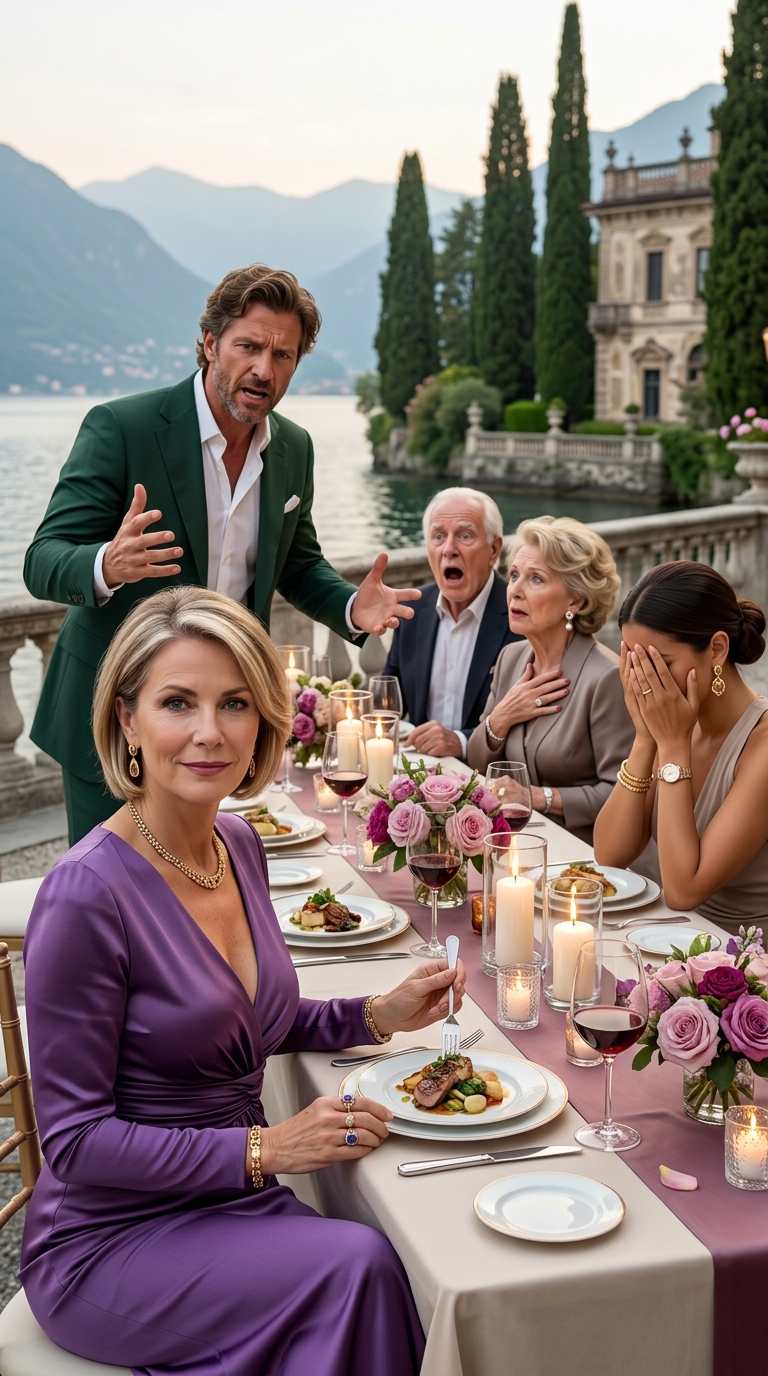
We moved to the dining table. Chloe had spent weeks agonizing over the menu, eventually settling on a complex, slow-cooked beef bourguignon, a nod to their Parisian life, made with a deeply reduced Pinot Noir. The table was set with heavy linen and flickering tapers.
The evening was proceeding with strained politeness until the main course was served. That was when Preston reached into his leather briefcase, which he had strangely kept by his feet, and pulled out a thick, cream-colored document bound in navy ribbon.
He slid it across the rough-hewn oak table toward Chloe.
“Chloe, my dear,” Preston said, his voice smooth and commanding. “As you know, the Sterling family has significant… structural assets. Before we can pop the champagne, there is a matter of tradition to attend to.”
Chloe looked down at the document, confusion knitting her brow. I leaned forward, a cold dread pooling in my stomach.
The document was nearly fifty pages long. And it was written entirely in French.
“It’s a standard prenuptial agreement,” Helen added smoothly, taking a delicate bite of her beef. “Drafted by Preston’s firm in Paris. It’s a formality, really. Just sign on the last page.”
Luke stared at his parents, his jaw tightening. “We talked about this, Dad. I told you we weren’t doing this.”
“Nonsense, Luke,” Preston dismissed him with a wave of his fork. “It protects you both. Chloe, darling, I know the French legal jargon might look intimidating to an American eye, but you can trust us. It simply ensures that our family’s legacy remains intact.”
Chloe looked at Luke, then at the document, entirely overwhelmed. She didn’t speak a word of French. Neither did Luke, having rebelled against his parents’ expatriate snobbery by stubbornly refusing to learn the language beyond basic conversational pleasantries.
And they all firmly believed that I, the mousy, retired teacher from upstate New York, was equally clueless.
Preston smiled, a shark-like baring of teeth. Then, leaning back in his chair, he looked at his wife and switched languages.
“Elle va le signer,” Preston said in French. She will sign it.
And with those four words, the trap was set, and the evening hurtled toward a point of no return.
“She will sign it,” Preston repeated in French, taking a slow, appreciative sip of the Bordeaux he had brought. “She is too intimidated not to. Look at her.”
Helen laughed, a high, thin sound that grated against the warm ambiance of the room. “Of course she is. She’s terrified we won’t approve of her. She’s a sweet girl, but terribly simple, Preston. No real lineage to speak of.”
I sat frozen, my hands resting in my lap, my fingernails digging into my palms.
They were speaking French. Rapid, Parisian French, laced with the lazy arrogance of people who believed they were untouchable.
What neither Preston nor Helen knew was that long before I became a subdued wife, before I was a mother, before I stood in front of chalkboards teaching teenagers about the Industrial Revolution, I had lived in Lyon for eight years.
At twenty-two, I had fled a suffocating hometown with one battered suitcase, a few hundred dollars, and no return ticket. I didn’t learn French in a sanitized university classroom. I learned it sweating in the kitchens of Rue Mercière, arguing with ruthless landlords in the Croix-Rousse district, and fiercely negotiating my worth in a city that ate the timid for breakfast. The French I knew was visceral, sharp, and precise.
But I had locked that girl away. After decades of a marriage that eroded my self-esteem, that fearless twenty-two-year-old felt like a stranger I had only read about in a book.
So, I did what I had been trained to do. I kept my eyes fixed on my plate and said nothing.
Luke reached across the table, putting his hand over Chloe’s. “I’m not letting you sign anything you can’t read, Chloe. We’ll get a translator in Boston.”
Preston’s eyes flashed with irritation, though his English voice remained perfectly modulated. “Don’t be dramatic, Luke. It’s a standard boilerplate.”
He turned to his wife, seamlessly slipping back into his native tongue. “The boy is soft. He always has been. He’s letting this little graphic designer from nowhere lead him by the nose.”
“It’s the mother’s influence,” Helen replied in French, her eyes sliding toward me with unmistakable pity. “Look at her, Preston. She’s practically trembling. Thirty years married to that businessman who finally dumped her, and she has nothing to show for it but a cheap casserole dish and a subservient posture. I refuse to let Luke marry into a lineage of cowardly, discarded women.”
My breath hitched. The air in my lungs turned to glass.
They weren’t just insulting my daughter’s background anymore. They were dissecting the deepest, most humiliating wound of my life, parading my trauma across the dinner table as a casual dinner-party anecdote.
“Agreed,” Preston chuckled, slicing his meat. “That’s exactly why I drafted Clause Four the way I did. Once they are married, we’ll move them to the Paris office within a year. The clause restricts her from taking any marital assets out of the European Union if she leaves. We isolate her there, keep the mother on this side of the Atlantic, and within two years, Chloe will be molded into exactly what we need, or she’ll leave with absolutely nothing.”
“Brilliant,” Helen murmured. “Cut the mother out entirely. It’s for the best. Her mediocrity is contagious.”
My heart slammed against my ribs. A loud, rushing sound filled my ears. They were openly plotting to steal my daughter, to trap her in a foreign country, and to erase me from her life—all while eating the food she had spent weeks perfecting to honor them.
I looked at Chloe. She was staring at the French document, her eyes brimming with anxious tears, wanting so desperately to please this family, unaware that she was holding the blueprint of her own cage.
I looked at my ex-husband’s ghost, the phantom that had sat on my shoulder for thirty years, telling me to be quiet, to be good, to not make a scene.
Then, I looked at the faded receipt from Lyon in my mind’s eye.
Something inside my chest—something ancient, rusted, and incredibly heavy—finally snapped. The woman who had cowered for three decades died right there in the dining chair.
Preston reached over, tapping the document with his manicured fingernail. “Look here, Helen. Clause Four. The phrasing is practically ironclad.”
I slowly picked up my fork, the metal cold and solid in my grip, and let it fall flat against the porcelain plate.
Clack.
The sharp sound cut through the room like a gunshot. The table went dead silent.
Preston stopped laughing. Helen looked up, annoyed.
I leaned forward, rested my elbows on the table, locked eyes with Preston Sterling, and opened my mouth.
“Votre Clause Quatre n’est pas seulement cruelle, Monsieur Sterling. Elle est rédigée de manière tout à fait incompétente.”
(Your Clause Four is not only cruel, Mr. Sterling. It is completely incompetently drafted.)
My voice did not shake. It resonated from the bottom of my diaphragm, carrying the precise, melodic, yet sharp accent of a true Lyonnais. I didn’t shout. I didn’t have to. The sheer impossibility of the words leaving my lips was louder than a scream.
Helen’s wine glass slipped from her fingers, shattering against the base of her plate, sending a dark red stain bleeding across the white linen.
Preston’s face drained of color so fast he looked as though he were having a stroke. His mouth opened, closed, and opened again, but no sound came out.
Chloe gasped, her hands flying to her mouth. Luke’s eyes widened to the size of saucers.
I didn’t break eye contact with Preston. I reached across the table, grabbed the heavy, ribbon-bound prenup, and pulled it toward me.
“I lived in Lyon for eight years, Preston,” I said in perfect, unhurried French. “I worked on Rue Mercière. I lived in Croix-Rousse. I learned this language from people who did not have the time or the patience to slow down for foreigners. I have understood every single venomous word you and your wife have spoken since you walked through that door.”
“You—” Preston stammered in English, his polished veneer cracking. “You speak—”
“Je n’ai pas terminé,” (I am not finished) I cut him off smoothly in French, raising a single finger. The authority in my voice surprised even me. It was the voice of a woman who had once chased a man down a cobblestone street for stealing her wages.
“You sat at my daughter’s table,” I continued in English, so Chloe and Luke would understand the full weight of what was happening. “You ate the meal she spent three weeks practicing just to honor your heritage. And you used a language you believed protected you to mock her, to insult my past, and to openly plot how you would isolate her in Europe and cut me out of her life.”
Helen was trembling now, her manicured hands gripping the edge of the table. “Eleanor, please, you misunderstood—”
“I misunderstood nothing, Helen,” I snapped, my voice finally adopting a razor’s edge. “You called me a cowardly, discarded woman. You called my daughter simple.”
I looked down at the document and flipped to the fourth page. I scanned the dense, legal French.
“And as for this ‘ironclad’ Clause Four,” I said, looking back at Preston, a terrifying, calm smile spreading across my face. I switched back to French, my tone mocking. “You used the term ‘biens propres’ incorrectly in the context of international relocation under the Hague Convention. Furthermore, your subjunctive phrasing in paragraph three creates a legal loophole large enough to drive a Renault through. Any first-year law student at the Sorbonne would tear this apart in ten minutes.”
Preston’s face shifted from pale white to a deep, mottled purple. His pride, his ego, his entire sense of superiority was being dismantled by a woman he had deemed culturally worthless.
I picked up the document, the symbol of their arrogance and my daughter’s intended imprisonment. I looked at Luke, whose face was a mask of sheer shock, and then at Chloe, who was staring at me as if I had suddenly sprouted wings.
“My daughter built a company from the ground up without a dime of your money,” I said, dropping the document back onto the table like a piece of trash. “She is a woman of immense substance. And I? I survived a marriage that would have crushed a weaker woman, and I raised her all by myself. The only people lacking class, lineage, and basic human decency at this table are the two of you.”
I expected them to shrink. I expected shame. I had assumed that pulling back the curtain on their cruelty would force an apology.
I was wrong.
Instead of remorse, Preston Sterling’s eyes narrowed into slits of pure, unadulterated venom. He slammed his fist onto the table, making the silverware jump.
“How dare you,” Preston hissed, abandoning French entirely. “You eavesdropped! You sat there maliciously hiding your background to trap us! You deceitful, classless—”
“Preston!” Helen shrieked, suddenly emboldened by her husband’s rage. She turned her icy glare onto Luke. “Luke, are you going to sit there and let this… this peasant speak to your father this way? Tell her to get out! Put her in her place!”
The room felt like a powder keg, the fuse burning down to the final millimeter. The silence that followed Helen’s demand was deafening, the air crackling with an electricity so violent it made my teeth ache.
We all turned to look at Luke.
Luke sat perfectly still. For a terrifying second, my old fears flared up. He is going to side with them, a voice whispered in my head. Blood is thicker than water. I have ruined my daughter’s life.
Chloe reached for him, her hand hovering over his arm, her eyes pleading.
Luke looked at his mother. Then he looked at his father. Finally, he looked down at the prenup lying like a dead thing on the table.
Slowly, deliberately, Luke stood up. He didn’t yell. He didn’t slam his fists. When he spoke, his voice was deathly quiet, which made it infinitely more terrifying than Preston’s bluster.
“You plotted to take her away from her family,” Luke said, his voice shaking with a rage so profound it seemed to lower the temperature in the room.
“Luke, be reasonable,” Preston barked, straightening his tie. “It was a strategic conversation about asset protection—”
“You called Chloe simple,” Luke interrupted, stepping away from his chair. “You called Eleanor a coward.”
He reached out and picked up the fifty-page, ribbon-bound document. With a slow, deliberate movement, he clamped his hands on either side of the thick paper.
RIIIP.
The sound of tearing paper echoed off the wooden walls. Preston gasped as if he had been physically struck. Luke tore it again, the heavy cardstock fighting him, until the document was reduced to jagged, meaningless shreds. He let the pieces fall like snow over his parents’ plates.
“Luke!” Helen cried out, tears finally spilling over her lashes—not tears of guilt, but of panic. “What are you doing?”
“I’m protecting my family,” Luke said. He walked around the table and stood firmly behind Chloe’s chair, resting his hands on her shoulders. “And I don’t mean you.”
Preston stood up, knocking his chair backward. “You are making a massive mistake, boy. If you walk away from us for this… this provincial nothing, you walk away from the trust. The firm. Everything.”
“Keep it,” Luke said without a second’s hesitation. He pointed toward the front door. “Get out.”
“Luke—” Helen sobbed, reaching for him.
And then, the polished facade completely shattered. Helen collapsed into her chair, burying her face in her hands, her shoulders heaving with ugly, raw sobs.
“I didn’t mean it!” she wailed, the aristocratic poise vanishing, leaving behind a terrified, desperate older woman. “I didn’t mean any of it, Luke, please!”
Chloe, despite everything that had just happened, softened slightly. “Helen, why? Why would you say those things?”
Helen looked up, her mascara running down her cheeks, the viciousness gone, replaced by a hollow vulnerability.
“Because you’re warm,” Helen choked out, looking at Chloe, then at me. “You’re a real family. You laugh, you cook together, you love each other. I saw the way Luke looked at you, Chloe. He’s never looked at me that way. I knew the moment he married you, we would lose him forever. I thought… I thought if I made you feel small, you wouldn’t have the strength to take him away.”
The confession hung in the air, pathetic and tragic. It didn’t excuse the cruelty, but it illuminated the deep, festering insecurity beneath their wealth. They weren’t powerful; they were terrified.
Preston, however, was incapable of such introspection. He grabbed Helen by the upper arm, hauling her to her feet.
“Stop groveling, Helen. We are leaving. If the boy wants to throw his life away on sentimentality, let him.”
Preston marched toward the front door, yanking it open. The smell of rain and wet earth flooded the room. He didn’t look back.
Helen lingered for a fraction of a second, looking at Luke with a desperate plea in her eyes. But Luke just stared back, his jaw set in stone. Sobbing, Helen turned and fled into the night after her husband.
The door slammed shut. The silence that rushed in to fill the void was heavier than lead.
Chloe stood up, turned around, and buried her face in Luke’s chest, sobbing violently. Luke held her, burying his face in her hair, his own shoulders shaking.
I sat alone at the table, surrounded by torn legal paper and cold beef bourguignon. My hands were shaking so hard I had to press them flat against my thighs.
I had blown up my daughter’s wedding. I had alienated her future in-laws.
But as I looked at the dark window, seeing my own reflection in the glass for the first time in thirty years, I realized something else.
The woman staring back at me wasn’t a ghost anymore.
The morning after the explosion, the lake house was wrapped in a thick, gray fog.
I woke up early, my body exhausted but my mind startlingly clear. I walked out to the wraparound porch with a mug of black coffee, wrapped in a thick cardigan, watching the mist roll off the black water.
I heard the crunch of tires on gravel.
I tensed, preparing for another battle. A sleek black town car pulled into the driveway. The passenger door opened, and Helen Sterling stepped out.
She was alone.
She wasn’t wearing her tailored blazer or her pearls. She wore a simple trench coat, her hair pulled back into a messy knot. She looked ten years older, and entirely stripped of her armor.
She walked up the wooden stairs of the porch and stopped a few feet away from me. She didn’t look at me with pity or arrogance. She looked at me with caution.
“Preston is at the airport,” Helen said quietly, her voice hoarse. “He’s flying back to Paris. He refuses to speak to Luke.”
I took a sip of my coffee. “And you?”
Helen looked down at her hands. Slowly, she reached into her trench coat pocket and pulled something out. She extended her hand toward me.
It was the faded receipt from Le Petit Bouchon. The memento she had scoffed at yesterday.
“When I was rushing out last night, I saw this on the floor. It must have fallen out of your book during the commotion,” she said. “I recognized the address. Rue Mercière. A working-class district.”
She looked up, meeting my eyes.
“I spent the entire night awake in the hotel,” Helen whispered. “Thinking about a twenty-two-year-old girl, alone in a foreign city, fighting for a place in the world. I realized I didn’t know you at all, Eleanor. And I realized… I am the coward.”
She placed the receipt gently on the wooden railing between us.
“I don’t expect you to forgive me,” Helen said, her voice cracking. “I don’t expect Chloe to ever want to see me again. But I am asking… I am begging you to teach me how to be brave enough to admit I was wrong. Because if I go back to Paris with Preston right now, I will lose my son forever.”
I looked at the woman standing before me. I could have crushed her. It would have been so easy, so satisfying to exact vengeance for the humiliation she had put me through.
But vengeance is a weapon used by the weak.
I reached out and picked up the receipt, sliding it into my pocket.
“Chloe and Luke are asleep,” I said softly. “But there’s a fresh pot of coffee in the kitchen. Come sit down, Helen. We have a lot of work to do.”
A year later, the spring sun shone brightly over a vineyard in the Finger Lakes.
Chloe looked radiant, a vision of joy in white lace. Luke stood at the altar, looking at her with a devotion that brought tears to my eyes.
In the second row, Helen sat beside me. It had been a grueling twelve months of painful conversations, boundaries being drawn and respected, and Helen learning to dismantle a lifetime of elitist armor. We weren’t best friends, but we had become allies in the business of loving our children.
And next to Helen, looking uncomfortable but incredibly subdued, sat Preston. It had taken ten months of absolute silence from Luke for Preston to crack. He had finally flown to Boston, unannounced, and offered an apology so stiff it practically creaked—but it was a start.
During the reception, the champagne flowed, and the music swelled.
Preston stood up, tapping a spoon against his crystal flute. The room quieted down.
He looked at Luke and Chloe, offering a toast about love and endurance. Then, he paused. He looked across the room, finding my eyes in the crowd.
He raised his glass directly to me.
“À la femme qui a refusé d’être invisible,” Preston said softly, a wry, respectful smile touching his lips.
(To the woman who refused to be invisible.)
He didn’t translate it for the room. He didn’t need to. He knew I understood every word.
I raised my glass back to him and took a sip.
Looking back, the story of that weekend was never really about Preston, Helen, or a vindictive prenuptial agreement. It was about the moment I put down my fork.
For over thirty years, I had believed that silence was the safest version of myself. I had let my ex-husband teach me that my voice was a burden. I had mistaken my trauma for my personality.
But the French language didn’t belong to the wealthy elites who tried to use it as a weapon against my family. It belonged to my youth. It belonged to courage, to one suitcase, and no plan.
When Helen and Preston insulted my daughter in French, they accidentally bypassed the quiet, broken, retired teacher sitting at the table. They spoke directly to the fierce, untamed woman buried underneath.
And that woman had never learned to lower her eyes.
She had survived the marriage, the divorce, and the silent decades. She had just been waiting for someone to speak to her in a language her fear hadn’t yet learned to silence.
At a dinner table beside a dark lake, someone finally did. And she answered.
If you want more stories like this, or if you’d like to share your thoughts about what you would have done in my situation, I’d love to hear from you. Your perspective helps these stories reach more people, so don’t be shy about commenting or sharing.