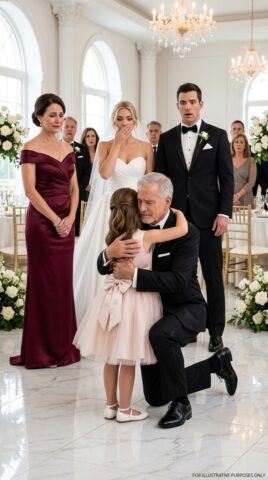
My ex-husband brought his twenty-eight-year-old fiancée to the Metropolitan gala to prove he had upgraded from me.
When the cameras turned away from them and began shouting my name, he smiled—until a financial reporter announced that my company had closed a $1.3 billion deal that morning.
By midnight, his fiancée was gone, his merger was suspended, and the divorce settlement he had cheated me into signing was about to be reopened.
The first flash hit me before both feet reached the pavement.
White light burst across the wet stone steps of the Metropolitan Museum, followed by a violent clicking from dozens of cameras pressed behind velvet ropes. The November air smelled of rain, exhaust, wool coats, and the faint metallic heat of electrical equipment. Reporters shouted names from beneath black umbrellas. Drivers leaned against polished cars while security officers tried to keep the entrance clear.
For one frightening second, I forgot how to move.
Eighteen months earlier, Richard Sterling had taught half of New York to regard me as a fragile woman recovering from an emotional collapse. He repeated the description to friends, attorneys, investors, and anyone else whose sympathy might interfere with the clean public story of our divorce.
Now every lens pointed toward me.
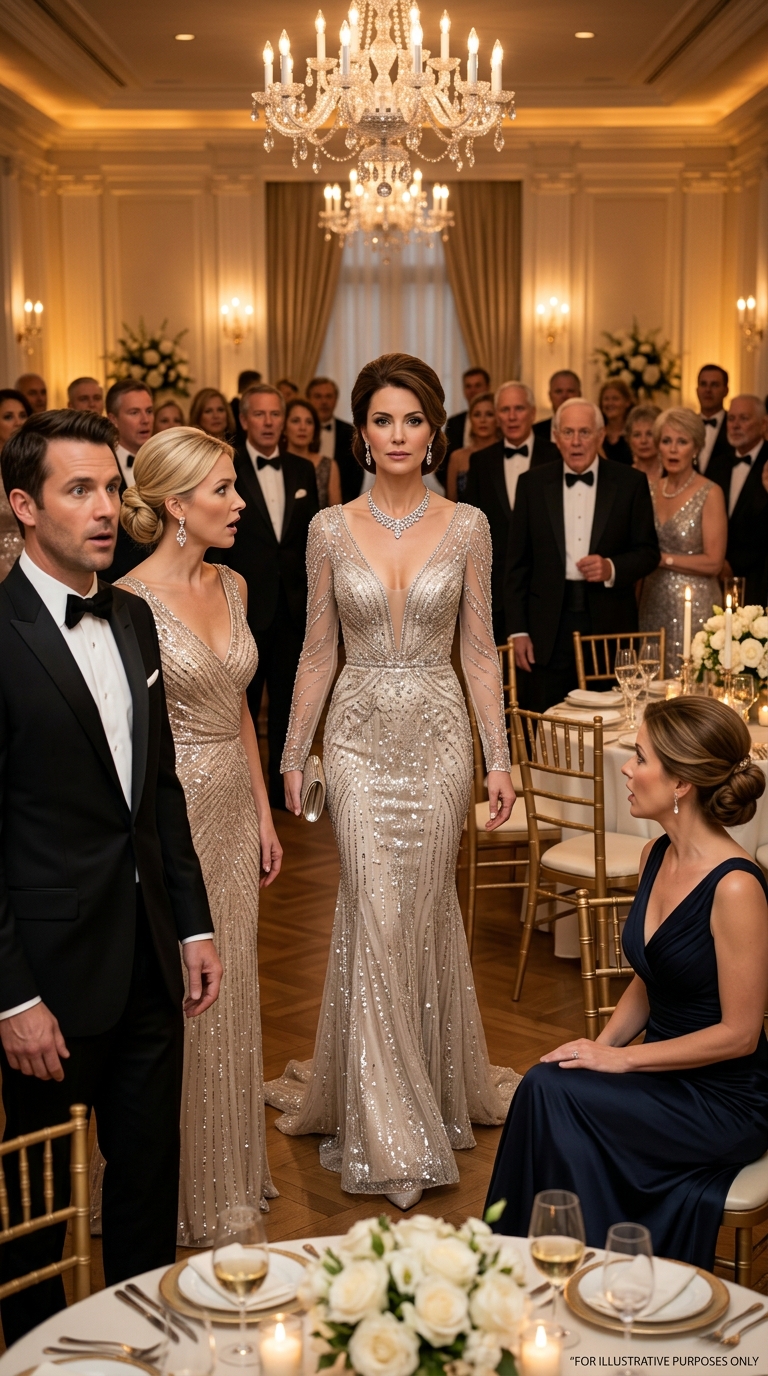
I stood beside the open door of a dark electric sedan with one gloved hand resting against its roof. My gown was silver-gray rather than the brighter metallic creation several fashion blogs would later describe. The designer had woven fine conductive fibers through layers of silk, allowing the material to catch light in narrow lines whenever I moved. It looked liquid under the flashbulbs, but it was not armor made from diamonds or a multimillion-dollar costume.
It was a dress.
A beautiful, carefully made dress I had purchased with my own money because I wanted to attend one important evening without dressing to make another person comfortable.
“Ms. Hayes!”
“Eleanor, look this way!”
“Is the Calder acquisition complete?”
“Did Aura close this morning?”
I heard my name repeatedly, but the sound seemed to come from far away.
Then I looked up the steps.
Richard stood beneath the entrance canopy with his arm around Isabelle Vance.
He wore a black tuxedo, a white pocket square, and the expression he once used whenever he believed a room had arranged itself in his favor. Isabelle stood beside him in pale rose silk, sapphires resting against her throat. She was young, blond, and visibly tense beneath the cameras, though Richard’s hand remained pressed against her waist as if he could stabilize her through possession.
They had announced their engagement three months earlier.
The society pages called Isabelle the graceful daughter of logistics magnate Arthur Vance and Richard the self-made real-estate visionary who had emerged renewed after a painful first marriage.
I had been the painful first marriage.
Richard watched the reporters gather around me.
At first, confusion crossed his face.
Then calculation.
I knew every stage of that expression. I had spent ten years watching him encounter information that threatened his view of himself.
He would deny it.
Then diminish it.
Then determine how it might still benefit him.
I climbed the steps.
The rain had ended, but water remained along the edges of the stone, reflecting the museum’s warm exterior lights. My heels struck each step with a soft, measured sound beneath the noise of the press.
I did not pose.
I did not search for Richard’s reaction.
I simply continued upward.
At the landing, Isabelle turned toward me before he did.
Her smile was correct but brittle.
“Eleanor,” she said. “What a surprise.”
The use of my first name sounded intimate despite the fact that we had met only twice—once while she was sleeping with my husband and pretending to be a junior adviser at one of his charity boards, and once in the courthouse hallway after the divorce became final.
“Isabelle.”
She touched the sapphires at her throat.
“We’re glad you could come.”
We.
A small territorial word.
Richard recovered his public smile.
“Ellie.”
No one had called me that since the divorce except Ben.
“You look different.”
“I am different.”
His eyes moved over my dress, the car waiting below, the reporters still calling questions, and the museum official hurrying down the steps to greet me.
Richard’s confusion deepened.
“How did you get on the donor list?”
The museum official reached us before I answered.
“Ms. Hayes, welcome. Ms. Rosen is waiting for you inside. We’re deeply grateful for Aura’s commitment to the digital-preservation initiative.”
Richard’s smile held, but only because years of practice prevented it from collapsing in public.
“Aura?” he said.
The official assumed the question reflected polite interest.
“Aura Privacy. Ms. Hayes is its cofounder and chief systems architect.”
Richard looked at me.
For the first time, he seemed to see something other than the dress.
“You work for Aura?”
“I built it.”
The nearest photographers heard.
Several moved closer.
A young reporter wearing a technology publication’s press badge lifted her phone.
“Ms. Hayes, can you confirm the Calder transaction closed this morning?”
Richard turned toward her.
“What transaction?”
The reporter glanced at him with polite surprise.
“Calder Systems acquired a controlling stake in Aura Privacy at a valuation reported to exceed $1.3 billion. The companies announced it before the markets opened.”
Silence widened around us.
Richard’s fingers loosened against Isabelle’s waist.
The reporter continued, looking at me.
“Aura’s founders are retaining operational control under the agreement, correct?”
“The board and management structure will remain independent for at least three years,” I said. “Our clients require continuity.”
Arthur Vance approached from inside the museum with two directors from Vance Continental Logistics. He was seventy, broad-shouldered, and carried the restrained authority of a man who understood that old institutions survived only when they respected facts more than pride.
He looked at me, then stopped.
“Eleanor Hayes?”
“Yes.”
Arthur extended his hand.
“My cybersecurity group has been trying to schedule a meeting with you for six months.”
Richard looked from Arthur to me.
“Why?”
Arthur barely glanced at him.
“Aura’s containment system protected our North American routing network during the coordinated breach in September. Without it, we would have lost operating access across eleven distribution centers.”
Isabelle’s face changed.
She had heard her father discuss that attack. Everyone in their family had. The disruption cost the company millions even with Aura’s system in place.
Arthur’s grip around my hand was firm.
“I was told the chief architect avoided public events.”
“I did.”
“What changed?”
I looked beyond him toward the great hall, where light spilled across columns and guests moved beneath suspended banners.
“I decided I no longer wanted fear making decisions on my behalf.”
Arthur nodded as though the answer required no further explanation.
Richard gave a short laugh.
“Well, the economy has clearly been kind to you, Ellie.”
It was the old voice.
Pleasant.
Dismissive.
A warning hidden inside humor.
He gestured toward the gown.
“Or did you find a generous patron?”
Isabelle lowered her eyes.
Arthur became very still.
The reporters did not.
Several phones rose higher.
I looked at Richard.
For ten years, remarks like that had worked. I would blush, retreat, or explain. He would later say I had misinterpreted harmless teasing.
That evening, I felt nothing except clarity.
“No patron,” I said. “Just intellectual property, a competent legal team, and contracts that survived due diligence.”
The remark was not loud.
It did not need to be.
Richard’s business survived on stories about his brilliance. The people surrounding us understood exactly what I had said.
Arthur turned toward his future son-in-law.
“We should speak before the board session tomorrow.”
Richard’s face tightened.
“The merger terms are ready.”
“Preliminary terms.”
“Our lenders expect an announcement tonight.”
“That was never authorized.”
Isabelle looked at Richard.
“You told me the agreement was final.”
“It is functionally final.”
Arthur’s voice became colder.
“There is no such category.”
A museum staff member invited us inside before the entrance became an uncontrolled press conference. Arthur offered me his arm—not romantically, but with the old-fashioned courtesy of someone guiding an honored guest through a crowd.
I accepted.
Richard remained beside Isabelle at the top of the steps.
When I passed him, he whispered, “What are you doing?”
I did not slow down.
“Attending a gala.”
The great hall smelled of candle wax, champagne, old stone, and white lilies. Tables stood beneath towering arrangements. The museum had closed several galleries for the annual benefactors’ event, and the guest list included financiers, university presidents, collectors, technology executives, political donors, and people who were famous mainly for having remained wealthy across several generations.
Eighteen months earlier, I would have entered such a room beside Richard and disappeared within minutes.
He would introduce me as “my wife Ellie” without mentioning my work. If someone asked what I did, he would say I was taking time away from the industry to focus on home. He described the decision as mine so often that eventually I did too.
That night, people approached me because they knew my name.
A bank chair asked about data-governance standards.
A hospital executive wanted to discuss privacy infrastructure.
Two museum trustees thanked me for funding the digitization of vulnerable archival records.
I answered carefully.
I did not pretend confidence came naturally. My throat tightened each time a stranger recognized me. The old instinct to search for Richard’s approval remained embedded somewhere inside my body even after my mind had rejected it.
But each conversation became easier.
When I spoke, people listened.
Not because of my dress.
Because I understood the work.
Across the hall, Richard watched.
The woman he had described as too unstable to manage a household account was discussing federal security compliance with the chair of a major bank. The former analyst he once called impractical was explaining data architecture to a museum board. Men Richard had spent years cultivating leaned closer when I spoke.
He was not looking at a woman he regretted losing.
He was looking at an asset he had failed to control.
That distinction protected me from mistaking his shock for love.
My name is Eleanor Hayes.
For most of my marriage, I used Sterling because Richard said a shared surname created confidence among investors.
I returned to Hayes the morning the divorce became final.
That day, rain tapped against the conference-room windows while lemon furniture polish fought unsuccessfully with the smell of stale coffee. Richard sat across from me beside two attorneys. He checked his watch four times before I signed.
My lawyer, a court-appointed replacement after Richard’s team created conflicts that forced my first attorney out, leaned close.
“This settlement is deeply unfavorable,” she whispered. “We can request additional discovery.”
“I want it over.”
“Eleanor, there are entities we have not valued.”
“I don’t care.”
I cared.
I simply could not endure another month of Richard telling me I was confused.
For nearly a year before the divorce, he had engaged in what my therapist later called coercive psychological control. He corrected my memories. Restricted access to financial statements. Told friends I was depressed when I questioned inconsistent numbers. Scheduled joint appointments with a psychiatrist he selected, then used my anxiety symptoms to support the idea that I lacked judgment.
He never struck me.
He rarely shouted.
He made reality exhausting until surrender felt like rest.
When I found messages between him and Isabelle, Richard did not apologize.
He sat at the edge of our bed and said, “This is what happens when one person stops participating in a marriage.”
I had worked sixty-hour weeks during the first seven years of our relationship while also reviewing financial models for his acquisitions at night.
Richard called that nonparticipation because I had begun refusing to approve his accounting assumptions.
His company purchased the analytics firm where I worked. Afterward, irregularities appeared inside property-performance data—vacancy rates that did not match leasing systems, renovation expenses routed between related entities, and debt presented differently to different audiences.
I built queries to identify the discrepancies.
Richard told me the data had been corrupted.
Then my system access disappeared.
Two weeks later, he suggested I take medical leave.
By the time divorce papers arrived, I no longer trusted my own interpretation of a spreadsheet, though pattern analysis had once been the most natural language in my mind.
Richard’s attorneys presented his business as highly leveraged and barely solvent. Shell companies, management agreements, minority interests, and personal guarantees made the picture intentionally opaque.
He offered me the West Village apartment I had purchased before our marriage, presenting it as generosity, plus a modest cash payment.
I signed.
Richard stood afterward, buttoned his jacket, and said, “I hope you finally get the help you need.”
For six months, I lived inside gray days.
I stopped answering calls.
I ate crackers for dinner because selecting food felt complicated. Unopened boxes crowded the apartment. Richard’s voice remained in every decision.
Too sensitive.
Too difficult.
Not built for serious business.
No one will value you the way I did.
Ben Carter found me in February.
He had worked beside me at the analytics firm before Richard acquired it. Ben possessed an aggressive loyalty to facts and an almost complete inability to perform politeness when dishonesty would do.
He stood in my doorway holding takeout curry.
“God, El. You look terrible.”
I began crying before he finished the sentence.
Not graceful tears.
The kind that bent my body forward and left my throat raw.
Ben carried the food inside, held me until I could breathe, then placed a container in my hands.
“Eat.”
“I’m not hungry.”
“That’s irrelevant.”
After I managed three bites, he removed a secured drive from his coat.
“I resigned.”
“When?”
“Six months after you left.”
“Why?”
“Because Richard ordered compliance to delete your audit queries and describe them as defective.”
I stared at him.
“He said the system produced false correlations.”
“It didn’t.”
Ben had been a senior infrastructure engineer. As part of a legally required retention process, he preserved server logs and reported the deletion request to the firm’s outside compliance counsel. The counsel never acted because Richard’s acquisition team controlled the engagement.
Ben had not stolen company data.
He had kept copies of his report, system metadata he was authorized to retain, and documentation showing that my work had been removed immediately after identifying related-party transactions.
“I thought I was losing my mind,” I said.
“You were finding something he could not explain.”
That sentence began my recovery.
Not the gala.
Not the acquisition.
A plain statement from someone who had no reason to flatter me.
My mind had worked.
My questions had been reasonable.
The person I trusted had deliberately taught me otherwise.
Ben and I spent the next month reconstructing only the technical methods I had created independently or owned under my former employment agreement. An intellectual-property attorney reviewed everything before we wrote a line of commercial code. We did not use Richard’s financial information or proprietary company datasets.
The original system had searched for hidden relationships inside complex records.
We applied the principle differently.
Could data be compartmentalized so that organizations gained useful insight without allowing any one administrator to view, manipulate, or export the full underlying record? Could access decisions be verified continuously rather than trusted because someone held a senior title?
That became Aura Privacy.
The name was Ben’s suggestion.
“It sounds calm,” he said.
“The product is not calm.”
“Exactly.”
We used most of my divorce payment and part of his retirement savings. For nine months, we worked from my living-room floor because office rent seemed irresponsible. Ben handled clients and financing. I built the architecture.
I remained invisible by choice.
At first, visibility felt dangerous. If people saw me, they could define me. If Richard discovered the company, he might interfere. If investors learned I had signed a disastrous settlement after being described as unstable, they might mistake victimization for incompetence.
Ben challenged that thinking without forcing me.
“You can remain private,” he said. “You cannot keep pretending your name is a liability.”
Our first clients were regional hospitals and law firms. Then a financial-services company used Aura during a ransomware attempt and retained access to critical systems while competitors shut down operations.
A federal contractor adopted the platform.
Vance Continental Logistics became a client after its insurer required stronger data controls.
Six weeks before the gala, a coordinated cyberattack struck transportation, manufacturing, and financial networks across North America. Aura clients contained the breach faster because compromised credentials could not reach full datasets.
The incident changed the company’s value overnight.
Calder Systems, a public cybersecurity firm, offered to acquire a controlling interest while allowing Aura to remain operationally independent. The final valuation reached $1.3 billion after weeks of legal, technical, and financial review.
The transaction closed at nine that morning.
My personal proceeds were substantial but nowhere near the full valuation. Much remained in equity, employee shares, taxes, and future performance conditions.
For the first time in my life, money would never again be the reason I stayed in a room where I was being diminished.
That mattered more than the number.
I attended the gala because Aura had committed ten million dollars over five years to protect digital archives held by public museums, libraries, and historically underfunded institutions.
I attended because I had been invited as myself.
The dress was simply the first beautiful thing I had purchased without asking whether Richard would think it was too much.
At dinner, Arthur Vance seated me beside him. His daughter and Richard occupied the same table, though the emotional distance between them had widened visibly.
Arthur asked technical questions about the September breach.
I answered them.
Then he asked whether Aura would consider a broader partnership with Vance Continental.
“Our procurement team can submit a formal request,” I said.
He smiled.
“You do not negotiate socially.”
“Social relationships may begin conversations. They should not replace review.”
Arthur looked toward Richard.
“That is becoming an expensive lesson.”
Richard’s proposed merger with Vance Continental involved combining several of Sterling Development’s urban properties with Vance distribution hubs. On paper, the arrangement promised valuable redevelopment sites and a major infusion of credit.
In reality, Richard needed Vance capital to avoid violating loan covenants on three overleveraged projects.
Arthur already knew portions of that.
What he did not know was that Richard had represented financing as more secure than it was. He had also failed to disclose several contingent guarantees and pending disputes involving minority investors.
My appearance did not create those problems.
It made Arthur question what else Richard had dismissed or misrepresented.
Isabelle spoke little during dinner.
When Richard attempted to explain Aura’s success as a fortunate market event, she looked at him with growing disgust.
“You told me she had never done serious technical work,” she said quietly.
Richard kept smiling toward the room.
“She was an analyst.”
“She founded the company that saved ours.”
“Ben Carter runs it.”
“Then why did everyone ask her the questions?”
Richard’s hand tightened around his wineglass.
“This isn’t the place.”
I remembered him saying that during our marriage whenever truth entered a room where he preferred appearances.
Before dessert, Ben intercepted Richard near our table.
I did not hear the beginning, but I saw Richard’s posture sharpen.
“I need to speak with Eleanor,” he said.
“No,” Ben answered.
“This has nothing to do with you.”
“She is my business partner.”
“She was my wife.”
“Past tense is doing important work in that sentence.”
Richard stepped closer.
Ben did not move.
For years, Richard had relied on the assumption that everyone eventually yielded to money, pressure, or his refusal to experience embarrassment.
Ben possessed little interest in any of the three.
“You spent a decade convincing the smartest person I know that her mind was a symptom,” he said. “You do not get to approach her now because other people finally understand its value.”
Richard saw me watching.
His face changed.
“Ellie, tell him to move.”
I stood.
The surrounding conversation quieted.
“Ben.”
He looked at me.
“It’s all right.”
He stepped aside but remained close.
Richard approached.
“We need to speak privately.”
“No.”
“You came here to do this.”
“To do what?”
“To humiliate me.”
I looked around the museum hall.
Waiters carried dessert plates between tables. A quartet played near the gallery entrance. Donors spoke beneath the enormous stone arches. No one had announced Richard’s debts. No one had shown his private records. No one had asked me to describe our marriage.
“I arrived at an event to which I was invited,” I said. “You insulted me in front of reporters. Someone recognized my company. None of that required planning.”
“The dress.”
“What about it?”
“It was meant to show me what I lost.”
“No, Richard.”
I touched the sleeve. The silver fibers reflected a narrow line of light.
“The dress was for the woman who signed those divorce papers because she could not lift her head. I wanted her to enter one room without apologizing.”
His mouth tightened.
“You think this changes what happened between us?”
“It changes nothing. That is the point.”
Richard lowered his voice.
“The Vance deal cannot fall apart.”
“I have no role in your merger.”
“Arthur is listening to you.”
“Then perhaps you should have told him the truth before he had reasons to question you.”
“I need you to explain that our divorce was personal. Tell him my business judgment was never the issue.”
I felt an old instinct rise—the reflex to rescue him before the cost reached other people.
Then I remembered the settlement room.
The erased queries.
The years of believing my intelligence had become illness.
“I will not make statements I cannot verify.”
“You know I’m good at what I do.”
“I know you are persuasive.”
“That is not the same thing.”
“No.”
For one second, I saw fear without performance.
“Are you working with Arthur to replace me?”
“The world is not a room organized around your position inside it.”
Richard looked as though I had struck him.
He stepped back.
Isabelle stood several feet away.
She had heard enough.
“You told me she was dependent on you,” she said.
Richard turned.
“Isabelle—”
“You said she received more than she deserved in the divorce.”
“This is complicated.”
“You said your merger with my father was fully financed.”
“It will be.”
“My father says your lenders expect his balance sheet to rescue yours.”
“That is business.”
“No. That is information you kept from me while asking me to marry you.”
Richard reached toward her.
She withdrew.
“You used me to secure my family’s name and credit.”
“That’s absurd.”
“Is it?”
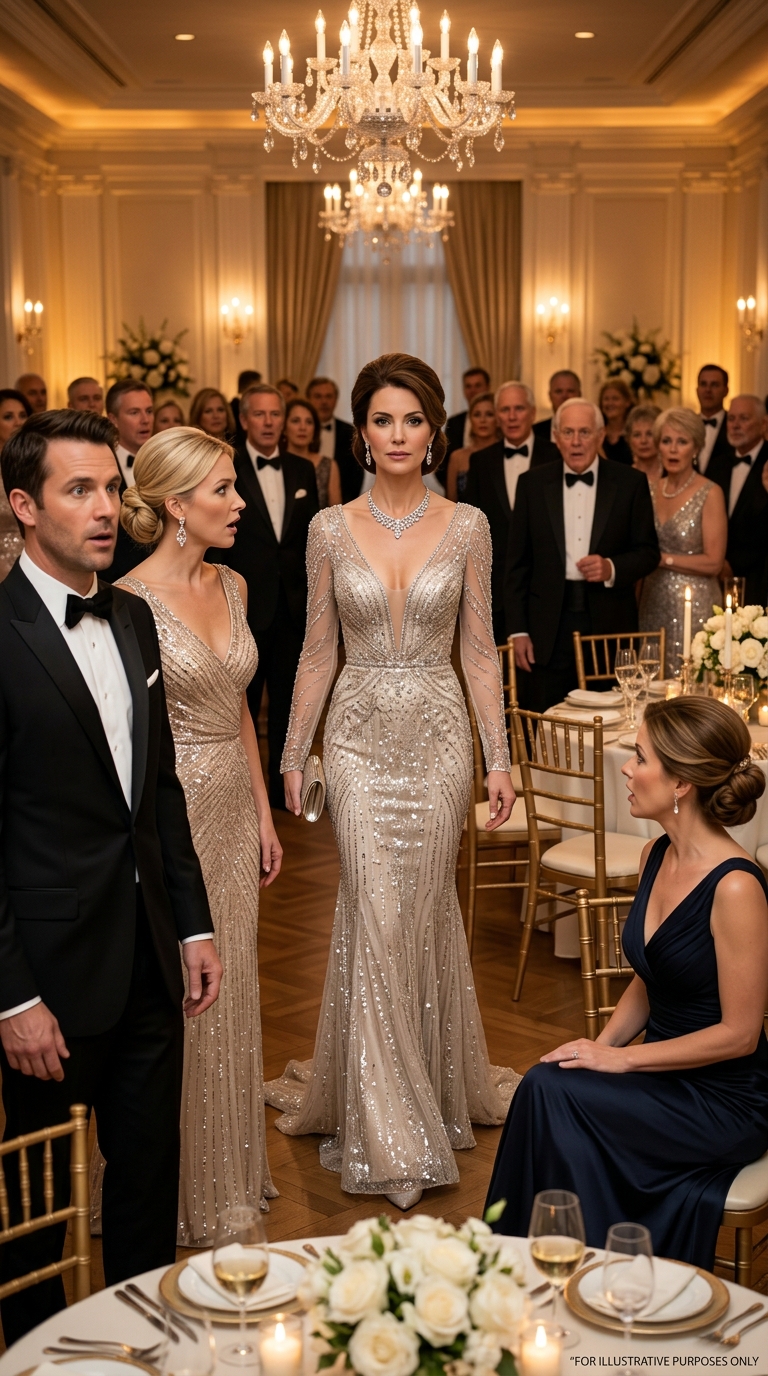
Her expression changed from hurt to recognition.
“I thought I was the woman you chose.”
She removed the sapphire necklace.
“You chose access.”
She placed it on the table.
Then she walked away.
Richard did not follow her.
Arthur Vance’s speech came twenty minutes later.
He thanked the museum trustees, conservation teams, donors, and staff. Then he announced Aura’s five-year digital-preservation commitment, accurately describing the gift without exaggerating my role or improvising a business partnership.
“Please join me in thanking Aura’s cofounders, Eleanor Hayes and Benjamin Carter.”
The hall rose.
Ben looked at me.
“Want to hide under the table?”
“Yes.”
“Too late.”
We stood together.
The applause moved through the room, warm and sustained. I looked at the museum staff near the doors and the archivists who had spent years protecting records with insufficient budgets.
The moment belonged to work larger than my marriage.
That was why I could survive it.
By midnight, the gala photographs had spread across financial media and society pages. The most popular image showed Richard and Isabelle near the entrance, turning as the cameras moved toward me.
The headlines were crueler than I wanted.
Billionaire Cybersecurity Founder Stuns Ex-Husband.
Sterling’s “Unstable” Ex Reemerges as Tech Powerhouse.
The Woman He Left Is Now Worth More Than His Empire.
I refused every interview focused on revenge.
Aura’s communications director released one statement.
Ms. Hayes attended the gala to support the museum’s digital-preservation program. She will not comment on her former marriage.
Richard’s problems began the following morning.
Arthur Vance postponed the merger committee meeting and ordered independent due diligence. Sterling Development’s lenders requested updated debt schedules. Minority investors demanded clarification of guarantees not included in the original presentation.
Within three weeks, the Vance transaction collapsed.
Not because Arthur suddenly preferred me.
Because Richard’s records failed review.
Sterling Development had used optimistic valuations from related brokers, shifted expenses between projects, and pledged overlapping assets to support separate lines of credit. Some practices were aggressive but lawful. Others violated loan covenants and investor agreements.
The board removed Richard as chief executive while it negotiated with lenders.
Several projects were sold.
Staff were laid off.
I felt no satisfaction about those employees. Their mortgages did not become less real because their boss had humiliated me.
Aura created a small emergency hiring program for qualified cybersecurity and data staff displaced during the restructuring, but we did not turn Richard’s collapse into a marketing campaign.
Real consequences were rarely as clean as public revenge stories.
People standing far from the lie still felt the impact.
My own legal consequences arrived more quietly.
Ben’s original compliance records and new lender disclosures suggested that Richard had hidden substantial business interests during our divorce. I hired Maya Chen, a litigation attorney experienced in financial fraud and post-judgment proceedings.
Maya reviewed the settlement.
“You signed under terrible emotional circumstances,” she said. “That alone may not reopen a final judgment.”
“I understand.”
“However, deliberate nondisclosure of material assets is different.”
Forensic accountants identified interests in three limited-liability companies Richard had omitted from his sworn financial statement. One owned valuable development rights. Another received management fees. The third held proceeds from a property sale completed shortly before the divorce.
The omitted assets had been worth more than eighteen million dollars at the time of settlement.
Maya filed a motion seeking to reopen the financial provisions based on fraud and material misrepresentation.
Richard called me the evening he was served.
I did not answer.
He left a voicemail.
“You are trying to take everything because you finally have the money to punish me.”
The old Eleanor would have listened repeatedly, searching for the part where his accusation became true.
I forwarded it to Maya and deleted it from my phone.
The court proceedings lasted eight months.
Richard’s attorneys argued that the assets had been disclosed indirectly through complex corporate schedules. Maya demonstrated that the schedules identified debts but excluded the corresponding ownership interests. Emails showed Richard directing his finance team to move certain entities outside the summary presented during matrimonial discovery.
The judge did not describe the original settlement as merely unfair.
She called the disclosure materially misleading.
The property portion of the judgment was reopened.
Richard ultimately settled before trial. I received the marital share that should have been calculated from the omitted assets, reimbursement of forensic costs, and a substantial portion of my legal fees.
I did not become wealthy because the court saved me.
Aura had already changed my finances.
The judgment mattered because the official record finally reflected what happened.
Richard had not generously supported a fragile ex-wife.
He had concealed property from a woman too exhausted to continue fighting.
Accuracy became its own form of relief.
Isabelle ended the engagement permanently. Her family released a brief statement citing irreconcilable differences and declining further comment.
Six months later, she sent me a handwritten note.
I believed everything he told me because the story made me feel chosen. I knew your marriage had not fully ended when our relationship began. I told myself he was trapped and that you were keeping him for appearances. I am sorry for participating in your humiliation.
I did not answer.
Her apology was honest enough to deserve silence rather than cruelty.
Arthur Vance later requested a formal Aura proposal through procurement. His team evaluated our platform against competitors, negotiated pricing, and completed security testing.
We won the contract.
Not because he pitied me.
Because the product survived examination.
That distinction mattered more than being admired at a gala.
Richard’s company entered restructuring. He sold the Central Park penthouse, resigned from several boards, and became an adviser to a smaller development firm after his noncompete period ended.
He was not imprisoned.
He was not left begging in the street.
He simply became a man whose confidence no longer arrived automatically with a title.
People asked harder questions.
Banks required more documentation.
Investors remembered that his financial statements had failed scrutiny.
Reputation, once damaged by records rather than gossip, recovered slowly.
He asked to meet a year after the gala.
Maya advised there was no legal reason to refuse, provided the discussion occurred in her office.
Richard arrived wearing a dark suit that fit slightly too loosely. Gray had spread through his hair near the temples. He looked older but not transformed.
“I suppose you’re happy,” he said.
“No.”
The answer unsettled him.
“You won.”
“I recovered assets you concealed.”
“Aura succeeded.”
“Yes.”
“Vance left me.”
“Isabelle left you.”
His jaw tightened.
“You always correct everything.”
“I stopped allowing you to define accuracy as hostility.”
He looked toward the conference-room window.
“Did you attend the gala knowing what it would do?”
“I knew the transaction announcement might attract attention. I did not know reporters would recognize me at the entrance.”
“You wore that dress.”
“Yes.”
“You wanted me to see you.”
I considered the question carefully.
“A small part of me did.”
His eyes returned to mine.
“I wanted the man who told me I was worthless to see that he had been wrong. I am not proud of needing that.”
Richard leaned forward.
“At least you admit it.”
“I also learned that your reaction lasted less than one evening. My life had to continue after you stopped looking.”
He became quiet.
“Was Ben always in love with you?”
“No.”
“I never believed that.”
“Because you cannot imagine loyalty without ownership.”
The sentence landed between us.
Richard rubbed one hand across his mouth.
“I destroyed our marriage.”
“Yes.”
“I was afraid of you.”
I had not expected the admission.
“Why?”
“You saw patterns before I finished arranging them. You would ask one question and suddenly everyone else’s assumptions looked weak.”
His expression twisted.
“I liked your intelligence when it made me feel interesting. I hated it when it made me accountable.”
There it was.
Not love.
Not absolution.
Truth.
“I told myself you were unstable because the alternative was admitting you understood me.”
I felt sadness for the years, but no desire to return.
“I am sorry,” he said.
“I believe you regret what happened.”
“That isn’t the same.”
“No.”
“Will you forgive me?”
“I am trying.”
Hope moved across his face.
I continued.
“Forgiveness will not restore access to me. It means one day your name may become only information.”
He leaned back.
“You sound like a machine.”
“No, Richard. I sound like a woman who no longer has to soften every boundary so you can survive hearing it.”
We never met again.
Aura grew after the Calder transaction, though growth created problems success stories often omitted. Employees feared losing the culture. Government clients demanded complex oversight. A competitor challenged one of our patents. Ben and I disagreed over hiring, pricing, and whether to open an office in Europe.
There were mornings when I entered our conference room and felt like the junior analyst Richard once dismissed.
The difference was that no one used uncertainty to erase my authority.
Ben argued fiercely and documented his reasoning. I did the same. When one of us was wrong, the work changed.
Respect did not eliminate conflict.
It made conflict survivable.
I began therapy before the gala and continued long after the headlines disappeared. Dr. Lena Ortiz never allowed wealth to masquerade as healing.
“You became financially safe,” she said. “Your nervous system does not receive acquisition announcements.”
I still froze when men interrupted me sharply.
I still checked bank accounts several times before large decisions.
I still feared that one mistake would cause everyone to realize Richard had been right.
Recovery did not care about valuation.
It arrived through smaller evidence.
Speaking at a meeting after losing my place.
Correcting an executive without apologizing.
Allowing a friend to see me tired.
Buying furniture because it was comfortable rather than impressive.
Inviting people into my apartment without cleaning every surface first.
I kept the silver gown in a cedar garment box.
For a year, I believed it represented the night I became visible.
Later, I understood visibility built on spectacle could become another dependency.
At the next museum gala, I wore a simple black dress.
No conductive fibers.
No dramatic entrance.
I arrived through the same doors and felt no need for the cameras to turn.
The museum invited me to speak about the archives program. The project had secured millions of photographs, oral histories, and public records vulnerable to loss.
I stood beneath the stone arches with Ben, librarians, conservators, and technology staff seated before me.
“Data is often discussed as property,” I said. “But much of what we protect is memory.”
I looked toward a projection of restored photographs from communities damaged by floods and fires.
“Who controls memory controls which lives remain visible. Security is not only about preventing theft. It is about preventing erasure.”
The words came from somewhere deeper than the speech.
Richard had tried to erase my contribution to his business.
His lawyers tried to erase assets from the divorce.
He taught me to erase my own judgment.
Aura existed because I understood what disappearance cost.
After the speech, a young analyst approached me.
She held her phone against her chest and spoke quickly.
“My boss tells people my models are unreliable, but he uses them in his presentations.”
I felt the past open nearby.
“Do you have documentation of your work?”
“Yes.”
“Preserve it lawfully. Keep contemporaneous notes. Speak to compliance or independent counsel before taking company data anywhere.”
She nodded.
“What if he says I’m difficult?”
“He may.”
“How do I know I’m not?”
“You verify your methods. You invite legitimate review. You correct errors when they exist.”
I paused.
“Being wrong sometimes does not make you unworthy. And someone disliking your questions does not make the questions invalid.”
Her eyes filled.
I gave her my assistant’s card for Aura’s mentorship program.
That program became the work I valued most.
We funded legal consultations for women and junior employees facing retaliation after identifying financial, safety, or data concerns. We supported people returning to technical careers after caregiving, illness, or coercive relationships. We required careful screening because not every workplace disagreement was abuse and not every accusation was true.
Facts remained important.
So did access to the means of establishing them.
Ben never became my romantic reward.
He was my friend, cofounder, and the person who brought curry when I could not feed myself. Our bond was too valuable to force into a shape neither of us needed.
Years later, I began seeing Daniel Mercer, a museum architect who spent more time asking about ventilation systems than acquisition prices. He was divorced, patient, and unimpressed by headlines.
On our third date, he asked what I enjoyed doing before Richard.
“No one asks that,” I said.
“I just did.”
I told him about rowing in college, drawing building facades badly, and reading technical papers in bed because puzzles calmed me.
He listened.
Not strategically.
Simply because the answer mattered.
When we eventually moved in together, we signed a cohabitation agreement. Separate property. Shared expenses. Written ownership of furniture over a certain value.
Daniel called the process deeply romantic.
“Nothing says trust like making sure neither person has to become financially trapped to remain loved.”
I laughed.
Then I cried later in the bathroom because safety sometimes hurt when it first arrived.
Five years after the divorce, I passed Richard on a Manhattan sidewalk.
He was leaving a restaurant with two business associates. I was walking toward the museum with Daniel.
Richard recognized me.
His gaze moved briefly toward Daniel, then back to me. The old calculation appeared and faded.
“Eleanor.”
“Richard.”
He looked older again. So did I.
Time had touched us more honestly than marriage had.
“I saw the archives report,” he said. “Impressive.”
“Thank you.”
He glanced at Daniel.
I did not introduce them.
Richard nodded once and continued down the street.
No apology.
No request.
No dramatic collapse.
Only distance.
I stood beneath the awning listening to rain strike the pavement.
Daniel touched my elbow.
“You all right?”
“Yes.”
And I was.
That realization felt larger than the gala.
Richard had once occupied every room inside me, even when absent. Now I could encounter him without needing to win, explain, or be witnessed.
The flashbulbs at the Metropolitan gala had felt like weapons because I still believed other people’s attention could determine my size.
They could not.
The acquisition could not.
Richard’s downfall could not.
A court’s corrected settlement could restore property, but not identity.
I rebuilt that through thousands of ordinary decisions made when no one was photographing me.
Opening Ben’s secured drive.
Calling a lawyer before writing code.
Allowing our product to undergo hostile testing.
Speaking despite panic.
Returning to therapy after success made quitting tempting.
Hiring people smarter than I was.
Admitting when I needed help.
Loving without surrendering financial independence.
One winter morning, I visited the old West Village apartment before selling it. The rooms were empty except for a box of college books and the worn rug where Ben and I built Aura’s first prototype.
Snow moved beyond the windows.
I sat on the floor where I had once cried over cold curry.
The woman I had been after the divorce believed Richard had taken everything valuable from her.
He had taken money.
Time.
Confidence.
He had distorted relationships and turned exhaustion into evidence against her.
But he had not taken her mind.
He convinced her not to trust it.
That was different.
Trust could be rebuilt.
I placed one hand against the old floorboards.
“Thank you,” I whispered.
Not to Richard.
To the woman who survived long enough for Ben to knock.
The gala became a legend other people told badly. In their version, a discarded wife arrived in a brilliant gown, revealed a fortune, and destroyed the arrogant husband who replaced her.
They loved the dress.
The cameras.
The shock on Richard’s face.
They rarely mentioned the months on the apartment floor, the attorneys checking every line of code, the panic attacks, the hostile product audits, the court filings, or the employees whose jobs became uncertain when Sterling Development collapsed.
Real transformation was less elegant.
It included invoices, therapy appointments, corrected passwords, compliance reports, sleepless nights, difficult boundaries, and the decision to try again after being wrong.
The gala was not the night I became powerful.
It was the night people noticed.
I had become powerful earlier, when I accepted that Richard’s description of me was not evidence.
I became powerful when I allowed Ben to show me the logs.
When I rebuilt the model.
When I placed my own name on the patent application.
When I entered a room without knowing whether anyone would approve.
By the time the cameras turned toward me, the most important change had already happened.
I no longer needed Richard to understand what he had lost.
I understood what I had recovered.
And this time, I had no intention of disappearing.