By the time I reached my parents’ house outside Lexington, Kentucky, Christmas dinner should have been nearly over, but I had expected to find enough warmth left in the evening for my eight-year-old daughter, Ruby, to race into my arms and tell me everything I had missed.
I worked as an emergency communications supervisor for the county, and holidays rarely belonged entirely to me. That year, a coworker had taken the final hours of my shift because I had covered Thanksgiving for her, so I stopped for cinnamon rolls, loaded the presents into my car, and drove to my parents’ house imagining Ruby’s delight when I arrived early.
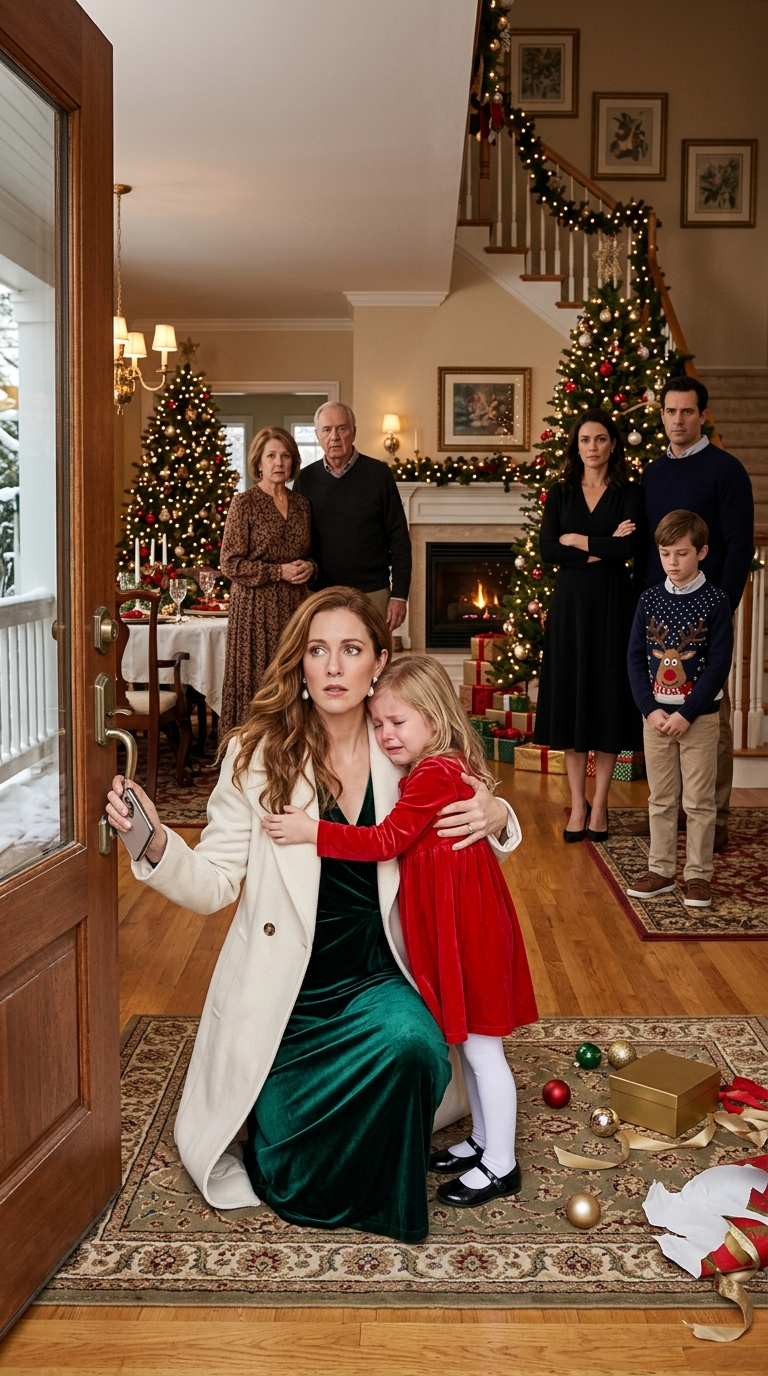
The front door stood partly open.
Inside, the living room looked as though a strong wind had passed through it. The Christmas tree leaned against the curtains, ornaments lay scattered across the floor, and cranberry punch had stained one corner of the pale carpet. Yet in the dining room, my parents, Elaine and Howard, were calmly eating pie with my sister Paige, her husband Colin, and their ten-year-old son, Mason. My brother Trevor sat beside his wife, Beth, and their daughter, Lily.
Ruby was nowhere in sight.
“Where is my daughter?”
Conversation stopped. Paige lowered her fork, my father studied his coffee, and my mother pointed toward the hallway.
“She’s in the corner, where she belongs.”
I followed the direction of her hand and found Ruby standing against the wall of the small den. One strap of her red velvet dress had torn loose, and faint scrapes marked her knees. Tears had dried on her cheeks, although more were gathering in her eyes.
Across her forehead, someone had written one word in black marker:
LIAR.
A cardboard sign hung from a ribbon around her neck.
THE FAMILY’S CHRISTMAS SHAME.
“Mom…”
She hurried toward me and wrapped both arms around my waist. When I lifted her, she felt cold, and the frightened way she clung to me told me more than any explanation could have.
I carried her into the dining room.
“Who did this?”
My mother remained perfectly composed.
“Ruby knocked over the tree, ruined half the decorations, and blamed Mason. She needed to learn that lying has consequences.”
“Mason pushed me,” Ruby whispered. “He told me to stand on the chair. He said he would hold it.”
Mason looked down at the table.
Paige immediately folded her arms. “My son doesn’t make up stories.”
I took out my phone and photographed Ruby’s forehead, the sign, her clothing, and every adult seated around that table.
My father finally looked up. “What are you doing?”
“Saving a record of tonight, because sooner or later, some of you will pretend it happened differently.”
I dampened a napkin and tried to remove the marker, but Ruby winced, and the skin beneath the ink was already irritated.
“Even if she had knocked over the tree, what kind of adults write on a child’s face and hang a humiliating sign around her neck?”
“It was discipline,” my mother replied. “You protect her from every consequence. Somebody had to teach her to be ashamed of what she did.”
Trevor leaned back in his chair. “She has to learn to take responsibility.”
Ruby tugged weakly at my sleeve.
“Mom, I’m really hungry.”
I looked at the half-empty serving dishes, then at my family.
“You didn’t give her dinner?”
No one answered.
In that silence, something inside me became very clear. I stopped arguing, helped Ruby into her coat, picked up her overnight bag, and headed toward the door.
Before leaving, I turned around.
“Ruby is not the shame of this family. One day, all of you may finally understand who is.”
The Story No One Wanted to Hear
At home, I made chicken soup, mashed potatoes, and warm cocoa. Ruby ate quickly, occasionally glancing at me as though someone might take the plate away. Afterward, I helped her bathe, gently cleaned her knees, and settled her beneath her favorite quilt.
The black letters remained faintly visible on her forehead.
I turned on my phone’s recorder and sat beside her.
“Tell me what happened from the beginning. Take all the time you need.”
Mason had pointed to an ornament near the top of the tree and told Ruby it was crooked. Because she was smaller, he said, she should climb onto a dining chair while he held it steady. When Ruby reached toward the branch, he gave the chair a shove. She lost her balance and tumbled into the tree, bringing it down with her.
Mason immediately claimed she had climbed up alone. When Ruby tried to explain, Paige accused her of making excuses, and my mother brought out the marker. My father and Trevor kept Ruby from leaving while the sign was placed around her neck. Then they made her stand alone while everyone else finished dinner.
“I thought you weren’t coming,” she said. “I thought they might leave me there all night.”
I held her until she fell asleep, but I remained awake for a long time, remembering my own childhood in that house.
Paige had been the admired daughter, praised for every achievement. Trevor had been the cherished son whose mistakes were always explained away. I was the dependable child, the one who could manage without much attention. I cooked, cleaned, helped with homework, and learned early that being useful was the easiest way to earn a place at the table.
That pattern followed me into adulthood. Whenever my family needed money, they called me. I helped with my parents’ household bills, Mason’s summer programs, Trevor’s car payments, private insurance plans, school expenses, and countless emergencies that never seemed to require anyone else’s sacrifice.
I had even paid for that Christmas celebration.
As gifts, I had booked two family trips to a mountain resort in Tennessee for Paige and Trevor. I had also reserved a weekend at a historic spa hotel for my parents.
The following morning, I took Ruby to a children’s clinic. A physician documented the marks on her knees and the irritation from the marker, while a child counselor listened to her account. What my relatives had dismissed as a family correction was now recorded by professionals.
When we returned home, I pulled out the travel confirmations, canceled every reservation, and placed copies of the cancellation notices inside the gift envelopes.
Then I ended the monthly transfer to my parents, withdrew payment for Mason’s summer camp, canceled the insurance policies I had been covering, and stopped the scheduled payment for Trevor’s car repair.
The calls began within hours.
Paige was first.
“What kind of person cancels a child’s Christmas trip?”
“The kind who just brought her own hungry child home from your Christmas dinner.”
Trevor demanded to know how he was supposed to get to work without his car.
“You’ll find a solution. Other adults do it every day.”
My mother called about the missing transfer.
“You owe us respect. We raised you.”
“You raised me to solve every problem you didn’t want to solve yourselves. That arrangement is over.”
Not one of them asked how Ruby was feeling.
Two days later, I gave the photographs, Ruby’s recorded statement, and the clinic report to child protective services. The caseworker reviewed everything carefully before speaking.
“This was not ordinary discipline. We need to begin a formal assessment.”
Calls arrived from unfamiliar numbers after caseworkers visited my relatives’ homes. Paige complained that Mason had been questioned. Trevor insisted his pregnant wife was under unnecessary stress. My father accused me of embarrassing the family in front of the neighbors.
I asked each of them the same question.
“Have you called even once to ask about Ruby?”
None of them could answer.
They did not yet know that I had one more piece of evidence.
What the Doorbell Remembered
Several months earlier, I had installed a smart doorbell at my parents’ house because my mother kept hearing noises near the porch. The family shared access to the account, but I was still its administrator.
The camera did not face the Christmas tree. However, when the interior door remained open, the microphone picked up voices from the adjoining room.
On the recording from Christmas evening, Ruby appeared in the entryway with tears on her cheeks. Mason followed her, unaware that the device was recording.
“I told you not to say anything,” he whispered.
“You pushed the chair.”
“Only a little. They’ll believe me anyway.”
“Why?”
Mason gave a small, confident laugh.
“Because they always do.”
A moment later, Paige entered and ordered Ruby back into the living room. What happened next was outside the camera’s view, but the voices were clear.
“Stop making things up.”
“Apologize to Mason.”
“Bring me the marker.”
“Don’t let her leave.”
“She needs to learn.”
Above those voices was Ruby, pleading with them not to write on her face.
I submitted the original file, including its date and time information. A digital specialist confirmed that it had not been altered.
When Paige learned about the recording, she called from another number.
“You were secretly recording us?”
“The doorbell was installed in plain sight, and everyone knew it had a camera and microphone.”
“Mason is only a child.”
“So is Ruby.”
“You’re going to ruin his future over one foolish prank.”
“I didn’t report Mason. I reported the adults who refused to ask a single question before publicly humiliating a little girl.”
Paige began to cry, but her concerns were about the canceled trip, the school hearing about the case, and the possibility that people might no longer see her family as perfect.
“Mom says you’ve been waiting years to get even with us.”
“No. For years, I was waiting for all of you to love me the way I kept loving you. I’m simply not waiting anymore.”
Temporary no-contact conditions were established while the case was reviewed. My parents, Paige, and Trevor were ordered to participate in parenting education and psychological assessments. Mason’s school arranged counseling to help him understand honesty, accountability, and empathy.
Some relatives called me disloyal. One aunt urged me to continue supporting my parents because they had become accustomed to the money.
“Ruby was accustomed to believing her grandparents would protect her,” I replied. “Their comfort is no longer my responsibility.”
Strangely enough, everyone found a way to manage. My parents reduced unnecessary expenses. Paige paid for Mason’s activities herself. Trevor obtained a modest loan for his car.
They had never been helpless. They had merely grown comfortable letting me carry them.
Meanwhile, Ruby began counseling. For a while, she asked to leave the hallway light on at night and kept snacks in her room. Her counselor explained that reassurance alone would not restore her sense of safety. She needed predictable routines, small choices, patience, and repeated proof that her voice mattered.
So we created another Christmas, one that belonged only to us.
We bought a small tree and let Ruby choose every ornament. Together, using a sturdy step stool, we placed the decorations on the upper branches. When she set the star on top, it leaned noticeably to one side.
I smiled.
“I think it’s perfect that way.”
Her shoulders slowly relaxed.
The Word She Chose
Near the end of January, I arrived early to pick Ruby up from an art class. While waiting near the school gym, I heard Mason talking with several classmates.
He was boasting about Christmas, saying he had moved Ruby’s chair and blamed her because he knew the adults would take his side. He even laughed about the sign they had made her wear.
I quietly recorded the conversation without filming the other children’s faces, then shared it with the school counselor and the professional overseeing the family case.
I felt no satisfaction. Mason was still a child, one who had learned that dishonesty offered power because the adults around him rewarded it. He needed guidance, not public disgrace. The school increased his counseling support and kept him separated from Ruby during shared activities.
Several months later, we attended a family protection hearing. My mother arrived dressed as though she were the injured party. My father avoided looking at me, while Paige watched me with open resentment.
The judge reviewed the clinic report, the photographs, Ruby’s recorded account, the doorbell file, Mason’s later admission, and the conflicting statements from the adults.
Her voice remained calm.
“Discipline cannot be built on humiliation, withheld meals, physical restraint, or fear. Family relationships do not give adults permission to treat a child this way.”
She continued the no-contact conditions until professionals determined that safe contact was possible. Counseling and ongoing supervision were also required.
My mother asked to speak.
“I only wanted Ruby to learn not to lie.”
The judge looked directly at her.
“Ruby was telling the truth.”
For once, my mother had no prepared answer.
In the hallway, Paige caught up with me.
“Are you satisfied now?”
Ruby stood nearby with her counselor, holding a folder filled with bright watercolor paintings.
“No. I would be satisfied if none of this had ever happened.”
“You destroyed this family.”
“The family began breaking when a room full of adults heard a frightened child asking for help and chose to continue eating.”
“Someday Ruby will blame you for separating her from everyone.”
“Someday Ruby will understand that her mother believed her from the very first minute.”
Almost a year passed before Ruby asked whether she would ever see her grandparents again.
“Maybe,” I told her. “But only when the professionals believe it is safe and when you feel ready.”
“What if I don’t want to?”
“Then you don’t have to.”
She considered that quietly.
“Does Grandma still think I lied?”
“She knows you told the truth.”
“Did she say she was sorry?”
I wished I could give her a different answer.
“Not yet.”
Ruby nodded.
“Then I’m not ready to see her.”
The following Christmas, I worked only in the morning and returned home long before dinner. Ruby and I baked cookies, played music too loudly, and decorated our little tree. She wore a green dress she had chosen herself, and the crooked star remained at the top.
At one point, the house became quiet. I found her standing before the hallway mirror, studying her forehead.
“What are you looking at?”
She touched the place where the black letters had once been.
“You can’t see anything now.”
I knelt beside her.
“There was never anything wrong with you there—or anywhere else.”
Ruby smiled, picked up a washable marker, and printed one word on a small card.
BRAVE.
She hung it around her neck and ran laughing through the living room, circling the tree while the silver ornaments caught the afternoon light.
My relatives had tried to teach my daughter shame. Instead, that Christmas taught me what protection truly means. It does not mean asking a child to tolerate cruelty simply because it comes from people who share her name. It means making certain she knows that real love will never demand her hunger, her silence, or her humiliation.
Sometimes closing a door does not destroy a home.
Sometimes it is how a safer one finally begins.