My husband slapped me in front of twenty relatives and ordered me out of our home because a DNA report said our daughter was not his.
Before I could reach the stairs to hold her, the doorbell rang—and an attorney stepped inside carrying proof that the report should never have been trusted.
What none of us knew was that the lie had been waiting inside our family for nine years.
The slap came so quickly that Natalie Evans did not see Mark’s hand move.
One second, she stood in the center of her own living room beneath the warm light of a brass floor lamp, still wearing the navy dress she had chosen for their daughter’s school play. The next, white light burst at the edge of her vision. Her head turned. Pain spread across her left cheek and into her ear with a hot, electric pulse.
The room fell completely silent.
Nearly twenty people watched her.
Mark’s parents stood beside the coffee table. His younger sister, Cathy, remained near the front window with both hands pressed against her coat. Two cousins occupied the sofa. An aunt from Cincinnati held a glass of wine she had apparently poured from Natalie’s kitchen. Even the next-door neighbors had been invited.
No one moved.
No one asked whether she was hurt.
A thick manila envelope rested on the coffee table beside a stack of divorce papers.
Mark’s mother, Elaine, stood over them like a prosecutor admiring evidence. She wore a cream wool suit and pearl earrings, her gray-blond hair arranged in the smooth helmet she preferred for important family events. Her expression contained anger, triumph, and something colder beneath both.
“Tell everyone,” Elaine said. “Tell us who Lily’s real father is.”
Natalie pressed her palm against her face.
Her cheek throbbed beneath her fingers.
“I don’t know what you’re talking about.”
Mark stepped away from the fireplace. His face had gone pale, but his eyes remained hard.
“She isn’t mine.”
The words came out broken.
For fourteen years, Natalie had known every version of his voice. The low, patient voice he used when helping Lily with homework. The easy voice he used with clients. The tired one that appeared after bad weeks at the insurance office. The private voice that whispered her name when they were young and still believed marriage could protect them from becoming strangers.
She had never heard this one.
It sounded like grief sharpened into punishment.
“Mark,” she said carefully, “whatever that report says, it’s wrong.”
Elaine lifted the envelope.
“You expect us to believe you over science?”
“What science?”
“Do not insult us further.”
Natalie looked toward the staircase.
Nine-year-old Lily had fallen asleep in the car on the way home from her elementary school’s fall play. Mark had carried her upstairs forty minutes earlier, still wearing the silver firefly wings from her costume. She had played the lead, a small light guiding lost forest animals through darkness. Natalie had cried during the final bow.
Two hours earlier, she believed the night belonged to her daughter.
Now relatives filled the house like witnesses assembled for an execution.
“Where did you get the report?” Natalie asked.
Mark threw the divorce papers onto the table.
“Get out.”
“Where did you get it?”
“My mother had it done.”
Natalie stared at Elaine.
“How?”
Elaine’s mouth curved.
“You became careless.”
The answer frightened Natalie more than an explanation might have.
She looked around the living room and saw the life she had built in ordinary objects: Lily’s colored pencils inside a ceramic cup, Mark’s reading glasses near the armchair, family photographs along the staircase, a small indentation in the rug where Lily sat each Saturday morning to watch cartoons.
Fourteen years of marriage remained visible everywhere.
Yet every person in the room looked at Natalie as though she had entered under a false name.
“Mark, listen to me,” she said. “Lily is your daughter.”
“Stop.”
“You were in the delivery room.”
“That proves nothing.”
“You cut the cord.”
His face twisted.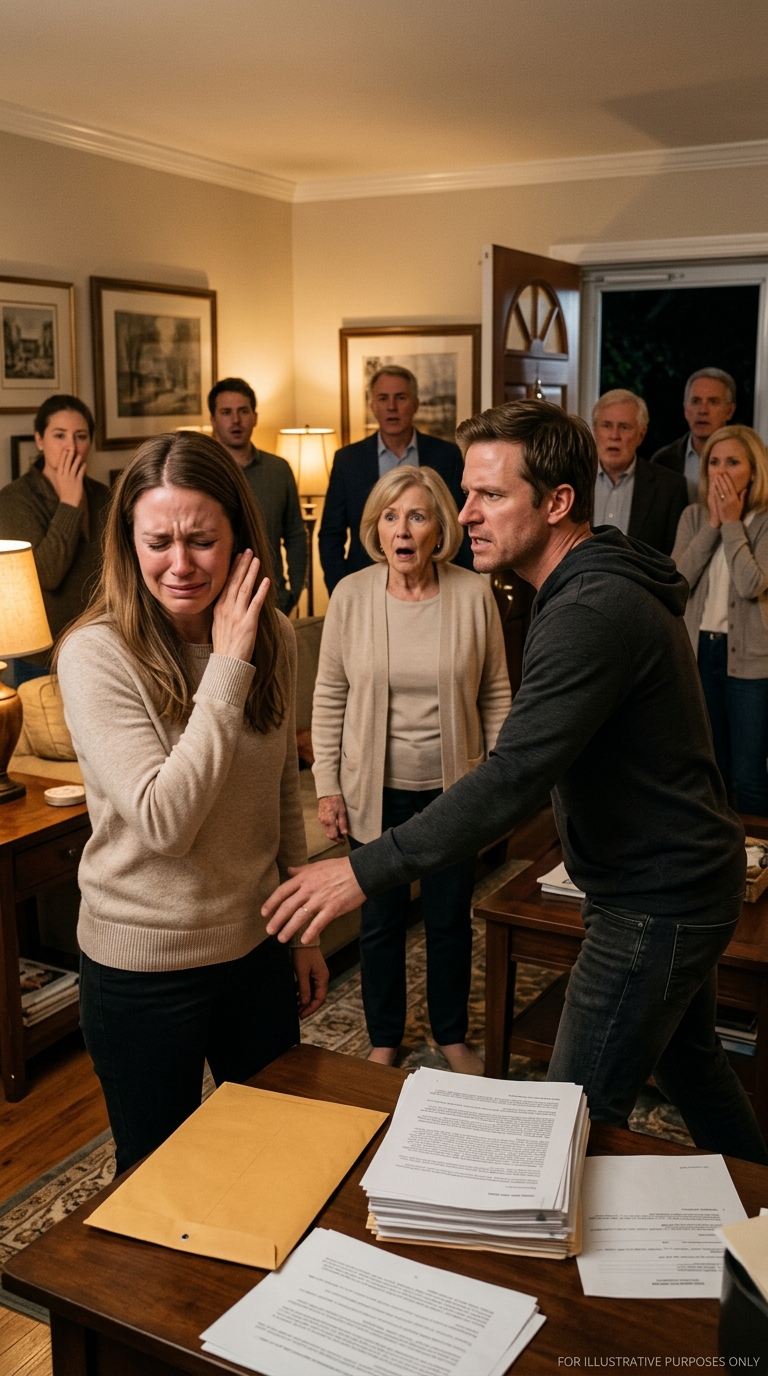
“Do you think saying that makes this easier?”
“I’m saying it because it happened.”
Elaine placed one hand on his arm.
“She will keep manipulating you as long as you allow her.”
Natalie looked at Mark’s mother.
The arrangement became clearer.
This was not a conversation.
It was a performance Elaine had prepared, complete with an audience, documents, and a son already coached to interpret every denial as further deceit.
Mark moved toward the entryway and lifted an overnight bag from behind the console table.
It was Natalie’s old canvas travel bag.
Someone had packed it for her.
“You planned this,” she whispered.
He placed the bag near her feet.
“I need you gone tonight.”
“Lily is upstairs.”
“You’re not taking her.”
“She is my child.”
Mark’s face hardened.
“That is exactly what we’re trying to determine.”
The doorbell rang.
The sound cut through the room with such clarity that everyone turned toward it.
For several seconds, no one moved.
Then Cathy opened the door.
A man stood beneath the porch light wearing a gray suit and holding a leather briefcase. He appeared to be in his early fifties, with silver at his temples and the calm posture of someone accustomed to delivering information people did not want.
“I’m looking for Natalie Evans.”
Mark laughed bitterly.
“Of course you are.”
The man glanced past Cathy into the crowded living room.
“I’m sorry?”
“Convenient timing,” Mark said. “Did she call you before she came home?”
The stranger’s expression shifted from professional politeness to confusion.
“My name is David Brooks. I’m an attorney representing Heartland Diagnostics and several families affected by an ongoing investigation. I’ve been trying to reach Mrs. Evans all afternoon.”
Natalie stepped forward.
“I’m Natalie.”
David noticed the red mark forming across her cheek.
His gaze moved to the divorce papers and the manila envelope.
“I appear to have arrived during a private matter.”
Elaine reached for the envelope.
“What investigation?”
David opened his briefcase and removed a letter.
“A former Heartland laboratory technician has been charged with falsifying reports and interfering with evidence in multiple paternity and custody cases. A court-appointed administrator is notifying families whose samples or identifying information may have been connected to his work.”
The room changed.
Accusation gave way to uncertainty.
David looked toward the envelope.
“Is that a paternity report?”
Elaine’s fingers tightened around it.
“It has nothing to do with Heartland.”
“May I see the laboratory name?”
“You have no authority in this house.”
“I agree. I’m asking, not demanding.”
Mark took the folder from his mother and handed it to David.
“Read it.”
David examined the first page.
He turned to the second.
Then back to the first.
“This is not a certified Heartland report.”
Elaine lifted her chin.
“It came from an independent investigator.”
“Was the sample collected by an accredited laboratory?”
“He handled everything.”
“Who collected the child’s sample?”
“The investigator.”
“Did either legal parent consent?”
Elaine did not answer.
“Was there a witnessed collection?” David continued. “Photo identification? Tamper-evident packaging? Documented chain of custody?”
“I was assured the test was reliable.”
David set the report on the table.
“I cannot determine whether the biological conclusion is accurate by looking at this document. I can tell you it would likely have little legal value without verified collection procedures.”
Natalie turned toward Mark.
“Do you hear him?”
Mark’s jaw remained rigid.
“I know what the paper says.”
“It may not be real.”
“My mother hired someone reputable.”
David glanced at the letterhead again.
“This report lists a laboratory in Indiana. The formatting is unusual, and there is no accession number I recognize. Before making irreversible decisions, I strongly recommend obtaining a court-approved test.”
Mark looked toward his relatives.
The doubt appearing across their faces seemed to make him more determined.
“Everyone leaves,” he said.
Cathy stared at him.
“Mark—”
“I said everyone leaves.”
The relatives collected coats quietly. Their earlier hunger for confrontation had disappeared. No one apologized to Natalie. One cousin touched her arm briefly before walking away, a gesture too small to qualify as courage.
Elaine remained.
“I’m staying with my son.”
David handed Natalie his card.
“Please call me tomorrow. Even if this report is unrelated to Heartland, something about its presentation concerns me.”
“Thank you.”
Upstairs, a floorboard creaked.
Lily stood halfway down the staircase wearing purple pajamas and holding her stuffed rabbit. Her dark hair had escaped its braid. The remains of silver stage makeup shimmered near one temple.
“Mommy?”
Natalie moved toward her.
Mark stepped between them.
The cruelty of that motion hurt more than the slap.
“Go back to bed, sweetheart,” he said gently.
Lily looked toward Natalie’s swollen face.
“What happened?”
“Nothing you caused,” Natalie said.
“Why is everyone here?”
“We’ll talk tomorrow.”
Elaine moved closer to the stairs.
“Come with Grandma.”
Lily did not move.
“Mommy, are you leaving?”
Natalie swallowed against the pain in her throat.
“Just for tonight.”
“I want to come.”
Mark’s voice sharpened.
“No.”
Lily began crying.
Natalie reached toward her, but Mark blocked the stairs again.
David stepped forward.
“Mr. Evans, I’m not a family-law attorney, and this is not legal advice. But preventing a mother from comforting her child because of an unverified private report may become relevant very quickly.”
Mark looked at him.
“This is my family.”
David’s eyes moved toward Natalie’s cheek.
“That is what concerns me.”
Natalie picked up the overnight bag.
She wanted to fight.
She wanted to run upstairs, take Lily, and leave before anyone could stop her. But she understood enough about custody disputes to know that a confrontation in front of witnesses could be reshaped later.
“I love you,” she told Lily.
“Mommy—”
“I love you more than anything.”
Then Natalie walked out of her house.
Cold October air struck her face. Fallen maple leaves moved across the driveway beneath a dry wind. She stood on the lawn listening to Lily cry through an upstairs window while the front door closed behind her.
Her sister Angela arrived twenty-five minutes later.
Angela asked no questions when she saw the swelling.
She wrapped Natalie in a blanket, placed the canvas bag in the trunk, and drove forty minutes to her home outside Dayton.
Natalie stared through the passenger window.
She had spent her career helping children relearn ordinary tasks after illness, injury, or developmental delays. As a pediatric occupational therapist, she taught small hands how to grip pencils, button shirts, tolerate textures, and perform movements other people never considered miraculous.
Her work required patience.
Observation.
Faith in evidence too subtle for impatient people.
Inside her own marriage, she had ignored every small sign.
Mark taking phone calls in the garage.
Elaine asking increasingly specific questions about Lily’s blood type and birth records.
The distance in Mark’s body when he climbed into bed.
His insistence that Natalie attend Lily’s play separately because he needed to help his mother with “a surprise.”
She had interpreted each clue generously.
Generosity felt foolish now.
Angela led her into the guest room and brought ice wrapped in a dish towel.
“Did Mark do that?”
Natalie nodded.
“Do you want me to call the police?”
“I don’t know.”
“That means yes.”
“He’s never hit me before.”
“That sentence is not a defense.”
Natalie pressed the ice against her cheek.
“Lily is there.”
Angela sat beside her.
“Then we do this correctly.”
The following morning, Natalie photographed the bruising and filed a police report. She described the slap precisely without exaggeration. The officer explained that Mark could face an assault charge, though the prosecutor would decide whether to proceed.
Then she called Rachel Monroe.
Rachel practiced family law in Columbus and had a reputation for being both relentless and deeply unimpressed by theatrics. Her office contained plain furniture, organized files, and a framed photograph of three rescue dogs.
She listened without interrupting.
When Natalie finished, Rachel folded her hands.
“A private investigator obtained a child’s DNA without parental consent, produced a report with no verified chain of custody, and presented it during a family ambush?”
“Yes.”
“Your husband then hit you and prevented you from reaching your daughter.”
“Yes.”
“He filed for divorce and emergency custody within two days?”
“The papers were already prepared.”
Rachel’s eyes sharpened.
“So the report did not create the plan. It was used to execute one.”
The distinction settled heavily inside Natalie.
“I want Lily home.”
“We will ask the court for immediate temporary parenting time and a neutral certified test. But we should assume Mark’s attorney will argue that emotional uncertainty justifies caution.”
“I raised her for nine years.”
“I know. Courts do not normally sever a primary maternal relationship based on an unofficial report. However, emergency judges work quickly with incomplete information. We correct the record.”
The first temporary hearing occurred three days later.
Mark’s attorney presented the private report and argued that Natalie might remove Lily from the state if confronted. Rachel presented the police report, photographs, David’s declaration questioning the document, and Natalie’s long history as Lily’s primary caregiver.
The judge ordered supervised visits temporarily—not because she accepted the report as true, but because the parents had made competing allegations, violence had occurred, and the court wanted stability while arranging proper testing.
Natalie understood the procedural logic.
It still felt like punishment.
She met Lily inside a family-services office beneath fluorescent lights. A caseworker sat in the corner taking notes while Lily ran into Natalie’s arms.
“Did you leave because of me?”
“No.”
“Daddy says there are questions.”
“Adults are checking something. It is not your job to fix it.”
“Grandma says families need truth.”
Natalie closed her eyes briefly.
“Grandma is right about truth. She is wrong to make you responsible for finding it.”
Lily touched the yellowing bruise on her cheek.
“Did Daddy do that?”
Natalie refused to lie.
“Yes.”
Lily’s face crumpled.
“Does that mean he’s bad?”
“No. It means he did something wrong and serious.”
The caseworker looked up.
Natalie continued carefully.
“People are more complicated than one word. But no one is allowed to hit someone because they are angry or afraid.”
Lily leaned against her.
“I want to go home with you.”
“I know.”
The hour ended too quickly.
Afterward, Natalie cried in her car until she could no longer see through the windshield.
Rachel’s investigation began with the man who produced the report.
Gary Pruitt operated from a second-floor office above an insurance agency near a strip mall. His private-investigator license had expired eleven months earlier. He claimed he had failed to renew it because of an administrative error.
Under oath, his account changed repeatedly.
First, he said he collected a swab from Lily during a school event.
Attendance logs and school cameras disproved that claim.
Then he said an associate collected it.
He could not identify the associate.
Finally, he admitted Elaine delivered an envelope containing a hairbrush and tissues she claimed belonged to Lily, along with a disposable razor taken from Mark’s bathroom.
No one verified who had used any item.
No laboratory employee witnessed collection.
No chain-of-custody record existed.
The laboratory named on the report denied conducting the analysis. Its director’s signature had been copied from an online certification document.
Bank records showed Elaine paid Pruitt eleven thousand dollars across four months.
That amount was not the cost of a test.
It was the price of cooperation.
Rachel placed the financial records before Natalie.
“This report was manufactured.”
Natalie felt no immediate relief.
“Why?”
“We still need that answer.”
The answer began inside old hospital records.
Nine years earlier, Lily was born at Riverside Memorial Hospital during a week when the hospital migrated newborn information to a new electronic system. A clerical transfer error temporarily attached another infant’s blood-type entry to Lily’s intake file.
The error was caught within forty-eight hours and corrected before affecting treatment or official records.
The temporary page should have disappeared into routine administrative history.
Elaine had saved it.
Hospital visitor logs showed she requested records during a period when Natalie was briefly rehospitalized for an infection. Elaine had been listed as an emergency contact and had access to a folder of discharge papers while assisting Mark.
A photograph recovered from Elaine’s old phone showed the incorrect page.
For nine years, she preserved it.
Not as evidence.
As possibility.
Rachel interviewed family members carefully. Cathy eventually admitted that Elaine had never accepted Natalie. She wanted Mark to marry a woman from a wealthier family, preferably the daughter of one of her husband’s business associates.
Natalie’s work with disabled children was, in Elaine’s language, “lovely but provincial.”
“She thought you limited him,” Cathy said during a recorded statement.
“How?”
“You wanted a normal life. She wanted him moving in more ambitious circles.”
“Mark sells insurance to local businesses.”
“I know.”
The absurdity made the prejudice more painful. Elaine did not reject Natalie because Mark possessed extraordinary status. She rejected her because Elaine needed the family to appear more important than it was.
Four months before the ambush, Mark complained to his mother that the marriage had become strained. He felt neglected because Natalie’s caseload increased while Lily rehearsed for the school play. He said they argued about money, chores, and Elaine’s constant presence.
Ordinary marital stress.
Elaine interpreted it as an opening.
She showed Mark the outdated hospital page and claimed it proved Natalie had lied about Lily’s blood type. Then she hired Pruitt to build a report around the suspicion.
Mark never asked Natalie.
He never requested a legitimate test.
He trusted the person who raised him to believe questioning her was betrayal.
One evening, Lily texted Natalie from an old phone Mark had forgotten to reset.
Mommy, I miss you.
Daddy cries when Grandma leaves.
Please don’t stop being my mom.
Natalie read the messages until the words blurred.
Rachel instructed her not to encourage secret communication that might place Lily between the adults. Natalie replied only once.
I will never stop being your mother. You do not have to choose sides. Tell Daddy you need to speak with me through the approved schedule.
The restraint felt unbearable.
But love could not require Lily to become a spy.
The court-ordered test took place on a gray Wednesday morning at an accredited clinic. A licensed technician checked identification. Samples were collected in full view of both attorneys, sealed in tamper-evident envelopes, and logged by number.
Mark sat across the waiting room from Natalie.
He looked exhausted.
For the first time since the living-room confrontation, he met her eyes without anger.
“I saw the hospital correction,” he said quietly.
Natalie did not answer.
“My mother had the original wrong page.”
“Yes.”
“I should have asked you.”
“Yes.”
His face tightened.
“I thought if I heard your voice, you would convince me.”
The confession struck harder than denial would have.
“You believed my ability to speak for myself was manipulation.”
“I was afraid.”
“You made fear more important than fourteen years.”
He lowered his gaze.
The results took eleven days.
Rachel called at seven forty-three on a Monday morning.
“Mark is Lily’s biological father. Probability exceeds 99.99 percent.”
Natalie sat down on Angela’s kitchen floor.
The room smelled of toast and coffee. Rain tapped against the window above the sink.
For several seconds, she could not breathe.
Then the tears came.
She cried for the truth, for the time lost, for every supervised visit, for Lily asking whether she was still her mother, and for the terrible knowledge that vindication could not restore innocence.
The next hearing lasted less than an hour.
Judge Patricia Alvarez read the certified result into the record. She dissolved the restrictions on Natalie’s parenting time and restored the shared schedule pending the divorce proceedings.
Then she addressed the forged report.
“This court has reviewed evidence suggesting a deliberate campaign involving fabricated documents, unlawful collection of personal materials, and manipulation of emergency custody procedures.”
Elaine sat behind Mark, rigid and pale.
Judge Alvarez continued.
“The matter will be referred to the county prosecutor and the licensing authorities. The court will also consider sanctions and attorney-fee allocation.”
Elaine attempted to speak.
Her lawyer placed one hand on her arm.
The judge looked toward Mark.
“Mr. Evans, you relied on an unverified private document to remove your wife from the home and restrict her contact with a child she had raised since birth. You also admitted striking her during the confrontation.”
Mark’s face collapsed.
“I understand.”
“I am not convinced you did at the time.”
“No, Your Honor.”
The judge ordered Mark to complete a domestic-violence intervention assessment, continue individual counseling, and communicate with Natalie only through a court-approved parenting application except during emergencies.
Outside the courtroom, Mark approached Natalie.
Rachel remained beside her.
“I destroyed everything,” he said.
Natalie studied him.
His remorse appeared genuine.
That did not make it sufficient.
“You believed your mother’s suspicion before asking me one question.”
“I know.”
“You let relatives stand in my house and judge me.”
“I know.”
“You stopped me from holding Lily.”
Tears entered his eyes.
“I know.”
“No, Mark. You remember. Understanding takes longer.”
He nodded.
“Can we talk?”
“Not today.”
“What do you need?”
“I need to pick up my daughter without a caseworker watching.”
Mark stepped aside.
Lily ran toward Natalie outside the courthouse.
Her backpack bounced against her shoulders. She threw both arms around her mother’s waist so hard that Natalie nearly lost her balance.
“You can take me?”
“Yes.”
“Home?”
Natalie looked toward Mark.
The old house no longer felt like home.
“To Aunt Angela’s for now.”
Lily accepted the answer and held her hand all the way to the car.
The criminal and civil consequences developed over the following months.
Gary Pruitt pleaded guilty to forgery-related offenses, unlawful investigative activity, and evidence tampering in several unrelated cases uncovered during the inquiry. His license was permanently revoked, and he received probation, restitution obligations, and a period of home confinement.
Elaine faced charges involving forgery, conspiracy, and interference with a custody matter. She eventually accepted a plea agreement requiring community service, restitution for part of Natalie’s legal expenses, counseling, and a permanent criminal record.
She avoided prison.
Natalie was relieved.
Not because Elaine deserved protection.
Because punishment severe enough to satisfy anger might also have become another burden Lily was expected to understand.
The family court prohibited Elaine from unsupervised contact with Lily until a therapist recommended otherwise.
At first, Elaine described herself as a grandmother who had tried to protect a child.
The court-ordered counselor challenged that story.
“You did not seek truth,” the counselor told her in a session later summarized for the court. “You created a conclusion and then paid someone to manufacture support for it.”
Elaine stopped attending after three weeks.
Consequences did not automatically produce insight.
Mark’s response was different.
He moved into a small apartment after the court granted Natalie temporary exclusive use of the house. Then, by mutual agreement, they sold it. Neither could walk through the living room without remembering the slap, the audience, and Lily crying from the stairs.
The divorce proceeded through mediation.
Natalie received compensation for the legal expenses caused by the fraudulent accusation and a fair division of marital property. Mark did not contest the settlement. He signed every correction Rachel prepared and issued written statements to relatives, neighbors, Lily’s school, and the church community.
“My wife did not deceive me about our daughter,” he wrote. “I accepted false information without verification, assaulted her, and allowed my mother’s manipulation to harm my family. Natalie bears no responsibility for what happened.”
The statement spread through the same networks that carried the original gossip.
Some people apologized.
Others became excessively warm, eager to attach themselves to the vindicated person.
Natalie accepted sincere apologies and ignored performances.
She had learned that social loyalty based on whichever story currently looked safest was not loyalty.
Her relationship with Mark remained more complicated.
During their first co-parenting therapy session, Dr. Maya Patel asked him why he trusted Elaine so completely.
Mark stared at the carpet.
“My whole life, she has been the loudest voice in every room.”
“That does not explain why you struck your wife.”
“No.”
“Then explain that part.”
Mark took a long breath.
“I was terrified the report was true. I felt humiliated before Natalie even entered the house. My mother had invited everyone. I knew if I questioned the report, she would say I was weak and being manipulated.”
“So you chose violence.”
“Yes.”
“Against whom?”
“The person with less social protection in the room.”
Natalie looked at him.
For the first time, he identified not only what he did, but how power had shaped the choice.
“I hated myself the moment it happened,” he continued. “Then I kept going because admitting I was wrong would mean facing what I had done.”
Dr. Patel nodded.
“That is important. Remorse after violence does not undo violence. But understanding the mechanism is necessary if you intend never to repeat it.”
Mark completed counseling. He learned to communicate without using his mother as an authority. He established boundaries Elaine had never believed possible.
When she called Lily’s school demanding information, Mark reported the violation himself.
When Elaine blamed Natalie for “breaking the family,” Mark ended the conversation.
“You broke trust,” he told her. “I chose to help you do it.”
Lily needed her own therapy.
She developed stomachaches before transitions between parents. She worried that hidden tests might suddenly change where she lived again. She asked whether adults could stop being related if paperwork said so.
Dr. Patel used drawings, stories, and simple explanations.
“Paper can contain mistakes,” she told Lily. “Good systems check them. Love is shown through care and truth, not one sheet inside an envelope.”
One evening, Lily sat between Natalie and Mark during a family session.
“Are you getting married again?” she asked.
Natalie felt Mark become still.
“No,” she answered.
Lily looked down.
“Does that mean we’re not a family?”
Mark spoke carefully.
“We are still your family. Your mother and I will live separately.”
“Because Grandma lied?”
“The lie hurt us,” Natalie said. “But your father and I also have things between us that cannot be repaired by proving the test was false.”
Mark lowered his eyes.
Lily looked toward him.
“Because you hit Mommy?”
“Yes,” he said.
The honesty hurt him visibly.
“It was wrong. Nothing Mommy said or did caused it.”
“Are you dangerous?”
Mark’s face tightened.
“I did something dangerous. I am getting help so I never make that choice again. You are allowed to tell an adult immediately if anyone frightens you, including me.”
Lily reached for Natalie’s hand.
Then Mark’s.
She held both without bringing them together.
That became the shape of their family.
Connected.
Separate.
Honest.
A year after the ambush, Natalie moved into a small house near Lily’s school. The living room had large windows and pale-green walls. No one else selected the furniture. No mother-in-law entered without permission.
Mark lived ten minutes away. Their custody schedule became stable. He attended school conferences, therapy appointments, and occupational-therapy fundraisers without pretending consistency earned reconciliation.
On Tuesdays, he went to counseling.
On Fridays, he picked Lily up after school.
He arrived on time.
When he failed, he admitted it without blaming traffic, work, or Natalie.
Reliability became ordinary.
That was its value.
Natalie also began examining what the case had exposed about systems larger than her marriage. The forged report nearly succeeded because the document looked scientific, the accusation moved faster than verification, and legal procedures initially responded to uncertainty rather than history.
With Rachel, David Brooks, and two accredited laboratories, Natalie established the Family Evidence Access Project.
The organization helped low-income parents obtain certified testing, challenge suspicious private reports, preserve chain-of-custody records, and secure counseling for children caught inside paternity or custody disputes.
They did not promise favorable outcomes.
They promised valid evidence.
At the first public workshop, Natalie held up two documents.
One was Elaine’s forged report.
The other was the certified result.
“To an untrained eye, they both look official,” she told the room. “Letterhead can be copied. Signatures can be imitated. A conclusion is only as reliable as the process that produced it.”
A father near the back raised his hand.
“My ex says I have to accept a test she ordered online.”
“No,” Rachel answered. “You may agree to a properly witnessed test or ask the court for one. You do not have to accept an anonymous sample with no documented custody.”
Afterward, a woman approached Natalie.
“My husband’s family says my son doesn’t look like them.”
Natalie recognized the shame immediately.
“What evidence do they have?”
“Pictures.”
“Pictures are not evidence.”
The woman began crying.
Natalie sat with her until the room emptied.
The work did not make the past worthwhile.
Pain did not need to earn legitimacy by becoming useful.
But usefulness gave Natalie a place to put what remained after the courts finished.
Elaine sent a letter eighteen months after the case.
It contained no accusation and no request for contact.
I treated your marriage and Lily’s life as things I had authority to rearrange. I told myself I was protecting Mark because admitting I wanted control would have required me to see myself honestly. I cannot ask you to forgive what I did. I only want you to know I no longer call it love.
Natalie read the letter twice.
Then she placed it in a file.
She did not reply immediately.
Several weeks later, she sent one sentence.
Acknowledging the truth is necessary. It does not restore access.
Elaine eventually began supervised visits with Lily at a therapist’s office. The process remained cautious. Lily was allowed to refuse. Mark attended the first meeting but did not manage it.
Elaine cried when she saw her granddaughter.
Lily did not comfort her.
That boundary was another form of healing.
Two years after the forged report, Lily performed in another school play. She was no longer a firefly. This time, she played a young scientist trying to convince a town that the stars could be studied without superstition.
Natalie sat in the third row.
Mark sat several seats away with his sister Cathy.
Angela occupied the chair beside Natalie.
When Lily took her final bow, both parents stood.
Their eyes met across the aisle.
Mark smiled sadly.
Natalie nodded.
There was no return to the old marriage.
There was something more responsible in its place.
After the performance, Lily ran toward them carrying a cardboard telescope.
“You both came.”
“Of course,” Natalie said.
Lily hugged Mark, then Natalie.
She did not ask them to stand together for the photograph. She stood between them, one arm around each.
Children adjusted to truth more effectively than adults often expected.
They struggled most when adults asked them to maintain lies.
On the anniversary of the night she was forced from her home, Natalie visited Rachel’s office to sign final paperwork transferring the remaining settlement funds into the nonprofit.
Rachel placed the pen on the desk.
“You once told me you wanted justice.”
“I did.”
“Do you feel you got it?”
Natalie looked through the window at the cold Ohio rain.
“The result was corrected. Lily came home. Elaine and Pruitt faced consequences. Mark admitted what he did.”
“That sounds like justice.”
“It is.”
“But?”
Natalie folded her hands.
“I used to think justice would feel like watching the people who hurt me become ashamed.”
“What does it feel like?”
“Like accurate records.”
Rachel smiled.
“That may be the most accountant-like answer ever given by someone who isn’t an accountant.”
Natalie laughed.
Then her expression softened.
“Truth did not return the nights Lily cried without me. It did not remove the slap. It did not restore the version of Mark I believed I married.”
“No.”
“But it stopped the lie from owning the future.”
Rachel nodded.
“That is often the most law can do.”
Natalie returned home before Lily arrived from school. The house smelled of cinnamon and laundry detergent. Autumn light entered through the front windows.
She stood in the quiet living room and remembered the twenty faces turned toward her in judgment.
For months, she believed the greatest betrayal was Elaine manufacturing the report.
Later, she understood that Mark’s decision wounded more deeply.
He had fourteen years of lived evidence.
Fourteen years of mornings, illnesses, bills, arguments, affection, pregnancy, childbirth, and the daily reality of raising Lily.
He abandoned all of it for a page his mother placed on a table.
He did not betray Natalie by becoming confused.
He betrayed her by deciding she did not deserve a question before punishment.
That was why reconciliation never became possible.
Remorse changed him.
It did not rewrite him.
Forgiveness allowed Natalie to stop building every decision around anger. It did not require returning to a room where trust had become dangerous.
At four o’clock, the front door opened.
Lily entered carrying her backpack and talking rapidly about a science assignment. Mark stood on the porch behind her.
“She left her lunchbox in my car,” he said.
“I did not,” Lily protested.
He held it up.
“You absolutely did.”
She laughed and ran upstairs.
Mark remained outside.
“Can I ask you something?”
Natalie waited.
“Do you ever regret not trying again?”
The question no longer frightened her.
“No.”
He accepted the answer slowly.
“I regret what I did every day.”
“I know.”
“I thought changing might earn another chance.”
“Changing gave Lily a safer father.”
His eyes filled.
“That has to be enough.”
“It is not small.”
He nodded.
“Thank you for saying that.”
Natalie closed the door gently after he left.
Not slammed.
Not locked in fear.
Simply closed because the conversation had ended.
She walked upstairs and found Lily spreading papers across her bedroom floor.
“What are you building?”
“A family-history project.”
Natalie paused.
Lily looked up.
“Don’t worry. I’m not using DNA.”
The joke surprised laughter from both of them.
Lily placed photographs across a poster board. Natalie and Mark at her birth. Angela at Christmas. Cathy teaching her to ride a bicycle. Dr. Patel at the nonprofit picnic. Even one carefully selected photograph of Elaine from years earlier.
“You included Grandma.”
“She did something terrible,” Lily said. “But she is still part of what happened.”
Natalie sat beside her.
“That is a mature way to see it.”
“I don’t forgive her all the way.”
“You don’t have to forgive on anyone else’s schedule.”
Lily arranged another photograph.
“Families are messy.”
“Yes.”
“But they’re still real.”
Natalie touched her daughter’s hair.
“Yes.”
The forged report had tried to reduce their family to a number.
The certified test corrected the number.
But biology had never been the full truth.
The deeper truth lived in who stayed beside a frightened child without asking her to choose, who accepted consequences without demanding restoration, who protected evidence instead of controlling conclusions, and who understood that love without honesty could become another kind of harm.
That night, after Lily went to sleep, Natalie sat by the window with a cup of tea.
Rain moved across the glass.
She thought about the woman standing in the living room with her cheek burning, surrounded by people who had already decided what she was.
That woman believed proving innocence would restore everything.
It did not.
It restored her name.
The rest she rebuilt herself.
A new house.
A different family structure.
Work that protected people without pretending courts could heal every wound.
A daughter who understood that truth could be painful without becoming cruel.
A former husband learning that remorse was a responsibility, not a key.
The greatest victory was not Elaine’s conviction, Mark’s shame, or the certified percentage printed on laboratory paper.
It was the fact that Natalie no longer needed anyone in that living room to believe her before she believed herself.
The lie had arrived dressed as science.
The truth arrived slowly—through records, witnesses, sealed samples, difficult questions, and people willing to verify what others found convenient to assume.
It took longer.
It cost more.
It hurt almost everyone.
But unlike the lie, it endured.
And once the record was corrected, no one could ever use that envelope to make Natalie disappear again.