“She couldn’t possibly sing Ave Maria,” Mara muttered.
Unfortunately for her, the microphone carried the remark across the entire ballroom.
Every conversation stopped.
I watched surprise flash across her face when she realized all two hundred guests had heard her. A second later, that surprise tightened into alarm.
For weeks, Mara had dismissed me as dull, unremarkable, and completely without talent.
Now the entire room was waiting to see whether I would crumble beneath the chandeliers.
I drew one slow breath, met her stare, and asked, “Are you absolutely certain you want me to start?”
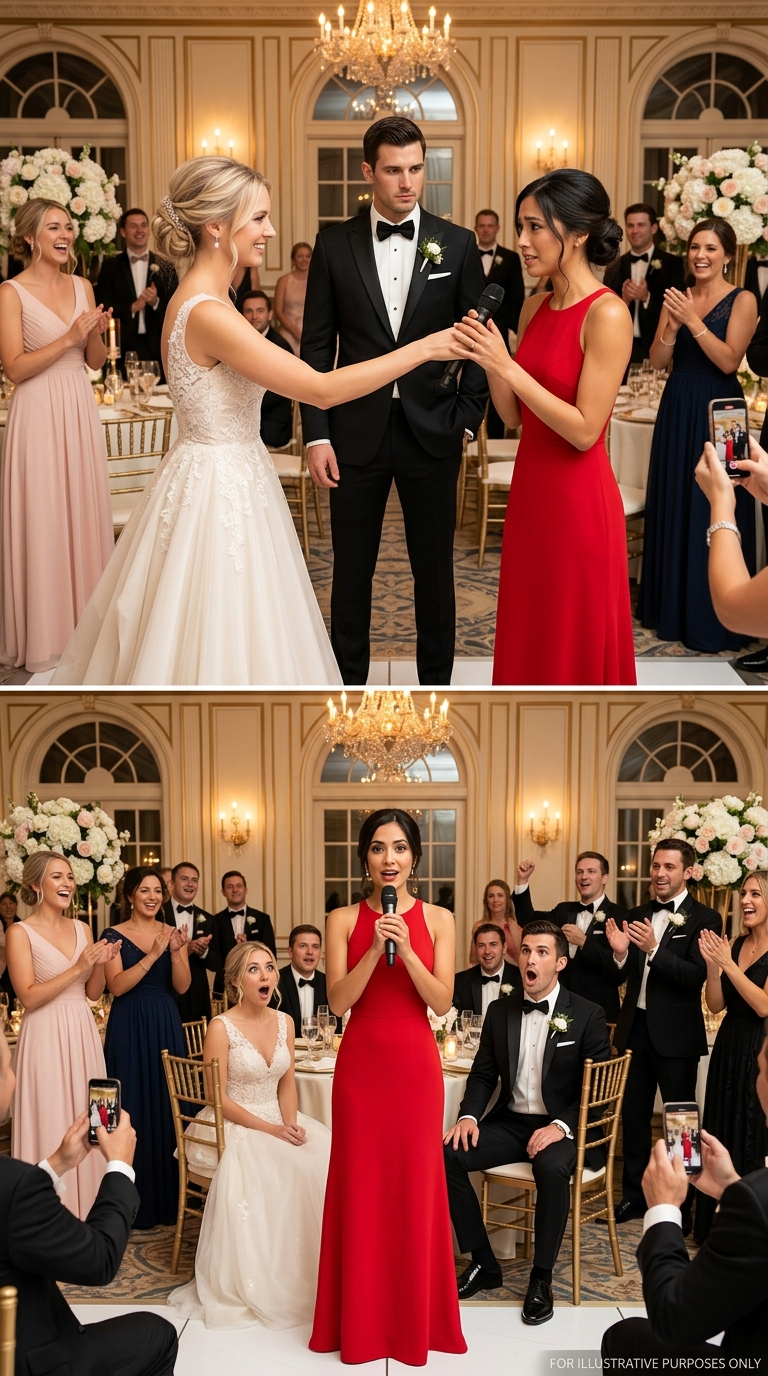
The instant Mara pushed the microphone into my hands, the ballroom fell quiet—but not out of anticipation.
Everyone understood what she was doing.
She wanted to humiliate me.
Under the glittering crystal lights, her bridal smile appeared flawless, bright, and merciless. The wedding musicians stopped in the middle of their song. Around us, two hundred guests turned in their gilded chairs. Forks hovered above plates of sea bass while bubbles drifted through untouched champagne like silent warnings.
“Go ahead, Lena,” Mara coaxed sweetly. “You told everyone you sang in school once, didn’t you?”
My gaze dropped to the microphone.
I had never told her that.
My aunt had mentioned it years earlier during a family dinner. Mara had remembered because she never forgot anything that might eventually be used to embarrass someone.
Mara Vale was the bride and a recent graduate of Bellmont Conservatory.
She carried that degree as though it were a royal title.
Throughout the reception, she had repeatedly informed guests that she was “professionally trained,” that her singing possessed “European richness,” and that serious music should never be attempted by amateurs.
I was merely her new husband’s cousin.
The reserved one.
The relative who worked “somewhere in production,” as Mara always described it, making my career sound as if I spent my days taping electrical cords to the floor.
Her bridesmaids covered their smiles beside the wedding cake.
“Don’t be nervous,” Mara called, raising her voice. “Consider it your wedding present to me.”
My cousin Daniel shifted awkwardly at her side but said nothing.
His silence wounded me more than Mara’s cruelty.
When we were children, I had sung to Daniel whenever thunderstorms frightened him. Now he stood beside the woman who had carefully arranged my public humiliation and refused to intervene.
“Mara,” I said quietly, “tonight is supposed to be about you.”
“Oh, but I’m insisting.”
Naturally, she was.
Three weeks earlier, Mara had overheard Daniel telling his mother that I possessed a beautiful singing voice.
From that moment on, she had turned it into a running joke.
“Beautiful according to relatives?” she had asked with a laugh. “Or beautiful in the karaoke sense?”
This was clearly meant to be the final performance of that joke.
There had been no rehearsal.
No advance notice.
No music prepared for me.
Only a microphone, a crowded ballroom, and a bride eager to watch me break in front of everyone she knew.
“What would you like me to sing?” I asked.
Triumph gleamed in Mara’s eyes.
“Ave Maria.”
A nervous ripple passed through the guests.
Even those who knew nothing about classical music recognized the cruelty of her choice. It was exposed, technically demanding, and merciless toward every weakness in a singer’s voice.
I glanced toward the pianist.
He immediately lowered his eyes.
Then I noticed a compact black camera positioned near the flower-covered arch.
A red recording light blinked steadily.
Mara had hired someone to film the reception.
She didn’t want my humiliation to last for one evening.
She wanted it preserved forever.
I smiled.
Not because I had suddenly discovered courage.
I smiled because, two months earlier, the Royal Meridian Opera had appointed me its newest principal soprano.
They knew me by my professional name.
Elena Maris.
And Mara had just placed a microphone in my hand.