“Think about the baby,” he said.
That hurt worse than the slap.
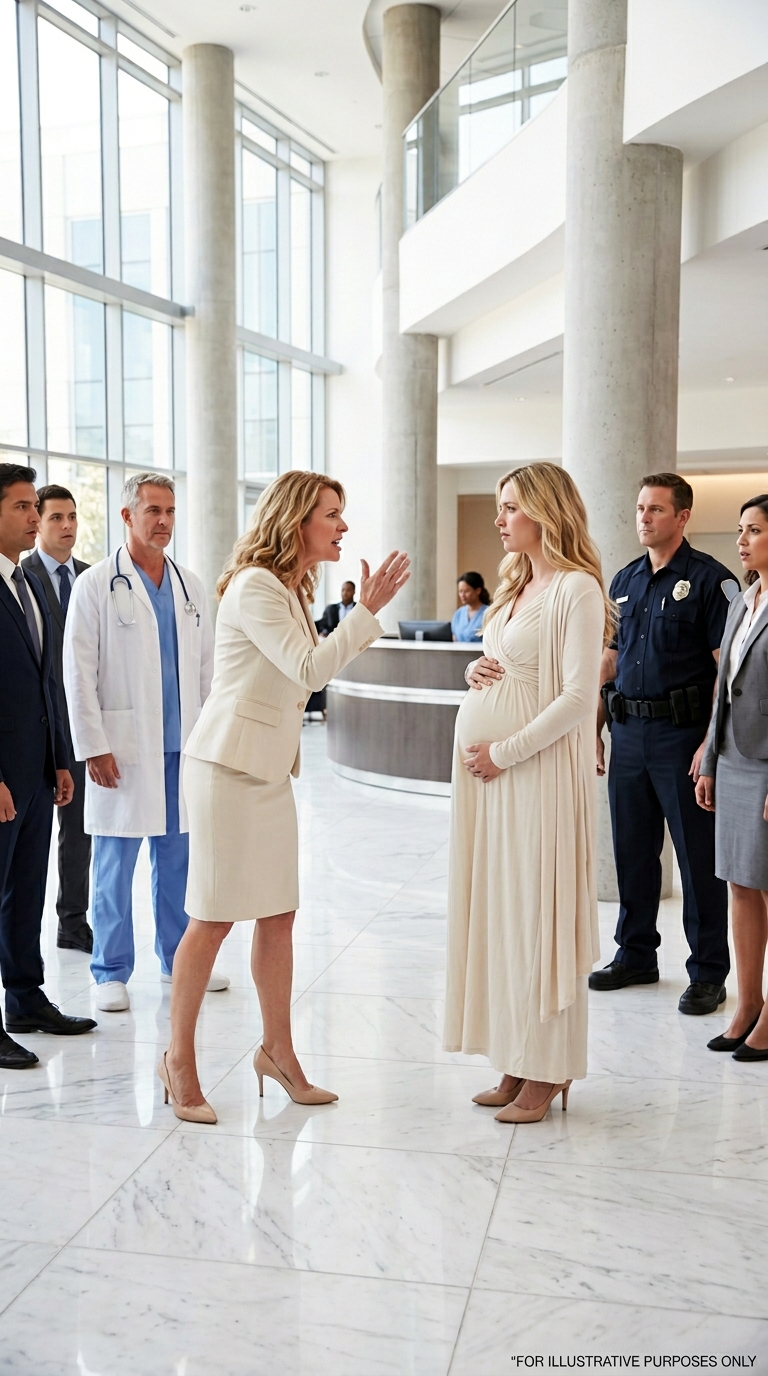
Madison stepped close enough that only he and Brianna could hear.
“It is exactly because I’m thinking about my child,” she said, “that I stopped protecting you.”
Then she walked into the elevator with Dr. Avery beside her, leaving Ryan staring at doors that closed like a verdict.
By morning, Ryan had turned the hospital into a whispering machine.
Before seven, the communications office had received instructions to describe the incident as “a private family disagreement with no impact on patient care.” By eight, two nurses in the cafe were already repeating that Madison Prescott had caused a scene because her marriage was falling apart.
Madison read the forwarded memo from her observation room with a blanket over her shoulders and the blue folder open on her lap.
Her cheek was less red now, but the bruise showed when the light hit it.
Theo entered with her latest numbers. “Blood pressure is better.”
“The hospital’s?”
“No.”
She locked her phone before he could read the whole message, but he saw enough.
Emergency board meeting requested by Ryan Prescott.
Theo’s expression hardened. “He’s using your pregnancy against you.”
Madison folded the printout calmly. “He’s using our child as evidence of my incapacity.”
The word our landed between them.
For a moment, Theo saw not the board chair, not the investigator, but a woman whose husband had weaponized the most vulnerable part of her life.
“You shouldn’t go,” he said.
“I know.”
“But you will.”
“If I don’t appear, they’ll say my absence proves instability. If I appear exhausted, they’ll say my condition proves risk. So I have to appear whole.”
Theo hated that she was right.
Upstairs, Ryan was building his case.
He stood in his glass office overlooking Midtown Manhattan, speaking to two board members on video.
“Madison is emotionally compromised,” he said, voice heavy with manufactured concern. “The pregnancy, the public scene, the marital stress. We need to protect the institution from impulsive leadership.”
Brianna sat behind him, sunglasses on indoors.
When the call ended, she said, “You talk about her like you still care.”
“I talk about her like a risk.”
“And me?”
Ryan turned. “You are part of the risk.”
Her face tightened. “Yesterday I was the woman you were finally going to choose.”
“Yesterday you hadn’t slapped the board chair inside the maternity lobby.”
The words hit her.
“Board chair?” she whispered.
Ryan laughed once, without humor. “That’s the problem with Madison. She doesn’t need to announce power. She waits until people reveal what they do when they think she has none.”
Brianna stood. “You let me walk into that.”
“I told you to stay away from her.”
“You told me she was weak.”
Ryan said nothing, because it was true.
That afternoon, Brianna made things worse.
She brought a society columnist to the hospital cafe, hoping to frame Madison as a jealous wife abusing her position. Madison was there at Theo’s insistence, drinking coconut water and eating half a muffin because he had accused her of treating food like an optional policy.
Brianna entered with the columnist beside her.
“What a coincidence,” Brianna said. “Still here?”
Theo stood. “This is a patient area. If you’re not receiving care, leave.”
Brianna smiled. “Do you treat all visitors that way, Doctor, or only when the patient is powerful?”
Madison saw the trap. If she snapped, Brianna would call her arrogant. If she stayed silent, Brianna would narrate the scene herself.
The columnist glanced at Madison’s belly, then at her bruised cheek. “Mrs. Prescott, is it true you plan to use your position to punish another woman over a personal matter?”
Madison set down her cup. “Who told you it was personal?”
Brianna cut in. “Everyone knows you were replaced.”
“And still,” Madison said, “you were the one who had to raise your hand.”
The cafe went silent.
Brianna’s mask slipped for one second. The columnist saw it.
Theo stepped between them. “Enough.”
Brianna looked him up and down. “Careful, Doctor. Women like Madison collect defenders until they don’t need them anymore.”
Madison stood. “I have never needed defenders to speak for me. I needed professionals who wouldn’t lie for Ryan.”
Brianna leaned close. “You can chair any board you want, but at the end of the night, he came home to me.”
Madison felt the words pierce her, but she did not lower her eyes.
“And this morning,” she said, “he woke up trying to erase what you did. Think about that before you call it love.”
Theo escorted Madison out before the scene became a spectacle. In the hallway, she steadied herself against the wall.
“Don’t say you warned me,” she whispered.
“I was going to say you don’t have to win every sentence.”
Her laugh was small and sad. “I do when people have spent years writing my story without asking me.”
In the exam room, another test showed the baby was fine, but Madison was exhausted.
Theo turned off the monitor. “That’s enough. I can recommend admission for observation.”
“And I can refuse if there’s no immediate risk.”
“You use every rule like a shield.”
“And you use every rule like a wall.”
The words opened something.
Theo stepped back. “My sister died behind a wall like that. Beautiful hospital. Polite administrators. Perfect reports. When we asked for answers, they gave us technical language and condolences on letterhead. So yes, I distrust board chairs who walk into hospitals with secret audits and say it’s for the patients.”
Madison’s face softened.
“My mother was ignored in a waiting room because she didn’t look important,” she said. “My father bought into this hospital afterward, as if owning walls could apologize for what they failed to protect. I inherited the name, the building, and the guilt.”
For the first time, they were not on opposite sides.
They were standing at the same wound from different doors.
At five o’clock, the boardroom filled with polished fear.
The long table reflected the city lights. Bottled water stood in perfect lines. Several board members avoided looking at Madison’s cheek. Others looked too long.
Brianna sat behind Ryan, dressed in careful gray, ready to look persecuted.
Theo stayed near the door, uncomfortable in a room where white coats seemed less powerful than surnames.
The interim board president opened with a smooth voice. “We are here to preserve the institution.”
Madison opened her blue folder. “Good. For the first time today, we agree.”
Ryan spoke first.
He described emotional exposure, marital conflict, media risk, pregnancy-related vulnerability, and the need to consider a temporary limitation on Madison’s decision-making authority.
Every phrase wore concern like perfume.
Madison listened without interrupting.
Brianna watched for tears.
None came.
When Ryan finished, the room was prepared to doubt Madison politely.
She rested one hand on her belly and the other on the first document.
“Before you decide whether pregnancy makes me unfit to lead,” she said, “I ask you to decide whether assaulting a pregnant patient inside this hospital makes someone unfit to be protected by its executive director.”
Ryan shifted.
Brianna’s smile died.
Madison continued. “I did not come here to discuss my marriage. Ryan can destroy our private life without needing board minutes. I came to discuss women being silenced, records being altered, and a hospital that confused reputation with care.”
Ryan leaned forward. “This is emotional manipulation.”
“No,” Madison said. “Emotional manipulation is trying to remove me by using my child as evidence against me.”
The room went still.
Then she connected her tablet to the screen.
The security footage appeared.
The lobby. Madison sitting alone. Brianna entering with Ryan. Ryan stopping Lucy from calling help. Brianna stepping close. The slap.
When the audio played, Brianna’s voice filled the boardroom.
“Women like you only understand when someone puts you in your place.”
No one spoke.
Brianna whispered, “That was edited.”
“The access chain is attached,” Madison said. “Preserved after a security incident involving a pregnant patient.”
An older board member cleared his throat. “The assault is clear. But the administrative connection?”
Madison turned the page.
“The connection begins when the executive director orders staff not to call for help, then asks that the incident be reclassified as a private disagreement.”
The next screen showed timestamps, Lucy’s original report, Theo’s clinical note, and the administrative request to replace the word assault with interpersonal conflict.
Ryan gripped the table. “I acted to avoid unnecessary exposure.”
Madison looked at him. “Exposure for the hospital, or for you?”
Brianna stood. “This is revenge. She hates that he left her.”
Madison did not raise her voice.
“Brianna, if I wanted personal revenge, I would have started with the hotel room, the messages, and the corporate benefits Ryan used to pay for your apartment. I started with the maternity department because yesterday was not the first abuse. It was just the first one committed against the wrong woman in front of the right cameras.”
Ryan turned toward Brianna with fury.
Fern Caldwell, the compliance director, entered and placed a gray folder beside Madison.
“The independent audit restored twelve complaints from pregnant patients marked ‘no severity’ over eight months,” Fern said. “All were downgraded after executive review.”
Theo stepped forward. “The documents do not yet prove clinical malpractice. They do show administrative interference that prevented medical teams from correcting real risks.”
Madison nodded. “This meeting is not about my marriage. It is about a system that taught staff to fear Ryan more than they respected patients.”
Ryan slammed his hand on the table. “You’re destroying the institution you claim to protect.”
“No,” Madison said. “I’m separating the institution from the men using it as shelter.”
The final file was a hallway recording after the incident. Brianna cornering Lucy near the wall of newborn photos.
Her voice was clear enough.
“Disposable employees shouldn’t pick fights for millionaires.”
Then Lucy, trembling but brave.
“You slapped a pregnant woman.”
Brianna covered her face. “You can’t record private conversations.”
Fern answered. “The security protocol activated in an internal circulation area after a documented incident. Use is restricted to the conduct review.”
Ryan no longer looked at Brianna.
Madison saw the truth hit her. Brianna had not been loved. She had been convenient. And once she stopped being convenient, she was alone.
Madison placed one last document in the center.
“The audit was authorized ten days before Brianna struck me. Any argument that this is the emotional reaction of a betrayed wife fails by the date on that page.”
The silence changed.
Ryan tried one last weapon.
“Madison,” he said softly, “I failed as a husband. I admit that. But mixing our pain with hospital governance will hurt our child.”
For the first time, her voice trembled.
“Do not use my child as a curtain for your cowardice. You did not think of him when you brought Brianna to my prenatal appointment. You did not think of him when you tried to call me unstable. You did not think of him when you turned my pregnancy into a reason to take my authority. I thought of him when I decided no child should be born in a place where women are silenced for convenience.”
Brianna began to cry.
“I’m not the villain,” she said. “I just wanted to be chosen.”
Madison looked at her. The room waited for humiliation.
It did not come.
“Wanting a place does not give you the right to tear another woman out of hers with violence,” Madison said. “You could have hated Ryan for hiding you. You chose to hit me because I looked easier to reach.”
The vote took less than ten minutes.
Ryan Prescott was suspended from executive leadership pending the full audit.
It was not unanimous. Madison noticed who hesitated. She always noticed.
When it ended, Ryan stayed seated as if the chair had become a sentence.
Madison did not smile.
Victory tasted like blood.
Part 3
Ryan waited until the boardroom emptied.
City lights reflected across the table, turning the scattered documents into the remains of a private war.
“You planned all of this,” he said.
Madison slid the blue folder closed. “No. I investigated. You planned your own fall when you mistook silence for permission.”
“I loved you.”
She stopped.
That sentence, spoken so late, hurt more than she expected.
“Maybe you loved the woman who stayed quiet so she wouldn’t threaten your ambition,” she said. “That woman doesn’t exist anymore.”
He looked at her belly. “Our child…”
“Our child will have a father if you learn how to be one without using power as a weapon. But as my husband, Ryan, you ended before you admitted it.”
He tried to touch her arm.
Theo appeared at the door and said nothing.
Madison did not need him to defend her, but his presence stopped Ryan from pretending the scene still belonged to their marriage.
In the hallway, Brianna waited without sunglasses, without lipstick, without armor.
“You won,” she said. “Are you happy?”
Madison paused. Somewhere down the hall, a baby cried, and life kept going despite everyone’s ruins.
“Don’t confuse consequence with victory.”
Brianna’s laugh broke. “You have everything. The board. The name. Money. A baby. I just didn’t want to be nobody.”
“Then you should have started by not turning another woman into nothing.”
Madison walked away.
Later, Theo reviewed her discharge instructions with irritating seriousness.
“Real rest,” he said. “No hidden meetings. No press statements. No heroics.”
“And if the hospital needs me?”
“The hospital needed you today. Tomorrow your son needs you more.”
Madison went quiet.
She had no better argument.
The next morning did not bring peace to Aurora Grace. It brought movement.
Former patients called. Nurses sent statements. Lucy cried in the bathroom for three minutes, then returned to the front desk with her spine straighter than before.
Madison stayed home under medical orders, looking out over Manhattan with tea cooling in her hands. Her cheek still carried a shadow of the slap, but the deeper wound was Ryan using the word child as shield and threat.
A message from Theo arrived just before noon.
Patient complaints now bypass executive review. Obstetrics appointments are continuing normally. You need to rest, not disappear.
Madison read the last sentence twice.
Ryan had always confused care with control. Theo did not ask where she was, who she saw, what she owed him. He marked a medical boundary and let her choose.
She replied, I’ll rest today. Tomorrow I’ll come in for one hour.
His answer came quickly.
Forty minutes.
For the first time in days, Madison laughed.
Ryan came to the apartment that evening.
The doorman called before allowing him up, a small courtesy that proved the world had shifted. Madison received him standing. Between them sat a coffee table, a broken marriage, and a child neither had the right to turn into a battlefield.
“I’m not here to fight,” Ryan said.
“Good. I don’t have energy for useless fights.”
“I lost the position. I may lose my career.”
“You lost the position because you tried to erase what could not be erased. Your career depends on what you do with the truth now.”
He rubbed his face. “I was afraid of you. Not of you as a woman. Of you as force. The way people listened when you entered a room. The way your father trusted you. The way the hospital felt more yours than mine, even though I was there every day.”
Madison let the confession land. She did not let it become an excuse.
“So you tried to make me small enough to fit inside your fear.”
“Brianna made me feel needed.”
“And I made you feel seen.”
He nodded, defeated. “I’m sorry.”
The words finally came without strategy. But they arrived at a door that had already closed.
“I believe you’re sorry,” Madison said. “But regret does not rebuild trust. You may learn to be a father. You are no longer my husband.”
Brianna came once, two days later, to apologize.
She stood near the hospital’s side entrance without makeup, hands clasped hard.
“I spent years hating women who had a place,” Brianna said, “instead of hating the men who promised me a borrowed one.”
Madison studied her long enough to separate the wounded woman from the woman who wounded.
“Your apology belongs to the human part of what happened,” Madison said. “The consequences belong to the institutional part.”
“You’re going to sue me.”
“I’m going to let the legal and administrative process go where it should. I won’t increase or reduce anything to satisfy my pain.”
Brianna cried then, maybe because she expected revenge and received something harder.
Justice without spectacle.
“I don’t know who I am if no one chooses me,” she whispered.
“Then begin by not choosing yourself against another woman.”
Madison continued down the hall. Theo walked beside her, not asking if she was okay. He had learned that sometimes she did not want to answer. Sometimes she only wanted to keep walking.
The reform of Aurora Grace began with small, uncomfortable changes.
Lucy was promoted into patient experience coordination. Complaints went to an outside review channel. The “premium reception” lost its quiet power to sort women by appearance before triage. Nurses were invited to speak without supervisors in the room. Consent language was rewritten. Every patient was told who to call if she felt dismissed.
Madison chaired the first meetings remotely, with Theo interrupting whenever she exceeded the promised time.
“Forty minutes are over,” he would say in front of board members who did not know whether to be offended or relieved.
Madison would glare.
Then she would log off.
Slowly, something in her changed too.
She learned that delegation was not disappearance. She learned that pregnancy did not make her incapable, but it also did not require her to prove strength until she collapsed.
Weeks later, on a rainy afternoon, Theo found her in the old lobby where everything had begun.
The chairs had been rearranged. The glossy campaign video was gone. In its place was a simple notice about patient rights, reporting channels, and respectful care.
Madison stood near the window holding an old photograph of her mother.
“Her name was Helen,” Madison said. “She waited three hours in a hospital that thought her pain could wait. My father bought into Aurora Grace afterward like walls could apologize.”
Theo stood beside her. “I spent years turning grief into distrust.”
“That’s why you judged me.”
“Yes.”
His honesty did more than any speech.
“I saw in you the kind of power that destroyed my family,” he said. “It took me time to understand power can also open doors people like my sister never got through.”
Madison placed the photograph into a new white folder.
“I thought if I controlled every fact, every document, every silence, no one could hurt me,” she said. “They hurt me anyway.”
Theo’s voice softened. “Being hurt doesn’t mean you failed.”
She absorbed the words like a language she was still learning.
Three months later, Aurora Grace reopened its maternity wing in a quiet ceremony. No red carpet. No empty speeches. Just staff, board members, health reporters, and a few former patients who agreed to share their stories anonymously.
Madison wore a simple navy dress and moved slowly now, her pregnancy advanced.
“This wing was not rebuilt because a board chair was assaulted,” she told the room. “It was rebuilt because many women were ignored before someone powerful felt, on her own skin, what they had felt in silence. A hospital does not prove its greatness by serving the famous well. It proves it by protecting the frightened.”
Lucy cried in the front row.
Fern blinked hard.
Theo stood in the back, watching Madison not as a patient or a board chair, but as a whole woman.
Ryan did not attend. His suspension had become permanent. He was in mediation, parenting classes, and the early stages of learning humility without an audience.
Brianna never returned to Aurora Grace. Madison heard she had left the city for a while. She felt no pleasure. Only the strange calm of not needing to watch another person fall to know she had survived.
At the end of the ceremony, Theo brought Madison a glass of water.
“Before you ask,” he said, “yes, it’s a medical order.”
“Are you always this bossy with board chairs?”
“Only the ones who forget they’re human.”
She hid a smile and drank.
Three weeks later, Madison came back for a private appointment.
No cameras. No board members. No reporters.
At the front desk, Lucy smiled. “Good morning, Mrs. Hale. Your appointment is confirmed.”
Madison touched the counter, remembering the day she had asked to be only a patient.
“Good morning, Lucy. Today I’m here just as a mother.”
The sentence changed something in her chest.
For months, she had fought to prove she was not fragile. Then she had fought to prove she was right. Now she wanted to prove nothing. She only wanted to hear her baby’s heartbeat.
In the ultrasound room, the technician explained every step before touching her. Madison noticed. Every gesture asked permission. Every sentence returned presence.
Then the heartbeat filled the room, fast and fierce.
Madison closed her eyes.
All the strength she had used in the boardroom, in the lobby, in front of Ryan and Brianna, dissolved into that tiny sound.
When the scan ended, Theo glanced at the screen and said, “He’s doing well.”
Then he froze.
Madison opened her eyes.
“He?” she whispered.
“I’m sorry. I thought you knew.”
She covered her mouth, then her belly, laughing and crying at once.
“I asked not to be told yet,” she said. “I wanted to find out when I was ready.”
Theo stepped closer, but not too close. “I’m sorry.”
“Don’t be. I think I was ready and didn’t know it.”
When the technician handed her the printed image, Madison traced it with her thumb.
“Henry,” she murmured.
Theo smiled softly. “That’s the name?”
“My mother used to say she would name a son Henry if she ever had one. I never told anyone.”
“Then he’ll carry a beautiful memory.”
Madison looked at the image. “He’ll carry a memory that couldn’t be saved, but still managed to save something.”
On her way out, Madison saw Ryan near the indoor garden.
He had come to drop off signed parenting documents. Supervised early visits. Mediation. Classes. Boundaries. Everything she had requested.
“I signed,” he said. “Not because you’re punishing me. Because you’re protecting him from the man I still have to stop being.”
The sentence did not fix the past.
But it did not diminish it either.
Madison looked at him with less anger than she expected.
“I found out today,” she said. “It’s a boy.”
Ryan’s eyes filled. He did not step toward her.
That restraint was small and enormous.
“May I know his name?”
“Henry.”
Ryan closed his eyes. “Your mother would have loved that.”
Madison did not answer. The truth was too tender.
“I’ll earn the right to know him,” Ryan said. “Not with words. With time.”
“Then try far from power,” Madison said. “And close to the truth.”
After he left, Theo handed her a folded note.
“Lucy asked me to give you this.”
Madison opened it.
Mrs. Hale, today a patient told me this was the first time she felt heard in a hospital. I thought you should know.
Madison read it three times.
“That’s why,” she said.
Theo looked at her. “Why what?”
“Why I needed to come back here without feeling like I was running.”
The next morning, Madison walked through the maternity lobby without being announced.
A nervous young pregnant woman stood near reception, whispering to her husband that she was afraid to go into the appointment alone.
Lucy leaned forward gently.
“You don’t have to be embarrassed to ask for support here.”
Madison paused for half a second.
No one noticed.
She kept walking.
She did not need to appear in every scene to know something had changed.
In the elevator, the baby moved. Madison smiled, touched her belly, and whispered, “Do you see, Henry? Sometimes winning isn’t making someone fall. Sometimes it’s making sure the next woman doesn’t have to walk the same hallway alone.”
And for the first time since the slap, Madison Hale did not think about the mark left on her face.
She thought only of the light beginning to rise.