I was scrubbing the kitchen floor on my hands and knees when my son deliberately stepped on my fingers with his heavy boots.
“Watch where you’re crawling,” he grunted, while his wife giggled from the hallway.
I slowly pulled my bruised hand away, stood up, and picked up my heavy cast-iron skillet.
The kitchen smelled like lemon cleaner, cold gravy, and the burnt coffee Caleb had left on the counter all morning.
The cup still sat beside the sink with one brown ring dried around the inside, as if even his trash expected me to clean up after it.
Sunlight came through the back window in a square so bright it showed every smear on the tile.
It showed the crumbs under the island.
It showed the little gray hairs that had slipped out of my bun and stuck to the sweat at my temple.
It showed my son’s boots.
I was seventy-one years old, kneeling in my own kitchen.
Not his kitchen.
Not Marissa’s kitchen.
Mine.
The deed had my name on it, and the mortgage had been paid off with my late husband’s overtime, my weekend shifts, and twenty-three years of saying no to things we wanted so our son could say yes to things he needed.
Caleb used to be a sweet boy.
That is the part people hate to hear when they want a villain to arrive fully formed.
He was not born cruel.
He once brought me dandelions from the ditch because he thought yellow flowers belonged in a jelly jar.
He once cried because his father worked late and missed his school concert.
He once fell asleep at the kitchen table with math homework under his cheek while I stood behind him and rubbed his shoulders.
After his father died, he changed in small ways I kept explaining away.
Grief looks like anger sometimes.
Fear looks like arrogance.
A boy without a father can mistake control for safety, and a mother who has already buried her husband will forgive almost anything if it means keeping her child close.
So I forgave.
I forgave the missed calls.
I forgave the business loans he promised were temporary.
I forgave the way he began saying “Mom” only when he needed something and “Mother” when he wanted to remind me of my place.
Then he married Marissa.
Marissa did not come into my life loudly.
She came in polished.
Soft perfume.
Quiet smile.
A hand on Caleb’s sleeve every time he was about to tell the truth by accident.
She thanked me for hosting Thanksgiving.
She complimented my curtains.
She stood in my kitchen after the wedding and said, “Evelyn, I just want Caleb to feel supported.”
I believed her because I wanted to.
Trust is not always given because someone earned it.
Sometimes trust is what lonely people pay to keep the room warm.
Six months before the skillet, Caleb’s business was “turning around.”
That was the phrase he used.
Not failing.
Not buried in debt.
Turning around.
He and Marissa asked to move in “just for a little while.”
They brought three suitcases, two garment bags, and one framed photograph of themselves from a beach trip I had not been invited to hear about until after it happened.
I made up the guest room.
I cleared half the hallway closet.
I bought the coffee Caleb liked, even though it cost too much and he always left it unfinished.
For the first week, they were careful.
Marissa called me “Evelyn” with a little smile.
Caleb kissed my forehead before leaving the house.
They carried groceries in from the car without being asked.
By the third week, the groceries were my job again.
By the fourth, Marissa had moved my mixing bowls to a cabinet I could barely reach.
By the fifth, Caleb was telling me I should not worry about the mail because he would bring it in.
The mailbox sat at the end of the porch, painted white with a small flag on the side.
My husband had installed it the summer Caleb turned twelve.
He had said, “A house should look like someone answers here.”
For forty years, I answered there.
Then my bank statements stopped coming.
At first I blamed the mail.
Then I blamed myself.
That is what they were counting on.
When you are older, people do not have to steal your voice all at once.
They just keep asking if you are sure until you start editing yourself before you speak.
“Caleb,” I said one morning, “did the bank statement come yesterday?”
He barely looked up from his phone.
“You asked me that already.”
“I did?”
“Twice,” Marissa said from the kitchen table.
She did not look at me when she said it.
She looked at her nails.
A week later, the lock on my study changed.
Caleb said the old one had been sticking.
Marissa said she worried about me leaving important papers everywhere.
I asked for a key.
Caleb gave me that patient smile people use when they are building a story about you.
“Mother,” he said, “let us handle the stressful stuff.”
Stressful stuff.
My husband’s life insurance file.
My bank folders.
The house deed.
The little envelope of savings bonds my sister had given Caleb when he was born.
All of it disappeared behind a door in my own hallway.
I did not make a scene.
Not then.
I had learned something after seven decades of being a woman people underestimated.
The person yelling is not always the person with power.
Sometimes the person with power is the one writing down the date.
So I started writing things down.
April 3, 8:20 a.m., missing bank envelope.
April 9, 2:15 p.m., Caleb says I already asked.
April 12, new study lock, no key given.
April 17, Marissa tells me I should “rest my mind.”
At 9:06 on a Tuesday morning, I called the bank from the laundry room with the dryer running so they would not hear me.
The woman on the phone was kind.
Kind enough to be dangerous to people like Caleb.
She could not give me everything over the phone, but she confirmed that a change request had been submitted.
“By you?” I asked.
There was a pause.
“Mrs. Whitaker, I recommend you come in with identification.”
That was the first time my hands went cold.
Not fear.
Confirmation.
The body knows when a suspicion has become a fact.
I went to the bank the next day while Caleb and Marissa were at brunch.
I wore my navy cardigan, the one with the good buttons.
I brought my driver’s license, my Social Security card, and the old leather folder my husband used for tax papers.
At the bank desk, they printed three pages.
One was a change-of-mailing-address form.
One was an account access request.
One was a copy of a power of attorney document they had been asked to put on file.
My signature sat at the bottom.
It looked like mine if you had never watched me sign birthday cards.
It looked like mine if you did not know my hand had developed a small tremor after arthritis took my right thumb.
It looked like mine to a stranger.
To me, it looked like theft wearing my name.
The branch manager used the words “review,” “freeze,” and “fraud department.”
I used the word “forged.”
He did not argue.
At 10:14 the following morning, I had a locksmith open my study.
Caleb and Marissa were out again.
Brunch had become their favorite alibi.
The locksmith was a young man with careful eyes.
He looked at my driver’s license, looked at the house deed copy I had gotten from the bank folder, and wrote “owner present” on the work order.
That line mattered.
I knew it would.
I stood in the hallway while he drilled the lock Caleb had installed without permission.
Metal shavings fell onto the floor like gray dust.
When the door opened, the room smelled stale, trapped, and wrong.
My study had always smelled like paper, lemon oil, and my husband’s old pipe box, even though he quit smoking before Caleb was born.
Now it smelled like Marissa’s perfume.
There were folders on my desk that had not been there before.
There were envelopes in a storage bin labeled with my own name.
There was a printed power of attorney packet with a notary stamp, a bank request form, a mail-forwarding confirmation, and two sticky notes in Marissa’s handwriting.
One said, “Need clean copy.”
The other said, “C. says she won’t notice.”
I photographed everything.
Every page.
Every drawer.
Every sticky note.
I took pictures while the locksmith pretended not to see me crying.
Then I put the folders back exactly where I found them and left the new key in my pocket.
By noon, I was back on the kitchen floor.
That part surprises people.
They ask why I did not confront them immediately.
Because Caleb had spent six months building a version of me that could be dismissed.
Forgetful.
Fragile.
Confused.
Overemotional.
If I came at him wild, he would only point and say, “See?”
So I cleaned.
I scrubbed the tile because Marissa had spilled gravy the night before and told me the floor felt sticky.
I scrubbed because my hand needed something to do besides shake.
I scrubbed because I was waiting to see if my son had any line left inside him he would not cross.
He crossed it with his boot.
The pressure was deliberate.
There are accidents that come with apologies already rising in the throat.
This was not one of them.
His heel came down on my fingers and stayed there.
Pain shot up my wrist into my elbow.
My breath broke.
My cheek nearly touched the wet tile.
Marissa giggled.
Not laughed.
Giggled.
That is worse sometimes.
A laugh can escape.
A giggle chooses a side.
“Watch where you’re crawling,” Caleb said.
For a second, I did not move.
I stared at the tile.
There was a crumb near the leg of the island.
There was a thin line of dirty water along the grout.
There was my hand, trapped under my son’s boot in the house I had once signed overtime slips to keep.
Then I pulled my fingers free.
The skin was already swelling.
Purple rose under the knuckles.
My ring finger throbbed against the old wedding band I had never taken off.
Caleb stepped back like he expected me to cry.
Marissa tilted her head.
I saw the story they wanted.
Poor Evelyn
.
Poor confused Evelyn.
She fell.
She became agitated.
She imagined things.
I stood up.
Caleb frowned.
“What are you doing?”
I did not scream.
I did not slap him.
I did not pick up the knife from the counter, and I did not throw the coffee mug by the sink, though for one human second I wanted the room to feel the same shock my body felt.
I reached for the cast-iron skillet.
It was my mother’s skillet first.
Then mine.
It had fried chicken, cornbread, pork chops, onions, pancakes, and a thousand ordinary dinners that kept people alive when gratitude was scarce.
It was heavy in my good hand.
Caleb’s eyes changed.
“Mom.”
That was the first time all morning he used the softer word.
I walked past him.
Marissa stepped back from the hallway, her champagne flute held close to her chest.
“Evelyn?”
I opened the front door.
The afternoon hit my face bright and warm.
The porch boards creaked under my slippers.
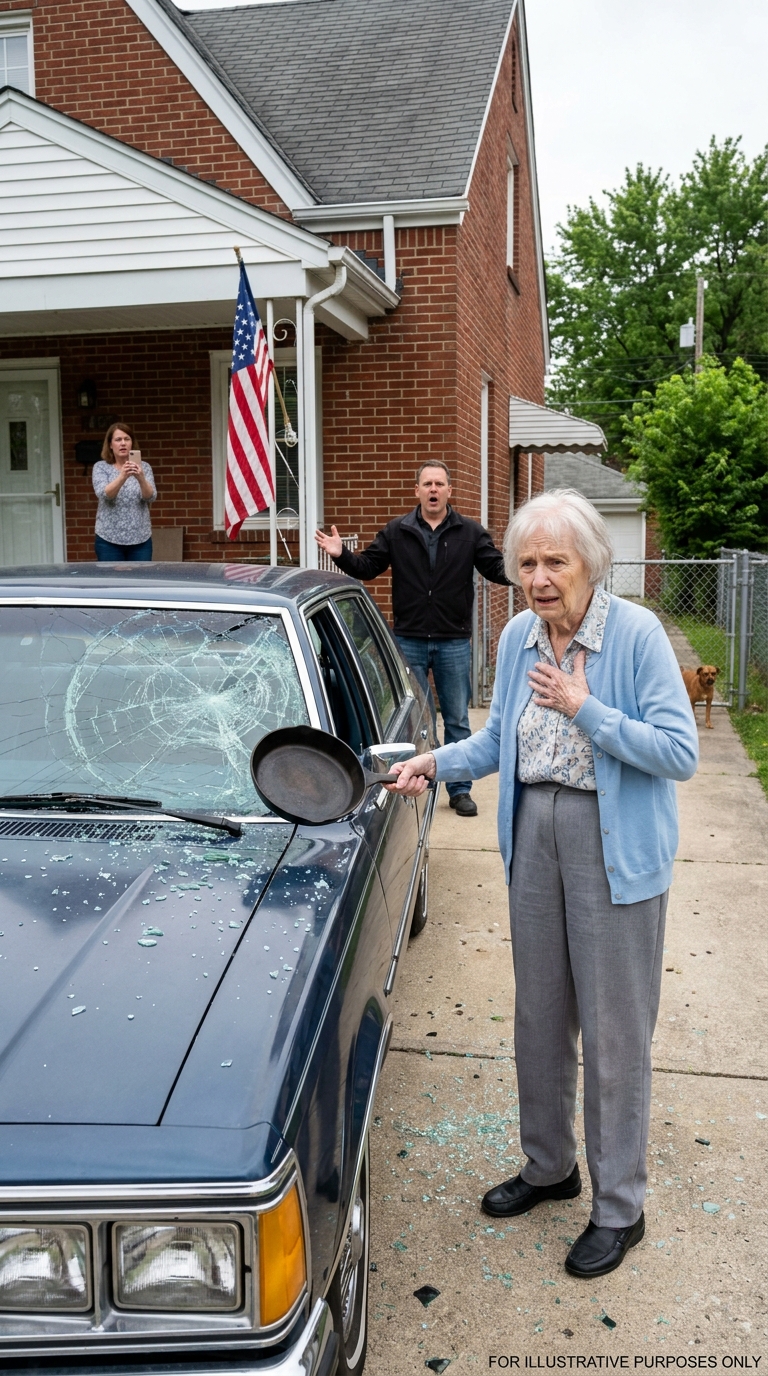
A small American flag moved lightly beside the mailbox because my husband used to put one there every spring and I kept replacing it after he died.
Caleb’s car sat in the driveway.
Midnight-blue.
Waxed.
Covered.
Protected.
He loved that car in public.
He checked the weather for that car.
He wiped dust from that car with a cloth he once told me not to use on the kitchen counters.
The windshield was perfect.
For about three more seconds.
“Mother, put that down,” he snapped.
I raised the skillet.
The sound of the first strike was enormous.
Not just loud.
Clean.
Final.
Glass broke in a white burst across the hood.
A dog started barking from next door.
A curtain moved.
Marissa gasped and clutched her phone.
I struck once.
Only once.
That was all it took.
The windshield spiderwebbed from the center, and safety glass glittered on the driveway like ice.
Nobody moved.
The whole street seemed to hold its breath, except for the lawn mower still droning two houses down.
Caleb came onto the porch with his face twisted.
“Are you insane?”
I turned around.
The skillet hung at my side.
My bruised hand was tucked against my chest.
“No,” I said. “I’m done crawling.”
It was not a speech.
It was not a performance.
It was the truest sentence I had said in my own house for half a year.
Marissa lifted her phone.
“I’m calling the police.”
“Call them,” I said. “Ask them to send a squad car.”
Caleb’s face tightened.
He was not worried about the car anymore.
Not really.
He was watching my hand.
He was watching the way I stood.
He was beginning to understand that the woman in front of him was not the woman he had described to bank clerks, neighbors, and his own wife.
“While they’re here,” I said, “I can show them the forged power of attorney papers you two left in the study you locked me out of.”
The color dropped from Marissa’s face.
Caleb opened his mouth.
Nothing came out.
“The same study,” I said, “I had a locksmith open this morning while you were out at brunch.”
That did it.
His eyes flicked toward the hall.
Not toward me.
Not toward my hand.
Toward the study.
Guilt has reflexes before it has words.
Marissa whispered, “Caleb.”
Her voice had lost every polished edge.
My neighbor’s curtain was fully open now.
Another house across the street had a woman standing in the doorway with a dish towel in her hand.
Caleb lowered his voice.
“Mom, let’s go inside.”
There it was.
The private-room request.
The place where families bury things.
“No,” I said.
A squad car turned the corner four minutes later.
Marissa had called them because she thought the windshield made her the victim.
People like Marissa often believe the first person to dial gets to write the truth.
The officer stepped out and looked at the car.
Then he looked at me.
Then he looked at my hand.
He was middle-aged, tired around the eyes, and not easily impressed by broken glass.
“Ma’am,” he said, “are you hurt?”
Caleb answered before I could.
“She’s confused. She attacked my vehicle.”
The officer did not look away from me.
“Ma’am?”
I held out my hand.
The swelling had grown ugly.
Purple and red across the knuckles.
The skin near my ring had split just enough to bead.
“That happened before the windshield,” I said.
Caleb laughed once.
It was a bad laugh.
Thin.
Panicked.
“She fell.”
“No,” I said. “He stepped on my hand while I was cleaning the kitchen floor.”
Marissa said, “That is not true.”
Her voice shook.
The officer asked if I wanted medical attention.
I said I wanted the injury documented first.
That word changed his face.
Documented.
It is a calm word.
It is also a door.
He took photographs.
My hand.
The driveway.
The broken windshield.
The porch.
The kitchen floor where the wet rag still lay near the island.
Caleb kept talking.
The officer kept writing.
Marissa kept looking at the study door.
Then I gave him the folder.
Not the originals.
Copies.
I am old, not foolish.
Inside were the bank printouts, the power of attorney packet, the mail-forwarding confirmation, the locksmith receipt, and photographs of the sticky notes.
The officer did not read every page there in the driveway.
That was not his job.
But he read enough.
At the first sticky note, his jaw tightened.
At the notary stamp, he asked where the originals were.
“In my study,” I said. “Behind the door he changed the lock on.”
Caleb said, “This is a family matter.”
The officer looked at him then.
“No, sir,” he said. “It may be several things, but it is not just that.”
Marissa sat down on the porch step like her legs had gone out from under her.
Her champagne flute was gone.
There was a dark spill on the boards where wine had run between the cracks.
She had been so elegant five minutes earlier.
Now she looked small.
Not innocent.
Small.
Caleb asked for a lawyer.
The officer said that was his right.
I said nothing.
My hand hurt enough to make my stomach roll, but I kept standing.
A woman from across the street came over with a clean dish towel and an ice pack.
Her name was Denise.
I had waved to her for nine years and never once asked for help.
She wrapped the towel around my hand without making me feel ashamed.
“You’re coming to my porch after this,” she whispered.
I almost cried then.
Not when Caleb crushed my fingers.
Not when Marissa laughed.
Not when the glass broke.
A neighbor being gentle nearly undid me.
The officer took my statement in the kitchen.
He sat at the table where Caleb had once done homework.
I told him about the missing mail.
The changed lock.
The bank documents.
The forged signature.
The boot.
I did not embellish.
I did not need to.
Some stories become stronger when you stop decorating them.
Caleb paced in the hallway until the officer told him to stay on the porch.
Marissa stared at her phone and answered no questions without Caleb looking at her first.
That told its own story.
The ambulance was not necessary, but the officer advised urgent care.
Denise drove me.
Before I left, I walked to the study.
The new key turned smoothly.
Inside, the folders waited exactly where I had put them back.
The officer photographed the room.
He bagged nothing himself, but he told me what to preserve and what not to touch.
He gave me a report number.
I wrote it in my notebook under the others.
April 21, 1:38 p.m., officer photographs injury and documents locked study.
At urgent care, the nurse asked how it happened.
I said, “My son stepped on my hand.”
She paused only a moment.
Then she wrote it down.
That is the mercy of trained people.
They do not ask you to make pain sound prettier.
The X-ray showed no break, just deep bruising and swelling.
The doctor wrapped my fingers and told me to watch for numbness.
He asked if I felt safe going home.
I looked at Denise sitting beside me with her purse in her lap and her mouth pressed into a hard line.
“Not with them there,” I said.
Denise answered before I could soften it.
“Then she is not going back with them there.”
By evening, Caleb and Marissa were gone from my house.
Not politely.
Not gracefully.
But gone.
The officer had explained enough.
The bank had already frozen access.
The originals were secured.
The report had been made.
Caleb packed under supervision, furious in the way people get when consequences interrupt their favorite lie.
Marissa cried once.
Not for me.
Not for the hand.
For herself.
“I didn’t know he would hurt you,” she whispered when Caleb carried their suitcases to the car.
I looked at her red nails, her perfect hair, her frightened eyes.
“But you knew about the papers,” I said.
She did not answer.
That was answer enough.
The next weeks were not cinematic.
They were paperwork.
Bank appointments.
Statements.
A fraud packet.
Calls to a lawyer.
A new lock on every exterior door.
A fraud alert.
A postal hold.
A neighbor walking over with soup in a plastic container.
Denise drove me twice before I could use my hand comfortably.
The bank reversed the access request.
The power of attorney was challenged and removed from the file pending investigation.
The notary claimed she had met me.
Then she was shown the bank camera timestamp proving I had been elsewhere during the appointment time listed on the document.
After that, her confidence changed.
Caleb called twelve times the first night.
Then he texted.
Mom, this got out of hand.
Then:
You know I would never really hurt you.
Then:
Marissa pushed me.
Then:
Do you want your only son ruined?
I did not answer the first three.
I answered the last one.
I wrote:
I wanted my only son to stop stepping on my hand.
Then I blocked him for the night.
The next morning, I unblocked him because blocking felt childish.
Then I silenced him because peace is not childish.
Peace is survival.
The windshield cost him money.
The papers cost him more.
But the thing he could not forgive me for was not the car.
It was the witness.
He could have explained away a confused mother in a private kitchen.
He could not explain away photographs, documents, a report number, a locksmith receipt, bank records, and three neighbors who had watched him scream on my porch while my hand swelled in front of them.
People think dignity is quiet.
Sometimes it is.
Sometimes dignity is a skillet through a windshield because the quiet has been used against you long enough.
I stayed with Denise for two nights while the locks were changed.
On the third morning, I walked back up my own porch.
The small flag beside the mailbox had wrapped itself around the pole in the wind.
I untangled it with my good hand.
Inside, the house smelled faintly of lemon cleaner again.
This time, I had used it because I wanted the room clean, not because someone had ordered me onto my knees.
The study door opened with my key.
My father’s old desk sat by the window.
My husband’s pipe box was still on the shelf.
I opened the windows and let the stale smell out.
Then I carried the cast-iron skillet back to the kitchen.
There was one dent along the rim.
Not much.
Cast iron survives things.
So do women who have been mistaken for furniture.
I washed it carefully.
I dried it on the stove.
I rubbed it with a little oil the way my mother taught me.
That evening, I made cornbread.
Not for Caleb.
Not for Marissa.
For myself.
Denise came over with butter and honey.
We ate at the kitchen table while the sun dropped behind the houses and the lawn mower two doors down started its ordinary evening noise again.
She did not ask me if I was sad.
Of course I was sad.
A mother does not stop loving her son because she finally tells the truth about him.
Love and access are not the same thing.
That is a lesson that took me seventy-one years, one forged signature, and one crushed hand to learn.
Weeks later, the bruise faded from purple to yellow to nothing.
The ring finger stayed stiff in the mornings.
The windshield was replaced.
The investigation moved slowly, as these things do.
Caleb sent one letter through an attorney that called the incident “an unfortunate family misunderstanding.”
My attorney sent back copies.
The tone changed after that.
I do not know what Caleb tells people now.
Maybe he says I lost my temper.
Maybe he says Marissa was misunderstood.
Maybe he says an old woman got dramatic over a car.
He can say whatever helps him sleep.
I have the notebook.
I have the report number.
I have the bank letters.
I have the locksmith receipt marked owner present.
And every time I pass the kitchen tile, I remember the moment my son’s boot came down and something inside me went quiet.
I also remember what came after.
The porch.
The sunlight.
The skillet.
The windshield breaking like the last little wall between who I had been and who I was still allowed to become.
I was seventy-one years old, kneeling in my own kitchen.
But I did not stay there.
I stood up.