The ancient words fell from the Russian duchess’s lips like drops of poison.
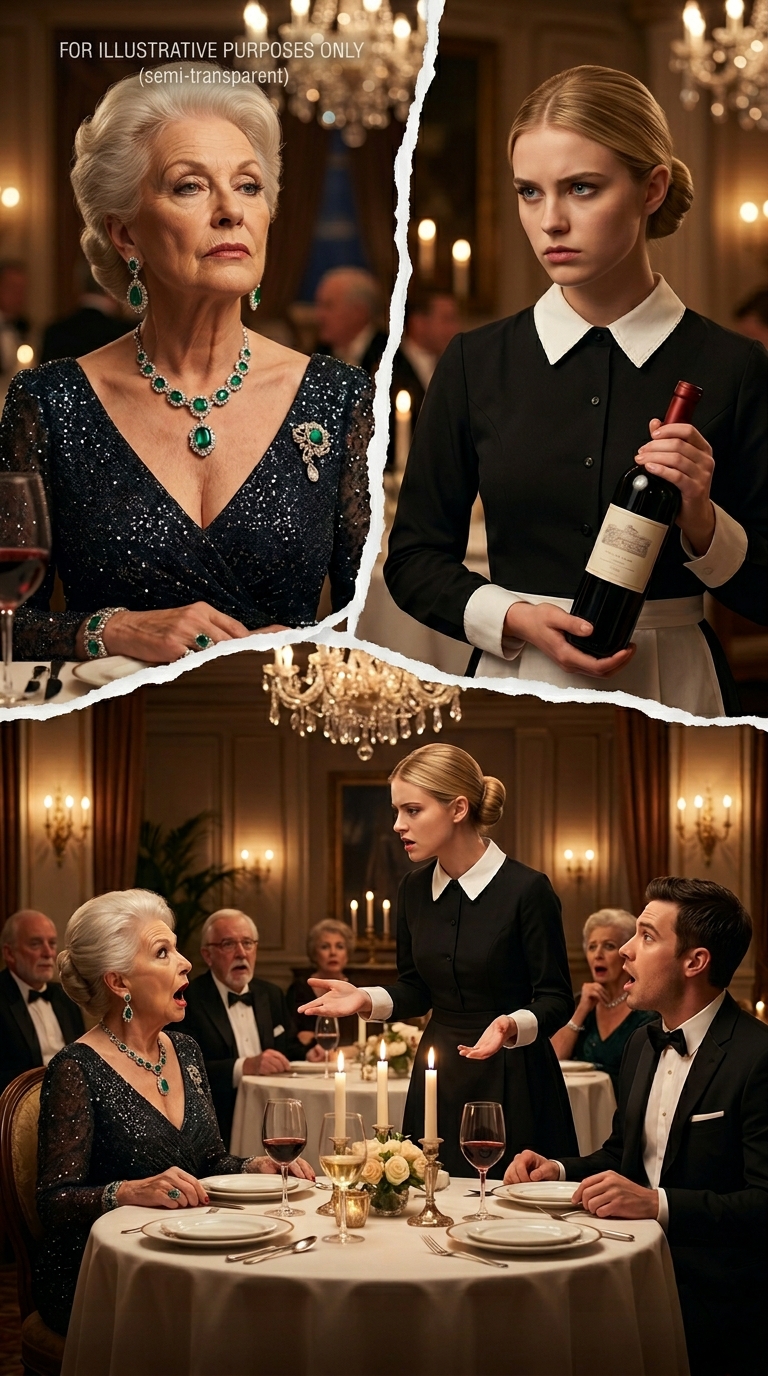
They were soft enough that most of the dining room never noticed them. They slipped beneath the gentle notes of the string quartet, beneath the muted clink of crystal and silver, beneath the low murmur of Chicago’s wealthiest families discussing markets, politics, and winter homes in Europe.
But Natasha Orlova heard every syllable.
She understood the insult about servants knowing their place.
She understood the laughter that followed.
And she understood that the old woman had chosen a language dead for centuries because she believed the waitress standing beside her table could never answer back.
For one long second, Natasha remained motionless.
Her hand tightened around the neck of a twelve-hundred-dollar bottle of Château Margaux. Her polished black shoes pressed into the Persian carpet. The muscles in her shoulders trembled beneath the severe black uniform she had worn for nearly sixteen hours.
She could have walked away.
For twenty months, walking away had been her greatest skill.
She had walked away from crude remarks, careless hands, condescending smiles, and customers who snapped their fingers as though calling a dog. She had apologized for meals she had not cooked, delays she had not caused, and mistakes made by people earning three times her hourly wage.
She had swallowed humiliation because humiliation paid for medication.
It paid for physical therapy.
It paid the rent on the small apartment where her father now struggled to button his own shirts.
Tonight, however, something inside Natasha finally stopped bending.
She turned back toward the table.
The woman who had insulted her was Duchess Ekaterina Dmitrievna Volkovskaya, seventy-three years old, widow of a Russian prince, matriarch of a family that claimed a noble lineage stretching back nearly eight centuries.
She sat beneath a crystal chandelier in a cream Chanel suit, her posture rigid, her silver hair arranged in a sculpted twist. An antique sapphire rested against her throat, framed by diamonds that caught the candlelight like chips of ice.
The duchess was still smiling when Natasha spoke.
Her reply came in the same archaic dialect.
Not modern Russian.
Not the language of television, newspapers, or crowded Moscow streets.
Natasha answered in the formal Church Slavonic pronunciation used by educated clergy in the eleventh century.
“True nobility is revealed through deeds,” she said quietly, “not through jewels taken from the dead.”
The duchess’s smile disappeared.
Her wineglass stopped halfway to her lips.
Around the table, three elderly aristocrats froze. One woman’s fingers remained suspended over a silver dessert fork. Another slowly turned her head toward Natasha, her powdered face suddenly pale.
Across from the duchess, her grandson Alexei Volkovsky looked up so quickly that the stem of his glass struck the edge of his plate.
The sound was tiny.
Yet in the silence surrounding table twelve, it seemed as loud as a gunshot.
Natasha stood beside them with the bottle still in her hand.
Her heart hammered against her ribs.
Her face remained calm.
The duchess lowered her glass.
“What did you say?”
This time, she spoke modern Russian. Her aristocratic St. Petersburg accent sharpened each word.
Natasha answered in the same language.
“I replied to your observation about my spiritual poverty, Your Excellency.”
A dark crimson stain began spreading across the duchess’s cheeks.
“You understood me?”
“Yes.”
“All of it?”
“Every word.”
The two aristocratic women exchanged stunned glances.
Alexei continued staring at Natasha as though the young waitress had transformed in front of him.
The duchess’s voice dropped.
“Who taught you that language?”
“No one person taught me. I studied it for years.”
“You studied Church Slavonic?”
“I was a doctoral candidate in medieval Slavic languages and literature at the University of Chicago.”
The duchess blinked.
Natasha placed the wine bottle carefully on the table. Her fingers were beginning to shake, and she refused to let anyone see.
“My research focused on the linguistic development of liturgical manuscripts between the tenth and fourteenth centuries. I specialized in Church Slavonic, Old East Slavic, Old Russian, and regional manuscript traditions from Kievan Rus through the early Muscovite period.”
The elderly woman seated to the duchess’s right leaned forward.
“You are a philologist?”
“I was.”
“Was?”
Natasha felt the familiar pressure in her throat.
Twenty months earlier, that single word would have broken her.
Now it merely opened a door she had spent almost two years trying to keep closed.
“My father became ill,” she said. “I left the program.”
The duchess recovered from her surprise quickly.
Shock hardened into contempt.
“So your little education failed you.”
Natasha met her eyes.
The old woman looked pleased to have found a wound.
“You studied dead languages,” the duchess continued, “and where did they bring you? Here. Serving wine. Carrying plates. Wearing a uniform.”
Her gaze moved slowly down Natasha’s body, from the tight bun that pulled painfully at her scalp to the black shoes hiding swollen feet.
“You may recite the prayers of medieval monks,” the duchess said, “but you remain exactly what you are.”
The words landed with surgical precision.
Natasha heard a chair shift at the neighboring table.
She knew people were listening now.
She saw the sommelier, Jean-Baptiste Moreau, standing near the kitchen entrance with a white cloth draped over one arm. His expression was tight with alarm.
He wanted her to walk away.
She could see it in his eyes.
Natasha should have walked away.
She needed this job.
She needed every hour.
Every tip.
Every shift that left her limping home after midnight.
But the duchess had made one mistake.
She thought poverty had erased Natasha’s pride.
In truth, poverty had stripped away almost everything except her pride.
“You are correct, Your Excellency,” Natasha said.
The duchess’s thin mouth curved in satisfaction.
“My education brought me here. It gave me the ability to work eighty hours a week so my father can receive treatment for Parkinson’s disease. It gave me the discipline to stand for sixteen hours while my feet bleed inside my shoes. It gave me enough knowledge to understand every insult you believed was safely hidden inside a dead language.”
The satisfaction vanished from the duchess’s face.
Natasha’s voice remained low.
“But I am curious. What did your education give you?”
The duchess stiffened.
“Excuse me?”
“Did it teach you kindness? Restraint? Courage? Or did it only teach you how to humiliate people who cannot afford to challenge you?”
Alexei lowered his eyes.
One of the older women drew in a quiet breath.
The duchess’s hand trembled against the tablecloth.
“You dare lecture me?”
“No. I am asking a question.”
“You are a waitress.”
“Yes.”
“You are employed to serve me.”
“I am employed to serve dinner. I am not employed to surrender my dignity.”
The duchess pushed back her chair.
Its carved wooden legs scraped sharply against the floor.
Several conversations around them stopped.
“You insolent little creature.”
Jean-Baptiste took one step forward, but Natasha raised a hand without looking at him.
She knew the consequences were coming.
She would be fired before midnight.
By morning, the restaurant’s owner might blacklist her among every elite dining room in Chicago.
By the end of the week, she might be unable to afford her father’s newest medication.
The fear was real.
It crawled through her stomach and pressed cold fingers against her spine.
But beneath that fear was something stronger.
For the first time in twenty months, Natasha felt visible.
The duchess rose.
At seventy-three, she was not physically imposing. She was barely five feet four. But she carried the confidence of someone who had spent a lifetime watching doors open before she reached them.
“I am Duchess Volkovskaya,” she announced. “My family’s bloodline can be traced to the princes of ancient Rus.”
Natasha’s academic mind responded before fear could silence it.
“That claim is historically questionable.”
The duchess stared at her.
“What?”
“The Volkovsky family did not descend from the early princes of Rus.”
One of the aristocratic women closed her eyes.
Alexei whispered, “Natasha…”
But it was too late.
Years of research, memorization, abandoned notes, and unfinished chapters rushed back into Natasha’s mind.
“The earliest verified Volkovsky ancestor was Grigori Volkov, a fourteenth-century merchant associated with the Moscow salt trade. His descendants purchased a patent of nobility during a period of financial instability under Boris Godunov. The relevant records are preserved in the Muscovite rank books.”
The duchess opened her mouth.
No sound emerged.
Natasha continued with the calm clarity of a scholar defending a dissertation.
“The family later commissioned genealogical revisions that connected the Volkovsky line to an extinct branch of regional princes. Modern historians consider those records politically motivated and unreliable.”
“You are lying.”
“I read the original documents.”
“My family archives—”
“Contain copies prepared almost a century after the supposed events.”
The duchess’s breathing grew shallow.
Her companions looked increasingly uncomfortable.
One of them, a narrow-faced woman wearing emerald earrings, leaned toward the duchess.
“Ekaterina,” she murmured, “the girl may be correct.”
The duchess turned on her.
“Do not be ridiculous.”
“I have seen references to the Volkov patent.”
“You have seen revolutionary propaganda.”
“No,” the woman said quietly. “Imperial tax records.”
The duchess’s face went white.
Natasha noticed three phones lifted at nearby tables.
People were recording.
The realization made her stomach drop.
Whatever happened next would not remain inside the restaurant.
By morning, this could be everywhere.
She thought of her father.
He still believed she worked at a university library.
Natasha had never told him the full truth.
She had not wanted him to know that she had traded lecture halls for dining rooms, academic conferences for double shifts, and research grants for envelopes of cash tips counted beneath fluorescent lights after midnight.
He carried enough guilt already.
Every time his hands shook, he apologized.
Every time Natasha helped him lift a spoon, he whispered that she should be living her own life.
She always smiled.
She always told him she was fine.
Standing before the duchess, Natasha wondered how long that lie would survive once the videos appeared online.
Alexei Volkovsky rose slowly from his chair.
He was thirty-eight, tall, broad-shouldered, and dressed in a dark suit that looked almost plain compared with the jewelry surrounding him. Until that moment, he had barely spoken.
Throughout dinner, he had listened to his grandmother’s complaints with the exhausted patience of a man accustomed to public embarrassment.
Now his expression had changed.
“Grandmother,” he said. “Sit down.”
The duchess turned toward him in disbelief.
“Alexei, this servant has insulted our family.”
“You insulted her first.”
“I spoke privately.”
“You spoke directly beside her.”
“In a language she had no business understanding.”
A murmur passed through the nearby tables.
Alexei’s jaw tightened.
“You believed she had no business understanding because she was carrying a bottle of wine.”
The duchess drew herself upright.
“You will not speak to me in that tone.”
“I am asking you to sit down.”
“She called our lineage fraudulent.”
“She described historical records.”
“She humiliated me.”
Alexei’s eyes moved briefly to the raised phones surrounding them.
“No, Grandmother. You humiliated yourself.”
The duchess recoiled as though he had slapped her.
Natasha saw genuine pain flash across the old woman’s face.
For one second, the arrogance vanished. Beneath the jewels and titles stood an aging woman whose grandson had refused to protect her illusion.
Then the mask returned.
“You know nothing about what this family has survived.”
Alexei’s voice softened, but not with surrender.
“I know exactly what it survived. Revolution. Exile. War. Financial collapse. Reinvention. I also know survival does not give us permission to treat other people as if they are less human.”
The duchess’s lower lip trembled.
One of her companions reached toward her, but she pulled away.
Alexei turned to Natasha.
“What is your full name?”
“Natasha Sergeyevna Orlova.”
He took out his phone.
“And you studied at the University of Chicago?”
“Yes.”
“What was your dissertation topic?”
Natasha hesitated.
The entire restaurant seemed to be waiting.
“The evolution of scribal variation in Church Slavonic liturgical texts between the Kievan and early Muscovite traditions.”
Alexei began typing.
“Did you publish?”
“Three articles and two conference papers.”
“Under your full name?”
“Yes.”
The duchess gave a bitter laugh.
“Are you interviewing the waitress now?”
Alexei ignored her.
He scrolled through his phone, then stopped.
Natasha watched his eyes move across the screen.
His expression became very still.
“You presented a paper in Prague four years ago.”
“Yes.”
“On phonological evidence in a thirteenth-century manuscript fragment.”
Natasha nodded.
“That paper won the conference prize.”
She felt heat rise into her face.
“It was a student prize.”
“It was an international competition.”
“I was fortunate.”
“No,” Alexei said. “You were apparently very good.”
The words struck Natasha harder than the insults had.
Very good.
No one had spoken to her that way in nearly two years.
At the restaurant, she was described as efficient, reliable, quiet, available, or exhausted.
At home, her father called her his miracle, but his love was too close to her sacrifice. His praise carried guilt.
Very good belonged to another life.
A life of dusty archives, handwritten notes, crowded lectures, and arguments over a single word copied incorrectly eight hundred years earlier.
A life she had buried.
Alexei turned his phone so she could see the screen.
Her old university profile stared back at her.
The photograph had been taken when she was twenty-two.
Her hair had been loose. Her face had been rounder. Her eyes had not yet learned to calculate the price of every hour.
“I run the Volkovsky Cultural Foundation,” Alexei said.
Natasha knew the name.
Anyone in her field knew it.
The foundation held one of the largest private collections of medieval Slavic manuscripts outside Eastern Europe. Scholars had criticized the family for limiting access, but the archive itself was legendary.
Fragments from monasteries destroyed by fire.
Prayer books carried through revolution.
Illuminated manuscripts believed lost for generations.
Natasha had cited several of the foundation’s published facsimiles in her dissertation.
“We have been searching for a specialist in Church Slavonic manuscript traditions for eighteen months,” Alexei continued. “Our senior consultant accepted a position at Harvard. The search committee has rejected every candidate we sent them.”
The duchess stared at him.
“No.”
Alexei did not look at her.
“Miss Orlova, would you be willing to speak with me about the position?”
Natasha thought she had misunderstood.
“The position?”
“Senior manuscript consultant.”
The words seemed absurd inside the dining room.
She looked down at her uniform.
There was a faint wine stain near her cuff.
One of her stockings had torn at the ankle.
Her lower back burned from carrying trays.
“You are offering me an interview?”
“I am offering you more than an interview.”
The duchess gripped the edge of the table.
“Alexei, stop this performance immediately.”
He finally looked at his grandmother.
“It is not a performance.”
“You cannot reward her for attacking me.”
“I am not rewarding an attack. I am recognizing expertise.”
“She is unstable.”
Natasha flinched.
The duchess saw it and pressed harder.
“She abandoned her studies. She works in a restaurant. You know nothing about her.”
Alexei’s expression cooled.
“I know she can identify a regional Church Slavonic register after hearing one sentence. I know she can cite Muscovite archival records from memory. I know her work was recognized internationally before she left her program.”
He looked back at Natasha.
“And I know our foundation needs exactly those abilities.”
Natasha’s mouth had gone dry.
“How did you know I left because of my father?”
“You told us.”
“No. I mean, how can you know I am still capable of doing that work?”
Alexei considered the question.
“You heard an archaic insult in a crowded restaurant after working all day, identified the linguistic register, replied with historically appropriate pronunciation, and then corrected my family’s genealogy without notes.”
For the first time, a faint smile touched his face.
“I suspect your abilities have survived.”
A few people nearby laughed softly.
Not at Natasha.
With her.
The difference almost brought tears to her eyes.
The duchess sank slowly into her chair.
She looked smaller now.
Her sapphire necklace no longer appeared regal. It seemed heavy, as though the stone were pulling her toward the floor.
Jean-Baptiste finally approached.
He stopped beside Natasha with his hands folded.
“Miss Orlova.”
His formal tone made her brace for dismissal.
“Yes?”
“The owner is on the phone.”
Natasha’s heart dropped.
Jean-Baptiste glanced at the recording phones, the pale duchess, and Alexei standing beside the table.
“He has seen the livestream.”
A diner near the window quickly lowered his phone.
Natasha closed her eyes.
“Am I fired?”
Jean-Baptiste’s expression softened.
“No.”
The word surprised everyone.
“The owner asked me to tell you that no employee of Maison Noire is required to accept personal abuse from a guest.”
The duchess looked up sharply.
Jean-Baptiste turned toward her.
“Your Excellency, the restaurant values your patronage. However, our staff members are not property. If you continue speaking to Miss Orlova in this manner, I will ask you to leave.”
The duchess stared at him as though he had begun speaking another dead language.
“You would remove me?”
“If necessary.”
“Do you know who I am?”
“Yes.”
“Then you know what my family spends here.”
Jean-Baptiste nodded.
“I also know what kind of establishment we intend to be.”
The duchess’s companions lowered their eyes.
Alexei gave Jean-Baptiste a brief look of gratitude.
Natasha felt something shift inside the room.
For years, perhaps decades, Duchess Volkovskaya had relied on the same question.
Do you know who I am?
It had opened doors, silenced criticism, and restored the social order whenever someone forgot to fear her.
Tonight, for the first time, the answer was yes—and it did not save her.
Jean-Baptiste faced Natasha again.
“Your shift is over.”
Natasha swallowed.
“Mr. Moreau, I still have four tables.”
“We will cover them.”
“I cannot afford to lose the hours.”
“You will not.”
He lowered his voice.
“Take off your apron. Sit down. Speak to Mr. Volkovsky properly.”
Natasha’s hands trembled as she untied the knot at her waist.
For twenty months, removing that apron had meant one thing.
Exhaustion.
A dark train ride home.
A few hours of sleep before the alarm rang again.
Tonight, it felt like stepping out of a skin that had grown too tight.
The kitchen doors opened behind her.
Several servers stood watching from the corridor.
Marcus Bell, the head chef, lifted his chin.
“Go,” he mouthed.
Natasha folded the apron carefully.
She had spent so long trying to remain useful that she no longer knew how to accept kindness without apologizing.
Alexei pulled out an empty chair from the neighboring table.
“Please.”
Natasha looked at the duchess.
The old woman’s eyes burned with anger and humiliation.
Sitting beside her felt dangerous.
It also felt necessary.
Natasha lowered herself into the chair.
Pain shot through her feet when the pressure changed. She hid the wince.
Alexei noticed.
“How long have you been standing today?”
“Since six this morning.”
“It is almost ten.”
“I know.”
“You work sixteen-hour shifts?”
“Not every day.”
“How many days a week?”
“Usually five. Sometimes six.”
The duchess looked away.
Alexei sat across from her.
“Tell me about your father.”
Natasha’s fingers closed around the folded apron.
“His name is Sergei. He is fifty-eight.”
“Fifty-eight?”
“The symptoms began early.”
“I am sorry.”
“He was a machinist. A very good one. He worked at the same manufacturing plant for twenty-seven years.”
Natasha looked toward the candles on the table.
“When his hands started shaking, he hid it. At first, he said it was stress. Then he began dropping tools. He was afraid they would fire him.”
“Did they?”
“He resigned before they could.”
The memory came back with painful clarity.
Her father standing in the kitchen of their apartment, one hand wrapped around the other, trying to stop the tremor.
The letter from the hospital.
The appointments.
The scans.
The doctor speaking slowly, as though each word required careful placement.
Early-onset Parkinson’s disease.
Natasha had sat beside her father beneath fluorescent lights and watched his entire future change shape.
At the time, she had been twenty-four hours away from submitting a fellowship application.
She remembered the open laptop on her desk.
The paragraph she never finished.
“The insurance covered basic treatment,” Natasha said. “It did not cover the specialists we needed, experimental therapy, adaptive equipment, or enough home care.”
“How much debt?”
“About two hundred eighty thousand dollars.”
One of the aristocratic women inhaled sharply.
The duchess remained silent.
Alexei’s brows drew together.
“How are you managing it?”
“I am not. I make payments. Then another bill arrives.”
“Do you have siblings?”
“No.”
“Other family?”
“My mother died when I was seventeen. My father raised me.”
She gave a small, tired smile.
“He worked nights so I could attend academic programs in the summer. He learned how to pronounce Church Slavonic simply because I loved talking about it.”
Alexei glanced at the duchess.
The old woman’s expression had changed slightly.
The fury remained, but something less certain had entered her eyes.
Natasha continued.
“When I received the fellowship offer from Moscow State University, my father cried. He never cried at my graduations. He said graduations were expected.”
Her smile trembled.
“But Moscow made him cry.”
“What happened to the fellowship?”
“I declined it.”
“Because he became ill?”
“Yes.”
“Did he ask you to?”
“No. He begged me not to.”
The candles blurred.
Natasha blinked quickly.
“He said he would rather die than become the reason I abandoned my life.”
No one at the table moved.
“I told him I was taking a temporary leave. I said I would return after one semester.”
“You did not.”
“The bills did not stop after one semester.”
Alexei leaned back slowly.
The duchess looked down at her hands.
For the first time that evening, she seemed to see the rings covering them.
“Does your father know you work here?” Alexei asked.
“He knows I work in hospitality.”
“That is not what I asked.”
Natasha’s gaze dropped.
“No.”
“Why not?”
“Because he would blame himself.”
“Would he be wrong?”
The question was not cruel, but it hurt.
Natasha’s jaw tightened.
“He became sick. He did not choose it.”
“Neither did you.”
Silence settled between them.
Alexei took a business card from his wallet and placed it on the table.
“The consultant position pays one hundred eighty thousand dollars a year.”
Natasha stared at him.
She thought she had heard incorrectly.
“Full health insurance,” he continued. “Medical and dental coverage can be extended to a dependent parent under our family-care policy.”
The room seemed to tilt.
“The position is based in Chicago. Some travel would be required to partner archives in Prague, Sofia, Belgrade, and London. You would work with original manuscripts, supervise cataloging, train junior researchers, and assist with provenance evaluations.”
Natasha did not touch the card.
“Why?”
“Because we need someone with your expertise.”
“You found my university profile five minutes ago.”
“I also found your publications.”
“That is not enough to offer someone a position.”
“No,” Alexei admitted. “It is enough to begin a conversation.”
The duchess made a quiet sound of disbelief.
He ignored it.
“The final appointment would require approval from our academic board. But I chair the foundation, and I can offer you an interim senior consultancy beginning immediately.”
“Immediately?”
“Monday, if you choose.”
Natasha shook her head.
“This does not happen.”
“What does not happen?”
“People do not insult waitresses, discover they were academics, and hand them six-figure jobs before dessert.”
A few people at the surrounding tables smiled.
Alexei did not.
“You are right. It does not happen often enough.”
“That is not an answer.”
“It is the honest one.”
Natasha finally looked at the card.
The black lettering seemed impossibly sharp.
Alexei Mikhailovich Volkovsky.
Chairman and Executive Director.
Volkovsky Cultural Foundation.
A direct telephone number had been written on the back.
The duchess reached across the table.
“Alexei, may I speak to you privately?”
“No.”
Her hand stopped.
“Do not humiliate me further.”
“You did not ask for privacy when you insulted Miss Orlova.”
The old woman’s fingers curled.
“I am your grandmother.”
“And she is someone’s daughter.”
The words hit the duchess with visible force.
For the first time, Natasha wondered what kind of mother the old woman had been. What kind of grandmother.
Perhaps people were not born believing the world existed beneath them.
Perhaps arrogance was constructed slowly, one unquestioned privilege at a time, until even love became another form of obedience.
The narrow-faced aristocrat beside the duchess cleared her throat.
“Ekaterina.”
The duchess did not look at her.
“What?”
“You should apologize.”
The duchess’s head turned.
The woman held her gaze.
“You used Church Slavonic because you wanted to insult the girl without consequences. You cannot now object because consequences appeared.”
“I did not ask for your judgment, Irina.”
“No. You invited witnesses.”
The second companion nodded reluctantly.
“She is right.”
The duchess looked from one woman to the other.
Both had spent the evening laughing at her remarks.
Now neither would defend her.
Her posture sagged.
For one brief moment, Natasha felt no triumph.
Only pity.
Then the duchess lifted her chin again.
“I will not apologize to an employee who publicly attacked my family.”
Natasha stood.
The pain in her legs returned immediately.
“I do not need your apology.”
The duchess’s eyes narrowed.
Natasha placed the folded apron on the empty chair.
“But I will give you mine.”
Alexei looked surprised.
Natasha faced the old woman.
“Your Excellency, I apologize for challenging you publicly. I was angry, and I spoke in a way that was not professional.”
The duchess’s lips parted.
Natasha continued before she could respond.
“I do not apologize for understanding you. I do not apologize for defending myself. And I do not apologize for saying that nobility without compassion is only expensive cruelty.”
No one laughed.
No one moved.
The duchess stared at Natasha.
Her eyes glistened, though her face remained rigid.
Natasha turned to Alexei.
“I need time.”
“Of course.”
“I cannot accept a position without knowing whether it is real.”
“That is reasonable.”
“I need to see the contract. The insurance policy. The archive. I need to know what the work actually requires.”
“Also reasonable.”
“And I will not be used to punish your grandmother.”
Alexei’s expression changed.
“This is not revenge.”
“It may not feel like revenge to you.”
He considered her words carefully.
“I understand.”
“Do you?”
“I understand that you have spent almost two years surviving consequences created by other people. You do not want your future to depend on another family conflict.”
Natasha said nothing.
Alexei nodded once.
“You may speak directly with the foundation’s attorney and academic director. No one from my family will be present unless you request it. The offer will be in writing.”
He took out his pen.
“There will also be an immediate advance.”
“I did not ask for money.”
“I know.”
“Then do not offer charity.”
“It is not charity. We pay signing advances to specialists who leave existing employment.”
“I am carrying plates.”
“You are leaving existing employment.”
Despite everything, Natasha almost laughed.
She did not.
“How much?”
“Fifty thousand dollars.”
Her breath caught.
The duchess looked up.
Even the aristocrats seemed startled.
“That is unnecessary,” Natasha said.
“It is standard for senior appointments involving urgent relocation or financial hardship.”
“I am not relocating.”
“Then consider it an advance against the first year’s salary.”
“My father’s debt is two hundred eighty thousand.”
“I heard you.”
“Fifty thousand will not solve everything.”
“No.”
Alexei’s gaze held hers.
“But it may allow you to breathe while we solve the rest properly.”
Natasha looked away.
Breathing had become a luxury.
Every morning began with numbers.
Rent.
Medication.
Transportation.
Minimum payments.
Interest.
Groceries.
Home care.
Each number competed with the others, and every choice felt like deciding which part of their life could be allowed to fail.
Fifty thousand dollars would not erase the debt.
It would stop the immediate collapse.
It would silence the collection calls.
It would let her father return to the physical therapist Natasha had canceled three weeks earlier.
It would give her something she had not possessed since the diagnosis.
Time.
“I cannot give you my bank information in the middle of a restaurant,” she said.
“Then give it to our finance director.”
Alexei wrote an email address beneath his number.
“She is awake. She will respond tonight.”
Natasha stared at the card again.
Across the room, a woman at table seven began clapping.
The sound was slow and uncertain.
Her husband reached for her arm, but she continued.
Another diner joined her.
Then someone near the bar.
Within seconds, applause spread across the dining room.
Natasha’s face burned.
She had not wanted an audience.
She had not wanted to become a symbol.
She had only wanted the duchess to know that her cruelty had been understood.
Jean-Baptiste stepped beside Natasha.
He leaned close.
“You should leave through the kitchen.”
“Why?”
“There are reporters outside.”
Natasha stared at him.
“Reporters?”
“One of the recordings is already online.”
“How long has this been happening?”
“Twelve minutes.”
“That is impossible.”
“Apparently not.”
Alexei checked his phone.
His expression darkened.
“The video has been reposted by several accounts.”
The duchess closed her eyes.
Natasha’s fear returned instantly.
“What does it show?”
“Most of the exchange.”
“Does it include my father?”
“Yes.”
Her stomach twisted.
“I need to go home.”
Alexei stood.
“I can arrange a car.”
“No.”
“There may be cameras at the entrance.”
“I take the train.”
“Not tonight.”
Natasha’s voice sharpened.
“I said no.”
He stopped.
The surrounding applause faded.
Natasha took a breath.
“I am sorry. I know you are trying to help.”
“You do not need to apologize.”
“I need to think.”
“Then think.”
He picked up the business card and placed it in her hand.
“But do not throw that away because you are frightened.”
Natasha’s fingers closed around it.
“I am not frightened.”
Alexei looked toward the windows, where flashes now reflected against the glass.
“Yes,” he said quietly. “You are.”
She hated that he was right.
The kitchen staff surrounded her the moment the doors closed behind her.
Cooks, servers, dishwashers, and bartenders filled the narrow corridor. Some were grinning. Others looked stunned.
Marcus, the head chef, pushed through the crowd.
He was a large man with tattooed forearms and a voice that usually carried across the kitchen above every timer and exhaust fan.
Now he stared at Natasha as though he had never seen her before.
“What in God’s name happened out there?”
“She insulted me.”
“In Russian?”
“Church Slavonic.”
Marcus blinked.
“Is that different?”
“Yes.”
“How different?”
“About a thousand years.”
A young line cook whispered, “That is the coldest thing I have ever heard.”
Several people laughed.
Natasha did not.
She leaned against the stainless-steel prep counter.
Her legs had begun to shake uncontrollably.
Marcus caught her elbow.
“Sit down.”
“I am fine.”
“You are about to collapse.”
He guided her toward a stool.
Someone brought water.
Someone else placed a clean kitchen towel around her shoulders even though she was not cold.
Jean-Baptiste entered with his phone in one hand.
“The owner wants to speak with you.”
Natasha’s fingers tightened around the paper cup.
“Now?”
“He is on the line.”
She took the phone.
“Hello?”
“Miss Orlova.”
The voice belonged to Charles Beaumont, the restaurant’s owner, a man Natasha had met twice in twenty months.
“Mr. Beaumont.”
“I have reviewed the video.”
“I understand.”
“I also spoke with Mr. Moreau.”
Natasha closed her eyes.
“I am sorry for disrupting service.”
“Do not apologize for that.”
“I argued with a guest.”
“You defended yourself against a guest who insulted you.”
“I corrected her family history.”
A pause.
“Yes. That portion was unusually thorough.”
Marcus covered a laugh with a cough.
Natasha looked down at the floor.
“Am I fired?”
“No.”
The answer came immediately.
“However, I am placing you on paid leave for one week.”
Her eyes opened.
“Paid leave?”
“You have become the focus of a public story. I do not want reporters approaching you during service. I also believe you need time to evaluate Mr. Volkovsky’s offer.”
“You know about it?”
“Everyone in the dining room knows about it.”
“I cannot accept a week of pay for not working.”
“You can and you will.”
“Mr. Beaumont—”
“You have worked more double shifts than any server in this restaurant. You have covered colleagues who were ill. You have never missed a scheduled day. Consider the leave overdue.”
Natasha pressed her lips together.
“Thank you.”
“There is something else.”
Her grip on the phone tightened.
“The duchess’s security team is demanding that we remove the recordings from our surveillance system.”
“Can they do that?”
“No.”
Natasha heard his tone change.
“We retain footage for safety and legal purposes. The cameras recorded the entire exchange, including the remarks made before the public videos began.”
The kitchen became very quiet.
“Why does that matter?” Natasha asked.
“Because several online accounts are already claiming you provoked her without cause.”
The air left Natasha’s lungs.
“Who?”
“I do not know yet. The posts appear coordinated.”
Alexei’s offer suddenly felt less like rescue and more like the center of a storm.
“What will the restaurant do?”
“Preserve the evidence.”
“Will you release it?”
“Only with your consent or if legally required.”
Natasha looked toward the kitchen doors.
Beyond them, Duchess Volkovskaya was still seated beneath the chandelier.
The old woman had lost an argument.
But people like her did not survive for decades by accepting defeat.
“Do not release anything yet,” Natasha said.
“Understood.”
“I need to speak to my father first.”
“Of course.”
Charles’s voice softened.
“Miss Orlova, for what it is worth, I am sorry we did not know about your academic background.”
“Why would you?”
“Because good employers should know who works for them.”
Natasha had no answer.
After the call ended, Jean-Baptiste showed her the rear exit.
Marcus insisted on walking with her.
They stepped into an alley behind Maison Noire, where the November wind cut between the buildings. Garbage bins stood beside stacks of empty wine crates. Steam rose from a vent overhead.
The ordinary ugliness of the alley felt comforting after the gold-leaf ceilings and cameras.
Marcus handed Natasha her coat.
“You really studied all that language stuff?”
“Yes.”
“Why did you never tell anyone?”
“No one asked.”
He looked wounded.
“I asked you things.”
“You asked whether I could work Christmas.”
“That counts as a thing.”
Natasha smiled despite herself.
Marcus shoved his hands into the pockets of his chef’s coat.
“My brother had cancer.”
She looked at him.
“Eight years ago. He survived, but the bills destroyed him. Lost his house. Lost his business. He was fifty and moved into our mother’s basement.”
“I am sorry.”
“People think education protects you. A good job protects you. Insurance protects you.”
His breath fogged in the air.
“Then somebody gets sick, and you find out protection was just a story.”
Natasha looked at the glowing windows above them.
“You should take that job,” Marcus said.
“I do not know whether it is real.”
“Fifty thousand dollars sounds real.”
“So did my doctoral funding until it ended.”
He nodded slowly.
“Fair.”
A black sedan pulled into the alley.
Natasha stepped back.
Alexei emerged from the rear door of the restaurant.
“I told you I did not need a car.”
“It is not mine.”
He held up both hands before she could object.
“Mr. Moreau ordered it through the restaurant. No Volkovsky driver. No security. The license information has been sent to your phone.”
Jean-Baptiste appeared behind him.
“It is true.”
Natasha looked at the sedan.
“I can take the train.”
Marcus shook his head.
“There are reporters at both street entrances.”
“Already?”
“A woman from some entertainment website tried to enter the kitchen.”
Natasha felt trapped.
She turned to Alexei.
“Did your grandmother arrange the online posts?”
His face tightened.
“I do not know.”
“That is not a reassuring answer.”
“I will find out.”
“What happens if she decides I have embarrassed her?”
“She already believes you have.”
“And?”
“And she is accustomed to solving problems with lawyers, influence, and silence.”
Marcus stepped closer to Natasha.
Alexei noticed.
“I am not threatening her.”
“It sounded like a threat.”
“It was a warning.”
“To whom?”
“To Natasha.”
He faced her.
“My grandmother employs a public relations firm. The firm has managed scandals involving politicians, business executives, and members of our family. They will try to change the story.”
“By lying?”
“By making the truth less clear.”
Natasha thought of the online posts claiming she had provoked the confrontation.
“Can they damage the foundation offer?”
“No.”
“Can they make you withdraw it?”
“No.”
“Can she remove you?”
Alexei hesitated.
That hesitation answered everything.
Natasha’s voice became quiet.
“She controls the money.”
“She controls a large personal trust. The foundation has an independent board and endowment.”
“But your family name is on the building.”
“Yes.”
“And she sits on the board.”
“Yes.”
“Then do not promise me something you may not be able to deliver.”
Alexei’s expression hardened—not at her, but at the possibility.
“I will deliver it.”
“You cannot know that.”
“I know the foundation bylaws.”
“Your grandmother probably helped write them.”
“She did.”
Natasha looked toward the idling car.
“I cannot build my father’s future on a war inside your family.”
“I am not asking you to.”
“That is exactly what you are asking.”
“No. I am asking you to consider a job for which you are qualified.”
“A job you remembered existed while your grandmother was humiliating me.”
The words hung between them.
Alexei lowered his eyes.
“You are right.”
Natasha had expected denial.
His agreement disarmed her.
“This began in anger,” he said. “My anger, not yours. I sat at that table while she insulted employees all evening. I said nothing. When you answered her, I realized how cowardly my silence looked.”
He glanced toward the restaurant door.
“I offered you the position because we need your expertise. But I also offered it in that moment because I was ashamed.”
“Thank you for admitting that.”
“It does not make the opportunity false.”
“No.”
“But it makes your suspicion reasonable.”
The wind lifted a loose strand of Natasha’s hair across her cheek.
She was suddenly too tired to continue.
“I need to go home.”
Alexei opened the rear door of the sedan, then stepped away.
“I will not contact you again tonight.”
“Good.”
“The finance director may email the employment documents.”
“That is fine.”
“My grandmother may attempt to contact you.”
“That is not fine.”
“Do not speak to her without an attorney.”
Natasha gave a humorless laugh.
“I cannot afford an attorney.”
“I can provide one.”
“No.”
“The foundation can—”
“No.”
Alexei stopped.
Natasha rubbed her forehead.
“I am not rejecting help. I am trying to understand where help ends and control begins.”
His expression softened.
“That is fair.”
Marcus waited until Natasha was seated in the car.
Before closing the door, he leaned toward her.
“Call me when you get home.”
“I will.”
“And Natasha?”
“Yes?”
“Whatever happens tomorrow, you were not wrong tonight.”
She looked back at him.
The kitchen light framed his broad figure in the alley.
For months, they had stood beside each other during chaotic services without speaking about anything beyond orders, ingredients, or broken equipment.
Yet in that moment, his certainty felt like family.
The car pulled away.
Chicago passed outside the window in streaks of white and red.
Natasha opened her phone.
There were eighty-three missed calls and messages.
Most came from numbers she did not recognize.
Her university email account, which she checked only once a month, had received dozens of notifications. Former classmates had sent links to the video. Professors she had avoided since withdrawing had written to ask whether she was safe.
The clip already had more than two million views.
The caption read:
RUSSIAN DUCHESS INSULTS WAITRESS IN DEAD LANGUAGE—WAITRESS DESTROYS HER WITH PERFECT REPLY.
Natasha watched the first three seconds without sound.
She saw herself beside the table.
She looked thinner than she realized.
The black uniform hung from her shoulders. Her face was pale. Her hair had been pulled so tightly that her forehead appeared strained.
Then the camera shifted to the duchess.
Natasha stopped the video.
She did not need to relive it through strangers’ eyes.
A message appeared from an unfamiliar address.
MISS ORLOVA, THIS IS ELENA PARK, CHIEF FINANCIAL OFFICER OF THE VOLKOVSKY CULTURAL FOUNDATION. MR. VOLKOVSKY HAS AUTHORIZED A $50,000 EMPLOYMENT ADVANCE SUBJECT TO YOUR REVIEW AND ACCEPTANCE OF THE ATTACHED INTERIM CONSULTING AGREEMENT. THERE IS NO OBLIGATION TO ACCEPT. PLEASE CONTACT ME DIRECTLY WITH QUESTIONS.
Natasha opened the attachment.
The contract was twelve pages long.
Her exhausted mind caught only fragments.
One hundred eighty thousand dollars.
Health coverage effective immediately.
Dependent parent eligibility.
Thirty days of temporary home-care support.
Academic reinstatement assistance.
Research publication rights.
No public relations obligations.
No requirement to discuss the restaurant incident.
She read that line twice.
A second attachment contained the foundation’s financial statements.
A third listed the members of the academic board.
Natasha recognized three names.
One belonged to Professor Miriam Halpern, her former dissertation adviser.
Her phone began ringing.
Professor Halpern.
Natasha stared at the name until the call almost ended.
Then she answered.
“Hello?”
For a moment, neither woman spoke.
Professor Halpern’s voice sounded exactly as Natasha remembered—precise, controlled, and incapable of wasting a word.
“Are you safe?”
“Yes.”
“Are you alone?”
“I am in a car.”
“Going home?”
“Yes.”
“Good.”
Another silence.
Natasha looked at the city outside.
“I am sorry I disappeared,” she said.
“You did not disappear. You stopped responding.”
“I should have told you.”
“Yes.”
The blunt agreement hurt more than sympathy would have.
Professor Halpern continued.
“I called you forty-seven times during your first leave of absence.”
“I know.”
“I contacted the department, the dean, and three emergency assistance programs.”
“I know.”
“You rejected every offer.”
“They were loans.”
“Two were grants.”
“They required me to remain enrolled.”
“You could have remained enrolled.”
“I could not care for my father, work full-time, and complete a dissertation.”
“You did not have to do all three alone.”
Natasha closed her eyes.
“I did not want everyone to know.”
“Know what?”
“That I had failed.”
Professor Halpern’s voice softened slightly.
“Natasha, leaving a doctoral program to keep your father alive is not failure.”
“It felt like it.”
“I know.”
The admission broke something open.
Tears slipped down Natasha’s cheeks.
She wiped them away angrily.
“I saw the video,” Professor Halpern said.
“Everyone has.”
“I also received a call from Alexei Volkovsky.”
Natasha sat upright.
“When?”
“Seven minutes ago.”
“What did he say?”
“He asked whether your academic record was genuine.”
“And?”
“I told him his question was insulting.”
Despite herself, Natasha laughed.
Professor Halpern continued.
“Then I told him you were the most naturally gifted medieval Slavic linguist I had taught in twenty-six years.”
Natasha stopped breathing.
“He asked whether I would serve on an emergency review committee for your appointment.”
“You are on the foundation’s academic board?”
“As of six months ago.”
“I saw your name in the contract.”
“Then you have the documents.”
“Yes.”
“The offer is real.”
Natasha looked down at the phone in her hand.
“Should I take it?”
“That is not my decision.”
“Please do not answer like a professor.”
“I am a professor.”
“You know what I mean.”
Another pause.
“If you are asking whether the work is legitimate, yes. The collection is extraordinary. The foundation has problems, especially regarding family influence and restricted access, but Alexei has spent three years attempting to modernize it.”
“And the duchess?”
“She opposes him.”
“Why?”
“She believes the archive exists to preserve the family’s prestige. He believes it exists to preserve history.”
“That sounds like the same thing he told me.”
“Then perhaps he meant it.”
Natasha leaned her forehead against the cool window.
“I am afraid.”
“Of the duchess?”
“Of all of it.”
The truth came out in a whisper.
“What if I am not who I was?”
Professor Halpern did not answer immediately.
The car turned onto a quieter street.
“You are not who you were,” she said at last.
Natasha’s throat tightened.
“You were brilliant, impatient, ambitious, and convinced that intelligence could solve almost anything. Then life gave you a problem intelligence could not solve.”
“That is supposed to reassure me?”
“No. It is supposed to remind you that survival changed you without erasing you.”
Natasha watched apartment buildings pass in the darkness.
“Do you still have my dissertation files?”
“I have every draft.”
“Why?”
“Because I expected you to return.”
“After twenty months?”
“After twenty years, if necessary.”
Natasha covered her mouth with one hand.
She did not want the driver to hear her crying.
Professor Halpern’s voice grew firmer.
“Go home. Speak to your father. Do not make a decision tonight. Tomorrow morning, I will send an attorney to review the contract.”
“I cannot pay—”
“The university has a legal assistance fund for former students in employment negotiations.”
“Former students?”
“You are still on academic leave.”
Natasha opened her eyes.
“What?”
“Your withdrawal was never finalized.”
“I signed the forms.”
“You submitted the forms. The department did not process them.”
“You can do that?”
“We did.”
“Why?”
“Because I was angry.”
Natasha almost smiled.
“That is not a legal reason.”
“It was sufficient.”
“So technically…”
“You remain a doctoral candidate.”
The city lights blurred again.
Professor Halpern continued.
“If you accept the foundation position, we can restructure your dissertation around the archive work. You may be able to finish within eighteen months.”
Natasha could not speak.
For twenty months, she had told herself that the academic part of her life was dead.
She had forced herself to believe it because hope was expensive.
Hope distracted her during shifts.
Hope made the medical bills feel more cruel.
Hope showed her the person she might have become and then reminded her of the distance between them.
Now, in a single car ride, doors she had sealed shut were opening one after another.
A job.
Insurance.
Her dissertation.
Her father’s care.
It was too much.
“Professor?”
“Yes?”
“Why did you not tell me my withdrawal was incomplete?”
“I tried.”
Natasha glanced at the eighty-three missed communications.
“You did.”
“I also went to your apartment.”
“When?”
“Last winter.”
Natasha remembered that day.
A woman had knocked while her father was sleeping.
Natasha had been wearing her restaurant uniform beneath an old coat. She had looked through the peephole, recognized Professor Halpern, and stood silently until the woman left.
“I was home,” Natasha whispered.
“I know.”
“How?”
“I heard you crying.”
The shame returned with brutal force.
Professor Halpern spoke before Natasha could apologize.
“I left because I understood you were not ready to be found.”
Natasha pressed her fist against her chest.
“But you are found now,” the professor said. “Whether you like it or not.”
The car stopped outside Natasha’s apartment building.
It was a narrow brick structure on the North Side, far from the lakefront mansions where Maison Noire’s guests lived. A flickering light illuminated the entrance.
Natasha paid the driver despite the restaurant’s note that the ride had already been covered.
She needed to perform one ordinary action.
One familiar exchange.
One moment in which money left her hand and the world behaved normally.
Before she entered the building, Professor Halpern said, “There is one more thing.”
“What?”
“The dialect the duchess used.”
“Church Slavonic.”
“Not merely Church Slavonic.”
Natasha stopped beneath the flickering light.
“I know.”
“What did you hear?”
Natasha looked up at the dark windows of her apartment.
“A northern liturgical register. Conservative pronunciation. Probably learned from an émigré priest.”
“From which tradition?”
“Novgorodian influence.”
Professor Halpern exhaled.
“That is what I thought.”
“Why does it matter?”
“The Volkovsky Foundation’s most valuable uncataloged collection came from a monastery near Novgorod.”
Natasha’s fingers tightened around the phone.
“So?”
“So the foundation has spent years searching for someone who can distinguish those regional forms.”
“Alexei said that.”
“He did not tell you why.”
A cold unease spread through Natasha.
“Why?”
“Three months ago, they discovered a sealed wooden case inside a false wall in the archive.”
“What was in it?”
“No one knows.”
“That makes no sense.”
“The documents are written in a regional hand their current staff cannot confidently identify. The first consultant believed they were nineteenth-century reproductions. The second believed they might be medieval.”
“Have they tested the materials?”
“The parchment dates to the thirteenth century.”
Natasha forgot the cold.
“Why has this not been announced?”
“Because the case also bears the Volkovsky family seal.”
“That family did not exist under that name in the thirteenth century.”
“Exactly.”
The implications unfolded instantly.
Either the seal had been added later.
The documents were part of an elaborate forgery.
Or the accepted history of the archive—and possibly the family—contained a secret no one wanted exposed.
Professor Halpern’s voice lowered.
“Alexei was already looking for you before tonight.”
Natasha’s breath caught.
“What?”
“He saw your Prague paper six months ago. I recommended you.”
“You told him where I worked?”
“No. I did not know.”
“Then why did he act as though he had just discovered me?”
“I do not know.”
Natasha turned toward the street.
The black sedan had not driven away.
Its headlights remained on.
The driver sat motionless behind the wheel.
“Professor, I need to go.”
“Natasha—”
“I will call you tomorrow.”
She ended the call.
For several seconds, she stood beneath the apartment light with the business card in one hand and her phone in the other.
Alexei had claimed to find her academic profile during the confrontation.
But he had seen her work six months earlier.
Maybe he had not recognized her in the uniform.
Maybe Professor Halpern was mistaken.
Maybe the coincidence was exactly what it appeared to be.
Then the rear window of the sedan lowered.
Alexei was sitting inside.
Natasha stepped backward.
He opened the door and got out.
“You said the car was not yours.”
“It is not.”
“You said you would not contact me again tonight.”
“I was not planning to.”
“Then why are you here?”
His face looked tense beneath the streetlight.
“Because my grandmother left the restaurant five minutes after you.”
“So?”
“She ordered her driver to come to this address.”
Natasha’s blood ran cold.
“How does she know where I live?”
“I was hoping you could tell me.”
“I have never met her before tonight.”
“I believe you.”
“Do you?”
“Yes.”
The front curtain of Natasha’s apartment moved.
Her father was awake.
She looked toward the second-floor window.
“What does she want?”
“I do not know.”
“Where is she?”
“My security director intercepted her car two blocks from here.”
“You intercepted your grandmother?”
“I asked her driver to stop.”
“And he obeyed you?”
“He works for the foundation, not for her.”
Natasha heard the distant hum of traffic.
“Professor Halpern said you were already looking for me.”
Alexei’s expression changed.
“Did she?”
“Was she lying?”
“No.”
The answer came quietly.
Natasha stepped closer.
“You knew my name before I gave it to you.”
“I knew the name Natasha Orlova.”
“You had seen my photograph.”
“An old photograph.”
“You knew what I looked like.”
“You looked different tonight.”
“Because I was wearing a uniform?”
“Because the profile photograph was nearly five years old.”
“That is convenient.”
“I did not recognize you immediately.”
“When did you recognize me?”
“When you described your dissertation.”
“Before or after you offered me the job?”
“Before.”
Natasha laughed without humor.
“You stood in that restaurant and searched my name as though you had never heard it.”
“I searched to confirm it was you.”
“Why not tell me?”
“Because everything was happening in public.”
“No. You wanted the story to look miraculous.”
Alexei’s jaw tightened.
“That is not true.”
“Then explain the truth.”
He looked toward her apartment building.
“Not on the sidewalk.”
“This is where I live. You do not get to decide where I ask questions.”
“You are right.”
He took a breath.
“Six months ago, Professor Halpern sent me your Prague paper. Your analysis matched linguistic patterns found in documents from the sealed case.”
“What documents?”
“I cannot discuss them without a confidentiality agreement.”
“Then leave.”
“Natasha.”
“Leave.”
“Listen to me.”
“I have spent the last two hours listening to wealthy people decide what should happen to my life.”
“That is not what I am doing.”
“You arrived at my workplace knowing I might be the specialist you needed.”
“I did not know you worked there.”
“You expect me to believe your family randomly chose my section?”
“Yes.”
“After searching for me for six months?”
“We were dining there because my grandmother insisted.”
“Did she know my name?”
“I do not know.”
“She had my address.”
His silence confirmed that possibility.
Natasha’s voice dropped.
“What is in the sealed case?”
“I told you—”
“What is connected to my family?”
Alexei went still.
The cold wind moved between them.
Natasha felt the answer before he spoke.
Her father’s name.
Orlova.
Novgorod.
An émigré priest.
The old dialect.
The duchess arriving at the exact restaurant where Natasha worked.
Her address in the old woman’s possession.
“This was not an accident,” Natasha whispered.
“The confrontation was.”
“But the dinner was not.”
“I do not know.”
“You keep saying that.”
“Because my grandmother controls information by dividing it. She tells each person only what she wants them to know.”
Natasha looked again at the apartment window.
Her father’s silhouette appeared behind the curtain.
“What does she know about my father?”
Alexei did not answer quickly enough.
Natasha stepped toward him.
“What does she know?”
“She asked the foundation archivist to investigate Sergei Orlov eight weeks ago.”
The world narrowed to the sound of Natasha’s own breathing.
“Why?”
“I was not told.”
“You run the foundation.”
“I run its public operations. My grandmother retains authority over the private family archive.”
“And you let her investigate my father?”
“I did not know until tonight.”
“Do not lie to me again.”
“I am not lying.”
“You knew she had my address.”
“I learned twenty minutes ago when her driver entered it into the navigation system.”
“How?”
“Our security vehicles share routing data.”
Natasha looked down the street.
A silver car was parked beneath a tree half a block away.
Its engine appeared to be running.
“Is that her?”
Alexei followed her gaze.
His posture changed immediately.
“No.”
The certainty in his voice frightened her more than hesitation would have.
He reached for his phone.
The silver car pulled away from the curb.
Alexei spoke rapidly in Russian to someone on the line.
Natasha caught fragments.
Unknown vehicle.
Follow it.
Do not approach.
Record the plate.
When he ended the call, Natasha was already moving toward the building entrance.
“I need to get my father.”
“Do not bring him outside.”
“I am not leaving him alone.”
“I will have security—”
“No one from your family is entering my home.”
“Then call the police.”
“And tell them what? A duchess insulted me, offered me a job, and someone parked on my street?”
“Tell them you believe you are being watched.”
Natasha reached the door.
Alexei called after her.
“The documents contain the name Orlov.”
Her hand stopped on the metal handle.
The hallway light buzzed behind the glass.
Slowly, she turned.
“What?”
“I have seen only three photographed pages.”
“And?”
“One includes a later annotation. Eighteenth century, perhaps early nineteenth.”
“What does it say?”
“We have not completed the translation.”
“You have experts.”
“Not in that regional form.”
“Tell me what you think it says.”
Alexei looked up at the apartment window.
“It refers to a guardian of the archive.”
“That could mean anything.”
“The guardian is identified as an Orlov.”
Natasha felt the building door press cold against her palm.
“Orlov is a common name.”
“Yes.”
“So why investigate my father?”
“Because the annotation includes a symbol.”
“What symbol?”
Alexei removed his wallet.
He took out a folded photograph and handed it to her.
Natasha unfolded it beneath the light.
The image showed a piece of darkened parchment covered in faded writing. Near the bottom stood a small ink mark shaped like a bird with spread wings inside a circle.
Natasha had seen it thousands of times.
It was carved into the wooden box where her father kept her mother’s letters.
It appeared on the back of an old silver pendant hidden in his dresser.
When Natasha was a child, her father had drawn it on birthday cards and told her it was merely a family joke.
Her hands began to shake.
“Where did you get this?”
“From the sealed case.”
“My father has this mark.”
“I know.”
“How?”
“Your mother wore the pendant in a photograph.”
Natasha looked up sharply.
“You investigated my mother too?”
“The foundation’s researcher found an immigration photograph from 1989.”
“My mother was sixteen in 1989.”
“Yes.”
“Why was your family looking for her?”
“Because her name was not Orlova.”
Natasha’s skin went cold.
“What are you talking about?”
“The immigration record listed her as Elena Mikhailovna Sokolova.”
Natasha stared at him.
“My mother’s maiden name was Petrov.”
“According to public records, it was changed three years before you were born.”
“No.”
“I am sorry.”
“You are wrong.”
“I hope I am.”
The apartment door opened above them.
Natasha heard the slow scrape of her father’s walker against the hallway floor.
“Natasha?”
His voice traveled down the stairwell.
She pushed through the entrance.
“Papa, stay there.”
Sergei Orlov stood at the top of the first flight of stairs.
He wore gray sweatpants and an old university sweatshirt Natasha had given him. His left hand trembled against the walker. His face was pale with worry.
“You are early.”
“I know.”
“I saw the television.”
Natasha stopped halfway up the stairs.
Her father looked past her toward Alexei, who remained outside.
“Who is that man?”
“No one.”
Sergei’s eyes narrowed.
Even illness had not erased his ability to recognize a lie.
“He looks like Nikolai.”
Alexei entered the doorway.
Sergei’s entire body stiffened.
The tremor in his hand became violent.
Natasha climbed the remaining steps.
“Papa?”
Her father did not look at her.
“Why is a Volkovsky here?”
The question echoed through the stairwell.
Natasha’s heart seemed to stop.
“You know him?”
“I know his face.”
Alexei stood beneath them.
“You knew my father?”
Sergei gripped the walker.
“I knew what he did.”
Natasha looked between the two men.
“Papa, what is happening?”
Her father’s breathing became strained.
“You need to come inside.”
“No. Tell me now.”
“Natasha.”
“You hid our family name. You hid Mama’s records. You have the same symbol that was found in their archive.”
The color drained from Sergei’s face.
“How do you know about the symbol?”
She held up the photograph.
His knees buckled.
Natasha caught him before he fell.
Alexei raced up the stairs, but Sergei shoved one arm outward.
“Do not touch me.”
“I am trying to help.”
“Your family has helped enough.”
Natasha guided her father into the apartment.
Alexei remained in the hall until she looked back.
“Come in,” she said.
The apartment was warm and dim.
Medical equipment occupied one corner of the living room. Bottles of medication lined a shelf beside framed photographs. A stack of unopened bills sat on the kitchen counter.
Sergei lowered himself into his chair.
His breathing gradually steadied.
Natasha knelt in front of him.
“Tell me the truth.”
He looked at her face for a long time.
“I wanted to protect you.”
“From whom?”
His eyes moved toward Alexei.
“The Volkovskys.”
Alexei closed the door behind him.
“My father died ten years ago. Whatever happened—”
“This began before your father.”
Sergei’s voice was rough.
“Before any of us.”
Natasha placed the photograph on the coffee table.
“What does the symbol mean?”
Sergei stared at it.
“The Order of Saint Arseny.”
Alexei frowned.
“I have never heard of it.”
“You were not supposed to.”
“An order of what?” Natasha asked.
“Archivists. Priests. Scholars. Families trusted to protect manuscripts during war, revolution, and persecution.”
“That sounds like a legend.”
“It was meant to.”
Sergei leaned back, exhausted.
“In the early twentieth century, monasteries and private libraries were being destroyed. Collections disappeared. Some were burned. Some were stolen. Some were sold to foreign collectors.”
His gaze sharpened on Alexei.
“The Volkovsky family acquired many that did not belong to them.”
Alexei’s face tightened.
“Our foundation purchased collections through legal dealers.”
“Some.”
Sergei pointed weakly toward the photograph.
“That case was not purchased. It was entrusted.”
“To whom?” Natasha asked.
“To your great-grandfather.”
The room went silent.
“My great-grandfather was a railway worker.”
“That is what I told you.”
“What was he?”
“A historian named Mikhail Sokolov.”
Natasha thought of her mother’s hidden immigration record.
“Sokolov.”
“Yes.”
“He was Mama’s grandfather?”
Sergei nodded.
“During the Second World War, he helped move religious manuscripts away from advancing armies. Later, Soviet authorities arrested several members of the order. Mikhail survived and continued protecting the collection.”
“How did it reach the Volkovskys?”
“It was not given to them permanently.”
Alexei stepped closer.
“What does that mean?”
“The family was supposed to hide it in the West until a legitimate scholarly institution could preserve it. The agreement required the archive to remain accessible and prohibited the Volkovskys from claiming ownership.”
Alexei looked toward the parchment photograph.
“There is no such agreement in our files.”
“There was.”
“How do you know?”
“Because I saw it.”
Natasha stared at her father.
“When?”
“In Russia. Thirty-four years ago.”
The years rearranged themselves.
Thirty-four years ago, Sergei had been twenty-four.
Her mother had been sixteen.
“You were part of this order?”
“No. Elena’s family was.”
Natasha sat on the edge of the sofa.
“Tell me everything.”
Sergei closed his eyes.
“When the Soviet Union began to weaken, people started searching for old properties, art, and documents. Your mother’s father learned that the Volkovskys were quietly selling pieces from the collection.”
Alexei shook his head.
“My grandfather would not—”
“Your grandfather sold six illuminated leaves to a collector in Geneva.”
“That is an accusation.”
“It is a fact.”
“Do you have proof?”
Sergei gave a bitter smile.
“That is why your grandmother wanted the sealed case.”
Alexei went still.
Sergei continued.
“The case contains an inventory. Dates. Descriptions. Names of buyers. It proves which documents were entrusted and which were sold.”
Natasha looked at the photograph.
“Why was it hidden inside their archive?”
“Because Elena’s grandfather placed it there during an inspection in 1978. He believed the family would destroy the evidence if they found it.”
“And Mama?”
“She inherited the key.”
“What key?”
Sergei looked at Natasha’s throat.
She wore no jewelry.
The silver pendant remained in his dresser.
“The pendant.”
Natasha stood and walked quickly toward the bedroom.
She returned with the small wooden box.
Her fingers struggled with the clasp.
Inside lay her mother’s letters, a faded photograph, and the round silver pendant.
The bird symbol was engraved on the back.
She handed it to Sergei.
He pressed the edge.
A narrow section opened.
Inside was a tiny metal key.
Alexei sat down slowly.
“Our archivists could not open the inner compartment.”
Sergei looked at him.
“Now you know why.”
Natasha felt anger rising beneath her shock.
“You had this the entire time?”
“Yes.”
“You knew their foundation had the case?”
“I suspected it.”
“Why did you say nothing?”
“Because your mother died.”
His voice broke.
Natasha froze.
Sergei closed his hand around the pendant.
“She did not die in an ordinary car accident.”
The apartment seemed to lose all sound.
Natasha heard only the soft mechanical hum of her father’s medical equipment.
“The police report said the roads were icy.”
“The road was dry.”
“You told me—”
“I told you what I needed you to believe.”
Alexei leaned forward.
“Are you suggesting my family was involved?”
Sergei looked at him with open hatred.
“Your father met Elena two days before she died.”
Alexei recoiled.
“My father was in London that year.”
“He flew to Chicago under another name.”
“That is impossible.”
“I drove her to the hotel.”
Natasha stood so quickly that the coffee table shook.
“You let her meet him?”
“She believed he wanted to return the manuscripts.”
“And afterward?”
“She came home terrified. She said the Volkovskys knew about the key.”
Sergei’s trembling hand pressed against his knee.
“She planned to contact federal authorities. The next morning, her car went through a barrier on Lake Shore Drive.”
Natasha’s eyes filled.
Her mother had died when Natasha was seventeen.
For years, Natasha had blamed weather, fate, and the cruelty of ordinary accidents.
She had imagined her mother alone inside the car during the final seconds.
Now every memory was poisoned by doubt.
“Why did you never investigate?” Natasha asked.
“I did.”
“What happened?”
“The detective assigned to the case retired three weeks later. Evidence disappeared. A witness changed his statement.”
“And you gave up?”
Sergei’s face twisted.
“I had a seventeen-year-old daughter. Men followed you to school.”
Natasha stopped breathing.
“What?”
“For two weeks. A gray car. Two men.”
“I never saw them.”
“I made sure you did not.”
His eyes filled with tears.
“I was afraid they would take you too.”
Natasha turned away.
She pressed both hands against the kitchen counter.
The stack of medical bills shifted beneath her fingers.
All her life, she had thought her father’s silence came from grief.
Now she understood it had been fear.
Alexei stood.
“I need to call our attorney.”
Sergei laughed bitterly.
“Your family attorney?”
“The foundation’s independent counsel.”
“There is no independence when your name pays the salary.”
Alexei’s face hardened.
“If what you are saying is true, I want it investigated.”
“You want it contained.”
“No.”
“Your father may have killed my wife.”
Alexei flinched.
Natasha turned.
“My mother.”
Both men looked at her.
“Stop speaking as though she is evidence in your argument.”
Sergei lowered his eyes.
Alexei nodded.
“You are right.”
Natasha picked up the pendant.
The small key rested inside her palm.
“What happens if this opens the compartment?”
Sergei answered quietly.
“The truth becomes impossible to hide.”
“And if the inventory proves the collection was stolen?”
“The foundation may lose much of its archive.”
Alexei looked around the modest apartment.
Then he looked at Natasha.
“If it was stolen, we should lose it.”
Sergei studied him.
“Your grandmother will not agree.”
“No.”
“Will you oppose her?”
“Yes.”
“Even if it destroys your family?”
Alexei’s response came without hesitation.
“If my family’s name depends on a lie, the lie deserves to be destroyed.”
Natasha wanted to believe him.
But she had watched wealthy people perform morality before.
Generosity was easy when no real sacrifice had begun.
The true test would come when lawyers, trustees, and relatives placed numbers beside the truth.
When honesty threatened the foundation’s reputation.
When restitution meant surrendering objects worth hundreds of millions of dollars.
“When can we see the case?” Natasha asked.
Alexei checked the time.
“Tonight, if necessary.”
Sergei shook his head.
“She should not go.”
“I am not asking permission.”
“Natasha—”
“You kept this from me for seventeen years.”
“To keep you alive.”
“And now someone knows where we live.”
Sergei’s face collapsed.
Natasha immediately regretted the cruelty in her tone.
She knelt beside him again.
“I understand why you were afraid.”
“No, you do not.”
“You are right. I do not.”
She took his shaking hand.
“But hiding is no longer protecting us.”
A knock struck the apartment door.
Everyone froze.
Three firm taps.
Then silence.
Alexei moved between the door and Natasha.
“Did you call anyone?” she whispered.
“No.”
The knock came again.
Sergei gripped the arm of his chair.
Natasha reached for her phone.
Alexei motioned for silence and looked through the peephole.
His shoulders relaxed slightly.
“It is my grandmother.”
Sergei tried to stand.
Natasha pushed him gently back.
“She cannot come in.”
The duchess’s voice sounded through the door.
“Alexei, I know you are there.”
He did not answer.
“Miss Orlova,” the old woman continued. “I came alone.”
Alexei looked at Natasha.
“She is not alone,” he said quietly. “Her driver will be downstairs.”
“Ask her what she wants.”
He opened the door only a few inches, keeping the chain attached.
Duchess Ekaterina stood in the hallway.
She no longer wore the sapphire necklace.
Her silver hair had loosened around her face. Without the chandelier, companions, and polished dining room, she looked old.
Not harmless.
But old.
“Leave,” Alexei said.
“I need to speak to Miss Orlova.”
“You had that opportunity.”
“This is not about the restaurant.”
Sergei’s voice came from behind them.
“It is about Elena.”
The duchess went completely still.
Natasha opened the door.
Alexei reached for her arm, but she pulled away.
The duchess looked past her and saw Sergei.
Whatever remained of her composure disappeared.
“Sergei.”
He stared at her.
“You remember me.”
“I remember everything.”
Natasha stepped into the hallway and closed the door behind her.
“You knew my mother.”
The duchess looked at her face.
For the first time that night, her gaze held no contempt.
Only recognition.
“You have her eyes.”
“Did your son meet her before she died?”
“Yes.”
“Why?”
The duchess glanced toward the apartment door.
“We should not discuss this in the hallway.”
“You are not entering my home.”
“Then come with me.”
“No.”
“Miss Orlova—”
“My name is Natasha.”
The old woman closed her eyes briefly.
“Natasha. The video from the restaurant will attract attention. People will search your history. They will find Elena.”
“They already have.”
The duchess looked at Alexei.
“What have you told her?”
“Less than her father.”
Fear moved across the duchess’s face.
Not embarrassment.
Not anger.
Fear.
“What is inside the sealed case?” Natasha asked.
The duchess’s lips tightened.
“You know about it.”
“I know there is an inventory.”
The old woman swayed slightly.
Alexei caught her elbow.
She jerked away.
“Do not touch me.”
“Grandmother, sit down.”
“No.”
She looked at Natasha.
“You cannot open that case.”
“I have the key.”
The duchess’s hand flew to her mouth.
For several seconds, she seemed unable to breathe.
Then she whispered something in Church Slavonic.
Natasha understood.
The guardian returns.
“You knew who I was at the restaurant,” Natasha said.
The duchess did not deny it.
“You chose my table deliberately.”
“Yes.”
“Why insult me?”
The duchess’s eyes filled with shame.
“Because I wanted to see whether you understood.”
Natasha stared at her.
“You could have asked.”
“I could not risk approaching the wrong person.”
“So you humiliated me.”
“I used a phrase known to the guardians.”
“That phrase was about servants knowing their place.”
“It was part of an old challenge.”
“No. It was cruelty wearing history as a disguise.”
The duchess looked away.
“I had been told you abandoned your education.”
“Who told you?”
“My investigators.”
“You investigated me for months.”
“Yes.”
“Why?”
“Because we found your conference paper. The linguistic examples matched passages inside the case.”
Alexei stepped closer.
“You told me the researchers could not identify the dialect.”
“I told you what was necessary.”
His face darkened.
“You manipulated the foundation search.”
“I protected the archive.”
“You sent us after Natasha without explaining why.”
“I needed to know whether she carried Elena’s knowledge.”
Natasha’s anger rose.
“You could have contacted my father.”
The duchess looked toward the closed apartment door.
“Sergei would never have spoken to me.”
“He is speaking now.”
“Because I came without lawyers.”
Alexei gave a cold laugh.
“You never go anywhere without lawyers.”
The duchess reached into her handbag.
Alexei immediately moved forward.
She stopped.
“It is a letter.”
Slowly, she removed a yellowed envelope.
Natasha recognized the handwriting before she saw the signature.
Her mother’s letters filled the wooden box inside the apartment. Natasha had read them so many times that each curve and slant lived inside her memory.
The envelope bore her name.
NATASHA.
Her knees weakened.
“Where did you get that?”
“Elena gave it to me.”
“My mother gave you a letter for me?”
“Yes.”
“When?”
“Two days before she died.”
The hallway seemed to tilt.
“You kept it for seventeen years?”
“I was told to destroy it.”
“By whom?”
“My son.”
Alexei went pale.
The duchess held out the envelope.
“I did not.”
Natasha did not take it.
“Why give it to me now?”
“Because the case has been found.”
“That does not answer the question.”
The duchess’s eyes met hers.
“Because tonight, when you answered me in that language, you sounded exactly like her.”
Natasha slapped the envelope from the duchess’s hand.
It struck the floor.
“You do not get to turn my mother into a sentimental memory.”
Alexei bent to retrieve it, but Natasha stopped him.
“Leave it.”
The duchess’s face crumpled.
“I deserve your anger.”
“You deserve more than anger.”
“Yes.”
“Did your son kill her?”
The duchess’s silence lasted too long.
Natasha’s voice broke.
“Answer me.”
“I do not know.”
“You expect me to believe that?”
“My son told me the meeting ended peacefully. He said Elena left with the key.”
“Then why order you to destroy her letter?”
“Because it named him.”
“As what?”
The duchess looked toward the envelope on the floor.
“Read it.”
Natasha’s hands shook.
She picked up the envelope and tore it open.
Inside were three folded pages.
The first line blurred through her tears.
My dearest Natasha,
If you are reading this, then I was not able to explain the truth myself.
Natasha pressed one hand against the wall.
Alexei stood nearby but did not touch her.
She continued reading.
Her mother described the Order of Saint Arseny.
The manuscripts.
The Volkovsky family’s promise.
The hidden inventory.
She wrote that several items had been sold illegally and that she had arranged to meet Prince Nikolai Volkovsky to demand their return.
Then the letter changed.
Natasha read the next paragraph twice.
Nikolai is not the only person involved. His mother knows more than she admits, but I no longer believe she is the greatest danger. Someone inside the foundation has been altering records and moving funds through false restoration projects.
Natasha looked at the duchess.
“Who?”
“I did not know then.”
“And now?”
The duchess’s gaze shifted toward Alexei.
He saw it.
“Why are you looking at me?”
“Not you,” she whispered.
“Then who?”
The apartment door opened.
Sergei stood behind it with one hand on his walker.
“Read the final page, Natasha.”
She looked at him.
“You knew about the letter?”
“No.”
“But you know what it says?”
“I know what Elena suspected.”
Natasha unfolded the final page.
Her mother’s handwriting became hurried.
If anything happens to me, do not trust the person who presents himself as the family’s savior. The archive is not threatened only by those who wish to sell it. It is also threatened by someone who wishes to control its history.
Below that paragraph stood a name.
Not Prince Nikolai.
Not Duchess Ekaterina.
Viktor Mikhailovich Volkovsky.
Alexei’s uncle.
The current vice-chairman of the foundation.
Alexei stared at the name.
“My uncle was in Switzerland when Elena died.”
The duchess shook her head.
“No. That was the official story.”
“You knew?”
“I learned years later.”
“Why did you protect him?”
“He had evidence against your father.”
“What evidence?”
“That Nikolai sold manuscripts to cover gambling debts.”
Sergei gave a bitter laugh.
“So you protected one criminal from another.”
The duchess flinched.
“Yes.”
Alexei stepped away from her.
“You allowed me to work beside Viktor for twelve years.”
“I believed I could control him.”
“He sits on every financial committee.”
“I know.”
“He approved the archive renovation.”
“I know.”
“He could have built the false wall.”
“Yes.”
Alexei took out his phone.
The duchess reached for him.
“Do not call the foundation.”
He pulled away.
“Why?”
“Because Viktor still has people inside.”
“You should have told me before.”
“I was trying to remove him quietly.”
“Seventeen years is not quiet. It is complicity.”
The words struck her harder than anything Natasha had said.
The duchess lowered her hand.
Alexei called the foundation’s security director.
No answer.
He called again.
Still nothing.
His face changed.
“The night team is not responding.”
The duchess looked terrified.
“He knows.”
“Knows what?”
“That Natasha has the key.”
A distant alarm began sounding from Alexei’s phone.
He opened a security application.
The screen filled with red notifications.
ARCHIVE TEMPERATURE FAILURE.
FIRE SUPPRESSION OFFLINE.
UNAUTHORIZED ACCESS—LOWER VAULT.
Alexei looked up.
“He is inside the archive.”
Natasha folded her mother’s letter and placed it inside her coat.
“We are going there.”
Sergei shook his head.
“No.”
“If Viktor destroys the case, Mama’s evidence disappears.”
“The building has security.”
“Security is not answering.”
The duchess gripped the wall.
“He will burn everything.”
Alexei was already moving toward the stairs.
“I am calling the police and fire department.”
Natasha followed him.
Sergei called her name.
She turned.
Her father stood in the doorway, shaking so badly that he needed both hands on the walker.
For years, he had protected her by hiding the truth.
Now fear begged him to do it again.
Natasha went back and embraced him.
His body felt smaller than she remembered.
“I cannot lose you too,” he whispered.
“You will not.”
“You cannot promise that.”
“No.”
She pulled back and held his face between her hands.
“But you taught me that fear does not get to choose what is right.”
Tears filled his eyes.
“I taught you too well.”
Marcus answered Natasha’s call on the first ring.
“What happened?”
“I need you to stay with my father.”
“Where are you?”
“At home.”
“I will be there in fifteen minutes.”
“Do not ask questions.”
“I have never heard you sound like this. I am asking questions.”
“I will explain later.”
“Are you in danger?”
Natasha looked at Alexei and the duchess waiting near the stairs.
“I do not know.”
Marcus’s voice became firm.
“Send me your location even though I already know it. Keep your phone on. I am coming.”
By the time they reached the street, sirens were audible in the distance.
The duchess’s driver stood beside a dark Mercedes.
Alexei ordered him out of the front seat and took the wheel himself.
Natasha sat beside him.
The duchess sat in the rear, suddenly stripped of every visible sign of authority. She clutched her handbag against her chest and stared through the window.
For several blocks, no one spoke.
Then Natasha asked, “Why did you cry in the restaurant?”
The duchess looked at her reflection in the glass.
“Because you were right.”
“About your family history?”
“About me.”
The admission was nearly inaudible.
“I spent my life believing survival made us noble. My parents fled Europe with almost nothing. They raised me on stories of what had been taken from us.”
Her fingers tightened around the handbag.
“When our fortune returned, I thought it proved we had been chosen to preserve something greater than ourselves.”
“So you treated everyone else as lesser.”
“Yes.”
The direct answer surprised Natasha.
The duchess continued.
“The jewels, the titles, the old language—I used them like walls. If people feared the walls, they could not see what was behind them.”
“What was behind them?”
“A frightened girl whose parents told her the world was waiting to take everything again.”
Natasha looked forward.
“Fear explains cruelty. It does not excuse it.”
“I know.”
“Do you?”
“I am beginning to.”
Alexei drove faster as they approached the foundation.
The Volkovsky Cultural Foundation occupied a former private residence near the lake, a limestone mansion built in the early twentieth century. Its public galleries faced the avenue. The climate-controlled archive extended beneath the building.
Smoke rose from a lower service entrance.
Fire engines blocked the street.
Police officers shouted at bystanders to move back.
Alexei stopped before the barricade.
A security guard ran toward them.
“Mr. Volkovsky, you cannot enter.”
“Where is the fire?”
“Lower archive.”
“Is Viktor inside?”
The guard hesitated.
Alexei grabbed his arm.
“Is he inside?”
“His access card opened the vault twenty-three minutes ago.”
“Did he leave?”
“We cannot confirm.”
A fire captain approached.
“Sir, move behind the perimeter.”
Alexei identified himself.
“The suppression system was disabled,” the captain said. “We are sending a team through the east service corridor.”
“There are priceless manuscripts in the lower vault.”
“Then the people who disabled your system endangered them.”
Natasha stepped forward.
“There is a sealed wooden case inside.”
The captain looked at her uniform and coat.
“Ma’am, step back.”
“It may contain evidence connected to a death.”
“That is a police matter.”
“It will become ash in minutes.”
Alexei pointed toward a blueprint displayed on a tablet held by another firefighter.
“The case is likely in vault C-seven. The fire appears concentrated near C-five.”
The captain looked at him.
“How do you know?”
“The temperature sensors.”
“You are not entering.”
“I understand.”
Alexei turned to Natasha.
“The vault doors may contain the same order symbol.”
“So?”
“The key may open C-seven, not merely the case.”
Natasha reached into her pocket.
The pendant felt cold in her hand.
A firefighter overheard.
“You have a vault key?”
“Possibly.”
The captain held out his hand.
Natasha hesitated.
“It belonged to my mother.”
“And right now, it may help my team open a locked compartment safely.”
She gave him the key.
He passed it to a firefighter in protective gear and explained the location.
The duchess stood several feet away, watching smoke escape from the building her family had treated like a monument.
Her face was empty.
Police officers approached Alexei with questions about Viktor.
Natasha moved toward the duchess.
“If the case survives, what will you do?”
The old woman did not answer.
“Will you allow the inventory to be published?”
“Yes.”
“Will you return what remains of the collection?”
“If lawful ownership can be established.”
“That sounds like a lawyer’s answer.”
“It is the only answer I can give before seeing the evidence.”
Natasha studied her.
“What if returning it destroys the foundation?”
“Then the foundation should become something else.”
“And your family name?”
The duchess looked at the smoke.
“A name that survives only because everyone is forced to lie is already dead.”
Natasha heard her mother’s words in the letter.
Do not trust the person who presents himself as the family’s savior.
Perhaps redemption did not belong to one person.
Perhaps it belonged to the act of refusing another lie.
Twenty minutes passed.
Then thirty.
The fire was contained before it reached the upper archive.
A firefighter emerged carrying a scorched wooden case inside a protective container.
Natasha stopped breathing.
The captain approached.
“The outer compartment was damaged. The key opened an inner lock.”
“Were the documents destroyed?” Alexei asked.
“Not from what we can see.”
Police officers escorted another man from the service entrance.
He was in his early sixties, silver-haired and elegantly dressed despite the soot on his coat.
Viktor Volkovsky.
He saw the duchess first.
Then Alexei.
Finally, his gaze found Natasha.
Recognition flashed across his face.
“You,” he said.
Natasha stepped forward.
“You knew my mother.”
Viktor smiled faintly.
“She was much more beautiful.”
Alexei moved toward him, but two officers intervened.
“Did you kill her?” Natasha asked.
The smile remained.
“You should ask your father.”
Natasha froze.
Sergei had told her Viktor was responsible.
Her mother’s letter had named him as the danger.
But Viktor looked almost amused.
“What does my father have to do with it?”
“You believe Sergei Orlov is your father?”
The duchess whispered, “Viktor, stop.”
His smile widened.
“Still protecting the family, Ekaterina?”
Alexei’s face hardened.
“Do not listen to him.”
Viktor ignored him.
He looked only at Natasha.
“Your mother carried many secrets. The greatest was not inside that case.”
Natasha’s pulse pounded in her throat.
“What are you saying?”
Viktor leaned closer as the officers led him past.
“I am saying the man who died ten years ago was not only Alexei’s father.”
The world seemed to stop.
Alexei stared at his uncle.
The duchess closed her eyes.
Natasha looked at her.
“No.”
The old woman’s silence answered before words could.
“No,” Natasha repeated.
The duchess began to cry.
Not the offended tears of the restaurant.
Not tears for lost status.
These were the broken sobs of someone who had carried one truth too long.
“Elena came to meet Nikolai because of the archive,” she said. “But they had known each other before.”
Natasha felt sick.
Sergei had raised her.
Sergei had worked nights.
Sergei had held her after nightmares and taught her to ride a bicycle in an empty parking lot.
Sergei had sold his tools to pay for her first trip to an academic conference.
Blood could not undo that.
But the duchess’s face told her there was more.
“How long?” Natasha asked.
“One summer.”
“Did Sergei know?”
“Not until after Elena died.”
Natasha remembered Viktor’s final words.
You should ask your father.
She took out her phone.
Marcus answered.
“I am with Sergei,” he said. “He is safe.”
“Put him on.”
“Natasha—”
“Please.”
A moment later, her father’s voice came through.
“You found the case?”
“Yes.”
“Was it damaged?”
“Papa, was Nikolai Volkovsky my biological father?”
Silence.
In the distance, firefighters moved equipment across the wet pavement.
Alexei stood motionless beside her.
The duchess covered her face.
Sergei finally spoke.
“Yes.”
One word.
One word split Natasha’s life into before and after.
She closed her eyes.
“Why did you not tell me?”
“Because he did not deserve to be your father.”
“That was not your decision.”
“No.”
Sergei’s voice broke.
“It was Elena’s.”
Natasha pressed the phone tightly against her ear.
“She knew?”
“Of course.”
“Did Nikolai know?”
“Yes.”
“Did he want me?”
A long silence followed.
Then Sergei said, “He wanted the key.”
Natasha opened her eyes.
The answer hurt more than rejection.
Alexei stood only a few feet away, staring at the ground.
If Nikolai Volkovsky was Natasha’s biological father, then Alexei was not merely the chairman offering her a job.
He was her half-brother.
The same realization reached him.
He looked at Natasha.
Neither spoke.
The night flashed red and blue around them.
The burned archive stood behind Alexei.
The rescued case rested inside a police vehicle.
The duchess’s empire of secrets was collapsing on the sidewalk.
And somewhere inside the scorched wooden case lay an inventory that might destroy the foundation, clear Elena’s name, expose a decades-old network of stolen history, and prove that Natasha Orlova was connected by blood to the very family that had treated her as invisible.
She ended the call without saying goodbye.
Alexei approached slowly.
“I did not know.”
Natasha believed him.
That did not make the truth easier.
“My father is Sergei,” she said.
“Yes.”
“No document changes that.”
“No.”
“No bloodline changes that.”
“I understand.”
She looked toward the duchess.
“Do you?”
The old woman lowered her hands.
“You are my granddaughter.”
Natasha felt nothing noble in the words.
No miracle.
No sudden belonging.
Only the weight of another identity being placed upon her without permission.
“I am Natasha Orlova.”
The duchess nodded through her tears.
“Yes.”
“Your son did not raise me.”
“No.”
“Your title is not mine.”
“No.”
“Your money does not buy forgiveness.”
“I know.”
Natasha looked at Alexei.
“And the job?”
His expression was steady.
“Still yours, if you want it.”
“Because I am family?”
“No.”
“Be careful.”
“Because Professor Halpern recommended you. Because your publications are exceptional. Because you can open and interpret a case that no one else has understood.”
He paused.
“And because you challenged all of us before you knew there was any connection.”
The fire captain returned with a police detective.
“Miss Orlova?”
“Yes?”
“We need you to identify something.”
Inside a temporary evidence tent, the scorched case sat beneath bright portable lights.
The outer wood had blackened along one side, but the inner compartment remained intact.
The small key rested in an evidence bag.
A detective lifted a protective sheet.
Inside lay folded parchment, bound volumes, letters, photographs, and an inventory written in several hands across centuries.
On top rested a modern envelope.
NATASHA ORLOVA was written across the front.
Her mother’s handwriting.
Natasha’s legs nearly failed.
“There was another letter,” she whispered.
The detective handed her gloves.
“You may read it here. We will need to retain the original as evidence.”
Natasha opened the envelope.
My dearest daughter,
If you have found this letter, then you have already learned that history is not only what survives. History is also what powerful people choose to hide.
You may be told that blood gives you a place in the Volkovsky family. Do not believe it.
A family is not a name carved above a door.
It is the person who stays when staying becomes difficult.
Sergei stayed.
He chose you every day, even after learning the truth.
Nikolai gave you life, but Sergei gave you a childhood, a home, and the freedom to become yourself.
Do not let anyone use blood to take that from him.
Natasha stopped reading.
Tears fell onto her gloved hands.
Alexei stood outside the tent, visible through the opening.
The duchess waited farther away.
Natasha returned to the letter.
Inside this case is evidence of what was stolen, what was sold, and who profited. There is also evidence that not every Volkovsky acted dishonorably. Some tried to protect the collection. Some failed because they were weak. Others failed because they were afraid.
You will be tempted to divide them into heroes and villains.
Life is rarely so generous.
Judge them by what they do after the truth is known.
Natasha looked toward the duchess again.
The old woman stood alone.
No companions.
No jewels.
No one bowing.
Only the truth remained beside her.
The final lines were shorter.
You once asked me what makes a language die.
I told you a language dies when no one needs its words anymore.
I was wrong.
A language dies when people are afraid to answer.
Never be afraid to answer.
With all my love,
Mama.
Natasha lowered the pages.
For seventeen years, she had imagined what her mother might say if given one final conversation.
She had expected comfort.
Perhaps apology.
Instead, Elena had given her an instruction.
Never be afraid to answer.
The Church Slavonic words in the restaurant had not resurrected Natasha’s future by accident.
They had opened a path her mother had prepared before her death.
Yet Natasha understood something else now.
Her mother had not preserved the key for revenge.
She had preserved it so history could leave the hands of people who treated truth as property.
By dawn, federal investigators had been contacted.
Viktor Volkovsky was detained on charges related to attempted destruction of evidence, financial misconduct, and unlawful interference with protected cultural property.
The investigation into Elena’s death was reopened.
The foundation’s board voted to suspend every member of the Volkovsky family from decisions involving the archive until an independent review could be completed.
Alexei voted in favor of his own suspension.
Duchess Ekaterina provided investigators with private records her family had concealed for decades.
She also resigned from the board.
When reporters asked why, she answered without a publicist beside her.
“Because titles do not place anyone above the truth.”
The quote appeared on front pages across Europe.
Some called her brave.
Natasha did not.
Bravery would have been telling the truth seventeen years earlier.
What the duchess did now was accountability.
There was a difference.
The restaurant video continued spreading.
For several days, Natasha became the unwilling center of a national conversation.
Former academics working as drivers, bartenders, cleaners, warehouse employees, and home-care aides shared their stories.
People wrote about medical debt.
About careers abandoned to care for parents.
About education that did not guarantee security.
About the assumption that a person’s job revealed the limits of their intelligence.
Natasha refused every television interview.
She issued one written statement.
I did not answer the duchess because I believed I was better than a waitress. I answered because no waitress should be treated as less than human. Education did not create my dignity. It gave me one language in which to defend it.
Maison Noire received thousands of requests from people hoping to reserve “Natasha’s table.”
Charles Beaumont refused to profit from the incident.
Instead, he announced a medical emergency fund for restaurant employees and paid sick leave for full-time staff.
Marcus called Natasha after reading the announcement.
“You changed the entire place.”
“No,” she said. “Public embarrassment changed the owner.”
“That still counts.”
One week after the fire, Natasha entered the Volkovsky Foundation through the public doors.
She did not wear a black serving dress.
She wore a navy suit borrowed from Professor Halpern and comfortable shoes purchased by Marcus, Jean-Baptiste, and the kitchen staff.
Inside the main gallery, medieval icons lined the walls.
Sunlight fell across marble floors.
For years, Natasha had dreamed of entering buildings like this as a scholar.
Now she understood that the building itself was on trial.
Professor Halpern waited beside the staircase.
She embraced Natasha without asking permission.
Then she held her at arm’s length.
“You look exhausted.”
“I am.”
“Good. You are recognizable again.”
Natasha laughed.
The academic board had appointed an independent review team made up of historians, archivists, legal experts, and representatives from institutions that might have legitimate ownership claims.
Natasha was offered the role of senior linguistic consultant.
The salary remained one hundred eighty thousand dollars.
The insurance coverage for Sergei became effective on her first day.
The fifty-thousand-dollar advance arrived after an independent attorney reviewed the contract.
Natasha used part of it to clear the most urgent medical bills.
She used another part to hire a qualified home-care aide.
When she told Sergei, he cried at the kitchen table.
“I should not take your money,” he said.
“It is not only my money.”
“You earned it.”
“You earned it when you worked nights so I could study.”
He shook his head.
“That is not how parenting works.”
“Then stop apologizing for being my father.”
The tremor in his hands continued.
But for the first time in months, fear did not dominate his face.
Three days later, he returned to physical therapy.
Two weeks later, Professor Halpern formally reinstated Natasha’s dissertation.
The foundation archive became her research site.
The work was slow.
Every document had to be photographed, tested, cataloged, translated, and compared with records held by monasteries, libraries, and museums.
The rescued inventory revealed more than anyone expected.
Dozens of manuscripts had been sold illegally during the twentieth century.
Some had entered prestigious private collections.
Others had been donated to museums by families unaware of their origins.
A few remained inside the foundation beneath false catalog numbers.
The records also showed that several Volkovsky ancestors had tried to preserve the collection honestly.
One had refused to sell a single page despite facing bankruptcy.
Another had secretly funded monastery libraries in exile.
Elena had been right.
History offered no simple heroes.
Only choices.
Duchess Ekaterina returned to the foundation once during Natasha’s first month.
She arrived without jewelry.
Her clothes were still expensive, but she no longer carried herself like an empress entering a conquered room.
Natasha found her standing before the rescued case.
“You should not be in the archive without an escort,” Natasha said.
“I have one.”
An independent security officer stood near the door.
The duchess nodded toward the case.
“Have you translated the inventory?”
“Parts of it.”
“And?”
“Your family stole some items.”
The old woman closed her eyes.
“Some were protected legally. Others were purchased in good faith. Several were entrusted under conditions your family violated.”
“How many must be returned?”
“We do not know yet.”
“Will you tell me when you do?”
“The findings will be public.”
The duchess accepted the answer.
She looked toward Natasha.
“How is Sergei?”
“Improving.”
“I sent him a letter.”
“He burned it.”
A shadow of pain crossed her face.
“I understand.”
“No, you do not. But perhaps one day you will.”
The duchess nodded.
After a moment, she said, “I have thought about what you told me in the restaurant.”
“You said many things in the restaurant.”
“The sentence about expensive cruelty.”
Natasha waited.
“I spent my life believing refinement was the same as goodness.”
“It is not.”
“No.”
The old woman looked down at her empty hands.
“I cannot undo what I became.”
“No.”
“Do you believe people can change at seventy-three?”
Natasha studied her.
“I believe people can make different choices at seventy-three.”
“That is not the same thing.”
“It is where change begins.”
The duchess left without asking for forgiveness.
Natasha respected her slightly more for that.
Alexei kept his distance during the first months.
Their biological connection appeared in headlines despite attempts to keep it private.
Reporters described Natasha as the “secret Volkovsky granddaughter.”
She rejected the label every time.
Alexei never used the word sister unless they were alone.
Even then, he waited until she did first.
They worked on opposite sides of the independent investigation. He provided foundation records and accepted questioning about decisions made under his leadership.
Some records showed he had fought Viktor’s financial practices.
Others showed he had ignored warning signs because challenging his uncle would have threatened family unity.
Alexei did not excuse himself.
“I wanted reform without scandal,” he told investigators. “That allowed misconduct to continue.”
Natasha remembered her mother’s letter.
Judge them by what they do after the truth is known.
Six months after the restaurant confrontation, Natasha and Professor Halpern opened the final compartment of the rescued case.
Inside lay a manuscript no one expected.
The parchment dated to the late thirteenth century.
Its language preserved a rare regional transition between Old East Slavic and later Church Slavonic forms.
The text itself was not a prayer book.
It was a record written by generations of guardians describing how books, icons, and community histories had been moved during invasions and political upheaval.
Near the final pages, Natasha found the earliest version of the phrase the duchess had used in the restaurant.
Servants know their place.
Except the original sentence did not mean what the duchess believed.
The full passage read:
Those who serve truth know their place is beside it, even when princes command them to kneel.
Natasha sat beneath the archive lights for a long time.
A sentence preserved for seven centuries had been shortened, distorted, and transformed into an insult.
Power had removed the words that challenged it.
History had not merely been hidden in locked cases.
It had been edited until obedience looked sacred.
Natasha published the discovery in an academic journal.
Her article received international attention.
The manuscript became the centerpiece of a new exhibition titled Those Who Serve Truth.
The exhibition did not bear the Volkovsky family name.
At the entrance stood a list of every known family, priest, archivist, librarian, worker, and unnamed courier who had protected the collection.
The Orlov and Sokolov names appeared among them.
So did several Volkovskys.
On opening night, Maison Noire closed early so the entire staff could attend.
Marcus wore a suit that did not fit properly across his shoulders.
Jean-Baptiste cried before reaching the second display case.
Charles Beaumont stood beside a group of servers whose continuing education was now funded by the restaurant.
Sergei entered in a wheelchair.
His tremor had worsened, but his smile had not.
When he saw Natasha’s name printed beneath the manuscript description, he covered his face.
She knelt beside him.
“Papa?”
“You finished.”
“Not yet.”
“You came back.”
“Yes.”
He touched her cheek with an unsteady hand.
“I was so afraid I had taken this from you.”
“You gave it to me.”
Across the gallery, Alexei watched them.
He did not approach until Sergei motioned for him.
The two men had spoken only twice since the truth emerged.
Sergei still struggled to look at the face of the man who shared Nikolai’s blood.
Alexei stopped several feet away.
“Mr. Orlov.”
Sergei studied him.
“You protected her job.”
“She earned it.”
“You supported the investigation.”
“It was necessary.”
“You voted to return the collection.”
“It was not ours.”
Sergei nodded.
“Then perhaps blood does not decide everything.”
Alexei’s eyes moved toward Natasha.
“No. It does not.”
Duchess Ekaterina attended the opening quietly.
She stood at the back during Natasha’s speech.
No one announced her title.
No one reserved a special seat.
When Natasha finished, the duchess applauded with everyone else.
Later, she approached Sergei.
He looked away.
She did not demand acknowledgment.
“I am sorry,” she said.
His hand trembled against the wheelchair arm.
“For which part?”
“All of it.”
“That is too large for one apology.”
“I know.”
“You protected the people who destroyed Elena.”
“Yes.”
“You watched Natasha struggle while your family had everything.”
“I did not know where she was until recently.”
“You could have looked sooner.”
“Yes.”
Sergei turned toward her.
The duchess lowered her head.
For decades, she had expected others to bow.
Now she did.
Sergei did not forgive her.
But he allowed her to stand beside him while they looked at Elena’s letter displayed behind protective glass.
It was not reconciliation.
It was not redemption.
It was only two old people facing the consequences of choices that could no longer be changed.
Sometimes that was the most justice time allowed.
Natasha completed her doctorate eighteen months later.
Her dissertation defense took place in a crowded lecture hall.
Marcus sat in the front row beside Jean-Baptiste.
Sergei watched through a live video connection from home because his health no longer allowed long outings.
Alexei attended quietly.
The duchess did not come, but she sent a handwritten note in Church Slavonic.
Natasha read it after the committee announced its decision.
Those who serve truth know their place is beside it.
Below the sentence, the duchess had added:
I spent seventy-three years demanding that others kneel. Thank you for standing.
Natasha folded the note and placed it inside her mother’s wooden box.
She did not display it.
Some words belonged to history.
Others belonged to the private space where healing began.
After the defense, Professor Halpern raised a glass.
“To Dr. Natasha Orlova.”
The room erupted.
Natasha looked toward the laptop screen.
Sergei was crying.
“Papa,” she said, “we did it.”
He shook his head.
“You did.”
“No.”
Her voice trembled.
“We did.”
The following winter, federal prosecutors announced charges related to the attempted destruction of the archive, fraud, obstruction, trafficking in stolen cultural property, and the concealment of evidence connected to Elena’s death.
Investigators could not prove that Viktor personally caused the crash.
But they proved that he had arranged surveillance of Elena, threatened witnesses, and paid a former foundation employee to remove evidence from the police file.
The reopened investigation revealed that Elena’s car had been forced from the road by another vehicle.
The driver had died years earlier.
His payment had come from an account controlled by Viktor.
For Sergei, the truth brought no relief.
It did not return Elena.
It did not restore the seventeen years spent wondering whether he could have protected her.
But it ended the lie.
On the anniversary of her mother’s death, Natasha and Sergei visited the lakefront.
The wind moved across the dark water.
Natasha wore Elena’s pendant.
Inside it, the key no longer opened any hidden case. The foundation had replaced the damaged lock and placed the original mechanism in the exhibition.
But Natasha kept the key inside the pendant.
Not as a symbol of bloodline.
As a reminder.
Truth often survived in small, ordinary objects because someone had decided it mattered.
A letter.
A photograph.
A language almost no one spoke.
A waitress who refused to pretend she had not understood.
Sergei looked toward the water.
“Do you regret answering her?”
Natasha smiled.
“Ask me when I am less tired.”
“You are always tired.”
“Then you may never know.”
He laughed softly.
The tremor moved through his shoulders.
Natasha linked her arm through his.
After a while, he asked, “Do you think Elena knew this would happen?”
“No.”
“She prepared everything.”
“She prepared a choice.”
“What choice?”
“To remain silent or answer.”
Sergei nodded.
“And you answered.”
“Yes.”
Behind them, footsteps approached.
Alexei stopped a respectful distance away.
He carried a folder beneath one arm.
“I am sorry to interrupt.”
Natasha turned.
“What happened?”
His expression was serious.
“The archivists found another sealed record.”
“Where?”
“Inside the binding of the guardian manuscript.”
“Another inventory?”
“No.”
He held out the folder.
“It appears to be a list of names.”
“What names?”
“People connected to collections that disappeared after the war.”
Natasha opened the folder.
The first page contained photographs of faded writing.
Some names belonged to aristocrats.
Others belonged to museum directors, diplomats, dealers, and donors whose reputations remained celebrated around the world.
Several institutions currently displayed objects described in the list.
At the bottom of the final photograph, one handwritten line had been added in English.
The archive is larger than the Volkovskys.
Natasha looked up.
“How many collections?”
“We do not know.”
“Who else has seen this?”
“Only the three of us on the review team.”
Sergei watched them.
“What does it mean?”
Natasha looked across the dark water.
The case had exposed one family.
The manuscript suggested an entire international network.
Museums.
Foundations.
Private estates.
Governments.
People who had built reputations on preservation while concealing how their treasures were acquired.
Alexei’s phone began ringing.
He looked at the screen.
“It is the director of a museum in London.”
“Does he know?”
“He should not.”
The call stopped.
A message appeared.
Alexei showed it to Natasha.
DO NOT PUBLISH THE NAMES. YOU DO NOT UNDERSTAND WHAT YOU ARE OPENING.
Sergei’s breathing changed.
“Go home,” Natasha told him.
“I am not leaving you.”
“Marcus is waiting in the car.”
“Natasha—”
She knelt beside his wheelchair.
“This time, I am not hiding the truth from you. I am asking you to trust me while I protect you.”
He studied her face.
Then he nodded.
After Sergei left, Natasha stood with Alexei beside the lake.
The cold wind pressed against them.
“What are you going to do?” he asked.
Natasha looked at the list again.
Eighteen months earlier, she had been carrying a bottle of wine through a dining room where powerful people assumed she was invisible.
One insult had forced her to choose between silence and dignity.
Now the same choice had returned on a scale she could barely comprehend.
She folded the pages carefully.
“We verify every name.”
“And after that?”
“We publish the truth.”
Alexei looked toward the city lights.
“People will come after the foundation.”
“They already have.”
“They may come after us.”
Natasha placed her mother’s pendant beneath her coat.
The silver rested above her heart.
“Then they should choose their language carefully.”
Far across the water, thunder rolled beneath the winter clouds.
Natasha turned toward the city.
The first time she answered in a dead language, she had resurrected her own future.
The next time she answered, she might force half the world to confront its past.
And somewhere, inside museums guarded by marble walls and polished reputations, powerful people were already learning her name.
The ancient words fell from the Russian duchess’s lips like drops of poison.
They were soft enough that most of the dining room never noticed them. They slipped beneath the gentle notes of the string quartet, beneath the muted clink of crystal and silver, beneath the low murmur of Chicago’s wealthiest families discussing markets, politics, and winter homes in Europe.
But Natasha Orlova heard every syllable.
She understood the insult about servants knowing their place.
She understood the laughter that followed.
And she understood that the old woman had chosen a language dead for centuries because she believed the waitress standing beside her table could never answer back.
For one long second, Natasha remained motionless.
Her hand tightened around the neck of a twelve-hundred-dollar bottle of Château Margaux. Her polished black shoes pressed into the Persian carpet. The muscles in her shoulders trembled beneath the severe black uniform she had worn for nearly sixteen hours.
She could have walked away.
For twenty months, walking away had been her greatest skill.
She had walked away from crude remarks, careless hands, condescending smiles, and customers who snapped their fingers as though calling a dog. She had apologized for meals she had not cooked, delays she had not caused, and mistakes made by people earning three times her hourly wage.
She had swallowed humiliation because humiliation paid for medication.
It paid for physical therapy.
It paid the rent on the small apartment where her father now struggled to button his own shirts.
Tonight, however, something inside Natasha finally stopped bending.
She turned back toward the table.
The woman who had insulted her was Duchess Ekaterina Dmitrievna Volkovskaya, seventy-three years old, widow of a Russian prince, matriarch of a family that claimed a noble lineage stretching back nearly eight centuries.
She sat beneath a crystal chandelier in a cream Chanel suit, her posture rigid, her silver hair arranged in a sculpted twist. An antique sapphire rested against her throat, framed by diamonds that caught the candlelight like chips of ice.
The duchess was still smiling when Natasha spoke.
Her reply came in the same archaic dialect.
Not modern Russian.
Not the language of television, newspapers, or crowded Moscow streets.
Natasha answered in the formal Church Slavonic pronunciation used by educated clergy in the eleventh century.
“True nobility is revealed through deeds,” she said quietly, “not through jewels taken from the dead.”
The duchess’s smile disappeared.
Her wineglass stopped halfway to her lips.
Around the table, three elderly aristocrats froze. One woman’s fingers remained suspended over a silver dessert fork. Another slowly turned her head toward Natasha, her powdered face suddenly pale.
Across from the duchess, her grandson Alexei Volkovsky looked up so quickly that the stem of his glass struck the edge of his plate.
The sound was tiny.
Yet in the silence surrounding table twelve, it seemed as loud as a gunshot.
Natasha stood beside them with the bottle still in her hand.
Her heart hammered against her ribs.
Her face remained calm.
The duchess lowered her glass.
“What did you say?”
This time, she spoke modern Russian. Her aristocratic St. Petersburg accent sharpened each word.
Natasha answered in the same language.
“I replied to your observation about my spiritual poverty, Your Excellency.”
A dark crimson stain began spreading across the duchess’s cheeks.
“You understood me?”
“Yes.”
“All of it?”
“Every word.”
The two aristocratic women exchanged stunned glances.
Alexei continued staring at Natasha as though the young waitress had transformed in front of him.
The duchess’s voice dropped.
“Who taught you that language?”
“No one person taught me. I studied it for years.”
“You studied Church Slavonic?”
“I was a doctoral candidate in medieval Slavic languages and literature at the University of Chicago.”
The duchess blinked.
Natasha placed the wine bottle carefully on the table. Her fingers were beginning to shake, and she refused to let anyone see.
“My research focused on the linguistic development of liturgical manuscripts between the tenth and fourteenth centuries. I specialized in Church Slavonic, Old East Slavic, Old Russian, and regional manuscript traditions from Kievan Rus through the early Muscovite period.”
The elderly woman seated to the duchess’s right leaned forward.
“You are a philologist?”
“I was.”
“Was?”
Natasha felt the familiar pressure in her throat.
Twenty months earlier, that single word would have broken her.
Now it merely opened a door she had spent almost two years trying to keep closed.
“My father became ill,” she said. “I left the program.”
The duchess recovered from her surprise quickly.
Shock hardened into contempt.
“So your little education failed you.”
Natasha met her eyes.
The old woman looked pleased to have found a wound.
“You studied dead languages,” the duchess continued, “and where did they bring you? Here. Serving wine. Carrying plates. Wearing a uniform.”
Her gaze moved slowly down Natasha’s body, from the tight bun that pulled painfully at her scalp to the black shoes hiding swollen feet.
“You may recite the prayers of medieval monks,” the duchess said, “but you remain exactly what you are.”
The words landed with surgical precision.
Natasha heard a chair shift at the neighboring table.
She knew people were listening now.
She saw the sommelier, Jean-Baptiste Moreau, standing near the kitchen entrance with a white cloth draped over one arm. His expression was tight with alarm.
He wanted her to walk away.
She could see it in his eyes.
Natasha should have walked away.
She needed this job.
She needed every hour.
Every tip.
Every shift that left her limping home after midnight.
But the duchess had made one mistake.
She thought poverty had erased Natasha’s pride.
In truth, poverty had stripped away almost everything except her pride.
“You are correct, Your Excellency,” Natasha said.
The duchess’s thin mouth curved in satisfaction.
“My education brought me here. It gave me the ability to work eighty hours a week so my father can receive treatment for Parkinson’s disease. It gave me the discipline to stand for sixteen hours while my feet bleed inside my shoes. It gave me enough knowledge to understand every insult you believed was safely hidden inside a dead language.”
The satisfaction vanished from the duchess’s face.
Natasha’s voice remained low.
“But I am curious. What did your education give you?”
The duchess stiffened.
“Excuse me?”
“Did it teach you kindness? Restraint? Courage? Or did it only teach you how to humiliate people who cannot afford to challenge you?”
Alexei lowered his eyes.
One of the older women drew in a quiet breath.
The duchess’s hand trembled against the tablecloth.
“You dare lecture me?”
“No. I am asking a question.”
“You are a waitress.”
“Yes.”
“You are employed to serve me.”
“I am employed to serve dinner. I am not employed to surrender my dignity.”
The duchess pushed back her chair.
Its carved wooden legs scraped sharply against the floor.
Several conversations around them stopped.
“You insolent little creature.”
Jean-Baptiste took one step forward, but Natasha raised a hand without looking at him.
She knew the consequences were coming.
She would be fired before midnight.
By morning, the restaurant’s owner might blacklist her among every elite dining room in Chicago.
By the end of the week, she might be unable to afford her father’s newest medication.
The fear was real.
It crawled through her stomach and pressed cold fingers against her spine.
But beneath that fear was something stronger.
For the first time in twenty months, Natasha felt visible.
The duchess rose.
At seventy-three, she was not physically imposing. She was barely five feet four. But she carried the confidence of someone who had spent a lifetime watching doors open before she reached them.
“I am Duchess Volkovskaya,” she announced. “My family’s bloodline can be traced to the princes of ancient Rus.”
Natasha’s academic mind responded before fear could silence it.
“That claim is historically questionable.”
The duchess stared at her.
“What?”
“The Volkovsky family did not descend from the early princes of Rus.”
One of the aristocratic women closed her eyes.
Alexei whispered, “Natasha…”
But it was too late.
Years of research, memorization, abandoned notes, and unfinished chapters rushed back into Natasha’s mind.
“The earliest verified Volkovsky ancestor was Grigori Volkov, a fourteenth-century merchant associated with the Moscow salt trade. His descendants purchased a patent of nobility during a period of financial instability under Boris Godunov. The relevant records are preserved in the Muscovite rank books.”
The duchess opened her mouth.
No sound emerged.
Natasha continued with the calm clarity of a scholar defending a dissertation.
“The family later commissioned genealogical revisions that connected the Volkovsky line to an extinct branch of regional princes. Modern historians consider those records politically motivated and unreliable.”
“You are lying.”
“I read the original documents.”
“My family archives—”
“Contain copies prepared almost a century after the supposed events.”
The duchess’s breathing grew shallow.
Her companions looked increasingly uncomfortable.
One of them, a narrow-faced woman wearing emerald earrings, leaned toward the duchess.
“Ekaterina,” she murmured, “the girl may be correct.”
The duchess turned on her.
“Do not be ridiculous.”
“I have seen references to the Volkov patent.”
“You have seen revolutionary propaganda.”
“No,” the woman said quietly. “Imperial tax records.”
The duchess’s face went white.
Natasha noticed three phones lifted at nearby tables.
People were recording.
The realization made her stomach drop.
Whatever happened next would not remain inside the restaurant.
By morning, this could be everywhere.
She thought of her father.
He still believed she worked at a university library.
Natasha had never told him the full truth.
She had not wanted him to know that she had traded lecture halls for dining rooms, academic conferences for double shifts, and research grants for envelopes of cash tips counted beneath fluorescent lights after midnight.
He carried enough guilt already.
Every time his hands shook, he apologized.
Every time Natasha helped him lift a spoon, he whispered that she should be living her own life.
She always smiled.
She always told him she was fine.
Standing before the duchess, Natasha wondered how long that lie would survive once the videos appeared online.
Alexei Volkovsky rose slowly from his chair.
He was thirty-eight, tall, broad-shouldered, and dressed in a dark suit that looked almost plain compared with the jewelry surrounding him. Until that moment, he had barely spoken.
Throughout dinner, he had listened to his grandmother’s complaints with the exhausted patience of a man accustomed to public embarrassment.
Now his expression had changed.
“Grandmother,” he said. “Sit down.”
The duchess turned toward him in disbelief.
“Alexei, this servant has insulted our family.”
“You insulted her first.”
“I spoke privately.”
“You spoke directly beside her.”
“In a language she had no business understanding.”
A murmur passed through the nearby tables.
Alexei’s jaw tightened.
“You believed she had no business understanding because she was carrying a bottle of wine.”
The duchess drew herself upright.
“You will not speak to me in that tone.”
“I am asking you to sit down.”
“She called our lineage fraudulent.”
“She described historical records.”
“She humiliated me.”
Alexei’s eyes moved briefly to the raised phones surrounding them.
“No, Grandmother. You humiliated yourself.”
The duchess recoiled as though he had slapped her.
Natasha saw genuine pain flash across the old woman’s face.
For one second, the arrogance vanished. Beneath the jewels and titles stood an aging woman whose grandson had refused to protect her illusion.
Then the mask returned.
“You know nothing about what this family has survived.”
Alexei’s voice softened, but not with surrender.
“I know exactly what it survived. Revolution. Exile. War. Financial collapse. Reinvention. I also know survival does not give us permission to treat other people as if they are less human.”
The duchess’s lower lip trembled.
One of her companions reached toward her, but she pulled away.
Alexei turned to Natasha.
“What is your full name?”
“Natasha Sergeyevna Orlova.”
He took out his phone.
“And you studied at the University of Chicago?”
“Yes.”
“What was your dissertation topic?”
Natasha hesitated.
The entire restaurant seemed to be waiting.
“The evolution of scribal variation in Church Slavonic liturgical texts between the Kievan and early Muscovite traditions.”
Alexei began typing.
“Did you publish?”
“Three articles and two conference papers.”
“Under your full name?”
“Yes.”
The duchess gave a bitter laugh.
“Are you interviewing the waitress now?”
Alexei ignored her.
He scrolled through his phone, then stopped.
Natasha watched his eyes move across the screen.
His expression became very still.
“You presented a paper in Prague four years ago.”
“Yes.”
“On phonological evidence in a thirteenth-century manuscript fragment.”
Natasha nodded.
“That paper won the conference prize.”
She felt heat rise into her face.
“It was a student prize.”
“It was an international competition.”
“I was fortunate.”
“No,” Alexei said. “You were apparently very good.”
The words struck Natasha harder than the insults had.
Very good.
No one had spoken to her that way in nearly two years.
At the restaurant, she was described as efficient, reliable, quiet, available, or exhausted.
At home, her father called her his miracle, but his love was too close to her sacrifice. His praise carried guilt.
Very good belonged to another life.
A life of dusty archives, handwritten notes, crowded lectures, and arguments over a single word copied incorrectly eight hundred years earlier.
A life she had buried.
Alexei turned his phone so she could see the screen.
Her old university profile stared back at her.
The photograph had been taken when she was twenty-two.
Her hair had been loose. Her face had been rounder. Her eyes had not yet learned to calculate the price of every hour.
“I run the Volkovsky Cultural Foundation,” Alexei said.
Natasha knew the name.
Anyone in her field knew it.
The foundation held one of the largest private collections of medieval Slavic manuscripts outside Eastern Europe. Scholars had criticized the family for limiting access, but the archive itself was legendary.
Fragments from monasteries destroyed by fire.
Prayer books carried through revolution.
Illuminated manuscripts believed lost for generations.
Natasha had cited several of the foundation’s published facsimiles in her dissertation.
“We have been searching for a specialist in Church Slavonic manuscript traditions for eighteen months,” Alexei continued. “Our senior consultant accepted a position at Harvard. The search committee has rejected every candidate we sent them.”
The duchess stared at him.
“No.”
Alexei did not look at her.
“Miss Orlova, would you be willing to speak with me about the position?”
Natasha thought she had misunderstood.
“The position?”
“Senior manuscript consultant.”
The words seemed absurd inside the dining room.
She looked down at her uniform.
There was a faint wine stain near her cuff.
One of her stockings had torn at the ankle.
Her lower back burned from carrying trays.
“You are offering me an interview?”
“I am offering you more than an interview.”
The duchess gripped the edge of the table.
“Alexei, stop this performance immediately.”
He finally looked at his grandmother.
“It is not a performance.”
“You cannot reward her for attacking me.”
“I am not rewarding an attack. I am recognizing expertise.”
“She is unstable.”
Natasha flinched.
The duchess saw it and pressed harder.
“She abandoned her studies. She works in a restaurant. You know nothing about her.”
Alexei’s expression cooled.
“I know she can identify a regional Church Slavonic register after hearing one sentence. I know she can cite Muscovite archival records from memory. I know her work was recognized internationally before she left her program.”
He looked back at Natasha.
“And I know our foundation needs exactly those abilities.”
Natasha’s mouth had gone dry.
“How did you know I left because of my father?”
“You told us.”
“No. I mean, how can you know I am still capable of doing that work?”
Alexei considered the question.
“You heard an archaic insult in a crowded restaurant after working all day, identified the linguistic register, replied with historically appropriate pronunciation, and then corrected my family’s genealogy without notes.”
For the first time, a faint smile touched his face.
“I suspect your abilities have survived.”
A few people nearby laughed softly.
Not at Natasha.
With her.
The difference almost brought tears to her eyes.
The duchess sank slowly into her chair.
She looked smaller now.
Her sapphire necklace no longer appeared regal. It seemed heavy, as though the stone were pulling her toward the floor.
Jean-Baptiste finally approached.
He stopped beside Natasha with his hands folded.
“Miss Orlova.”
His formal tone made her brace for dismissal.
“Yes?”
“The owner is on the phone.”
Natasha’s heart dropped.
Jean-Baptiste glanced at the recording phones, the pale duchess, and Alexei standing beside the table.
“He has seen the livestream.”
A diner near the window quickly lowered his phone.
Natasha closed her eyes.
“Am I fired?”
Jean-Baptiste’s expression softened.
“No.”
The word surprised everyone.
“The owner asked me to tell you that no employee of Maison Noire is required to accept personal abuse from a guest.”
The duchess looked up sharply.
Jean-Baptiste turned toward her.
“Your Excellency, the restaurant values your patronage. However, our staff members are not property. If you continue speaking to Miss Orlova in this manner, I will ask you to leave.”
The duchess stared at him as though he had begun speaking another dead language.
“You would remove me?”
“If necessary.”
“Do you know who I am?”
“Yes.”
“Then you know what my family spends here.”
Jean-Baptiste nodded.
“I also know what kind of establishment we intend to be.”
The duchess’s companions lowered their eyes.
Alexei gave Jean-Baptiste a brief look of gratitude.
Natasha felt something shift inside the room.
For years, perhaps decades, Duchess Volkovskaya had relied on the same question.
Do you know who I am?
It had opened doors, silenced criticism, and restored the social order whenever someone forgot to fear her.
Tonight, for the first time, the answer was yes—and it did not save her.
Jean-Baptiste faced Natasha again.
“Your shift is over.”
Natasha swallowed.
“Mr. Moreau, I still have four tables.”
“We will cover them.”
“I cannot afford to lose the hours.”
“You will not.”
He lowered his voice.
“Take off your apron. Sit down. Speak to Mr. Volkovsky properly.”
Natasha’s hands trembled as she untied the knot at her waist.
For twenty months, removing that apron had meant one thing.
Exhaustion.
A dark train ride home.
A few hours of sleep before the alarm rang again.
Tonight, it felt like stepping out of a skin that had grown too tight.
The kitchen doors opened behind her.
Several servers stood watching from the corridor.
Marcus Bell, the head chef, lifted his chin.
“Go,” he mouthed.
Natasha folded the apron carefully.
She had spent so long trying to remain useful that she no longer knew how to accept kindness without apologizing.
Alexei pulled out an empty chair from the neighboring table.
“Please.”
Natasha looked at the duchess.
The old woman’s eyes burned with anger and humiliation.
Sitting beside her felt dangerous.
It also felt necessary.
Natasha lowered herself into the chair.
Pain shot through her feet when the pressure changed. She hid the wince.
Alexei noticed.
“How long have you been standing today?”
“Since six this morning.”
“It is almost ten.”
“I know.”
“You work sixteen-hour shifts?”
“Not every day.”
“How many days a week?”
“Usually five. Sometimes six.”
The duchess looked away.
Alexei sat across from her.
“Tell me about your father.”
Natasha’s fingers closed around the folded apron.
“His name is Sergei. He is fifty-eight.”
“Fifty-eight?”
“The symptoms began early.”
“I am sorry.”
“He was a machinist. A very good one. He worked at the same manufacturing plant for twenty-seven years.”
Natasha looked toward the candles on the table.
“When his hands started shaking, he hid it. At first, he said it was stress. Then he began dropping tools. He was afraid they would fire him.”
“Did they?”
“He resigned before they could.”
The memory came back with painful clarity.
Her father standing in the kitchen of their apartment, one hand wrapped around the other, trying to stop the tremor.
The letter from the hospital.
The appointments.
The scans.
The doctor speaking slowly, as though each word required careful placement.
Early-onset Parkinson’s disease.
Natasha had sat beside her father beneath fluorescent lights and watched his entire future change shape.
At the time, she had been twenty-four hours away from submitting a fellowship application.
She remembered the open laptop on her desk.
The paragraph she never finished.
“The insurance covered basic treatment,” Natasha said. “It did not cover the specialists we needed, experimental therapy, adaptive equipment, or enough home care.”
“How much debt?”
“About two hundred eighty thousand dollars.”
One of the aristocratic women inhaled sharply.
The duchess remained silent.
Alexei’s brows drew together.
“How are you managing it?”
“I am not. I make payments. Then another bill arrives.”
“Do you have siblings?”
“No.”
“Other family?”
“My mother died when I was seventeen. My father raised me.”
She gave a small, tired smile.
“He worked nights so I could attend academic programs in the summer. He learned how to pronounce Church Slavonic simply because I loved talking about it.”
Alexei glanced at the duchess.
The old woman’s expression had changed slightly.
The fury remained, but something less certain had entered her eyes.
Natasha continued.
“When I received the fellowship offer from Moscow State University, my father cried. He never cried at my graduations. He said graduations were expected.”
Her smile trembled.
“But Moscow made him cry.”
“What happened to the fellowship?”
“I declined it.”
“Because he became ill?”
“Yes.”
“Did he ask you to?”
“No. He begged me not to.”
The candles blurred.
Natasha blinked quickly.
“He said he would rather die than become the reason I abandoned my life.”
No one at the table moved.
“I told him I was taking a temporary leave. I said I would return after one semester.”
“You did not.”
“The bills did not stop after one semester.”
Alexei leaned back slowly.
The duchess looked down at her hands.
For the first time that evening, she seemed to see the rings covering them.
“Does your father know you work here?” Alexei asked.
“He knows I work in hospitality.”
“That is not what I asked.”
Natasha’s gaze dropped.
“No.”
“Why not?”
“Because he would blame himself.”
“Would he be wrong?”
The question was not cruel, but it hurt.
Natasha’s jaw tightened.
“He became sick. He did not choose it.”
“Neither did you.”
Silence settled between them.
Alexei took a business card from his wallet and placed it on the table.
“The consultant position pays one hundred eighty thousand dollars a year.”
Natasha stared at him.
She thought she had heard incorrectly.
“Full health insurance,” he continued. “Medical and dental coverage can be extended to a dependent parent under our family-care policy.”
The room seemed to tilt.
“The position is based in Chicago. Some travel would be required to partner archives in Prague, Sofia, Belgrade, and London. You would work with original manuscripts, supervise cataloging, train junior researchers, and assist with provenance evaluations.”
Natasha did not touch the card.
“Why?”
“Because we need someone with your expertise.”
“You found my university profile five minutes ago.”
“I also found your publications.”
“That is not enough to offer someone a position.”
“No,” Alexei admitted. “It is enough to begin a conversation.”
The duchess made a quiet sound of disbelief.
He ignored it.
“The final appointment would require approval from our academic board. But I chair the foundation, and I can offer you an interim senior consultancy beginning immediately.”
“Immediately?”
“Monday, if you choose.”
Natasha shook her head.
“This does not happen.”
“What does not happen?”
“People do not insult waitresses, discover they were academics, and hand them six-figure jobs before dessert.”
A few people at the surrounding tables smiled.
Alexei did not.
“You are right. It does not happen often enough.”
“That is not an answer.”
“It is the honest one.”
Natasha finally looked at the card.
The black lettering seemed impossibly sharp.
Alexei Mikhailovich Volkovsky.
Chairman and Executive Director.
Volkovsky Cultural Foundation.
A direct telephone number had been written on the back.
The duchess reached across the table.
“Alexei, may I speak to you privately?”
“No.”
Her hand stopped.
“Do not humiliate me further.”
“You did not ask for privacy when you insulted Miss Orlova.”
The old woman’s fingers curled.
“I am your grandmother.”
“And she is someone’s daughter.”
The words hit the duchess with visible force.
For the first time, Natasha wondered what kind of mother the old woman had been. What kind of grandmother.
Perhaps people were not born believing the world existed beneath them.
Perhaps arrogance was constructed slowly, one unquestioned privilege at a time, until even love became another form of obedience.
The narrow-faced aristocrat beside the duchess cleared her throat.
“Ekaterina.”
The duchess did not look at her.
“What?”
“You should apologize.”
The duchess’s head turned.
The woman held her gaze.
“You used Church Slavonic because you wanted to insult the girl without consequences. You cannot now object because consequences appeared.”
“I did not ask for your judgment, Irina.”
“No. You invited witnesses.”
The second companion nodded reluctantly.
“She is right.”
The duchess looked from one woman to the other.
Both had spent the evening laughing at her remarks.
Now neither would defend her.
Her posture sagged.
For one brief moment, Natasha felt no triumph.
Only pity.
Then the duchess lifted her chin again.
“I will not apologize to an employee who publicly attacked my family.”
Natasha stood.
The pain in her legs returned immediately.
“I do not need your apology.”
The duchess’s eyes narrowed.
Natasha placed the folded apron on the empty chair.
“But I will give you mine.”
Alexei looked surprised.
Natasha faced the old woman.
“Your Excellency, I apologize for challenging you publicly. I was angry, and I spoke in a way that was not professional.”
The duchess’s lips parted.
Natasha continued before she could respond.
“I do not apologize for understanding you. I do not apologize for defending myself. And I do not apologize for saying that nobility without compassion is only expensive cruelty.”
No one laughed.
No one moved.
The duchess stared at Natasha.
Her eyes glistened, though her face remained rigid.
Natasha turned to Alexei.
“I need time.”
“Of course.”
“I cannot accept a position without knowing whether it is real.”
“That is reasonable.”
“I need to see the contract. The insurance policy. The archive. I need to know what the work actually requires.”
“Also reasonable.”
“And I will not be used to punish your grandmother.”
Alexei’s expression changed.
“This is not revenge.”
“It may not feel like revenge to you.”
He considered her words carefully.
“I understand.”
“Do you?”
“I understand that you have spent almost two years surviving consequences created by other people. You do not want your future to depend on another family conflict.”
Natasha said nothing.
Alexei nodded once.
“You may speak directly with the foundation’s attorney and academic director. No one from my family will be present unless you request it. The offer will be in writing.”
He took out his pen.
“There will also be an immediate advance.”
“I did not ask for money.”
“I know.”
“Then do not offer charity.”
“It is not charity. We pay signing advances to specialists who leave existing employment.”
“I am carrying plates.”
“You are leaving existing employment.”
Despite everything, Natasha almost laughed.
She did not.
“How much?”
“Fifty thousand dollars.”
Her breath caught.
The duchess looked up.
Even the aristocrats seemed startled.
“That is unnecessary,” Natasha said.
“It is standard for senior appointments involving urgent relocation or financial hardship.”
“I am not relocating.”
“Then consider it an advance against the first year’s salary.”
“My father’s debt is two hundred eighty thousand.”
“I heard you.”
“Fifty thousand will not solve everything.”
“No.”
Alexei’s gaze held hers.
“But it may allow you to breathe while we solve the rest properly.”
Natasha looked away.
Breathing had become a luxury.
Every morning began with numbers.
Rent.
Medication.
Transportation.
Minimum payments.
Interest.
Groceries.
Home care.
Each number competed with the others, and every choice felt like deciding which part of their life could be allowed to fail.
Fifty thousand dollars would not erase the debt.
It would stop the immediate collapse.
It would silence the collection calls.
It would let her father return to the physical therapist Natasha had canceled three weeks earlier.
It would give her something she had not possessed since the diagnosis.
Time.
“I cannot give you my bank information in the middle of a restaurant,” she said.
“Then give it to our finance director.”
Alexei wrote an email address beneath his number.
“She is awake. She will respond tonight.”
Natasha stared at the card again.
Across the room, a woman at table seven began clapping.
The sound was slow and uncertain.
Her husband reached for her arm, but she continued.
Another diner joined her.
Then someone near the bar.
Within seconds, applause spread across the dining room.
Natasha’s face burned.
She had not wanted an audience.
She had not wanted to become a symbol.
She had only wanted the duchess to know that her cruelty had been understood.
Jean-Baptiste stepped beside Natasha.
He leaned close.
“You should leave through the kitchen.”
“Why?”
“There are reporters outside.”
Natasha stared at him.
“Reporters?”
“One of the recordings is already online.”
“How long has this been happening?”
“Twelve minutes.”
“That is impossible.”
“Apparently not.”
Alexei checked his phone.
His expression darkened.
“The video has been reposted by several accounts.”
The duchess closed her eyes.
Natasha’s fear returned instantly.
“What does it show?”
“Most of the exchange.”
“Does it include my father?”
“Yes.”
Her stomach twisted.
“I need to go home.”
Alexei stood.
“I can arrange a car.”
“No.”
“There may be cameras at the entrance.”
“I take the train.”
“Not tonight.”
Natasha’s voice sharpened.
“I said no.”
He stopped.
The surrounding applause faded.
Natasha took a breath.
“I am sorry. I know you are trying to help.”
“You do not need to apologize.”
“I need to think.”
“Then think.”
He picked up the business card and placed it in her hand.
“But do not throw that away because you are frightened.”
Natasha’s fingers closed around it.
“I am not frightened.”
Alexei looked toward the windows, where flashes now reflected against the glass.
“Yes,” he said quietly. “You are.”
She hated that he was right.
The kitchen staff surrounded her the moment the doors closed behind her.
Cooks, servers, dishwashers, and bartenders filled the narrow corridor. Some were grinning. Others looked stunned.
Marcus, the head chef, pushed through the crowd.
He was a large man with tattooed forearms and a voice that usually carried across the kitchen above every timer and exhaust fan.
Now he stared at Natasha as though he had never seen her before.
“What in God’s name happened out there?”
“She insulted me.”
“In Russian?”
“Church Slavonic.”
Marcus blinked.
“Is that different?”
“Yes.”
“How different?”
“About a thousand years.”
A young line cook whispered, “That is the coldest thing I have ever heard.”
Several people laughed.
Natasha did not.
She leaned against the stainless-steel prep counter.
Her legs had begun to shake uncontrollably.
Marcus caught her elbow.
“Sit down.”
“I am fine.”
“You are about to collapse.”
He guided her toward a stool.
Someone brought water.
Someone else placed a clean kitchen towel around her shoulders even though she was not cold.
Jean-Baptiste entered with his phone in one hand.
“The owner wants to speak with you.”
Natasha’s fingers tightened around the paper cup.
“Now?”
“He is on the line.”
She took the phone.
“Hello?”
“Miss Orlova.”
The voice belonged to Charles Beaumont, the restaurant’s owner, a man Natasha had met twice in twenty months.
“Mr. Beaumont.”
“I have reviewed the video.”
“I understand.”
“I also spoke with Mr. Moreau.”
Natasha closed her eyes.
“I am sorry for disrupting service.”
“Do not apologize for that.”
“I argued with a guest.”
“You defended yourself against a guest who insulted you.”
“I corrected her family history.”
A pause.
“Yes. That portion was unusually thorough.”
Marcus covered a laugh with a cough.
Natasha looked down at the floor.
“Am I fired?”
“No.”
The answer came immediately.
“However, I am placing you on paid leave for one week.”
Her eyes opened.
“Paid leave?”
“You have become the focus of a public story. I do not want reporters approaching you during service. I also believe you need time to evaluate Mr. Volkovsky’s offer.”
“You know about it?”
“Everyone in the dining room knows about it.”
“I cannot accept a week of pay for not working.”
“You can and you will.”
“Mr. Beaumont—”
“You have worked more double shifts than any server in this restaurant. You have covered colleagues who were ill. You have never missed a scheduled day. Consider the leave overdue.”
Natasha pressed her lips together.
“Thank you.”
“There is something else.”
Her grip on the phone tightened.
“The duchess’s security team is demanding that we remove the recordings from our surveillance system.”
“Can they do that?”
“No.”
Natasha heard his tone change.
“We retain footage for safety and legal purposes. The cameras recorded the entire exchange, including the remarks made before the public videos began.”
The kitchen became very quiet.
“Why does that matter?” Natasha asked.
“Because several online accounts are already claiming you provoked her without cause.”
The air left Natasha’s lungs.
“Who?”
“I do not know yet. The posts appear coordinated.”
Alexei’s offer suddenly felt less like rescue and more like the center of a storm.
“What will the restaurant do?”
“Preserve the evidence.”
“Will you release it?”
“Only with your consent or if legally required.”
Natasha looked toward the kitchen doors.
Beyond them, Duchess Volkovskaya was still seated beneath the chandelier.
The old woman had lost an argument.
But people like her did not survive for decades by accepting defeat.
“Do not release anything yet,” Natasha said.
“Understood.”
“I need to speak to my father first.”
“Of course.”
Charles’s voice softened.
“Miss Orlova, for what it is worth, I am sorry we did not know about your academic background.”
“Why would you?”
“Because good employers should know who works for them.”
Natasha had no answer.
After the call ended, Jean-Baptiste showed her the rear exit.
Marcus insisted on walking with her.
They stepped into an alley behind Maison Noire, where the November wind cut between the buildings. Garbage bins stood beside stacks of empty wine crates. Steam rose from a vent overhead.
The ordinary ugliness of the alley felt comforting after the gold-leaf ceilings and cameras.
Marcus handed Natasha her coat.
“You really studied all that language stuff?”
“Yes.”
“Why did you never tell anyone?”
“No one asked.”
He looked wounded.
“I asked you things.”
“You asked whether I could work Christmas.”
“That counts as a thing.”
Natasha smiled despite herself.
Marcus shoved his hands into the pockets of his chef’s coat.
“My brother had cancer.”
She looked at him.
“Eight years ago. He survived, but the bills destroyed him. Lost his house. Lost his business. He was fifty and moved into our mother’s basement.”
“I am sorry.”
“People think education protects you. A good job protects you. Insurance protects you.”
His breath fogged in the air.
“Then somebody gets sick, and you find out protection was just a story.”
Natasha looked at the glowing windows above them.
“You should take that job,” Marcus said.
“I do not know whether it is real.”
“Fifty thousand dollars sounds real.”
“So did my doctoral funding until it ended.”
He nodded slowly.
“Fair.”
A black sedan pulled into the alley.
Natasha stepped back.
Alexei emerged from the rear door of the restaurant.
“I told you I did not need a car.”
“It is not mine.”
He held up both hands before she could object.
“Mr. Moreau ordered it through the restaurant. No Volkovsky driver. No security. The license information has been sent to your phone.”
Jean-Baptiste appeared behind him.
“It is true.”
Natasha looked at the sedan.
“I can take the train.”
Marcus shook his head.
“There are reporters at both street entrances.”
“Already?”
“A woman from some entertainment website tried to enter the kitchen.”
Natasha felt trapped.
She turned to Alexei.
“Did your grandmother arrange the online posts?”
His face tightened.
“I do not know.”
“That is not a reassuring answer.”
“I will find out.”
“What happens if she decides I have embarrassed her?”
“She already believes you have.”
“And?”
“And she is accustomed to solving problems with lawyers, influence, and silence.”
Marcus stepped closer to Natasha.
Alexei noticed.
“I am not threatening her.”
“It sounded like a threat.”
“It was a warning.”
“To whom?”
“To Natasha.”
He faced her.
“My grandmother employs a public relations firm. The firm has managed scandals involving politicians, business executives, and members of our family. They will try to change the story.”
“By lying?”
“By making the truth less clear.”
Natasha thought of the online posts claiming she had provoked the confrontation.
“Can they damage the foundation offer?”
“No.”
“Can they make you withdraw it?”
“No.”
“Can she remove you?”
Alexei hesitated.
That hesitation answered everything.
Natasha’s voice became quiet.
“She controls the money.”
“She controls a large personal trust. The foundation has an independent board and endowment.”
“But your family name is on the building.”
“Yes.”
“And she sits on the board.”
“Yes.”
“Then do not promise me something you may not be able to deliver.”
Alexei’s expression hardened—not at her, but at the possibility.
“I will deliver it.”
“You cannot know that.”
“I know the foundation bylaws.”
“Your grandmother probably helped write them.”
“She did.”
Natasha looked toward the idling car.
“I cannot build my father’s future on a war inside your family.”
“I am not asking you to.”
“That is exactly what you are asking.”
“No. I am asking you to consider a job for which you are qualified.”
“A job you remembered existed while your grandmother was humiliating me.”
The words hung between them.
Alexei lowered his eyes.
“You are right.”
Natasha had expected denial.
His agreement disarmed her.
“This began in anger,” he said. “My anger, not yours. I sat at that table while she insulted employees all evening. I said nothing. When you answered her, I realized how cowardly my silence looked.”
He glanced toward the restaurant door.
“I offered you the position because we need your expertise. But I also offered it in that moment because I was ashamed.”
“Thank you for admitting that.”
“It does not make the opportunity false.”
“No.”
“But it makes your suspicion reasonable.”
The wind lifted a loose strand of Natasha’s hair across her cheek.
She was suddenly too tired to continue.
“I need to go home.”
Alexei opened the rear door of the sedan, then stepped away.
“I will not contact you again tonight.”
“Good.”
“The finance director may email the employment documents.”
“That is fine.”
“My grandmother may attempt to contact you.”
“That is not fine.”
“Do not speak to her without an attorney.”
Natasha gave a humorless laugh.
“I cannot afford an attorney.”
“I can provide one.”
“No.”
“The foundation can—”
“No.”
Alexei stopped.
Natasha rubbed her forehead.
“I am not rejecting help. I am trying to understand where help ends and control begins.”
His expression softened.
“That is fair.”
Marcus waited until Natasha was seated in the car.
Before closing the door, he leaned toward her.
“Call me when you get home.”
“I will.”
“And Natasha?”
“Yes?”
“Whatever happens tomorrow, you were not wrong tonight.”
She looked back at him.
The kitchen light framed his broad figure in the alley.
For months, they had stood beside each other during chaotic services without speaking about anything beyond orders, ingredients, or broken equipment.
Yet in that moment, his certainty felt like family.
The car pulled away.
Chicago passed outside the window in streaks of white and red.
Natasha opened her phone.
There were eighty-three missed calls and messages.
Most came from numbers she did not recognize.
Her university email account, which she checked only once a month, had received dozens of notifications. Former classmates had sent links to the video. Professors she had avoided since withdrawing had written to ask whether she was safe.
The clip already had more than two million views.
The caption read:
RUSSIAN DUCHESS INSULTS WAITRESS IN DEAD LANGUAGE—WAITRESS DESTROYS HER WITH PERFECT REPLY.
Natasha watched the first three seconds without sound.
She saw herself beside the table.
She looked thinner than she realized.
The black uniform hung from her shoulders. Her face was pale. Her hair had been pulled so tightly that her forehead appeared strained.
Then the camera shifted to the duchess.
Natasha stopped the video.
She did not need to relive it through strangers’ eyes.
A message appeared from an unfamiliar address.
MISS ORLOVA, THIS IS ELENA PARK, CHIEF FINANCIAL OFFICER OF THE VOLKOVSKY CULTURAL FOUNDATION. MR. VOLKOVSKY HAS AUTHORIZED A $50,000 EMPLOYMENT ADVANCE SUBJECT TO YOUR REVIEW AND ACCEPTANCE OF THE ATTACHED INTERIM CONSULTING AGREEMENT. THERE IS NO OBLIGATION TO ACCEPT. PLEASE CONTACT ME DIRECTLY WITH QUESTIONS.
Natasha opened the attachment.
The contract was twelve pages long.
Her exhausted mind caught only fragments.
One hundred eighty thousand dollars.
Health coverage effective immediately.
Dependent parent eligibility.
Thirty days of temporary home-care support.
Academic reinstatement assistance.
Research publication rights.
No public relations obligations.
No requirement to discuss the restaurant incident.
She read that line twice.
A second attachment contained the foundation’s financial statements.
A third listed the members of the academic board.
Natasha recognized three names.
One belonged to Professor Miriam Halpern, her former dissertation adviser.
Her phone began ringing.
Professor Halpern.
Natasha stared at the name until the call almost ended.
Then she answered.
“Hello?”
For a moment, neither woman spoke.
Professor Halpern’s voice sounded exactly as Natasha remembered—precise, controlled, and incapable of wasting a word.
“Are you safe?”
“Yes.”
“Are you alone?”
“I am in a car.”
“Going home?”
“Yes.”
“Good.”
Another silence.
Natasha looked at the city outside.
“I am sorry I disappeared,” she said.
“You did not disappear. You stopped responding.”
“I should have told you.”
“Yes.”
The blunt agreement hurt more than sympathy would have.
Professor Halpern continued.
“I called you forty-seven times during your first leave of absence.”
“I know.”
“I contacted the department, the dean, and three emergency assistance programs.”
“I know.”
“You rejected every offer.”
“They were loans.”
“Two were grants.”
“They required me to remain enrolled.”
“You could have remained enrolled.”
“I could not care for my father, work full-time, and complete a dissertation.”
“You did not have to do all three alone.”
Natasha closed her eyes.
“I did not want everyone to know.”
“Know what?”
“That I had failed.”
Professor Halpern’s voice softened slightly.
“Natasha, leaving a doctoral program to keep your father alive is not failure.”
“It felt like it.”
“I know.”
The admission broke something open.
Tears slipped down Natasha’s cheeks.
She wiped them away angrily.
“I saw the video,” Professor Halpern said.
“Everyone has.”
“I also received a call from Alexei Volkovsky.”
Natasha sat upright.
“When?”
“Seven minutes ago.”
“What did he say?”
“He asked whether your academic record was genuine.”
“And?”
“I told him his question was insulting.”
Despite herself, Natasha laughed.
Professor Halpern continued.
“Then I told him you were the most naturally gifted medieval Slavic linguist I had taught in twenty-six years.”
Natasha stopped breathing.
“He asked whether I would serve on an emergency review committee for your appointment.”
“You are on the foundation’s academic board?”
“As of six months ago.”
“I saw your name in the contract.”
“Then you have the documents.”
“Yes.”
“The offer is real.”
Natasha looked down at the phone in her hand.
“Should I take it?”
“That is not my decision.”
“Please do not answer like a professor.”
“I am a professor.”
“You know what I mean.”
Another pause.
“If you are asking whether the work is legitimate, yes. The collection is extraordinary. The foundation has problems, especially regarding family influence and restricted access, but Alexei has spent three years attempting to modernize it.”
“And the duchess?”
“She opposes him.”
“Why?”
“She believes the archive exists to preserve the family’s prestige. He believes it exists to preserve history.”
“That sounds like the same thing he told me.”
“Then perhaps he meant it.”
Natasha leaned her forehead against the cool window.
“I am afraid.”
“Of the duchess?”
“Of all of it.”
The truth came out in a whisper.
“What if I am not who I was?”
Professor Halpern did not answer immediately.
The car turned onto a quieter street.
“You are not who you were,” she said at last.
Natasha’s throat tightened.
“You were brilliant, impatient, ambitious, and convinced that intelligence could solve almost anything. Then life gave you a problem intelligence could not solve.”
“That is supposed to reassure me?”
“No. It is supposed to remind you that survival changed you without erasing you.”
Natasha watched apartment buildings pass in the darkness.
“Do you still have my dissertation files?”
“I have every draft.”
“Why?”
“Because I expected you to return.”
“After twenty months?”
“After twenty years, if necessary.”
Natasha covered her mouth with one hand.
She did not want the driver to hear her crying.
Professor Halpern’s voice grew firmer.
“Go home. Speak to your father. Do not make a decision tonight. Tomorrow morning, I will send an attorney to review the contract.”
“I cannot pay—”
“The university has a legal assistance fund for former students in employment negotiations.”
“Former students?”
“You are still on academic leave.”
Natasha opened her eyes.
“What?”
“Your withdrawal was never finalized.”
“I signed the forms.”
“You submitted the forms. The department did not process them.”
“You can do that?”
“We did.”
“Why?”
“Because I was angry.”
Natasha almost smiled.
“That is not a legal reason.”
“It was sufficient.”
“So technically…”
“You remain a doctoral candidate.”
The city lights blurred again.
Professor Halpern continued.
“If you accept the foundation position, we can restructure your dissertation around the archive work. You may be able to finish within eighteen months.”
Natasha could not speak.
For twenty months, she had told herself that the academic part of her life was dead.
She had forced herself to believe it because hope was expensive.
Hope distracted her during shifts.
Hope made the medical bills feel more cruel.
Hope showed her the person she might have become and then reminded her of the distance between them.
Now, in a single car ride, doors she had sealed shut were opening one after another.
A job.
Insurance.
Her dissertation.
Her father’s care.
It was too much.
“Professor?”
“Yes?”
“Why did you not tell me my withdrawal was incomplete?”
“I tried.”
Natasha glanced at the eighty-three missed communications.
“You did.”
“I also went to your apartment.”
“When?”
“Last winter.”
Natasha remembered that day.
A woman had knocked while her father was sleeping.
Natasha had been wearing her restaurant uniform beneath an old coat. She had looked through the peephole, recognized Professor Halpern, and stood silently until the woman left.
“I was home,” Natasha whispered.
“I know.”
“How?”
“I heard you crying.”
The shame returned with brutal force.
Professor Halpern spoke before Natasha could apologize.
“I left because I understood you were not ready to be found.”
Natasha pressed her fist against her chest.
“But you are found now,” the professor said. “Whether you like it or not.”
The car stopped outside Natasha’s apartment building.
It was a narrow brick structure on the North Side, far from the lakefront mansions where Maison Noire’s guests lived. A flickering light illuminated the entrance.
Natasha paid the driver despite the restaurant’s note that the ride had already been covered.
She needed to perform one ordinary action.
One familiar exchange.
One moment in which money left her hand and the world behaved normally.
Before she entered the building, Professor Halpern said, “There is one more thing.”
“What?”
“The dialect the duchess used.”
“Church Slavonic.”
“Not merely Church Slavonic.”
Natasha stopped beneath the flickering light.
“I know.”
“What did you hear?”
Natasha looked up at the dark windows of her apartment.
“A northern liturgical register. Conservative pronunciation. Probably learned from an émigré priest.”
“From which tradition?”
“Novgorodian influence.”
Professor Halpern exhaled.
“That is what I thought.”
“Why does it matter?”
“The Volkovsky Foundation’s most valuable uncataloged collection came from a monastery near Novgorod.”
Natasha’s fingers tightened around the phone.
“So?”
“So the foundation has spent years searching for someone who can distinguish those regional forms.”
“Alexei said that.”
“He did not tell you why.”
A cold unease spread through Natasha.
“Why?”
“Three months ago, they discovered a sealed wooden case inside a false wall in the archive.”
“What was in it?”
“No one knows.”
“That makes no sense.”
“The documents are written in a regional hand their current staff cannot confidently identify. The first consultant believed they were nineteenth-century reproductions. The second believed they might be medieval.”
“Have they tested the materials?”
“The parchment dates to the thirteenth century.”
Natasha forgot the cold.
“Why has this not been announced?”
“Because the case also bears the Volkovsky family seal.”
“That family did not exist under that name in the thirteenth century.”
“Exactly.”
The implications unfolded instantly.
Either the seal had been added later.
The documents were part of an elaborate forgery.
Or the accepted history of the archive—and possibly the family—contained a secret no one wanted exposed.
Professor Halpern’s voice lowered.
“Alexei was already looking for you before tonight.”
Natasha’s breath caught.
“What?”
“He saw your Prague paper six months ago. I recommended you.”
“You told him where I worked?”
“No. I did not know.”
“Then why did he act as though he had just discovered me?”
“I do not know.”
Natasha turned toward the street.
The black sedan had not driven away.
Its headlights remained on.
The driver sat motionless behind the wheel.
“Professor, I need to go.”
“Natasha—”
“I will call you tomorrow.”
She ended the call.
For several seconds, she stood beneath the apartment light with the business card in one hand and her phone in the other.
Alexei had claimed to find her academic profile during the confrontation.
But he had seen her work six months earlier.
Maybe he had not recognized her in the uniform.
Maybe Professor Halpern was mistaken.
Maybe the coincidence was exactly what it appeared to be.
Then the rear window of the sedan lowered.
Alexei was sitting inside.
Natasha stepped backward.
He opened the door and got out.
“You said the car was not yours.”
“It is not.”
“You said you would not contact me again tonight.”
“I was not planning to.”
“Then why are you here?”
His face looked tense beneath the streetlight.
“Because my grandmother left the restaurant five minutes after you.”
“So?”
“She ordered her driver to come to this address.”
Natasha’s blood ran cold.
“How does she know where I live?”
“I was hoping you could tell me.”
“I have never met her before tonight.”
“I believe you.”
“Do you?”
“Yes.”
The front curtain of Natasha’s apartment moved.
Her father was awake.
She looked toward the second-floor window.
“What does she want?”
“I do not know.”
“Where is she?”
“My security director intercepted her car two blocks from here.”
“You intercepted your grandmother?”
“I asked her driver to stop.”
“And he obeyed you?”
“He works for the foundation, not for her.”
Natasha heard the distant hum of traffic.
“Professor Halpern said you were already looking for me.”
Alexei’s expression changed.
“Did she?”
“Was she lying?”
“No.”
The answer came quietly.
Natasha stepped closer.
“You knew my name before I gave it to you.”
“I knew the name Natasha Orlova.”
“You had seen my photograph.”
“An old photograph.”
“You knew what I looked like.”
“You looked different tonight.”
“Because I was wearing a uniform?”
“Because the profile photograph was nearly five years old.”
“That is convenient.”
“I did not recognize you immediately.”
“When did you recognize me?”
“When you described your dissertation.”
“Before or after you offered me the job?”
“Before.”
Natasha laughed without humor.
“You stood in that restaurant and searched my name as though you had never heard it.”
“I searched to confirm it was you.”
“Why not tell me?”
“Because everything was happening in public.”
“No. You wanted the story to look miraculous.”
Alexei’s jaw tightened.
“That is not true.”
“Then explain the truth.”
He looked toward her apartment building.
“Not on the sidewalk.”
“This is where I live. You do not get to decide where I ask questions.”
“You are right.”
He took a breath.
“Six months ago, Professor Halpern sent me your Prague paper. Your analysis matched linguistic patterns found in documents from the sealed case.”
“What documents?”
“I cannot discuss them without a confidentiality agreement.”
“Then leave.”
“Natasha.”
“Leave.”
“Listen to me.”
“I have spent the last two hours listening to wealthy people decide what should happen to my life.”
“That is not what I am doing.”
“You arrived at my workplace knowing I might be the specialist you needed.”
“I did not know you worked there.”
“You expect me to believe your family randomly chose my section?”
“Yes.”
“After searching for me for six months?”
“We were dining there because my grandmother insisted.”
“Did she know my name?”
“I do not know.”
“She had my address.”
His silence confirmed that possibility.
Natasha’s voice dropped.
“What is in the sealed case?”
“I told you—”
“What is connected to my family?”
Alexei went still.
The cold wind moved between them.
Natasha felt the answer before he spoke.
Her father’s name.
Orlova.
Novgorod.
An émigré priest.
The old dialect.
The duchess arriving at the exact restaurant where Natasha worked.
Her address in the old woman’s possession.
“This was not an accident,” Natasha whispered.
“The confrontation was.”
“But the dinner was not.”
“I do not know.”
“You keep saying that.”
“Because my grandmother controls information by dividing it. She tells each person only what she wants them to know.”
Natasha looked again at the apartment window.
Her father’s silhouette appeared behind the curtain.
“What does she know about my father?”
Alexei did not answer quickly enough.
Natasha stepped toward him.
“What does she know?”
“She asked the foundation archivist to investigate Sergei Orlov eight weeks ago.”
The world narrowed to the sound of Natasha’s own breathing.
“Why?”
“I was not told.”
“You run the foundation.”
“I run its public operations. My grandmother retains authority over the private family archive.”
“And you let her investigate my father?”
“I did not know until tonight.”
“Do not lie to me again.”
“I am not lying.”
“You knew she had my address.”
“I learned twenty minutes ago when her driver entered it into the navigation system.”
“How?”
“Our security vehicles share routing data.”
Natasha looked down the street.
A silver car was parked beneath a tree half a block away.
Its engine appeared to be running.
“Is that her?”
Alexei followed her gaze.
His posture changed immediately.
“No.”
The certainty in his voice frightened her more than hesitation would have.
He reached for his phone.
The silver car pulled away from the curb.
Alexei spoke rapidly in Russian to someone on the line.
Natasha caught fragments.
Unknown vehicle.
Follow it.
Do not approach.
Record the plate.
When he ended the call, Natasha was already moving toward the building entrance.
“I need to get my father.”
“Do not bring him outside.”
“I am not leaving him alone.”
“I will have security—”
“No one from your family is entering my home.”
“Then call the police.”
“And tell them what? A duchess insulted me, offered me a job, and someone parked on my street?”
“Tell them you believe you are being watched.”
Natasha reached the door.
Alexei called after her.
“The documents contain the name Orlov.”
Her hand stopped on the metal handle.
The hallway light buzzed behind the glass.
Slowly, she turned.
“What?”
“I have seen only three photographed pages.”
“And?”
“One includes a later annotation. Eighteenth century, perhaps early nineteenth.”
“What does it say?”
“We have not completed the translation.”
“You have experts.”
“Not in that regional form.”
“Tell me what you think it says.”
Alexei looked up at the apartment window.
“It refers to a guardian of the archive.”
“That could mean anything.”
“The guardian is identified as an Orlov.”
Natasha felt the building door press cold against her palm.
“Orlov is a common name.”
“Yes.”
“So why investigate my father?”
“Because the annotation includes a symbol.”
“What symbol?”
Alexei removed his wallet.
He took out a folded photograph and handed it to her.
Natasha unfolded it beneath the light.
The image showed a piece of darkened parchment covered in faded writing. Near the bottom stood a small ink mark shaped like a bird with spread wings inside a circle.
Natasha had seen it thousands of times.
It was carved into the wooden box where her father kept her mother’s letters.
It appeared on the back of an old silver pendant hidden in his dresser.
When Natasha was a child, her father had drawn it on birthday cards and told her it was merely a family joke.
Her hands began to shake.
“Where did you get this?”
“From the sealed case.”
“My father has this mark.”
“I know.”
“How?”
“Your mother wore the pendant in a photograph.”
Natasha looked up sharply.
“You investigated my mother too?”
“The foundation’s researcher found an immigration photograph from 1989.”
“My mother was sixteen in 1989.”
“Yes.”
“Why was your family looking for her?”
“Because her name was not Orlova.”
Natasha’s skin went cold.
“What are you talking about?”
“The immigration record listed her as Elena Mikhailovna Sokolova.”
Natasha stared at him.
“My mother’s maiden name was Petrov.”
“According to public records, it was changed three years before you were born.”
“No.”
“I am sorry.”
“You are wrong.”
“I hope I am.”
The apartment door opened above them.
Natasha heard the slow scrape of her father’s walker against the hallway floor.
“Natasha?”
His voice traveled down the stairwell.
She pushed through the entrance.
“Papa, stay there.”
Sergei Orlov stood at the top of the first flight of stairs.
He wore gray sweatpants and an old university sweatshirt Natasha had given him. His left hand trembled against the walker. His face was pale with worry.
“You are early.”
“I know.”
“I saw the television.”
Natasha stopped halfway up the stairs.
Her father looked past her toward Alexei, who remained outside.
“Who is that man?”
“No one.”
Sergei’s eyes narrowed.
Even illness had not erased his ability to recognize a lie.
“He looks like Nikolai.”
Alexei entered the doorway.
Sergei’s entire body stiffened.
The tremor in his hand became violent.
Natasha climbed the remaining steps.
“Papa?”
Her father did not look at her.
“Why is a Volkovsky here?”
The question echoed through the stairwell.
Natasha’s heart seemed to stop.
“You know him?”
“I know his face.”
Alexei stood beneath them.
“You knew my father?”
Sergei gripped the walker.
“I knew what he did.”
Natasha looked between the two men.
“Papa, what is happening?”
Her father’s breathing became strained.
“You need to come inside.”
“No. Tell me now.”
“Natasha.”
“You hid our family name. You hid Mama’s records. You have the same symbol that was found in their archive.”
The color drained from Sergei’s face.
“How do you know about the symbol?”
She held up the photograph.
His knees buckled.
Natasha caught him before he fell.
Alexei raced up the stairs, but Sergei shoved one arm outward.
“Do not touch me.”
“I am trying to help.”
“Your family has helped enough.”
Natasha guided her father into the apartment.
Alexei remained in the hall until she looked back.
“Come in,” she said.
The apartment was warm and dim.
Medical equipment occupied one corner of the living room. Bottles of medication lined a shelf beside framed photographs. A stack of unopened bills sat on the kitchen counter.
Sergei lowered himself into his chair.
His breathing gradually steadied.
Natasha knelt in front of him.
“Tell me the truth.”
He looked at her face for a long time.
“I wanted to protect you.”
“From whom?”
His eyes moved toward Alexei.
“The Volkovskys.”
Alexei closed the door behind him.
“My father died ten years ago. Whatever happened—”
“This began before your father.”
Sergei’s voice was rough.
“Before any of us.”
Natasha placed the photograph on the coffee table.
“What does the symbol mean?”
Sergei stared at it.
“The Order of Saint Arseny.”
Alexei frowned.
“I have never heard of it.”
“You were not supposed to.”
“An order of what?” Natasha asked.
“Archivists. Priests. Scholars. Families trusted to protect manuscripts during war, revolution, and persecution.”
“That sounds like a legend.”
“It was meant to.”
Sergei leaned back, exhausted.
“In the early twentieth century, monasteries and private libraries were being destroyed. Collections disappeared. Some were burned. Some were stolen. Some were sold to foreign collectors.”
His gaze sharpened on Alexei.
“The Volkovsky family acquired many that did not belong to them.”
Alexei’s face tightened.
“Our foundation purchased collections through legal dealers.”
“Some.”
Sergei pointed weakly toward the photograph.
“That case was not purchased. It was entrusted.”
“To whom?” Natasha asked.
“To your great-grandfather.”
The room went silent.
“My great-grandfather was a railway worker.”
“That is what I told you.”
“What was he?”
“A historian named Mikhail Sokolov.”
Natasha thought of her mother’s hidden immigration record.
“Sokolov.”
“Yes.”
“He was Mama’s grandfather?”
Sergei nodded.
“During the Second World War, he helped move religious manuscripts away from advancing armies. Later, Soviet authorities arrested several members of the order. Mikhail survived and continued protecting the collection.”
“How did it reach the Volkovskys?”
“It was not given to them permanently.”
Alexei stepped closer.
“What does that mean?”
“The family was supposed to hide it in the West until a legitimate scholarly institution could preserve it. The agreement required the archive to remain accessible and prohibited the Volkovskys from claiming ownership.”
Alexei looked toward the parchment photograph.
“There is no such agreement in our files.”
“There was.”
“How do you know?”
“Because I saw it.”
Natasha stared at her father.
“When?”
“In Russia. Thirty-four years ago.”
The years rearranged themselves.
Thirty-four years ago, Sergei had been twenty-four.
Her mother had been sixteen.
“You were part of this order?”
“No. Elena’s family was.”
Natasha sat on the edge of the sofa.
“Tell me everything.”
Sergei closed his eyes.
“When the Soviet Union began to weaken, people started searching for old properties, art, and documents. Your mother’s father learned that the Volkovskys were quietly selling pieces from the collection.”
Alexei shook his head.
“My grandfather would not—”
“Your grandfather sold six illuminated leaves to a collector in Geneva.”
“That is an accusation.”
“It is a fact.”
“Do you have proof?”
Sergei gave a bitter smile.
“That is why your grandmother wanted the sealed case.”
Alexei went still.
Sergei continued.
“The case contains an inventory. Dates. Descriptions. Names of buyers. It proves which documents were entrusted and which were sold.”
Natasha looked at the photograph.
“Why was it hidden inside their archive?”
“Because Elena’s grandfather placed it there during an inspection in 1978. He believed the family would destroy the evidence if they found it.”
“And Mama?”
“She inherited the key.”
“What key?”
Sergei looked at Natasha’s throat.
She wore no jewelry.
The silver pendant remained in his dresser.
“The pendant.”
Natasha stood and walked quickly toward the bedroom.
She returned with the small wooden box.
Her fingers struggled with the clasp.
Inside lay her mother’s letters, a faded photograph, and the round silver pendant.
The bird symbol was engraved on the back.
She handed it to Sergei.
He pressed the edge.
A narrow section opened.
Inside was a tiny metal key.
Alexei sat down slowly.
“Our archivists could not open the inner compartment.”
Sergei looked at him.
“Now you know why.”
Natasha felt anger rising beneath her shock.
“You had this the entire time?”
“Yes.”
“You knew their foundation had the case?”
“I suspected it.”
“Why did you say nothing?”
“Because your mother died.”
His voice broke.
Natasha froze.
Sergei closed his hand around the pendant.
“She did not die in an ordinary car accident.”
The apartment seemed to lose all sound.
Natasha heard only the soft mechanical hum of her father’s medical equipment.
“The police report said the roads were icy.”
“The road was dry.”
“You told me—”
“I told you what I needed you to believe.”
Alexei leaned forward.
“Are you suggesting my family was involved?”
Sergei looked at him with open hatred.
“Your father met Elena two days before she died.”
Alexei recoiled.
“My father was in London that year.”
“He flew to Chicago under another name.”
“That is impossible.”
“I drove her to the hotel.”
Natasha stood so quickly that the coffee table shook.
“You let her meet him?”
“She believed he wanted to return the manuscripts.”
“And afterward?”
“She came home terrified. She said the Volkovskys knew about the key.”
Sergei’s trembling hand pressed against his knee.
“She planned to contact federal authorities. The next morning, her car went through a barrier on Lake Shore Drive.”
Natasha’s eyes filled.
Her mother had died when Natasha was seventeen.
For years, Natasha had blamed weather, fate, and the cruelty of ordinary accidents.
She had imagined her mother alone inside the car during the final seconds.
Now every memory was poisoned by doubt.
“Why did you never investigate?” Natasha asked.
“I did.”
“What happened?”
“The detective assigned to the case retired three weeks later. Evidence disappeared. A witness changed his statement.”
“And you gave up?”
Sergei’s face twisted.
“I had a seventeen-year-old daughter. Men followed you to school.”
Natasha stopped breathing.
“What?”
“For two weeks. A gray car. Two men.”
“I never saw them.”
“I made sure you did not.”
His eyes filled with tears.
“I was afraid they would take you too.”
Natasha turned away.
She pressed both hands against the kitchen counter.
The stack of medical bills shifted beneath her fingers.
All her life, she had thought her father’s silence came from grief.
Now she understood it had been fear.
Alexei stood.
“I need to call our attorney.”
Sergei laughed bitterly.
“Your family attorney?”
“The foundation’s independent counsel.”
“There is no independence when your name pays the salary.”
Alexei’s face hardened.
“If what you are saying is true, I want it investigated.”
“You want it contained.”
“No.”
“Your father may have killed my wife.”
Alexei flinched.
Natasha turned.
“My mother.”
Both men looked at her.
“Stop speaking as though she is evidence in your argument.”
Sergei lowered his eyes.
Alexei nodded.
“You are right.”
Natasha picked up the pendant.
The small key rested inside her palm.
“What happens if this opens the compartment?”
Sergei answered quietly.
“The truth becomes impossible to hide.”
“And if the inventory proves the collection was stolen?”
“The foundation may lose much of its archive.”
Alexei looked around the modest apartment.
Then he looked at Natasha.
“If it was stolen, we should lose it.”
Sergei studied him.
“Your grandmother will not agree.”
“No.”
“Will you oppose her?”
“Yes.”
“Even if it destroys your family?”
Alexei’s response came without hesitation.
“If my family’s name depends on a lie, the lie deserves to be destroyed.”
Natasha wanted to believe him.
But she had watched wealthy people perform morality before.
Generosity was easy when no real sacrifice had begun.
The true test would come when lawyers, trustees, and relatives placed numbers beside the truth.
When honesty threatened the foundation’s reputation.
When restitution meant surrendering objects worth hundreds of millions of dollars.
“When can we see the case?” Natasha asked.
Alexei checked the time.
“Tonight, if necessary.”
Sergei shook his head.
“She should not go.”
“I am not asking permission.”
“Natasha—”
“You kept this from me for seventeen years.”
“To keep you alive.”
“And now someone knows where we live.”
Sergei’s face collapsed.
Natasha immediately regretted the cruelty in her tone.
She knelt beside him again.
“I understand why you were afraid.”
“No, you do not.”
“You are right. I do not.”
She took his shaking hand.
“But hiding is no longer protecting us.”
A knock struck the apartment door.
Everyone froze.
Three firm taps.
Then silence.
Alexei moved between the door and Natasha.
“Did you call anyone?” she whispered.
“No.”
The knock came again.
Sergei gripped the arm of his chair.
Natasha reached for her phone.
Alexei motioned for silence and looked through the peephole.
His shoulders relaxed slightly.
“It is my grandmother.”
Sergei tried to stand.
Natasha pushed him gently back.
“She cannot come in.”
The duchess’s voice sounded through the door.
“Alexei, I know you are there.”
He did not answer.
“Miss Orlova,” the old woman continued. “I came alone.”
Alexei looked at Natasha.
“She is not alone,” he said quietly. “Her driver will be downstairs.”
“Ask her what she wants.”
He opened the door only a few inches, keeping the chain attached.
Duchess Ekaterina stood in the hallway.
She no longer wore the sapphire necklace.
Her silver hair had loosened around her face. Without the chandelier, companions, and polished dining room, she looked old.
Not harmless.
But old.
“Leave,” Alexei said.
“I need to speak to Miss Orlova.”
“You had that opportunity.”
“This is not about the restaurant.”
Sergei’s voice came from behind them.
“It is about Elena.”
The duchess went completely still.
Natasha opened the door.
Alexei reached for her arm, but she pulled away.
The duchess looked past her and saw Sergei.
Whatever remained of her composure disappeared.
“Sergei.”
He stared at her.
“You remember me.”
“I remember everything.”
Natasha stepped into the hallway and closed the door behind her.
“You knew my mother.”
The duchess looked at her face.
For the first time that night, her gaze held no contempt.
Only recognition.
“You have her eyes.”
“Did your son meet her before she died?”
“Yes.”
“Why?”
The duchess glanced toward the apartment door.
“We should not discuss this in the hallway.”
“You are not entering my home.”
“Then come with me.”
“No.”
“Miss Orlova—”
“My name is Natasha.”
The old woman closed her eyes briefly.
“Natasha. The video from the restaurant will attract attention. People will search your history. They will find Elena.”
“They already have.”
The duchess looked at Alexei.
“What have you told her?”
“Less than her father.”
Fear moved across the duchess’s face.
Not embarrassment.
Not anger.
Fear.
“What is inside the sealed case?” Natasha asked.
The duchess’s lips tightened.
“You know about it.”
“I know there is an inventory.”
The old woman swayed slightly.
Alexei caught her elbow.
She jerked away.
“Do not touch me.”
“Grandmother, sit down.”
“No.”
She looked at Natasha.
“You cannot open that case.”
“I have the key.”
The duchess’s hand flew to her mouth.
For several seconds, she seemed unable to breathe.
Then she whispered something in Church Slavonic.
Natasha understood.
The guardian returns.
“You knew who I was at the restaurant,” Natasha said.
The duchess did not deny it.
“You chose my table deliberately.”
“Yes.”
“Why insult me?”
The duchess’s eyes filled with shame.
“Because I wanted to see whether you understood.”
Natasha stared at her.
“You could have asked.”
“I could not risk approaching the wrong person.”
“So you humiliated me.”
“I used a phrase known to the guardians.”
“That phrase was about servants knowing their place.”
“It was part of an old challenge.”
“No. It was cruelty wearing history as a disguise.”
The duchess looked away.
“I had been told you abandoned your education.”
“Who told you?”
“My investigators.”
“You investigated me for months.”
“Yes.”
“Why?”
“Because we found your conference paper. The linguistic examples matched passages inside the case.”
Alexei stepped closer.
“You told me the researchers could not identify the dialect.”
“I told you what was necessary.”
His face darkened.
“You manipulated the foundation search.”
“I protected the archive.”
“You sent us after Natasha without explaining why.”
“I needed to know whether she carried Elena’s knowledge.”
Natasha’s anger rose.
“You could have contacted my father.”
The duchess looked toward the closed apartment door.
“Sergei would never have spoken to me.”
“He is speaking now.”
“Because I came without lawyers.”
Alexei gave a cold laugh.
“You never go anywhere without lawyers.”
The duchess reached into her handbag.
Alexei immediately moved forward.
She stopped.
“It is a letter.”
Slowly, she removed a yellowed envelope.
Natasha recognized the handwriting before she saw the signature.
Her mother’s letters filled the wooden box inside the apartment. Natasha had read them so many times that each curve and slant lived inside her memory.
The envelope bore her name.
NATASHA.
Her knees weakened.
“Where did you get that?”
“Elena gave it to me.”
“My mother gave you a letter for me?”
“Yes.”
“When?”
“Two days before she died.”
The hallway seemed to tilt.
“You kept it for seventeen years?”
“I was told to destroy it.”
“By whom?”
“My son.”
Alexei went pale.
The duchess held out the envelope.
“I did not.”
Natasha did not take it.
“Why give it to me now?”
“Because the case has been found.”
“That does not answer the question.”
The duchess’s eyes met hers.
“Because tonight, when you answered me in that language, you sounded exactly like her.”
Natasha slapped the envelope from the duchess’s hand.
It struck the floor.
“You do not get to turn my mother into a sentimental memory.”
Alexei bent to retrieve it, but Natasha stopped him.
“Leave it.”
The duchess’s face crumpled.
“I deserve your anger.”
“You deserve more than anger.”
“Yes.”
“Did your son kill her?”
The duchess’s silence lasted too long.
Natasha’s voice broke.
“Answer me.”
“I do not know.”
“You expect me to believe that?”
“My son told me the meeting ended peacefully. He said Elena left with the key.”
“Then why order you to destroy her letter?”
“Because it named him.”
“As what?”
The duchess looked toward the envelope on the floor.
“Read it.”
Natasha’s hands shook.
She picked up the envelope and tore it open.
Inside were three folded pages.
The first line blurred through her tears.
My dearest Natasha,
If you are reading this, then I was not able to explain the truth myself.
Natasha pressed one hand against the wall.
Alexei stood nearby but did not touch her.
She continued reading.
Her mother described the Order of Saint Arseny.
The manuscripts.
The Volkovsky family’s promise.
The hidden inventory.
She wrote that several items had been sold illegally and that she had arranged to meet Prince Nikolai Volkovsky to demand their return.
Then the letter changed.
Natasha read the next paragraph twice.
Nikolai is not the only person involved. His mother knows more than she admits, but I no longer believe she is the greatest danger. Someone inside the foundation has been altering records and moving funds through false restoration projects.
Natasha looked at the duchess.
“Who?”
“I did not know then.”
“And now?”
The duchess’s gaze shifted toward Alexei.
He saw it.
“Why are you looking at me?”
“Not you,” she whispered.
“Then who?”
The apartment door opened.
Sergei stood behind it with one hand on his walker.
“Read the final page, Natasha.”
She looked at him.
“You knew about the letter?”
“No.”
“But you know what it says?”
“I know what Elena suspected.”
Natasha unfolded the final page.
Her mother’s handwriting became hurried.
If anything happens to me, do not trust the person who presents himself as the family’s savior. The archive is not threatened only by those who wish to sell it. It is also threatened by someone who wishes to control its history.
Below that paragraph stood a name.
Not Prince Nikolai.
Not Duchess Ekaterina.
Viktor Mikhailovich Volkovsky.
Alexei’s uncle.
The current vice-chairman of the foundation.
Alexei stared at the name.
“My uncle was in Switzerland when Elena died.”
The duchess shook her head.
“No. That was the official story.”
“You knew?”
“I learned years later.”
“Why did you protect him?”
“He had evidence against your father.”
“What evidence?”
“That Nikolai sold manuscripts to cover gambling debts.”
Sergei gave a bitter laugh.
“So you protected one criminal from another.”
The duchess flinched.
“Yes.”
Alexei stepped away from her.
“You allowed me to work beside Viktor for twelve years.”
“I believed I could control him.”
“He sits on every financial committee.”
“I know.”
“He approved the archive renovation.”
“I know.”
“He could have built the false wall.”
“Yes.”
Alexei took out his phone.
The duchess reached for him.
“Do not call the foundation.”
He pulled away.
“Why?”
“Because Viktor still has people inside.”
“You should have told me before.”
“I was trying to remove him quietly.”
“Seventeen years is not quiet. It is complicity.”
The words struck her harder than anything Natasha had said.
The duchess lowered her hand.
Alexei called the foundation’s security director.
No answer.
He called again.
Still nothing.
His face changed.
“The night team is not responding.”
The duchess looked terrified.
“He knows.”
“Knows what?”
“That Natasha has the key.”
A distant alarm began sounding from Alexei’s phone.
He opened a security application.
The screen filled with red notifications.
ARCHIVE TEMPERATURE FAILURE.
FIRE SUPPRESSION OFFLINE.
UNAUTHORIZED ACCESS—LOWER VAULT.
Alexei looked up.
“He is inside the archive.”
Natasha folded her mother’s letter and placed it inside her coat.
“We are going there.”
Sergei shook his head.
“No.”
“If Viktor destroys the case, Mama’s evidence disappears.”
“The building has security.”
“Security is not answering.”
The duchess gripped the wall.
“He will burn everything.”
Alexei was already moving toward the stairs.
“I am calling the police and fire department.”
Natasha followed him.
Sergei called her name.
She turned.
Her father stood in the doorway, shaking so badly that he needed both hands on the walker.
For years, he had protected her by hiding the truth.
Now fear begged him to do it again.
Natasha went back and embraced him.
His body felt smaller than she remembered.
“I cannot lose you too,” he whispered.
“You will not.”
“You cannot promise that.”
“No.”
She pulled back and held his face between her hands.
“But you taught me that fear does not get to choose what is right.”
Tears filled his eyes.
“I taught you too well.”
Marcus answered Natasha’s call on the first ring.
“What happened?”
“I need you to stay with my father.”
“Where are you?”
“At home.”
“I will be there in fifteen minutes.”
“Do not ask questions.”
“I have never heard you sound like this. I am asking questions.”
“I will explain later.”
“Are you in danger?”
Natasha looked at Alexei and the duchess waiting near the stairs.
“I do not know.”
Marcus’s voice became firm.
“Send me your location even though I already know it. Keep your phone on. I am coming.”
By the time they reached the street, sirens were audible in the distance.
The duchess’s driver stood beside a dark Mercedes.
Alexei ordered him out of the front seat and took the wheel himself.
Natasha sat beside him.
The duchess sat in the rear, suddenly stripped of every visible sign of authority. She clutched her handbag against her chest and stared through the window.
For several blocks, no one spoke.
Then Natasha asked, “Why did you cry in the restaurant?”
The duchess looked at her reflection in the glass.
“Because you were right.”
“About your family history?”
“About me.”
The admission was nearly inaudible.
“I spent my life believing survival made us noble. My parents fled Europe with almost nothing. They raised me on stories of what had been taken from us.”
Her fingers tightened around the handbag.
“When our fortune returned, I thought it proved we had been chosen to preserve something greater than ourselves.”
“So you treated everyone else as lesser.”
“Yes.”
The direct answer surprised Natasha.
The duchess continued.
“The jewels, the titles, the old language—I used them like walls. If people feared the walls, they could not see what was behind them.”
“What was behind them?”
“A frightened girl whose parents told her the world was waiting to take everything again.”
Natasha looked forward.
“Fear explains cruelty. It does not excuse it.”
“I know.”
“Do you?”
“I am beginning to.”
Alexei drove faster as they approached the foundation.
The Volkovsky Cultural Foundation occupied a former private residence near the lake, a limestone mansion built in the early twentieth century. Its public galleries faced the avenue. The climate-controlled archive extended beneath the building.
Smoke rose from a lower service entrance.
Fire engines blocked the street.
Police officers shouted at bystanders to move back.
Alexei stopped before the barricade.
A security guard ran toward them.
“Mr. Volkovsky, you cannot enter.”
“Where is the fire?”
“Lower archive.”
“Is Viktor inside?”
The guard hesitated.
Alexei grabbed his arm.
“Is he inside?”
“His access card opened the vault twenty-three minutes ago.”
“Did he leave?”
“We cannot confirm.”
A fire captain approached.
“Sir, move behind the perimeter.”
Alexei identified himself.
“The suppression system was disabled,” the captain said. “We are sending a team through the east service corridor.”
“There are priceless manuscripts in the lower vault.”
“Then the people who disabled your system endangered them.”
Natasha stepped forward.
“There is a sealed wooden case inside.”
The captain looked at her uniform and coat.
“Ma’am, step back.”
“It may contain evidence connected to a death.”
“That is a police matter.”
“It will become ash in minutes.”
Alexei pointed toward a blueprint displayed on a tablet held by another firefighter.
“The case is likely in vault C-seven. The fire appears concentrated near C-five.”
The captain looked at him.
“How do you know?”
“The temperature sensors.”
“You are not entering.”
“I understand.”
Alexei turned to Natasha.
“The vault doors may contain the same order symbol.”
“So?”
“The key may open C-seven, not merely the case.”
Natasha reached into her pocket.
The pendant felt cold in her hand.
A firefighter overheard.
“You have a vault key?”
“Possibly.”
The captain held out his hand.
Natasha hesitated.
“It belonged to my mother.”
“And right now, it may help my team open a locked compartment safely.”
She gave him the key.
He passed it to a firefighter in protective gear and explained the location.
The duchess stood several feet away, watching smoke escape from the building her family had treated like a monument.
Her face was empty.
Police officers approached Alexei with questions about Viktor.
Natasha moved toward the duchess.
“If the case survives, what will you do?”
The old woman did not answer.
“Will you allow the inventory to be published?”
“Yes.”
“Will you return what remains of the collection?”
“If lawful ownership can be established.”
“That sounds like a lawyer’s answer.”
“It is the only answer I can give before seeing the evidence.”
Natasha studied her.
“What if returning it destroys the foundation?”
“Then the foundation should become something else.”
“And your family name?”
The duchess looked at the smoke.
“A name that survives only because everyone is forced to lie is already dead.”
Natasha heard her mother’s words in the letter.
Do not trust the person who presents himself as the family’s savior.
Perhaps redemption did not belong to one person.
Perhaps it belonged to the act of refusing another lie.
Twenty minutes passed.
Then thirty.
The fire was contained before it reached the upper archive.
A firefighter emerged carrying a scorched wooden case inside a protective container.
Natasha stopped breathing.
The captain approached.
“The outer compartment was damaged. The key opened an inner lock.”
“Were the documents destroyed?” Alexei asked.
“Not from what we can see.”
Police officers escorted another man from the service entrance.
He was in his early sixties, silver-haired and elegantly dressed despite the soot on his coat.
Viktor Volkovsky.
He saw the duchess first.
Then Alexei.
Finally, his gaze found Natasha.
Recognition flashed across his face.
“You,” he said.
Natasha stepped forward.
“You knew my mother.”
Viktor smiled faintly.
“She was much more beautiful.”
Alexei moved toward him, but two officers intervened.
“Did you kill her?” Natasha asked.
The smile remained.
“You should ask your father.”
Natasha froze.
Sergei had told her Viktor was responsible.
Her mother’s letter had named him as the danger.
But Viktor looked almost amused.
“What does my father have to do with it?”
“You believe Sergei Orlov is your father?”
The duchess whispered, “Viktor, stop.”
His smile widened.
“Still protecting the family, Ekaterina?”
Alexei’s face hardened.
“Do not listen to him.”
Viktor ignored him.
He looked only at Natasha.
“Your mother carried many secrets. The greatest was not inside that case.”
Natasha’s pulse pounded in her throat.
“What are you saying?”
Viktor leaned closer as the officers led him past.
“I am saying the man who died ten years ago was not only Alexei’s father.”
The world seemed to stop.
Alexei stared at his uncle.
The duchess closed her eyes.
Natasha looked at her.
“No.”
The old woman’s silence answered before words could.
“No,” Natasha repeated.
The duchess began to cry.
Not the offended tears of the restaurant.
Not tears for lost status.
These were the broken sobs of someone who had carried one truth too long.
“Elena came to meet Nikolai because of the archive,” she said. “But they had known each other before.”
Natasha felt sick.
Sergei had raised her.
Sergei had worked nights.
Sergei had held her after nightmares and taught her to ride a bicycle in an empty parking lot.
Sergei had sold his tools to pay for her first trip to an academic conference.
Blood could not undo that.
But the duchess’s face told her there was more.
“How long?” Natasha asked.
“One summer.”
“Did Sergei know?”
“Not until after Elena died.”
Natasha remembered Viktor’s final words.
You should ask your father.
She took out her phone.
Marcus answered.
“I am with Sergei,” he said. “He is safe.”
“Put him on.”
“Natasha—”
“Please.”
A moment later, her father’s voice came through.
“You found the case?”
“Yes.”
“Was it damaged?”
“Papa, was Nikolai Volkovsky my biological father?”
Silence.
In the distance, firefighters moved equipment across the wet pavement.
Alexei stood motionless beside her.
The duchess covered her face.
Sergei finally spoke.
“Yes.”
One word.
One word split Natasha’s life into before and after.
She closed her eyes.
“Why did you not tell me?”
“Because he did not deserve to be your father.”
“That was not your decision.”
“No.”
Sergei’s voice broke.
“It was Elena’s.”
Natasha pressed the phone tightly against her ear.
“She knew?”
“Of course.”
“Did Nikolai know?”
“Yes.”
“Did he want me?”
A long silence followed.
Then Sergei said, “He wanted the key.”
Natasha opened her eyes.
The answer hurt more than rejection.
Alexei stood only a few feet away, staring at the ground.
If Nikolai Volkovsky was Natasha’s biological father, then Alexei was not merely the chairman offering her a job.
He was her half-brother.
The same realization reached him.
He looked at Natasha.
Neither spoke.
The night flashed red and blue around them.
The burned archive stood behind Alexei.
The rescued case rested inside a police vehicle.
The duchess’s empire of secrets was collapsing on the sidewalk.
And somewhere inside the scorched wooden case lay an inventory that might destroy the foundation, clear Elena’s name, expose a decades-old network of stolen history, and prove that Natasha Orlova was connected by blood to the very family that had treated her as invisible.
She ended the call without saying goodbye.
Alexei approached slowly.
“I did not know.”
Natasha believed him.
That did not make the truth easier.
“My father is Sergei,” she said.
“Yes.”
“No document changes that.”
“No.”
“No bloodline changes that.”
“I understand.”
She looked toward the duchess.
“Do you?”
The old woman lowered her hands.
“You are my granddaughter.”
Natasha felt nothing noble in the words.
No miracle.
No sudden belonging.
Only the weight of another identity being placed upon her without permission.
“I am Natasha Orlova.”
The duchess nodded through her tears.
“Yes.”
“Your son did not raise me.”
“No.”
“Your title is not mine.”
“No.”
“Your money does not buy forgiveness.”
“I know.”
Natasha looked at Alexei.
“And the job?”
His expression was steady.
“Still yours, if you want it.”
“Because I am family?”
“No.”
“Be careful.”
“Because Professor Halpern recommended you. Because your publications are exceptional. Because you can open and interpret a case that no one else has understood.”
He paused.
“And because you challenged all of us before you knew there was any connection.”
The fire captain returned with a police detective.
“Miss Orlova?”
“Yes?”
“We need you to identify something.”
Inside a temporary evidence tent, the scorched case sat beneath bright portable lights.
The outer wood had blackened along one side, but the inner compartment remained intact.
The small key rested in an evidence bag.
A detective lifted a protective sheet.
Inside lay folded parchment, bound volumes, letters, photographs, and an inventory written in several hands across centuries.
On top rested a modern envelope.
NATASHA ORLOVA was written across the front.
Her mother’s handwriting.
Natasha’s legs nearly failed.
“There was another letter,” she whispered.
The detective handed her gloves.
“You may read it here. We will need to retain the original as evidence.”
Natasha opened the envelope.
My dearest daughter,
If you have found this letter, then you have already learned that history is not only what survives. History is also what powerful people choose to hide.
You may be told that blood gives you a place in the Volkovsky family. Do not believe it.
A family is not a name carved above a door.
It is the person who stays when staying becomes difficult.
Sergei stayed.
He chose you every day, even after learning the truth.
Nikolai gave you life, but Sergei gave you a childhood, a home, and the freedom to become yourself.
Do not let anyone use blood to take that from him.
Natasha stopped reading.
Tears fell onto her gloved hands.
Alexei stood outside the tent, visible through the opening.
The duchess waited farther away.
Natasha returned to the letter.
Inside this case is evidence of what was stolen, what was sold, and who profited. There is also evidence that not every Volkovsky acted dishonorably. Some tried to protect the collection. Some failed because they were weak. Others failed because they were afraid.
You will be tempted to divide them into heroes and villains.
Life is rarely so generous.
Judge them by what they do after the truth is known.
Natasha looked toward the duchess again.
The old woman stood alone.
No companions.
No jewels.
No one bowing.
Only the truth remained beside her.
The final lines were shorter.
You once asked me what makes a language die.
I told you a language dies when no one needs its words anymore.
I was wrong.
A language dies when people are afraid to answer.
Never be afraid to answer.
With all my love,
Mama.
Natasha lowered the pages.
For seventeen years, she had imagined what her mother might say if given one final conversation.
She had expected comfort.
Perhaps apology.
Instead, Elena had given her an instruction.
Never be afraid to answer.
The Church Slavonic words in the restaurant had not resurrected Natasha’s future by accident.
They had opened a path her mother had prepared before her death.
Yet Natasha understood something else now.
Her mother had not preserved the key for revenge.
She had preserved it so history could leave the hands of people who treated truth as property.
By dawn, federal investigators had been contacted.
Viktor Volkovsky was detained on charges related to attempted destruction of evidence, financial misconduct, and unlawful interference with protected cultural property.
The investigation into Elena’s death was reopened.
The foundation’s board voted to suspend every member of the Volkovsky family from decisions involving the archive until an independent review could be completed.
Alexei voted in favor of his own suspension.
Duchess Ekaterina provided investigators with private records her family had concealed for decades.
She also resigned from the board.
When reporters asked why, she answered without a publicist beside her.
“Because titles do not place anyone above the truth.”
The quote appeared on front pages across Europe.
Some called her brave.
Natasha did not.
Bravery would have been telling the truth seventeen years earlier.
What the duchess did now was accountability.
There was a difference.
The restaurant video continued spreading.
For several days, Natasha became the unwilling center of a national conversation.
Former academics working as drivers, bartenders, cleaners, warehouse employees, and home-care aides shared their stories.
People wrote about medical debt.
About careers abandoned to care for parents.
About education that did not guarantee security.
About the assumption that a person’s job revealed the limits of their intelligence.
Natasha refused every television interview.
She issued one written statement.
I did not answer the duchess because I believed I was better than a waitress. I answered because no waitress should be treated as less than human. Education did not create my dignity. It gave me one language in which to defend it.
Maison Noire received thousands of requests from people hoping to reserve “Natasha’s table.”
Charles Beaumont refused to profit from the incident.
Instead, he announced a medical emergency fund for restaurant employees and paid sick leave for full-time staff.
Marcus called Natasha after reading the announcement.
“You changed the entire place.”
“No,” she said. “Public embarrassment changed the owner.”
“That still counts.”
One week after the fire, Natasha entered the Volkovsky Foundation through the public doors.
She did not wear a black serving dress.
She wore a navy suit borrowed from Professor Halpern and comfortable shoes purchased by Marcus, Jean-Baptiste, and the kitchen staff.
Inside the main gallery, medieval icons lined the walls.
Sunlight fell across marble floors.
For years, Natasha had dreamed of entering buildings like this as a scholar.
Now she understood that the building itself was on trial.
Professor Halpern waited beside the staircase.
She embraced Natasha without asking permission.
Then she held her at arm’s length.
“You look exhausted.”
“I am.”
“Good. You are recognizable again.”
Natasha laughed.
The academic board had appointed an independent review team made up of historians, archivists, legal experts, and representatives from institutions that might have legitimate ownership claims.
Natasha was offered the role of senior linguistic consultant.
The salary remained one hundred eighty thousand dollars.
The insurance coverage for Sergei became effective on her first day.
The fifty-thousand-dollar advance arrived after an independent attorney reviewed the contract.
Natasha used part of it to clear the most urgent medical bills.
She used another part to hire a qualified home-care aide.
When she told Sergei, he cried at the kitchen table.
“I should not take your money,” he said.
“It is not only my money.”
“You earned it.”
“You earned it when you worked nights so I could study.”
He shook his head.
“That is not how parenting works.”
“Then stop apologizing for being my father.”
The tremor in his hands continued.
But for the first time in months, fear did not dominate his face.
Three days later, he returned to physical therapy.
Two weeks later, Professor Halpern formally reinstated Natasha’s dissertation.
The foundation archive became her research site.
The work was slow.
Every document had to be photographed, tested, cataloged, translated, and compared with records held by monasteries, libraries, and museums.
The rescued inventory revealed more than anyone expected.
Dozens of manuscripts had been sold illegally during the twentieth century.
Some had entered prestigious private collections.
Others had been donated to museums by families unaware of their origins.
A few remained inside the foundation beneath false catalog numbers.
The records also showed that several Volkovsky ancestors had tried to preserve the collection honestly.
One had refused to sell a single page despite facing bankruptcy.
Another had secretly funded monastery libraries in exile.
Elena had been right.
History offered no simple heroes.
Only choices.
Duchess Ekaterina returned to the foundation once during Natasha’s first month.
She arrived without jewelry.
Her clothes were still expensive, but she no longer carried herself like an empress entering a conquered room.
Natasha found her standing before the rescued case.
“You should not be in the archive without an escort,” Natasha said.
“I have one.”
An independent security officer stood near the door.
The duchess nodded toward the case.
“Have you translated the inventory?”
“Parts of it.”
“And?”
“Your family stole some items.”
The old woman closed her eyes.
“Some were protected legally. Others were purchased in good faith. Several were entrusted under conditions your family violated.”
“How many must be returned?”
“We do not know yet.”
“Will you tell me when you do?”
“The findings will be public.”
The duchess accepted the answer.
She looked toward Natasha.
“How is Sergei?”
“Improving.”
“I sent him a letter.”
“He burned it.”
A shadow of pain crossed her face.
“I understand.”
“No, you do not. But perhaps one day you will.”
The duchess nodded.
After a moment, she said, “I have thought about what you told me in the restaurant.”
“You said many things in the restaurant.”
“The sentence about expensive cruelty.”
Natasha waited.
“I spent my life believing refinement was the same as goodness.”
“It is not.”
“No.”
The old woman looked down at her empty hands.
“I cannot undo what I became.”
“No.”
“Do you believe people can change at seventy-three?”
Natasha studied her.
“I believe people can make different choices at seventy-three.”
“That is not the same thing.”
“It is where change begins.”
The duchess left without asking for forgiveness.
Natasha respected her slightly more for that.
Alexei kept his distance during the first months.
Their biological connection appeared in headlines despite attempts to keep it private.
Reporters described Natasha as the “secret Volkovsky granddaughter.”
She rejected the label every time.
Alexei never used the word sister unless they were alone.
Even then, he waited until she did first.
They worked on opposite sides of the independent investigation. He provided foundation records and accepted questioning about decisions made under his leadership.
Some records showed he had fought Viktor’s financial practices.
Others showed he had ignored warning signs because challenging his uncle would have threatened family unity.
Alexei did not excuse himself.
“I wanted reform without scandal,” he told investigators. “That allowed misconduct to continue.”
Natasha remembered her mother’s letter.
Judge them by what they do after the truth is known.
Six months after the restaurant confrontation, Natasha and Professor Halpern opened the final compartment of the rescued case.
Inside lay a manuscript no one expected.
The parchment dated to the late thirteenth century.
Its language preserved a rare regional transition between Old East Slavic and later Church Slavonic forms.
The text itself was not a prayer book.
It was a record written by generations of guardians describing how books, icons, and community histories had been moved during invasions and political upheaval.
Near the final pages, Natasha found the earliest version of the phrase the duchess had used in the restaurant.
Servants know their place.
Except the original sentence did not mean what the duchess believed.
The full passage read:
Those who serve truth know their place is beside it, even when princes command them to kneel.
Natasha sat beneath the archive lights for a long time.
A sentence preserved for seven centuries had been shortened, distorted, and transformed into an insult.
Power had removed the words that challenged it.
History had not merely been hidden in locked cases.
It had been edited until obedience looked sacred.
Natasha published the discovery in an academic journal.
Her article received international attention.
The manuscript became the centerpiece of a new exhibition titled Those Who Serve Truth.
The exhibition did not bear the Volkovsky family name.
At the entrance stood a list of every known family, priest, archivist, librarian, worker, and unnamed courier who had protected the collection.
The Orlov and Sokolov names appeared among them.
So did several Volkovskys.
On opening night, Maison Noire closed early so the entire staff could attend.
Marcus wore a suit that did not fit properly across his shoulders.
Jean-Baptiste cried before reaching the second display case.
Charles Beaumont stood beside a group of servers whose continuing education was now funded by the restaurant.
Sergei entered in a wheelchair.
His tremor had worsened, but his smile had not.
When he saw Natasha’s name printed beneath the manuscript description, he covered his face.
She knelt beside him.
“Papa?”
“You finished.”
“Not yet.”
“You came back.”
“Yes.”
He touched her cheek with an unsteady hand.
“I was so afraid I had taken this from you.”
“You gave it to me.”
Across the gallery, Alexei watched them.
He did not approach until Sergei motioned for him.
The two men had spoken only twice since the truth emerged.
Sergei still struggled to look at the face of the man who shared Nikolai’s blood.
Alexei stopped several feet away.
“Mr. Orlov.”
Sergei studied him.
“You protected her job.”
“She earned it.”
“You supported the investigation.”
“It was necessary.”
“You voted to return the collection.”
“It was not ours.”
Sergei nodded.
“Then perhaps blood does not decide everything.”
Alexei’s eyes moved toward Natasha.
“No. It does not.”
Duchess Ekaterina attended the opening quietly.
She stood at the back during Natasha’s speech.
No one announced her title.
No one reserved a special seat.
When Natasha finished, the duchess applauded with everyone else.
Later, she approached Sergei.
He looked away.
She did not demand acknowledgment.
“I am sorry,” she said.
His hand trembled against the wheelchair arm.
“For which part?”
“All of it.”
“That is too large for one apology.”
“I know.”
“You protected the people who destroyed Elena.”
“Yes.”
“You watched Natasha struggle while your family had everything.”
“I did not know where she was until recently.”
“You could have looked sooner.”
“Yes.”
Sergei turned toward her.
The duchess lowered her head.
For decades, she had expected others to bow.
Now she did.
Sergei did not forgive her.
But he allowed her to stand beside him while they looked at Elena’s letter displayed behind protective glass.
It was not reconciliation.
It was not redemption.
It was only two old people facing the consequences of choices that could no longer be changed.
Sometimes that was the most justice time allowed.
Natasha completed her doctorate eighteen months later.
Her dissertation defense took place in a crowded lecture hall.
Marcus sat in the front row beside Jean-Baptiste.
Sergei watched through a live video connection from home because his health no longer allowed long outings.
Alexei attended quietly.
The duchess did not come, but she sent a handwritten note in Church Slavonic.
Natasha read it after the committee announced its decision.
Those who serve truth know their place is beside it.
Below the sentence, the duchess had added:
I spent seventy-three years demanding that others kneel. Thank you for standing.
Natasha folded the note and placed it inside her mother’s wooden box.
She did not display it.
Some words belonged to history.
Others belonged to the private space where healing began.
After the defense, Professor Halpern raised a glass.
“To Dr. Natasha Orlova.”
The room erupted.
Natasha looked toward the laptop screen.
Sergei was crying.
“Papa,” she said, “we did it.”
He shook his head.
“You did.”
“No.”
Her voice trembled.
“We did.”
The following winter, federal prosecutors announced charges related to the attempted destruction of the archive, fraud, obstruction, trafficking in stolen cultural property, and the concealment of evidence connected to Elena’s death.
Investigators could not prove that Viktor personally caused the crash.
But they proved that he had arranged surveillance of Elena, threatened witnesses, and paid a former foundation employee to remove evidence from the police file.
The reopened investigation revealed that Elena’s car had been forced from the road by another vehicle.
The driver had died years earlier.
His payment had come from an account controlled by Viktor.
For Sergei, the truth brought no relief.
It did not return Elena.
It did not restore the seventeen years spent wondering whether he could have protected her.
But it ended the lie.
On the anniversary of her mother’s death, Natasha and Sergei visited the lakefront.
The wind moved across the dark water.
Natasha wore Elena’s pendant.
Inside it, the key no longer opened any hidden case. The foundation had replaced the damaged lock and placed the original mechanism in the exhibition.
But Natasha kept the key inside the pendant.
Not as a symbol of bloodline.
As a reminder.
Truth often survived in small, ordinary objects because someone had decided it mattered.
A letter.
A photograph.
A language almost no one spoke.
A waitress who refused to pretend she had not understood.
Sergei looked toward the water.
“Do you regret answering her?”
Natasha smiled.
“Ask me when I am less tired.”
“You are always tired.”
“Then you may never know.”
He laughed softly.
The tremor moved through his shoulders.
Natasha linked her arm through his.
After a while, he asked, “Do you think Elena knew this would happen?”
“No.”
“She prepared everything.”
“She prepared a choice.”
“What choice?”
“To remain silent or answer.”
Sergei nodded.
“And you answered.”
“Yes.”
Behind them, footsteps approached.
Alexei stopped a respectful distance away.
He carried a folder beneath one arm.
“I am sorry to interrupt.”
Natasha turned.
“What happened?”
His expression was serious.
“The archivists found another sealed record.”
“Where?”
“Inside the binding of the guardian manuscript.”
“Another inventory?”
“No.”
He held out the folder.
“It appears to be a list of names.”
“What names?”
“People connected to collections that disappeared after the war.”
Natasha opened the folder.
The first page contained photographs of faded writing.
Some names belonged to aristocrats.
Others belonged to museum directors, diplomats, dealers, and donors whose reputations remained celebrated around the world.
Several institutions currently displayed objects described in the list.
At the bottom of the final photograph, one handwritten line had been added in English.
The archive is larger than the Volkovskys.
Natasha looked up.
“How many collections?”
“We do not know.”
“Who else has seen this?”
“Only the three of us on the review team.”
Sergei watched them.
“What does it mean?”
Natasha looked across the dark water.
The case had exposed one family.
The manuscript suggested an entire international network.
Museums.
Foundations.
Private estates.
Governments.
People who had built reputations on preservation while concealing how their treasures were acquired.
Alexei’s phone began ringing.
He looked at the screen.
“It is the director of a museum in London.”
“Does he know?”
“He should not.”
The call stopped.
A message appeared.
Alexei showed it to Natasha.
DO NOT PUBLISH THE NAMES. YOU DO NOT UNDERSTAND WHAT YOU ARE OPENING.
Sergei’s breathing changed.
“Go home,” Natasha told him.
“I am not leaving you.”
“Marcus is waiting in the car.”
“Natasha—”
She knelt beside his wheelchair.
“This time, I am not hiding the truth from you. I am asking you to trust me while I protect you.”
He studied her face.
Then he nodded.
After Sergei left, Natasha stood with Alexei beside the lake.
The cold wind pressed against them.
“What are you going to do?” he asked.
Natasha looked at the list again.
Eighteen months earlier, she had been carrying a bottle of wine through a dining room where powerful people assumed she was invisible.
One insult had forced her to choose between silence and dignity.
Now the same choice had returned on a scale she could barely comprehend.
She folded the pages carefully.
“We verify every name.”
“And after that?”
“We publish the truth.”
Alexei looked toward the city lights.
“Peo
The ancient words fell from the Russian duchess’s lips like drops of poison.
They were soft enough that most of the dining room never noticed them. They slipped beneath the gentle notes of the string quartet, beneath the muted clink of crystal and silver, beneath the low murmur of Chicago’s wealthiest families discussing markets, politics, and winter homes in Europe.
But Natasha Orlova heard every syllable.
She understood the insult about servants knowing their place.
She understood the laughter that followed.
And she understood that the old woman had chosen a language dead for centuries because she believed the waitress standing beside her table could never answer back.
For one long second, Natasha remained motionless.
Her hand tightened around the neck of a twelve-hundred-dollar bottle of Château Margaux. Her polished black shoes pressed into the Persian carpet. The muscles in her shoulders trembled beneath the severe black uniform she had worn for nearly sixteen hours.
She could have walked away.
For twenty months, walking away had been her greatest skill.
She had walked away from crude remarks, careless hands, condescending smiles, and customers who snapped their fingers as though calling a dog. She had apologized for meals she had not cooked, delays she had not caused, and mistakes made by people earning three times her hourly wage.
She had swallowed humiliation because humiliation paid for medication.
It paid for physical therapy.
It paid the rent on the small apartment where her father now struggled to button his own shirts.
Tonight, however, something inside Natasha finally stopped bending.
She turned back toward the table.
The woman who had insulted her was Duchess Ekaterina Dmitrievna Volkovskaya, seventy-three years old, widow of a Russian prince, matriarch of a family that claimed a noble lineage stretching back nearly eight centuries.
She sat beneath a crystal chandelier in a cream Chanel suit, her posture rigid, her silver hair arranged in a sculpted twist. An antique sapphire rested against her throat, framed by diamonds that caught the candlelight like chips of ice.
The duchess was still smiling when Natasha spoke.
Her reply came in the same archaic dialect.
Not modern Russian.
Not the language of television, newspapers, or crowded Moscow streets.
Natasha answered in the formal Church Slavonic pronunciation used by educated clergy in the eleventh century.
“True nobility is revealed through deeds,” she said quietly, “not through jewels taken from the dead.”
The duchess’s smile disappeared.
Her wineglass stopped halfway to her lips.
Around the table, three elderly aristocrats froze. One woman’s fingers remained suspended over a silver dessert fork. Another slowly turned her head toward Natasha, her powdered face suddenly pale.
Across from the duchess, her grandson Alexei Volkovsky looked up so quickly that the stem of his glass struck the edge of his plate.
The sound was tiny.
Yet in the silence surrounding table twelve, it seemed as loud as a gunshot.
Natasha stood beside them with the bottle still in her hand.
Her heart hammered against her ribs.
Her face remained calm.
The duchess lowered her glass.
“What did you say?”
This time, she spoke modern Russian. Her aristocratic St. Petersburg accent sharpened each word.
Natasha answered in the same language.
“I replied to your observation about my spiritual poverty, Your Excellency.”
A dark crimson stain began spreading across the duchess’s cheeks.
“You understood me?”
“Yes.”
“All of it?”
“Every word.”
The two aristocratic women exchanged stunned glances.
Alexei continued staring at Natasha as though the young waitress had transformed in front of him.
The duchess’s voice dropped.
“Who taught you that language?”
“No one person taught me. I studied it for years.”
“You studied Church Slavonic?”
“I was a doctoral candidate in medieval Slavic languages and literature at the University of Chicago.”
The duchess blinked.
Natasha placed the wine bottle carefully on the table. Her fingers were beginning to shake, and she refused to let anyone see.
“My research focused on the linguistic development of liturgical manuscripts between the tenth and fourteenth centuries. I specialized in Church Slavonic, Old East Slavic, Old Russian, and regional manuscript traditions from Kievan Rus through the early Muscovite period.”
The elderly woman seated to the duchess’s right leaned forward.
“You are a philologist?”
“I was.”
“Was?”
Natasha felt the familiar pressure in her throat.
Twenty months earlier, that single word would have broken her.
Now it merely opened a door she had spent almost two years trying to keep closed.
“My father became ill,” she said. “I left the program.”
The duchess recovered from her surprise quickly.
Shock hardened into contempt.
“So your little education failed you.”
Natasha met her eyes.
The old woman looked pleased to have found a wound.
“You studied dead languages,” the duchess continued, “and where did they bring you? Here. Serving wine. Carrying plates. Wearing a uniform.”
Her gaze moved slowly down Natasha’s body, from the tight bun that pulled painfully at her scalp to the black shoes hiding swollen feet.
“You may recite the prayers of medieval monks,” the duchess said, “but you remain exactly what you are.”
The words landed with surgical precision.
Natasha heard a chair shift at the neighboring table.
She knew people were listening now.
She saw the sommelier, Jean-Baptiste Moreau, standing near the kitchen entrance with a white cloth draped over one arm. His expression was tight with alarm.
He wanted her to walk away.
She could see it in his eyes.
Natasha should have walked away.
She needed this job.
She needed every hour.
Every tip.
Every shift that left her limping home after midnight.
But the duchess had made one mistake.
She thought poverty had erased Natasha’s pride.
In truth, poverty had stripped away almost everything except her pride.
“You are correct, Your Excellency,” Natasha said.
The duchess’s thin mouth curved in satisfaction.
“My education brought me here. It gave me the ability to work eighty hours a week so my father can receive treatment for Parkinson’s disease. It gave me the discipline to stand for sixteen hours while my feet bleed inside my shoes. It gave me enough knowledge to understand every insult you believed was safely hidden inside a dead language.”
The satisfaction vanished from the duchess’s face.
Natasha’s voice remained low.
“But I am curious. What did your education give you?”
The duchess stiffened.
“Excuse me?”
“Did it teach you kindness? Restraint? Courage? Or did it only teach you how to humiliate people who cannot afford to challenge you?”
Alexei lowered his eyes.
One of the older women drew in a quiet breath.
The duchess’s hand trembled against the tablecloth.
“You dare lecture me?”
“No. I am asking a question.”
“You are a waitress.”
“Yes.”
“You are employed to serve me.”
“I am employed to serve dinner. I am not employed to surrender my dignity.”
The duchess pushed back her chair.
Its carved wooden legs scraped sharply against the floor.
Several conversations around them stopped.
“You insolent little creature.”
Jean-Baptiste took one step forward, but Natasha raised a hand without looking at him.
She knew the consequences were coming.
She would be fired before midnight.
By morning, the restaurant’s owner might blacklist her among every elite dining room in Chicago.
By the end of the week, she might be unable to afford her father’s newest medication.
The fear was real.
It crawled through her stomach and pressed cold fingers against her spine.
But beneath that fear was something stronger.
For the first time in twenty months, Natasha felt visible.
The duchess rose.
At seventy-three, she was not physically imposing. She was barely five feet four. But she carried the confidence of someone who had spent a lifetime watching doors open before she reached them.
“I am Duchess Volkovskaya,” she announced. “My family’s bloodline can be traced to the princes of ancient Rus.”
Natasha’s academic mind responded before fear could silence it.
“That claim is historically questionable.”
The duchess stared at her.
“What?”
“The Volkovsky family did not descend from the early princes of Rus.”
One of the aristocratic women closed her eyes.
Alexei whispered, “Natasha…”
But it was too late.
Years of research, memorization, abandoned notes, and unfinished chapters rushed back into Natasha’s mind.
“The earliest verified Volkovsky ancestor was Grigori Volkov, a fourteenth-century merchant associated with the Moscow salt trade. His descendants purchased a patent of nobility during a period of financial instability under Boris Godunov. The relevant records are preserved in the Muscovite rank books.”
The duchess opened her mouth.
No sound emerged.
Natasha continued with the calm clarity of a scholar defending a dissertation.
“The family later commissioned genealogical revisions that connected the Volkovsky line to an extinct branch of regional princes. Modern historians consider those records politically motivated and unreliable.”
“You are lying.”
“I read the original documents.”
“My family archives—”
“Contain copies prepared almost a century after the supposed events.”
The duchess’s breathing grew shallow.
Her companions looked increasingly uncomfortable.
One of them, a narrow-faced woman wearing emerald earrings, leaned toward the duchess.
“Ekaterina,” she murmured, “the girl may be correct.”
The duchess turned on her.
“Do not be ridiculous.”
“I have seen references to the Volkov patent.”
“You have seen revolutionary propaganda.”
“No,” the woman said quietly. “Imperial tax records.”
The duchess’s face went white.
Natasha noticed three phones lifted at nearby tables.
People were recording.
The realization made her stomach drop.
Whatever happened next would not remain inside the restaurant.
By morning, this could be everywhere.
She thought of her father.
He still believed she worked at a university library.
Natasha had never told him the full truth.
She had not wanted him to know that she had traded lecture halls for dining rooms, academic conferences for double shifts, and research grants for envelopes of cash tips counted beneath fluorescent lights after midnight.
He carried enough guilt already.
Every time his hands shook, he apologized.
Every time Natasha helped him lift a spoon, he whispered that she should be living her own life.
She always smiled.
She always told him she was fine.
Standing before the duchess, Natasha wondered how long that lie would survive once the videos appeared online.
Alexei Volkovsky rose slowly from his chair.
He was thirty-eight, tall, broad-shouldered, and dressed in a dark suit that looked almost plain compared with the jewelry surrounding him. Until that moment, he had barely spoken.
Throughout dinner, he had listened to his grandmother’s complaints with the exhausted patience of a man accustomed to public embarrassment.
Now his expression had changed.
“Grandmother,” he said. “Sit down.”
The duchess turned toward him in disbelief.
“Alexei, this servant has insulted our family.”
“You insulted her first.”
“I spoke privately.”
“You spoke directly beside her.”
“In a language she had no business understanding.”
A murmur passed through the nearby tables.
Alexei’s jaw tightened.
“You believed she had no business understanding because she was carrying a bottle of wine.”
The duchess drew herself upright.
“You will not speak to me in that tone.”
“I am asking you to sit down.”
“She called our lineage fraudulent.”
“She described historical records.”
“She humiliated me.”
Alexei’s eyes moved briefly to the raised phones surrounding them.
“No, Grandmother. You humiliated yourself.”
The duchess recoiled as though he had slapped her.
Natasha saw genuine pain flash across the old woman’s face.
For one second, the arrogance vanished. Beneath the jewels and titles stood an aging woman whose grandson had refused to protect her illusion.
Then the mask returned.
“You know nothing about what this family has survived.”
Alexei’s voice softened, but not with surrender.
“I know exactly what it survived. Revolution. Exile. War. Financial collapse. Reinvention. I also know survival does not give us permission to treat other people as if they are less human.”
The duchess’s lower lip trembled.
One of her companions reached toward her, but she pulled away.
Alexei turned to Natasha.
“What is your full name?”
“Natasha Sergeyevna Orlova.”
He took out his phone.
“And you studied at the University of Chicago?”
“Yes.”
“What was your dissertation topic?”
Natasha hesitated.
The entire restaurant seemed to be waiting.
“The evolution of scribal variation in Church Slavonic liturgical texts between the Kievan and early Muscovite traditions.”
Alexei began typing.
“Did you publish?”
“Three articles and two conference papers.”
“Under your full name?”
“Yes.”
The duchess gave a bitter laugh.
“Are you interviewing the waitress now?”
Alexei ignored her.
He scrolled through his phone, then stopped.
Natasha watched his eyes move across the screen.
His expression became very still.
“You presented a paper in Prague four years ago.”
“Yes.”
“On phonological evidence in a thirteenth-century manuscript fragment.”
Natasha nodded.
“That paper won the conference prize.”
She felt heat rise into her face.
“It was a student prize.”
“It was an international competition.”
“I was fortunate.”
“No,” Alexei said. “You were apparently very good.”
The words struck Natasha harder than the insults had.
Very good.
No one had spoken to her that way in nearly two years.
At the restaurant, she was described as efficient, reliable, quiet, available, or exhausted.
At home, her father called her his miracle, but his love was too close to her sacrifice. His praise carried guilt.
Very good belonged to another life.
A life of dusty archives, handwritten notes, crowded lectures, and arguments over a single word copied incorrectly eight hundred years earlier.
A life she had buried.
Alexei turned his phone so she could see the screen.
Her old university profile stared back at her.
The photograph had been taken when she was twenty-two.
Her hair had been loose. Her face had been rounder. Her eyes had not yet learned to calculate the price of every hour.
“I run the Volkovsky Cultural Foundation,” Alexei said.
Natasha knew the name.
Anyone in her field knew it.
The foundation held one of the largest private collections of medieval Slavic manuscripts outside Eastern Europe. Scholars had criticized the family for limiting access, but the archive itself was legendary.
Fragments from monasteries destroyed by fire.
Prayer books carried through revolution.
Illuminated manuscripts believed lost for generations.
Natasha had cited several of the foundation’s published facsimiles in her dissertation.
“We have been searching for a specialist in Church Slavonic manuscript traditions for eighteen months,” Alexei continued. “Our senior consultant accepted a position at Harvard. The search committee has rejected every candidate we sent them.”
The duchess stared at him.
“No.”
Alexei did not look at her.
“Miss Orlova, would you be willing to speak with me about the position?”
Natasha thought she had misunderstood.
“The position?”
“Senior manuscript consultant.”
The words seemed absurd inside the dining room.
She looked down at her uniform.
There was a faint wine stain near her cuff.
One of her stockings had torn at the ankle.
Her lower back burned from carrying trays.
“You are offering me an interview?”
“I am offering you more than an interview.”
The duchess gripped the edge of the table.
“Alexei, stop this performance immediately.”
He finally looked at his grandmother.
“It is not a performance.”
“You cannot reward her for attacking me.”
“I am not rewarding an attack. I am recognizing expertise.”
“She is unstable.”
Natasha flinched.
The duchess saw it and pressed harder.
“She abandoned her studies. She works in a restaurant. You know nothing about her.”
Alexei’s expression cooled.
“I know she can identify a regional Church Slavonic register after hearing one sentence. I know she can cite Muscovite archival records from memory. I know her work was recognized internationally before she left her program.”
He looked back at Natasha.
“And I know our foundation needs exactly those abilities.”
Natasha’s mouth had gone dry.
“How did you know I left because of my father?”
“You told us.”
“No. I mean, how can you know I am still capable of doing that work?”
Alexei considered the question.
“You heard an archaic insult in a crowded restaurant after working all day, identified the linguistic register, replied with historically appropriate pronunciation, and then corrected my family’s genealogy without notes.”
For the first time, a faint smile touched his face.
“I suspect your abilities have survived.”
A few people nearby laughed softly.
Not at Natasha.
With her.
The difference almost brought tears to her eyes.
The duchess sank slowly into her chair.
She looked smaller now.
Her sapphire necklace no longer appeared regal. It seemed heavy, as though the stone were pulling her toward the floor.
Jean-Baptiste finally approached.
He stopped beside Natasha with his hands folded.
“Miss Orlova.”
His formal tone made her brace for dismissal.
“Yes?”
“The owner is on the phone.”
Natasha’s heart dropped.
Jean-Baptiste glanced at the recording phones, the pale duchess, and Alexei standing beside the table.
“He has seen the livestream.”
A diner near the window quickly lowered his phone.
Natasha closed her eyes.
“Am I fired?”
Jean-Baptiste’s expression softened.
“No.”
The word surprised everyone.
“The owner asked me to tell you that no employee of Maison Noire is required to accept personal abuse from a guest.”
The duchess looked up sharply.
Jean-Baptiste turned toward her.
“Your Excellency, the restaurant values your patronage. However, our staff members are not property. If you continue speaking to Miss Orlova in this manner, I will ask you to leave.”
The duchess stared at him as though he had begun speaking another dead language.
“You would remove me?”
“If necessary.”
“Do you know who I am?”
“Yes.”
“Then you know what my family spends here.”
Jean-Baptiste nodded.
“I also know what kind of establishment we intend to be.”
The duchess’s companions lowered their eyes.
Alexei gave Jean-Baptiste a brief look of gratitude.
Natasha felt something shift inside the room.
For years, perhaps decades, Duchess Volkovskaya had relied on the same question.
Do you know who I am?
It had opened doors, silenced criticism, and restored the social order whenever someone forgot to fear her.
Tonight, for the first time, the answer was yes—and it did not save her.
Jean-Baptiste faced Natasha again.
“Your shift is over.”
Natasha swallowed.
“Mr. Moreau, I still have four tables.”
“We will cover them.”
“I cannot afford to lose the hours.”
“You will not.”
He lowered his voice.
“Take off your apron. Sit down. Speak to Mr. Volkovsky properly.”
Natasha’s hands trembled as she untied the knot at her waist.
For twenty months, removing that apron had meant one thing.
Exhaustion.
A dark train ride home.
A few hours of sleep before the alarm rang again.
Tonight, it felt like stepping out of a skin that had grown too tight.
The kitchen doors opened behind her.
Several servers stood watching from the corridor.
Marcus Bell, the head chef, lifted his chin.
“Go,” he mouthed.
Natasha folded the apron carefully.
She had spent so long trying to remain useful that she no longer knew how to accept kindness without apologizing.
Alexei pulled out an empty chair from the neighboring table.
“Please.”
Natasha looked at the duchess.
The old woman’s eyes burned with anger and humiliation.
Sitting beside her felt dangerous.
It also felt necessary.
Natasha lowered herself into the chair.
Pain shot through her feet when the pressure changed. She hid the wince.
Alexei noticed.
“How long have you been standing today?”
“Since six this morning.”
“It is almost ten.”
“I know.”
“You work sixteen-hour shifts?”
“Not every day.”
“How many days a week?”
“Usually five. Sometimes six.”
The duchess looked away.
Alexei sat across from her.
“Tell me about your father.”
Natasha’s fingers closed around the folded apron.
“His name is Sergei. He is fifty-eight.”
“Fifty-eight?”
“The symptoms began early.”
“I am sorry.”
“He was a machinist. A very good one. He worked at the same manufacturing plant for twenty-seven years.”
Natasha looked toward the candles on the table.
“When his hands started shaking, he hid it. At first, he said it was stress. Then he began dropping tools. He was afraid they would fire him.”
“Did they?”
“He resigned before they could.”
The memory came back with painful clarity.
Her father standing in the kitchen of their apartment, one hand wrapped around the other, trying to stop the tremor.
The letter from the hospital.
The appointments.
The scans.
The doctor speaking slowly, as though each word required careful placement.
Early-onset Parkinson’s disease.
Natasha had sat beside her father beneath fluorescent lights and watched his entire future change shape.
At the time, she had been twenty-four hours away from submitting a fellowship application.
She remembered the open laptop on her desk.
The paragraph she never finished.
“The insurance covered basic treatment,” Natasha said. “It did not cover the specialists we needed, experimental therapy, adaptive equipment, or enough home care.”
“How much debt?”
“About two hundred eighty thousand dollars.”
One of the aristocratic women inhaled sharply.
The duchess remained silent.
Alexei’s brows drew together.
“How are you managing it?”
“I am not. I make payments. Then another bill arrives.”
“Do you have siblings?”
“No.”
“Other family?”
“My mother died when I was seventeen. My father raised me.”
She gave a small, tired smile.
“He worked nights so I could attend academic programs in the summer. He learned how to pronounce Church Slavonic simply because I loved talking about it.”
Alexei glanced at the duchess.
The old woman’s expression had changed slightly.
The fury remained, but something less certain had entered her eyes.
Natasha continued.
“When I received the fellowship offer from Moscow State University, my father cried. He never cried at my graduations. He said graduations were expected.”
Her smile trembled.
“But Moscow made him cry.”
“What happened to the fellowship?”
“I declined it.”
“Because he became ill?”
“Yes.”
“Did he ask you to?”
“No. He begged me not to.”
The candles blurred.
Natasha blinked quickly.
“He said he would rather die than become the reason I abandoned my life.”
No one at the table moved.
“I told him I was taking a temporary leave. I said I would return after one semester.”
“You did not.”
“The bills did not stop after one semester.”
Alexei leaned back slowly.
The duchess looked down at her hands.
For the first time that evening, she seemed to see the rings covering them.
“Does your father know you work here?” Alexei asked.
“He knows I work in hospitality.”
“That is not what I asked.”
Natasha’s gaze dropped.
“No.”
“Why not?”
“Because he would blame himself.”
“Would he be wrong?”
The question was not cruel, but it hurt.
Natasha’s jaw tightened.
“He became sick. He did not choose it.”
“Neither did you.”
Silence settled between them.
Alexei took a business card from his wallet and placed it on the table.
“The consultant position pays one hundred eighty thousand dollars a year.”
Natasha stared at him.
She thought she had heard incorrectly.
“Full health insurance,” he continued. “Medical and dental coverage can be extended to a dependent parent under our family-care policy.”
The room seemed to tilt.
“The position is based in Chicago. Some travel would be required to partner archives in Prague, Sofia, Belgrade, and London. You would work with original manuscripts, supervise cataloging, train junior researchers, and assist with provenance evaluations.”
Natasha did not touch the card.
“Why?”
“Because we need someone with your expertise.”
“You found my university profile five minutes ago.”
“I also found your publications.”
“That is not enough to offer someone a position.”
“No,” Alexei admitted. “It is enough to begin a conversation.”
The duchess made a quiet sound of disbelief.
He ignored it.
“The final appointment would require approval from our academic board. But I chair the foundation, and I can offer you an interim senior consultancy beginning immediately.”
“Immediately?”
“Monday, if you choose.”
Natasha shook her head.
“This does not happen.”
“What does not happen?”
“People do not insult waitresses, discover they were academics, and hand them six-figure jobs before dessert.”
A few people at the surrounding tables smiled.
Alexei did not.
“You are right. It does not happen often enough.”
“That is not an answer.”
“It is the honest one.”
Natasha finally looked at the card.
The black lettering seemed impossibly sharp.
Alexei Mikhailovich Volkovsky.
Chairman and Executive Director.
Volkovsky Cultural Foundation.
A direct telephone number had been written on the back.
The duchess reached across the table.
“Alexei, may I speak to you privately?”
“No.”
Her hand stopped.
“Do not humiliate me further.”
“You did not ask for privacy when you insulted Miss Orlova.”
The old woman’s fingers curled.
“I am your grandmother.”
“And she is someone’s daughter.”
The words hit the duchess with visible force.
For the first time, Natasha wondered what kind of mother the old woman had been. What kind of grandmother.
Perhaps people were not born believing the world existed beneath them.
Perhaps arrogance was constructed slowly, one unquestioned privilege at a time, until even love became another form of obedience.
The narrow-faced aristocrat beside the duchess cleared her throat.
“Ekaterina.”
The duchess did not look at her.
“What?”
“You should apologize.”
The duchess’s head turned.
The woman held her gaze.
“You used Church Slavonic because you wanted to insult the girl without consequences. You cannot now object because consequences appeared.”
“I did not ask for your judgment, Irina.”
“No. You invited witnesses.”
The second companion nodded reluctantly.
“She is right.”
The duchess looked from one woman to the other.
Both had spent the evening laughing at her remarks.
Now neither would defend her.
Her posture sagged.
For one brief moment, Natasha felt no triumph.
Only pity.
Then the duchess lifted her chin again.
“I will not apologize to an employee who publicly attacked my family.”
Natasha stood.
The pain in her legs returned immediately.
“I do not need your apology.”
The duchess’s eyes narrowed.
Natasha placed the folded apron on the empty chair.
“But I will give you mine.”
Alexei looked surprised.
Natasha faced the old woman.
“Your Excellency, I apologize for challenging you publicly. I was angry, and I spoke in a way that was not professional.”
The duchess’s lips parted.
Natasha continued before she could respond.
“I do not apologize for understanding you. I do not apologize for defending myself. And I do not apologize for saying that nobility without compassion is only expensive cruelty.”
No one laughed.
No one moved.
The duchess stared at Natasha.
Her eyes glistened, though her face remained rigid.
Natasha turned to Alexei.
“I need time.”
“Of course.”
“I cannot accept a position without knowing whether it is real.”
“That is reasonable.”
“I need to see the contract. The insurance policy. The archive. I need to know what the work actually requires.”
“Also reasonable.”
“And I will not be used to punish your grandmother.”
Alexei’s expression changed.
“This is not revenge.”
“It may not feel like revenge to you.”
He considered her words carefully.
“I understand.”
“Do you?”
“I understand that you have spent almost two years surviving consequences created by other people. You do not want your future to depend on another family conflict.”
Natasha said nothing.
Alexei nodded once.
“You may speak directly with the foundation’s attorney and academic director. No one from my family will be present unless you request it. The offer will be in writing.”
He took out his pen.
“There will also be an immediate advance.”
“I did not ask for money.”
“I know.”
“Then do not offer charity.”
“It is not charity. We pay signing advances to specialists who leave existing employment.”
“I am carrying plates.”
“You are leaving existing employment.”
Despite everything, Natasha almost laughed.
She did not.
“How much?”
“Fifty thousand dollars.”
Her breath caught.
The duchess looked up.
Even the aristocrats seemed startled.
“That is unnecessary,” Natasha said.
“It is standard for senior appointments involving urgent relocation or financial hardship.”
“I am not relocating.”
“Then consider it an advance against the first year’s salary.”
“My father’s debt is two hundred eighty thousand.”
“I heard you.”
“Fifty thousand will not solve everything.”
“No.”
Alexei’s gaze held hers.
“But it may allow you to breathe while we solve the rest properly.”
Natasha looked away.
Breathing had become a luxury.
Every morning began with numbers.
Rent.
Medication.
Transportation.
Minimum payments.
Interest.
Groceries.
Home care.
Each number competed with the others, and every choice felt like deciding which part of their life could be allowed to fail.
Fifty thousand dollars would not erase the debt.
It would stop the immediate collapse.
It would silence the collection calls.
It would let her father return to the physical therapist Natasha had canceled three weeks earlier.
It would give her something she had not possessed since the diagnosis.
Time.
“I cannot give you my bank information in the middle of a restaurant,” she said.
“Then give it to our finance director.”
Alexei wrote an email address beneath his number.
“She is awake. She will respond tonight.”
Natasha stared at the card again.
Across the room, a woman at table seven began clapping.
The sound was slow and uncertain.
Her husband reached for her arm, but she continued.
Another diner joined her.
Then someone near the bar.
Within seconds, applause spread across the dining room.
Natasha’s face burned.
She had not wanted an audience.
She had not wanted to become a symbol.
She had only wanted the duchess to know that her cruelty had been understood.
Jean-Baptiste stepped beside Natasha.
He leaned close.
“You should leave through the kitchen.”
“Why?”
“There are reporters outside.”
Natasha stared at him.
“Reporters?”
“One of the recordings is already online.”
“How long has this been happening?”
“Twelve minutes.”
“That is impossible.”
“Apparently not.”
Alexei checked his phone.
His expression darkened.
“The video has been reposted by several accounts.”
The duchess closed her eyes.
Natasha’s fear returned instantly.
“What does it show?”
“Most of the exchange.”
“Does it include my father?”
“Yes.”
Her stomach twisted.
“I need to go home.”
Alexei stood.
“I can arrange a car.”
“No.”
“There may be cameras at the entrance.”
“I take the train.”
“Not tonight.”
Natasha’s voice sharpened.
“I said no.”
He stopped.
The surrounding applause faded.
Natasha took a breath.
“I am sorry. I know you are trying to help.”
“You do not need to apologize.”
“I need to think.”
“Then think.”
He picked up the business card and placed it in her hand.
“But do not throw that away because you are frightened.”
Natasha’s fingers closed around it.
“I am not frightened.”
Alexei looked toward the windows, where flashes now reflected against the glass.
“Yes,” he said quietly. “You are.”
She hated that he was right.
The kitchen staff surrounded her the moment the doors closed behind her.
Cooks, servers, dishwashers, and bartenders filled the narrow corridor. Some were grinning. Others looked stunned.
Marcus, the head chef, pushed through the crowd.
He was a large man with tattooed forearms and a voice that usually carried across the kitchen above every timer and exhaust fan.
Now he stared at Natasha as though he had never seen her before.
“What in God’s name happened out there?”
“She insulted me.”
“In Russian?”
“Church Slavonic.”
Marcus blinked.
“Is that different?”
“Yes.”
“How different?”
“About a thousand years.”
A young line cook whispered, “That is the coldest thing I have ever heard.”
Several people laughed.
Natasha did not.
She leaned against the stainless-steel prep counter.
Her legs had begun to shake uncontrollably.
Marcus caught her elbow.
“Sit down.”
“I am fine.”
“You are about to collapse.”
He guided her toward a stool.
Someone brought water.
Someone else placed a clean kitchen towel around her shoulders even though she was not cold.
Jean-Baptiste entered with his phone in one hand.
“The owner wants to speak with you.”
Natasha’s fingers tightened around the paper cup.
“Now?”
“He is on the line.”
She took the phone.
“Hello?”
“Miss Orlova.”
The voice belonged to Charles Beaumont, the restaurant’s owner, a man Natasha had met twice in twenty months.
“Mr. Beaumont.”
“I have reviewed the video.”
“I understand.”
“I also spoke with Mr. Moreau.”
Natasha closed her eyes.
“I am sorry for disrupting service.”
“Do not apologize for that.”
“I argued with a guest.”
“You defended yourself against a guest who insulted you.”
“I corrected her family history.”
A pause.
“Yes. That portion was unusually thorough.”
Marcus covered a laugh with a cough.
Natasha looked down at the floor.
“Am I fired?”
“No.”
The answer came immediately.
“However, I am placing you on paid leave for one week.”
Her eyes opened.
“Paid leave?”
“You have become the focus of a public story. I do not want reporters approaching you during service. I also believe you need time to evaluate Mr. Volkovsky’s offer.”
“You know about it?”
“Everyone in the dining room knows about it.”
“I cannot accept a week of pay for not working.”
“You can and you will.”
“Mr. Beaumont—”
“You have worked more double shifts than any server in this restaurant. You have covered colleagues who were ill. You have never missed a scheduled day. Consider the leave overdue.”
Natasha pressed her lips together.
“Thank you.”
“There is something else.”
Her grip on the phone tightened.
“The duchess’s security team is demanding that we remove the recordings from our surveillance system.”
“Can they do that?”
“No.”
Natasha heard his tone change.
“We retain footage for safety and legal purposes. The cameras recorded the entire exchange, including the remarks made before the public videos began.”
The kitchen became very quiet.
“Why does that matter?” Natasha asked.
“Because several online accounts are already claiming you provoked her without cause.”
The air left Natasha’s lungs.
“Who?”
“I do not know yet. The posts appear coordinated.”
Alexei’s offer suddenly felt less like rescue and more like the center of a storm.
“What will the restaurant do?”
“Preserve the evidence.”
“Will you release it?”
“Only with your consent or if legally required.”
Natasha looked toward the kitchen doors.
Beyond them, Duchess Volkovskaya was still seated beneath the chandelier.
The old woman had lost an argument.
But people like her did not survive for decades by accepting defeat.
“Do not release anything yet,” Natasha said.
“Understood.”
“I need to speak to my father first.”
“Of course.”
Charles’s voice softened.
“Miss Orlova, for what it is worth, I am sorry we did not know about your academic background.”
“Why would you?”
“Because good employers should know who works for them.”
Natasha had no answer.
After the call ended, Jean-Baptiste showed her the rear exit.
Marcus insisted on walking with her.
They stepped into an alley behind Maison Noire, where the November wind cut between the buildings. Garbage bins stood beside stacks of empty wine crates. Steam rose from a vent overhead.
The ordinary ugliness of the alley felt comforting after the gold-leaf ceilings and cameras.
Marcus handed Natasha her coat.
“You really studied all that language stuff?”
“Yes.”
“Why did you never tell anyone?”
“No one asked.”
He looked wounded.
“I asked you things.”
“You asked whether I could work Christmas.”
“That counts as a thing.”
Natasha smiled despite herself.
Marcus shoved his hands into the pockets of his chef’s coat.
“My brother had cancer.”
She looked at him.
“Eight years ago. He survived, but the bills destroyed him. Lost his house. Lost his business. He was fifty and moved into our mother’s basement.”
“I am sorry.”
“People think education protects you. A good job protects you. Insurance protects you.”
His breath fogged in the air.
“Then somebody gets sick, and you find out protection was just a story.”
Natasha looked at the glowing windows above them.
“You should take that job,” Marcus said.
“I do not know whether it is real.”
“Fifty thousand dollars sounds real.”
“So did my doctoral funding until it ended.”
He nodded slowly.
“Fair.”
A black sedan pulled into the alley.
Natasha stepped back.
Alexei emerged from the rear door of the restaurant.
“I told you I did not need a car.”
“It is not mine.”
He held up both hands before she could object.
“Mr. Moreau ordered it through the restaurant. No Volkovsky driver. No security. The license information has been sent to your phone.”
Jean-Baptiste appeared behind him.
“It is true.”
Natasha looked at the sedan.
“I can take the train.”
Marcus shook his head.
“There are reporters at both street entrances.”
“Already?”
“A woman from some entertainment website tried to enter the kitchen.”
Natasha felt trapped.
She turned to Alexei.
“Did your grandmother arrange the online posts?”
His face tightened.
“I do not know.”
“That is not a reassuring answer.”
“I will find out.”
“What happens if she decides I have embarrassed her?”
“She already believes you have.”
“And?”
“And she is accustomed to solving problems with lawyers, influence, and silence.”
Marcus stepped closer to Natasha.
Alexei noticed.
“I am not threatening her.”
“It sounded like a threat.”
“It was a warning.”
“To whom?”
“To Natasha.”
He faced her.
“My grandmother employs a public relations firm. The firm has managed scandals involving politicians, business executives, and members of our family. They will try to change the story.”
“By lying?”
“By making the truth less clear.”
Natasha thought of the online posts claiming she had provoked the confrontation.
“Can they damage the foundation offer?”
“No.”
“Can they make you withdraw it?”
“No.”
“Can she remove you?”
Alexei hesitated.
That hesitation answered everything.
Natasha’s voice became quiet.
“She controls the money.”
“She controls a large personal trust. The foundation has an independent board and endowment.”
“But your family name is on the building.”
“Yes.”
“And she sits on the board.”
“Yes.”
“Then do not promise me something you may not be able to deliver.”
Alexei’s expression hardened—not at her, but at the possibility.
“I will deliver it.”
“You cannot know that.”
“I know the foundation bylaws.”
“Your grandmother probably helped write them.”
“She did.”
Natasha looked toward the idling car.
“I cannot build my father’s future on a war inside your family.”
“I am not asking you to.”
“That is exactly what you are asking.”
“No. I am asking you to consider a job for which you are qualified.”
“A job you remembered existed while your grandmother was humiliating me.”
The words hung between them.
Alexei lowered his eyes.
“You are right.”
Natasha had expected denial.
His agreement disarmed her.
“This began in anger,” he said. “My anger, not yours. I sat at that table while she insulted employees all evening. I said nothing. When you answered her, I realized how cowardly my silence looked.”
He glanced toward the restaurant door.
“I offered you the position because we need your expertise. But I also offered it in that moment because I was ashamed.”
“Thank you for admitting that.”
“It does not make the opportunity false.”
“No.”
“But it makes your suspicion reasonable.”
The wind lifted a loose strand of Natasha’s hair across her cheek.
She was suddenly too tired to continue.
“I need to go home.”
Alexei opened the rear door of the sedan, then stepped away.
“I will not contact you again tonight.”
“Good.”
“The finance director may email the employment documents.”
“That is fine.”
“My grandmother may attempt to contact you.”
“That is not fine.”
“Do not speak to her without an attorney.”
Natasha gave a humorless laugh.
“I cannot afford an attorney.”
“I can provide one.”
“No.”
“The foundation can—”
“No.”
Alexei stopped.
Natasha rubbed her forehead.
“I am not rejecting help. I am trying to understand where help ends and control begins.”
His expression softened.
“That is fair.”
Marcus waited until Natasha was seated in the car.
Before closing the door, he leaned toward her.
“Call me when you get home.”
“I will.”
“And Natasha?”
“Yes?”
“Whatever happens tomorrow, you were not wrong tonight.”
She looked back at him.
The kitchen light framed his broad figure in the alley.
For months, they had stood beside each other during chaotic services without speaking about anything beyond orders, ingredients, or broken equipment.
Yet in that moment, his certainty felt like family.
The car pulled away.
Chicago passed outside the window in streaks of white and red.
Natasha opened her phone.
There were eighty-three missed calls and messages.
Most came from numbers she did not recognize.
Her university email account, which she checked only once a month, had received dozens of notifications. Former classmates had sent links to the video. Professors she had avoided since withdrawing had written to ask whether she was safe.
The clip already had more than two million views.
The caption read:
RUSSIAN DUCHESS INSULTS WAITRESS IN DEAD LANGUAGE—WAITRESS DESTROYS HER WITH PERFECT REPLY.
Natasha watched the first three seconds without sound.
She saw herself beside the table.
She looked thinner than she realized.
The black uniform hung from her shoulders. Her face was pale. Her hair had been pulled so tightly that her forehead appeared strained.
Then the camera shifted to the duchess.
Natasha stopped the video.
She did not need to relive it through strangers’ eyes.
A message appeared from an unfamiliar address.
MISS ORLOVA, THIS IS ELENA PARK, CHIEF FINANCIAL OFFICER OF THE VOLKOVSKY CULTURAL FOUNDATION. MR. VOLKOVSKY HAS AUTHORIZED A $50,000 EMPLOYMENT ADVANCE SUBJECT TO YOUR REVIEW AND ACCEPTANCE OF THE ATTACHED INTERIM CONSULTING AGREEMENT. THERE IS NO OBLIGATION TO ACCEPT. PLEASE CONTACT ME DIRECTLY WITH QUESTIONS.
Natasha opened the attachment.
The contract was twelve pages long.
Her exhausted mind caught only fragments.
One hundred eighty thousand dollars.
Health coverage effective immediately.
Dependent parent eligibility.
Thirty days of temporary home-care support.
Academic reinstatement assistance.
Research publication rights.
No public relations obligations.
No requirement to discuss the restaurant incident.
She read that line twice.
A second attachment contained the foundation’s financial statements.
A third listed the members of the academic board.
Natasha recognized three names.
One belonged to Professor Miriam Halpern, her former dissertation adviser.
Her phone began ringing.
Professor Halpern.
Natasha stared at the name until the call almost ended.
Then she answered.
“Hello?”
For a moment, neither woman spoke.
Professor Halpern’s voice sounded exactly as Natasha remembered—precise, controlled, and incapable of wasting a word.
“Are you safe?”
“Yes.”
“Are you alone?”
“I am in a car.”
“Going home?”
“Yes.”
“Good.”
Another silence.
Natasha looked at the city outside.
“I am sorry I disappeared,” she said.
“You did not disappear. You stopped responding.”
“I should have told you.”
“Yes.”
The blunt agreement hurt more than sympathy would have.
Professor Halpern continued.
“I called you forty-seven times during your first leave of absence.”
“I know.”
“I contacted the department, the dean, and three emergency assistance programs.”
“I know.”
“You rejected every offer.”
“They were loans.”
“Two were grants.”
“They required me to remain enrolled.”
“You could have remained enrolled.”
“I could not care for my father, work full-time, and complete a dissertation.”
“You did not have to do all three alone.”
Natasha closed her eyes.
“I did not want everyone to know.”
“Know what?”
“That I had failed.”
Professor Halpern’s voice softened slightly.
“Natasha, leaving a doctoral program to keep your father alive is not failure.”
“It felt like it.”
“I know.”
The admission broke something open.
Tears slipped down Natasha’s cheeks.
She wiped them away angrily.
“I saw the video,” Professor Halpern said.
“Everyone has.”
“I also received a call from Alexei Volkovsky.”
Natasha sat upright.
“When?”
“Seven minutes ago.”
“What did he say?”
“He asked whether your academic record was genuine.”
“And?”
“I told him his question was insulting.”
Despite herself, Natasha laughed.
Professor Halpern continued.
“Then I told him you were the most naturally gifted medieval Slavic linguist I had taught in twenty-six years.”
Natasha stopped breathing.
“He asked whether I would serve on an emergency review committee for your appointment.”
“You are on the foundation’s academic board?”
“As of six months ago.”
“I saw your name in the contract.”
“Then you have the documents.”
“Yes.”
“The offer is real.”
Natasha looked down at the phone in her hand.
“Should I take it?”
“That is not my decision.”
“Please do not answer like a professor.”
“I am a professor.”
“You know what I mean.”
Another pause.
“If you are asking whether the work is legitimate, yes. The collection is extraordinary. The foundation has problems, especially regarding family influence and restricted access, but Alexei has spent three years attempting to modernize it.”
“And the duchess?”
“She opposes him.”
“Why?”
“She believes the archive exists to preserve the family’s prestige. He believes it exists to preserve history.”
“That sounds like the same thing he told me.”
“Then perhaps he meant it.”
Natasha leaned her forehead against the cool window.
“I am afraid.”
“Of the duchess?”
“Of all of it.”
The truth came out in a whisper.
“What if I am not who I was?”
Professor Halpern did not answer immediately.
The car turned onto a quieter street.
“You are not who you were,” she said at last.
Natasha’s throat tightened.
“You were brilliant, impatient, ambitious, and convinced that intelligence could solve almost anything. Then life gave you a problem intelligence could not solve.”
“That is supposed to reassure me?”
“No. It is supposed to remind you that survival changed you without erasing you.”
Natasha watched apartment buildings pass in the darkness.
“Do you still have my dissertation files?”
“I have every draft.”
“Why?”
“Because I expected you to return.”
“After twenty months?”
“After twenty years, if necessary.”
Natasha covered her mouth with one hand.
She did not want the driver to hear her crying.
Professor Halpern’s voice grew firmer.
“Go home. Speak to your father. Do not make a decision tonight. Tomorrow morning, I will send an attorney to review the contract.”
“I cannot pay—”
“The university has a legal assistance fund for former students in employment negotiations.”
“Former students?”
“You are still on academic leave.”
Natasha opened her eyes.
“What?”
“Your withdrawal was never finalized.”
“I signed the forms.”
“You submitted the forms. The department did not process them.”
“You can do that?”
“We did.”
“Why?”
“Because I was angry.”
Natasha almost smiled.
“That is not a legal reason.”
“It was sufficient.”
“So technically…”
“You remain a doctoral candidate.”
The city lights blurred again.
Professor Halpern continued.
“If you accept the foundation position, we can restructure your dissertation around the archive work. You may be able to finish within eighteen months.”
Natasha could not speak.
For twenty months, she had told herself that the academic part of her life was dead.
She had forced herself to believe it because hope was expensive.
Hope distracted her during shifts.
Hope made the medical bills feel more cruel.
Hope showed her the person she might have become and then reminded her of the distance between them.
Now, in a single car ride, doors she had sealed shut were opening one after another.
A job.
Insurance.
Her dissertation.
Her father’s care.
It was too much.
“Professor?”
“Yes?”
“Why did you not tell me my withdrawal was incomplete?”
“I tried.”
Natasha glanced at the eighty-three missed communications.
“You did.”
“I also went to your apartment.”
“When?”
“Last winter.”
Natasha remembered that day.
A woman had knocked while her father was sleeping.
Natasha had been wearing her restaurant uniform beneath an old coat. She had looked through the peephole, recognized Professor Halpern, and stood silently until the woman left.
“I was home,” Natasha whispered.
“I know.”
“How?”
“I heard you crying.”
The shame returned with brutal force.
Professor Halpern spoke before Natasha could apologize.
“I left because I understood you were not ready to be found.”
Natasha pressed her fist against her chest.
“But you are found now,” the professor said. “Whether you like it or not.”
The car stopped outside Natasha’s apartment building.
It was a narrow brick structure on the North Side, far from the lakefront mansions where Maison Noire’s guests lived. A flickering light illuminated the entrance.
Natasha paid the driver despite the restaurant’s note that the ride had already been covered.
She needed to perform one ordinary action.
One familiar exchange.
One moment in which money left her hand and the world behaved normally.
Before she entered the building, Professor Halpern said, “There is one more thing.”
“What?”
“The dialect the duchess used.”
“Church Slavonic.”
“Not merely Church Slavonic.”
Natasha stopped beneath the flickering light.
“I know.”
“What did you hear?”
Natasha looked up at the dark windows of her apartment.
“A northern liturgical register. Conservative pronunciation. Probably learned from an émigré priest.”
“From which tradition?”
“Novgorodian influence.”
Professor Halpern exhaled.
“That is what I thought.”
“Why does it matter?”
“The Volkovsky Foundation’s most valuable uncataloged collection came from a monastery near Novgorod.”
Natasha’s fingers tightened around the phone.
“So?”
“So the foundation has spent years searching for someone who can distinguish those regional forms.”
“Alexei said that.”
“He did not tell you why.”
A cold unease spread through Natasha.
“Why?”
“Three months ago, they discovered a sealed wooden case inside a false wall in the archive.”
“What was in it?”
“No one knows.”
“That makes no sense.”
“The documents are written in a regional hand their current staff cannot confidently identify. The first consultant believed they were nineteenth-century reproductions. The second believed they might be medieval.”
“Have they tested the materials?”
“The parchment dates to the thirteenth century.”
Natasha forgot the cold.
“Why has this not been announced?”
“Because the case also bears the Volkovsky family seal.”
“That family did not exist under that name in the thirteenth century.”
“Exactly.”
The implications unfolded instantly.
Either the seal had been added later.
The documents were part of an elaborate forgery.
Or the accepted history of the archive—and possibly the family—contained a secret no one wanted exposed.
Professor Halpern’s voice lowered.
“Alexei was already looking for you before tonight.”
Natasha’s breath caught.
“What?”
“He saw your Prague paper six months ago. I recommended you.”
“You told him where I worked?”
“No. I did not know.”
“Then why did he act as though he had just discovered me?”
“I do not know.”
Natasha turned toward the street.
The black sedan had not driven away.
Its headlights remained on.
The driver sat motionless behind the wheel.
“Professor, I need to go.”
“Natasha—”
“I will call you tomorrow.”
She ended the call.
For several seconds, she stood beneath the apartment light with the business card in one hand and her phone in the other.
Alexei had claimed to find her academic profile during the confrontation.
But he had seen her work six months earlier.
Maybe he had not recognized her in the uniform.
Maybe Professor Halpern was mistaken.
Maybe the coincidence was exactly what it appeared to be.
Then the rear window of the sedan lowered.
Alexei was sitting inside.
Natasha stepped backward.
He opened the door and got out.
“You said the car was not yours.”
“It is not.”
“You said you would not contact me again tonight.”
“I was not planning to.”
“Then why are you here?”
His face looked tense beneath the streetlight.
“Because my grandmother left the restaurant five minutes after you.”
“So?”
“She ordered her driver to come to this address.”
Natasha’s blood ran cold.
“How does she know where I live?”
“I was hoping you could tell me.”
“I have never met her before tonight.”
“I believe you.”
“Do you?”
“Yes.”
The front curtain of Natasha’s apartment moved.
Her father was awake.
She looked toward the second-floor window.
“What does she want?”
“I do not know.”
“Where is she?”
“My security director intercepted her car two blocks from here.”
“You intercepted your grandmother?”
“I asked her driver to stop.”
“And he obeyed you?”
“He works for the foundation, not for her.”
Natasha heard the distant hum of traffic.
“Professor Halpern said you were already looking for me.”
Alexei’s expression changed.
“Did she?”
“Was she lying?”
“No.”
The answer came quietly.
Natasha stepped closer.
“You knew my name before I gave it to you.”
“I knew the name Natasha Orlova.”
“You had seen my photograph.”
“An old photograph.”
“You knew what I looked like.”
“You looked different tonight.”
“Because I was wearing a uniform?”
“Because the profile photograph was nearly five years old.”
“That is convenient.”
“I did not recognize you immediately.”
“When did you recognize me?”
“When you described your dissertation.”
“Before or after you offered me the job?”
“Before.”
Natasha laughed without humor.
“You stood in that restaurant and searched my name as though you had never heard it.”
“I searched to confirm it was you.”
“Why not tell me?”
“Because everything was happening in public.”
“No. You wanted the story to look miraculous.”
Alexei’s jaw tightened.
“That is not true.”
“Then explain the truth.”
He looked toward her apartment building.
“Not on the sidewalk.”
“This is where I live. You do not get to decide where I ask questions.”
“You are right.”
He took a breath.
“Six months ago, Professor Halpern sent me your Prague paper. Your analysis matched linguistic patterns found in documents from the sealed case.”
“What documents?”
“I cannot discuss them without a confidentiality agreement.”
“Then leave.”
“Natasha.”
“Leave.”
“Listen to me.”
“I have spent the last two hours listening to wealthy people decide what should happen to my life.”
“That is not what I am doing.”
“You arrived at my workplace knowing I might be the specialist you needed.”
“I did not know you worked there.”
“You expect me to believe your family randomly chose my section?”
“Yes.”
“After searching for me for six months?”
“We were dining there because my grandmother insisted.”
“Did she know my name?”
“I do not know.”
“She had my address.”
His silence confirmed that possibility.
Natasha’s voice dropped.
“What is in the sealed case?”
“I told you—”
“What is connected to my family?”
Alexei went still.
The cold wind moved between them.
Natasha felt the answer before he spoke.
Her father’s name.
Orlova.
Novgorod.
An émigré priest.
The old dialect.
The duchess arriving at the exact restaurant where Natasha worked.
Her address in the old woman’s possession.
“This was not an accident,” Natasha whispered.
“The confrontation was.”
“But the dinner was not.”
“I do not know.”
“You keep saying that.”
“Because my grandmother controls information by dividing it. She tells each person only what she wants them to know.”
Natasha looked again at the apartment window.
Her father’s silhouette appeared behind the curtain.
“What does she know about my father?”
Alexei did not answer quickly enough.
Natasha stepped toward him.
“What does she know?”
“She asked the foundation archivist to investigate Sergei Orlov eight weeks ago.”
The world narrowed to the sound of Natasha’s own breathing.
“Why?”
“I was not told.”
“You run the foundation.”
“I run its public operations. My grandmother retains authority over the private family archive.”
“And you let her investigate my father?”
“I did not know until tonight.”
“Do not lie to me again.”
“I am not lying.”
“You knew she had my address.”
“I learned twenty minutes ago when her driver entered it into the navigation system.”
“How?”
“Our security vehicles share routing data.”
Natasha looked down the street.
A silver car was parked beneath a tree half a block away.
Its engine appeared to be running.
“Is that her?”
Alexei followed her gaze.
His posture changed immediately.
“No.”
The certainty in his voice frightened her more than hesitation would have.
He reached for his phone.
The silver car pulled away from the curb.
Alexei spoke rapidly in Russian to someone on the line.
Natasha caught fragments.
Unknown vehicle.
Follow it.
Do not approach.
Record the plate.
When he ended the call, Natasha was already moving toward the building entrance.
“I need to get my father.”
“Do not bring him outside.”
“I am not leaving him alone.”
“I will have security—”
“No one from your family is entering my home.”
“Then call the police.”
“And tell them what? A duchess insulted me, offered me a job, and someone parked on my street?”
“Tell them you believe you are being watched.”
Natasha reached the door.
Alexei called after her.
“The documents contain the name Orlov.”
Her hand stopped on the metal handle.
The hallway light buzzed behind the glass.
Slowly, she turned.
“What?”
“I have seen only three photographed pages.”
“And?”
“One includes a later annotation. Eighteenth century, perhaps early nineteenth.”
“What does it say?”
“We have not completed the translation.”
“You have experts.”
“Not in that regional form.”
“Tell me what you think it says.”
Alexei looked up at the apartment window.
“It refers to a guardian of the archive.”
“That could mean anything.”
“The guardian is identified as an Orlov.”
Natasha felt the building door press cold against her palm.
“Orlov is a common name.”
“Yes.”
“So why investigate my father?”
“Because the annotation includes a symbol.”
“What symbol?”
Alexei removed his wallet.
He took out a folded photograph and handed it to her.
Natasha unfolded it beneath the light.
The image showed a piece of darkened parchment covered in faded writing. Near the bottom stood a small ink mark shaped like a bird with spread wings inside a circle.
Natasha had seen it thousands of times.
It was carved into the wooden box where her father kept her mother’s letters.
It appeared on the back of an old silver pendant hidden in his dresser.
When Natasha was a child, her father had drawn it on birthday cards and told her it was merely a family joke.
Her hands began to shake.
“Where did you get this?”
“From the sealed case.”
“My father has this mark.”
“I know.”
“How?”
“Your mother wore the pendant in a photograph.”
Natasha looked up sharply.
“You investigated my mother too?”
“The foundation’s researcher found an immigration photograph from 1989.”
“My mother was sixteen in 1989.”
“Yes.”
“Why was your family looking for her?”
“Because her name was not Orlova.”
Natasha’s skin went cold.
“What are you talking about?”
“The immigration record listed her as Elena Mikhailovna Sokolova.”
Natasha stared at him.
“My mother’s maiden name was Petrov.”
“According to public records, it was changed three years before you were born.”
“No.”
“I am sorry.”
“You are wrong.”
“I hope I am.”
The apartment door opened above them.
Natasha heard the slow scrape of her father’s walker against the hallway floor.
“Natasha?”
His voice traveled down the stairwell.
She pushed through the entrance.
“Papa, stay there.”
Sergei Orlov stood at the top of the first flight of stairs.
He wore gray sweatpants and an old university sweatshirt Natasha had given him. His left hand trembled against the walker. His face was pale with worry.
“You are early.”
“I know.”
“I saw the television.”
Natasha stopped halfway up the stairs.
Her father looked past her toward Alexei, who remained outside.
“Who is that man?”
“No one.”
Sergei’s eyes narrowed.
Even illness had not erased his ability to recognize a lie.
“He looks like Nikolai.”
Alexei entered the doorway.
Sergei’s entire body stiffened.
The tremor in his hand became violent.
Natasha climbed the remaining steps.
“Papa?”
Her father did not look at her.
“Why is a Volkovsky here?”
The question echoed through the stairwell.
Natasha’s heart seemed to stop.
“You know him?”
“I know his face.”
Alexei stood beneath them.
“You knew my father?”
Sergei gripped the walker.
“I knew what he did.”
Natasha looked between the two men.
“Papa, what is happening?”
Her father’s breathing became strained.
“You need to come inside.”
“No. Tell me now.”
“Natasha.”
“You hid our family name. You hid Mama’s records. You have the same symbol that was found in their archive.”
The color drained from Sergei’s face.
“How do you know about the symbol?”
She held up the photograph.
His knees buckled.
Natasha caught him before he fell.
Alexei raced up the stairs, but Sergei shoved one arm outward.
“Do not touch me.”
“I am trying to help.”
“Your family has helped enough.”
Natasha guided her father into the apartment.
Alexei remained in the hall until she looked back.
“Come in,” she said.
The apartment was warm and dim.
Medical equipment occupied one corner of the living room. Bottles of medication lined a shelf beside framed photographs. A stack of unopened bills sat on the kitchen counter.
Sergei lowered himself into his chair.
His breathing gradually steadied.
Natasha knelt in front of him.
“Tell me the truth.”
He looked at her face for a long time.
“I wanted to protect you.”
“From whom?”
His eyes moved toward Alexei.
“The Volkovskys.”
Alexei closed the door behind him.
“My father died ten years ago. Whatever happened—”
“This began before your father.”
Sergei’s voice was rough.
“Before any of us.”
Natasha placed the photograph on the coffee table.
“What does the symbol mean?”
Sergei stared at it.
“The Order of Saint Arseny.”
Alexei frowned.
“I have never heard of it.”
“You were not supposed to.”
“An order of what?” Natasha asked.
“Archivists. Priests. Scholars. Families trusted to protect manuscripts during war, revolution, and persecution.”
“That sounds like a legend.”
“It was meant to.”
Sergei leaned back, exhausted.
“In the early twentieth century, monasteries and private libraries were being destroyed. Collections disappeared. Some were burned. Some were stolen. Some were sold to foreign collectors.”
His gaze sharpened on Alexei.
“The Volkovsky family acquired many that did not belong to them.”
Alexei’s face tightened.
“Our foundation purchased collections through legal dealers.”
“Some.”
Sergei pointed weakly toward the photograph.
“That case was not purchased. It was entrusted.”
“To whom?” Natasha asked.
“To your great-grandfather.”
The room went silent.
“My great-grandfather was a railway worker.”
“That is what I told you.”
“What was he?”
“A historian named Mikhail Sokolov.”
Natasha thought of her mother’s hidden immigration record.
“Sokolov.”
“Yes.”
“He was Mama’s grandfather?”
Sergei nodded.
“During the Second World War, he helped move religious manuscripts away from advancing armies. Later, Soviet authorities arrested several members of the order. Mikhail survived and continued protecting the collection.”
“How did it reach the Volkovskys?”
“It was not given to them permanently.”
Alexei stepped closer.
“What does that mean?”
“The family was supposed to hide it in the West until a legitimate scholarly institution could preserve it. The agreement required the archive to remain accessible and prohibited the Volkovskys from claiming ownership.”
Alexei looked toward the parchment photograph.
“There is no such agreement in our files.”
“There was.”
“How do you know?”
“Because I saw it.”
Natasha stared at her father.
“When?”
“In Russia. Thirty-four years ago.”
The years rearranged themselves.
Thirty-four years ago, Sergei had been twenty-four.
Her mother had been sixteen.
“You were part of this order?”
“No. Elena’s family was.”
Natasha sat on the edge of the sofa.
“Tell me everything.”
Sergei closed his eyes.
“When the Soviet Union began to weaken, people started searching for old properties, art, and documents. Your mother’s father learned that the Volkovskys were quietly selling pieces from the collection.”
Alexei shook his head.
“My grandfather would not—”
“Your grandfather sold six illuminated leaves to a collector in Geneva.”
“That is an accusation.”
“It is a fact.”
“Do you have proof?”
Sergei gave a bitter smile.
“That is why your grandmother wanted the sealed case.”
Alexei went still.
Sergei continued.
“The case contains an inventory. Dates. Descriptions. Names of buyers. It proves which documents were entrusted and which were sold.”
Natasha looked at the photograph.
“Why was it hidden inside their archive?”
“Because Elena’s grandfather placed it there during an inspection in 1978. He believed the family would destroy the evidence if they found it.”
“And Mama?”
“She inherited the key.”
“What key?”
Sergei looked at Natasha’s throat.
She wore no jewelry.
The silver pendant remained in his dresser.
“The pendant.”
Natasha stood and walked quickly toward the bedroom.
She returned with the small wooden box.
Her fingers struggled with the clasp.
Inside lay her mother’s letters, a faded photograph, and the round silver pendant.
The bird symbol was engraved on the back.
She handed it to Sergei.
He pressed the edge.
A narrow section opened.
Inside was a tiny metal key.
Alexei sat down slowly.
“Our archivists could not open the inner compartment.”
Sergei looked at him.
“Now you know why.”
Natasha felt anger rising beneath her shock.
“You had this the entire time?”
“Yes.”
“You knew their foundation had the case?”
“I suspected it.”
“Why did you say nothing?”
“Because your mother died.”
His voice broke.
Natasha froze.
Sergei closed his hand around the pendant.
“She did not die in an ordinary car accident.”
The apartment seemed to lose all sound.
Natasha heard only the soft mechanical hum of her father’s medical equipment.
“The police report said the roads were icy.”
“The road was dry.”
“You told me—”
“I told you what I needed you to believe.”
Alexei leaned forward.
“Are you suggesting my family was involved?”
Sergei looked at him with open hatred.
“Your father met Elena two days before she died.”
Alexei recoiled.
“My father was in London that year.”
“He flew to Chicago under another name.”
“That is impossible.”
“I drove her to the hotel.”
Natasha stood so quickly that the coffee table shook.
“You let her meet him?”
“She believed he wanted to return the manuscripts.”
“And afterward?”
“She came home terrified. She said the Volkovskys knew about the key.”
Sergei’s trembling hand pressed against his knee.
“She planned to contact federal authorities. The next morning, her car went through a barrier on Lake Shore Drive.”
Natasha’s eyes filled.
Her mother had died when Natasha was seventeen.
For years, Natasha had blamed weather, fate, and the cruelty of ordinary accidents.
She had imagined her mother alone inside the car during the final seconds.
Now every memory was poisoned by doubt.
“Why did you never investigate?” Natasha asked.
“I did.”
“What happened?”
“The detective assigned to the case retired three weeks later. Evidence disappeared. A witness changed his statement.”
“And you gave up?”
Sergei’s face twisted.
“I had a seventeen-year-old daughter. Men followed you to school.”
Natasha stopped breathing.
“What?”
“For two weeks. A gray car. Two men.”
“I never saw them.”
“I made sure you did not.”
His eyes filled with tears.
“I was afraid they would take you too.”
Natasha turned away.
She pressed both hands against the kitchen counter.
The stack of medical bills shifted beneath her fingers.
All her life, she had thought her father’s silence came from grief.
Now she understood it had been fear.
Alexei stood.
“I need to call our attorney.”
Sergei laughed bitterly.
“Your family attorney?”
“The foundation’s independent counsel.”
“There is no independence when your name pays the salary.”
Alexei’s face hardened.
“If what you are saying is true, I want it investigated.”
“You want it contained.”
“No.”
“Your father may have killed my wife.”
Alexei flinched.
Natasha turned.
“My mother.”
Both men looked at her.
“Stop speaking as though she is evidence in your argument.”
Sergei lowered his eyes.
Alexei nodded.
“You are right.”
Natasha picked up the pendant.
The small key rested inside her palm.
“What happens if this opens the compartment?”
Sergei answered quietly.
“The truth becomes impossible to hide.”
“And if the inventory proves the collection was stolen?”
“The foundation may lose much of its archive.”
Alexei looked around the modest apartment.
Then he looked at Natasha.
“If it was stolen, we should lose it.”
Sergei studied him.
“Your grandmother will not agree.”
“No.”
“Will you oppose her?”
“Yes.”
“Even if it destroys your family?”
Alexei’s response came without hesitation.
“If my family’s name depends on a lie, the lie deserves to be destroyed.”
Natasha wanted to believe him.
But she had watched wealthy people perform morality before.
Generosity was easy when no real sacrifice had begun.
The true test would come when lawyers, trustees, and relatives placed numbers beside the truth.
When honesty threatened the foundation’s reputation.
When restitution meant surrendering objects worth hundreds of millions of dollars.
“When can we see the case?” Natasha asked.
Alexei checked the time.
“Tonight, if necessary.”
Sergei shook his head.
“She should not go.”
“I am not asking permission.”
“Natasha—”
“You kept this from me for seventeen years.”
“To keep you alive.”
“And now someone knows where we live.”
Sergei’s face collapsed.
Natasha immediately regretted the cruelty in her tone.
She knelt beside him again.
“I understand why you were afraid.”
“No, you do not.”
“You are right. I do not.”
She took his shaking hand.
“But hiding is no longer protecting us.”
A knock struck the apartment door.
Everyone froze.
Three firm taps.
Then silence.
Alexei moved between the door and Natasha.
“Did you call anyone?” she whispered.
“No.”
The knock came again.
Sergei gripped the arm of his chair.
Natasha reached for her phone.
Alexei motioned for silence and looked through the peephole.
His shoulders relaxed slightly.
“It is my grandmother.”
Sergei tried to stand.
Natasha pushed him gently back.
“She cannot come in.”
The duchess’s voice sounded through the door.
“Alexei, I know you are there.”
He did not answer.
“Miss Orlova,” the old woman continued. “I came alone.”
Alexei looked at Natasha.
“She is not alone,” he said quietly. “Her driver will be downstairs.”
“Ask her what she wants.”
He opened the door only a few inches, keeping the chain attached.
Duchess Ekaterina stood in the hallway.
She no longer wore the sapphire necklace.
Her silver hair had loosened around her face. Without the chandelier, companions, and polished dining room, she looked old.
Not harmless.
But old.
“Leave,” Alexei said.
“I need to speak to Miss Orlova.”
“You had that opportunity.”
“This is not about the restaurant.”
Sergei’s voice came from behind them.
“It is about Elena.”
The duchess went completely still.
Natasha opened the door.
Alexei reached for her arm, but she pulled away.
The duchess looked past her and saw Sergei.
Whatever remained of her composure disappeared.
“Sergei.”
He stared at her.
“You remember me.”
“I remember everything.”
Natasha stepped into the hallway and closed the door behind her.
“You knew my mother.”
The duchess looked at her face.
For the first time that night, her gaze held no contempt.
Only recognition.
“You have her eyes.”
“Did your son meet her before she died?”
“Yes.”
“Why?”
The duchess glanced toward the apartment door.
“We should not discuss this in the hallway.”
“You are not entering my home.”
“Then come with me.”
“No.”
“Miss Orlova—”
“My name is Natasha.”
The old woman closed her eyes briefly.
“Natasha. The video from the restaurant will attract attention. People will search your history. They will find Elena.”
“They already have.”
The duchess looked at Alexei.
“What have you told her?”
“Less than her father.”
Fear moved across the duchess’s face.
Not embarrassment.
Not anger.
Fear.
“What is inside the sealed case?” Natasha asked.
The duchess’s lips tightened.
“You know about it.”
“I know there is an inventory.”
The old woman swayed slightly.
Alexei caught her elbow.
She jerked away.
“Do not touch me.”
“Grandmother, sit down.”
“No.”
She looked at Natasha.
“You cannot open that case.”
“I have the key.”
The duchess’s hand flew to her mouth.
For several seconds, she seemed unable to breathe.
Then she whispered something in Church Slavonic.
Natasha understood.
The guardian returns.
“You knew who I was at the restaurant,” Natasha said.
The duchess did not deny it.
“You chose my table deliberately.”
“Yes.”
“Why insult me?”
The duchess’s eyes filled with shame.
“Because I wanted to see whether you understood.”
Natasha stared at her.
“You could have asked.”
“I could not risk approaching the wrong person.”
“So you humiliated me.”
“I used a phrase known to the guardians.”
“That phrase was about servants knowing their place.”
“It was part of an old challenge.”
“No. It was cruelty wearing history as a disguise.”
The duchess looked away.
“I had been told you abandoned your education.”
“Who told you?”
“My investigators.”
“You investigated me for months.”
“Yes.”
“Why?”
“Because we found your conference paper. The linguistic examples matched passages inside the case.”
Alexei stepped closer.
“You told me the researchers could not identify the dialect.”
“I told you what was necessary.”
His face darkened.
“You manipulated the foundation search.”
“I protected the archive.”
“You sent us after Natasha without explaining why.”
“I needed to know whether she carried Elena’s knowledge.”
Natasha’s anger rose.
“You could have contacted my father.”
The duchess looked toward the closed apartment door.
“Sergei would never have spoken to me.”
“He is speaking now.”
“Because I came without lawyers.”
Alexei gave a cold laugh.
“You never go anywhere without lawyers.”
The duchess reached into her handbag.
Alexei immediately moved forward.
She stopped.
“It is a letter.”
Slowly, she removed a yellowed envelope.
Natasha recognized the handwriting before she saw the signature.
Her mother’s letters filled the wooden box inside the apartment. Natasha had read them so many times that each curve and slant lived inside her memory.
The envelope bore her name.
NATASHA.
Her knees weakened.
“Where did you get that?”
“Elena gave it to me.”
“My mother gave you a letter for me?”
“Yes.”
“When?”
“Two days before she died.”
The hallway seemed to tilt.
“You kept it for seventeen years?”
“I was told to destroy it.”
“By whom?”
“My son.”
Alexei went pale.
The duchess held out the envelope.
“I did not.”
Natasha did not take it.
“Why give it to me now?”
“Because the case has been found.”
“That does not answer the question.”
The duchess’s eyes met hers.
“Because tonight, when you answered me in that language, you sounded exactly like her.”
Natasha slapped the envelope from the duchess’s hand.
It struck the floor.
“You do not get to turn my mother into a sentimental memory.”
Alexei bent to retrieve it, but Natasha stopped him.
“Leave it.”
The duchess’s face crumpled.
“I deserve your anger.”
“You deserve more than anger.”
“Yes.”
“Did your son kill her?”
The duchess’s silence lasted too long.
Natasha’s voice broke.
“Answer me.”
“I do not know.”
“You expect me to believe that?”
“My son told me the meeting ended peacefully. He said Elena left with the key.”
“Then why order you to destroy her letter?”
“Because it named him.”
“As what?”
The duchess looked toward the envelope on the floor.
“Read it.”
Natasha’s hands shook.
She picked up the envelope and tore it open.
Inside were three folded pages.
The first line blurred through her tears.
My dearest Natasha,
If you are reading this, then I was not able to explain the truth myself.
Natasha pressed one hand against the wall.
Alexei stood nearby but did not touch her.
She continued reading.
Her mother described the Order of Saint Arseny.
The manuscripts.
The Volkovsky family’s promise.
The hidden inventory.
She wrote that several items had been sold illegally and that she had arranged to meet Prince Nikolai Volkovsky to demand their return.
Then the letter changed.
Natasha read the next paragraph twice.
Nikolai is not the only person involved. His mother knows more than she admits, but I no longer believe she is the greatest danger. Someone inside the foundation has been altering records and moving funds through false restoration projects.
Natasha looked at the duchess.
“Who?”
“I did not know then.”
“And now?”
The duchess’s gaze shifted toward Alexei.
He saw it.
“Why are you looking at me?”
“Not you,” she whispered.
“Then who?”
The apartment door opened.
Sergei stood behind it with one hand on his walker.
“Read the final page, Natasha.”
She looked at him.
“You knew about the letter?”
“No.”
“But you know what it says?”
“I know what Elena suspected.”
Natasha unfolded the final page.
Her mother’s handwriting became hurried.
If anything happens to me, do not trust the person who presents himself as the family’s savior. The archive is not threatened only by those who wish to sell it. It is also threatened by someone who wishes to control its history.
Below that paragraph stood a name.
Not Prince Nikolai.
Not Duchess Ekaterina.
Viktor Mikhailovich Volkovsky.
Alexei’s uncle.
The current vice-chairman of the foundation.
Alexei stared at the name.
“My uncle was in Switzerland when Elena died.”
The duchess shook her head.
“No. That was the official story.”
“You knew?”
“I learned years later.”
“Why did you protect him?”
“He had evidence against your father.”
“What evidence?”
“That Nikolai sold manuscripts to cover gambling debts.”
Sergei gave a bitter laugh.
“So you protected one criminal from another.”
The duchess flinched.
“Yes.”
Alexei stepped away from her.
“You allowed me to work beside Viktor for twelve years.”
“I believed I could control him.”
“He sits on every financial committee.”
“I know.”
“He approved the archive renovation.”
“I know.”
“He could have built the false wall.”
“Yes.”
Alexei took out his phone.
The duchess reached for him.
“Do not call the foundation.”
He pulled away.
“Why?”
“Because Viktor still has people inside.”
“You should have told me before.”
“I was trying to remove him quietly.”
“Seventeen years is not quiet. It is complicity.”
The words struck her harder than anything Natasha had said.
The duchess lowered her hand.
Alexei called the foundation’s security director.
No answer.
He called again.
Still nothing.
His face changed.
“The night team is not responding.”
The duchess looked terrified.
“He knows.”
“Knows what?”
“That Natasha has the key.”
A distant alarm began sounding from Alexei’s phone.
He opened a security application.
The screen filled with red notifications.
ARCHIVE TEMPERATURE FAILURE.
FIRE SUPPRESSION OFFLINE.
UNAUTHORIZED ACCESS—LOWER VAULT.
Alexei looked up.
“He is inside the archive.”
Natasha folded her mother’s letter and placed it inside her coat.
“We are going there.”
Sergei shook his head.
“No.”
“If Viktor destroys the case, Mama’s evidence disappears.”
“The building has security.”
“Security is not answering.”
The duchess gripped the wall.
“He will burn everything.”
Alexei was already moving toward the stairs.
“I am calling the police and fire department.”
Natasha followed him.
Sergei called her name.
She turned.
Her father stood in the doorway, shaking so badly that he needed both hands on the walker.
For years, he had protected her by hiding the truth.
Now fear begged him to do it again.
Natasha went back and embraced him.
His body felt smaller than she remembered.
“I cannot lose you too,” he whispered.
“You will not.”
“You cannot promise that.”
“No.”
She pulled back and held his face between her hands.
“But you taught me that fear does not get to choose what is right.”
Tears filled his eyes.
“I taught you too well.”
Marcus answered Natasha’s call on the first ring.
“What happened?”
“I need you to stay with my father.”
“Where are you?”
“At home.”
“I will be there in fifteen minutes.”
“Do not ask questions.”
“I have never heard you sound like this. I am asking questions.”
“I will explain later.”
“Are you in danger?”
Natasha looked at Alexei and the duchess waiting near the stairs.
“I do not know.”
Marcus’s voice became firm.
“Send me your location even though I already know it. Keep your phone on. I am coming.”
By the time they reached the street, sirens were audible in the distance.
The duchess’s driver stood beside a dark Mercedes.
Alexei ordered him out of the front seat and took the wheel himself.
Natasha sat beside him.
The duchess sat in the rear, suddenly stripped of every visible sign of authority. She clutched her handbag against her chest and stared through the window.
For several blocks, no one spoke.
Then Natasha asked, “Why did you cry in the restaurant?”
The duchess looked at her reflection in the glass.
“Because you were right.”
“About your family history?”
“About me.”
The admission was nearly inaudible.
“I spent my life believing survival made us noble. My parents fled Europe with almost nothing. They raised me on stories of what had been taken from us.”
Her fingers tightened around the handbag.
“When our fortune returned, I thought it proved we had been chosen to preserve something greater than ourselves.”
“So you treated everyone else as lesser.”
“Yes.”
The direct answer surprised Natasha.
The duchess continued.
“The jewels, the titles, the old language—I used them like walls. If people feared the walls, they could not see what was behind them.”
“What was behind them?”
“A frightened girl whose parents told her the world was waiting to take everything again.”
Natasha looked forward.
“Fear explains cruelty. It does not excuse it.”
“I know.”
“Do you?”
“I am beginning to.”
Alexei drove faster as they approached the foundation.
The Volkovsky Cultural Foundation occupied a former private residence near the lake, a limestone mansion built in the early twentieth century. Its public galleries faced the avenue. The climate-controlled archive extended beneath the building.
Smoke rose from a lower service entrance.
Fire engines blocked the street.
Police officers shouted at bystanders to move back.
Alexei stopped before the barricade.
A security guard ran toward them.
“Mr. Volkovsky, you cannot enter.”
“Where is the fire?”
“Lower archive.”
“Is Viktor inside?”
The guard hesitated.
Alexei grabbed his arm.
“Is he inside?”
“His access card opened the vault twenty-three minutes ago.”
“Did he leave?”
“We cannot confirm.”
A fire captain approached.
“Sir, move behind the perimeter.”
Alexei identified himself.
“The suppression system was disabled,” the captain said. “We are sending a team through the east service corridor.”
“There are priceless manuscripts in the lower vault.”
“Then the people who disabled your system endangered them.”
Natasha stepped forward.
“There is a sealed wooden case inside.”
The captain looked at her uniform and coat.
“Ma’am, step back.”
“It may contain evidence connected to a death.”
“That is a police matter.”
“It will become ash in minutes.”
Alexei pointed toward a blueprint displayed on a tablet held by another firefighter.
“The case is likely in vault C-seven. The fire appears concentrated near C-five.”
The captain looked at him.
“How do you know?”
“The temperature sensors.”
“You are not entering.”
“I understand.”
Alexei turned to Natasha.
“The vault doors may contain the same order symbol.”
“So?”
“The key may open C-seven, not merely the case.”
Natasha reached into her pocket.
The pendant felt cold in her hand.
A firefighter overheard.
“You have a vault key?”
“Possibly.”
The captain held out his hand.
Natasha hesitated.
“It belonged to my mother.”
“And right now, it may help my team open a locked compartment safely.”
She gave him the key.
He passed it to a firefighter in protective gear and explained the location.
The duchess stood several feet away, watching smoke escape from the building her family had treated like a monument.
Her face was empty.
Police officers approached Alexei with questions about Viktor.
Natasha moved toward the duchess.
“If the case survives, what will you do?”
The old woman did not answer.
“Will you allow the inventory to be published?”
“Yes.”
“Will you return what remains of the collection?”
“If lawful ownership can be established.”
“That sounds like a lawyer’s answer.”
“It is the only answer I can give before seeing the evidence.”
Natasha studied her.
“What if returning it destroys the foundation?”
“Then the foundation should become something else.”
“And your family name?”
The duchess looked at the smoke.
“A name that survives only because everyone is forced to lie is already dead.”
Natasha heard her mother’s words in the letter.
Do not trust the person who presents himself as the family’s savior.
Perhaps redemption did not belong to one person.
Perhaps it belonged to the act of refusing another lie.
Twenty minutes passed.
Then thirty.
The fire was contained before it reached the upper archive.
A firefighter emerged carrying a scorched wooden case inside a protective container.
Natasha stopped breathing.
The captain approached.
“The outer compartment was damaged. The key opened an inner lock.”
“Were the documents destroyed?” Alexei asked.
“Not from what we can see.”
Police officers escorted another man from the service entrance.
He was in his early sixties, silver-haired and elegantly dressed despite the soot on his coat.
Viktor Volkovsky.
He saw the duchess first.
Then Alexei.
Finally, his gaze found Natasha.
Recognition flashed across his face.
“You,” he said.
Natasha stepped forward.
“You knew my mother.”
Viktor smiled faintly.
“She was much more beautiful.”
Alexei moved toward him, but two officers intervened.
“Did you kill her?” Natasha asked.
The smile remained.
“You should ask your father.”
Natasha froze.
Sergei had told her Viktor was responsible.
Her mother’s letter had named him as the danger.
But Viktor looked almost amused.
“What does my father have to do with it?”
“You believe Sergei Orlov is your father?”
The duchess whispered, “Viktor, stop.”
His smile widened.
“Still protecting the family, Ekaterina?”
Alexei’s face hardened.
“Do not listen to him.”
Viktor ignored him.
He looked only at Natasha.
“Your mother carried many secrets. The greatest was not inside that case.”
Natasha’s pulse pounded in her throat.
“What are you saying?”
Viktor leaned closer as the officers led him past.
“I am saying the man who died ten years ago was not only Alexei’s father.”
The world seemed to stop.
Alexei stared at his uncle.
The duchess closed her eyes.
Natasha looked at her.
“No.”
The old woman’s silence answered before words could.
“No,” Natasha repeated.
The duchess began to cry.
Not the offended tears of the restaurant.
Not tears for lost status.
These were the broken sobs of someone who had carried one truth too long.
“Elena came to meet Nikolai because of the archive,” she said. “But they had known each other before.”
Natasha felt sick.
Sergei had raised her.
Sergei had worked nights.
Sergei had held her after nightmares and taught her to ride a bicycle in an empty parking lot.
Sergei had sold his tools to pay for her first trip to an academic conference.
Blood could not undo that.
But the duchess’s face told her there was more.
“How long?” Natasha asked.
“One summer.”
“Did Sergei know?”
“Not until after Elena died.”
Natasha remembered Viktor’s final words.
You should ask your father.
She took out her phone.
Marcus answered.
“I am with Sergei,” he said. “He is safe.”
“Put him on.”
“Natasha—”
“Please.”
A moment later, her father’s voice came through.
“You found the case?”
“Yes.”
“Was it damaged?”
“Papa, was Nikolai Volkovsky my biological father?”
Silence.
In the distance, firefighters moved equipment across the wet pavement.
Alexei stood motionless beside her.
The duchess covered her face.
Sergei finally spoke.
“Yes.”
One word.
One word split Natasha’s life into before and after.
She closed her eyes.
“Why did you not tell me?”
“Because he did not deserve to be your father.”
“That was not your decision.”
“No.”
Sergei’s voice broke.
“It was Elena’s.”
Natasha pressed the phone tightly against her ear.
“She knew?”
“Of course.”
“Did Nikolai know?”
“Yes.”
“Did he want me?”
A long silence followed.
Then Sergei said, “He wanted the key.”
Natasha opened her eyes.
The answer hurt more than rejection.
Alexei stood only a few feet away, staring at the ground.
If Nikolai Volkovsky was Natasha’s biological father, then Alexei was not merely the chairman offering her a job.
He was her half-brother.
The same realization reached him.
He looked at Natasha.
Neither spoke.
The night flashed red and blue around them.
The burned archive stood behind Alexei.
The rescued case rested inside a police vehicle.
The duchess’s empire of secrets was collapsing on the sidewalk.
And somewhere inside the scorched wooden case lay an inventory that might destroy the foundation, clear Elena’s name, expose a decades-old network of stolen history, and prove that Natasha Orlova was connected by blood to the very family that had treated her as invisible.
She ended the call without saying goodbye.
Alexei approached slowly.
“I did not know.”
Natasha believed him.
That did not make the truth easier.
“My father is Sergei,” she said.
“Yes.”
“No document changes that.”
“No.”
“No bloodline changes that.”
“I understand.”
She looked toward the duchess.
“Do you?”
The old woman lowered her hands.
“You are my granddaughter.”
Natasha felt nothing noble in the words.
No miracle.
No sudden belonging.
Only the weight of another identity being placed upon her without permission.
“I am Natasha Orlova.”
The duchess nodded through her tears.
“Yes.”
“Your son did not raise me.”
“No.”
“Your title is not mine.”
“No.”
“Your money does not buy forgiveness.”
“I know.”
Natasha looked at Alexei.
“And the job?”
His expression was steady.
“Still yours, if you want it.”
“Because I am family?”
“No.”
“Be careful.”
“Because Professor Halpern recommended you. Because your publications are exceptional. Because you can open and interpret a case that no one else has understood.”
He paused.
“And because you challenged all of us before you knew there was any connection.”
The fire captain returned with a police detective.
“Miss Orlova?”
“Yes?”
“We need you to identify something.”
Inside a temporary evidence tent, the scorched case sat beneath bright portable lights.
The outer wood had blackened along one side, but the inner compartment remained intact.
The small key rested in an evidence bag.
A detective lifted a protective sheet.
Inside lay folded parchment, bound volumes, letters, photographs, and an inventory written in several hands across centuries.
On top rested a modern envelope.
NATASHA ORLOVA was written across the front.
Her mother’s handwriting.
Natasha’s legs nearly failed.
“There was another letter,” she whispered.
The detective handed her gloves.
“You may read it here. We will need to retain the original as evidence.”
Natasha opened the envelope.
My dearest daughter,
If you have found this letter, then you have already learned that history is not only what survives. History is also what powerful people choose to hide.
You may be told that blood gives you a place in the Volkovsky family. Do not believe it.
A family is not a name carved above a door.
It is the person who stays when staying becomes difficult.
Sergei stayed.
He chose you every day, even after learning the truth.
Nikolai gave you life, but Sergei gave you a childhood, a home, and the freedom to become yourself.
Do not let anyone use blood to take that from him.
Natasha stopped reading.
Tears fell onto her gloved hands.
Alexei stood outside the tent, visible through the opening.
The duchess waited farther away.
Natasha returned to the letter.
Inside this case is evidence of what was stolen, what was sold, and who profited. There is also evidence that not every Volkovsky acted dishonorably. Some tried to protect the collection. Some failed because they were weak. Others failed because they were afraid.
You will be tempted to divide them into heroes and villains.
Life is rarely so generous.
Judge them by what they do after the truth is known.
Natasha looked toward the duchess again.
The old woman stood alone.
No companions.
No jewels.
No one bowing.
Only the truth remained beside her.
The final lines were shorter.
You once asked me what makes a language die.
I told you a language dies when no one needs its words anymore.
I was wrong.
A language dies when people are afraid to answer.
Never be afraid to answer.
With all my love,
Mama.
Natasha lowered the pages.
For seventeen years, she had imagined what her mother might say if given one final conversation.
She had expected comfort.
Perhaps apology.
Instead, Elena had given her an instruction.
Never be afraid to answer.
The Church Slavonic words in the restaurant had not resurrected Natasha’s future by accident.
They had opened a path her mother had prepared before her death.
Yet Natasha understood something else now.
Her mother had not preserved the key for revenge.
She had preserved it so history could leave the hands of people who treated truth as property.
By dawn, federal investigators had been contacted.
Viktor Volkovsky was detained on charges related to attempted destruction of evidence, financial misconduct, and unlawful interference with protected cultural property.
The investigation into Elena’s death was reopened.
The foundation’s board voted to suspend every member of the Volkovsky family from decisions involving the archive until an independent review could be completed.
Alexei voted in favor of his own suspension.
Duchess Ekaterina provided investigators with private records her family had concealed for decades.
She also resigned from the board.
When reporters asked why, she answered without a publicist beside her.
“Because titles do not place anyone above the truth.”
The quote appeared on front pages across Europe.
Some called her brave.
Natasha did not.
Bravery would have been telling the truth seventeen years earlier.
What the duchess did now was accountability.
There was a difference.
The restaurant video continued spreading.
For several days, Natasha became the unwilling center of a national conversation.
Former academics working as drivers, bartenders, cleaners, warehouse employees, and home-care aides shared their stories.
People wrote about medical debt.
About careers abandoned to care for parents.
About education that did not guarantee security.
About the assumption that a person’s job revealed the limits of their intelligence.
Natasha refused every television interview.
She issued one written statement.
I did not answer the duchess because I believed I was better than a waitress. I answered because no waitress should be treated as less than human. Education did not create my dignity. It gave me one language in which to defend it.
Maison Noire received thousands of requests from people hoping to reserve “Natasha’s table.”
Charles Beaumont refused to profit from the incident.
Instead, he announced a medical emergency fund for restaurant employees and paid sick leave for full-time staff.
Marcus called Natasha after reading the announcement.
“You changed the entire place.”
“No,” she said. “Public embarrassment changed the owner.”
“That still counts.”
One week after the fire, Natasha entered the Volkovsky Foundation through the public doors.
She did not wear a black serving dress.
She wore a navy suit borrowed from Professor Halpern and comfortable shoes purchased by Marcus, Jean-Baptiste, and the kitchen staff.
Inside the main gallery, medieval icons lined the walls.
Sunlight fell across marble floors.
For years, Natasha had dreamed of entering buildings like this as a scholar.
Now she understood that the building itself was on trial.
Professor Halpern waited beside the staircase.
She embraced Natasha without asking permission.
Then she held her at arm’s length.
“You look exhausted.”
“I am.”
“Good. You are recognizable again.”
Natasha laughed.
The academic board had appointed an independent review team made up of historians, archivists, legal experts, and representatives from institutions that might have legitimate ownership claims.
Natasha was offered the role of senior linguistic consultant.
The salary remained one hundred eighty thousand dollars.
The insurance coverage for Sergei became effective on her first day.
The fifty-thousand-dollar advance arrived after an independent attorney reviewed the contract.
Natasha used part of it to clear the most urgent medical bills.
She used another part to hire a qualified home-care aide.
When she told Sergei, he cried at the kitchen table.
“I should not take your money,” he said.
“It is not only my money.”
“You earned it.”
“You earned it when you worked nights so I could study.”
He shook his head.
“That is not how parenting works.”
“Then stop apologizing for being my father.”
The tremor in his hands continued.
But for the first time in months, fear did not dominate his face.
Three days later, he returned to physical therapy.
Two weeks later, Professor Halpern formally reinstated Natasha’s dissertation.
The foundation archive became her research site.
The work was slow.
Every document had to be photographed, tested, cataloged, translated, and compared with records held by monasteries, libraries, and museums.
The rescued inventory revealed more than anyone expected.
Dozens of manuscripts had been sold illegally during the twentieth century.
Some had entered prestigious private collections.
Others had been donated to museums by families unaware of their origins.
A few remained inside the foundation beneath false catalog numbers.
The records also showed that several Volkovsky ancestors had tried to preserve the collection honestly.
One had refused to sell a single page despite facing bankruptcy.
Another had secretly funded monastery libraries in exile.
Elena had been right.
History offered no simple heroes.
Only choices.
Duchess Ekaterina returned to the foundation once during Natasha’s first month.
She arrived without jewelry.
Her clothes were still expensive, but she no longer carried herself like an empress entering a conquered room.
Natasha found her standing before the rescued case.
“You should not be in the archive without an escort,” Natasha said.
“I have one.”
An independent security officer stood near the door.
The duchess nodded toward the case.
“Have you translated the inventory?”
“Parts of it.”
“And?”
“Your family stole some items.”
The old woman closed her eyes.
“Some were protected legally. Others were purchased in good faith. Several were entrusted under conditions your family violated.”
“How many must be returned?”
“We do not know yet.”
“Will you tell me when you do?”
“The findings will be public.”
The duchess accepted the answer.
She looked toward Natasha.
“How is Sergei?”
“Improving.”
“I sent him a letter.”
“He burned it.”
A shadow of pain crossed her face.
“I understand.”
“No, you do not. But perhaps one day you will.”
The duchess nodded.
After a moment, she said, “I have thought about what you told me in the restaurant.”
“You said many things in the restaurant.”
“The sentence about expensive cruelty.”
Natasha waited.
“I spent my life believing refinement was the same as goodness.”
“It is not.”
“No.”
The old woman looked down at her empty hands.
“I cannot undo what I became.”
“No.”
“Do you believe people can change at seventy-three?”
Natasha studied her.
“I believe people can make different choices at seventy-three.”
“That is not the same thing.”
“It is where change begins.”
The duchess left without asking for forgiveness.
Natasha respected her slightly more for that.
Alexei kept his distance during the first months.
Their biological connection appeared in headlines despite attempts to keep it private.
Reporters described Natasha as the “secret Volkovsky granddaughter.”
She rejected the label every time.
Alexei never used the word sister unless they were alone.
Even then, he waited until she did first.
They worked on opposite sides of the independent investigation. He provided foundation records and accepted questioning about decisions made under his leadership.
Some records showed he had fought Viktor’s financial practices.
Others showed he had ignored warning signs because challenging his uncle would have threatened family unity.
Alexei did not excuse himself.
“I wanted reform without scandal,” he told investigators. “That allowed misconduct to continue.”
Natasha remembered her mother’s letter.
Judge them by what they do after the truth is known.
Six months after the restaurant confrontation, Natasha and Professor Halpern opened the final compartment of the rescued case.
Inside lay a manuscript no one expected.
The parchment dated to the late thirteenth century.
Its language preserved a rare regional transition between Old East Slavic and later Church Slavonic forms.
The text itself was not a prayer book.
It was a record written by generations of guardians describing how books, icons, and community histories had been moved during invasions and political upheaval.
Near the final pages, Natasha found the earliest version of the phrase the duchess had used in the restaurant.
Servants know their place.
Except the original sentence did not mean what the duchess believed.
The full passage read:
Those who serve truth know their place is beside it, even when princes command them to kneel.
Natasha sat beneath the archive lights for a long time.
A sentence preserved for seven centuries had been shortened, distorted, and transformed into an insult.
Power had removed the words that challenged it.
History had not merely been hidden in locked cases.
It had been edited until obedience looked sacred.
Natasha published the discovery in an academic journal.
Her article received international attention.
The manuscript became the centerpiece of a new exhibition titled Those Who Serve Truth.
The exhibition did not bear the Volkovsky family name.
At the entrance stood a list of every known family, priest, archivist, librarian, worker, and unnamed courier who had protected the collection.
The Orlov and Sokolov names appeared among them.
So did several Volkovskys.
On opening night, Maison Noire closed early so the entire staff could attend.
Marcus wore a suit that did not fit properly across his shoulders.
Jean-Baptiste cried before reaching the second display case.
Charles Beaumont stood beside a group of servers whose continuing education was now funded by the restaurant.
Sergei entered in a wheelchair.
His tremor had worsened, but his smile had not.
When he saw Natasha’s name printed beneath the manuscript description, he covered his face.
She knelt beside him.
“Papa?”
“You finished.”
“Not yet.”
“You came back.”
“Yes.”
He touched her cheek with an unsteady hand.
“I was so afraid I had taken this from you.”
“You gave it to me.”
Across the gallery, Alexei watched them.
He did not approach until Sergei motioned for him.
The two men had spoken only twice since the truth emerged.
Sergei still struggled to look at the face of the man who shared Nikolai’s blood.
Alexei stopped several feet away.
“Mr. Orlov.”
Sergei studied him.
“You protected her job.”
“She earned it.”
“You supported the investigation.”
“It was necessary.”
“You voted to return the collection.”
“It was not ours.”
Sergei nodded.
“Then perhaps blood does not decide everything.”
Alexei’s eyes moved toward Natasha.
“No. It does not.”
Duchess Ekaterina attended the opening quietly.
She stood at the back during Natasha’s speech.
No one announced her title.
No one reserved a special seat.
When Natasha finished, the duchess applauded with everyone else.
Later, she approached Sergei.
He looked away.
She did not demand acknowledgment.
“I am sorry,” she said.
His hand trembled against the wheelchair arm.
“For which part?”
“All of it.”
“That is too large for one apology.”
“I know.”
“You protected the people who destroyed Elena.”
“Yes.”
“You watched Natasha struggle while your family had everything.”
“I did not know where she was until recently.”
“You could have looked sooner.”
“Yes.”
Sergei turned toward her.
The duchess lowered her head.
For decades, she had expected others to bow.
Now she did.
Sergei did not forgive her.
But he allowed her to stand beside him while they looked at Elena’s letter displayed behind protective glass.
It was not reconciliation.
It was not redemption.
It was only two old people facing the consequences of choices that could no longer be changed.
Sometimes that was the most justice time allowed.
Natasha completed her doctorate eighteen months later.
Her dissertation defense took place in a crowded lecture hall.
Marcus sat in the front row beside Jean-Baptiste.
Sergei watched through a live video connection from home because his health no longer allowed long outings.
Alexei attended quietly.
The duchess did not come, but she sent a handwritten note in Church Slavonic.
Natasha read it after the committee announced its decision.
Those who serve truth know their place is beside it.
Below the sentence, the duchess had added:
I spent seventy-three years demanding that others kneel. Thank you for standing.
Natasha folded the note and placed it inside her mother’s wooden box.
She did not display it.
Some words belonged to history.
Others belonged to the private space where healing began.
After the defense, Professor Halpern raised a glass.
“To Dr. Natasha Orlova.”
The room erupted.
Natasha looked toward the laptop screen.
Sergei was crying.
“Papa,” she said, “we did it.”
He shook his head.
“You did.”
“No.”
Her voice trembled.
“We did.”
The following winter, federal prosecutors announced charges related to the attempted destruction of the archive, fraud, obstruction, trafficking in stolen cultural property, and the concealment of evidence connected to Elena’s death.
Investigators could not prove that Viktor personally caused the crash.
But they proved that he had arranged surveillance of Elena, threatened witnesses, and paid a former foundation employee to remove evidence from the police file.
The reopened investigation revealed that Elena’s car had been forced from the road by another vehicle.
The driver had died years earlier.
His payment had come from an account controlled by Viktor.
For Sergei, the truth brought no relief.
It did not return Elena.
It did not restore the seventeen years spent wondering whether he could have protected her.
But it ended the lie.
On the anniversary of her mother’s death, Natasha and Sergei visited the lakefront.
The wind moved across the dark water.
Natasha wore Elena’s pendant.
Inside it, the key no longer opened any hidden case. The foundation had replaced the damaged lock and placed the original mechanism in the exhibition.
But Natasha kept the key inside the pendant.
Not as a symbol of bloodline.
As a reminder.
Truth often survived in small, ordinary objects because someone had decided it mattered.
A letter.
A photograph.
A language almost no one spoke.
A waitress who refused to pretend she had not understood.
Sergei looked toward the water.
“Do you regret answering her?”
Natasha smiled.
“Ask me when I am less tired.”
“You are always tired.”
“Then you may never know.”
He laughed softly.
The tremor moved through his shoulders.
Natasha linked her arm through his.
After a while, he asked, “Do you think Elena knew this would happen?”
“No.”
“She prepared everything.”
“She prepared a choice.”
“What choice?”
“To remain silent or answer.”
Sergei nodded.
“And you answered.”
“Yes.”
Behind them, footsteps approached.
Alexei stopped a respectful distance away.
He carried a folder beneath one arm.
“I am sorry to interrupt.”
Natasha turned.
“What happened?”
His expression was serious.
“The archivists found another sealed record.”
“Where?”
“Inside the binding of the guardian manuscript.”
“Another inventory?”
“No.”
He held out the folder.
“It appears to be a list of names.”
“What names?”
“People connected to collections that disappeared after the war.”
Natasha opened the folder.
The first page contained photographs of faded writing.
Some names belonged to aristocrats.
Others belonged to museum directors, diplomats, dealers, and donors whose reputations remained celebrated around the world.
Several institutions currently displayed objects described in the list.
At the bottom of the final photograph, one handwritten line had been added in English.
The archive is larger than the Volkovskys.
Natasha looked up.
“How many collections?”
“We do not know.”
“Who else has seen this?”
“Only the three of us on the review team.”
Sergei watched them.
“What does it mean?”
Natasha looked across the dark water.
The case had exposed one family.
The manuscript suggested an entire international network.
Museums.
Foundations.
Private estates.
Governments.
People who had built reputations on preservation while concealing how their treasures were acquired.
Alexei’s phone began ringing.
He looked at the screen.
“It is the director of a museum in London.”
“Does he know?”
“He should not.”
The call stopped.
A message appeared.
Alexei showed it to Natasha.
DO NOT PUBLISH THE NAMES. YOU DO NOT UNDERSTAND WHAT YOU ARE OPENING.
Sergei’s breathing changed.
“Go home,” Natasha told him.
“I am not leaving you.”
“Marcus is waiting in the car.”
“Natasha—”
She knelt beside his wheelchair.
“This time, I am not hiding the truth from you. I am asking you to trust me while I protect you.”
He studied her face.
Then he nodded.
After Sergei left, Natasha stood with Alexei beside the lake.
The cold wind pressed against them.
“What are you going to do?” he asked.
Natasha looked at the list again.
Eighteen months earlier, she had been carrying a bottle of wine through a dining room where powerful people assumed she was invisible.
One insult had forced her to choose between silence and dignity.
Now the same choice had returned on a scale she could barely comprehend.
She folded the pages carefully.
“We verify every name.”
“And after that?”
“We publish the truth.”
Alexei looked toward the city lights.
“People will come after the foundation.”
“They already have.”
“They may come after us.”
Natasha placed her mother’s pendant beneath her coat.
The silver rested above her heart.
“Then they should choose their language carefully.”
Far across the water, thunder rolled beneath the winter clouds.
Natasha turned toward the city.
The first time she answered in a dead language, she had resurrected her own future.
The next time she answered, she might force half the world to confront its past.
And somewhere, inside museums guarded by marble walls and polished reputations, powerful people were already learning her name.
ple will come after the foundation.”
“They already have.”
“They may come after us.”
Natasha placed her mother’s pendant beneath her coat.
The silver rested above her heart.
“Then they should choose their language carefully.”
Far across the water, thunder rolled beneath the winter clouds.
Natasha turned toward the city.
The first time she answered in a dead language, she had resurrected her own future.
The next time she answered, she might force half the world to confront its past.
And somewhere, inside museums guarded by marble walls and polished reputations, powerful people were already learning her name.