
The arrogant billionaire laughed as the kid tried to crack his impenetrable safe. Then the heavy brass door clicked open.
The boy didn’t find gold inside.
He pulled out the one secret file that would destroy an empire.
The room froze in horror.
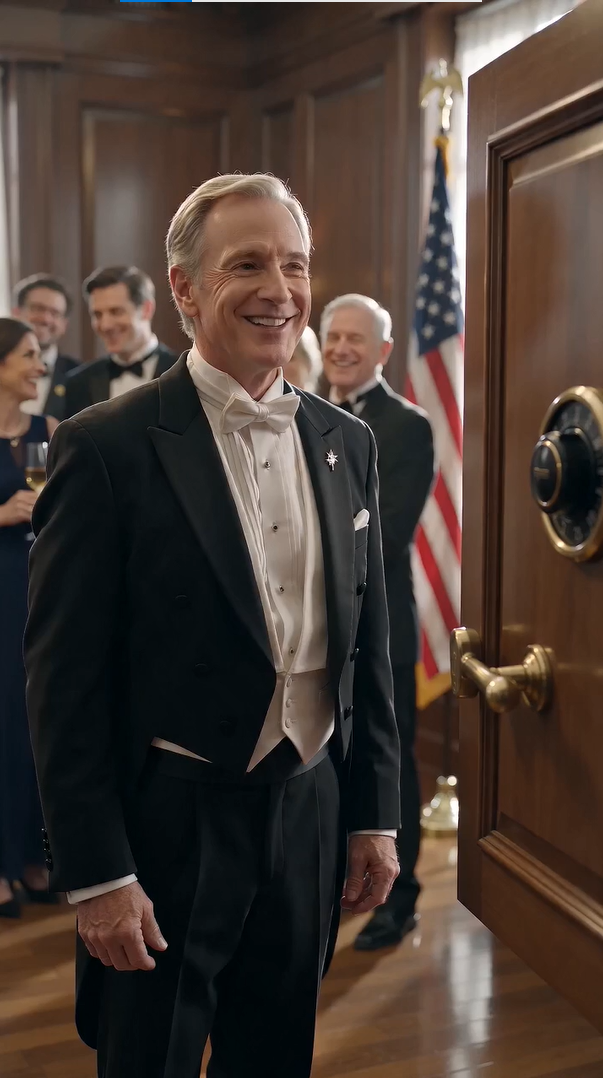
The invitation had been a mistake. Everyone in that ballroom knew it.
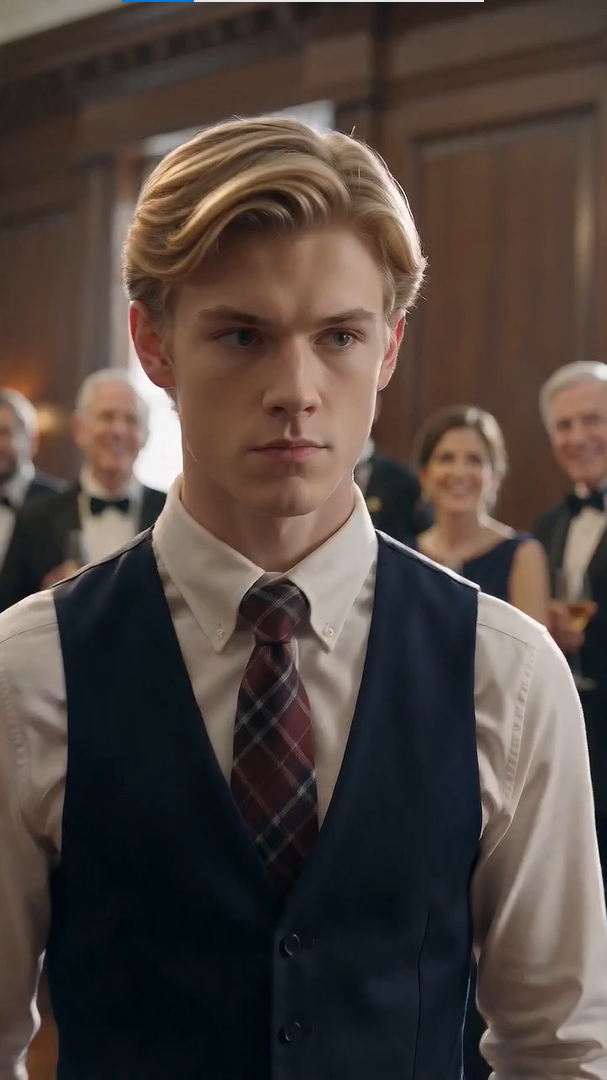
Marcus stood just inside the gilded entrance of the Vale estate, eleven years old in his dead father’s blazer, sleeves swallowing his wrists. Around him, men in cufflinks laughed at things that weren’t funny. Women in diamonds glanced at him the way people glance at a stain on a tablecloth.
Someone had bet him fifty dollars he wouldn’t walk in.
He’d taken the bet.
“You lost, kid,” said a boy about his age, silk tie and a smirk. “Security’s going to throw you out in about thirty seconds.”
“I haven’t touched anything yet,” Marcus said.
“You breathed wrong. That’s enough.”
A hand landed on Marcus’s shoulder.
Heavy.
Deliberate.
He turned to find a tall man with silver hair and a smile that didn’t reach anywhere near his eyes.
“Adrian Vale,” the man said, like the name was a gift he was giving. “And you are?”
“Marcus Reyes.”
Something shifted in Vale’s face.
Just a flicker.
Then the smile widened.
“Reyes,” he repeated slowly. “Well. You have nerve, Marcus Reyes. I’ll give you that. How would you like to earn something tonight?”
The whole room was watching now.
“There’s a safe in this room,” Vale said, loud enough for everyone. “Old family piece. Nobody’s opened it in years. I’ve lost the combination.”
He gestured toward the far wall, where a golden safe sat recessed into dark paneling.
“First person to open it keeps whatever’s inside.”
Laughter rippled.
Crystal clinked.
“He’s serious?” a woman murmured.
“It’s a parlor trick,” said another. “He does this.”
“Go on, boy,” Vale said, still smiling. “Ten thousand if you open it.”
Marcus looked at the safe.
He looked at Vale’s smile.
Then he walked across the marble floor while sixty people watched.
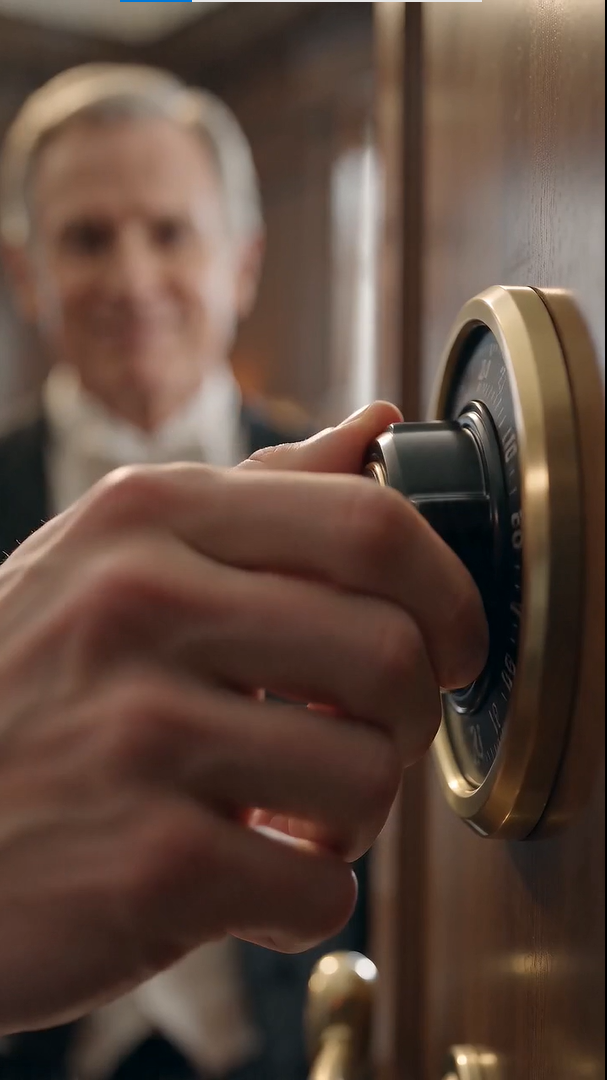
The safe was old, far older than the room around it. The dial was worn smooth. Marcus pressed his ear close the way his father had taught him with the old lockbox they’d kept beneath their kitchen sink.
Listen for the click that sounds like it means it.
He turned the dial.
Click.
Click.
Click.
The room had gone very quiet.
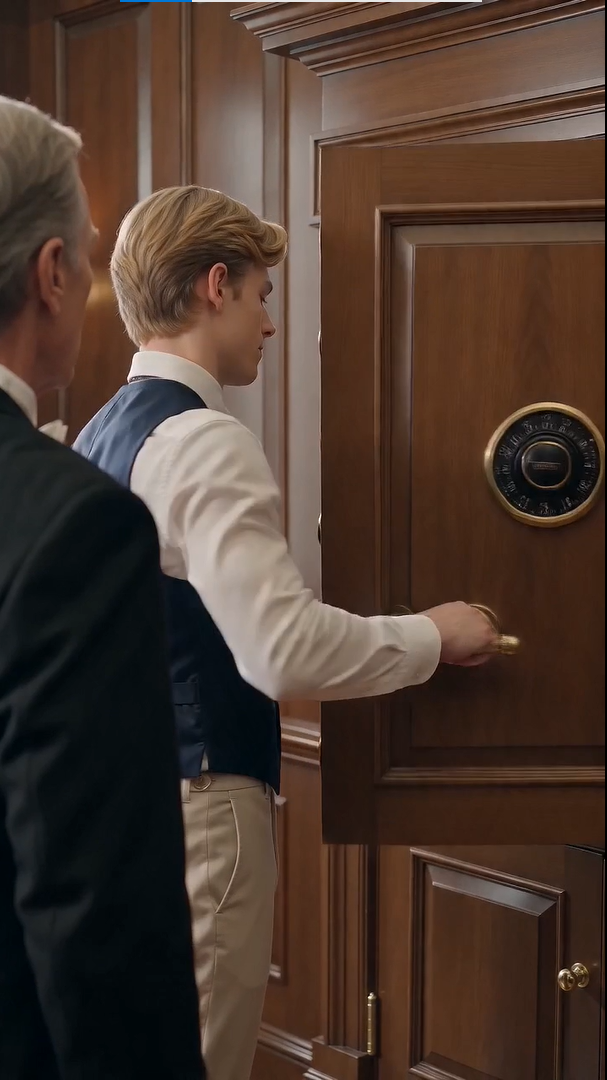
He pulled.
The golden doors opened with a low groan.
There was no pile of jewels inside.
No stacks of money.
No treasure worthy of the laughter and champagne surrounding him.
Only a small wooden box.
And a framed photograph.
Marcus lifted the photograph with both hands.
His father stood in it, younger, smiling. The smile Marcus only knew from birthday cards and one faded snapshot on their refrigerator. Beside his father stood a woman in a silk gown, beautiful and laughing, holding a newborn wrapped in white.
Behind them stood Adrian Vale.
But that wasn’t the thing that stopped Marcus’s breath.
The woman in the silk gown, the woman standing inside this very estate, laughing like she belonged here, like she owned here, was his mother.
His mother, who worked the overnight shift washing dishes at the hospital cafeteria.
His mother, who rationed her blood pressure medication because they couldn’t always afford the full prescription.
His mother, who told him his father had been a good man who worked hard and died too young.
His mother in silk.
Twenty years ago.
In this house.
“Why is my mother in your house?”
His voice came out strange and too loud.
Vale said nothing.
An older woman nearby stepped forward, champagne glass trembling. She was in her seventies, pearls at her throat, and she was staring at the photograph like she’d seen a ghost.
“That’s Evelyn,” the woman whispered. “That’s Adrian’s daughter. We were told she died overseas.”
The room went very, very still.
Marcus couldn’t feel his legs.
“My mother isn’t dead.”
Every face turned toward Adrian Vale.
His jaw was a hard line.
When he finally spoke, his voice was perfectly controlled.
“She made her choice.”
Marcus opened the wooden box.
Inside lay a birth certificate, his own, he realized, seeing his name. There were several envelopes bound with a rubber band, and an old recording device, small and rectangular, the kind his father had used for voice memos.
His father’s handwriting was across the top envelope.
The same slanted letters Marcus recognized from the birthday cards he still kept in a shoebox under his bed.
For Marcus, if you ever find this.
Dad.
His hands were shaking.
He pressed the play button on the recorder.
Static.
Then his father’s voice, tired and careful, filled the entire ballroom.
“Evelyn. If our son ever hears this, it means your father kept his promise and found a way to destroy me. I need you to know, I never stole from this family. Adrian hid the inheritance your mother left you. He buried it in accounts our lawyer couldn’t touch and told everyone you’d disgraced the family by marrying me. He said it was your punishment for choosing a man without money.”
A pause.
The sound of his father breathing.
“Tell Marcus I was not ashamed of being poor. I was only ashamed I could not protect his mother from the man who decided her life wasn’t hers to live. Everything I tried to rebuild, everything I tried to save for you both, Adrian took it. The letters in that box are the proof. He’s been taking it for twenty years.”
Marcus wasn’t trying to stop his tears anymore.
There wasn’t any point.
His father’s voice cracked through the recording.
“Tell our son I loved him. Tell Evelyn she was never the disgrace. He was.”
The recording ended.
The ballroom was silent except for Marcus’s uneven breathing and the soft clink of a champagne glass being set down.
Adrian Vale had backed away from the open safe.
Three steps.
Four.
As if distance could help him now.
Marcus clutched the photograph against his chest with one arm. He picked up the box of letters with his other hand. He looked up at the man who had let his mother wash dishes and ration pills while her inheritance sat locked in accounts named after shell companies and old grudges.
“My mother wakes up at four in the morning,” he said.
His voice broke twice on the sentence, and he let it.
“She works until midnight. She cuts her medication in half to make it last the month. And all this time…”
He stopped.
Started again.
“All this time you knew she was your daughter?”
Adrian’s eyes flickered.
His mouth opened.
Nothing came out.
That silence cost him everything.
The older woman with the pearls stepped beside Marcus. She reached out and put her hand gently on his shoulder.
“These are the letters?” she asked quietly.
Marcus nodded.
She looked around at the room.
At the guests who had been laughing at a poor boy in an oversized jacket twenty minutes ago and were now standing with their drinks forgotten, some of them with expressions that looked almost like shame.
“I have a very good attorney,” she said, loudly enough for Vale to hear. “And I have known this family for forty years. I knew Evelyn’s mother. I knew what she left behind.”
She looked at Vale.
“I always thought it was strange that a woman that careful left nothing to her own daughter.”
A man in a gray suit had already taken his phone from his pocket.
He wasn’t filming.
He was dialing.
Vale said, “You have no idea what you’re doing.”
“I know exactly what I’m doing,” the older woman said.
She looked down at Marcus.
“Go home to your mother tonight. Take everything in that box. Don’t lose a single piece of paper.”
Marcus looked around the room one last time.
He had come in here as a dare.
As a joke.
A poor kid in an oversized jacket standing in a room full of people who were supposed to be better than him.
He stood straighter.
“I don’t want your ten thousand,” he said to Adrian Vale.
He held up the recorder, small and steady in his hand.
“I want my father’s name back.”
The older woman’s voice was quiet and absolute.
“So does everyone in this room.”
Vale looked around.
He looked at the man who was still dialing.
He looked at the guests who had edged, subtly and unmistakably, away from him.
He looked at the open safe with its empty golden doors.
He had no more moves.
Marcus walked out through the gilded entrance and down the long drive with the photograph pressed against his chest and the box under his arm, the cool night air hitting his face.
He took the bus home.
His mother was in the kitchen when he got back, still in her work uniform, pouring a glass of water.
She turned when she heard the door.
“You’re late,” she said. “Where were you?”
Marcus didn’t answer at first.
He walked to her and placed the photograph in her hands.
She looked at it.
Her face changed in a way he had never seen before.
Layers of something old and locked falling away all at once.
Her fingers traced the silk gown.
The estate.
The woman she used to be.
“Marcus…”
“Dad opened the safe for us,” he said.
His mother held the photograph to her chest, closed her eyes, and for the first time in as long as Marcus could remember, she didn’t look tired.
She looked broken.
Then she looked alive.
Her knees weakened, and Marcus caught her around the waist.
“Mom?”
Evelyn held the photograph with both hands as if it might disappear.
“I thought he burned everything,” she whispered.
“Who?”
“My father.”
Marcus looked down at the box.
“No. Dad hid it.”
Evelyn’s eyes moved to the wooden box under his arm.
For a moment, fear crossed her face.
Not fear of the money.
Not fear of the truth.
Fear of opening a door she had spent twenty years trying to survive without.
Marcus set the box on the kitchen table.
The same table with one wobbly leg.
The same table where they counted coins.
The same table where his mother wrote grocery lists on the backs of old envelopes.
Evelyn sat down slowly.
Marcus pushed the recorder toward her.
“Dad left a message.”
Her hand covered her mouth.
“No.”
“It’s his voice.”
Tears filled her eyes before he pressed play.
Static.
Then the voice.
The kitchen changed.
The peeling paint.
The old kettle.
The medicine bottle near the sink.
The cheap curtains.
Everything seemed to go still and listen.
Evelyn didn’t move through the whole recording.
Not once.
But when Marcus’s father said, Tell Evelyn she was never the disgrace. He was, her face crumpled.
She bent over the table and sobbed like someone had finally unlocked a room inside her chest.
Marcus had seen his mother cry before.
Quietly.
In the bathroom.
In the middle of the night.
When bills came.
When his father’s birthday passed.
But never like this.
Never with her whole body shaking.
Never like she had been waiting for permission to hurt.
He walked around the table and wrapped his arms around her.
She pulled him close.
“I’m sorry,” she cried into his shoulder. “I’m so sorry, baby.”
“For what?”
“For the life you should have had.”
Marcus held her tighter.
“I had you.”
She shook her head.
“You had half of me. The tired half. The scared half. The half that thought if I asked for anything, he would come back and take more.”
Marcus pulled away just enough to look at her.
“He can’t take this now.”
Evelyn looked at the box.
Then at him.
Her voice trembled.
“No. He can’t.”
That night, they didn’t sleep.
Evelyn opened every letter.
Some were from her mother, written before she died, full of love and worry and instructions about the estate.
Some were from Marcus’s father, documenting meetings, bank names, hidden transfers, threats, and the day Adrian Vale had told him, “Poor men don’t win against families like mine.”
There were copies of legal papers.
Old account numbers.
A letter from Evelyn’s mother’s attorney.
A page with Evelyn’s name written over and over in her mother’s handwriting.
For my daughter, Evelyn.
Marcus watched his mother read those words.
Her lips moved silently.
For my daughter.
As if she had forgotten what it felt like to belong to someone who wanted her protected.
Near dawn, Evelyn picked up one final envelope.
It was addressed to her in her father’s handwriting.
She stared at it for a long time.
Then she opened it.
Inside was only one sheet.
One sentence.
You chose poverty, now live in it.
Marcus saw the words before she could hide them.
His stomach turned.
Evelyn folded the page slowly.
For years, that sentence had lived inside her even before she saw it written down.
She had lived in it.
Worked in it.
Raised her son under it.
Taken half pills because of it.
Apologized for needing help because of it.
But now, sitting beside the proof of what had been stolen from her, she looked at the sentence one last time.
Then she tore it in half.
And then again.
And again.
Until the pieces lay scattered on the kitchen table like dead insects.
“I didn’t choose poverty,” she whispered. “I chose love.”
Marcus looked at her.
She wiped her face.
“And your father was worth choosing.”
Three weeks later, Adrian Vale’s estate was frozen pending a fraud investigation.
Six months after that, the inheritance Evelyn Reyes, born Evelyn Vale, had never known she was owed was returned to her with interest, by order of a judge who used the word unconscionable four times in his ruling.
Marcus kept his father’s recording in the shoebox under his bed, beside the birthday cards.
He listened to it sometimes.
Not because it made him sad anymore.
But because it was proof that his father had been exactly the man his mother always said he was.
A good man.
But money did not heal everything at once.
People thought it would.
They thought Evelyn would move into a mansion, buy new dresses, smile in photographs, and forget the hospital cafeteria, the unpaid bills, the fear of pharmacy counters and rent notices.
But pain does not leave because a judge signs paper.
For the first month, Evelyn still woke at four in the morning.
She still reached for her old uniform.
She still counted pills.
She still checked prices twice at the grocery store and put things back even when she didn’t need to.
Marcus noticed.
One afternoon, he found her standing in the medicine aisle, holding the full bottle she could finally afford.
She wasn’t moving.
“Mom?”
She blinked.
“I used to stand here and calculate how long I could last if I skipped every other dose.”
Marcus looked at the bottle in her hand.
Then at her face.
“You don’t have to do that anymore.”
Evelyn nodded.
But tears slipped down anyway.
“I know. My body just doesn’t believe it yet.”
So Marcus did the only thing he knew to do.
He took the bottle gently from her, placed it in the basket, and added another one.
She let out a broken laugh.
“We don’t need two.”
“I know,” he said. “But I want the shelf to know we can.”
She laughed again.

Then she cried right there in the aisle while Marcus held her hand.
People looked.
He didn’t care.
He had seen rich people stare at him like he was nothing.
He had seen a ballroom go silent when the truth came out.
A few strangers in a pharmacy could not scare him anymore.
The older woman with the pearls visited them often after that.
Her name was Mrs. Whitmore.
At first, Evelyn couldn’t look at her without flinching, because Mrs. Whitmore belonged to the world that had thrown her away.
But Mrs. Whitmore never came with pity.
She came with documents.
Names.
Old photographs.
Memories of Evelyn’s mother.
“She loved you fiercely,” Mrs. Whitmore told her one rainy afternoon.
Evelyn sat across from her, hands wrapped around a mug of tea.
“My father told me she was disappointed in me.”
Mrs. Whitmore’s face hardened.
“Your father lied whenever truth was inconvenient.”
Evelyn looked down.
“I believed him.”
“You were young.”
“I was a daughter.”
Mrs. Whitmore’s eyes softened.
“Yes. And daughters are supposed to be protected by fathers, not punished by them.”
Evelyn looked toward the hallway, where Marcus was doing homework.
“Marcus walked into that house because someone dared him.”
Mrs. Whitmore smiled sadly.
“No. He walked in because your husband raised a brave son, even after death.”
That sentence stayed with Evelyn.
That night, she took Marcus to the cemetery.
They hadn’t gone in months because each visit used to make her feel guilty.
Guilty she had survived.
Guilty she had nothing better to bring than cheap flowers.
Guilty that she had not been able to prove what had been done to him.
But this time, she brought the photograph from the safe.
And the recorder.
And one white rose.
Marcus stood beside her at his father’s grave.
The grass was damp.
The evening air smelled like rain.
Evelyn knelt and brushed dirt from the stone with her fingertips.
“I found it,” she whispered.
Her voice broke.
“Or maybe you found us.”
Marcus stood very still.
Evelyn placed the photograph against the headstone.
“You were right,” she said. “You were right about all of it. And I’m sorry I couldn’t fight longer.”
The wind moved through the trees.
Marcus bent down and placed the recorder beside the rose.
“Dad,” he whispered, “I opened it.”
His throat tightened.
“I heard you.”
Evelyn reached for his hand.
Marcus kept looking at the stone.
“I wish you were here.”
The words came out small.
Like the eleven-year-old boy finally sounded eleven.
Evelyn pulled him into her arms.
For a long time, they stayed like that.
Mother and son.
Holding each other in front of the man who had left behind one last way to protect them.
The court case became city news.
Reporters stood outside the Vale estate.
Articles called Adrian a titan.
A fraud.
A fallen power.
A ruthless patriarch.
But Marcus hated one phrase most of all.
Secret heir.
He was not a secret.
His mother was not a scandal.
His father was not a thief.
They were a family someone had tried to erase.
Evelyn refused most interviews.
But one day, after another headline described her as Adrian Vale’s runaway daughter, she agreed to speak.
Not from the estate.
Not from a lawyer’s office.
From their old kitchen.
The reporter seemed surprised.
“You could meet anywhere now,” she said.
Evelyn looked around the small room.
The chipped counter.
The faded curtains.
The table where Marcus’s father’s truth had been heard for the first time.
“This is where my son brought me back my name,” Evelyn said. “This is where the story should be told.”
The interview was short.
Evelyn did not cry on command.
She did not perform pain for strangers.
She only said what needed to be said.
“My husband was accused of stealing from a family that was stealing from us. My son was laughed at by people who thought poverty meant weakness. My father did not punish me because I chose wrong. He punished me because I chose for myself.”
The reporter asked, “What do you want now?”
Evelyn looked at Marcus.
He was sitting quietly at the end of the table, his father’s blazer folded beside him.
“I want my son to grow up knowing the truth,” she said. “And I want every person who helped bury it to understand that silence is not innocence.”
That line spread through the city.
Silence is not innocence.
Some guests from that night called to apologize.
Most did not.
Some sent flowers.
Marcus threw away the ones that arrived without names.
Mrs. Whitmore helped Evelyn set up a trust in Marcus’s father’s name.
Not for luxury.
Not for revenge.
For families like theirs.
For widows fighting stolen benefits.
For children who had lost parents and were told paperwork mattered more than grief.
For workers who had been bullied by powerful people and couldn’t afford lawyers.
Evelyn named it The Reyes Fund.
When the sign was unveiled, Marcus stood beside his mother in a clean jacket that actually fit.
He looked at the letters.
Reyes.
His father’s name.
His name.
No longer whispered.
No longer buried.
Evelyn touched the sign with trembling fingers.
“Your dad would have laughed at all this attention,” she said.
Marcus smiled.
“Then he would have asked if there was food.”
Evelyn laughed through tears.
“Yes. He would have.”
For the first time, talking about him didn’t only hurt.
It warmed.
It filled the space instead of emptying it.
Adrian Vale never apologized.
Not truly.
Through lawyers, he said he regretted misunderstandings.
Through statements, he denied cruelty.
Through clenched teeth in court, he admitted only what the evidence forced him to admit.
But Marcus stopped waiting for his apology.
One day, before Adrian was moved out of the estate, Marcus and Evelyn returned there.
The gates opened for them this time.
No dare.
No laughter.
No one telling him he breathed wrong.
The ballroom was empty.
Without people, it looked smaller.
The chandeliers still glittered.
The marble still shone.
The golden safe was still set into the wall, its heavy brass door closed again.
Marcus stood in front of it.
Evelyn stood beside him.
“This was the room?” she asked.
He nodded.
Her face tightened.
“I’m sorry you had to be alone here.”
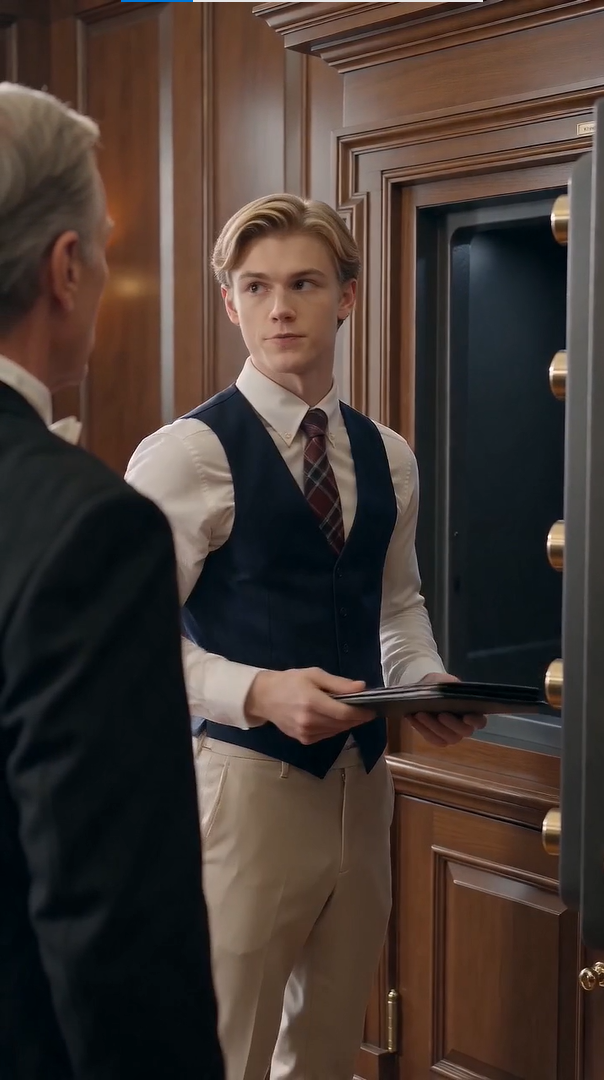
Marcus looked at the safe.
“I wasn’t alone. Dad was in there.”
Evelyn’s eyes filled.
She took his hand.
Together, they walked to the safe.
Marcus placed his palm against the cold brass door.
For a moment, he remembered the laughter.
The smirking boy.
Vale’s hand on his shoulder.
The way the room had treated him like entertainment.
Then he remembered the click.
The photograph.
His father’s voice.
The truth.
He turned to his mother.
“Do you want to open it?”
Evelyn hesitated.
Then nodded.
Marcus showed her where to place her ear.
How to breathe.
How to listen.
She turned the dial slowly.
Click.
Click.
Click.
The door opened.
Empty now.
But not really.
Evelyn looked inside and began to cry softly.
Not because there was anything left to find.
Because there wasn’t.
The safe that had once held her stolen life was empty.
It had no power over her anymore.
She reached into her coat and pulled out the torn pieces of Adrian’s letter.
You chose poverty, now live in it.
She had kept them in an envelope.
Not because she valued them.
Because she had wanted this moment.
She placed the pieces inside the safe.
Then she closed the brass door.
Marcus looked at her.
“You’re locking it away?”
Evelyn wiped her face.
“No,” she said. “I’m leaving it where it belongs.”
They walked out of the Vale estate before sunset.
Not as beggars.
Not as disgraced family.
Not as people asking permission to belong.
As Evelyn Reyes and Marcus Reyes.
Mother and son.
Carrying nothing from that house except what had always been theirs.
Months became years.
Marcus grew taller.
The blazer that had once swallowed his wrists was framed in their hallway, not because it was expensive, but because it had become a symbol.
The night he walked in unseen and walked out heard.
Evelyn’s health improved.
Her laugh came back slowly.
At first, it surprised Marcus when he heard it from another room.
Then it became normal.
She went back to school, not because she had to work to survive, but because she wanted to learn the things she had been forced to give up.
She studied law.
People said it was too late.
She smiled at that.
Too late was a word other people used when they didn’t want you to begin.
Marcus watched her study at the kitchen table, surrounded by books, highlighters, and cups of tea.
Sometimes he teased her.
“You have homework?”
She would point her pen at him.
“So do you.”
They did it together.
Mother and son.
Building a life no one could steal with signatures, threats, or locked safes.
On Marcus’s sixteenth birthday, Evelyn gave him the wooden box.
He stared at it.
“I thought you kept this locked away.”
“I did,” she said. “Until I realized it was never meant to be a wound. It was meant to be a witness.”
Inside were the letters, the birth certificate, the photograph, and the recorder.
But there was something new too.
A letter from Evelyn.
Marcus opened it with careful hands.
My son,
You were eleven when you walked into a room built to make you feel small.
You opened a safe full of secrets, but you also opened a door I thought had been sealed forever.
You gave me back my mother.
You gave your father back his honor.
You gave yourself back a name no one could laugh at again.
But I need you to remember this.
You were never worthy because of inheritance.
You were never important because a judge said so.
You were never powerful because a rich man fell.
You were always enough.
Before the safe.
Before the money.
Before the truth came out.
You were enough when you wore your father’s old blazer and rode the bus home with shaking hands.
You were enough when all you had was courage.
And that will always be worth more than gold.
Love,
Mom.
Marcus read the letter twice.
Then a third time.
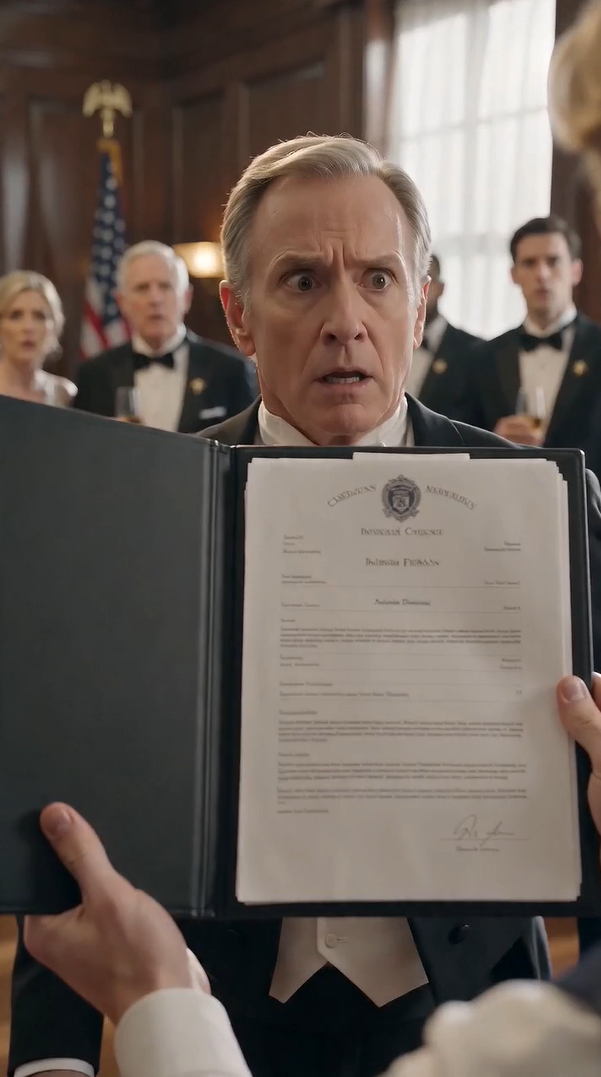
When he looked up, his eyes were wet.
Evelyn smiled through her own tears.
“Happy birthday.”
He hugged her so hard she laughed.
Years later, people still talked about the night Adrian Vale challenged a poor kid to open his safe.
They remembered the golden doors.
The wooden box.
The recording that silenced a ballroom.
They remembered how the billionaire laughed before the click and stopped laughing forever after it.
But Marcus remembered the bus ride home.
The weight of the photograph against his chest.
The way his mother’s face changed when she saw who she used to be.
He remembered the pharmacy aisle, the cemetery, the empty safe, and the first time his mother laughed without sounding tired.
Most of all, he remembered his father’s voice.
Tell our son I loved him.
And he believed it.
Not because the world finally did.
Not because the court restored the money.
Not because Adrian Vale lost everything.
Marcus believed it because love had survived the one place greed thought it could bury it.
Inside a locked safe.
Behind a golden door.
Waiting for a boy brave enough to listen for the right click.