
Jonathan smiled. “That’s the question real players ask.”
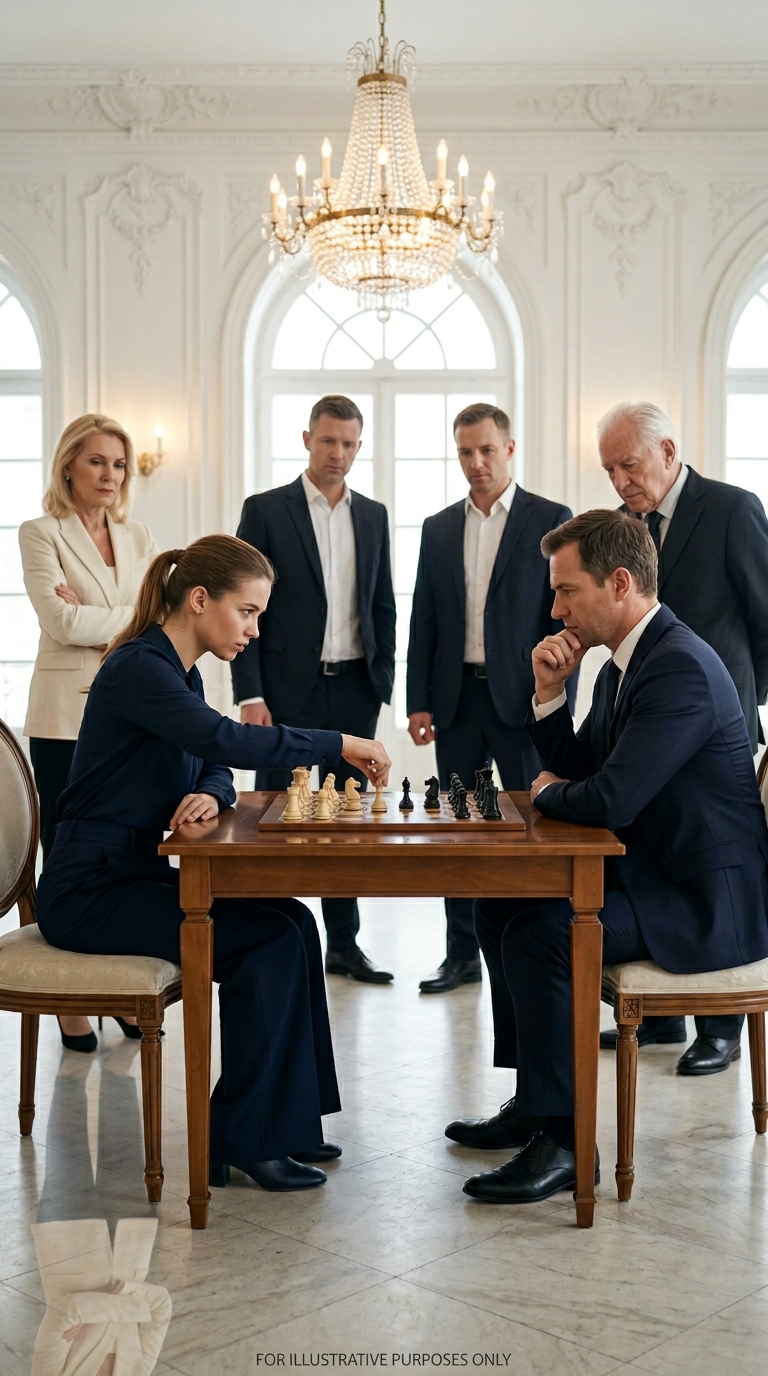
In the final round, Emma faced the top seed, a boy who had already won regional events. A small crowd gathered as the game stretched on. Emma sat still, chin tucked, her little fingers hovering above the board.
Then she sacrificed her queen.
A parent gasped.
The boy blinked, took the queen, and only then realized the trap.
Three moves later, Emma said, “Checkmate.”
Applause broke the silence.
Emma finished second.
When she stood on the small stage with a silver medal around her neck, her face glowed with something Martha had never been able to buy for her.
Belonging.
That night, after Emma fell asleep clutching the medal, Martha stood in the doorway of their small apartment and looked at her daughter.
She had spent years trying to protect Emma from wanting too much.
Now she wondered if love meant letting her reach anyway.
Part 2
The newspaper article was small, but it changed everything.
“Chess prodigy emerges from unlikely background.”
Martha hated the word unlikely.
She hated the way the reporter described her as a single mother and custodian before mentioning Emma’s name. She hated the smiling messages from people who had never noticed Emma before. She hated the principal suddenly calling her daughter “exceptional” when six months earlier the school had told Martha that Emma needed to stop asking “disruptive questions.”
Jonathan, however, seemed unsurprised.
“Attention was inevitable,” he said over coffee one Sunday while Emma and Robert studied a game across the café.
“She’s a child, not a headline,” Martha replied.
Jonathan’s face softened. “I know.”
“Do you?” she asked. “Because people like you are used to attention. People like us are used to being watched only when someone thinks we did something wrong.”
He did not answer quickly, which Martha respected more than she wanted to.
Finally he said, “Then we make rules. No interviews without your permission. No photographs unless Emma agrees. No pressure from me, Robert, the school, or anyone else.”
“And when everyone expects her to win?”
“Then I remind her that chess is not about becoming what other people need her to be.”
Martha looked across the café.
Emma was explaining something to Robert with her hands, moving invisible pieces through the air. Her face was bright. Alive.
“She wants this,” Martha said quietly.
Jonathan nodded. “Yes.”
“And what happens if she gets it?”
He looked at her. “Then her life changes.”
Martha closed her eyes.
That was what she feared.
Emma’s life did change.
Westfield Academy, one of Boston’s most elite private schools, offered a full scholarship after Emma placed third at the New England Scholastic Championship. Martha walked through the school’s brick archway on the first day feeling like someone had made a clerical error.
The other parents wore wool coats and confidence. Martha wore her only black dress and shoes that pinched.
Emma wore a navy blazer, a plaid skirt, and a nervous expression.
“Remember,” Martha whispered, kneeling to straighten her collar, “your mind earned you this place.”
Emma nodded. “Will you be here after school?”
“I have to work. But Mr. Jonathan arranged for Ms. Peterson to bring you to his office for your lesson with Robert.”
Emma’s eyes flickered.
The new life came with schedules, rides, forms, tournament fees, chess camps, homework, interviews, rankings. Everything good seemed to arrive with a bill attached.
Jonathan paid many of those bills.
Martha allowed it because Emma’s talent needed support, because Robert insisted it was normal, because Jonathan used words like sponsorship and development program instead of charity.
But every time Martha signed another form, she felt the invisible debt grow heavier.
Then came the apartment.
Martha had been working sixty hours a week to afford a place close enough to Westfield. One night, after Emma fell asleep over her homework, Martha called Jonathan and admitted she was drowning.
Jonathan listened.
Then he said, “Hartwell Technologies owns a corporate apartment two blocks from Westfield. It’s empty.”
“No.”
“Martha.”
“No, Jonathan.”
“You haven’t heard the terms.”
“I already know the terms. Rich people call it help. Poor people call it dependence.”
He went quiet.
She regretted the words instantly, but not enough to take them back.
Finally, he said, “Then let me say it differently. Emma’s training schedule is unsustainable if you are exhausted and she is traveling across the city every day. The apartment is company property. It can be assigned as part of a formal chess development sponsorship. You will sign paperwork. You will owe me nothing.”
“And if the company changes its mind?”
“Then I will handle the company.”
She laughed once, bitterly. “That easy?”
“No,” he admitted. “But I have spent my life fighting men in suits. You have spent yours fighting bills, landlords, school forms, and the quiet humiliation of being underestimated. Don’t pretend I’m the only one here who knows how to fight.”
That stopped her.
Two weeks later, Martha and Emma moved into the corporate apartment.
It had two bedrooms, clean windows, warm light, and a desk where Emma could leave her chessboard set up without folding it away for dinner. On the first night, Emma stood at the window and watched the lights of Boston.
“Mom,” she said, “is this ours?”
Martha took a slow breath. “For now.”
Emma looked down. “I liked when our old place was ours.”
Martha sat beside her. “Me too.”
“Then why are we here?”
“Because sometimes help is a bridge,” Martha said carefully. “We just have to remember it’s not the ground.”
Emma thought about that. “Like a temporary square?”
Martha smiled sadly. “Exactly.”
The national tournament in Chicago arrived four months later.
More than a thousand children filled the convention center. Coaches with clipboards. Parents with laptops. Children in team jackets embroidered with names from private academies Martha had never heard of.
Emma’s name drew whispers.
“That’s the Boston girl.”
“She’s only been playing a year.”
“Robert Winters is coaching her.”
Jonathan stood beside Martha, proud but tense. He kept checking his phone.
“What’s wrong?” Martha asked.
“Business.”
“You’re lying.”
His mouth tightened. “The board is unhappy with how much time I’ve devoted to Emma’s development.”
Martha felt cold. “Because of us.”
“No.”
“Don’t insult me.”
Jonathan looked at her then. “Because they understand quarterly returns better than human potential.”
Emma won her first two games and drew the third. On day two, she defeated the top seed with a bishop sacrifice that made spectators gather around her board. By the end, she placed fifth in the country for her age division.
The applause was thunderous.
Martha cried behind her hand.
Emma ran into Jonathan’s arms first.
Martha saw it.
She saw the way Jonathan held her daughter carefully, like something precious. She saw the way Emma trusted him. She saw the way his face changed when he looked over Emma’s head and found Martha watching.
That was when the danger became clear.
Not the danger of money.
The danger of love.
That night, in the hotel lounge, Martha confronted him.
“Your board is right,” she said.
Jonathan turned from the window. “About what?”
“You’re too involved.”
His expression sharpened. “Emma is extraordinary.”
“Emma is a child.”
“I know that.”
“Do you? Because sometimes I think everyone sees her gift before they see her age.”
“I see both.”
“And me?” Martha asked before she could stop herself. “What do you see when you look at me?”
The silence between them changed.
Jonathan did not look away.
“I see a woman who has carried more than anyone should and still made room for her daughter to dream,” he said. “I see courage. Pride. Fear. Love. And I see someone I care about more than is convenient.”
Martha’s breath caught.
“That complicates everything,” she whispered.
“Yes,” he said. “It does.”
The next week, Jonathan’s board froze all discretionary sponsorship funds.
Martha found out from Robert, not Jonathan.
“London will cost around twenty thousand dollars,” Robert said, his voice heavy. “The International Youth Championship is important, Martha. She would face children from countries that identify talent early and train them properly. It would be invaluable.”
Martha stared at the number on the paper.
Twenty thousand dollars.
That was not a tournament.
That was survival money. Rent, food, emergencies, years of saying no to herself so Emma could have yes.
Jonathan offered to pay personally.
Martha refused.
He argued.
She refused harder.
Then she did something Jonathan never saw coming.
She went to Hartwell Technologies wearing her one good dress and asked to meet Eleanor Blackwood, the board chair.
The receptionist stared at her.
Martha stared back.
An hour later, she sat across from Eleanor in a conference room with a view Martha had cleaned from the other side of the glass.
Eleanor Blackwood was elegant, silver-haired, and cold enough to chill the coffee between them.
“Mrs. Wilson,” Eleanor said, “this is unusual.”
“I’ll be direct,” Martha replied. “You believe my daughter is interfering with Jonathan’s responsibilities.”
Eleanor’s eyebrow lifted. “We believe Mr. Hartwell’s personal interests have become entangled with corporate resources.”
“Then I’m removing the entanglement.”
For the first time, Eleanor looked surprised.
“Emma will withdraw from Jonathan’s mentorship. We’ll leave the apartment next month. She will not attend London through Hartwell funding.”
Eleanor studied her. “You would deny your daughter an opportunity to make a point?”
“No,” Martha said, her voice shaking but firm. “I would deny powerful people the chance to use my daughter as evidence in a fight she doesn’t understand.”
Eleanor said nothing.
Martha stood. “Emma is not a pet project. She is not a brand story. She is not proof that wealthy people are generous. She is a child with a gift. If your board cannot tell the difference, then you should all stay away from her.”
She left before Eleanor could answer.
That evening, Martha called Jonathan.
“We’re moving out,” she said.
The silence on the line hurt more than shouting would have.
“Martha,” Jonathan said finally, “please don’t do this.”
“I have to.”
“No. You don’t.”
“You admitted you have feelings for me. Your board is punishing you for helping Emma. Emma is attached to you. I’m attached to things I can’t afford to lose. This has gone too far.”
“So your solution is to make Emma lose something now so she won’t possibly lose it later?”
The words struck like a slap.
Martha closed her eyes.
“I’m protecting her.”
“From me?”
“From dependence.”
“Or from hope?”
She hung up because she had no answer.
The small apartment in Brighton had thin walls, a stubborn radiator, and a kitchen barely large enough for two chairs. But Martha paid for it herself.
Emma did not complain.
That made it worse.
She continued at Westfield. She trained with Coach Levenson. She won matches.
But the spark faded.
She stopped laughing over positions. Stopped calling Jonathan after tournaments. Stopped carrying her chessboard to breakfast.
At the regional qualifier, Emma placed second. A strong result. A respectable result.
Not an Emma result.
Martha watched her daughter scan the entrance between rounds.
“Were you looking for someone?” Martha asked, already knowing.
Emma looked down. “I thought Mr. Jonathan might come.”
Martha’s heart broke quietly.
After the final round, a tournament volunteer approached.
“Mrs. Wilson? Someone is asking for you.”
Martha’s pulse jumped.
But it was not Jonathan.
It was Eleanor Blackwood.
She stood beside the registration table in a camel coat, looking painfully out of place among children eating vending machine snacks.
“Mrs. Wilson,” Eleanor said. “Emma. Congratulations.”
Emma nodded politely. “Thank you.”
Eleanor looked at Martha. “May we speak?”
In the empty cafeteria, Eleanor set a folder on the table.
“I reviewed Emma’s achievements,” she said. “Then I reviewed Jonathan’s performance during the period of his involvement with her. Contrary to the board’s concerns, his strongest product ideas, highest-performing acquisition decisions, and most effective leadership initiatives occurred during the same period.”
Martha frowned. “What are you saying?”
“I’m saying we were wrong.”
Martha did not trust the words.
Eleanor continued. “The board has voted to reinstate the mentorship funding under a new corporate initiative. Chess for All. Educational access. STEM enrichment. Community outreach. Jonathan refused.”
“Why?”
“Because he believes you want nothing further to do with him.”
Emma spoke before Martha could.
“Is Mr. Jonathan okay?”
Something in Eleanor’s face softened.
“No,” she said honestly. “I don’t think he is.”
Martha looked at the folder. “Why are you telling me this?”
Eleanor hesitated.
Then she opened it.
Inside was an old document with Hartwell Technologies letterhead dated seventeen years earlier.
“My predecessor buried this,” Eleanor said. “I found it while reviewing the old corporate philanthropy files after our conversation. Jonathan’s mother, Helen Hartwell, created a fund before she died. The purpose was to support gifted children from low-income families in Boston. It was never activated.”
Martha stared at the page.
“She was a janitor’s daughter,” Eleanor said quietly. “Helen Hartwell. Jonathan doesn’t talk about it. His father hated that part of her history. After she died, the fund became inconvenient. Messy. Unprofitable. So it was shelved.”
Martha’s throat tightened.
Eleanor closed the folder.
“Jonathan did not start this because of charity. He started it because some part of him recognized the promise his mother left behind.”
Part 3
Martha called Jonathan that night with her hands shaking.
He answered on the first ring.
“Martha? Is Emma all right?”
“She’s fine.”
A pause.
“Are you?”
“No,” she said.
The honesty startled them both.
She sat at the tiny kitchen table while Emma slept in the next room, her silver medals lined along the windowsill because there was no shelf. Outside, traffic hissed over wet pavement. Boston looked different from the Brighton apartment, less like a skyline and more like a fight.
“We saw Eleanor today,” Martha said.
Jonathan exhaled slowly. “I see.”
“She told me about the board reversing its decision.”
“She shouldn’t have bothered you.”
“She told me about your mother.”
Silence.
This time it was not empty. It was full of grief.
Jonathan said, very quietly, “What exactly did she tell you?”
“That Helen Hartwell created a fund for gifted children from families like mine. That it was buried. That she was a janitor’s daughter.”
Jonathan did not speak for so long Martha thought the call had dropped.
Then he said, “My father spent my whole childhood trying to polish that truth out of our family history. My mother never let him. She said being poor taught her to see people who were trained to disappear.”
Martha closed her eyes.
“Why didn’t you tell me?”
“Because I didn’t want you to feel like Emma was a substitute for my mother’s unfinished dream.”
“Was she?”
“No,” Jonathan said. “Emma is Emma. But maybe my mother taught me enough to know what I was seeing when everyone else would have looked away.”
Martha wiped her cheek.
“I made a mistake,” she whispered. “I thought I was protecting Emma from being hurt later, but I hurt her now.”
“You were scared.”
“I was proud.”
“You were both.”
She gave a small, broken laugh. “You’re not supposed to make me sound reasonable.”
“You are reasonable. You’re also impossible.”
“Emma misses you.”
“I miss her.”
“She placed second today.”
“I know.”
Martha smiled through tears. “Of course you know.”
“I followed the results online.”
“She kept looking for you.”
Jonathan’s voice changed. “I didn’t come because I promised I would respect your boundaries.”
“I know.” Martha swallowed. “The state championship is next month. She wants you there.”
“And you?”
The question was gentle, but it landed hard.
Martha looked around the apartment she had chosen out of fear and dignity and love. She thought of the corporate apartment she had left because she had refused to confuse a bridge with solid ground. She thought of Helen Hartwell, a janitor’s daughter whose promise had waited seventeen years in a buried file.
“I want you there too,” Martha said.
Jonathan breathed out.
“Then I’ll be there.”
The state championship was held at a hotel ballroom in Cambridge. Emma arrived wearing a green sweater Martha had bought on sale, her curls pinned back with two clips, her chess bag hugged against her chest.
Jonathan and Robert were waiting near the entrance.
Emma stopped walking.
For one second, she looked like the little girl in Jonathan’s office again, uncertain whether she was allowed to reach for something beautiful.
Then Jonathan knelt.
“Hello, champion.”
Emma ran to him.
He hugged her tightly, eyes closing over her shoulder.
Martha looked away, not because she disapproved, but because some moments were too tender to watch directly.
Robert cleared his throat. “Well, if everyone is finished making an emotional spectacle, we have openings to review.”
Emma laughed.
There it was.
The spark.
She played the first round like a child who had remembered joy. Not reckless, not careless, but alive. Her pieces moved with rhythm. Her eyes brightened. She won with a rook sacrifice that made Robert mutter, “Completely unnecessary and absolutely beautiful.”
By the final round, Emma was tied for first.
Her opponent was a polished ten-year-old from New York named Caleb Morris, a national player with a private coach, a custom clock, and the calm arrogance of a child raised to expect victory.
The ballroom quieted as the game stretched into its third hour.
Martha stood between Jonathan and Robert, barely breathing.
Emma’s position was complicated. Too complicated for Martha to understand. But she understood faces.
Robert’s face was worried.
Jonathan’s was still.
Emma’s clock ticked down.
Caleb offered a draw.
A safe result. Enough for second place. Enough for applause.
Emma looked at him.
Then she looked toward Martha.
Martha did not know what to do. She was not Robert. She could not calculate variations or understand the danger.
But she knew her daughter.
So she smiled and mouthed, “Your choice.”
Emma turned back to the board.
She declined the draw.
A whisper moved through the spectators.
Caleb’s mouth tightened.
Five moves later, Emma gave up a knight.
Three moves after that, she gave up a bishop.
Martha’s stomach dropped.
But Robert’s eyes widened.
“Oh,” he whispered.
Jonathan leaned forward.
Emma had not sacrificed pieces.
She had built a cage.
Caleb saw it too late.
When Emma moved her queen to h6, the ballroom seemed to hold its breath.
Caleb stared.
His coach closed his eyes.
“Checkmate,” Emma said softly.
For a second, nobody moved.
Then applause rose around her like a wave.
Emma Wilson, the janitor’s daughter, was Massachusetts State Scholastic Champion.
Martha cried openly this time.
Jonathan did not hide his tears either.
After the ceremony, reporters gathered. Cameras flashed. Someone asked Emma how it felt to prove that background did not matter in chess.
Emma looked confused.
Then she said, “Background matters. It’s just not supposed to decide everything.”
The quote went viral by morning.
So did the photograph of Emma standing on the stage between Martha, Jonathan, and Robert, her trophy almost too big for her arms.
That photograph forced Hartwell Technologies into the spotlight again, but this time Jonathan did not wait for the board to manage the story.
At the next shareholder meeting, he walked onto the stage with Helen Hartwell’s forgotten documents in his hand.
“My mother created a fund seventeen years ago,” he told the room. “It was meant to find gifted children who were invisible to systems built for families with money. That fund was buried because it did not produce immediate financial returns.”
He paused.
A thousand people watched from the audience and online.
“That was a failure of imagination. Today, Hartwell Technologies is correcting it.”
On the screen behind him appeared the words Chess for All.
The program would fund chess education, academic support, tournament travel, and mentorship for children from underserved communities across Boston. Not as charity. Not as publicity. As investment in human potential.
Then Jonathan did something nobody expected.
He invited Martha to speak.
She nearly refused.
Then she thought of every parent who had ever looked at a form, a fee, a school email, a child’s dream, and felt the private shame of not having enough.
She walked to the microphone.
“My daughter is brilliant,” Martha said, her voice trembling at first. “But brilliance does not pay entry fees. It does not buy bus passes. It does not shorten a mother’s work shift. It does not make teachers listen. Talent matters, yes. But access decides whether talent survives.”
The room was silent.
Martha looked at Jonathan, then at Emma sitting in the front row.
“So if this program is going to mean anything, it cannot be about saving one lucky child. It has to be about changing how many children get seen before it is too late.”
The applause began slowly, then grew.
Eleanor Blackwood stood first.
Others followed.
Months passed.
Chess for All opened its first community room in South Boston, in a center where children came after school because their parents worked late and could not afford enrichment programs with glossy brochures.
Emma, now ten, insisted on teaching the beginner class.
Her first student was a six-year-old boy named Marcus who kept knocking over pawns and asking if knights were allowed to jump over “bad guys.”
Emma answered every question seriously.
Jonathan watched from the doorway.
Martha stood beside him.
“She’s good with them,” he said.
“She remembers what it felt like not to know the names of things she already understood.”
Across the room, Robert was losing an exhibition match to three children at once and pretending not to be offended.
Emma looked up and waved.
Martha waved back.
Her life was still not easy. She still worked, though fewer hours now, as facilities supervisor at Hartwell’s new community education wing. She still lived in the Brighton apartment because it was theirs. She still worried about Emma’s childhood, Emma’s pressure, Emma’s future.
But she no longer believed accepting help meant surrendering dignity.
Help could be a bridge.
And sometimes, if built honestly, a bridge could become part of the ground.
That evening, after the center emptied, Jonathan found Emma alone at a chessboard near the window. The city outside glowed blue with dusk.
“Studying?” he asked.
Emma nodded. “Thinking.”
“Dangerous habit.”
She smiled. Then her face grew serious. “Are you going to marry my mom?”
Jonathan nearly choked.
Across the room, Martha froze while stacking chairs.
Emma looked between them. “What? I notice things.”
Robert burst out laughing so loudly he had to leave the room.
Jonathan rubbed the back of his neck. “That is a conversation for your mother and me.”
Emma nodded wisely. “So yes, but not yet.”
Martha covered her face.
Jonathan looked at her, helpless.
Later, when Emma was busy helping Robert pack the boards, Jonathan stepped beside Martha.
“I was planning to ask you to dinner,” he said.
“You ask me to dinner all the time.”
“Not like this.”
She looked at him.
He was not the untouchable CEO from the glass office anymore. Or maybe he was, but he was also the man who had knelt to teach her daughter pawns, the man who had stepped back when Martha asked him to, the man who had returned without resentment, the man who had turned a buried promise into open doors.
“I don’t want to rush you,” he said. “I don’t want to complicate Emma’s life. I don’t want you to ever feel bought, rescued, or managed.”
“Good,” Martha said. “Because I would hate all of that.”
“I know.”
“But dinner,” she said, “would be fine.”
His smile was quiet and real.
One year later, Emma stood on a stage in New York accepting an award as one of the most promising young chess players in America.
In her speech, she thanked Robert for teaching her discipline, Jonathan for teaching her that strategy was also kindness, and her mother for teaching her that every queen started as someone other people underestimated.
Then she looked out at the crowd.
“I used to think chess was about winning,” Emma said. “Now I think it’s about seeing what others miss. Sometimes that’s a move on a board. Sometimes it’s a person in a hallway. Sometimes it’s a promise hidden in a drawer. But if you see it, you have to do something. Otherwise seeing doesn’t matter.”
Martha sat in the front row with tears in her eyes.
Jonathan reached for her hand.
She let him take it.
Behind them, Robert pretended to study the program so no one would see him crying.
Years from then, people would tell the story as if it had begun with a millionaire CEO discovering a child genius.
But Martha knew the truth.
It began with a tired mother bringing her daughter to work because she had no other choice.
It began with a little girl looking at a chessboard and seeing danger before anyone else did.
It began with one powerful man choosing not to look away.
And it ended not with Emma being saved by wealth, but with wealth finally being forced to serve something worthy.
At the South Boston center, a photograph hung near the entrance.
Emma at seven, standing beside the chessboard in Jonathan’s office.
Below it, a sentence was carved into a small brass plate.
The smallest piece can change the whole game.
Every afternoon, children passed under those words carrying backpacks, snacks, worries, talents, and dreams nobody had measured yet.
Some came for chess.
Some came for quiet.
Some came because the world outside had already told them they were too poor, too late, too difficult, too unlikely.
Inside, someone always looked up.
Someone always said, “Come in. Sit down. Let’s see what you can do.”
And somewhere in that room, Emma Wilson would smile, reset the board, and make sure no child ever had to be invisible before being seen.