My Daughter-In-Law Insisted On Hosting Dinner In M…
My Daughter-In-Law Insisted On Hosting Dinner In My Connecticut Farmhouse, Then Set A Special Glass At The Head Of The Table And Told Me I Looked Tired — She Thought A 68-Year-Old Widow Would Drink What She Was Given, But She Forgot I Had Spent 31 Years Reading Students Who Lied.
The first thing I noticed was the wrong cup.
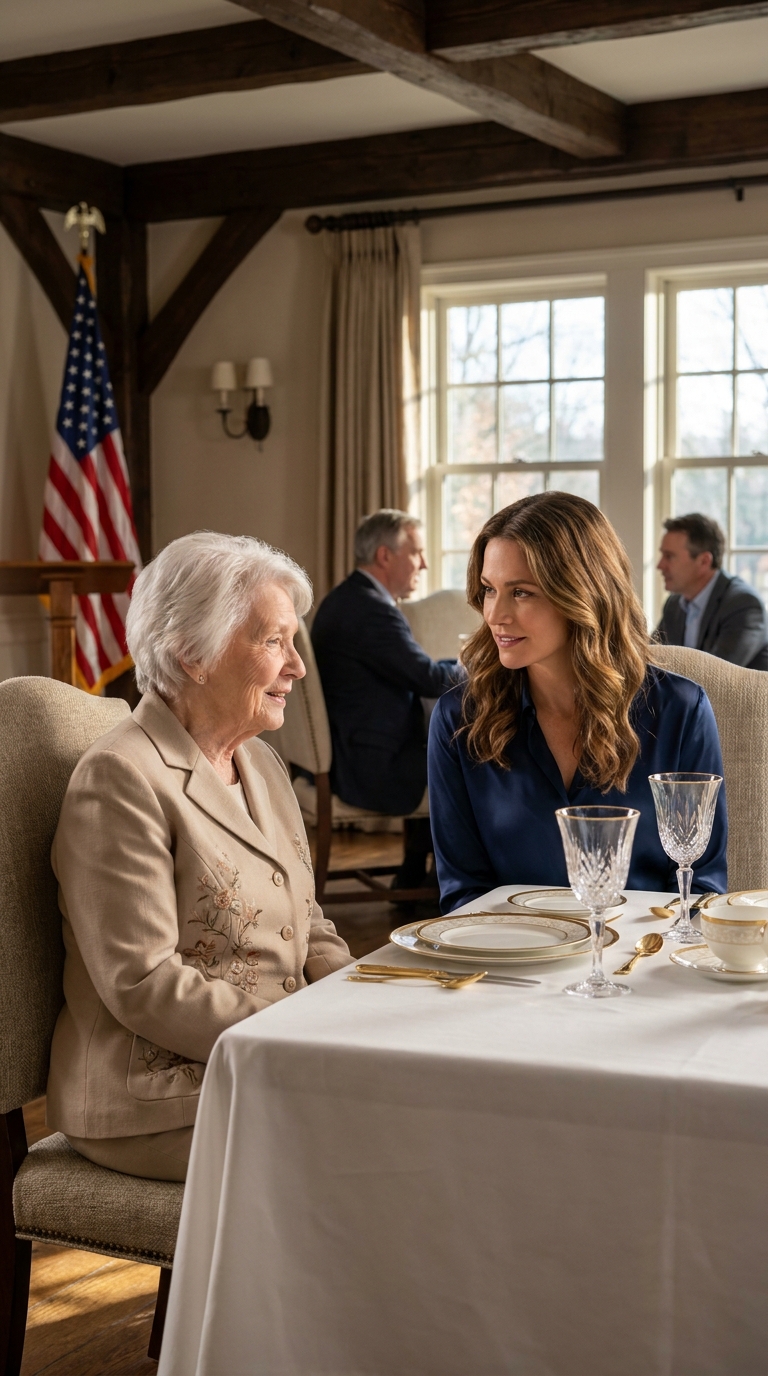
It was a Tuesday in October, the kind of evening when the light comes in through the kitchen window low and golden, touching everything softly enough to make a person forgive too much. I was standing at my counter slicing apples for the pie I had promised my granddaughter, Brin. She had called me that morning before school and said, “Grandma, can you make the one with the brown sugar and the cinnamon? The one Grandpa used to help with?”
She meant the lattice-top apple pie Roy used to make with me every Thanksgiving before his heart decided, one ordinary Sunday morning, that it had done enough work for one lifetime.
I had been up since five. At my age, sleep becomes less of a place you go and more of a porch you visit when it lets you. I had swept the kitchen, watered the herbs in the window box, rolled out the dough, and peeled enough apples to make the whole house smell like autumn.
That was when I saw the cup.
It sat next to my purse on the kitchen island.
White ceramic. Small. No handle. The kind of thing you might find at a fancy restaurant under a half-inch of espresso foam. Nobody in our family drank espresso. Nobody I knew owned a cup like that. I had a cabinet full of mugs, most of them chipped, most of them sentimental. One from the school where I taught for thirty-one years. One with a faded cardinal painted by Brin when she was six. One that said WORLD’S OKAYEST GRANDMA, which Roy bought at a church rummage sale and thought was hilarious.
I knew every cup in that kitchen.
This one was not mine.
Inside it was a shallow pool of amber liquid.
Not coffee.
Not tea.
It had a sweetness to it I could smell from two feet away, but beneath that sweetness was something flat and chemical, something that reminded me of the cough syrup Roy used to take when winter settled into his chest.
I did not touch it at first.
I only looked.
Then my son’s wife came in.
Her name was Saskia, and she had been married to my Andrew for nineteen years. She was wearing the gray cashmere sweater I had given her two Christmases ago, which surprised me because she had always said it itched. On her, the sweater looked effortless, expensive, soft in a way she herself had never been with me.
“Oh, good,” she said. “You’re here early.”
“In my own house,” I said, keeping my eyes on the apples. “That does happen.”
She gave a light laugh, the kind people use when they decide not to hear you.
She moved past me to the sink with that quick, stiff walk she always had around me, as if my kitchen were a narrow hallway she needed to cross without brushing against anything old. She turned on the water, rinsed her hands, and I watched her watch the cup out of the corner of her eye.
Just once.
A flicker.
Not enough for anyone else to notice.
Enough for me.
I said nothing.
Over the years, I had learned that silence was often the smartest thing a woman like me could use. People underestimate silence. They think it means fear, confusion, weakness, or age. Sometimes it means the other person has finally stopped warning you before they move.
I want to back up. I want to tell you who I was before that night, because otherwise you may misunderstand what I did next. You may think I was brave. You may think I acted with some great confidence. I did not. I was scared the whole time. My hands shook. My mouth went dry. My knees felt hollow.
But I had taught seventh and eighth grade English for thirty-one years in a public school outside Hartford, Connecticut. I had stood in front of classrooms full of children who could smell uncertainty the way coyotes smell blood. I had learned how to keep my face calm while a room tried to come apart. I had learned how to let people talk themselves into corners. I had learned that the quietest person in the room is often the one paying closest attention.
My name is Hannah Whitaker. I was sixty-eight years old that fall, a widow for seven years. I lived in the same five-bedroom colonial Roy and I bought in 1983, set back from a quiet road in a town west of Hartford where the maples turn red so violently in October that tourists slow down to take pictures. The house had blue shutters, a deep front porch, stone steps Roy reset every few years because the frost kept shifting them, and a kitchen where every drawer had been opened by three generations of hands.
I had two children.
My daughter, Pearl, Brin’s mother, lived in Oregon and called me every Sunday at four o’clock without fail. She had left Connecticut after college, married a quiet man who taught environmental science, and built a life among rain, mountains, and people who composted with religious conviction. She was far away, but she never made me feel abandoned.
My son, Andrew, lived twelve minutes away in a four-bedroom colonial that I had helped buy. I paid the down payment. Not as a loan. Not as leverage. As a gift. A start. My own mother had done something similar for Roy and me when we were newly married and desperate to look more stable than we were. I wanted to pass that forward.
I never mentioned it afterward. Not to neighbors. Not to friends. Not even to him.
That is what a gift is supposed to be.
Roy died of a heart attack on a Sunday morning in March. He was sixty-four. We had been married thirty-nine years. He was making coffee. I was upstairs folding towels. I heard the mug break. By the time the ambulance came, he was already somewhere I could not follow.
He left me the house, the small farm in Litchfield County that had been in his family for three generations, a pension, his life insurance, and an investment portfolio managed by his cousin Bram, who had been Roy’s best friend since boyhood and my financial adviser after Roy died.
If you added up the land alone, I was what people in our town would politely call comfortable.
I never thought about it that way.
I just lived.
I tended the garden. I went to church on Sundays. I volunteered twice a month at the library. I babysat Brin on Wednesdays after ballet class. I made soup in winter and jam in summer. I wrote checks to charities Roy had cared about. I kept his boots in the mudroom for three years because throwing them out felt like declaring him gone in a way death itself had not managed.
For the first two years after Roy died, Andrew called me every day. Sometimes twice. He came over to fix the gutter. He drove me to doctor appointments. He sat with me on the porch in the evenings drinking iced tea from the pitcher I kept in the fridge, and sometimes he cried about his father.
So did I.
Those years were painful, but they were also close. It felt as if grief had opened a door between my son and me that had not been open when life was busier. I felt lucky. I felt held.
Then Saskia got involved.
I do not want to make her into a cartoon. She was not always cruel. When she and Andrew first met, she was twenty-six and bartending at a place near his law firm. She was bright, funny, quick with people. She came from very little, which I respected, and she clawed her way through a marketing degree at night school, which I respected even more.
I gave her my mother’s pearls at her bridal shower.
I cried at their wedding.
When Brin was born, Saskia let me hold her in the hospital before anyone else except Andrew. For years, I believed we were not close because we were different, not because she disliked me. That was easier to accept.
But something turned in her slowly, the way milk turns. Quiet at first. Then undeniable.
She started complaining to Andrew about how often I came over. She started making little comments about my house.
“It is a lot of space for one person, Hannah.”
“Do you really use all those rooms?”
“I just worry about you out there alone.”
She said it gently. Always gently. That is the trick with certain kinds of people. They wrap a demand in concern and wait for you to feel guilty for hearing the demand.
Then came the farm.
Roy’s family farm sat in Litchfield County, a little over sixty acres of old pasture, stone walls, a hayfield, a small pond, and a farmhouse we did not live in but kept maintained. Roy had spent summers there as a boy. His grandfather had milked cows there. His father had nearly sold it once during hard times and then cried when the deal fell through from sheer relief.
Before Roy died, I promised him I would hold on to it.
Not forever, maybe. But as long as I could.
Saskia began bringing it up over dinner.
“Wouldn’t it be smarter to sell while the market is strong?”
“Land is only useful if it is producing income.”
“Andrew says the property taxes are becoming ridiculous.”
Andrew says.
That was how her thoughts arrived wearing my son’s shoes.
I told her no. Politely. I said I was not ready. I said the farm was Roy’s family land. I said I had promised him.
That was when Andrew’s calls got shorter.
The porch visits became less frequent. He still loved me, I told myself. He was busy. His firm had grown. Brin’s school schedule was complicated. Marriage shifts people. Sons do not always notice when their wives begin managing the distance between them and their mothers.
I told myself many things.
That is why, when I saw that espresso cup on my kitchen island in October, I was not surprised.
Sad, yes.
Sick, yes.
Frightened, absolutely.
But not surprised.
A woman who has lived inside her body for sixty-eight years learns to feel a thing coming the way she feels rain in her knee. By the time I saw that cup, I had been feeling the rain for a long time.
So I sliced apples.
And I said nothing.
The dinner that night was supposed to be a family thing. Andrew, Saskia, Brin, Saskia’s brother Corwin, who was visiting from Seattle, and me. Saskia had insisted on hosting it at my house. She said I had the best dining room. She said it would feel more special.
I said yes because Brin would be there.
Brin was the only person in that family I still trusted completely.
The cup, I realized later, had been brought from Saskia’s house in her tote bag. She must have set it out before I came downstairs from changing. It was waiting for me because I was the one who used the white china when guests came. She knew that. She knew my habits. She had been counting on them.
Whatever was inside that cup, I did not yet know. I only knew the smell was wrong.
Saskia moved around the kitchen, pretending to be helpful. She talked about a vacation she and Andrew were planning, somewhere in Portugal.
“It will be so good for us,” she said, rinsing carrots in my sink. “And honestly, it might be nice for you to have some quiet time alone in the house.”
“I have quite a lot of quiet time,” I said.
She smiled.
“Healthy quiet, I mean. Restorative.”
I nodded as if that made sense.
“When are you leaving?”
“The second week of November. Just two weeks from now.”
That was when my hand stopped on the knife.
Two weeks.
I had a cardiology appointment the third week of November. Andrew knew that. He had driven me to the last one, the one where Dr. Levin told me my heart was strong but there was a slight rhythm irregularity and I should avoid certain sedatives and sleep medications because they could slow the heart too much. He printed a medication warning list and told me to put it somewhere visible.
Andrew had stuck it to my refrigerator himself with a little sunflower magnet Brin picked out at the botanical garden.
I looked at Saskia.
She was still watching the carrots.
“That sounds wonderful,” I said. “I am sure I will manage.”
Here is what I did next.
I excused myself to the powder room. On the way, I passed the kitchen island and picked up the espresso cup as if I were simply tidying. Saskia was stirring something at the stove, but I could feel her attention move with me.
In the bathroom, I locked the door.
My hands shook so hard the little cup clicked against the sink.
I poured a small amount of the amber liquid into one of the plastic pill cups I kept in the medicine cabinet for travel. I snapped on the lid, wrapped it in tissue, and tucked it inside the toiletry bag under the sink, the one nobody ever opened but me.
Then I rinsed the espresso cup, dried it, and refilled it with cold black coffee from the pot on the counter, watered down with a touch of honey to imitate the color and sweetness. I set it back exactly where Saskia had left it.
It needed to look untouched.
If she was watching, and she was, she needed to believe nothing had changed.
Then I went upstairs to my bedroom.
I locked the door.
I sat on the edge of the bed and called Bram.
He answered on the second ring.
“Hannah?”
His voice was already concerned. Bram had known me too long. He could hear the difference between a normal call and the kind that comes from a woman sitting on a bed with her bedroom door locked.
I told him everything.
The cup.
The smell.
Saskia’s comments.
Portugal.
The cardiology appointment.
The little sample hidden in the powder room.
Bram listened without interrupting. He had always been calm in a crisis. Roy used to say Bram could watch a barn catch fire and still remember where he left the insurance papers.
When I finished, he said, “Hannah, I want you to write down exactly what you just told me. Date. Time. Every detail. Email it to me tonight from a new email account nobody in your family knows about. Do not use your regular one.”
“All right.”
“I am coming up tomorrow morning.”
“Bram—”
“No. I am coming.”
I closed my eyes.
“Do you have a safe in the house?”
“Yes.”
Roy had installed it in the floor of the office closet in 1991 after a string of burglaries in town.
“Put the sample there after dinner. Do not tell anyone. Do not accuse anyone tonight. Do not change your behavior. Smile. Be the mother-in-law she expects you to be. Can you do that?”
I looked down at my hands.
“I taught middle school for thirty-one years.”
“That is a yes, then.”
“It is.”
When I came downstairs, the smell of roast beef hit me. Saskia was pretending to cook it, though I had seasoned it that morning and put it in the oven myself. My legs felt weak, but I held the banister and continued down.
Brin ran up to hug me.
She was eleven that year, all long limbs and serious eyes, with Roy’s lashes and Pearl’s stubborn chin.
“Grandma, I helped set the table.”
“I cannot wait to see it.”
She pulled me toward the dining room.
The table was beautiful. Good linen. Silver candlesticks. The china with blue edging that Roy’s mother had given us. Christmas candles even though it was October, because Brin liked them.
At every place setting sat a glass of pale, sparkling cider Saskia had brought from a “heritage orchard” in Vermont. She was making quite a production of it. Six glasses on the table.
Five looked identical.
One was set apart at the head.
Mine.
It was a slightly different shape. Just slightly. The base was a hair wider. The bowl curved a touch deeper.
It was Roy’s old scotch glass.
The one Saskia had asked me about three months earlier.
“Oh, where did you get this set?” she had asked casually. “Are they all original?”
They were not all original. Two had broken over the years. There were six left, and one was distinct enough to be identified by anyone paying attention.
I sat at the head of the table.
Corwin was talking about a hike he had done somewhere in Washington State. He was a broad-shouldered man with kind eyes and a nervous way of laughing when Saskia spoke too sharply. I had never known him well. He lived across the country and seemed to visit his sister out of duty more than joy.
Andrew nodded along to Corwin’s story while refilling his own glass.
Saskia brought in the roast.
Brin told me about a book she was reading for school.
Everything on the surface looked like an ordinary American family dinner. Plates. Candles. A child’s voice. Wind moving through the maple outside. The dishwasher humming faintly from the kitchen.
Then Saskia said, “Brin, sweetie, why don’t you go get the salad from the kitchen?”
Brin slid from her chair and trotted away.
Saskia took the seat on my left and leaned toward me.
“You look tired, Hannah. Have you been sleeping all right?”
“I have been sleeping fine.”
“You should drink something. You have not touched your glass.”
I picked up the glass at my place.
Held it.
“Oh, thank you. I will. But first, let me say grace.”
We had not said grace at a family meal in fifteen years.
Andrew looked up, surprised.
Corwin set his glass down.
Saskia’s mouth made a small shape it did not usually make.
I bowed my head. I closed my eyes most of the way.
While everyone looked down at their plates in that uncomfortable Sunday-school posture adults get when ritual returns without warning, I quietly switched my glass with Saskia’s.
It took less than two seconds.
Her glass was near the salt shaker. Mine was by my plate. I moved the way I had moved a thousand books, papers, lesson plans, and cafeteria trays while teenagers tried to distract me. Left hand, right hand, set down, fold hands.
“Dear Lord,” I said, my voice steady by some miracle, “we thank you for this food, for this family, and for the gift of being together. Amen.”
When I opened my eyes, Saskia was looking at me.
Just looking.
Her face had not moved, but something inside her had.
It was the expression I used to see from a certain kind of seventh grader, the kind who had plagiarized an essay and had not yet realized I already knew.
I smiled at her.
“Isn’t it lovely to have everyone home?”
Brin came back with the salad.
We ate.
I lifted my glass several times but never truly drank. I touched it to my lips. I tilted it. I made the little swallowing motion people make when sipping. I had thirty-one years of pretending to taste cafeteria food I had not eaten. This was not difficult.
Saskia drank from her glass.
Slowly at first.
Then more, because Andrew was telling a story about a new associate at his firm and she was laughing and relaxing and enjoying whatever victory she thought was coming. She emptied it. Andrew refilled it from the bottle without thinking.
I watched her finish that one too.
It was near the end of the meal, when I was bringing in the apple pie, that Saskia began to look pale.
She pressed two fingers against her temple.
“I think I need to lie down for a minute.”
Andrew looked up. “Honey?”
“I just feel a little strange.”
She stood, put her hand on the back of the chair, and the chair shifted. She stumbled.
Andrew stood quickly. “Are you okay?”
“I just feel—”
Then she sat back down heavily.
Brin stopped smiling.
Corwin’s expression changed first. He had been watching more closely than Andrew, maybe because distance makes certain family performances easier to see.
“Saskia,” he said. “What did you take?”
Her head turned toward him slowly.
Andrew said, “Mom, what’s in the pie?”
I looked at him.
“Apples, cinnamon, and brown sugar. The way I always make it.”
“She has not had any pie,” Corwin said sharply.
Andrew looked at Saskia’s glass.
Then at mine.
Mine was still mostly full.
Hers was empty.
“Did you drink something?” he asked her.
She whispered, “Just the cider.”
“The cider you brought?” Corwin asked.
Andrew said, “I didn’t bring any cider.”
There was a silence then that I will remember for the rest of my life.
A small dining-room silence.
The dishwasher hummed. Brin breathed unevenly. The wind moved the maple outside. The candles flickered in their silver holders.
Inside that silence, my son’s face changed.
Until that moment, I had allowed myself one hope. A foolish one, perhaps, but a mother lives on foolish hopes when all reasonable hopes are gone.
I had hoped Andrew did not know.
I had hoped this was Saskia’s plan, Saskia’s desperation, Saskia’s cruelty. I had hoped my son was inattentive, manipulated, weak, but not involved.
Then he said, “I didn’t bring any cider,” and what I heard underneath was something else entirely.
I didn’t bring the cider.
You did.
And you were not supposed to drink it.
His eyes met mine.
He saw that I had heard it.
Saskia tried to stand again.
This time her knees buckled.
Andrew caught her under the arms before she hit the floor. Brin started crying. Corwin was already calling 911.
I went to the kitchen.
I picked up the espresso cup I had refilled with watered-down coffee. I held it for a moment, staring at its small white shape.
Then I walked out to the front porch and waited for the ambulance.
The October air was cold. The sky had gone dark blue. A few leaves moved across the porch boards. I remember thinking that Roy would have known what to do with his hands. He always did.
The paramedics came.
They asked what Saskia had consumed.
I said, “The cider.”
I said, “I do not know what was in it.”
I said, “My son may know.”
Andrew did not say anything.
He rode in the ambulance with her. Corwin took Brin back to Andrew’s house, though I saw in his face that he no longer trusted his sister and did not know what to do with that truth.
I stayed in my house alone.
The dining room looked abandoned after a disaster. Five nearly empty glasses on the table. One almost full one at the head. Plates half-cleared. Apple pie cooling on the sideboard.
I sat in my own chair.
I put my face in my hands.
I did not cry.
Not yet.
I called Bram.
He drove up that night from New Haven. He brought a friend named Paul Mercer, a retired Hartford detective he had known for years. Paul had gray hair, careful eyes, and the quiet patience of a man who had spent his career listening to lies until the truth got tired and came out.
We placed the espresso cup, the small pill-cup sample, Saskia’s cider glass, and my nearly full glass into separate bags. Paul labeled everything. Bram photographed the table, the glass positions, the cider bottle, the kitchen island, and the powder room cabinet where I had hidden the sample.
“Chain of custody matters,” Paul said.
“I am not trying to become a police officer,” I told him.
“No. But if this goes where I think it may go, you do not want a defense attorney saying you mishandled the only proof you had.”
The next morning, Bram took the samples to a private lab through a toxicology contact Paul trusted.
The result came back fast.
A prescription sleep medication.
A substantial amount in the espresso-cup sample.
A smaller amount in the cider.
Nothing in the watered coffee I had substituted.
The lab report used careful language. It did not say murder. Lab reports do not accuse. They measure. They identify. They quantify.
But Bram read it, closed his eyes, and said, “Hannah.”
“I know.”
“The dose in that cup, with your heart history—”
“I know.”
“It could have killed you.”
“I know.”
Saskia woke in the hospital the next morning. They had treated her quickly. She was frightened, embarrassed, and physically all right. Andrew called at nine and left a voicemail saying there had been a terrible accident and he would come by after noon.
I listened to the message twice.
His voice was shaky.
Not with grief.
With calculation under stress.
At 11:50, I moved Roy’s old scotch glass from the dishwasher rack to the cabinet, then took it back out again. I wanted to throw it against the wall. Instead, I dried it and put it where it belonged.
Andrew arrived at noon.
He looked awful. Pale, unshaven, eyes swollen. He sat on the living room couch, the couch Roy had chosen after insisting the old one had “given all it could give,” and began to cry.
“Mom,” he said, “I don’t even know where to start.”
I sat across from him in Roy’s chair.
“Start wherever you like.”
He built the story slowly.
Saskia had been depressed lately.
Saskia had trouble sleeping.
Saskia had been taking pills.
Maybe she had confused the cider bottle.
Maybe she had been trying to calm herself before dinner and accidentally mixed something.
The espresso cup was just from Corwin’s bag, maybe. Or one of Brin’s craft things. Or maybe nobody knew.
The cider was meant for everyone.
It was a terrible mistake.
A frightening mistake.
A misunderstanding.
He spoke for nearly twenty minutes.
I let him.
I let him build the story all the way to the end.
When he was done, I stood. I walked into the dining room. I returned with the bagged espresso cup and Bram’s folder.
I placed both on the coffee table.
Andrew stared at them.
I said, “Your father loved you very much.”
His face crumpled.
“Mom—”
“I have loved you every day of your life. I loved you when you had colic and would only sleep if Roy walked you in circles around the kitchen. I loved you when you broke your wrist falling out of the maple tree. I loved you when you failed the bar exam the first time and thought your life was over. I will love you every day until I die.”
His mouth opened.
“But you are not coming back into this house.”
He went very still.
“Mom.”
“I have already moved everything.”
“What does that mean?”
“It means the farm is in trust. The portfolio is in trust. The house is in trust. As of nine o’clock this morning, none of it passes to you when I die. None of it passes to Saskia.”
His face drained.
“The trustee is Bram. The primary beneficiary is Brin when she turns thirty, with controlled distributions before that for education, care, health, and housing. Pearl will receive a lifetime stipend. You will receive nothing.”
“Mom, you cannot—”
“I have.”
I opened the folder.
“The lawyer was here at six this morning. The documents are executed and filed where they need to be filed.”
He stood.
“This is insane.”
“No. What happened last night was insane. This is planning.”
He looked toward the front door.
“If you contest the trust, if you try to force your way back into my finances, if you or Saskia challenge my competence, Bram will turn the lab results, the cup, the photographs, and Paul Mercer’s written statement over to the police. You and your wife can explain why a sixty-eight-year-old woman with a documented heart rhythm warning was served a drink containing medication she was medically advised to avoid.”
Andrew’s hands shook.
“You think I tried to kill you?”
“I think you knew more than you are willing to admit.”
He shook his head.
“No.”
“I think when you realized Saskia had drunk from the wrong glass, your first fear was not for her. It was that the story had gone wrong.”
He looked at me like I had slapped him.
“Mom, I would never—”
I raised one hand.
“Do not insult us both.”
The room went quiet.
“I have spent forty-three years protecting you from the consequences of being yourself,” I said. “That is over now.”
He stared at me as if I were someone he did not know.
In some way, I was.
The woman who had stood at the counter slicing apples the afternoon before still believed, somewhere deep and stubborn, that her son loved her in the way sons are supposed to love mothers.
The woman sitting across from him at noon the next day did not believe that anymore.
Losing that belief was a second widowhood.
I am still walking through it.
Andrew left without hugging me. Without touching the cup. Without taking the folder. At the door, he turned as if he might say something that could save us both.
Nothing came.
He walked out.
He has not been back.
Saskia filed for divorce within a month. Her petition mentioned emotional distress, unsafe family dynamics, and Andrew’s “failure to protect the marital unit from extended-family manipulation.” I do not know how much of the original plan was hers and how much was his. I have stopped trying to know. The need to know every shade of guilt belongs to people who still believe a full explanation can repair a broken thing.
Sometimes it cannot.
The lab evidence remained in Bram’s safe. Paul advised me to file a police report. Bram agreed. Pearl begged me to consider what an investigation would do to Brin. I spent many nights pacing the hallway, torn between justice and the child who still loved both her parents.
In the end, I did file a sealed report through an attorney, not a public accusation, not a spectacle. The evidence was preserved. The statement was documented. If Andrew or Saskia ever tried to challenge the trusts or claim I had imagined the whole thing, the record would be there waiting.
That was enough for me.
For now.
Brin comes to see me every other Saturday.
Pearl flies her out when school schedules allow, and sometimes Corwin brings her because, after that night, he quietly became someone I trust more than I ever expected to. He called me two weeks after the dinner and said, “I should have seen who my sister was sooner.”
I told him, “We all see people when we are ready to survive it.”
Brin is thirteen now. She knows her parents are not together. She knows her father has done things he is sorry for. She does not know about the cup. She does not know about the cider. She will not know until she is old enough to hold the truth without it breaking something essential in her.
She makes apple pie with me now.
The lattice top is still uneven, but she is getting better. She hums when she works, just like Roy did. Sometimes she uses too much cinnamon. I never correct that. There are worse things than too much cinnamon.
The farm is still mine in every way that matters, though on paper it belongs to the trust. I still walk the fence lines when the weather is good. I still pick wild blackberries near the old stone wall. I still sit by the pond and remember Roy teaching Andrew to skip rocks.
Memory is a strange country. You can love the person someone was and still protect yourself from the person they became.
Pearl calls every Sunday at four.
Sometimes we talk about ordinary things: Oregon rain, library events, Brin’s school projects, the price of eggs. Sometimes we talk about Andrew. Mostly, Pearl is angry. Not loud angry. The controlled kind. She is a woman who moved across the country to build peace and does not forgive easily when someone threatens it.
“He should have to face it,” she told me once.
“He is facing something.”
“Not enough.”
“Maybe not.”
“You are protecting him.”
“No,” I said. “I am protecting Brin.”
Pearl went quiet.
Then she said, “I hate that those two things look similar.”
“So do I.”
In the last year, I have started having tea on Tuesdays with my neighbor, Wisteria Bell. She lost her husband around the same time I lost Roy. Her real name is Susan, but her mother loved flowers and made questionable naming decisions. Wisteria says that with good humor, though I think she likes the name more than she pretends.
We sit on my porch with tea and sometimes say nothing for twenty minutes.
That is a friendship women our age understand.
People ask me sometimes—the few people who know any piece of this—whether I forgive my son.
I tell them forgiveness is not something you hand to a person who has not asked for it. Forgiveness is a door, and the door opens from the inside, but the person on the other side still has to knock.
Andrew has not knocked.
He has sent flowers twice on Mother’s Day. The cards said things like Thinking of you and Hope you are well. Nothing about the dinner. Nothing about the cup. Nothing about the glass. Nothing about the story he built on my couch while the evidence sat under his nose.
I send the flowers back.
I keep the cards in a drawer.
I do not read them anymore.
What I have done instead of forgiveness is harder, quieter, and more honest.
I have built a life that does not include him.
I planted three new rose bushes along the south fence. I learned to make sourdough starter. I replaced the curtains in the sitting room because Saskia once said they made the house look “elderly,” and I decided elderly curtains suited me just fine but ugly ones did not. I joined a book group at the library and argued about a novel with such enthusiasm that the librarian asked if I missed teaching.
I do.
Sometimes.
I also started writing everything down in a green notebook I keep in the kitchen. Not because I want revenge. Not because I want Brin to hate her father someday. Hate is heavy, and children should not be made to carry what adults could not put down.
I write so that one day, if Brin needs the truth, she will have it in my words.
She will know her grandmother was not a fool.
Not a victim.
Not bitter.
A woman can be betrayed and still remain clear.
That is what I want her to understand.
The espresso cup is still in Bram’s safe.
I think about it sometimes.
Bram says I should let him destroy it. Paul says evidence should remain evidence as long as I remain uncertain about the future. Wisteria says nothing, but once, when I told her about it, she reached across the porch table and put her hand over mine.
I think one day I will take it back.
I think one day I will carry it down to the far edge of the farm where the creek runs over flat stones and the ferns grow thick in the shade. I will stand there alone. I will hold that small white cup one last time. Then I will drop it into the water and watch the creek carry it away.
Maybe I will feel lighter.
Maybe I will feel nothing.
Then I will walk back up the hill, make myself a cup of real coffee in my chipped cardinal mug, sit on the porch with Wisteria, and not say a word about it to anyone.
A wise woman once told me kindness is a gift, and a gift must be given freely. The moment you start charging interest on it, kindness becomes a debt no one agreed to carry.
I gave my children kindness for forty-three years.
I gave it freely.
They were not entitled to it.
They were lucky to have it.
When kindness stopped being met with kindness, I stopped giving it in the same direction. That is not bitterness. That is, I think, finally growing up at sixty-eight years old.
I have thought about that October night more times than I can count.
What I keep returning to is this: nothing in that dining room was an accident.
Not the espresso cup.
Not the cider.
Not the slightly different glass at my place setting.
Not Saskia watching me from the sink.
Not Andrew’s face when he realized what I had realized.
Every one of those things was a seed someone planted. Seeds do not become trees overnight. They grow because somebody waters them, year after year, with small permissions.
I had been watering those seeds for a long time.
I told myself I was being a good mother.
I told myself love meant saying yes.
When Saskia hinted I should sell the farm, I went quiet instead of firm. When Andrew stopped calling, I made excuses for him instead of asking why. When I sensed something wrong, I called it grief, distance, stress, adjustment, anything but what it was.
Every time I chose comfort over honesty, I taught the people around me that my limits were not real.
People believe what you teach them.
My son and his wife learned exactly what I had spent years showing them.
Hannah will bend.
Hannah will absorb.
Hannah will not push back.
That night was the harvest of that lesson.
It was not bad luck.
It was the natural ending of a road I had been walking for two decades without looking up.
What saved me was not cleverness. I want to be honest about that. What saved me was the small voice that said, Pay attention. The voice I had spent years hushing so I could keep the peace.
When I finally listened to it, all I did was look.
I looked at the cup.
I looked at the glass.
I looked at my son’s face.
And I let myself see what was there instead of the version I wished was there.
That is what I want anyone who hears this story to understand.
Not the drama.
Not the switched glasses.
Not the lab report.
This:
The truth is almost always already in the room with you.
The only question is whether you are willing to turn your head and look at it.
Strength is not always loud. Sometimes strength is a woman locking her bedroom door and calling the right person. Sometimes it is saving a sample in a pill cup while her hands shake. Sometimes it is sitting at the head of your own table and refusing to drink what you did not pour.
Sometimes strength is loving your child enough to stop protecting him from the person he has become.
I lost my son that night.
I will not pretend that does not still hurt.
But I found someone too.
I found Hannah again.
The woman beneath the mother.
Beneath the widow.
Beneath the grandmother.
She had been waiting there quietly, all this time, for me to choose her.
Now I do.
Every morning.
Every cup of coffee.