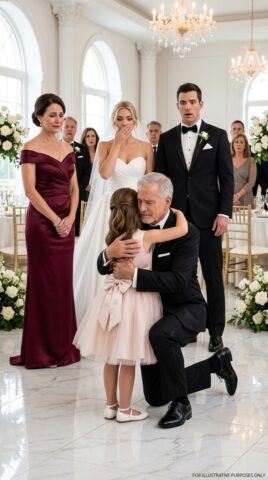
The father didn’t speak at first.
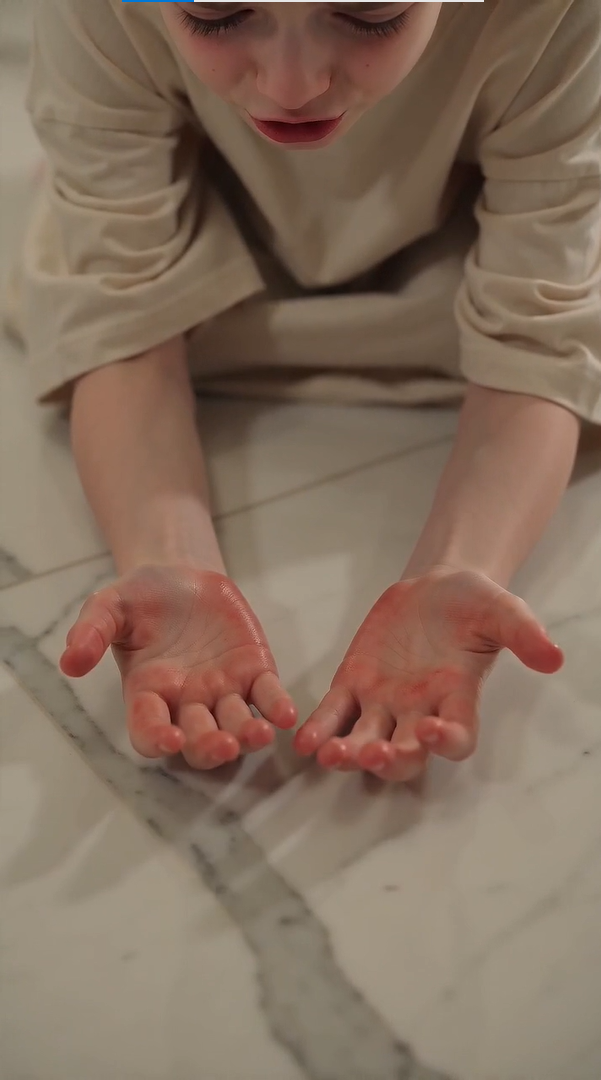
He knelt in front of his daughter and took her tiny hands like they were made of glass. Her palms were raw, red, and shaking.
His eyes filled with tears.
“How long?” he whispered.
The little girl looked at the woman, terrified.
The father gently turned her face back toward him.
“Look at me. Not her.”
The girl’s lips trembled.
“Every time you left.”
The woman stepped forward quickly.
“She’s exaggerating.”
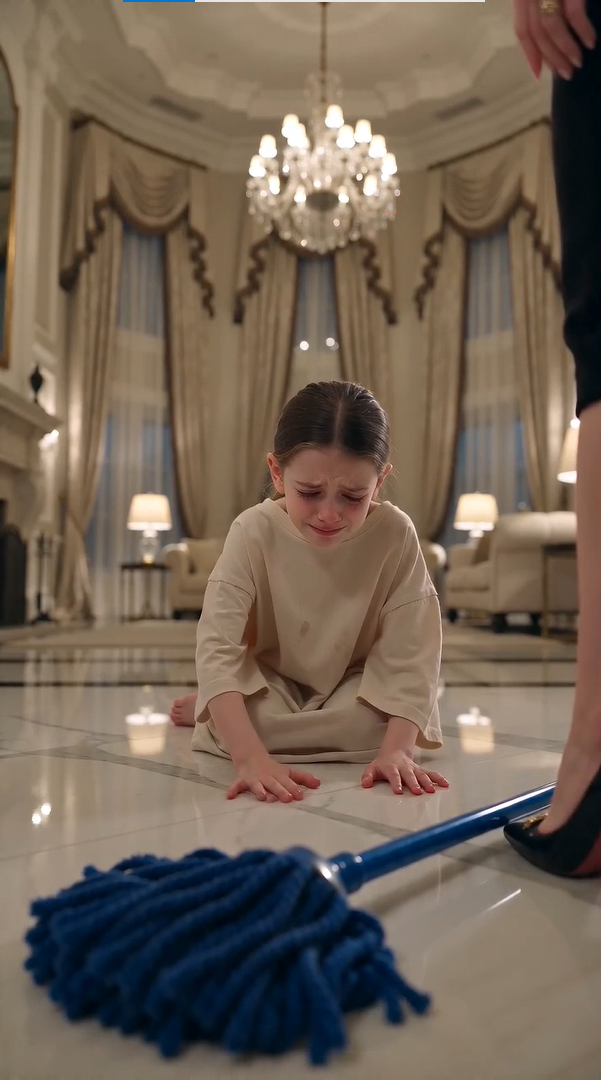
The child flinched at her voice.
That tiny movement told him more than any explanation could.
The father stood slowly, still holding his daughter against him.
The woman forced a soft laugh.
“She was being dramatic. Children need discipline.”
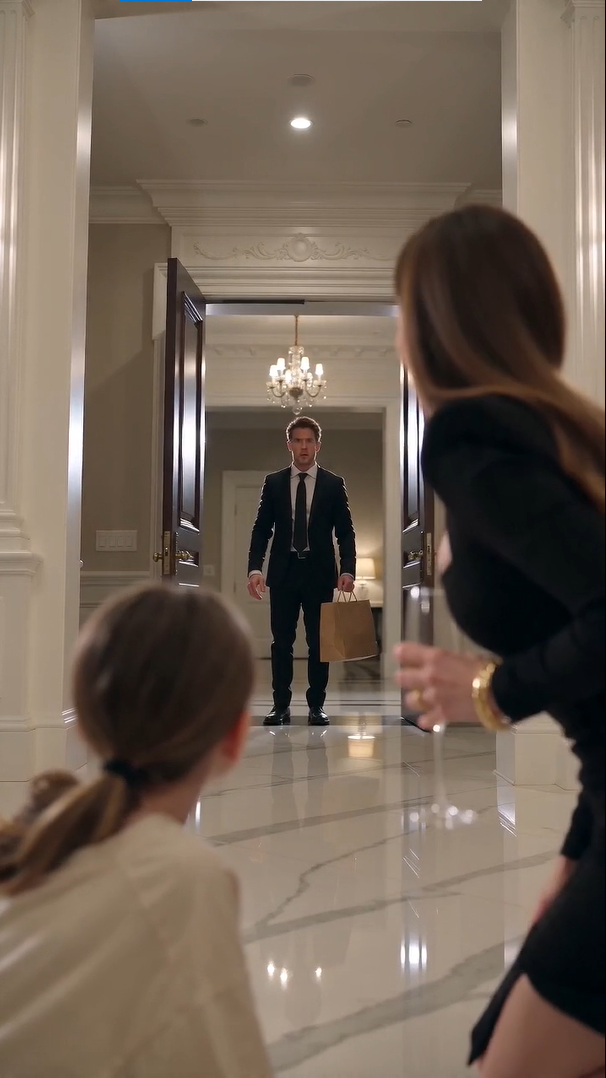
The father looked at the mop, the spilled water, the wine glass, the gift bag on the floor.
Then he saw the small phone hidden under the stairs.
His daughter’s phone.
Thirteen unsent messages were open on the screen.
“Daddy, please come home.”
“Daddy, my hands hurt.”
“Daddy, she says I’m not your real family.”
The father’s face broke.
The woman reached for the phone, but he pulled it away.
His voice was quiet.
“You made her clean this house like a servant.”
The woman swallowed.
He looked down at his daughter, crying into his jacket.
Then he looked back at the woman.
“And now you can leave it like one.”
The woman stared at him as if she had not understood.
Then her face changed.
The sweetness disappeared first.
Then the softness.
Then the little helpless act she had used for months every time he questioned why his daughter seemed quieter, thinner, more afraid.
“You can’t be serious,” she said.
He did not blink.
“Pack your things.”
Her mouth opened.
“After everything I’ve done for you?”
His arms tightened around his daughter.
“For me?”
She pointed toward the polished floors, the bright kitchen, the perfect living room.
“I kept this house together.”
He looked at the mop lying beside the stairs.
“No. She did.”
The little girl pressed her face harder into his chest.
The woman’s eyes flashed.
“She needed to learn respect.”
“She is seven.”
“She is spoiled.”
“She was hiding under the stairs with bleeding hands.”
The woman’s voice sharpened.
“And who made her weak? You did. You treat her like some fragile little princess just because her mother died.”
The room went silent.
Even the little girl stopped crying for one second.
The father’s face went pale.
His wife’s picture still hung on the wall near the staircase.
A soft smile.
Warm eyes.
The same eyes his daughter had.
For two years, he had tried to keep breathing after burying the woman who made the house feel alive.
And in his grief, he had let someone else step inside.
Someone who smiled at him.
Cooked when he was too tired.
Told him his daughter needed structure.
Told him children cried for attention.
Told him he was too emotional because he was still grieving.
Now he looked at that woman and finally saw the truth.
She had not entered his home to help heal it.
She had entered it to take control of it.
His voice came out low.
“Do not speak about her mother.”
The woman scoffed, but there was fear behind it now.
“Oh, please. You still keep her photo everywhere. Maybe that’s why your daughter acts like a victim. She learned it from you.”
The little girl whimpered.
The father turned and covered her ears gently with both hands.
Then he looked at the woman.
“Go upstairs. Pack.”
She laughed again, but it shook this time.
“You think you can just throw me out?”
“Yes.”
“This is my home too.”
“No,” he said. “This was my daughter’s home before you ever walked through the door.”
The woman’s lips trembled with anger.
“You’ll regret this.”
He picked up his phone.
“I already do.”
She froze.
“What are you doing?”
“Calling my lawyer.”
Her eyes widened.
“Don’t be ridiculous.”
He looked at his daughter’s raw hands.
Then at the unsent messages.
Then at the wine glass on the floor, the one the woman had dropped when he came in early and found his little girl scrubbing spilled red wine from the marble.
“I am done being ridiculous,” he said. “I should have listened the first time my child stopped smiling when I came home.”
The woman took one step back.
The call connected.
The father’s voice stayed calm, but every word carried pain.
“I need you at my house. Now. And I need an emergency order prepared. My daughter has been abused in my home.”
The woman gasped.
“Abused? How dare you?”
The little girl shook in his arms.
He lowered his voice into the phone.
“Yes. There are photos. Messages. Injuries. I’m also calling the police.”
The woman rushed toward him.
“You will not ruin my life over a child’s tantrum.”
Before she could touch the phone, the father stepped back.
His daughter cried out.
“Daddy, don’t let her take me.”
Those words cut through the room.
The woman stopped.
The father looked down at his daughter.
Her small hands were gripping his jacket so tightly her knuckles turned white.
He knelt again, blocking the woman with his body.
“No one is taking you,” he said. “Do you hear me? No one.”
The girl looked at him through tears.
“Even if I spill?”
His face broke again.
“Even if you spill.”
“Even if I forget?”
“Even then.”
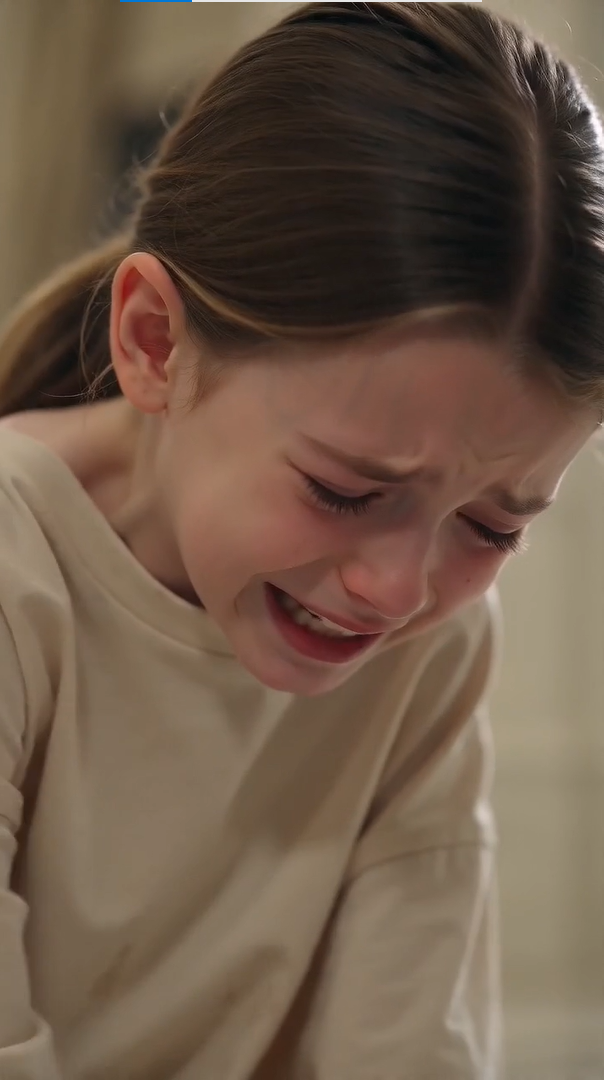
“Even if she says I’m bad?”
He touched her cheek.
“You are not bad. You are my child.”
The little girl began crying again, but this time the sound was different.
Not terror.
Relief.
The father lifted her into his arms and carried her to the sofa.
He wrapped a blanket around her and gently placed a cushion beneath her hands so they wouldn’t rub against the fabric.
Then he took pictures.
Not because he wanted to.
Because he had failed her once by ignoring the signs.
He would not fail her again by leaving the truth unprotected.
The woman watched from across the room, breathing hard.
“You’re acting like I beat her.”
The father did not look at her.
“You broke her quietly.”
The doorbell rang twenty minutes later.
The woman had not gone upstairs.
She stood near the kitchen island, arms crossed, trying to rebuild her face into innocence.
But when the door opened, and the father’s lawyer stepped inside with two police officers, the mask slipped again.
The little girl buried herself into the blanket.
One officer, a woman with kind eyes, knelt a few feet away from the sofa.
“Hi, sweetheart. My name is Officer Maria. I’m not going to touch you. Is it okay if I sit here?”
The little girl looked at her father.
He nodded gently.
“She’s here to help.”
The girl whispered, “Okay.”
The officer sat on the floor instead of the sofa.
That small choice mattered.
The girl watched her carefully.
The father showed the phone.
The messages.
The photos.
The wine on the floor.
The raw hands.
The officer’s expression changed as she scrolled through the unsent texts.
“Daddy, I’m hungry but she said I have to finish first.”
“Daddy, I broke a plate and she locked my room.”
“Daddy, I miss Mommy.”
The father turned away.
He couldn’t watch another person read what his daughter had been too scared to send.
The male officer asked the woman to step into the hallway.
She immediately began crying.
Not softly.
Not with guilt.
With performance.
“I tried my best,” she sobbed. “He’s never home. The child is impossible. She lies. She manipulates. She wants me gone because she can’t accept her mother is dead.”
The father flinched at the words.
But Officer Maria looked at the little girl, not the woman.
“Can you tell me your name?” she asked gently.
The girl whispered, “Sofia.”
“Sofia, did she make you clean today?”
Sofia nodded.
“With what?”
“The mop.”
“Did she ask you nicely?”
Sofia shook her head.
“She said if I didn’t clean before Daddy came home, she would throw Mommy’s picture away.”
The father froze.
His eyes moved to the wall.
His late wife’s picture.
The woman in the hallway stopped crying.
Officer Maria’s jaw tightened.
“What else did she make you do?”
Sofia looked at her father.
He took her feet gently into his lap.
“You can tell the truth.”
Sofia’s voice trembled.
“She made me scrub the bathroom when I cried. She said tears are dirty. She made me stand in the pantry if I talked back. She said Daddy wouldn’t believe me because grown-ups don’t believe needy kids.”
The father pressed one hand over his mouth.
All those nights.
All those excuses.
Sofia fell asleep early.
Sofia didn’t want dinner.
Sofia was clumsy.
Sofia needed discipline.
And he believed just enough of it to leave his daughter alone with a woman who hated her.
The lawyer placed a hand on his shoulder.
The father could not look at him.
The officer stood.
“We need to document everything. She should be checked by a doctor.”
The father nodded.
“I’ll take her.”
Sofia panicked.
“No hospital.”
He turned to her quickly.
“Baby, I’ll be with you the whole time.”
“They won’t be mad?”
“No.”
“They won’t tell me I’m dirty?”
His voice broke.
“No, Sofia.”
She looked at the woman in the hallway.
The woman glared at her for half a second before remembering people were watching.
Sofia saw it.
So did the officer.
That was the end.
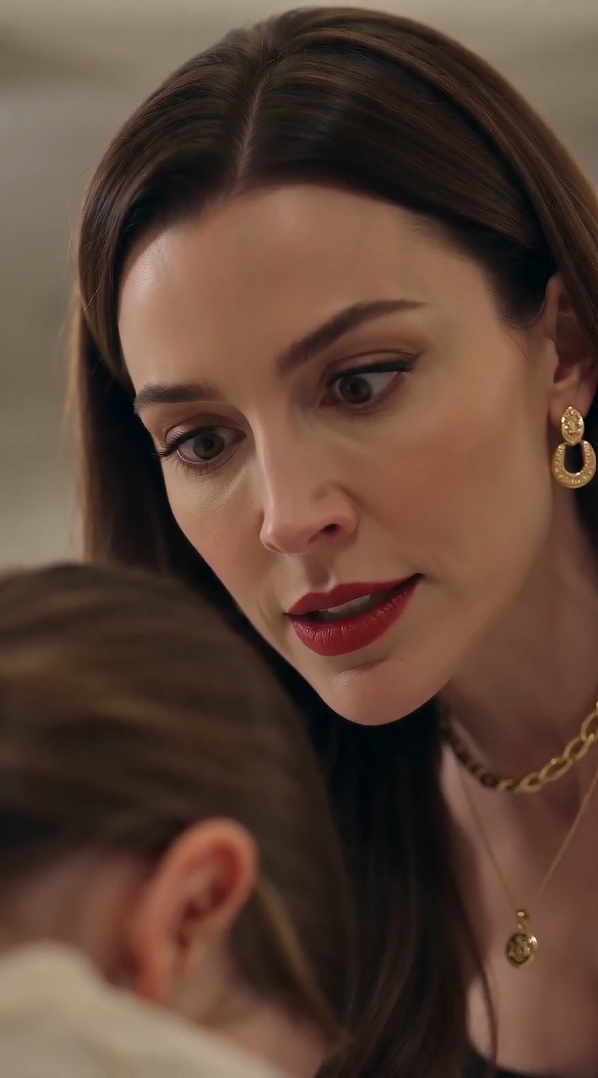
The woman was told to leave the house immediately while the investigation continued. She argued. She threatened. She demanded her jewelry, her bags, her phone charger.
The father stood in the living room, holding Sofia, while officers watched her pack.
She came down the stairs dragging two suitcases, face twisted with fury.
At the door, she turned back.
“You’ll come crawling back when she ruins your life.”
Sofia flinched.
The father kissed the top of her head.
Then he looked at the woman for the last time.
“She is my life.”
The door closed.
The house exhaled.
But it did not feel peaceful yet.
Not with the mop still on the floor.
Not with Sofia’s hands wrapped in clean cloth.
Not with the unsent messages glowing on the phone.
The father carried her upstairs to the bathroom.
He filled the sink with warm water.
Not hot.
Not cold.
He tested it with his wrist.
Then he knelt beside her and gently placed her hands in the water.
Sofia hissed in pain.
“I’m sorry,” he whispered.
She looked at him.
“For what?”
He swallowed hard.
“For not seeing.”
Her little face changed.
She looked older than seven in that moment.
“She told me if I told you, you would send me away.”
The father shook his head.
“Never.”
“She said you wanted a new family.”
He closed his eyes.
The words had found the deepest part of him.
Because there had been a time, after his wife died, when he wanted the house to feel normal so badly that he ignored what normal was costing his child.
He opened his eyes and looked at her.
“I don’t want a new family,” he said. “I want the one I already have.”
Sofia’s lips trembled.
“Me?”
“You.”
“And Mommy?”
He looked toward the hallway where the photo still hung.
“And Mommy.”
Sofia cried then.
Small, tired tears.
The kind children cry when they are too exhausted to be afraid anymore.
He washed her hands gently.
Put medicine on them.
Wrapped them.
Then he tucked her into his bed because she refused to sleep in her room.
He didn’t ask why.
He already knew.
The room had become a place where she had cried alone.
His bed was where she felt safe tonight.
So his bed it was.
Near midnight, Sofia woke screaming.
“No, I’ll clean it! I’ll clean it!”
The father sat up and pulled her into his arms.
“You’re okay. You’re okay. There’s nothing to clean.”
Her bandaged hands pushed against his chest.
“Don’t tell Daddy.”
“I am Daddy.”
She opened her eyes slowly.
The nightmare faded.
Her face crumpled.
He held her until the shaking stopped.
Then he stayed awake the rest of the night, watching her sleep.
By morning, he had made a list.
Not a business list.
Not work tasks.
A father’s list.
Doctor.
Therapist.
Change locks.
Remove her belongings.
Check cameras.
Talk to school.
Call Sofia’s grandmother.
Take time off work.
The last one hurt.
Because it should not have taken raw hands and hidden messages for him to realize his daughter needed him more than meetings did.
His assistant called at eight.
He answered quietly in the kitchen while Sofia slept on the sofa wrapped in his robe.
“Cancel everything for the next month.”
There was a pause.
“Everything, sir?”
“Yes.”
“The board meeting?”
“Yes.”
“The Zurich call?”
“Yes.”
“The charity dinner?”
He looked at Sofia.
Her bandaged hands rested near her face.
“Especially that.”
When Sofia woke, he was making pancakes.
Badly.
One was burned.
One was too pale.
One looked like a torn map.
She stood in the doorway, uncertain.
He turned with the pan in his hand.
“I may have made a mistake.”
Her eyes widened.
“Are you mad?”
The question hurt.
He smiled softly.
“No. I just made ugly pancakes.”
Sofia stared at him.
Then, for the first time in months, she smiled a little.
“They are ugly.”
He laughed.
The sound surprised both of them.
She came closer.
“Can I help?”
He almost said yes out of habit.
Then he remembered her hands.
“No cleaning. No cooking. Not today.”
Her smile faded.
“Did I do something wrong?”
“No, baby. You get to rest.”
She looked confused.
Rest had become something she had to earn.
He placed the plate on the table and pulled out a chair.
“Your job today is to eat ugly pancakes and tell me if they need more syrup.”
She sat slowly.
“Can I have a lot?”
“As much as you want.”
She poured syrup carefully, watching his face the whole time.
Waiting for a correction.
A scolding.
A sudden change.
He only smiled.
“More?”
Her shoulders relaxed a little.
“More.”
The healing started there.
Not fully.
Not quickly.
But there.
With syrup on ugly pancakes.
With the kitchen light warm.
With no one shouting about sticky fingers.
The doctor confirmed what the father already knew.
Sofia’s hands were inflamed from harsh cleaning products and repeated scrubbing. There were bruises on her arm. Nothing life-threatening.
But the doctor’s face was serious.
“Physical injuries will heal,” she said quietly. “The fear will need care too.”
The father nodded.
“I know.”
Sofia sat on the exam table, legs swinging, clutching his sleeve.
The doctor turned to her.
“You did nothing wrong.”
Sofia looked up.
The doctor repeated it.
“Nothing.”
Sofia’s eyes filled.
It was one thing to hear it from her father.
Another to hear it from a stranger in a white coat who was supposed to know things.
On the way home, Sofia asked, “Can we see Mommy?”
The father’s hands tightened on the steering wheel.
“You mean at the cemetery?”
She nodded.
He had avoided taking her there lately.
He thought he was protecting her.
Maybe he had only been protecting himself.
So he turned the car around.
The cemetery was quiet.
Wind moved gently through the trees.
Sofia held his hand as they walked to her mother’s grave.
Her bandages were bright white against his fingers.
When they reached the stone, Sofia crouched down.
“Hi, Mommy,” she whispered.
The father looked away, blinking hard.
Sofia touched the grass.
“She was mean to me,” she said softly. “But Daddy knows now.”
The father covered his mouth.
Sofia looked up at him.
“Tell her.”
He knelt beside her.
For a long moment, he could not speak.
Then he placed his hand on the stone.
“I failed her,” he whispered.
Sofia looked at him.
“Mommy?”
He shook his head.
“You.”
Sofia’s face softened.
He looked at his wife’s name.
“I brought someone into our home who hurt our little girl. I was lonely. I was tired. But none of that excuses what I missed.”
His voice broke.
“I’m sorry.”
The wind moved through the grass.
Sofia leaned against him.
“Mommy would forgive you.”
He looked at her through tears.
“How do you know?”
“Because you came home.”
He pulled her close.
That was the moment he understood something.
He could not undo the months of fear.
He could not erase the times Sofia had scrubbed floors with burning hands.
He could not unsend the messages she never sent.
But he could come home.
Every day after.
And that would have to be where forgiveness began.
The investigation moved forward.
The woman hired a lawyer.
She claimed Sofia lied.
She claimed the father was unstable from grief.
She claimed she had been the real victim, trapped in a house with an ungrateful child and a man still obsessed with his dead wife.
But the house told another story.
The phone messages.
The doctor’s report.
The security footage from the hallway.
The neighbor who remembered hearing Sofia crying one afternoon.
The housekeeper who had quit after seeing the woman force Sofia to scrub the stairs.
The school nurse who had noticed redness on Sofia’s hands and been told it was “dry skin.”
Piece by piece, the truth came out.
Not all at once.
Truth often crawls at first.
But once it reached daylight, it did not go back.
The woman was charged with child cruelty and assault.
A protective order was granted.
She was forbidden from contacting Sofia or entering the home.
The father thought he would feel relief.
Instead, he felt grief.
Not for the woman.
For the version of himself who had needed proof.
The first therapy session was hard.
Sofia sat beside him and refused to speak for twenty minutes.
The therapist did not push.
She placed crayons on the table.

Then paper.
Then a small dollhouse.
Sofia stared at it for a long time.
Finally, she took one doll and placed it in the tiny kitchen.
Then another doll in the bedroom.
Then a third doll outside the house.
The therapist asked gently, “Who is outside?”
Sofia whispered, “Daddy.”
The father closed his eyes.
The therapist asked, “Why is Daddy outside?”
Sofia looked at the floor.
“He’s at work.”
The father pressed his fists against his knees.
The therapist nodded.
“And who is in the kitchen?”
Sofia touched the smallest doll.
“Me.”
“What is she doing?”
“Cleaning.”
The therapist’s voice stayed soft.
“Does she want to clean?”
Sofia shook her head.
“What does she want?”
Sofia’s lips trembled.
“She wants Daddy to open the door.”
The father broke silently.
No sound.
Just tears falling before he could stop them.
Sofia saw.
Her face filled with panic.
“Don’t be sad. I’m sorry.”
He moved off the chair and knelt in front of her.
“No. You never have to say sorry for telling the truth.”
She looked unsure.
He pointed to the dollhouse door.
“I should have opened it sooner.”
Sofia stared at him.
Then slowly, she picked up the father doll and moved it inside the house.
She placed it beside the little girl doll.
The therapist said nothing.
She didn’t have to.
That was the first small repair.
Weeks passed.
The father changed the house.
Not the expensive things.
The important things.
The locked cleaning cabinet was emptied and replaced with Sofia’s art supplies.
The marble floor where she had scrubbed wine was covered with a soft rug.
The stairs where her phone had been hidden now held a small reading lamp and cushions, turning the space beneath into a cozy nook.
At first, Sofia refused to go near it.
Then one evening, she found a blanket there.
And a stack of books.
And a note in her father’s handwriting.
This space belongs to Sofia. No hiding required.
She read it three times.
Then carried it to him.
“Can I really sit there?”
“Yes.”
“Even if I don’t read?”
“Yes.”
“Even if I make crumbs?”
He smiled.
“Especially then.”
That night, she ate cookies under the stairs and left crumbs everywhere.
The father saw them.
He did not clean them.
He did not tell her to clean them.
He left them until morning because some messes are not problems.
Some messes are proof that a child finally feels safe enough to live.
The first time Sofia spilled juice after everything, the glass slipped from her bandaged fingers and shattered on the kitchen tile.
Her face went white.
She backed into the cabinet.
“No. No. I’m sorry. I’m sorry.”
The father set down his coffee and walked slowly toward her.
Not fast.
Not loud.
He crouched.
“Look at me.”
She shook her head, crying.
“Please don’t be mad.”
“I’m not mad.”
“I’ll clean it.”
“No.”
“I can.”
“I know you can. But you’re not going to.”
She stared at him.
He picked her up and placed her on the counter, away from the glass.
Then he grabbed a towel and broom.
Sofia watched, trembling.
He cleaned the spill quietly.
Then he poured another glass of juice and set it beside her.
Her eyes widened.
“I can still have it?”
He looked up at her.
“Of course.”
“But I broke the glass.”
“Glasses break.”
She looked at the clean floor.
“And people don’t?”
He stopped moving.
Her question had come from a place no child should know.
He stood and kissed her forehead.
“People break too,” he whispered. “But we help them heal. We don’t punish them for it.”
Sofia wrapped her arms around his neck.
That day, she drank the juice.
All of it.
Months later, she started school again with more confidence.
Her teacher called after the first week.
The father’s stomach dropped when he saw the school number.
But the teacher’s voice was warm.
“I just wanted to tell you Sofia helped another child today.”
He sat down slowly.
“What happened?”
“A boy spilled paint. He started crying. Sofia gave him paper towels and told him, ‘Paint is not trouble.’”
The father covered his face.
“She said that?”
“She did. Then she asked if she could paint a picture of her mother.”
He cried after the call.
Not because he was sad.
Because his daughter’s fear was turning into kindness.
And kindness after cruelty is not weakness.
It is victory.
One year after the woman left, the father asked Sofia what she wanted to do that day.
She thought about it seriously.
Then said, “Can we have a party?”
His heart jumped.
“A party?”
“Not big. Just us. And Grandma. And cake.”
“What are we celebrating?”
Sofia looked around the kitchen.
“No one is mean here anymore.”
He had to sit down.
So they had a party.
A small one.
Sofia’s grandmother came with flowers.
The father ordered too much cake.
Sofia wore a yellow dress and insisted on placing one slice beside her mother’s photograph.
“Mommy gets some too,” she said.
The father smiled through tears.
“Of course.”
After cake, Sofia brought out the phone.
The old one.
The one with the thirteen unsent messages.
The father had kept it in a drawer, unable to throw it away and unable to look at it.
Sofia placed it on the table.
“I don’t want it in the house anymore.”
He looked at her.
“Are you sure?”
She nodded.
“It was for scared Sofia.”
He swallowed.
“And what does Sofia now want?”
She thought for a moment.
“A new phone. With your number first.”
He laughed through tears.
“Yes. That can be arranged.”
Together, they deleted nothing.
They saved the messages in a folder for the case records.
Then they placed the phone in a box and gave it to the lawyer the next day.
Sofia walked out of the office lighter.
She held her father’s hand and skipped twice on the sidewalk.
Just twice.
But he noticed.
He noticed everything now.
Years later, people who knew the story often remembered the dramatic part.
The father coming home early.
The wine spilled across the floor.
The raw hands.
The woman being ordered out of the house she had tried to own.
But the father remembered smaller things.
The first ugly pancake.
The first spilled juice that didn’t end in fear.
The first night Sofia slept with the bedroom door closed because she chose to, not because someone forced her.
The first drawing she made of their family after therapy.

It showed three people.
Daddy.
Sofia.
Mommy in the sky, wearing a pink dress and smiling.
At the bottom, Sofia had written in uneven letters:
Our house is safe.
The father framed it and hung it beside his wife’s photograph.
Every time he passed it, he remembered the promise he had made the night he found those messages.
Not to be a perfect father.
Perfect fathers do not exist.
But to be a present one.
To listen before proof.
To come home before his child had to beg.
To make sure love in his house was never something Sofia had to earn by being quiet, clean, obedient, or afraid.
Sofia grew.
Her hands healed.
The skin softened.
The redness faded.
But for a long time, faint marks remained.
Sometimes she traced them with her finger and asked, “Will they go away?”
The father always answered the same way.
“Some marks fade. Some remind us how strong we were.”
One evening, when Sofia was older, she found the framed photo of her mother in the hallway and the drawing beside it.
She stood there for a long time.
Then she turned to her father.
“Do you think Mommy saw?”
He knew what she meant.
The bad days.
The hidden phone.
The night he finally came home.
He walked to her and placed an arm around her shoulders.
“I think she was with you when I wasn’t.”
Sofia leaned into him.
“And when you came back?”
He kissed the top of her head.
“I think she finally let me carry you again.”
Sofia smiled softly.
Then she reached for his hand.
Her hand was bigger now.
No longer raw.
No longer shaking.
But he still held it carefully.
Like glass.
Like a promise.
Like the most precious thing he had almost lost by not looking closely enough.
And in the quiet of that home, under the photograph of the woman they both loved, the father understood the truth that would guide the rest of his life.
A child should never have to beg to be believed.
A child should never have to work for kindness.
And a father should never be so lost in grief that he misses the small hands reaching for him in the dark.
He had missed them once.
He would never miss them again.