
The first thing I did after giving birth was hide the bill. Not kiss my daughter, not sleep, not call my family—hide a six-thousand-dollar hospital statement beneath a thin mattress because I was terrified my husband would see it. For three years, Malcolm had trained fear into me with numbers. “Do you know what electricity costs?” he would snap when I turned on the heater. “We’re one emergency away from losing everything,” he said whenever I needed shoes.
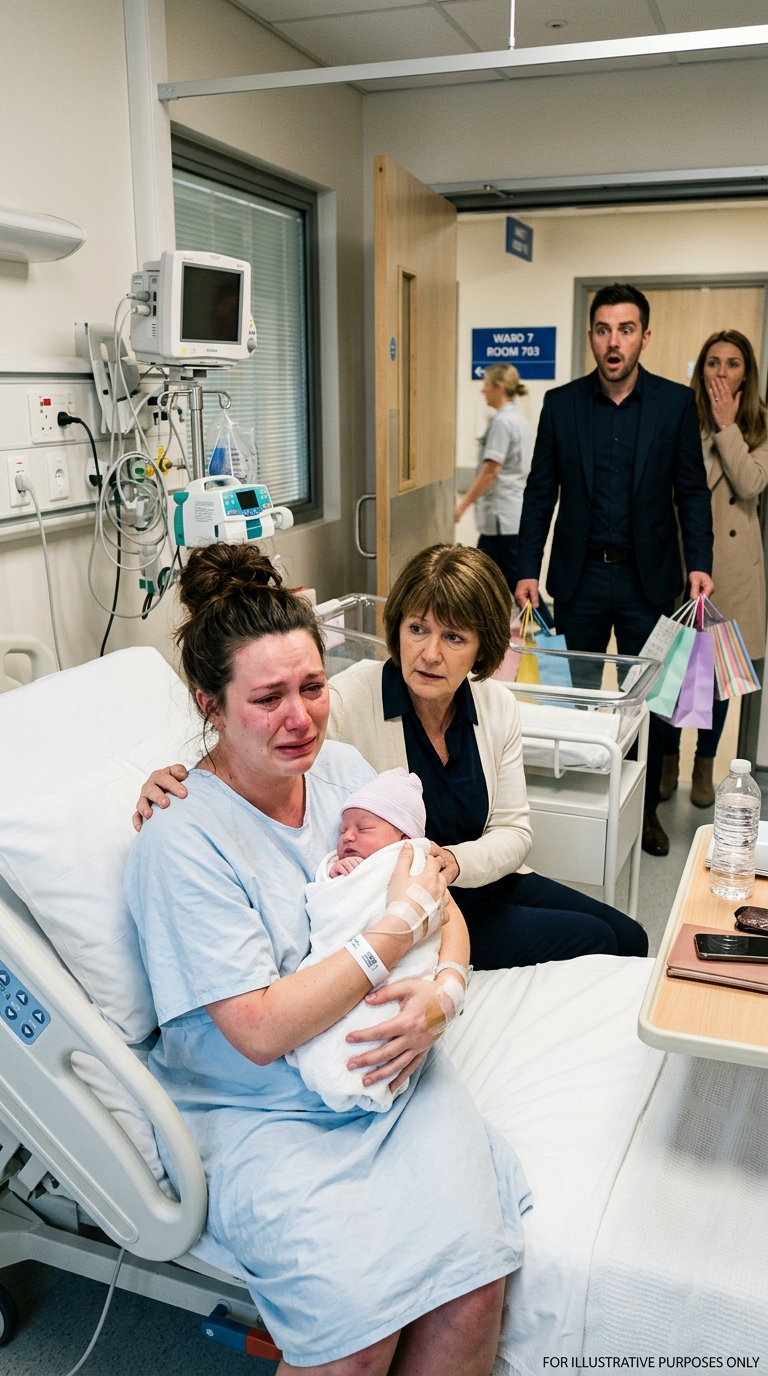
So I wore sweaters with frayed cuffs, skipped dentist appointments, and sold my mother’s jewelry to cover groceries. Malcolm, meanwhile, handled every bank account because he claimed I was “too emotional” for money. When he entered my hospital room, he barely looked at our newborn daughter. “You chose the private room?” he hissed. “The nurse said it was the only one available.” His jaw tightened. “You always find a way to spend.” I was still bleeding, still shaking, but I apologized.
Then the door opened. My grandmother, Josephine Vale, walked in wearing a cream coat and the expression that had once made corporate boards fall silent. At seventy-eight, she still controlled Vale Industries, the logistics empire my late grandfather built. I had avoided asking her for help because Malcolm insisted she had cut me off after our marriage. Grandmother’s eyes moved from my cheap gown to my cracked phone, then to the faded dress hanging beside the bed. “What happened to the clothes I sent you?” she asked. Malcolm answered quickly. “Vivian prefers a simple life.”
Grandmother ignored him. Her gaze sharpened. “Isn’t the twenty-thousand-dollar monthly allowance enough?” The room went silent. My blood turned cold. “What allowance?” I whispered. Malcolm laughed too loudly. “She’s confused. The medication—” Grandmother took out her phone. “Twenty thousand dollars, transferred on the first of every month for thirty-six months. Seven hundred twenty thousand total.” I looked at my husband. His face changed for only a second, but I saw it: not confusion. Calculation. Then he smiled. “Vivian, sweetheart, let’s discuss this privately.” That smile had frightened me for years. This time, it didn’t. Because before marriage, I had been a forensic accountant at Vale Industries. Malcolm had convinced me to quit, but he had not erased what I knew.
For years, he had convinced me that dependence was love and obedience was safety. But sitting beside my newborn, I understood the truth: poverty had never been our problem. Malcolm needed me ashamed, isolated, and grateful, because a frightened woman rarely asks to see the books. I reached beneath the mattress, pulled out the hospital bill, and placed it in Grandmother’s hand. “Don’t leave,” I said. “I think my husband has been robbing me.” Malcolm shut the hospital door and stood between us. “This is a misunderstanding,” he said. “I invested the allowance for our future.” “In whose name?” I asked. His eyes flickered. “Ours.”
Grandmother called her counsel, Helena Cross, and placed the phone on speaker. Helena confirmed that every payment had gone into an account Malcolm opened using a power of attorney bearing my signature. I had never signed it. Malcolm’s voice hardened. “You’re exhausted. Don’t accuse me of crimes because you can’t remember paperwork.” That was his favorite weapon: making me doubt my own mind. He leaned close enough that only I could hear him. “Send your grandmother away, or I’ll tell everyone you’re unstable. I’ll take the baby.” Once, that threat would have broken me. Instead, I looked at the security camera above the hospital door and said, “Could you repeat that?” He followed my gaze and went pale.
Grandmother smiled without warmth. “You targeted the wrong woman, Malcolm.” He recovered quickly. Arrogance had always been his strongest drug. He claimed he needed to check on the car and left, promising to return with proof that everything was legitimate. The moment the elevator doors closed, I asked Helena to freeze the trust distributions. Then I requested a laptop. Pain tore through my abdomen as I worked, but anger kept me awake. I searched old tax returns, insurance notices, and archived emails. Malcolm had deleted most records from my phone, yet he had forgotten that my previous accounting software automatically backed up attachments to a secure Vale server. By midnight, I found the pattern.
The stolen allowance had funded a penthouse, a luxury car, and a company called Northpoint Consulting. Its registered director was Sabrina Cole—Malcolm’s “married client,” whose midnight calls he always took on the balcony. There was more. Malcolm had used my forged signature to guarantee a two-million-dollar business loan. The money had been transferred through Northpoint, then spent on speculative property deals. If those deals collapsed, the lenders could pursue me. Grandmother wanted to call the police immediately. “Not yet,” I said. “He’ll claim I authorized everything.” So we let him believe I was still frightened.
The next morning, Malcolm returned carrying flowers and a folder. Sabrina followed him in wearing my grandmother’s diamond bracelet—the one Malcolm had told me was sold to pay our mortgage. Sabrina looked at my hospital gown and smirked. “You let yourself go.” Malcolm placed custody papers on my bed. “Sign these,” he said. “I’ll forgive the accusations, cover your medical bill, and allow supervised visits.” He believed the money, the house, and my daughter were already his. I picked up the pen with a trembling hand. Then I deliberately dropped it beside his phone. As he bent to retrieve it, Grandmother’s investigator photographed the unlocked screen from the hallway. A message from Sabrina glowed across it: Once she signs, transfer the last $300,000 and delete the forged files.
I began to cry. Malcolm mistook it for surrender. It was relief. I signed nothing. Instead, I looked at Malcolm and said, “The hospital requires a witness.” Helena entered before he could answer. Two detectives, a bank investigator, and security followed. Sabrina’s smirk vanished. Malcolm grabbed the custody papers. “This is harassment.” “No,” I said. “This is an audit.” Helena connected the laptop to the room’s television. The screen showed forged authorizations, diverted transfers, the fraudulent loan, property deeds, and messages between Malcolm and Sabrina discussing how to make me appear mentally incompetent. Malcolm’s own voice filled the room: “Once she signs, transfer the last three hundred thousand and delete the forged files.”
Sabrina whispered, “You said the documents were legal.” He turned on her. “Shut up.” Malcolm lunged for the laptop, but security stopped him. “Vivian, listen to me,” he begged. “I did this for us. I was building something.” “You made me sell my mother’s necklace while you bought her a penthouse.” Sabrina tore off the bracelet and threw it onto the bed. “He told me she was spoiled and pretending to be poor.” Grandmother picked up the bracelet. “And you found that believable while spending her money?” Sabrina had no answer. Malcolm tried one threat. “You can’t prove she didn’t approve the accounts.” I opened a sealed envelope from the hospital records office. “Actually, I can.”
Years earlier, I had created a verification rule: any trust authorization above ten thousand dollars required my in-person biometric confirmation and a rotating code stored with Vale’s legal department. Malcolm’s forged power of attorney had neither. He had stolen my signature. He had never stolen my training. The bank investigator informed him that his accounts were frozen. The detectives arrested him for identity theft, forgery, wire fraud, and coercive financial control. Sabrina was arrested as a co-conspirator after investigators found that Northpoint had been created solely to launder the transfers. As Malcolm was handcuffed, he stared at Grandmother. “You set me up.” “No,” I said. “You built the trap. I only turned on the light.”
The fraudulent loan was voided. The penthouse and car were seized. My stolen allowance was recovered through account and property seizures. In divorce court, Malcolm’s recorded threats destroyed his custody argument. He received supervised contact and later lost it after pressuring a witness. I stood outside Vale Industries with my daughter asleep against my chest. For the first time in years, I breathed without asking anyone’s permission. I had returned as director of forensic compliance and founded a program helping victims escape financial abuse. Malcolm was serving seven years in federal prison. Sabrina accepted a plea deal, surrendered the luxuries, and testified against him. Grandmother joined me on the steps. “Are you angry I didn’t discover it sooner?” she asked. I looked at my daughter’s face. “No. I’m angry I forgot who I was.” Grandmother squeezed my hand. I had once hidden a hospital bill in fear. Now my name was on the office that taught women how to follow the money—and take their lives back.