
The first thing Dana said to me was that I was not supposed to be there.
I had one suitcase behind me, a tote bag cutting into my shoulder, and the key the rental company had sent resting in my palm.
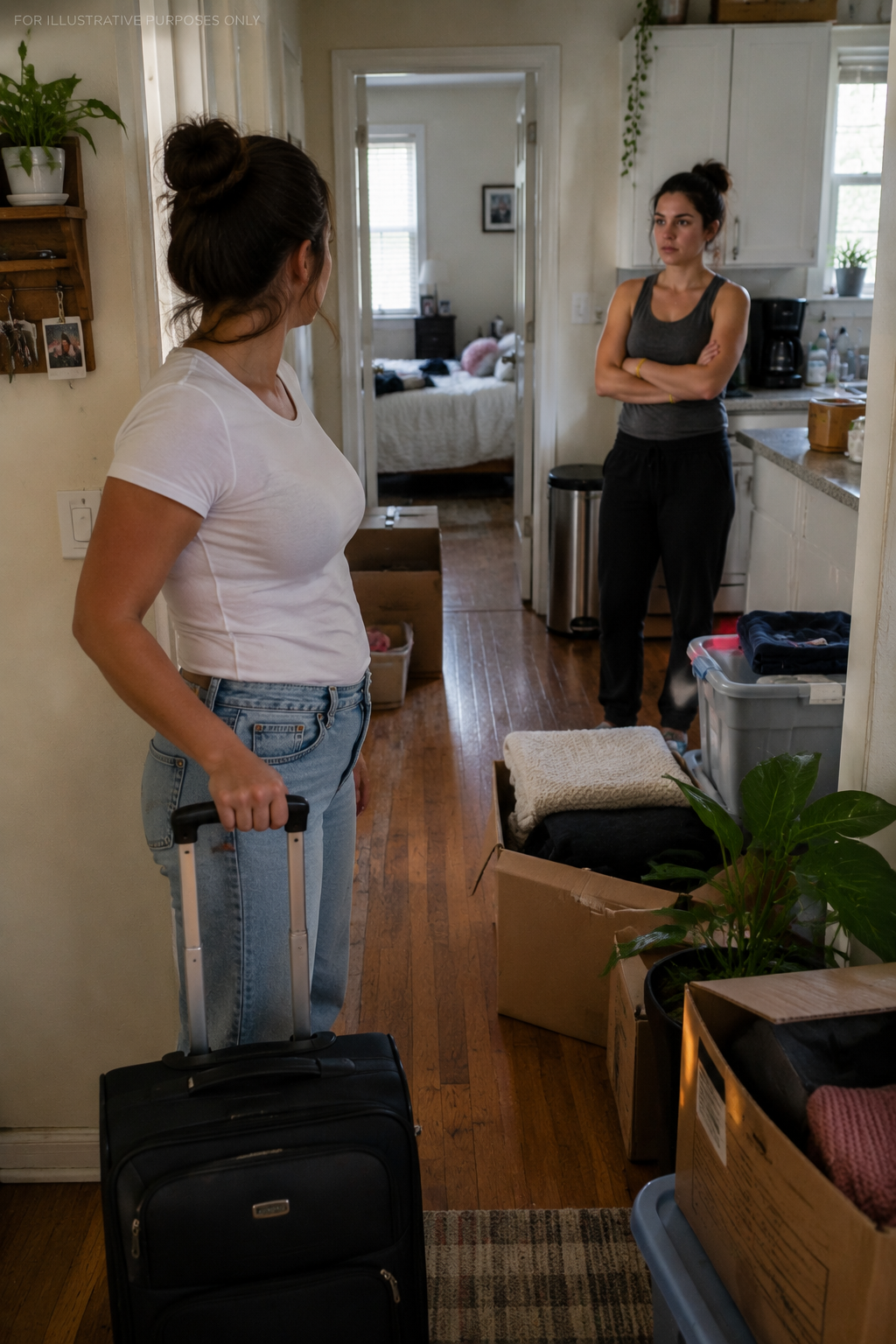
The apartment door had opened without any trouble. The code worked. My room number matched the confirmation email. The first month’s payment and security deposit had already left my bank account.
Still, the woman standing in the hallway looked at me as though I had climbed through a window.
She was tall and thin, with dark hair pulled tightly away from her face. She wore rubber cleaning gloves and held a folded dish towel against her chest.
For several seconds, neither of us spoke.
Then I smiled.
“Hi. I’m Maya. I’m moving into the room near the kitchen.”
Dana’s eyes widened.
“You’re moving in today?”
“Yes.”
She glanced behind me toward the open front door, almost as though she expected someone from the company to appear and admit they had made a mistake.
“Oh,” she said.
I waited.
Then she added, “Did they not tell you?”
“Tell me what?”
“They give me the option to approve or reject new roommates.”
I shifted my suitcase upright.
“I never heard anything about that.”
“I sent them a notice saying I didn’t want to live with you.”
There are moments when you know immediately that the conversation is not happening in the same reality for both people.
This was one of them.
Dana spoke as though her private email had canceled my signed agreement. The rental company had accepted my money, sent entry instructions, and confirmed the room for a little more than three months.
“I’m sorry they didn’t respond to you,” I said carefully, “but I have a lease.”
Her expression tightened.
“I told them no.”
“I understand that. But they told me yes.”
She stared at me.
I had arrived in Brooklyn that afternoon after dragging two suitcases through a crowded subway station in summer heat. I had spent the train ride imagining a shower, cold water, and perhaps ordering noodles before unpacking.
Instead, I was standing in a narrow hallway defending my legal presence to a stranger wearing cleaning gloves.
Dana stepped aside eventually.
“I guess you should contact the company.”
“I will.”
She turned and walked into one of the bedrooms without offering to show me anything.
That was how I moved into the apartment.
I was twenty-two and had accepted a short-term job assignment in New York.
My employer’s main office was in Manhattan, but the rooms I could afford there were either extremely small, badly reviewed, or far from public transportation.
The Brooklyn apartment seemed like a reasonable compromise.
It had four bedrooms, one shared bathroom, a kitchen, and a combined living and dining area. The photographs showed bright windows, wooden floors, and enough common space for several adults.
The arrangement worked more like student housing than a normal apartment lease.
Each tenant rented a private bedroom directly from the management company. We did not choose one another or divide rent ourselves. Our leases included access to the shared kitchen, bathroom, and living spaces.
Tenants could stay for as little as a month or as long as two years.
The company sent existing residents a brief profile when someone applied for an empty room. Current tenants could submit a notice objecting to the match.
I had assumed those objections were recommendations rather than absolute decisions.
Otherwise, one person could control who lived in an apartment she did not own.
Dana apparently believed she possessed exactly that power.
She had already lived there for more than a year.
From the way the apartment looked, she had used that time to spread into every available surface.
My bedroom was small but clean.
There was enough room for a bed, a narrow wardrobe, a bedside table, and little else.
I opened the wardrobe and began hanging clothes.
The walls were thin. I could hear Dana moving around outside, opening and closing cupboards.
After twenty minutes, I returned to the common area to inspect the kitchen.
That was when I saw how much of the apartment belonged to her in practice.
Plastic storage boxes covered one wall of the living room.
Empty cardboard boxes were stacked beneath the dining table.
Two fabric bins sat beside the sofa, overflowing with folded clothes.
A narrow shelf near the kitchen held bottles, jars, cleaning supplies, and kitchen equipment.
More containers lined the hallway.
One stack stood so close to another bedroom door that a person would need to turn sideways to enter.
At first, I assumed some items belonged to absent tenants.
Then Dana appeared behind me.
“Most of that is mine,” she said.
I turned.
“I was wondering.”
“I don’t have enough space in my room.”
I looked toward the hallway.
“Someone lives in the room behind those boxes?”
“Yes, but he’s hardly here.”
The boxes blocked part of his doorway.
“That seems unsafe.”
“He can still get in.”
Technically, a narrow path remained.
That did not make the arrangement reasonable.
Dana walked into the kitchen and opened a cupboard.
“I like to keep my things separate.”
“That’s fine.”
“I don’t share dishes.”
“I have my own.”
“Or pans.”
“I brought cookware too.”
“Or food.”
“Same.”
She looked mildly disappointed that I did not resist.
I explained that I had a food allergy, so I preferred keeping my cooking tools separate anyway.
That should have made us compatible.
Instead, every agreement seemed to lead her toward a smaller distinction.
Her shelf.
Her cupboard.
Her half of the refrigerator.
Her cleaning cloth.
Her sponge.
Her side of the sink.
She did not want clear boundaries.
She wanted proof that my presence would remain as small as possible.
I unpacked kitchen items the following morning.
When I went to throw away the packaging from a new set of utensils, Dana stopped me.
“You can’t use that trash can.”
I looked at the tall plastic bin beside the kitchen counter.
“What?”
“That’s mine.”
It was positioned in the center of our shared kitchen.
“I thought it was the apartment trash.”
“No.”
“Is there another one?”
“No.”
I stared at her.
“Where do the other tenants put rubbish?”
“They have their own arrangements.”
“What arrangements?”
She shrugged.
“I don’t know.”
I held the paper packaging in one hand.
“Could I use it if I take the trash out?”
Dana considered this.
“I don’t like other people touching the lid.”
“It’s a trash can.”
“I know.”
“I can use a bag inside it and take the bag out when it’s full.”
She hesitated, then nodded.
“Okay. But don’t put food directly into it.”
“I wasn’t planning to throw uncovered food into any trash can.”
Her mouth tightened.
Still, we had an agreement.
I added garbage bags to my shopping list in case I needed separate ones later.
I did not yet understand that Dana’s agreements expired whenever sharing began to feel real.
She had two cats.
I learned this through scratching sounds behind her bedroom door.
I saw one gray face watching me from beneath her bed when she briefly opened the door.
The cats rarely entered the shared space.
They remained in her room almost all day.
I wondered how much room they had among her belongings.
The thought made me sad.
Dana spoke about them affectionately but anxiously.
She worried that people would leave the front door open.
She worried cleaning products might harm them.
She worried someone would touch their bowls.
She said they were emotional-support animals, though I never asked whether both had formal documentation.
The cats were not the problem.
Nothing about them caused the tension.
They were simply another part of Dana’s life kept behind a closed door while her boxes occupied the rest of ours.
The second roommate I met was Anthony.
He was around twenty-eight and lived in the bedroom next to mine.
We did not meet immediately because he worked long hours and spent several nights away.
The fourth tenant, Liam, lived behind the partly blocked door. He was leaving after one month and seemed determined not to become involved in apartment politics.
I understood his position.
Three months did not feel long when I signed the lease.
After meeting Dana, it began to feel like a social experiment.
The bathroom incident happened during my first week.
I had plans to attend a friend’s birthday party in Manhattan.
At eight thirty, I gathered my clothes and went to the bathroom.
Water was running inside.
I returned to my room and began doing my hair.
At nine, the water was still running.
At nine thirty, I checked again.
Still running.
I knocked.
“Dana?”
The door opened a few inches.
She was fully dressed.
Steam filled the room behind her, but she had not been showering.
The bathtub faucet was on.
“Are you almost done?” I asked.
She looked surprised by the question.
“I’m using the bathroom.”
“I know, but it’s been more than an hour.”
“I’m cleaning.”
“Can you pause? I need to shower before leaving.”
She glanced back toward the tub.
“I’m almost finished.”
Almost finished lasted another fifteen minutes.
When she finally left, the bathroom smelled strongly of disinfectant.
The tub was wet and empty.
I never learned exactly why the faucet needed to run for so long.
Perhaps she was rinsing something.
Perhaps she needed to flush cleaning chemicals repeatedly.
Perhaps there was a reason that made perfect sense inside her own routines.
The practical result was the same.
Four adults shared one bathroom, and she had occupied it for more than an hour without considering whether anyone else needed it.
I arrived late to the party.
I told myself one difficult evening did not define a person.
That became harder to believe the next morning.
I had loaded my plates and cooking tools into the dishwasher before leaving.
The company had cleaned the apartment before my arrival, but I wanted to wash everything after travel.
I added my own dishwasher tablet and started filling the lower rack.
Dana had several dishes inside already.
I assumed that meant she accepted our items could be washed in the same machine, even if they remained separate afterward.
When I returned from my friend’s apartment the next morning, my dirty dishes were sitting on the counter.
Not clean.
Not stacked carefully.
Simply removed.
Dana’s items remained inside the dishwasher.
I stood there trying to understand what had happened.
Maybe she had needed the machine and planned to reload my things afterward.
Maybe she had discovered the cycle had not started.
Then she came out of her bedroom.
“Did you take my dishes out of the dishwasher?” I asked.
“Oh, yes.”
“Why?”
“I needed to wash my things.”
“There was room for both.”
“I can’t wash them together.”
“You could have told me.”
“I thought you’d understand when you saw them.”
“My dirty dishes sat on the counter overnight.”
She moved toward the dishwasher.
“Sorry. I can empty my dishes now.”
“That doesn’t explain why you removed mine.”
“I use a special detergent.”
“I put my detergent in.”
Her face changed.
“You used your tablet with my plates?”
“The cycle never started.”
“You shouldn’t put that near my things.”
“It was in the detergent compartment.”
“It could ruin them.”
“They’re ceramic plates.”
“They have a finish.”
I did not know what finish she meant.
The more important issue was that she had handled my dirty dishes to avoid letting them share a washing cycle with hers.
She could touch them long enough to remove them.
She simply could not allow them inside the machine with her belongings.
“I need to use the dishwasher too,” I said.
“You can. Just not with my things.”
“Then we can coordinate.”
“I don’t want people touching my dishes.”
“I don’t want people touching mine either, especially to leave them dirty on the counter.”
Her expression hardened.
I realized the conversation would not produce an apology.
Then Anthony walked into the kitchen.
It was the first time we had spoken properly.
He looked at my dishes, then at Dana.
“What happened?”
Dana said nothing.
I explained.
Anthony gave a short, tired laugh.
“That sounds familiar.”
Dana returned to her room.
The door closed.
Anthony leaned against the counter.
“She tried to stop me from moving in too.”
“What did she say?”
“When I toured the place, she followed us around explaining why the room was bad.”
“What reasons?”
“The bathroom was too crowded. The kitchen was too small. The neighbors were noisy. She said the company regularly lied about the building.”
“Then why does she live here?”
“Exactly.”
The person conducting the tour apparently told Anthony that Dana did this frequently.
Whenever a prospective tenant appeared, she tried to discourage them.
She had submitted objections to multiple applicants.
She behaved as though every empty room was another piece of the apartment she had earned by waiting long enough.
“She wants all four bedrooms without paying for them,” Anthony said.
“Does the company know?”
“They know she complains.”
“That is not the same as knowing she’s trying to frighten people away.”
“I reported it.”
“What happened?”
“Nothing.”
He looked toward the living room.
“She also needs to move those boxes.”
“One stack blocks Liam’s door.”
“I mentioned that.”
“Did she respond?”
“She says she has nowhere else.”
We stood in the crowded kitchen looking at the evidence that Dana’s lack of private space had become everyone’s shared problem.
Thirty minutes later, I found a note attached to the trash can.
Maya,
I know I said you could use my trash can, but I’m not comfortable with it anymore. Please buy your own.
Thank you.
The note changed something in me.
The dishwasher incident had been strange.
The bathroom issue had been inconsiderate.
The greeting had been hostile.
But the trash-can reversal made the pattern unmistakable.
Dana could tolerate an agreement only until it allowed another tenant to behave as though she belonged.
I waited for her to leave her room.
When she did, I held up the note.
“You said I could use this.”
“I changed my mind.”
“Fine. I’ll buy another one.”
“Thank you.”
“But there is no space for another trash can.”
“There’s space near your room.”
“I’m not keeping kitchen rubbish in my bedroom.”
“That’s not my problem.”
I looked around the common area.
“Your belongings occupy most of the space.”
“I don’t have room for them anywhere else.”
“That is not my problem either.”
Her face tightened.
I pointed toward the boxes beside Liam’s door.
“You need to move some of your things so the rest of us can use the apartment.”
“I use everything.”
“Empty cardboard boxes?”
“I need them.”
“For what?”
“Storage.”
“They are empty.”
“I might need them when I move.”
“You’re not moving now.”
She folded her arms.
“You don’t know that.”
I thought about her attempts to reject every roommate.
Perhaps she always imagined leaving.
Perhaps the empty boxes made that imagined escape feel possible.
I did not say it.
Instead, I returned to the dishwasher issue.
“You also need to tell me before removing my things.”
“I already explained that I can’t use your detergent.”
“We can run separate cycles.”
“Good.”
“But if my dishes are inside, leave them there.”
“What if I need the dishwasher?”
“Ask me to remove them.”
“I don’t want to wait.”
“Then wash your dishes by hand.”
She stared at me.
I could see that direct resistance surprised her.
She had probably succeeded with earlier tenants by creating so many small inconveniences that leaving felt easier than fighting.
I was only staying three months.
That made me less willing to surrender what I had paid for.
I bought a trash can that afternoon.
It was smaller than Dana’s but large enough for Anthony and me to share.
When I brought it into the apartment, the common area was still crowded with her bins.
Anthony was sitting at the table using his laptop.
He watched me search for a place to put the new can.
Then he looked at Dana’s bin.
“Dana,” he said when she entered the kitchen, “could you move your trash can?”
She stopped.
“Why?”
“If nobody else can use it, I don’t think it should occupy the shared kitchen.”
“I don’t have space in my room.”
Anthony nodded toward the living room.
“Neither do we. That’s the issue.”
“I’ve had it there for over a year.”
“That doesn’t make the space yours.”
“It’s a kitchen trash can.”
“Then let people use it.”
“No.”
“Then keep it in your private area.”
She looked at me as though I had recruited him against her.
I had not.
Her behavior had created the alliance without help.
Dana did not move the trash can.
We placed ours beside it temporarily.
Two bins stood in the small kitchen because one resident treated garbage disposal as a private privilege.
The arrangement looked ridiculous.
It also captured the entire problem.
Anthony and I reported the situation to the management company separately.
I focused on the lease.
The common spaces were included in my rent.
Dana’s boxes prevented reasonable use.
They also partly blocked a bedroom exit.
I attached photographs.
Anthony described her behavior during his tour and her repeated attempts to reject incoming tenants.
We hoped separate reports would demonstrate that this was not simply a personality conflict between two women.
For several days, the company did not answer.
Dana became quieter.
She remained in her bedroom for long periods.
When she came out, she cleaned.
Not casually.
She scrubbed handles, containers, bottles, shelves, and countertops with focused intensity.
She disinfected a bottle of olive oil after moving it from one shelf to another.
When I placed a storage container beneath the sink for my cleaning products, she insisted on moving her own soap and sponge herself.
“Don’t touch those,” she said.
“I wasn’t going to.”
“I need to move them first.”
She lifted each item carefully and wiped the surface beneath it.
By then, I had begun wondering whether contamination anxiety shaped much of her behavior.
The long bathroom routines.
The dishwasher separation.
The private trash can.
The fear of people touching her belongings.
Her refusal to let the cats leave her room where they might interact with other tenants.
I felt sympathy.
I also felt angry.
A mental-health condition could explain why sharing felt unbearable to her.
It did not give her the right to dominate an apartment leased to four people.
I could not diagnose her.
I would never raise the possibility directly.
I only knew that some of her behavior looked less like ordinary selfishness and more like fear organized into rules.
The problem was that she expected strangers to live inside those rules without discussion.
The company sent a cleaner one morning because several tenants had recently moved in.
The cleaner was friendly and worked quickly through the kitchen and bathroom.
While I was in my room, I heard Dana laughing with her.
I stepped into the hallway.
Dana’s expression changed immediately.
She turned toward the cleaner.
“Could we talk outside?”
They walked into the corridor and closed the apartment door behind them.
I had no proof that Dana complained about us.
The timing made it difficult to imagine another subject.
That was another part of living with her.
Everything felt secretive.
Notes instead of conversations.
Private complaints.
Emails rejecting people before meeting them.
Whispered discussions outside.
Small actions designed to keep her hands clean while creating discomfort for everyone else.
The company eventually called Dana and instructed her to remove the boxes blocking Liam’s doorway.
She complied that evening.
The doorway became accessible.
The boxes moved onto a table in the living room.
A hazard was reduced.
The common space remained unusable.
Dana behaved as though relocation equaled resolution.
She slid objects from one shared surface to another without acknowledging that the lease prohibited using communal areas as personal storage.
Liam did not care much.
He had only a few weeks left.
“I can get out now,” he told me.
“That’s enough for me.”
I understood.
He did not want to spend his final month fighting.
But every departing tenant who tolerated the problem made it easier for Dana to continue.
She did not need to force anyone out dramatically.
She only needed to make temporary residents decide the conflict was not worth their time.
Then the rooms emptied again.
For a while, she had more of the apartment to herself.
The management company answered our first reports with polite language.
They acknowledged the photographs.
They said the common spaces should remain available.
They said they would contact Dana and monitor the situation.
The message sounded reassuring until nothing changed.
Anthony and I continued documenting.
Photographs of boxes.
Photographs of blocked surfaces.
Dates of conversations.
Screenshots of messages.
I noticed scratches along the side of the living-room sofa, likely from Dana’s cats before she began keeping them permanently in her room.
I photographed those too.
Not because I wanted the cats blamed.
Because I had begun worrying that damage might later be assigned to the newest tenants.
Documentation became protection.
It also changed the way I experienced the apartment.
Every object became potential evidence.
A box was no longer only a box.
It was a lease violation.
A scratch was possible liability.
A note on a trash can was proof of antagonistic behavior.
I had moved into a home.
Within a week, I was building a case file.
Dana and I barely spoke for several days.
I used the dishwasher whenever I had enough for a full load.
She stopped using it entirely.
She washed her items by hand, sometimes for long periods.
She cleaned each plate before placing it into a cabinet.
I did not touch her things.
She behaved as though proximity itself created risk.
If I cooked while she was in the kitchen, she waited by the doorway until I finished.
If I walked near one of her bins, she watched.
Her belongings occupied almost every shared area, yet she wanted a physical boundary around each object.
The contradiction was impossible.
Private control required private space.
She had chosen to keep most of her things where other people lived.
At some point, avoidance became mathematically impossible.
The situation escalated when I needed to begin remote work.
My new position required a desktop computer.
The monitor, keyboard, and computer tower had been stored in a small rented unit while I settled into the apartment.
I retrieved them over the weekend.
My bedroom could not fit a desk.
The bed nearly touched both walls.
The shared living area should have been the obvious place.
There was a table beneath the window, but Dana’s bins covered it.
I moved one large box to the side and created a narrow workstation.
It was not attractive.
The monitor sat partly on a storage lid.
My keyboard barely fit.
Cables ran toward an outlet behind the sofa.
Still, I could work.
For one evening, everything was fine.
Then Dana approached me.
“Can you move your computer?”
I looked up.
“Why?”
“I use those bins for cooking.”
The bin beneath my monitor contained several kitchen tools, though I had never seen her open it.
“I need a place to work.”
“You can use your room.”
“There is no room for a desk.”
“Could you work from your bed?”
“Not for eight hours.”
She looked at the monitor.
“I need access to my things.”
“I can move it when you need something.”
“I don’t want your computer touching the bin.”
“The monitor stand is touching the lid.”
“That’s what I mean.”
I took a breath.
“Do you want to move your things?”
Her answer was immediate.
“Where?”
“To your room or storage.”
“I use them.”
“You cannot store everything you own in shared space and then prevent anyone else from using it.”
“I’ve been here longer than you.”
I stared at her.
“That is not how separate leases work.”
She pushed one table approximately six inches and suggested I could place the computer there.
The new position was barely different.
I moved my equipment because I needed to avoid a physical confrontation with her belongings.
My plan became moving the box whenever I worked and returning it afterward.
It was inconvenient.
It was also temporary.
Then the company sent another message.
That message made the conflict stop being mainly about Dana.
The company told us that Dana planned to move out in approximately two weeks.
Because her departure was approaching, they suggested allowing the situation to resolve naturally.
They would continue communicating with her.
They thanked us for our patience.
I read the message several times.
Anthony called me from the hallway.
“Did you see that?”
“Yes.”
“They’re doing nothing.”
The company had acknowledged that Dana violated the lease.
They had received photographs.
Two tenants had complained.
Their solution was for us to continue paying full rent while waiting for the person occupying most of the shared space to leave on her own schedule.
They presented her departure as though management had solved the problem.
It had not.
During the remaining two weeks, I still needed to work.
I still needed access to the kitchen, bathroom, and living room included in my contract.
Dana’s future move did not refund the days I had already lost.
It did not explain why the company rented rooms while allowing one tenant to control common areas.
It did not address her repeated efforts to reject or frighten off replacements.
The company wanted the calendar to complete the work they had avoided.
I called customer support.
The representative sounded polite and powerless.
I explained the situation from the beginning.
Separate leases.
Blocked common space.
Photographic evidence.
Reports from multiple tenants.
Lease clauses requiring shared spaces to remain accessible.
He placed me on hold twice.
When he returned, he said he could not guarantee compensation.
“I’m paying for access to the common area,” I said.
“I understand.”
“I do not have that access.”
“I understand your frustration.”
“This is not only frustration. It is a contractual issue.”
“We are working toward resolution.”
“You told me the resolution is that she leaves in two weeks.”
“That is one factor.”
“What action are you taking today?”
“I can escalate your complaint.”
“To whom?”
“Our property support team.”
“Can I speak to them?”
“No.”
“Can you guarantee they will contact me?”
“They usually respond within a certain period.”
“What period?”
He avoided the question.
I became the version of myself people dismissively call a difficult customer.
I repeated the lease terms.
I asked for names.
I requested written confirmation.
I refused to accept sympathy as action.
The representative still could not promise anything.
After the call, I searched for physical company offices in Manhattan.
I had a job interview nearby and decided to visit in person.
Two addresses appeared online.
Neither led to an accessible office.
One building directory did not list the company.
The other address appeared connected to a shared business service.
I stood on the sidewalk feeling foolish and furious.
The company had made itself easy to pay and difficult to confront.
When I returned to Brooklyn, Dana was wiping the outside of a storage container.
She looked at me but said nothing.
For the first time, I felt almost less angry with her than with management.
Dana had shown me who she was within the first minute.
She wanted the apartment to herself.
She resisted new tenants.
She built rules around her belongings.
She filled common rooms with private property.
Her behavior was unreasonable, but it was consistent.
The company knew.
They continued placing new tenants into the apartment without enforcing the lease.
They collected four separate rents for shared spaces one person had effectively taken over.
Then they treated conflict as an interpersonal inconvenience.
Dana created the conditions.
Management made them profitable.
Anthony and I compared lease sections.
The contract said common areas were available for shared residential use.
It prohibited obstruction, unauthorized storage, and interference with other tenants’ reasonable enjoyment.
It required residents to keep exits and passageways clear.
The language supported us.
The enforcement remained uncertain.
I began writing a formal timeline.
Move-in date.
Dana’s statement that she had rejected me.
Trash-can restriction.
Bathroom use.
Dishwasher incident.
Discovery that she discouraged Anthony during his tour.
Boxes blocking Liam’s doorway.
Photographs.
Reports.
Company responses.
Computer-workspace conflict.
Management’s decision to wait for her move.
I attached the relevant lease pages.
I requested a partial rent credit for the period during which the shared space was substantially unavailable.
I also asked for confirmation that the apartment would be cleared before the next tenant arrived.
Anthony submitted his own complaint.
We kept our accounts separate so the company could not dismiss them as one coordinated emotional reaction.
Dana began packing more seriously during her final week.
Her empty boxes finally gained purpose.
The living room became even less usable as items moved into piles.
She labeled containers, cleaned them, and placed them near the front door.
Her cats remained in the bedroom.
One evening, I heard her speaking on the phone.
“I tried to stop them from coming,” she said. “The company doesn’t care.”
I did not know who was listening.
Perhaps a friend.
Perhaps her mother.
Perhaps someone helping her move.
Her voice sounded less angry than exhausted.
For a moment, I saw the apartment from her perspective.
She had lived there more than a year.
Tenants arrived and disappeared.
Each new person represented unfamiliar germs, sounds, habits, dishes, rubbish, and contact with objects she tried to control.
Perhaps she had submitted rejection forms because she genuinely believed living alone was the only way to feel safe.
But she could not afford a four-bedroom Brooklyn apartment alone.
So she tried to create solitude inside shared housing.
That was sad.
It was also impossible.
Her fear did not make our rent imaginary.
Understanding another person’s struggle did not require surrendering to it.
Two nights before her departure, Dana and I spoke more honestly than we had before.
I was making tea.
She entered the kitchen carrying a sealed box.
For once, she did not wait for me to leave.
“I’m moving Friday,” she said.
“I heard.”
“The company told you?”
“Yes.”
She placed the box down.
“I didn’t want this many roommates.”
“I know.”
“They said I could reject profiles.”
“They gave you a form to express concerns. That does not mean you can keep every room empty.”
“They used to listen.”
“Did earlier tenants cancel?”
“Some.”
“Because you discouraged them?”
She looked away.
“I told them the truth.”
“You told Anthony not to move here.”
“He asked what it was like.”
“You told me I had been rejected after I already paid.”
“They should have informed you.”
“Yes, they should have told me you objected. They should not have treated the objection as cancellation.”
She touched the edge of the box.
“I don’t like people using my things.”
“I don’t want to use your things.”
“You used my trash can.”
“After asking.”
“I changed my mind.”
“I know.”
She became quiet.
I decided not to mention obsessive-compulsive disorder or contamination anxiety.
It was not my place.
Instead, I said, “You need a living arrangement where your private space is actually private.”
“I know.”
“This apartment was never going to give you that.”
“I had it mostly to myself before.”
“Because the rooms were empty.”
“Yes.”
“But you did not rent those rooms.”
Her face tightened.
“I know what the lease says.”
“Then why fight every person who arrives?”
“Because the company kept changing things.”
“What changed?”
“They stopped letting me choose.”
I almost argued.
Then I realized that from her perspective, allowing objections and ignoring them probably did feel like a broken promise.
The company’s system may have encouraged her belief that she had approval authority.
That still did not excuse her behavior after tenants legally arrived.
“I wish you had spoken to us normally,” I said.
“I did.”
“No. You used notes. You removed dishes. You blocked spaces. You told people not to move in.”
“You all touched things.”
“We live here.”
She looked distressed by that simple fact.
“I’m sorry about the boxes near Liam’s door,” she said.
It was the first apology I heard from her.
“Thank you.”
“I moved them.”
“To another shared table.”
“I didn’t have anywhere else.”
“I know.”
She picked up the box again.
The conversation ended there.
No friendship.
No complete understanding.
A brief acknowledgment that at least one boundary had been crossed.
Dana moved out on Friday.
The process took most of the day.
A van parked outside.
Two relatives helped carry boxes downstairs.
The living room slowly appeared.
First the dining table.
Then the wall.
Then the floor near the window.
The apartment looked larger with every trip.
Anthony and I watched without celebrating openly.
Dana cleaned the area beneath each box before allowing it to leave.
She wiped the trash can several times.
The cats were the last to go.
They emerged in carriers, blinking at the common room as though they had never seen it.
I felt sorry for them.
At the door, Dana paused.
She looked toward the kitchen.
“I left the shelf clean.”
“Okay.”
“The dishwasher is empty.”
“Thank you.”
She nodded.
Then she left.
The apartment door closed.
For several seconds, Anthony and I stood in silence.
Liam had already moved out.
Three rooms remained occupied.
The common space was finally common.
Anthony looked around.
“Do you want to move your computer to the table?”
I laughed.
“Yes.”
It was the first thing I did.
Management did not immediately offer compensation.
They sent a message confirming that Dana had vacated the unit and that the complaint was considered resolved.
I replied that her departure resolved the future obstruction, not the loss of access during the period already paid.
I attached the timeline again.
I cited the lease.
I requested escalation.
Anthony did the same.
After several more calls and emails, the company offered a small rent credit.
It was less than I requested.
More than they initially claimed was possible.
I accepted because my stay was short, my job had started, and I did not want the dispute to consume the rest of my time in New York.
Anthony continued pushing for a larger amount.
He enjoyed arguments more than I did.
The company also arranged to inspect and clean the common areas before filling the empty room.
Whether they changed their process for future objections, I never learned.
I hoped they stopped telling tenants that a notice of decline gave them veto power.
A form that created expectations without clear authority had helped produce the conflict.
Still, forms did not remove personal responsibility.
Dana could have disliked sharing without trying to erase everyone else.
The rest of my stay was almost peaceful.
A new tenant named Rosa moved into Dana’s former room.
On her first day, she entered cautiously and said, “I heard there were roommate problems.”
Anthony and I looked at one another.
“What did the company tell you?” I asked.
“Just that the previous tenant had moved.”
We showed her the kitchen shelves.
Explained the bathroom schedule.
Agreed on shared cleaning products.
Discussed rubbish.
The trash-can conversation took less than a minute.
Rosa bought coffee the next morning and left it on the counter with a note saying everyone could use it.
I almost cried over a bag of coffee because the gesture felt so normal.
Shared living did not require best friendship.
It required recognition that other people had equal reality.
Equal schedules.
Equal space.
Equal right to place a trash can in a kitchen.
Looking back, I do not think Dana was simply an evil roommate plotting to make everyone miserable.
I think she was frightened, controlling, entitled, and enabled.
Perhaps she had contamination-related obsessive-compulsive symptoms.
Perhaps another condition shaped her routines.
Perhaps she had lived alone in the apartment long enough that every new tenant felt like an invasion.
I cannot know.
A diagnosis would not have changed the lease.
Compassion did not mean allowing her boxes to block doors.
Empathy did not mean giving up a dishwasher, bathroom, table, or living room.
People sometimes confuse understanding with permission.
They are not the same.
I could understand that sharing distressed her.
She still had to share.
I could understand that touching her belongings frightened her.
She still could not fill every common surface with them.
I could understand that she wanted solitude.
She still could not obtain it by driving paying tenants away.
Her needs mattered.
So did ours.
The management company frustrated me more than Dana in the end.
They sold flexible communal housing without managing communal conflict.
They accepted rent from several tenants while allowing one resident to dominate the shared areas.
When complaints arrived, they waited for time to remove the problem.
That approach was convenient because temporary residents often left before enforcement became necessary.
People like Liam tolerated a month.
Others might cancel after a hostile tour.
New tenants arrived without knowing the history.
Dana remained.
The system rewarded the person most willing to make shared living unbearable.
Documentation disrupted that pattern.
Not malicious compliance.
Not revenge.
Photographs.
Dates.
Lease clauses.
Separate reports.
Written requests.
That was less entertaining than stacking her boxes outside or filling the apartment with extra trash cans.
It was also safer.
I did not want to become the person management could describe as equally disruptive.
I wanted the record to remain simple.
I paid for access.
The access was obstructed.
I asked them to enforce the agreement.
My three-month stay ended in November.
On my final morning, I packed my computer and cleaned my shelf.
Anthony helped carry one suitcase downstairs.
Rosa hugged me.
The apartment looked nothing like it had on my first day.
The living room table held a plant, two laptops, and a bowl of fruit.
The hallway remained clear.
One shared trash can sat in the kitchen.
Everyone used it.
No notes.
No private rules.
No argument.
Before leaving, I stood near the entrance and remembered Dana’s face when I first arrived.
Shock.
Then annoyance.
As if my body crossing the doorway had violated an arrangement I had never made.
I wondered how many people she had successfully turned away.
How many tours she had interrupted.
How many short-term tenants decided an empty room was not worth living beside her.
Then I thought about the first thing I told her.
They already took my money. I will be living here.
At the time, it felt like a defensive response.
Later, it became the principle beneath the entire conflict.
I had not paid only for a bed behind a closed door.
I had paid for a home with shared space.
The word shared meant she was entitled to use it.
It also meant she was not entitled to own it.
I carried my suitcase down the stairs, left the key in the lockbox, and walked toward the subway.
For the first time since moving in, I did not feel like I was leaving her apartment.
I was leaving mine.