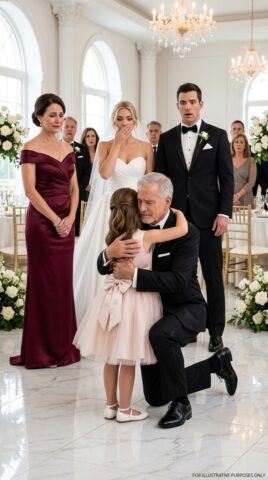
The champagne glass slipped from Margaret Rowan’s hand before she understood that she had let it go.
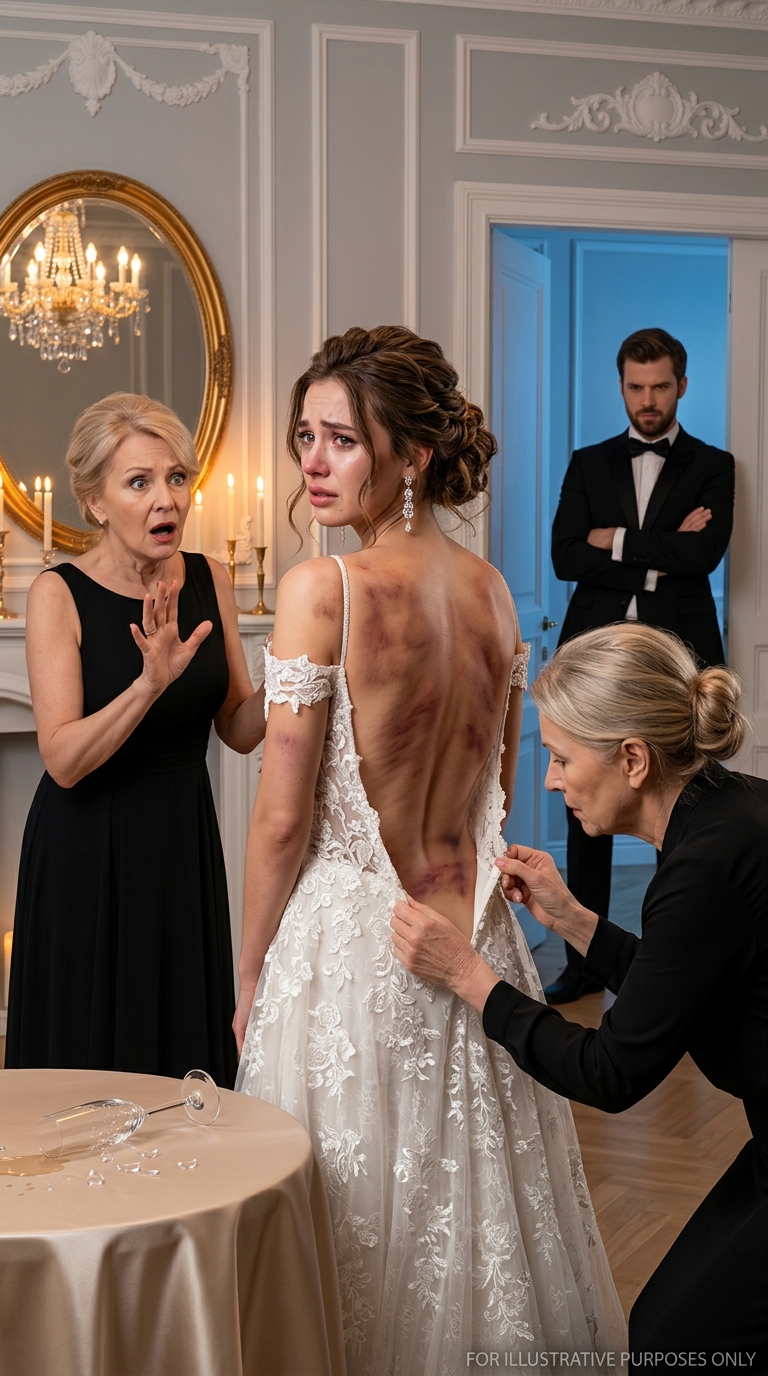
It struck the polished marble floor beneath the bridal platform and shattered with a sharp crack.
The seamstress gasped.
Margaret barely heard her.
Every broken piece reflected the same terrible image from a different angle.
Dark red lines crossed her daughter’s back from shoulder to waist. Some were fading at the edges. Others were fresh, raised, and angry against her pale skin. They ran in careful bands, too straight to be accidental and too numerous to be explained by one violent moment.
Elena stood frozen in the half-unfastened wedding gown, clutching the silk bodice against her chest.
“Mom,” she whispered.
Margaret did not move.
The private fitting room at Bellamy House had been bright and cheerful only seconds earlier. Afternoon sunlight entered through tall windows. White roses filled crystal vases. Elena’s veil lay across a velvet sofa, and two untouched glasses of champagne rested beside a plate of strawberries.
Now the room seemed too small.
The seamstress, Nadia Flores, still held the zipper between two trembling fingers.
Margaret looked from the marks to Elena’s face in the mirror.
Her daughter’s eyes were filled with fear.
Not embarrassment.
Not surprise.
Fear.
“Who did this?” Margaret asked.
Her voice sounded quieter than she expected.
Elena shook her head.
“Please zip the dress.”
“Who did this?”
“Mom, not here.”
Margaret looked toward Nadia.
The seamstress stepped backward.
“I can leave.”
“No,” Elena said quickly. “Please finish the fitting.”
Nadia’s eyes met Margaret’s in the mirror.
She had been sewing wedding gowns for nearly thirty years. She had probably seen tears, bruises, panic attacks, and brides who changed their minds. But the horror on her face told Margaret this was beyond anything she considered ordinary.
Margaret bent and picked up the largest piece of broken glass.
Her hand was steady.
That frightened Elena more than anger would have.
“Mom.”
Margaret placed the shard carefully on the table.
“Nadia, please lock the door.”
Elena turned.
“No.”
Nadia hesitated.
Margaret did not look away from her daughter.
“Lock it.”
The seamstress crossed the room and turned the brass key.
Elena’s breathing quickened.
“Why are you doing this?”
“Because no one is coming in until you tell me what happened.”
“I fell.”
Margaret looked at the lines again.
“No.”
“I hit the edge of something.”
“Several times?”
Elena closed her eyes.
Margaret stepped onto the platform.
Her daughter was twenty-seven years old, a pediatric surgeon who had spent the past six years moving through medical school, residency, and hospital corridors with a calmness that impressed senior doctors.
She could insert a breathing tube into a frightened child’s throat while parents cried beside her.
She could work through the night and still remember the names of every nurse on the floor.
Yet she was shaking like the little girl who once hid under the dining table during thunderstorms.
Margaret reached toward the open dress, then stopped.
“May I look more closely?”
Elena’s eyes opened.
For a moment, she appeared confused by the question.
Then she nodded.
Margaret moved the silk only enough to see the injuries clearly.
The oldest marks were brown at the edges.
The newer ones were deep red.
One line curved around Elena’s left side.
Another disappeared beneath the fabric near her ribs.
Margaret did not touch them.
She knew enough not to disturb evidence.
She also knew enough to recognize deliberate injury.
Her professional life had ended eight years earlier, but training did not disappear simply because someone stopped carrying a government identification card.
For eighteen years, Margaret had worked as a federal prosecutor specializing in financial crimes, coercive enterprises, public corruption, and complex fraud.
She had questioned bank executives, politicians, traffickers, and men who believed wealth transformed abuse into private business.
She had learned to watch details before emotion blurred them.
Direction.
Pattern.
Timing.
Language.
Who benefited.
Who was afraid.
She looked at Elena’s shoulder.
“Turn slightly.”
Elena obeyed.
The marks extended farther than Margaret first realized.
Nadia covered her mouth.
“Oh, sweetheart.”
Elena’s expression crumpled.
“Please don’t.”
Margaret lifted her phone.
“I need photographs.”
“No.”
“They may be important.”
“He’ll know.”
“Who?”
Elena’s lips trembled.
Margaret waited.
Years in court had taught her that silence could be kinder than repeated questions.
The room remained still except for Elena’s uneven breathing.
Finally she whispered, “Victor.”
Nadia began crying.
Margaret did not.
Not yet.
“What did he use?”
Elena looked toward the windows.
“I don’t know.”
“You know.”
“A belt.”
Margaret took one slow breath through her nose.
“When?”
“Last night.”
“Where?”
“At his father’s house.”
“Who else was there?”
“No one in the room.”
“Who was in the house?”
“Staff. Security. His parents were downstairs.”
“Did anyone hear?”
“I don’t know.”
“Why did he do it?”
Elena gave a broken laugh.
“He said I embarrassed him.”
“How?”
“At dinner, his father asked about the children’s hospital expansion. Victor answered incorrectly. I corrected one number.”
Margaret stared at her.
“That was all?”
“He said I made him look weak.”
The seamstress turned away.
Margaret’s mind began separating the moment into categories.
Physical assault.
Threats.
Witnesses.
Potential recordings.
Security systems.
Medical documentation.
Immediate danger.
Financial leverage.
Elena clutched the front of the gown tighter.
“He apologized afterward.”
Margaret said nothing.
“He said he was stressed.”
Still nothing.
“He had been drinking.”
“Elena.”
“He said it would never happen again.”
Margaret met her daughter’s eyes in the mirror.
“Is this the first time he has hurt you?”
Elena looked down.
That was the answer.
Margaret’s throat tightened.
“How many times?”
“I don’t know.”
“You do.”
“Not like this.”
“What did he do before?”
“He grabbed me.”
“Where?”
“My arms. My neck once.”
Margaret felt something cold settle behind her ribs.
“What else?”
“He pushed me into a wall.”
“When?”
“Two months ago.”
“And you told no one.”
“He said his father would destroy Daniel.”
Margaret’s attention sharpened.
“What does your brother have to do with this?”
Elena’s eyes filled.
“Daniel has been reviewing financial data for one of the Hale foundations.”
Margaret knew that much.
Her son worked as a forensic data analyst for an independent consulting group. He was quiet, observant, and far more cautious than Victor understood.
“What did Victor say?”
“He said Daniel had accessed restricted files.”
“Did he?”
“I don’t know.”
“What exactly was the threat?”
Elena swallowed.
“He said his father could make it look like Daniel stole donor information. He said they own prosecutors, judges, reporters—everyone who matters.”
Margaret almost smiled.
Not because anything was amusing.
Because arrogant families often repeated the same mistake.
They believed the people they bought represented the entire world.
“What else did he threaten?”
“Our house.”
Margaret frowned.
“What house?”
“This one. Your house.”
“My house is held in trust.”
“He said the trust could be challenged.”
“On what basis?”
“He said you were mentally unstable after Dad died.”
Margaret’s face remained still.
Her husband, Thomas, had died six years earlier after a sudden brain aneurysm.
The year afterward had been difficult.
Grief had slowed her, but it had not made her legally incompetent.
Victor had apparently collected private details and converted them into weapons.
Elena continued.
“He said Hale Meridian could destroy every retirement account connected to us. He said Daniel would be arrested before breakfast and you would spend everything defending him.”
“And you believed him?”
“I’ve seen what his father can do.”
Victor’s father, Conrad Hale, controlled Hale Meridian Group, a network of private banks, investment companies, charities, and real estate holdings spread across several countries.
He was one of those men described as self-made despite inheriting his first bank.
His name appeared on hospital wings, university programs, and public policy institutes.
He shook hands with governors.
He hosted judges at private retreats.
He donated to both sides of political campaigns and called it balance.
For the past year, Conrad had treated Margaret as a harmless suburban widow.
He asked whether she still did “a little legal consulting.”
Victor once joked that Margaret had spent her career chasing accountants who forgot receipts.
She had let them believe it.
Not because she was hiding.
Because correcting every condescending person was exhausting.
Now their misunderstanding became useful.
Margaret looked at Nadia.
“Please bring my bag.”
The seamstress crossed to the sofa and handed it to her.
Margaret removed a small measuring ruler she kept for alterations, a clean white towel, and her phone.
She photographed each injury with Elena’s permission, including wide images showing placement and closer images with the ruler beside the marks.
She recorded the date and time aloud.
Nadia stood nearby as a witness.
When Margaret finished, she helped Elena pull the dress back into place.
She raised the zipper slowly, careful not to touch the injuries.
Elena watched her in the mirror.
“What happens now?”
“You are seeing an independent doctor.”
“I can’t go to the hospital.”
“You work at a hospital.”
“Victor knows everyone there.”
“Then we go elsewhere.”
“The wedding is tomorrow.”
Margaret secured the hook at the top of the dress.
“You are not marrying him.”
Elena turned too quickly and winced.
“Mom.”
“No.”
“You don’t understand.”
“I understand that your fiancé beat you with a belt.”
“He will destroy us.”
“No.”
“You haven’t seen his father angry.”
“I have seen men more dangerous than Conrad Hale cry in federal court.”
“This isn’t one of your cases.”
Margaret gently placed both hands on Elena’s face.
“It became one when he touched you.”
Elena began crying.
Not loudly.
Her tears moved silently through the makeup while she tried to remain still so nothing would smear.
“If I cancel now, everyone will know.”
“Yes.”
“He’ll say I’m unstable.”
“Then we present evidence.”
“He’ll say I hurt myself.”
“We have photographs and a witness.”
“He’ll hurt Daniel.”
“We protect Daniel.”
“He’ll hurt you.”
Margaret kissed her forehead.
“He is not the first wealthy man to believe fear is a legal strategy.”
Elena looked at her.
“Then why did you tell me to walk down the aisle?”
Margaret paused.
The idea had not been fully formed when she said it.
Only the first shape of one.
“You will go to the cathedral,” she said. “But you will not become Victor’s wife.”
Elena’s fear returned.
“What are you planning?”
“First, we get you somewhere safe.”
Nadia unlocked the fitting room only after Margaret confirmed no one waited outside.
They wrapped Elena in a long coat despite the mild weather.
Nadia placed the wedding gown in a garment bag and told the staff the final fitting required private alterations.
No one questioned it.
Luxury businesses were trained not to question wealthy clients.
Margaret drove Elena to a private clinic twenty minutes outside the city.
The clinic belonged to Dr. Miriam Collins, a physician Margaret had once helped during a federal investigation involving fabricated medical billing.
Miriam examined Elena in a locked treatment room.
She documented bruising, abrasions, swelling, and injuries in different stages of healing.
Two marks suggested earlier strangulation.
That discovery nearly broke Margaret’s control.
Miriam saw it.
“You can step outside,” she said.
“No.”
“Margaret.”
“I’m staying if Elena wants me.”
Elena reached for her hand.
“Stay.”
The examination lasted forty minutes.
Miriam collected samples, prepared a formal medical report, and prescribed pain medication and a mild sedative.
She also insisted on photographs from the clinic’s evidence system.
“These injuries require reporting,” she said.
Elena looked at Margaret.
“I need a few hours.”
Miriam’s face became firm.
“You may have fewer than that.”
“He thinks I’m at the fitting.”
“Will he come looking?”
“Yes.”
“Then you do not leave here without protection.”
Margaret used a secure phone in Miriam’s office.
The first call went to Rebecca Chen.
Rebecca had supervised Margaret during her final seven years at the Department of Justice. She was now deputy director of a federal financial crime task force.
Rebecca answered after the second ring.
“Margaret?”
“I need you to listen before asking questions.”
A pause.
“All right.”
“My daughter’s fiancé assaulted her last night. He threatened our family using his father’s financial and political influence. He also threatened my son over data connected to Hale Meridian’s charitable operations.”
Rebecca’s voice changed.
“Victor Hale?”
“Yes.”
“Where is Elena?”
“Safe for now.”
“Do you have documentation?”
“Medical examination, photographs, witness statement, and likely deleted messages.”
“Likely?”
“Elena had an emergency cloud backup installed last year.”
“Who installed it?”
“Daniel.”
Rebecca exhaled.
“What do you need?”
“Secure extraction, emergency protection, and someone outside local Hale influence.”
“I can contact the regional office.”
“Not yet.”
“Margaret.”
“I need to know whether the threats connect to financial crimes.”
“You are not running the investigation.”
“No. But if we move too early on assault alone, Conrad will isolate Victor, destroy records, and turn this into a private dispute.”
Rebecca remained silent.
Margaret continued.
“The wedding brings the entire Hale structure together. Board members, foundation directors, bank executives, attorneys, and political allies will all be present.”
“You are considering using the wedding.”
“Yes.”
“That is dangerous.”
“So is allowing them twenty-four hours to clean their systems.”
“I cannot authorize an operation based on instinct.”
“I’m not asking you to.”
“What are you asking?”
“Give Daniel a protected channel. If he has evidence, assess it.”
“And Elena?”
“Secure her records first.”
Rebecca sighed.
“You haven’t changed.”
“I have changed. I’m calling before acting.”
“That is a low standard.”
“It is progress.”
Rebecca promised to call back within thirty minutes.
The second call went to Judge Malcolm Reid.
He had been a federal prosecutor before becoming a judge. Fifteen years earlier, Margaret had discovered falsified financial records planted to implicate him in a bribery scheme.
She proved the records were manufactured.
The actual conspirators went to prison.
Malcolm had never forgotten.
He answered from his chambers.
“Margaret Rowan. Either someone died or the republic finally collapsed.”
“My daughter is in danger.”
His humor disappeared.
She explained the immediate facts without exaggeration.
“I need independent review of an emergency protective application,” she said. “No local family court channels.”
“I cannot choose cases.”
“I know. I need guidance on the safest jurisdiction and emergency process.”
He gave her a name at the state attorney general’s office and another at the federal courthouse.
He also warned her.
“You are too close.”
“I know.”
“No, you know it intellectually. That is different.”
“I will not touch the evidence chain.”
“Good.”
“And Malcolm?”
“Yes?”
“If Hale attorneys contact you—”
“They will find the same locked door everyone else finds.”
The third call went to Daniel.
He answered immediately.
“Mom?”
“Where are you?”
“At home.”
“Are you alone?”
“Yes.”
“Lock the door.”
A pause.
“What happened?”
“Elena is safe. Victor assaulted her.”
Daniel stopped breathing for a moment.
Then his voice became very quiet.
“How badly?”
“She needs medical care but is stable.”
“I’m coming.”
“No.”
“Mom.”
“You are part of the threat.”
“What threat?”
“Victor says he can frame you for accessing foundation files.”
Daniel gave a short laugh.
“Then he knows.”
“Knows what?”
“I found irregular transfers.”
Margaret closed her eyes.
“How long ago?”
“Three months.”
“Why didn’t you tell me?”
“I wasn’t sure.”
“What did you find?”
“Hale Meridian’s children’s health foundation routes donor money through consulting companies. Several are linked to Conrad’s private investment office.”
“How much?”
“At least forty-two million dollars over five years.”
Margaret’s grip tightened around the phone.
“Do you have files?”
“Metadata, transaction maps, internal emails, and ledger snapshots.”
“Legally obtained?”
“I was authorized to analyze the foundation’s donor efficiency.”
“That was not my question.”
“I stayed within granted access.”
“Did you bypass controls?”
“No.”
“Did you download restricted data?”
“Only reports generated through my credentials.”
“Where are the copies?”
“Encrypted.”
“Where?”
“Three locations.”
Margaret almost smiled.
Her son had inherited her suspicion.
“Victor made Elena delete threats,” she said. “Can you restore them?”
“If her backup remained active.”
“Check now. Do not contact her normal phone.”
“I installed an independent emergency mirror after one of her patients’ mothers was threatened by an ex.”
“Why didn’t I know?”
“Elena asked me not to tell you.”
Margaret pressed two fingers against her temple.
“What do you need from me?” Daniel asked.
“Open the Hale files.”
Silence.
Then he whispered, “Finally.”
By ten that night, the situation had grown far beyond one wedding.
Daniel’s encrypted archive contained internal communications showing that Hale Meridian’s charitable foundation had paid fake consultants, inflated medical equipment costs, and transferred donor funds into private investment vehicles.
Some money returned as profit.
Much did not.
Several hospital expansion grants were tied to political donations and favorable zoning decisions.
Victor appeared in emails approving payments.
Conrad appeared rarely.
That suggested discipline, not innocence.
The deleted messages from Elena’s phone were worse.
Victor had sent voice notes demanding obedience.
He threatened Daniel repeatedly.
He described local officials as “family assets.”
He told Elena that once they married, her hospital influence and the Rowan family’s remaining trusts would become useful.
One message said:
My father expects your mother to sign the family cooperation agreement after the ceremony. If she refuses, we’ll make her grief history public and challenge her capacity.
Another said:
Daniel is one fabricated data breach away from prison. Remind him.
The final voice note had been recorded hours after the assault.
You made me correct you because you refused to understand the situation. Tomorrow you smile, walk, and sign. Do not make me teach this twice.
Rebecca listened to that recording through the secure line.
When it ended, she said, “We’re moving.”
Federal investigators had already opened a preliminary review of Hale Meridian after receiving unrelated whistleblower complaints.
Daniel’s files connected the missing pieces.
Emergency warrants were prepared overnight.
A federal judge approved targeted account freezes, device seizures, and arrest warrants for Victor and two foundation executives.
Conrad’s status remained under review.
Margaret sat beside Elena at the clinic while the work happened elsewhere.
Her daughter slept under medication, curled carefully on one side because her back hurt.
At two in the morning, Margaret stepped into the hall and cried.
Only for three minutes.
Then she washed her face.
At five, Rebecca arrived personally.
She wore a dark suit and carried a paper cup of coffee.
“You look terrible,” she said.
“Thank you.”
“You’re not attending the cathedral.”
“Yes, I am.”
“No.”
“Elena needs control over how this ends.”
“She does not need to be near Victor.”
“There will be agents.”
“There will also be five hundred guests, private security, media, and the Hale family’s lawyers.”
“Exactly.”
Rebecca stared at her.
“What is your plan?”
“Elena enters through the bridal entrance. She does not approach Victor. She stands before the congregation and states the wedding will not proceed.”
“That can be done through counsel.”
“Victor has spent months telling her no one will believe her.”
“A public statement is not therapy.”
“No. But leaving quietly may feel like another decision he made for her.”
Rebecca looked through the glass toward Elena.
“Has she asked for this?”
“Not yet.”
“Then you do not get to decide.”
Margaret accepted the correction.
When Elena woke at six thirty, Margaret explained every option.
A confidential cancellation.
A statement from attorneys.
Police intervention before guests arrived.
Or attendance under full protection.
Elena remained quiet.
“What would happen if I walk in?” she asked.
“Victor will be arrested before you reach him,” Rebecca said.
“Will everyone see?”
“Possibly.”
“Will they know why?”
“Not unless you tell them.”
Elena looked at Margaret.
“What do you think I should do?”
Margaret answered carefully.
“I think you should choose the option that leaves you safest tomorrow morning, not the one that satisfies anyone today.”
Her daughter studied her.
“You wanted me to walk down the aisle.”
“I wanted him unable to rewrite the ending.”
“That sounds like revenge.”
“Partly.”
Elena looked toward the window.
“I want to go.”
Rebecca frowned.
“You do not owe anyone a performance.”
“I know.”
“I need you to understand that entering the cathedral may be traumatic.”
“It already is.”
“Then why?”
Elena’s voice became steadier.
“Because Victor told me I would walk whether I wanted to or not.”
No one argued after that.
The cathedral opened to guests at ten.
The ceremony was scheduled for noon.
Victor arrived at nine thirty with six groomsmen, his father, several attorneys, and private security officers.
He wore a black morning coat and smiled for photographers.
Conrad Hale entered through a side door.
He was seventy-one, silver-haired, and calm.
He did not know federal accounts were already being frozen.
At ten fifteen, the first bank alerts reached Hale Meridian’s executive offices.
Staff attempted to contact Conrad.
Agents intercepted several calls under warrant.
At ten forty, foundation servers were secured.
At eleven, two executives were arrested at their homes.
Victor remained unaware.
Helena Hale, his mother, supervised flowers near the altar and complained that the white roses appeared cream beneath cathedral lighting.
Five hundred guests filled the pews.
Hospital trustees.
Banking executives.
Politicians.
Philanthropists.
Judges.
Journalists.
People who had accepted Hale invitations for years without asking what those invitations purchased.
Margaret arrived through the rear service entrance with Rebecca.
Elena came separately in an armored government vehicle.
The wedding dress had been altered overnight so the fabric did not press against her injuries.
Nadia came to the clinic before dawn and made the changes without charging anything.
She also agreed to give a formal statement.
Elena wore the same gown.
Not because she planned to marry Victor.
Because she wanted to reclaim the object he had connected to fear.
Margaret helped place the veil.
Her daughter looked pale but composed.
“Are you sure?” Margaret asked.
“No.”
“That is allowed.”
“I’m afraid my legs won’t move.”
“Then we stand here.”
“And if I change my mind halfway down?”
“We turn around.”
Elena looked at her reflection.
“What if he smiles?”
“He will.”
“How do you know?”
“Because he thinks fear completed the work.”
Elena reached for Margaret’s hand.
“Walk with me.”
Margaret’s throat tightened.
“Your father should be here.”
“He isn’t.”
“No.”
“You are.”
The cathedral bells began.
Federal agents positioned themselves near side exits, the choir balcony, and the rear doors.
They wore formal clothing over protective equipment.
Local officers from an independent unit waited outside.
Rebecca spoke into a concealed radio.
“Bride moving.”
The cathedral doors opened.
The organ began.
Guests stood.
Elena stepped into the aisle with Margaret beside her.
For the first few seconds, everything looked like an ordinary luxury wedding.
Phones lifted.
People smiled.
Victor waited beneath the altar arch.
Conrad stood in the front row.
Then Victor saw Elena’s face.
She was not smiling.
He noticed Margaret beside her.
His expression tightened.
They moved slowly.
Halfway down the aisle, Elena’s hand began shaking.
Margaret tightened her hold.
“You can stop.”
“No.”
At the front, Victor stepped forward.
“You’re late,” he whispered.
Elena looked at him.
For the first time in months, she did not lower her eyes.
The officiant smiled uncertainly.
“Shall we begin?”
Victor held out one hand.
Elena did not take it.
A murmur moved through the first rows.
Conrad turned slightly toward Margaret.
His expression remained polite.
“Mrs. Rowan,” he said. “The family seating is reserved.”
Margaret looked at him.
“I know.”
Victor’s voice lowered.
“Elena, take my hand.”
“No.”
The single word carried through the microphone near the altar.
The cathedral became quiet.
Victor smiled as though she had made a charming joke.
“Not now.”
“No,” she repeated.
His eyes sharpened.
“You’re confused.”
“I’m not.”
He stepped closer.
Federal agents began moving.
Elena lifted the microphone from the stand before Victor could reach her.
“My name is Dr. Elena Rowan,” she said.
Her voice shook on the first sentence.
Then steadied.
“This ceremony will not continue.”
The congregation reacted in waves.
Gasps.
Whispers.
Movement.
Victor reached for the microphone.
Margaret stepped between them.
He hissed, “What did you tell her?”
“The truth was already on her back.”
His face changed.
Conrad stood.
“This is a private medical matter.”
Rebecca stepped into the aisle.
“No, Mr. Hale. It is now a criminal matter.”
Agents approached the altar from both sides.
One addressed Victor.
“Victor Hale, you are under arrest pursuant to a federal warrant for conspiracy, financial fraud, witness intimidation, and related offenses.”
For one second, no one moved.
Then Victor laughed.
“You cannot be serious.”
The agent repeated the instruction.
“Place your hands where we can see them.”
Victor looked toward his father.
Conrad remained still.
That was the first thing that frightened him.
“Dad?”
Conrad’s eyes moved across the agents.
He understood faster.
“What exactly has been frozen?” he asked Rebecca.
She did not answer.
Agents restrained Victor’s wrists.
He looked at Elena.
“This is your mother’s doing.”
Elena’s face remained pale.
“No. It is yours.”
His smile disappeared.
“You think this protects Daniel?”
Margaret spoke.
“Daniel’s evidence is already in federal custody.”
Victor turned toward her.
For the first time, he looked uncertain.
Then angry.
“You little suburban widow.”
Margaret almost laughed.
A federal agent guided him away from Elena.
His mother began shouting from the front pew.
“This is outrageous. Conrad, stop them.”
Conrad did not move.
Another group of agents entered through the rear doors.
One approached him with a warrant for his devices and formal notice of account restrictions.
His expression remained controlled, but his hand tightened around the pew.
Guests began filming.
Rebecca ordered the cathedral’s internal system disconnected from public streaming.
Too late.
Several videos were already online.
Victor twisted toward Elena as agents led him down the aisle.
“You’ll regret this.”
She held the microphone.
“No.”
He stopped resisting for one second.
Elena continued.
“I regret every day I thought your fear was more powerful than the truth.”
The agents moved him toward the doors.
His mother followed, shouting at lawyers.
Conrad remained near the front while investigators spoke to him.
The officiant stood frozen beside the altar.
Five hundred guests waited for someone to explain what happened.
Elena looked toward Margaret.
“Do I have to say more?”
“No.”
“But they’ll speculate.”
“They will anyway.”
Elena lowered the microphone.
Then a hospital trustee stood.
She was an older pediatrician who had mentored Elena during residency.
“Dr. Rowan,” she said, “are you safe?”
Elena looked at her.
“Yes.”
That question changed the room.
Not What happened?
Not Is the wedding canceled?
Are you safe?
A second person stood.
Then another.
The congregation’s attention moved away from scandal and toward Elena.
Margaret saw her daughter breathe more easily.
Rebecca approached the microphone.
“This ceremony is concluded. Guests should exit through the main doors unless contacted by investigators. Please do not interfere with federal personnel.”
No one argued.
The wedding ended without vows.
The cake remained untouched at the hotel reception hall.
The flowers were later donated to hospitals.
The catering company distributed prepared food to shelters after the Hale accounts were frozen and payment became uncertain.
Margaret personally guaranteed every worker’s fee before leaving the cathedral.
By late afternoon, news outlets reported coordinated federal action against Hale Meridian.
More than sixty accounts were frozen.
Several shell companies were seized.
Foundation executives were questioned.
Conrad’s private offices were searched.
The investigation uncovered years of charitable fraud, money laundering, improper political payments, and falsified banking records.
Victor’s threats were not exaggerated in one sense.
The Hale family had cultivated influence.
But influence was not ownership.
Some officials accepted gifts.
Some looked away.
Others had been waiting for evidence strong enough to withstand the family’s lawyers.
Daniel’s files provided that structure.
Elena’s restored messages proved intimidation.
The assault provided urgency.
Victor was also charged under state law for domestic violence and coercive control.
His attorneys argued that the injuries came from consensual behavior.
The medical patterns, Elena’s statements, Nadia’s testimony, and recovered recordings contradicted them.
Security cameras from the Hale residence captured Elena entering without injuries and leaving stiffly the next morning.
One housekeeper testified that she heard crying.
Another admitted Victor instructed staff to remove a damaged belt from his room.
Conrad claimed ignorance of his son’s violence and foundation fraud.
Emails showed he knew enough.
A message to Victor read:
Marriage resolves the Rowan problem. Make certain she signs before sentiment interferes.
Another instructed an executive to prepare “contingency allegations” against Daniel.
Conrad was eventually indicted on fraud, conspiracy, obstruction, and bribery charges.
The Hale Meridian empire did not disappear overnight.
Real companies employed thousands of innocent people.
Regulators placed core banking operations under independent supervision rather than collapsing them.
Charitable programs were transferred to legitimate administrators.
Properties were sold.
Private jets disappeared.
Family offices closed.
Conrad spent years fighting the case before accepting a plea agreement that included prison, restitution, and permanent exclusion from banking leadership.
Victor went to trial.
He refused every reasonable plea offer because admitting guilt would mean accepting that Elena had defeated him.
Margaret sat behind her daughter throughout the proceedings.
She did not prosecute the case.
She did not advise the government team.
She answered only when asked.
That restraint was harder than any courtroom argument she had ever made.
The jury heard Victor’s voice notes.
They saw the medical photographs.
They reviewed financial transfers and threats.
Victor’s attorney tried to describe Elena as an ambitious surgeon who regretted marrying into a traditional family.
Elena remained calm.
“Did you continue with the wedding preparations after the assault?” he asked.
“Yes.”
“Doesn’t that suggest you intended to marry Mr. Hale?”
“It suggests I was afraid.”
“You attended the cathedral voluntarily.”
“Under federal protection.”
“You wore the gown.”
“Yes.”
“You allowed guests to believe a ceremony would occur.”
“For several minutes.”
The attorney smiled.
“Would you agree that was deceptive?”
Elena looked at Victor.
Then back at the jury.
“I allowed a man who had repeatedly deceived and threatened me to remain unaware that evidence had already reached law enforcement.”
The attorney’s smile faded.
Victor was convicted on nearly every count.
His sentence included a long federal term, followed by state penalties for assault.
He lost access to the Hale trusts.
Civil judgments required additional restitution.
His mother sold two homes to fund legal bills.
She never apologized to Elena.
Instead, she gave an interview accusing Margaret of using government friendships to destroy a family.
Margaret issued no response.
Rebecca advised her to let the record speak.
For once, she did.
Elena returned to work four months after the wedding.
The first day, she stood outside the children’s hospital and nearly turned around.
A nurse saw her through the doors.
She came outside, hugged her gently, and said nothing about the news.
Inside, staff treated Elena as a doctor again.
Not a victim.
That mattered.
She continued therapy.
Healing was less orderly than surgery.
Some days she spoke confidently about what happened.
Other days a man raising his voice in a restaurant made her hands shake.
She stopped wearing silk for a year because the fabric reminded her of the dress fitting.
She avoided champagne because the sound of breaking glass returned too easily.
Margaret attended therapy too.
At first, she resisted.
“I was not assaulted,” she told the therapist.
“No,” the woman replied. “You are a mother who discovered her child had been hiding terror from you.”
Margaret looked away.
“I should have seen it.”
“Why?”
“I notice patterns.”
“Professionally.”
“I knew Victor was arrogant.”
“That is not the same as knowing he was violent.”
“I let him insult me.”
“You chose not to challenge every insult.”
“I thought Elena was happy.”
“She wanted you to think so.”
Margaret had spent her career proving intent through evidence.
In family life, she had expected love to produce disclosure automatically.
It did not.
People often hide the worst things from those whose disappointment they fear most.
Daniel struggled differently.
He blamed himself for not connecting the financial irregularities to Victor’s control over Elena.
He reviewed old conversations, searching for missed warnings.
Eventually Elena told him, “You were my brother, not my surveillance system.”
He replied, “I could have asked better questions.”
“Yes,” she said. “So ask them now.”
Their relationship became closer.
Not because Daniel rescued her.
Because he stopped treating rescue as the only useful form of love.
Two years after the cathedral, Elena spoke publicly for the first time.
Not about Victor’s trial.
About healthcare workers experiencing domestic abuse.
The event took place in a hospital auditorium with no press announcement.
She said successful women often remain silent because competence becomes part of the trap.
“If everyone believes you are capable,” she explained, “you may start believing asking for help will expose you as fraudulent.”
Margaret sat in the back.
Afterward, Elena asked why she had not taken a front seat.
“I didn’t want to distract you.”
Elena smiled.
“That sounds familiar.”
Margaret understood.
At the next event, she sat in front.
Nadia, the seamstress, remained in their lives.
She closed her bridal shop three years later and began volunteering with an organization that provided clothing alterations for survivors attending court, interviews, and important family events.
She kept the broken champagne glass.
Not every piece.
One small shard sealed in a clear box.
She gave it to Elena after Victor’s sentencing.
A note inside read:
The truth was already visible before the room was ready to see it.
Elena kept the box in a drawer.
Margaret retired fully from legal consulting.
Then, predictably, failed at retirement.
She joined the board of an independent financial transparency organization and helped develop systems for detecting charitable fraud before money disappeared.
She refused to name the program after the Hale case.
“Scandal is not a sustainable brand,” she said.
Rebecca laughed.
“You really have changed.”
“Do not exaggerate.”
Five years after the canceled wedding, Elena met Dr. Simon Mercer, an emergency physician with no connection to the Hale family despite the similar surname.
They became friends before dating.
He knew about Victor because the case remained public, but he never asked Elena to tell the story before she was ready.
The first time they disagreed, Simon raised his voice.
Not dramatically.
Only enough that Elena became silent.
He noticed.
He stopped immediately.
“I frightened you.”
“Yes.”
“I’m sorry.”
She waited for the explanation.
None came.
He continued, “I will not speak to you that way again.”
“What if you’re angry?”
“I can be angry without making it your emergency.”
That sentence stayed with her.
They dated for three years.
When Simon proposed, Elena did not answer immediately.
She discussed it with her therapist, Margaret, Daniel, and Simon himself.
He did not interpret caution as rejection.
They planned a small civil ceremony.
No cathedral.
No five hundred guests.
No family business agreements.
Before the wedding, Simon suggested they sign a prenuptial agreement.
Elena laughed nervously.
“You’re the one asking?”
“Yes.”
“Why?”
“Because clarity is kinder than assumptions.”
Margaret reviewed neither document nor negotiation.
She insisted each party use independent counsel.
On the wedding morning, Elena wore a pale blue dress.
Nadia altered it.
There was no zipper across the back.
Only small covered buttons.
While fastening them, Nadia paused.
“Are you all right?”
Elena looked at herself in the mirror.
“Yes.”
“Truthfully?”
“Nervous.”
“About him?”
“About memory.”
Nadia nodded.
“Memory can attend without conducting the ceremony.”
Elena smiled.
Margaret walked her into the garden.
There were thirty guests.
Daniel stood beside Simon.
Rebecca attended wearing red.
No agents waited outside.
No accounts were frozen.
No one was arrested.
When the officiant asked whether Elena came freely, she answered clearly.
“Yes.”
Margaret cried then.
Not loudly.
Enough.
Years later, people still sometimes referred to Elena as the bride whose wedding ended in arrests.
She disliked the description.
It made the worst relationship of her life sound like her defining event.
She was a surgeon.
A sister.
A daughter.
A mentor.
A woman who still sometimes woke frightened but no longer mistook fear for instruction.
Margaret also became part of the public story.
Articles described her as the prosecutor mother who destroyed a banking dynasty.
That was wrong too.
The dynasty was damaged by its own records, greed, threats, and belief that influence eliminated consequences.
Margaret made calls.
Daniel preserved files.
Rebecca coordinated investigators.
Nadia locked a fitting-room door.
Miriam documented injuries.
Elena chose to tell the truth.
No single person destroyed the Hales.
The Hales had simply built an empire that depended on everyone else remaining afraid.
The day the champagne glass shattered, Margaret believed details were weapons.
She still believed evidence mattered.
But over time she understood something else.
Details could also be doors.
A bruise photographed correctly.
A deleted message recovered.
A witness who refused to leave.
A question asked without judgment.
A mother saying, “You do not have to marry him.”
A daughter realizing the aisle did not belong to the groom waiting at the end.
Victor had expected Elena to walk toward him because fear had always moved her in the direction he chose.
She walked that morning.
But not toward marriage.
Toward witnesses.
Toward the truth.
Toward a life he could no longer control.