PART 2
Windward Ridge Academy had been built on a bluff above the Pacific, the kind of campus that looked less like a school and more like the place wealthy families sent their children to practice belonging to power.
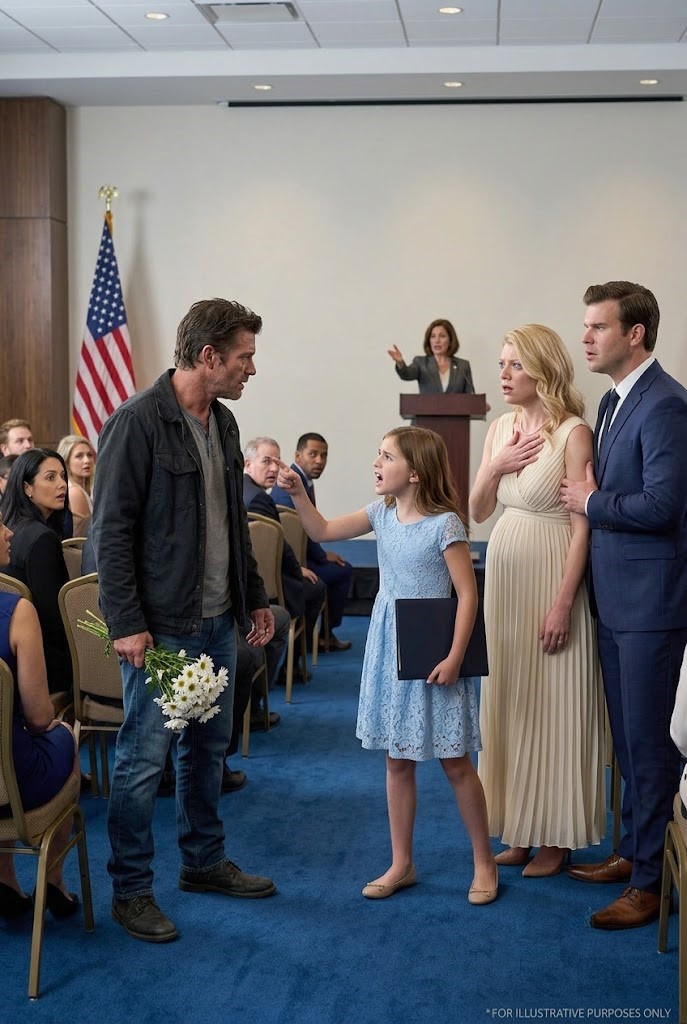
The auditorium had floor-to-ceiling windows along one side, though tonight they were hidden behind white curtains. Silver ribbon looped around cream flowers at the ends of each row. A string quartet played near the stage. Parents laughed quietly, the way people laughed when they wanted everyone else to notice their restraint.
Caleb sat with his shoulders slightly forward, daisies in one hand, program folded in the other.
He could feel people looking.
Not everyone. Some were kind. Some were busy. Some had probably never judged anyone by boots in their lives.
But enough of them did.
Enough for Lily to feel it from her seat in the student section.
She sat near the front with other honor students, shoulders straight, hands folded on her knees. Every few minutes she glanced back at Caleb. Each time, he smiled a little, hoping it gave her permission to breathe.
It did not.
Marissa and Preston sat in the third row, close to the trustees. Preston shook hands across the aisle with a man from the city council. Marissa smiled like she had not just asked Caleb to disappear.
When the lights dimmed, the room quieted.
Dr. Eleanor Price, the principal of Windward Ridge, stepped onto the stage.
She was a tall woman in her late fifties with silver hair cut just below her chin and a voice that could settle a cafeteria with one sentence. She wore a navy dress and no jewelry except a small pin shaped like an open book.
Caleb knew her from transportation safety meetings. Most parents did not attend those. Caleb did. Not because anyone thanked him, but because school buses carried children, and trucks had taught him that machines failed at the worst possible moment.
“Good evening,” Dr. Price said. “Welcome to our annual Student Honors Gala.”
Applause moved through the auditorium.
Caleb clapped when everyone else did, then rested his hands again.
The awards began.
Science. Debate. Music. Athletics. Leadership.
Students walked across the stage one by one, bright-faced and nervous. Parents lifted phones. Teachers smiled with practiced pride. Donors nodded as if education were a garden and their checks were sunlight.
When Lily’s name was called, Caleb felt his throat close.
“Lily Warren,” Dr. Price announced, “for academic distinction and exceptional service through the Coastal Reading Project.”
Lily rose.
Her dress shimmered softly under the stage lights. She walked with a careful confidence that made Caleb remember her first steps across a living room carpet, arms out, laughing before she fell.
The applause was warm.
Caleb clapped harder than anyone.
Lily accepted her plaque and turned toward the audience. Her eyes searched the room until they found him in the back row.
For half a second, everything else disappeared.
Then someone near Preston’s row whispered, “Is that her father?”
A few heads turned.
Lily’s smile faltered.
Caleb saw her fight to hold it.
Dr. Price placed a steady hand near Lily’s shoulder, not touching, just close enough to anchor her.
“This young woman,” the principal said into the microphone, “has earned every honor attached to her name tonight. Her work is not borrowed prestige. It is not inherited reputation. It is hers.”
The words were simple.
But Caleb noticed Marissa stiffen.
Preston’s jaw flexed.
Lily blinked, surprised, then nodded.
“Congratulations, Lily,” Dr. Price said.
Lily walked down from the stage. Instead of returning her gaze to the front rows, she looked back at Caleb again. This time, despite the whispers, she smiled.
Small.
Uncertain.
Real.
Caleb held up the daisies a little.
Her eyes filled with tears, but she turned away before anyone could see.
The ceremony continued, but something in the room had shifted. Dr. Price’s words seemed to have been aimed somewhere. Caleb did not know if others noticed, but Preston did.
He leaned back in his chair and whispered to Marissa, “What was that supposed to mean?”
Marissa said nothing.
Caleb tried not to watch them. Tonight was Lily’s night. He repeated that to himself like a prayer.
Then came the donor acknowledgments.
A screen lowered behind the podium. Names appeared in elegant white letters.
Preston Vale Foundation — Auditorium Renovation
Preston and Marissa Vale — Leadership Circle
Applause swelled.
Preston stood halfway, smiled, and gave a modest wave that contained no modesty at all. Marissa looked relieved. This was the version of the evening she understood. The version where money had a stage, and Preston stood on it.
Caleb clapped politely.
He was not jealous.
That was the strange part. He had been tired, broke, lonely, angry, ashamed, and afraid over the years. But he had never once wanted to be Preston Vale.
Preston sat down, then turned just enough to let Caleb see his profile.
It was a quiet victory pose.
Caleb almost laughed.
Not because anything was funny.
Because men like Preston believed recognition was the same thing as worth.
Dr. Price returned to the microphone after the applause faded.
“Before dinner is served,” she said, “there is one more matter. It concerns not only Windward Ridge Academy, but the entire San Diego school district.”
The screen changed.
STUDENT SAFETY AND SECOND CHANCE INITIATIVE
Murmurs moved through the audience.
Preston straightened. His eyes sharpened with interest. Marissa touched his arm, smiling faintly. Caleb saw them both assume what the room was supposed to assume.
Another donor moment.
Another polished announcement.
Another chance for Preston to rise.
Dr. Price continued, “This initiative will fund emergency transportation training, vehicle safety upgrades, after-school support for students from single-parent homes, and confidential scholarship assistance for families in crisis.”
The room quieted.
This was not glamorous. It was not a new marble lobby or a donor lounge with glass walls.
It was bus tires. Late pickups. Broken families. Children waiting alone because parents were working double shifts.
It was life beneath the polish.
Caleb lowered his eyes.
He knew what was coming before Dr. Price said another word.
His stomach tightened.
He had asked them not to do this.
Not tonight.
Not in front of Lily.
Not in front of Marissa.
Not in front of a room that had spent the evening deciding what kind of man he was from the jacket he wore.
Dr. Price looked toward the back row.
And Caleb understood that the truth was no longer his to keep hidden.
PART 3
“Four years ago,” Dr. Price said, “during a winter storm on Interstate 8, a bus carrying children from a neighboring district lost control near the mountain pass east of San Diego.”
The auditorium became perfectly still.
Parents who had been checking phones looked up. Teachers leaned forward. Even the students stopped whispering.
Caleb stared at the daisies in his lap.
He could smell that night again.
Rain on hot metal.
Diesel.
Burned rubber.
Fear.
He had been driving a refrigerated freight truck back from El Centro, tired enough to feel hollow behind the eyes. It was supposed to be his last long route before he moved fully local. Marissa had already left by then. Lily had been nine. The divorce papers were unsigned but inevitable.
He remembered coming around the bend and seeing red hazard lights through sheets of rain.
A school bus leaned half off the road, its front axle twisted, one side close to the drop. Cars had stopped, but no one knew what to do. The bus driver was injured. Children were crying inside. The wind pushed rain sideways across the highway.
Caleb had not thought about heroism.
He had thought about Lily.
What if she were on that bus?
So he stopped.
He blocked traffic with his truck. Grabbed tow straps. Cut a jammed emergency latch with tools from his box. Helped older kids climb out first. Carried a boy with a bleeding forehead. Wrapped two girls in moving blankets from his cab. Used his truck lights to guide responders when they finally arrived.
No cameras.
No speeches.
No one asking what his name was until later.
Dr. Price’s voice carried the story without decoration.
“A freight driver stopped before emergency crews arrived. He used his equipment and training to stabilize the scene long enough for the children to be evacuated safely.”
A woman near the front covered her mouth.
Lily had turned in her seat.
She was looking at Caleb now.
Not confused.
Shocked.
Dr. Price continued, “One of the children on that bus was the son of Graham Whitlock.”
At the mention of that name, the room stirred.
Graham Whitlock was not like Preston Vale. Preston wanted rooms to know he had entered them. Graham Whitlock built things and let other people put their names on plaques. He owned Whitlock Harbor Logistics, funded public library expansions, and sat quietly on committees that changed budgets without appearing in photographs.
A side door opened.
Graham Whitlock walked onto the stage.
He was broad-shouldered, gray-haired, and calm. He wore a black suit with no flashy watch. His expression was serious, almost severe, until his eyes found Caleb.
Then his face changed.
Respect.
Not politeness.
Not performance.
Recognition.
Caleb gave him a small nod.
Graham returned it.
Preston saw the exchange. His expression froze.
Dr. Price stepped aside, and Graham took the microphone.
“My son was eleven years old that night,” Graham said. “He was trapped near the rear of that bus with two other children. The driver who stopped did not know him. Did not know me. Did not know whether anyone would thank him. He simply saw children in danger and decided their lives mattered more than his schedule, his equipment, or his safety.”
Caleb swallowed.
He hated this.
He hated being watched.
He hated that Lily was hearing it for the first time in a room full of strangers.
But he also saw her face.
Her eyes were wide. Her lips were parted. The shame she had been carrying all night had cracked open, and something else was coming through.
Pride, maybe.
Or grief for not knowing sooner.
Graham continued, “Afterward, I tried to repay him privately. I offered money. A lot of it.”
A murmur passed through the audience.
“He refused.”
Now the room turned.
Not subtly.
Heads shifted toward Caleb in the back row.
Marissa turned so quickly her earrings flashed. Her face had gone pale.
Preston stared as if the story had broken a rule.
“He told me,” Graham said, “that if I wanted to repay him, I should build something for children whose parents were too tired, too broke, or too alone to ask for help.”
Lily put a hand over her mouth.
Caleb finally looked at her.
Her eyes were wet.
Graham’s voice deepened. “That sentence became the beginning of the Student Safety and Second Chance Initiative. Mr. Warren gave us the idea. He helped us understand what working families actually need. He reviewed transportation plans. He walked through emergency scenarios. He showed up at meetings after twelve-hour shifts with grease still on his hands because he cared more about children getting home safely than about how he looked in a boardroom.”
The auditorium was silent.
Then Dr. Price returned to the microphone.
“Tonight,” she said, “we are grateful for every donor who has supported our school. But this initiative is not about the largest check. It is about the first act of courage that made all the rest possible.”
Preston’s face darkened.
Marissa looked like she might stand, or run, or disappear.
Dr. Price looked directly at the back row.
“Mr. Caleb Warren,” she said, “would you please come to the stage?”
For several seconds, Caleb did not move.
The daisies trembled slightly in his hand.
He had spent years trying to teach Lily that a person’s worth did not need applause.
Now the entire room was waiting to clap for him.
He rose slowly.
The old jacket shifted on his shoulders. The name tag on his chest caught the light.
CALEB WARREN
PARENT OF LILY WARREN
The room watched him walk down the aisle.
No music.
No dramatic spotlight.
Just a tired father in worn boots crossing a room that had misjudged him before it knew his name.
Halfway down the aisle, Lily stood.
Her chair scraped softly.
Everyone looked at her.
Her voice shook, but it carried.
“That’s my dad.”
The first applause came from the teachers.
Then the students.
Then the parents.
Then the entire auditorium rose to its feet.
Caleb stopped for one second, because the sound hit him like weather.
Lily was crying openly now.
And for the first time all night, she did not look embarrassed.
She looked free.
PART 4
When Caleb reached the stage, Dr. Price shook his hand with both of hers.
“Thank you,” she said quietly.
Caleb nodded. “I only did what anyone should’ve done.”
Graham Whitlock stepped forward.
“No,” he said, still holding the microphone. “You did what many people hope they would do. There’s a difference.”
The applause rose again.
Caleb wanted to step back, but Dr. Price guided him gently toward the podium.
The room looked different from the stage. The faces that had measured him by his clothes were now lifted toward him with a kind of stunned respect. Some people seemed ashamed. Some seemed moved. Some looked irritated that their first judgment had been proven wrong in public.
Preston looked furious.
Marissa looked devastated.
Lily looked like she had just found a missing chapter of her own life.
Caleb stood behind the microphone.
He had driven through storms, slept in truck stops, repaired engines in alleys, sat through custody meetings where Marissa’s lawyer made his work schedule sound like a character flaw. He had faced many things.
But a silent auditorium was nearly too much.
“I’m not much for speeches,” he said.
A few people laughed softly, kindly.
He looked at Lily.
“This was supposed to be my daughter’s night. I asked Dr. Price not to mention me until after Lily received her award because I didn’t want anything taking that from her.”
Marissa closed her eyes.
Caleb continued, “Lily worked for what she got tonight. Nobody bought that for her. Nobody handed it to her. She earned it.”
Lily wiped her face with both hands.
Caleb took a breath.
“As for the bus, I stopped because there were kids inside. That’s all. You don’t need to be special to stop. You just need to remember that somebody’s child is always inside the emergency you’re passing.”
The room was still again.
“I’m grateful this school is building something useful. Not fancy. Useful. Kids need rides that are safe. Parents need help before things break completely. And some children need to know their family situation is not something they have to be ashamed of.”
His voice wavered slightly on the last sentence, but he steadied it.
“Thank you for helping them.”
That was all.
He stepped back.
The applause came harder this time.
Not polite. Not social. Not donor applause.
It was the kind of applause people give when something clean and painful has cut through a room full of performance.
Preston stood suddenly.
“Dr. Price,” he said loudly, smiling with effort, “this is all very inspiring. Truly. But I think we should also acknowledge that programs like this require serious funding. Vision is important, of course, but execution depends on donor leadership.”
The room cooled.
Marissa whispered, “Preston, don’t.”
But he was already committed.
“I’m proud,” Preston continued, “that the Vale Foundation has helped position Windward Ridge for this kind of district influence.”
Dr. Price’s expression did not change.
That made it worse.
“Mr. Vale,” she said, “your auditorium renovation donation is appreciated. It is also separate from the Student Safety and Second Chance Initiative.”
A few people shifted in their seats.
Preston’s smile held, but his eyes hardened. “Of course. I only meant—”
Graham took the microphone again. “To be clear, the initiative is funded through a district partnership, Whitlock Harbor Logistics, several private family foundations, and safety grants. Mr. Warren has been involved from the planning stage. The Vale Foundation has not contributed to it.”
The silence after that was brutal.
Preston’s face flushed.
Marissa looked at the floor.
Caleb did not enjoy it. That surprised him. For years, he had imagined what it might feel like for Marissa to understand she had been wrong about him. He had imagined vindication arriving like fire.
Instead, it felt heavy.
Like watching someone drop a mirror and finally see the pieces.
Preston sat down slowly.
No one clapped.
Dr. Price moved the evening forward with professional grace, announcing that dinner would begin in the courtyard. But the ceremony was already over in every way that mattered.
As people rose, Lily rushed toward the stage.
Caleb came down the steps just as she reached him.
She threw her arms around his waist with such force that he almost stepped backward.
“Dad,” she sobbed into his jacket. “Why didn’t you tell me?”
He held her carefully, one hand on the back of her head.
“Because you shouldn’t need a rescue story to love your father.”
She pulled back, crying harder. “I did love you.”
“I know.”
“But I was embarrassed.”
“I know that too.”
Her face crumpled. “I hate that I was.”
Caleb knelt slightly so his eyes were level with hers, right there beside the stage, while half the school pretended not to watch.
“You’re thirteen,” he said softly. “You’re allowed to get confused by the world. I’m your dad. I’m supposed to know who I am even when you’re still figuring out what matters.”
That broke her.
Not into shame.
Into relief.
She hugged him again, and this time Caleb looked over her shoulder.
Marissa stood ten feet away, one hand pressed to her mouth.
For the first time in years, she did not look polished.
She looked lost.
Preston stood behind her, angry and humiliated, but unwilling to leave because leaving would make defeat visible.
Marissa stepped forward.
“Caleb,” she said.
Lily stiffened in his arms.
Caleb released his daughter and stood.
Marissa’s eyes moved over his jacket, his boots, his hands, and finally his face. She looked at him as though she were seeing the man she had left and the man she had never bothered to know standing in the same place.
“I didn’t know,” she whispered.
Caleb’s expression stayed calm.
“No,” he said. “You didn’t.”
PART 5
The courtyard dinner should have been beautiful.
Lanterns hung from olive trees. White tablecloths moved softly in the ocean breeze. Beyond the school walls, San Diego glittered under a dark blue sky. Servers carried silver trays between clusters of parents who were suddenly much more interested in Caleb Warren than they had been an hour earlier.
A science teacher thanked him.
A mother from the lower school told him her son rode the bus every day, and she had never thought about safety checks until tonight.
A trustee shook his hand and said, “We owe you an apology.”
Caleb answered each person politely, but he never let go of Lily’s hand.
She stayed beside him as if making up for every time she had stepped away.
Across the courtyard, Preston worked the room with the stiff determination of a man trying to repair a cracked statue while everyone watched. He laughed too loudly. Shook hands too firmly. Mentioned the auditorium renovation three separate times.
But the room had changed.
Before, people had leaned toward him.
Now they leaned away.
Not dramatically.
Just enough.
Marissa noticed. Caleb could see it in the way her shoulders folded inward.
She approached him near the fountain after Lily went to speak with Dr. Price.
“Can we talk?” she asked.
Caleb looked toward Lily.
“She’s fine,” Marissa said. “Eleanor is showing her the scholarship wall.”
Caleb almost smiled. “You call the principal Eleanor now?”
Marissa looked wounded, but she deserved worse and knew it.
“I suppose I’ve been very good at getting close to important people,” she said quietly.
Caleb said nothing.
They stepped aside near a low stone wall overlooking the campus driveway. Below them, rows of expensive cars gleamed beneath security lights. Caleb’s old pickup sat near the far end, dented rear panel and all.
Marissa looked at it.
“I used to hate that truck.”
“I know.”
“I thought it represented everything wrong with our life.”
“No,” Caleb said. “It represented everything paying for our life.”
She flinched.
The truth did not need to be loud.
“I was tired,” she said. “Back then. You were gone so much. I was lonely. I felt like Lily and I were waiting for a man who only came home to sleep.”
“You were right about that.”
She looked surprised.
Caleb continued, “That’s why I changed.”
Marissa’s eyes shone. “I know. But by then I had already decided who you were.”
“And Preston helped with that?”
She looked toward the courtyard, where Preston was speaking to two board members who clearly wanted the conversation to end.
“Preston made life feel secure,” she said. “Clean. Predictable. He knew how to walk into rooms like this.”
Caleb looked at her. “And I didn’t.”
“No,” she admitted. “You didn’t.”
They stood in silence.
Then Caleb said, “You didn’t leave because I had nothing, Marissa. You left because what I had did not impress the people you wanted to impress.”
Her tears spilled over.
“I’m sorry.”
He nodded once.
The nod was not forgiveness.
Not punishment either.
Just acknowledgment.
“I don’t need you to be sorry for leaving,” he said. “Some marriages end. I made mistakes too. But I needed you to stop teaching Lily that loving me was something she had to explain.”
Marissa pressed her lips together.
“I didn’t realize I was doing that.”
“You did,” Caleb said gently. “You just called it protecting her.”
That one hurt her most.
She turned away, breathing unsteadily.
Behind them, Preston’s voice cut through the courtyard.
“Caleb.”
Caleb turned.
Preston approached with a glass in one hand and anger dressed as civility across his face.
“I think we should clear the air,” Preston said.
Marissa wiped her cheek. “Not now.”
“Yes, now,” Preston said. “Because apparently one emotional story has turned everyone sentimental.”
Caleb kept his voice even. “What do you want to clear?”
Preston smiled. “Lily still lives in my home half the time. She attends this school in part because of the environment Marissa and I provide. I pay for things you cannot. That does not disappear because you had one good night on a highway.”
Caleb studied him.
“One good night?”
Preston’s smile sharpened. “You know what I mean.”
“I do,” Caleb said. “That’s the problem.”
Marissa stepped between them. “Preston, stop.”
But Preston was not looking at her. He was looking at Caleb the way men look when they mistake quiet for weakness.
“You may have won applause tonight,” he said, “but Lily’s future still depends on stability.”
Caleb took a step closer.
The courtyard seemed to quiet around them.
“You bought a better address,” Caleb said. “You bought a better table. You bought your name on a wall. But you did not buy fatherhood.”
Preston’s face hardened.
Caleb continued, “Fatherhood is sitting in a parking lot at midnight because your daughter is afraid to go into a dance alone. It’s learning algebra again because she has a test. It’s changing your whole job so she stops growing up with an empty chair where you should be.”
Preston said nothing.
“And it’s knowing when to step back,” Caleb finished, “because her night should never have been about two grown men measuring themselves in front of her.”
Marissa looked down.
Preston’s jaw worked, but no words came.
Then Lily’s voice came from behind them.
“Dad?”
All three adults turned.
She stood with her plaque in one hand and the daisies in the other. She had heard enough. Maybe not all. Enough.
She looked at Preston first.
“Please don’t talk about my future like it belongs to whoever pays the most.”
Preston went pale.
Then she turned to Caleb.
“Can we go home?”
Caleb nodded.
Marissa whispered, “Lily—”
But Lily shook her head.
“Not tonight, Mom.”
It was not cruel.
That made it worse.
Caleb and Lily walked through the courtyard together, past the lanterns, past the donors, past the school banners, toward the parking lot where the old pickup waited under the lights.
For once, Lily did not let go of his hand.
PART 6
The truck smelled like old leather, motor oil, and peppermint gum.
Lily climbed into the passenger seat with her plaque on her lap and the daisies tucked against the door. Caleb started the engine. It coughed once, rough and familiar, then settled into a steady rumble.
Neither of them spoke until they reached the coast road.
The Pacific was a dark sheet beyond the cliffs. Streetlights slid across Lily’s face in gold flashes. She kept looking at Caleb as if he might disappear back into the smaller version of him she had carried in her head.
Finally she said, “Did Mom know about the bus?”
“No.”
“Why not?”
“Because I didn’t tell many people.”
“Why?”
Caleb kept his eyes on the road. “Some things feel smaller when you turn them into stories about yourself.”
Lily frowned. “But it wasn’t small.”
“No.”
“You saved those kids.”
“I helped.”
“Dad.”
He glanced at her. She had Marissa’s delicate face, but not Marissa’s softness around hard truths. Lily wanted answers straight.
“All right,” he said. “I helped save them.”
She sat back, absorbing that.
After a while she whispered, “I wish I had known.”
“I know.”
“I let people make me feel ashamed of you.”
Caleb’s hands tightened slightly on the wheel. “You didn’t let them. They pushed. There’s a difference.”
“I still believed them sometimes.”
“You’re a kid.”
“I’m not that little.”
“You’re little enough to be forgiven for not understanding grown-up pain.”
She looked out the window.
The truck rolled past expensive neighborhoods, then smaller houses, then the older part of town where Caleb rented a two-bedroom bungalow with a lemon tree in the front yard. Lily had once complained that it smelled like tires because he kept tools in the shed. Tonight, when they pulled into the driveway, she looked at the house like she was seeing it newly.
Inside, Caleb made grilled cheese because neither of them had eaten dinner. Lily sat at the kitchen table, still wearing her blue dress, her plaque beside a stack of unpaid bills and a mug full of pencils.
“This is weird,” she said.
“What is?”
“Eating grilled cheese after people clapped for you.”
He slid a plate in front of her. “Fame fades. Cheese stays.”
She laughed through the last of her tears.
That sound eased something in him.
For a while, they ate in quiet.
Then Lily asked, “Were you lonely after Mom left?”
Caleb leaned against the counter.
“Yes.”
“Really lonely?”
“Yes.”
“Did you hate her?”
He thought about lying, then decided she was old enough for a careful truth.
“Some days I wanted to. But hate takes a lot of energy, and I needed mine for you.”
Lily looked down at her plate.
“I’m sorry I didn’t always act proud of you.”
Caleb crossed the kitchen and sat across from her.
“Lily, listen to me. Pride is not the same thing as love. You loved me even when you were embarrassed. I knew that.”
“How?”
“Because you worried about me.”
Her chin trembled again.
“That made me feel worse.”
“It made me feel loved.”
She cried then, quietly, not the way she had in the auditorium. This was deeper. Private. The kind of crying children do when they realize their parents have been human the whole time.
Caleb reached across the table and held her hand.
The next morning, the story spread faster than either of them expected.
By Monday, students were talking about the bus rescue, the initiative, the way Lily had stood up and said, “That’s my dad.” Someone had recorded part of the ceremony, but Dr. Price made sure the school did not turn Caleb into a social media spectacle. She sent one official message to families about the new safety program and left his dignity intact.
Still, people knew.
At pickup that afternoon, Lily walked toward Caleb’s truck while three girls watched from the steps.
One of them, Madison Blake, the same girl who had once asked if Caleb slept in his truck, tilted her head.
“Is that your dad?” she asked.
Lily stopped.
Caleb heard the question through the open window.
A month ago, Lily might have blushed. She might have rushed into the truck. She might have answered too softly.
This time, she smiled.
“Yeah,” she said. “That’s my dad.”
Madison blinked. “The one from the award night?”
“The one from every night,” Lily said.
Then she climbed into the truck.
Caleb looked at her.
She buckled her seat belt and stared forward with a little too much seriousness.
“What?” she asked.
He hid a smile. “Nothing.”
“You’re smiling.”
“Am I?”
“Yes.”
“Must be the sun.”
She rolled her eyes, but she was smiling too.
In the weeks that followed, life did not become magical.
Bills still came.
The truck still needed a new transmission.
Caleb still worked freight routes before sunrise and repair jobs after dinner. Lily still had homework, bad moods, and days when being thirteen felt like living inside a thunderstorm.
But something important had shifted.
Lily no longer divided her life into what belonged at her mother’s house and what belonged at her father’s. She brought school friends to Caleb’s bungalow. She let him pick her up close to the entrance instead of at the far curb. She asked him to teach her how to change a tire for a community service project, then bragged about it in class.
Marissa changed too, slowly and painfully.
She stopped correcting Lily when Lily called Caleb first about school things. She stopped using phrases like “your father’s situation.” She apologized once more, this time in front of Lily, without excuses.
Preston changed least of all.
Men like him rarely changed unless losing cost more than pretending.
But even he learned not to speak about Caleb in that smooth, dismissive tone. Not in front of Lily. Not anymore.
The Student Safety and Second Chance Initiative launched in January. Caleb attended the first training in a clean work shirt Marissa had bought him and he had almost refused to wear.
Dr. Price asked him to speak to the volunteers.
He kept it short.
“Check the small things,” he told them. “Small things become emergencies when nobody respects them.”
People wrote that down.
Caleb found that funny.
He had been saying versions of it his whole life.
No one had written it down before.
PART 7
Two years later, Windward Ridge Academy held the first district-wide Safety and Second Chance banquet in the same auditorium where Caleb had once sat in the back row feeling the weight of every stare.
The room looked different now.
Or maybe Caleb did.
The donor wall still shone in the lobby. Preston Vale’s name remained where it had been engraved, permanent and polished. But beside the auditorium entrance hung a new display: photographs of bus safety trainings, scholarship students, emergency supply kits, volunteer mechanics, and parents attending evening workshops with coffee in paper cups and tired hope in their eyes.
At the center was not Caleb’s portrait.
He had refused that.
Instead, there was a simple line etched into brushed steel:
SOMEONE’S CHILD IS ALWAYS INSIDE THE EMERGENCY YOU’RE PASSING.
Lily had helped choose it.
She was fifteen now, taller, sharper, and more certain in the way she moved through rooms. She wore a black dress and a silver necklace Caleb had given her for her birthday. The necklace was not expensive. She wore it like it was.
Caleb stood beside her near the back doors before the program began.
“You nervous?” she asked.
“No.”
“Liar.”
“A little.”
She grinned. “Good. Builds character.”
He looked at her. “Who taught you that?”
“You did. Unfortunately.”
Across the lobby, Marissa arrived alone.
That was new.
Her marriage to Preston had not survived the year after the gala. Not because of Caleb, though Preston blamed him once in an email so long and ridiculous that Caleb deleted it halfway through. The marriage ended because Marissa had finally recognized the difference between security and control, and Preston had never forgiven her for learning it.
She and Caleb did not get back together.
Life was not that kind of movie.
But they became better parents apart than they had ever been spouses together. They sat near each other at Lily’s debate tournaments. They shared schedules without lawyers. They made mistakes and apologized faster.
Marissa approached Caleb now with a small smile.
“You clean up well,” she said.
He looked down at his navy jacket. “Lily approved it.”
“Then it must be right.”
Lily hugged her mother.
There was no bitterness in it tonight.
That, Caleb thought, was a miracle quieter than applause.
Dr. Price opened the banquet with updates. The initiative had funded repairs on twenty-three school buses, emergency training for six campuses, and scholarship support for forty-one students. It had helped single parents pay for after-school care during medical crises, job changes, court dates, and nights when one more problem might have broken the whole family.
Graham Whitlock spoke next.
Then Lily was called to the stage.
Caleb had known she was giving a student speech. He had helped her practice once, though she kicked him out after he started crying at the second paragraph.
She stood behind the podium, no longer the frightened girl clutching a plaque.
“My father hates being called a hero,” she began.
The audience laughed.
Caleb closed his eyes for one second.
“He says heroes are usually just people close enough to help and stubborn enough not to leave. I used to think that sounded too simple. Now I think simple things are usually the truest.”
She looked down at her notes, then back up.
“When I was younger, I was embarrassed by things I did not understand. My dad’s truck. His work clothes. His tiredness. I thought important people looked a certain way because that is what the world kept showing me.”
Her voice trembled, but she held steady.
“Then one night, in this room, I learned that my father had spent years doing important things without needing anyone to call them important. He changed his job to be there for me. He helped build a safety program for children he would never meet. He taught me that love is not loud just because money is.”
Marissa wiped her eyes.
Caleb stared at the floor.
Lily continued, “This initiative matters because it sees families before they fall apart. It helps parents who are doing their best while looking like they are barely holding on. And sometimes, those are the parents holding everything together.”
The applause began before she finished.
But she raised one hand, smiling through tears.
“I’m almost done.”
The room quieted.
She looked straight at Caleb.
“So tonight, I want to say something I should have said louder years ago. My dad drives trucks. He fixes engines. He comes home tired. He makes terrible grilled cheese unless I supervise. And he is the best man I know.”
The room rose.
Caleb did not move.
He could not.
Lily stepped away from the podium as the applause thundered around her. Dr. Price hugged her. Graham clapped with both hands. Marissa cried without trying to hide it.
And Caleb, who had once crossed that room under judgment, now sat surrounded by people who understood at least part of the truth.
Not all of it.
No room ever knows the whole of a father.
No stage can hold the weight of every early morning, every unpaid bill, every swallowed insult, every drive across town after a twelve-hour shift because a child forgot her science project.
But Lily knew more now.
That was enough.
After the banquet, father and daughter walked outside together. The night air smelled of salt and jasmine. The parking lot had changed too. There were still luxury cars, still polished people, still names on walls. But Caleb no longer measured the distance between his pickup and their vehicles.
Lily walked beside him, holding her heels in one hand.
“Dad?”
“Yeah?”
“When I have kids someday, I hope they look at me the way I look at you now.”
Caleb’s throat tightened.
“You’ll do better than me.”
“No,” she said. “I’ll do better because of you.”
They reached the truck. It was older now, louder too, but still running because Caleb kept it that way.
Lily opened the passenger door, then paused.
“Do you ever wish everyone had known sooner?” she asked.
Caleb looked back at the school, glowing white against the California night.
He thought about the years of being underestimated. The whispers. The custody hearings. The shame Lily had carried and the silence he had chosen. He thought about that storm on Interstate 8 and the children climbing out of the bus into the rain. He thought about applause, how sweet it sounded and how quickly it faded.
Then he looked at his daughter.
“No,” he said. “The people who needed a stage were never the reason I showed up.”
Lily smiled softly.
This time, she understood.
They drove home along the coast with the windows cracked open and the old engine humming beneath them. The city lights stretched ahead, bright and imperfect. Lily leaned her head against the seat and held the daisies from the banquet in her lap.
Caleb glanced over once and saw her smiling to herself.
Not because the world had finally approved of him.
Because she had.
And that was the only honor he had ever truly wanted.