The Night a 72-Year-Old Bus Driver Said She Was Grateful Her Husband Died Before Her, Her Daughters Learned the Real Price of Lasting Love
“Take me to where he is.”
My mother, Marlene, spoke those five words shortly before midnight, still dressed in the navy-blue outfit she had worn to my father’s funeral.
My sister and I stood in her kitchen among unfinished casseroles, disposable plates, and condolence cards sent by almost everyone in our small Kansas community.
Beyond the windows, snow had begun falling once more.
“Mom,” I said softly, “the cemetery is locked for the night. We can take you there first thing tomorrow.”
She raised her eyes from the coffee cup she had been holding for close to an hour.
The cup was empty.
She had prepared coffee automatically, then never remembered to drink it.
“I spent thirty-eight years driving schoolchildren through blizzards and ice,” she replied. “I believe I can reach my husband through a little snowfall.”
She did not sound angry.
What I heard was grief.
The kind that no longer cries out because it has settled too deeply inside a person to make noise.
My father, Wade, had died four days earlier while clearing snow from their front steps.
He was seventy-four, deeply stubborn, and firmly believed that accepting help revealed some kind of weakness.
Mom had warned him to leave the porch alone.
“The sun will take care of it before lunchtime,” she called from behind the screen door.
Dad smiled and raised his shovel.
“And have the mail carrier decide I’ve become lazy?”
Those were the final words she ever heard from him.
Several minutes later, Mom glanced through the kitchen window.
The shovel was lying abandoned in the snow.
Dad lay beside it.
She rushed outside wearing only her house slippers and fell to her knees next to him.
While a neighbor called an ambulance, Mom cradled Dad’s face between her palms and pleaded with him.
“Wade, look at me. Open your eyes. You still owe me breakfast.”
The emergency crew fought to save him.
But before the ambulance reached the county hospital, the man who had shared forty-nine years of her life was gone.
When the doctor delivered the news, Mom did not shed a tear.
She nodded once and asked whether Dad had remembered to put on his good socks.
That was who my mother had always been.
Practical even while the entire foundation of her life collapsed beneath her.
For almost four decades, she drove a yellow school bus along the gravel lanes and rural roads that curled through the farms surrounding our town.
She knew which children needed her to wait an extra minute because their mothers had worked overnight shifts.
She stored extra gloves beneath the driver’s seat for anyone who came outside with bare hands.
She kept crackers nearby for the children who insisted they were not hungry, then quietly ate everything she offered them.
Every morning at 5:15, Dad prepared her coffee and warmed her truck while she pinned her gray hair into place.
Each afternoon, he listened as she described forgotten homework, missed bus stops, and the strange, funny observations made by first graders.
Their marriage had never been perfect.
They disagreed over bills, thermostat temperatures, and Dad’s maddening refusal to close kitchen cabinets.
Once, Mom ignored him for an entire afternoon after he purchased a fishing boat without mentioning it to her.
That night, Dad slept on the sofa.
When morning came, he awakened to find a plate of homemade biscuits waiting beside him.
That was the shape their love took.
It was never grand or flawless.
But it remained faithful.
Nearly one hundred people attended Dad’s funeral.
Former students waited patiently to tell Mom what they still remembered about her.
A man in his forties recalled the afternoon she stayed with him after school because his father had forgotten to collect him.
A young mother explained that Mom had once bought her daughter a winter coat, then protected the family’s dignity by telling everyone it had simply been “forgotten on the bus.”
Mom received each story with quiet gratitude.
Still, she did not cry.
She stood beside Dad’s casket, her hands clasped in front of her, staring at the worn wedding ring resting on his finger.
After the service, mourners crowded into her home carrying food and memories.
They spoke about Dad repairing lawnmowers for widows who could not pay the prices charged by repair shops.
They remembered how he cleared snow from the pavement around the little church, then claimed the wind must have done it.
They laughed over his awful jokes and the battered red pickup truck he stubbornly refused to replace.
Mom sat silently in Dad’s favorite chair.
Every few minutes, her gaze wandered toward the hallway, as if she expected him to walk into the room and demand to know who had misplaced the television remote.
By eleven that night, almost everyone had departed.
My sister stood at the sink washing dishes while I sealed the leftover food inside plastic containers.
Mom remained in the chair, rotating her wedding band around her finger again and again.
Then she looked at us.
“Take me to where he is.”
We attempted to change her mind.
The pavement was icy.
The hour was late.
There would be no lights in the cemetery.
Then she gave us a look neither my sister nor I had ever seen on her face.
“For forty-nine years, I followed that man wherever he needed me to go,” she whispered. “Tonight, I need to be wherever he is.”
We stopped arguing and reached for our coats.
My husband drove us.
The cemetery occupied a hill beyond town, past an aging grain elevator and a line of leafless cottonwood trees.
As we had warned her, the main gate was secured.
Mom studied it for a moment.
Then she turned toward a narrow side entrance, where the chain hung loosely enough for us to slip between the gateposts.
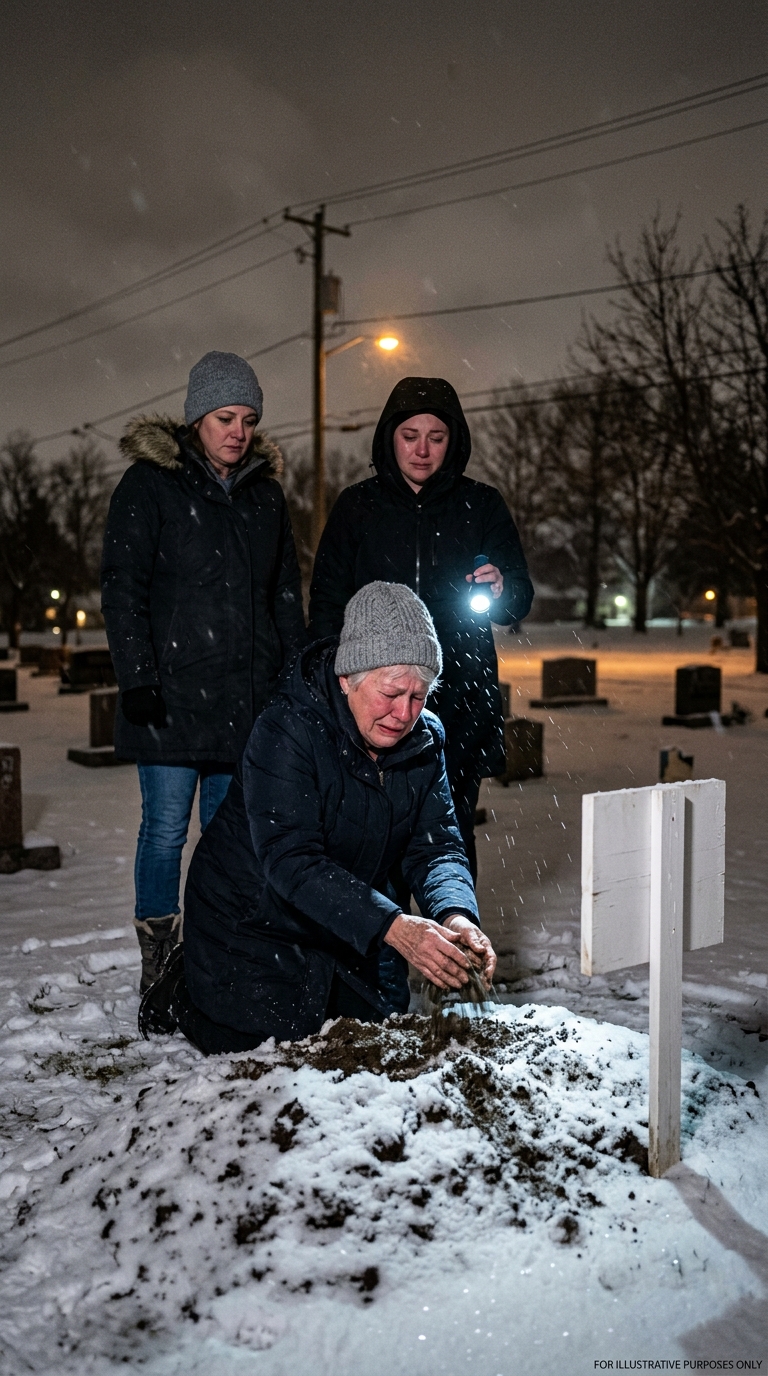
Snow settled across her shoulders as we followed the thin path winding among the graves.
My sister carried a flashlight.
I kept one hand around Mom’s arm.
When we found Dad’s burial place, a delicate layer of white covered the freshly turned earth.
Mom eased her arm out of my grasp and lowered herself to her knees.
Her dress sank into the snow.
Without gloves, she swept the powder away until her fingers reached the dark ground beneath it.
Then she spoke his name.
Not “Dad.”
Not “Grandpa.”
“Wade.”
She said it as I imagined she had when they first met.
Quietly.
With a trace of shyness.
For several minutes, we remained silent.
Then Mom began speaking to him.
“Do you remember our first house?” she asked. “That place where the furnace sounded as though it was trying to break free?”
A faint laugh slipped through her words.
“You told me we didn’t need money because we had canned beans and each other. I said I was already sick of both.”
She smiled at the memory.
Then her expression collapsed.
The change happened so suddenly that I almost grabbed her.
This was the woman who had safely transported children during tornado warnings.
She had buried both her parents, endured surgeries, and kept our family standing through every emergency.
Now, finally, she broke apart.
She placed both palms against the grave and began to sob.
“I don’t know how I’m supposed to walk back into that house without you,” she said.
My sister lowered herself beside her.
Mom shook her head.
“No. Please let me finish.”
She drew in a deep, unsteady breath.
“For forty-nine years, his face was the first one I saw each morning, and his voice was the last one I heard before sleeping. Even on the days we were furious with each other, I could still feel him there.”
She turned toward us.
“People believe love lives in bouquets and anniversary meals. Those things are lovely, but a marriage does not survive inside them.”
Her fingertips returned to the soil.
“A marriage lives inside ordinary days.”
“It lives in getting someone’s medicine at two in the morning. In clearing the frost from their windshield. In staying beside a hospital bed when you are terrified. In forgiving the same aggravating habits over and over again.”
“It is remembering exactly how they drink their coffee.”
“It is recognizing their footsteps in the hallway and knowing you are safe.”
Melted snow ran through the lines around her eyes.
Then she spoke the words I will remember for as long as I live.
“I’m grateful he died first.”
My sister stared at her in disbelief.
Mom slowly nodded.
“I know that sounds terrible. But Wade could never tolerate being alone. He struggled whenever I had to spend one night away on a school trip.”
A sorrowful smile moved across her lips.
“If I had died first, he would have been the one sitting alone in that kitchen. He would have slept on my side of the bed because his own side felt too empty. He would have been forced to come to this cemetery and somehow make himself leave me behind.”
Her gaze dropped to the earth covering him.
“I could never have wished that pain on him.”
Her voice became firmer.
“So I will bear it instead.”
“I will live inside the silent house. I will have my morning coffee alone. I will ache for him when I wake and again when I go to bed.”
“I’ll carry this loneliness because I loved him too much to make him carry it.”
No one tried to answer.
Some moments are too large for words.
Speaking would only reduce them.
Mom remained beside Dad’s grave a little longer.
She told him the snowfall was becoming heavier.
She reminded him that he had left a container of screws sitting on top of the washing machine.
Then she bent forward and rested her palm against the cold ground.
“I’ll meet you again when it’s time,” she murmured. “Until then, you go ahead of me.”
When we helped her to her feet, she brushed the snow from her navy dress.
During the journey home, she asked my husband to stop beside the school bus garage.
Her old yellow bus stood beneath a security lamp, its paint glowing warmly against the surrounding snow.
Mom gazed at it through the car window.
“Tomorrow is Monday,” she said.
“You won’t be driving tomorrow,” I told her.
“No,” she answered. “But those children still need somebody who will be there.”
That was her way of telling us she planned to continue living.
Not because her sorrow had become easier to bear.
But because loving Dad had taught her how to carry something unbearably heavy.
Two weeks later, she returned to her bus route.
Dad’s thermos stood beside the driver’s seat, empty and polished until it shone.
Every morning after that, she filled it with coffee and carried it with her.
Perhaps it was simply routine.
Perhaps it gave her comfort.
Or perhaps certain kinds of love do not disappear when a heart stops beating.
They transform into the strength the person left behind must carry for them both.
True love is not a promise that loneliness will never find you. It is loving someone so deeply that you willingly bear the loneliness after they are gone.