My Family Showed Up At My Mountain Cabin With A Moving Truck At Midnight—Then I Deleted The Gate Code While They Were Standing In The Snow
The first warning came as a small green blink on my phone at 11:51 p.m.
It was not loud.
It did not need to be.
The cabin was quiet enough that even the stove sounded dramatic, each small crack from the wood making the room feel more awake than it should have been.
Outside, snow moved through the trees in heavy curtains.
It softened the track, the roof, the dark line of pines, and the five miles of private road between me and the gate.
Inside, my mug of tea sat cooling beside the hearth, untouched since I had realised I was too tired to enjoy it.
The kettle had clicked off nearly an hour earlier.
The curtains were open because there was usually nothing to see except darkness, snow, and the reflection of my own face in the glass.
That night, my phone blinked again.
I knew, before I picked it up, that peace did not send messages at that hour.
The text was from Holly.
Not Mum.
That change in my contacts had taken me thirty-six years to make and two years to stop feeling guilty about.
There are people who earn their names every day.
There are others who only use them when they want a door opened.
Her message contained no apology, no explanation, and no soft approach.
“Code isn’t working. Alexis is freezing. Open the gate.”
I stared at it until the screen dimmed.
Then I touched it awake again and read it once more.
There was no, Julia, sorry it’s late.
There was no, We need to talk.
There was not even the theatrical panic Holly usually used when she wanted something to sound less like a demand.
Just the code.
Just Alexis.
Just an order.
I set the phone down carefully, as if moving too quickly might make me act like the person they still believed I was.
Then I reached for my tablet and opened the security app.
The feed from the bottom gate took a second to load.
It always did when the weather was bad.
A green-grey picture jumped, blurred, and then sharpened into the kind of image that turns blood cold because it confirms what your body already knows.
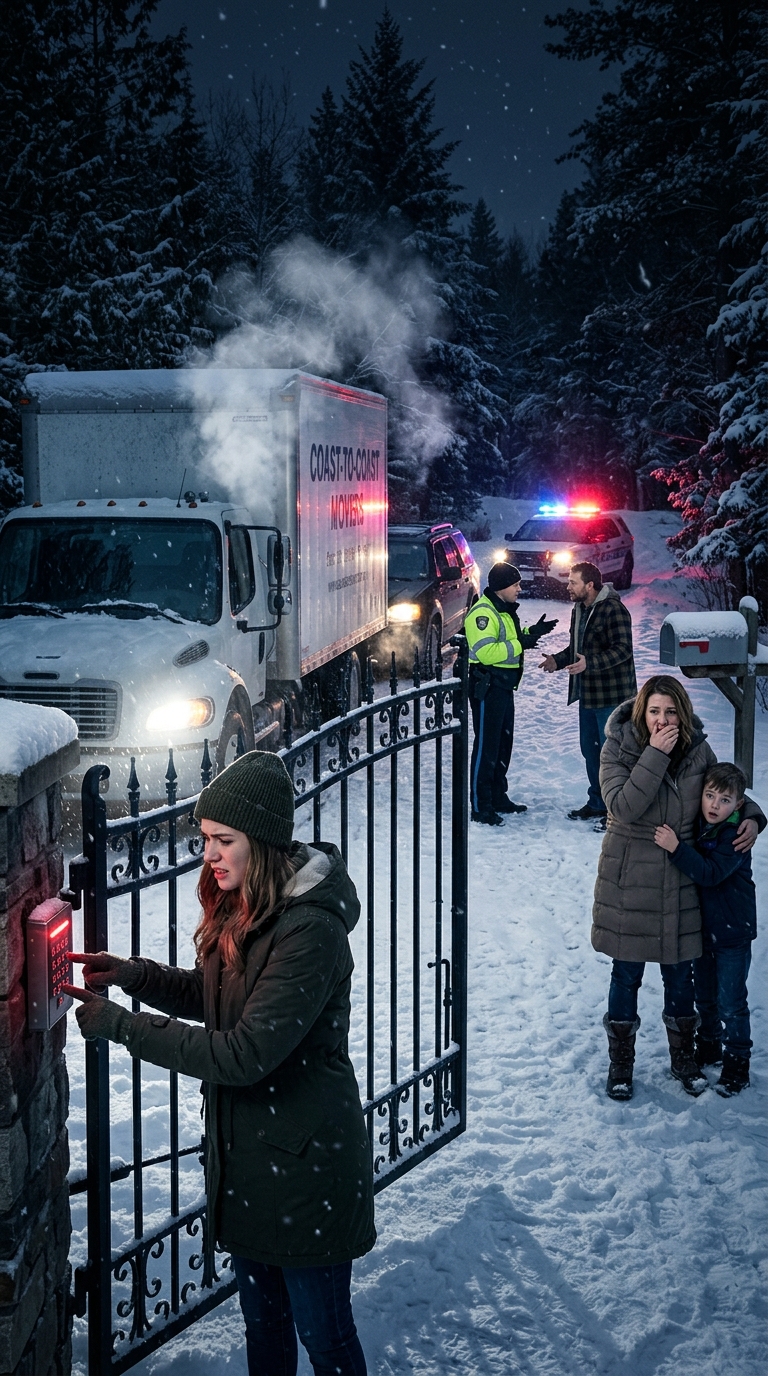
Alexis stood at the keypad.
She was wearing a white coat that probably looked lovely under restaurant lighting and utterly hopeless in a mountain snowfall.
Snow clung to her hair and shoulders.
Her face was tight with fury, not fear.
She jabbed at the numbers again, each press sharp and impatient, as though the keypad were a junior member of staff who had failed to recognise her.
Behind her, taking up half the road, was a moving truck.
A large one.
Not a family car with a couple of overnight bags.
Not a hired van with some emergency boxes.
A proper twenty-six-foot moving truck, idling in the snow with its headlights carving two yellow tunnels through the dark.
For a few seconds, I did not breathe properly.
Then my mind did what it has been trained to do.
It arranged the facts.
Midnight.
Locked gate.
Old guest code.
Alexis at the keypad.
Holly texting commands.
Dad somewhere nearby.
Alexander standing by the passenger side with his hands in his pockets, looking as if he wished the ground would make a decision for him.
And behind them all, a moving truck large enough to carry a life.
Or to unload one into mine.
I did not get up.
I did not put on boots.
I did not rush to the door with that horrible old panic in my chest, the one they had spent years installing and calling love.
They had not come to see me.
They had come to use me.
There is a difference so obvious that it becomes invisible when it is dressed as family.
My name is Julia Wells.
I work as a data actuary, which means my job is to look at uncomfortable patterns before they become expensive disasters.
Most people do not like patterns when the pattern is them.
They prefer surprises.
They prefer misunderstandings.
They prefer saying nobody could have known.
But I knew.
I had known for years, in pieces.
I had known it when Holly borrowed money and called it temporary.
I had known it when Dad turned every boundary into a referendum on my character.
I had known it when Alexis treated my achievements as family resources and my refusals as personal attacks.
I had known it when Alexander, who saw more than he ever admitted, still chose the comfortable side of silence.
The cabin was the one thing I had not let them touch.
I bought it after a year of working too much, sleeping too little, and finally understanding that quiet was not emptiness.
Quiet was space that nobody else had filled with their needs.
It was not grand.
It had a narrow kitchen, old tiles, a kettle that rattled before it boiled, a row of muddy boots by the back door, and a tea towel that never seemed to dry properly in winter.
It had a stove that demanded attention and windows that showed weather before they showed views.
It was mine in the deepest sense.
Not inherited.
Not shared.
Not owed.
Mine.
Which was why the sight of that truck at my gate felt less like inconvenience and more like an attempted erasure.
On the screen, Alexis leaned towards the intercom and shouted.
I muted the audio before her voice reached the room.
I did not need the words.
I knew the shape of them.
Open up.
Don’t be ridiculous.
We’re freezing.
This is your family.
You can’t leave us out here.
They were all variations of the same old sentence.
Your comfort belongs to us.
She tried the code again.
The old guest code.
The one Holly had requested two years earlier with a performance so careful I had almost admired it.
She had talked about emergencies.
She had talked about Dad’s health.
She had talked about bad weather, poor signal, and the difficulty of reaching me when I was working.
She had not talked about moving trucks.
She had cried just enough to make refusal feel cruel.
So I had given her a temporary code, then never quite deleted it.
That was my mistake.
Not giving it.
Leaving it there after I knew better.
People who test locked doors remember which ones opened last time.
I opened the smart-home administration panel.
My thumb moved more steadily than I expected.
Security.
Access codes.
Guest Code: Holly.
There it was, still sitting in the list like an old bruise.
I looked back at the camera.
Alexis was stamping her feet now.
Holly had climbed out of the truck and stood beside it with one gloved hand pressed to her mouth.
Dad was looking up the road towards the cabin, as though distance itself were disrespecting him.
Alexander kept his eyes low.
That detail stayed with me.
He was not confused.
He was ashamed.
There is a kind of shame that asks for rescue without admitting guilt.
I pressed delete.
The app asked me to confirm.
I did.
The command left my tablet and travelled through buried lines, frozen ground, a control box, and a locked metal gate five miles below.
It was the smallest movement I had made all night.
It was also the first honest one.
Alexis entered the code again.
Nothing happened.
She leaned closer, wiped snow from the keypad, and tried once more.
Nothing.
Then she kicked the post.
Hard.
Her boot slipped.
For half a second she flailed, grabbing the keypad to keep herself upright.
A few years earlier, that would have been enough.
I would have seen her cold and felt the old machinery start inside me.
Guilt first.
Logic later.
I would have imagined Holly telling everyone I had abandoned them.
I would have pictured Dad’s disappointed face, heavy with that particular sadness he used when anger would have made him look less noble.
I would have thought of Alexis shivering and decided that a boundary was less important than not being called heartless.
That was how they trained me.
Not with one dramatic cruelty, but with hundreds of small lessons.
Be reasonable.
Don’t make a scene.
Let it go.
You know what she’s like.
Your father’s tired.
Your mother worries.
Alexis has always been sensitive.
Alexander didn’t mean it.
Family helps family.
The phrase sounds lovely until you notice it only travels in one direction.
My phone began to ring.
Holly.
I watched it ring until it stopped.
Then Dad.
Then Alexis.
Then Holly again.
Each call created a record.
Each voicemail became a thing with a time attached.
Each failed code entry appeared in the security log.
I had spent years trying to explain patterns to people committed to pretending every incident was isolated.
That night, I stopped explaining.
I collected.
The text.
The calls.
The plate on the truck under the gate light.
The camera stills of Alexis at the keypad.
The image of Holly standing beside a moving truck after demanding I open my gate.
Documentation is not cold.
Sometimes it is the only warm thing left, because it keeps reality from being talked out of the room.
I let the phone ring again.
The sound travelled through the cabin, bounced off the kitchen tiles, and died near the stove.
Nobody at the gate moved for a while.
They had reached the moment all entitled people hate most.
The moment between demand and consequence.
Holly turned towards Dad.
Dad turned towards the intercom.
Alexis folded her arms and stared directly into the camera as if intimidation worked better in night vision.
Alexander rubbed both hands over his face.
Then Dad stepped forward and pressed the call button.
Inside the cabin, the intercom chimed.
It sounded almost polite.
That irritated me more than shouting would have.
I let it ring.
Dad pressed again.
I let that ring too.
There are people who believe access is the same thing as love.
They think if they can make you answer, they can make you negotiate.
If they can make you negotiate, they can make you apologise.
If they can make you apologise, they can make the thing your fault.
I stayed seated.
The tea beside me was completely cold by then.
Outside, the snow kept falling.
The road to my cabin is private, steep in places, and unforgiving when iced over.
There are drops along parts of it, the sort that look manageable to people who confuse confidence with competence.
I had warnings posted at the gate.
I had cameras.
I had a lock.
I had never hidden the fact that nobody was to come up without permission.
They knew that.
They simply believed permission was a formality other people needed.
I picked up the landline.
For one second, my hand hovered.
Not because I doubted what they were doing.
Because some part of me still understood that once I used the correct words, the family story would never recover.
Then I dialled.
When the dispatcher answered, my voice came out calm.
“This is Julia Wells,” I said. “There are trespassers blocking my private access road.”
The dispatcher asked for details.
I gave them.
Location.
Vehicle.
Number of people.
Gate camera.
No permission.
I did not say my mother was outside.
I did not say my sister was cold.
I did not say my father was angry.
Those were emotional facts, not operational ones.
The operational fact was simple.
Four people and a moving truck were blocking my private access road at midnight after attempting to use an old code to enter without permission.
The dispatcher asked whether I felt safe.
I looked at the locked gate on the tablet.
“Yes,” I said. “For now.”
That was the first time I heard it in my own voice.
For now.
Not because I thought they would break the gate down.
They were too invested in looking wronged to do anything that obviously criminal on camera.
But because people like Holly do not lose control gracefully.
They convert embarrassment into injury.
They convert refusal into betrayal.
They convert consequences into attacks.
And Dad always helped her translate.
While I waited, I saved everything twice.
The app clips.
The screenshots.
The text.
The call log.
One copy to cloud storage.
One to a folder on my laptop.
It was not dramatic.
There was no swelling music, no speech, no cathartic smashing of plates.
Just a woman in a quiet cabin, preserving proof while the people who raised her stood in the snow and discovered that a locked gate could mean what it said.
The first blue light appeared between the trees twenty minutes later.
It flashed once across the snow, vanished behind a bend, then returned brighter.
A police car pulled in behind the moving truck, slow and careful.
The headlights washed over the whole scene.
Alexis’s white coat looked grey now.
Holly’s face had gone stiff.
Dad lifted both hands before the officer even reached him, the universal gesture of a man preparing to sound reasonable.
Alexander stepped back towards the truck.
I leaned closer to the tablet.
The officer got out, looked around, and took in more in five seconds than my family had managed in five miles.
Locked gate.
Private road.
Keypad.
Camera.
Moving truck.
Four people without permission.
Dad began talking immediately.
Of course he did.
He had a voice for these moments.
Warm, weary, faintly amused by the inconvenience of rules.
He had used it with teachers, neighbours, receptionists, tradesmen, anyone he thought might respond to the performance of decency.
I had once watched him talk his way out of returning something he had broken.
He did not lie loudly.
He rearranged sympathy until the truth looked impolite.
On the feed, he pointed up towards my cabin.
Then at the truck.
Then at Alexis, who wrapped her arms tighter around herself as if cold were now evidence.
Holly added something, leaning in with that wounded expression she used when she wanted other people to feel ashamed of noticing facts.
The officer listened.
He did not nod much.
That alone told me the night was not going the way Dad expected.
Then the officer turned and looked at the keypad.
He looked at the intercom camera.
He looked at the truck again.
His radio moved in his hand.
For a strange moment, the whole scene seemed to pause.
The snow fell.
The truck idled.
The police lights pulsed red and blue across the metal gate.
My family stood in the middle of a plan that had required my obedience to make sense.
Without it, they looked exactly like what they were.
People trying to enter a home that was not theirs.
The officer stepped towards the camera.
I thought he was going to press the call button.
Instead, he looked straight into the lens.
Not vaguely.
Not by accident.
Straight into it.
As though he knew I was sitting in the warm light of my own home, watching the people who had mistaken my silence for consent.
My hand tightened around the edge of the tablet.
The look lasted only a second.
Then his radio crackled and he turned back to Dad.
Dad was still talking.
I could see his mouth moving, measured and patient.
Holly stood close beside him, nodding at the correct intervals.
Alexis had stopped performing cold and started performing outrage.
Alexander, though, had changed.
He was staring at the back of the moving truck.
Not the gate.
Not the officer.
The truck.
That was when I noticed the small thing I had missed before.
The rear door of the truck was secured with a cheap padlock, but the latch had a strip of tape looped beside it, as if someone had opened and closed it repeatedly on the way up.
The officer noticed Alexander noticing.
He walked to the back of the truck and gestured towards it.
Dad stopped mid-sentence.
Holly’s hand went to her mouth again.
Alexis turned sharply.
Alexander did not move.
The officer said something.
Alexander shook his head once, then looked at Dad.
Dad’s face changed so quickly that even without audio I felt it.
There are expressions a person saves for public disagreement.
There are others reserved for private warning.
Dad gave Alexander the second one.
Alexander reached into his pocket.
His hand shook as he produced a key.
The rear door rolled up.
The inside of the moving truck appeared in the wash of headlights and police lights.
Boxes were stacked almost to the roof.
Furniture was wrapped in blankets.
Bin bags were wedged between chair legs.
A mattress leaned against one side.
There were suitcases, lamps, a rolled rug, and several plastic tubs with labels too small for the camera to read.
They had not packed for a bad night.
They had packed for a takeover.
Then I saw the envelope.
It was taped to the inside wall near the door, large and pale against the dark wood lining.
Holly saw it at the same moment.
She moved fast.
Faster than I had seen her move all night.
The officer stepped sideways and lifted one arm, not aggressive, just blocking enough to stop her reaching it.
Alexander sat down.
Not slowly.
Not carefully.
He dropped onto the snowy road as though some essential cord inside him had snapped.
Alexis covered her mouth.
Dad went completely still.
And the officer reached for the envelope.
From my cabin, five miles away, I could not read the writing at first.
The camera adjusted.
The gate light flickered.
The police lights passed over it again.
Then three words became clear enough to make the room around me narrow.
Julia’s cabin documents.
For several seconds, I did not understand what I was seeing because my mind rejected the arrangement.
My documents should not have been in their truck.
My cabin papers should not have been taped inside a vehicle they had brought to my gate at midnight.
My private records should not have been anywhere near Holly’s hands.
The officer held up the envelope and looked from Dad to Holly.
Dad said something.
Holly said something more quickly.
Alexis shook her head with too much force.
Alexander stayed seated, his face lowered into his hands.
I felt the old reflex rise again, not guilt this time, but explanation.
Maybe it was not what it looked like.
Maybe there was some reason.
Maybe the label meant something else.
Maybe, maybe, maybe.
Families like mine survive on maybe.
Maybe they did not mean it.
Maybe you misunderstood.
Maybe it was just stress.
Maybe you are being dramatic.
Maybe you should calm down before you make this worse.
The officer walked towards the intercom.
This time he pressed the button.
The chime sounded in my cabin.
I answered.
For the first time that night, the audio opened.
Cold air, static, idling engine, and my father’s voice all entered my sitting room at once.
“Julia,” Dad called, before the officer could speak. “This has gone far enough.”
The officer turned his head slightly.
That was all.
Dad stopped.
I did not answer Dad.
I spoke to the officer.
“Yes?”
His voice was steady.
“Are you the property owner?”
“Yes.”
“Did you give these individuals permission to enter tonight?”
“No.”
“Did you give permission for them to bring a moving vehicle onto this access road?”
“No.”
Holly made a sound in the background.
It was half laugh, half gasp, the sort of noise she used when somebody else’s honesty embarrassed her.
The officer continued.
“There is an envelope here marked with your name and cabin documents. Do you know why they would have that?”
I looked at my small kitchen.
The kettle.
The mug gone cold.
The tea towel over the chair back.
The narrow hallway leading to the locked front door.
All the ordinary objects of a life I had built because I needed one place where nobody could rewrite me.
“No,” I said. “I do not.”
The silence that followed was not empty.
It was crowded with every lie waiting to be chosen.
Then Alexander lifted his head.
Even through the camera, I could see his face had crumpled.
He said something to the officer.
The officer asked him to repeat it.
Alexander looked towards Holly.
She shook her head once.
A small movement.
A command.
But Alexander had already broken.
He pointed at the envelope, then at Dad, then at the truck.
I heard only fragments because Dad began speaking over him.
“Confused.”
“Family matter.”
“Temporary.”
“Nowhere else.”
Those words, I heard clearly.
Nowhere else.
There it was.
The entire plan, stripped of decoration.
They had nowhere else, so they had decided I would.
They had not asked because asking creates the possibility of no.
They had not warned me because warning gives a person time to lock the door.
They had come late, in bad weather, with Alexis placed at the keypad like a moral hostage, because they had expected my conscience to do what their code could not.
They had expected me to confuse cruelty with refusal.
The officer asked me whether I wanted them removed from the road.
Holly cried out before I could answer.
“Julia, don’t you dare do this to your mother.”
There was the title, pulled from storage and thrown like a brick.
Mother.
Not Holly.
Not the woman who had arrived with a moving truck.
Mother.
The word hit the room and found fewer soft places than it used to.
I thought of all the times I had opened doors to avoid being accused of shutting people out.
I thought of the spare room I had never let them use.
I thought of the guest code sitting there for two years because deleting it had felt hostile.
I thought of the envelope marked with my cabin documents.
Then I thought of the gate.
Still locked.
Still doing the one job I had given it.
“Yes,” I said to the officer. “I want them removed.”
Dad’s face changed.
It was not anger first.
It was disbelief.
For people used to being accommodated, the word no can sound like violence.
Holly began talking quickly, but the officer stepped away from the intercom.
Alexis shouted something at the camera.
Alexander did not get up.
The officer spoke into his radio again.
Another set of lights appeared down the road a few minutes later.
While they waited, nobody at the gate looked like a family anymore.
They looked like four people caught in different versions of the same lie.
Holly stood rigid, injured by consequences.
Dad argued in lowered tones, trying to rescue authority from the wreckage.
Alexis paced beside the truck, leaving furious half-moons in the snow.
Alexander sat on the ground until the second officer helped him stand.
I remained in my chair, the tablet warm against my palms.
The cabin did not feel cosy now.
It felt awake.
Every object in it seemed to have chosen a side.
The locked door.
The cold tea.
The saved clips.
The landline.
The gate camera.
The deleted code.
All of them plain, practical things.
All of them holding the line better than I had for most of my life.
The officers made them move the truck.
Not up the road.
Away from it.
That distinction mattered.
The truck reversed slowly, tyres slipping once before catching.
Alexis climbed into the cab without looking at the camera.
Holly did look.
She stared into the lens with a face I knew too well.
It promised a later reckoning.
It promised phone calls, messages, relatives, accusations, selective memory, and public grief.
Dad looked once towards the cabin.
For the first time in my life, he seemed smaller than his disappointment.
Alexander turned before he got in.
He looked directly at the camera.
Then he mouthed two words.
I could not hear them.
I did not need to.
I’m sorry.
Maybe he meant it.
Maybe he meant he was sorry they had been caught.
The difference would reveal itself eventually.
It always does.
The moving truck rolled away from the gate, followed by the police car until the road bent and the trees swallowed the lights.
The screen returned to snow, metal, and darkness.
For a long while, I did not move.
The room hummed softly around me.
The stove settled.
The kettle sat silent.
My phone, facedown on the table, began buzzing again and again and again.
I did not turn it over.
Instead, I opened the security app one more time and checked the access list.
There were no guest codes left.
Not one.
The next morning, the world looked innocent.
Snow does that.
It covers tyre marks, softens edges, and makes even a place where something ugly happened look untouched.
But the files were still there.
The clips.
The logs.
The messages.
The envelope on camera.
The words on it.
Julia’s cabin documents.
By nine, Holly had sent eleven texts.
Dad had left four voicemails.
Alexis had sent one message that began with, “You’ve always hated me,” which told me she had chosen her version early.
Alexander sent nothing.
That silence worried me more than the rest.
Not because I missed him.
Because silence, in my family, usually meant somebody was deciding which truth could survive.
At 10:17 a.m., my phone lit up with a new message.
Not from Holly.
Not from Dad.
From Alexander.
It contained no apology.
No defence.
No family language.
Just one photograph.
A close-up of the envelope from inside the truck, taken before the police arrived.
Under the three words I had seen on camera was a smaller line I had not been able to read.