My husband texted me from Las Vegas saying he had married his assistant.
I didn’t respond.
I didn’t cry.
I didn’t scream.
I simply blocked his cards and changed the locks.
But when I woke up the next morning, the police were standing at my door.
My phone, sitting on the mahogany nightstand I inherited from my grandfather, buzzed loudly in the dark. The vibration felt sharper than usual, almost rude in the silence of the room. The screen lit up with a harsh blue glow that cut through the early morning darkness like a headlight through fog.
Nathan Brooks.
My husband was supposed to be in Las Vegas for a marketing conference, a networking event he had insisted was crucial for his career. Before he left on Thursday morning, he had stood in our kitchen with his coffee in one hand and his rolling suitcase beside him, talking about opportunity, growth, and the kind of people he needed to meet.
“I need to make more money,” he had said.
It was a line he had picked up from those motivational business circles he loved, the ones full of big promises and men who wore expensive watches they probably could not afford.
“This conference will open so many doors for us,” he added.
For us.
That was always the word he used when he wanted me to stop asking questions.
He kissed me goodbye with what looked like sincere tenderness, dragged his suitcase down the driveway, and drove off in the rental BMW I had co-signed for.
Now, at 3:47 in the morning, his name glowed on my phone.
I reached for it, squinting against the light, still sluggish from a restless night. I assumed it was some kind of emergency. A lost wallet. A missed flight. A request to transfer money for a hotel deposit or sudden business dinner. Nathan was impulsive with money. He always had been. Over the years, I had learned to treat that flaw like weather. Annoying, sometimes costly, but part of the life I had chosen.
Then I opened the message.
It was a photo.
The picture was grainy and slightly blurred, obviously taken by an unsteady hand under the harsh neon lights of the Las Vegas Strip. In the foreground stood my husband in a blue suit I had never seen before. It was definitely not one of the black suits hanging in his closet at home. The jacket looked cheap, shiny at the elbows, like something bought in a rush from a discount rack.
Standing beside him was Sophia Rivera.
His assistant.
He had mentioned her many times over the past year, always casually, always with that slightly irritated tone people use when they are trying too hard to sound normal.
“She just helps me schedule things.”
“She keeps the office running.”
“She’s young, but she’s sharp.”
“She saves me from unnecessary problems.”
In the photo, Sophia was wearing a white dress that looked like it belonged to another decade. They were holding a piece of paper toward the camera. Even through the blur, I could recognize formal lettering and what appeared to be an embossed seal.
A marriage certificate.
Behind them, the tacky faux-Gothic arches of a drive-through wedding chapel glowed with purple lights and fake flowers. It looked like the punchline to a joke no one decent would tell.
Then the text came through.
“Just married Sophia. I’ve been with her for eight months. Your weak energy made this too easy. Enjoy your pathetic little life. I’m finally free.”
I stared at the screen.
My thumb hovered over the glass, useless.
The timestamp glowed at the top.
3:47 a.m.
For what felt like a full minute, I could not breathe. The shock hit like something physical, an impact that split my thoughts apart and left my body sitting upright in the dark while my mind tried to catch up.
My heart pounded hard enough that I could feel my pulse in my temples, behind my eyes, in the tips of my fingers.
Then, just as suddenly as the shock had arrived, it pulled back.
What replaced it was not the anger I expected.
Not tears.
Not begging.
Not panic.
It was clarity.
Sharp, clean, almost frightening.
It felt as if someone had flipped a switch in a dark room. Every scattered thought began arranging itself into steps.
He had not simply betrayed me.
He had documented it.
He had sent proof of an affair, proof of a second marriage ceremony, and a message designed to humiliate me as deeply as possible. He had put it in writing. He had attached a photograph. He had delivered evidence directly to his legal wife at 3:47 in the morning because his ego was louder than his intelligence.
Nathan had handed me everything.
I did not reply.
I turned the phone face down and breathed until my chest settled.
Then I sat up, turned on the bedside lamp, and walked to the home office.
I did not cry.
I did not scream.
I did not throw anything.
I did not perform any dramatic movie version of heartbreak.
I simply got to work.
For the next three hours, I planned. Every keystroke was deliberate. Every decision was measured. Nathan had always been a chameleon, charming when he needed to be, ambitious to the point of recklessness, capable of twisting conversations so subtly that you often did not realize what had happened until long after.
But he had one weakness that would lead to his downfall.
He did not understand money.
He treated money like oxygen, limitless and invisible, something that simply existed in the air for him to breathe whenever he wanted.
I opened my laptop. The screen became my strategic map.
First, the house.
I pulled up the property records I kept in a secure folder, documents I had reviewed closely when we got married because my attorney had insisted on it. I had purchased the house three years before I ever met Nathan at an industry networking event. It was premarital property, clearly protected by the agreement he had signed before the wedding.
He had signed without reading.
I remembered that afternoon with uncomfortable clarity. He had laughed when I suggested he have his own attorney review the documents.
“Baby, I’m marrying you, not your house,” he had said.
Then he signed with cheerful enthusiasm and suggested we go out for expensive cocktails to celebrate.
Next came the financial accounts.
What Nathan called “our” joint checking account was actually my primary account, the one I had opened years before I knew him. I had added him as an authorized user after we married because I believed marriage required trust.
That distinction mattered.
A lot.
I logged into the bank website and navigated to account management.
Remove authorized user.
Confirm.
Confirm again.
The system processed for three seconds that felt like three hours.
User successfully removed.
The credit cards followed the same pattern. They were accounts I had opened before him. Nathan had supplementary cards, which gave him access to my credit, my limits, my history, my responsibility.
Cancel card.
Remove authorized user.
Confirm.
Confirm.
Confirm.
Everything happened with surgical precision.
One hour after receiving the photo, Nathan was cut off from every financial resource he had relied on for the past three years.
His own checking account, from what I had seen more than once on the banking app, usually hovered around fifty dollars. His paycheck disappeared almost immediately into networking lunches, golf clothes he never used, subscriptions he forgot to cancel, and little status symbols that made him feel more successful than he was.
Once the accounts were secure, I picked up my phone and called an emergency locksmith service.
“Emergency locksmith, this is Travis.”
His voice was sleepy but professional, the voice of someone used to strange calls at strange hours.
“Yes,” I said, my voice calm and flat. “I need all exterior locks changed immediately, and I need the garage door access code reset.”
“That’s going to run you at least three hundred dollars plus rush fees,” he said.
“I’ll pay six hundred if you get here within twenty minutes.”
A pause.
“Give me the address. I’ll be there in fifteen.”
Twelve minutes later, he pulled up in a white van. He was broad-shouldered, with a silver-streaked beard, wearing a tucked-in polo and worn jeans. He glanced at my face once and asked nothing.
He started working with a drill and key blanks, occasionally looking at me with a sympathetic expression, as if he had seen some version of this scene more times than he wanted to admit.
While Travis worked on the front door, I stood in the entryway under the porch light and took the next steps.
I screenshot Nathan’s messages and the wedding photo.
I backed them up in multiple places.
I sent copies to a personal email address Nathan did not know existed.
I saved everything.
By six in the morning, the house had become a fortress.
Every electronic bridge had been pulled up.
Every physical gate had been secured.
The keys Nathan carried in his wallet when he left for his “conference” were now useless pieces of metal.
They could not open a single lock in the home where he had lived for the past three years.
I thanked Travis, paid him in cash, and stepped back into the deep quiet of the house.
The adrenaline began to drain away, replaced by a heavy exhaustion. I did not feel victorious. I felt like a surgeon who had just removed something dangerous because leaving it in place would only spread the damage.
I lowered myself back into bed just as dawn began to seep through the curtains.
The new keys sat on the nightstand where the framed wedding photo of Nathan and me used to be.
I had turned that frame face down before leaving the room.
I could not look at his smile anymore.
I closed my eyes and wondered for one strange second if I was dreaming.
I was not dreaming.
I was simply waiting for the storm.
I woke up at eight o’clock to hard pounding on my front door.
The sound was heavy enough to rattle the frame.
I grabbed a robe over my nightgown, my body moving automatically, and checked the security camera feed before going downstairs.
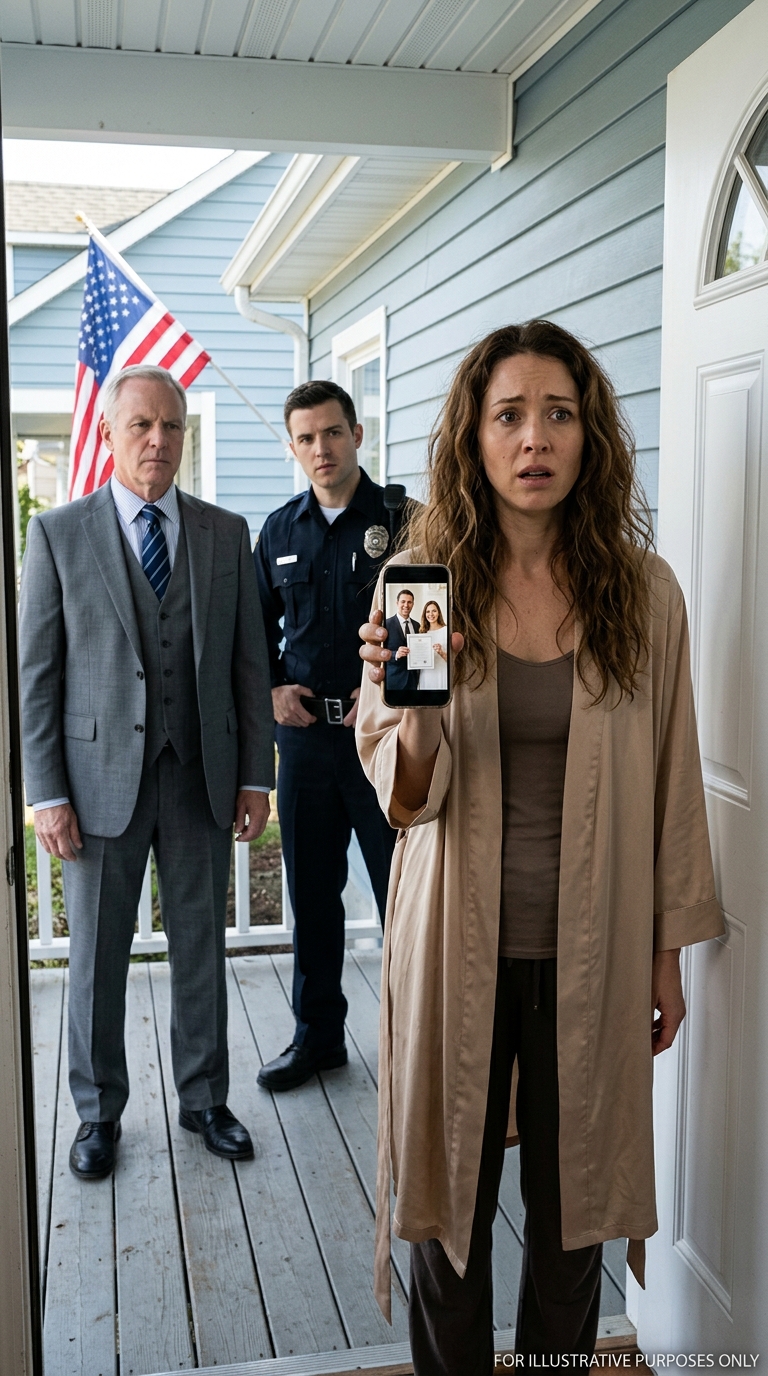
Two uniformed police officers stood on my porch.
One looked to be in his late fifties, with graying hair and the worn posture of someone who had handled too many household calls over too many years.
The younger officer looked about twenty-five, sharp-jawed and alert, eyes scanning the neighborhood with the caution of someone still new enough to take every situation at full intensity.
I opened the door but kept the screen door closed between us.
A small barrier.
Still a barrier.
“Good morning, officers,” I said. “How can I help you?”
The older officer adjusted his belt.
“Ma’am, we received a call about a domestic disturbance at this address. Specifically, we’re looking into a report that someone was locked out of the residence. The caller stated you changed the locks and cut off your husband’s access to money while he was out of town.”
“I see,” I said.
I leaned against the doorframe with the calm I wanted them to see.
I did not invite them in.
“And who exactly is making that claim?”
“Your husband, Nathan Brooks,” the younger officer said, glancing at a small notebook. “He reported that you locked him out of the residence and canceled his credit cards without warning.”
“Ah,” I said.
Then I nodded slowly.
“Well, officers, there is one small but very important issue with that claim.”
The older officer frowned.
“Ma’am, you cannot simply decide you are divorced and lock someone out. That is usually a civil matter that has to go through the court.”
“No,” I said gently, raising one hand. “I understand. I am not saying the court process has already happened. I am saying he voluntarily ended the marriage in a very public and documented way last night.”
I lifted my phone.
I had brought it downstairs specifically for this moment.
The wedding photo was already open.
“He married his assistant.”
The older officer leaned closer, squinting at the screen. I watched his eyes move across the image, taking in the white dress, the certificate, the chapel lights, and Nathan’s pleased little smile.
His eyebrows rose.
“Well,” he murmured, his tone shifting from official to genuinely stunned. “Is that an actual marriage certificate?”
“It appears to be,” I said. “And here is the message he sent with the photo.”
I swiped.
The cruel text filled the screen, timestamp included.
The younger officer leaned over his partner’s shoulder, and I saw the corner of his mouth twitch as he fought to keep a neutral expression.
“Now, about the property,” I continued.
I swiped to another prepared screenshot.
“This is the deed showing the house was purchased under my name only before the marriage. Nathan’s name is not on it. The agreement we signed before the wedding protects this property.”
Another swipe.
“As for the money, the cards he mentioned are accounts in my name. He was an authorized user. I revoked that access after receiving this.”
The officers exchanged a long look, the kind of wordless communication that happens between coworkers who have seen enough nonsense to talk without speaking.
It was the look of people realizing they had been sent somewhere on a story that had left out most of the truth.
“He also said you took some of his personal belongings,” the younger officer added, though the accusation had already lost force.
“His personal items are untouched inside the house,” I said. “If he needs them, he can arrange a proper supervised pickup. I am not damaging or discarding anything. But I will not allow him or Sophia into my private home.”
The older officer let out a long sigh.
He lifted his shoulder radio.
“Sir,” he said into it. “This is Officer Patterson. We’re on scene.”
A burst of static came through, followed by Nathan’s voice.
“Did you arrest her yet? Tell her to open the door right now. My credit cards are declined, and I need to pay for the hotel room. This is financial control.”
Officer Patterson’s jaw tightened.
“Sir,” he said with the weary authority of someone who had just reached the limit of his patience, “you need to contact a family law attorney. Based on the evidence we have reviewed, we cannot force your wife to let you into her home.”
“Her home?” Nathan’s voice shot up. “She stole my entire life. I’m coming back there right now. We’re getting my things.”
He disconnected before the officer could respond.
Patterson turned back to me, his expression professionally neutral but not unkind.
“Ma’am, a few things to protect yourself. Do not destroy anything of his. Do not throw anything away. Do not damage anything. If he comes back with a court order or police escort, you will need to allow supervised collection of his personal property. That will serve you better in the long run.”
“I understand,” I said. “Thank you, officer.”
They returned to their patrol car, spoke briefly about something I could not hear, and drove away.
I stood in the doorway watching them disappear.
The first wave had crashed against my defenses and retreated.
But I knew Nathan.
He would not stop.
And he would not come back alone.
That afternoon, I sent a carefully worded email to Nathan’s HR department. I included only the necessary information: the wedding photo, the apparent workplace relationship, and the fact that I was still legally his wife when the photo was sent to me. I did not embellish. I did not insult. I did not add commentary.
The facts were enough.
At four o’clock that same day, a Honda Civic came barreling down my driveway with the aggressive confidence of someone who believed they still held power.
It was not Nathan’s car.
His rental BMW was probably still sitting somewhere in Las Vegas, collecting fees he could not pay.
The Civic belonged to his mother, Barbara.
She was behind the wheel, a petite woman with dyed burgundy hair and the expression of someone who had spent the entire drive preparing to be offended.
Nathan sat in the passenger seat.
In the back were Sophia Rivera, who looked like a person just realizing she had walked into something much larger than she understood, and Nathan’s sister, Taylor, already filming with her phone before the car had fully stopped.
They spilled out in a chaotic storm of outrage, luggage, and performative injury.
I was ready.
I had spent the afternoon packing Nathan’s belongings. Not lovingly. Not cruelly. Just systematically.
Clothes.
Shoes.
Toiletries.
His baffling collection of golf gear, which he had bought for networking but never actually learned how to use.
Everything that belonged to him was stacked in the garage in heavy-duty bags and flattened cardboard boxes, all clearly labeled with his name in bold black marker.
I opened the garage door as they approached and stood in the doorway with my arms crossed.
“You monster,” Barbara shouted before she was even halfway up the driveway. “How dare you? Locking your husband out, stealing his money. We are calling the police immediately.”
“They were here this morning,” I said calmly. “They left. You are free to ask them why.”
Nathan yanked off his sunglasses with theatrical force.
The smugness from the wedding photo was gone. The arrogance had drained out of him overnight. He looked tired, desperate, and slightly panicked.
“You humiliated me,” he shouted, pointing at me. “I tried to rent a car and my card was declined. I tried booking a hotel, and that card was declined too. Sophia had to pay for gas just to drive back here. Do you know how embarrassing that is?”
I looked at Sophia.
She stood slightly behind Nathan, as if hoping his body could shield her from my attention. She would not meet my eyes. Instead, she stared at a crack in the concrete driveway.
“Hi, Sophia,” I said pleasantly. “Congratulations on your wedding. Quite a surprise. I hope HR at your company is as understanding about workplace relationships as I was about this entire situation.”
Sophia’s head snapped up.
“What? What are you talking about?”
“The company policy,” I said lightly. “The one about romantic relationships between employees. I am sure Janice in HR will find the wedding photo very informative. I sent it to her a couple of hours ago, along with proof that Nathan was still legally married to me.”
Sophia’s face drained so quickly that, for one second, I thought she might faint in my driveway.
Nathan’s voice cracked.
“You didn’t. You did not do that. That’s my job.”
“I did,” I said. “Amazing, isn’t it? That’s the word people like to use now for impulsive life decisions.”
“This is financial control,” Taylor shouted suddenly, stepping forward with her phone raised like a weapon. “I’m recording this. This is going online. Everyone will see what kind of person you are.”
“Go ahead and post it,” I said, looking directly into her camera. “Make sure you use plenty of hashtags. Tag me if you can find my account. I would be happy to comment with the wedding photo, the message your brother sent me, and the timeline.”
Taylor’s phone dipped slightly.
Online battles only work when the person filming has the stronger story.
“Where are my things?” Nathan demanded, his voice breaking around the edges. “Where is my stuff? You probably destroyed it, didn’t you? You are so vindictive.”
I stepped aside and gestured toward the garage.
An entire wall of boxes and contractor bags stood behind me, labeled and stacked.
“Everything is there,” I said. “Every shirt, every pair of shoes, every toiletry, and the entire golf collection. You have one hour to load it and leave my property. After that, I will close the garage door and call the police if you refuse to go.”
“After everything we’ve been through?” Nathan snapped, moving toward the pile of boxes with his fists tight at his sides. “After three years of marriage? I loved you, and this is how you treat me over one mistake?”
“You texted me at 3:47 in the morning calling me pathetic,” I said. My voice stayed steady, but something colder moved underneath it. “You married your assistant. You have been seeing her for eight months. Now you want to talk about what we had?”
No one answered.
They loaded the car in a mess of hostility and silence.
Sophia had to haul bags too. Barbara muttered under her breath and glared at me every few minutes. Taylor filmed in short bursts, though I noticed she carefully avoided showing the neatly labeled boxes, probably because proof that I had preserved Nathan’s belongings would ruin the story she wanted to build.
Nathan tried twice to get inside the house.
Once, he claimed he needed the bathroom.
The second time, he said he had to “double-check” whether I had missed anything.
Both times, I blocked the doorway.
“No.”
That was all I said.
When the trunk was full and the back seat was packed so tightly with bags that Sophia barely had room to sit, they finally retreated.
As the car pulled away, Nathan stared at me through the passenger-side window.
It was not hatred in his eyes.
I would have recognized hatred.
This was confusion.
Deep, disoriented confusion.
For years, Nathan had believed I was passive, safe, easy to control, predictable. He thought if he pressed the right button, I would collapse into begging, apologies, and desperate attempts to hold the marriage together.
Instead, he had activated a version of me he had never bothered to know.
I closed the garage door.
Then I leaned back against my car and felt my hands begin to shake for the first time since the nightmare began.
The adrenaline finally dissolved, leaving behind exhaustion and a hollow space in my chest, as if something had been carved out.
Over the next few days, Nathan launched an online campaign that would have impressed a full-time content creator.
Facebook.
Instagram.
X.
Everywhere at once.
He posted long emotional statements describing me as controlling, cruel, manipulative, paranoid. He claimed he had felt trapped in a loveless marriage and had run to Las Vegas because he feared for his future. He described Sophia as his “saving love,” as if he were the victim of his own affair instead of the person who had carried it out for months.
He posted photos of himself looking devastated.
He posted staged images of beer bottles and trash bags.
He posted captions about starting over.
Mutual friends began messaging me.
Some were supportive because they had known Nathan long enough to recognize the pattern.
Others asked careful, uncomfortable questions.
“What happened?”
“He says you controlled everything.”
“Is any of this true?”
“Why did you lock him out?”
I did not respond immediately.
Instead, I gathered the full picture through legal and appropriate channels. My attorney helped me organize the records I already had access to: shared devices, account statements, old messages, emails Nathan had left connected on the family computer, and financial documents that showed exactly how long the situation had been building.
By that evening, I had a seventy-three-page file.
It was not just betrayal.
It was a map.
Messages between Nathan and Sophia went back more than a year. They started lightly, then became colder, more calculated, and more contemptuous.
October 12.
“She has no idea. Give me six more months and I’ll have enough saved for our real future.”
December 24.
“Merry Christmas, baby. I hate pretending here.”
January 15.
“She’s paying for my marketing certificate. Once that’s done, I’ll pull another investment for the business.”
I read until my jaw hurt from clenching.
Nathan had not simply made one reckless choice in Las Vegas.
He had been planning an exit while using my money, my credit, my patience, and my home as a launchpad.
After reviewing everything with my attorney, I chose three screenshots.
Not seventy-three pages.
Not a rant.
Not a dramatic statement.
Just three screenshots that showed enough.
The admission that he was hiding money.
The message that showed he had been using my support for his own plans.
The line that revealed his contempt.
I posted them on my Facebook timeline without any personal commentary.
The reaction was immediate.
Within an hour, the post had been shared dozens of times. People who had supported Nathan quietly deleted their comments. Some who had known us both for years began posting their own stories about times he had lied, borrowed money, exaggerated opportunities, or manipulated sympathy.
Then Nathan’s father called my workplace.
He had never met my boss, but he called anyway, shouting that I was unstable and should be fired.
My boss, who had already seen enough of the situation to understand what was happening, calmly informed him that if he contacted the company again, the legal department would handle it.
At 3:17 on Thursday morning, less than a week after the first text, my phone buzzed with a security camera alert.
I opened the app, half asleep, and saw Nathan standing on my porch.
He was unsteady, trying to shove his old key into the new lock.
When it did not work, he started pounding on the door with a small garden stone.
“Give me my money back,” he shouted. “That’s my inheritance money.”
That was especially strange because his father was very much alive and had recently called my boss demanding I lose my job.
I did not open the door.
I did not respond through the camera.
I simply saved the footage and sent it to my attorney.
Two days later, I received a call from an unknown number.
I knew better than to answer.
I answered anyway.
“Is this the woman destroying my daughter’s life?” a sharp voice snapped.
“I’m sorry,” I said. “Who is this?”
“This is Margaret Rivera. Sophia’s mother.”
For one second, I almost laughed. I had to cover my mouth to stop the sound.
“Mrs. Rivera,” I said carefully, “I assume you are calling to apologize for your daughter having a relationship with a married man.”
“My daughter made a mistake,” she said. “Young women do foolish things when they are in love. But you are an adult. You should know better. You need to be the bigger person. You need to take your husband back.”
I paused.
I was genuinely stunned by the structure of that logic.
“Your daughter is only four years younger than I am,” I said. “And why exactly should I take Nathan back?”
Sophia is going to leave him, Margaret explained in a low, tense voice. She lived with her mother. She had student loans. Nathan could not support her. Sophia needed her life back. Therefore, according to Margaret, Nathan needed to become my problem again.
The audacity was breathtaking.
“Let me make sure I understand,” I said slowly. “You want me to reconcile with a man who married your daughter while he was still married to me, used my money, spent months lying, and then attacked my reputation online so your daughter does not have to deal with the consequences of her own choices?”
“When you say it like that, you sound selfish,” Margaret said.
“Marriage is about forgiveness and compromise.”
“Teach that to your daughter,” I replied.
Then I hung up and blocked the number.
After that, I sat in my office chair, stared at the wall, and started laughing.
Not because anything was funny.
Because sometimes the human mind reaches a point where laughter is the only sound left.
The divorce hearing was scheduled two weeks later.
My lawyer, Richard Henderson, had been recommended by a colleague. He was sharp, calm, and impossible to rattle.
From the first consultation, he told me the case was unusually clear.
“He gave us the documentation himself,” Henderson said. “The photo, the message, the timeline, the financial records. I have practiced family law for twenty-three years, and I have rarely seen someone create this much evidence against himself.”
On the morning of the hearing, I dressed in my best suit.
Not the prettiest one.
The strongest one.
The one that made me look composed even when my stomach felt like a fist.
Henderson met me outside the courthouse carrying a briefcase that held the seventy-three-page file and the supporting records.
“Ready?” he asked.
“Let’s finish this today,” I said.
The courtroom smelled faintly of floor wax, old coffee, and nervous people. The air conditioning was too cold, making the room feel sterile and uncomfortable.
Then the door opened.
Nathan walked in wearing a wrinkled dress shirt.
Barbara and Taylor flanked him like bodyguards, both glaring at me with identical contempt.
Sophia was not there.
Judge Patricia Caldwell sat at the bench with reading glasses perched on her nose and silver hair pulled into a neat bun. Her eyes moved from the paperwork to Nathan, then to the wedding photo clipped into the evidence packet.
“Mr. Brooks,” she said, her tone already skeptical. “I see conflicting information here. You participated in a marriage ceremony with another woman while still legally married to Mrs. Brooks.”
Nathan’s attorney rose quickly.
He was a nervous-looking man in an ill-fitting suit, and I could tell from his expression that this was not the case he had hoped to start his morning with.
“Your Honor,” he said, “we argue that the Las Vegas ceremony should be considered invalid due to emotional distress and impaired judgment.”
Judge Caldwell raised one eyebrow.
“Impaired judgment?”
“My client felt trapped in an unhealthy marriage,” the attorney continued. “He was under extreme distress and not thinking clearly at the time of the ceremony.”
Henderson stood slowly.
He did not shout.
He did not slam anything.
He simply opened his briefcase, removed the stack of documents, and approached the bench.
“Your Honor,” he said, his voice smooth and sharp, “I have submitted seventy-three pages of correspondence between Mr. Brooks and Ms. Rivera. These messages and emails date back more than a year. They describe a deliberate and sustained plan. In this correspondence, Mr. Brooks does not express fear or confusion. What he does express is intent.”
The courtroom became very quiet.
Henderson continued.
“The records show financial exploitation, including his own admissions of using access to my client’s resources while planning to leave only after she had funded his business ambitions.”
The ticking of the wall clock became audible.
Someone in the back row coughed.
Nathan shifted in his seat.
Barbara’s face turned red.
Judge Caldwell flipped one page.
Then another.
Her expression changed from professional neutrality to something much colder.
“Mr. Brooks,” she said finally, looking over the rim of her glasses. “Did you write, ‘I can’t wait to see the look on her face when she realizes I drained everything. She deserves it for being such a boring wife’?”
Nathan’s face went pale, then bright red.
“Your Honor, that was taken out of context. I was joking.”
“In what context,” Judge Caldwell asked dryly, “would that statement improve?”
Nathan opened his mouth.
Closed it.
No answer came out.
There was no answer that would not make things worse.
The ruling came quickly.
The divorce was granted.
My premarital property remained mine.
The protections in the agreement were upheld.
Nathan was assigned responsibility for certain debts and ordered to make limited payments to me over the following months.
It was not enough to repair the damage he had caused.
But it was enough to make the point official.
As we stood to leave, I felt Nathan staring at me.
The anger radiating from him was almost physical.
Outside the courthouse, whatever fragile peace existed shattered instantly.
Barbara, who had been simmering throughout the hearing, exploded the moment we stepped onto the courthouse steps.
“You ruined my son’s life,” she screamed, her voice bouncing against the concrete and marble.
She moved toward me, hands raised in fury.
“Ma’am, please step back,” Henderson warned, moving between us with impressive speed for a man in his fifties.
Taylor, who had clearly watched too much reality television and participated in too many online arguments, threw the large iced coffee she was holding.
She threw badly.
The cup arced wide, missed me, and burst against the chest of a woman walking up the courthouse steps behind us.
That woman was Margaret Rivera.
Sophia’s mother.
Apparently, she had decided to attend the hearing, perhaps to support what she considered young love, or perhaps to plead for her daughter’s reputation.
Instead, she was now covered in caramel coffee and ice cubes.
The sound she made did not resemble language.
Then she lunged at Taylor.
Chaos erupted.
Purses swung.
People shouted.
Courthouse security rushed up the steps within seconds, separating the women and warning everyone that the next person who escalated would be removed.
I stepped back with my lawyer beside me and watched the scene unfold.
Then I noticed Nathan.
He was not stopping anyone.
He was not defending his mother.
He was not helping his sister.
He was not checking on Margaret.
He simply stood there, watching the chaos he had created ripple outward into everyone else’s life.
Six months later, everything had quieted down.
But everything had also changed.
I sold the house about three months after the divorce was finalized.
It held too many memories tied to a version of myself I no longer recognized and did not want to rebuild. The market was strong, and I sold it for two hundred thousand dollars above asking to a young couple with twins who loved the backyard garden.
I used part of the proceeds to buy a modern condo downtown, closer to my office, with floor-to-ceiling windows and a doorman who screens every visitor.
No one enters the lobby unless I approve it.
According to mutual acquaintances, Nathan is living with his parents in their cramped two-bedroom apartment.
Apparently, it is its own special kind of punishment.
Sophia did not attend the hearing because, by then, she had already moved on.
New company.
New state.
New partner.
When she realized Nathan was broke and I had no intention of becoming anyone’s safety net, she disappeared from his life as quickly as she had entered mine.
Both Nathan and Sophia lost their positions at the old company. The workplace policy was clear, and the company did not appreciate being dragged into the consequences of their choices.
Margaret Rivera, in a twist that surprised absolutely no one, threatened legal action over emotional distress and reputational harm. She also demanded reimbursement for the dry-cleaning bill from the coffee incident.
I doubt it will go anywhere.
But it added one more layer to Nathan’s already complicated situation.
As for me, I changed in small ways first.
A yoga mat rolled out across pale wooden floors.
My hands trembling slightly as I pressed my toes into the mat and exhaled.
A pot simmering on the stove, the scrape of a wooden spoon reminding me that caring for myself could be as simple as making a good meal.
A text from a close friend asking, “Coffee today?”
And me replying, “Three o’clock. Bring your smile.”
No permission.
No guilt.
Friendships became anchors.
Their laughter.
Their hands on my shoulder.
Their eyes seeing me as someone returning to herself, not someone meant to endure.
I traveled, not to escape, but to open windows.
I packed a suitcase.
I placed my passport on the table.
I stood in front of the glass in my new apartment and saw a woman calmly arranging her life the way she wanted it.
Once, Nathan tried to find out where I lived.
The building’s security stopped him at reception.
A guard looked at him, checked the system, and shook his head.
That boundary was no longer just a sentence I said.
It was a door he could not open.
Slowly, like morning light filtering through a window, I realized how much I had allowed Nathan and his family to dim my life. Their words had settled over me for years like dust on glass, blurring my view until I saw myself only through them.
Now I wipe that glass clean piece by piece.
With small habits.
With friends.
With legal clarity.
With quiet mornings.
With dinners I cook just because I want to taste my own life again.
There was no grand celebration.
Only quiet afternoons where peace spread through my chest like warm water.
Sometimes I still think about the seventy-three pages.
The months of lies.
The early morning text calling me pathetic and telling me to enjoy my small life.
He played reckless games and received the kind of prize those games create.
My only regret is not recognizing the red flags sooner.
Like the day we first got married, when he told me his ex-girlfriend was “crazy and controlling” because she changed the Netflix password after he went to dinner with a client.
I should have realized then that I was looking at my own future.
But now I understand.
Healing is not going back to the person you were before someone hurt you.
Healing is moving forward.
Not rushed.
Not loud.
Just determined.
Choosing yourself again and again through small, intentional actions.
And sometimes, the strongest reply you can send is no reply at all.
Sometimes, it is changing the locks before sunrise.