Ava Mercer found the tracker because she dropped her keys.
Not because the police had believed her.
Not because her friends had stopped saying, “Maybe he’s just having a hard time letting go.”
Not because Mason Caldwell had finally made a mistake big enough for the world to see.
She found it because, at 9:17 on a rainy Thursday night in the parking lot behind a grocery store in Boston, her numb fingers lost their grip on her key ring, and the keys skittered under the back bumper of her old blue Subaru.
Ava crouched down, breath steaming in the cold, one hand braced against the wet asphalt, and reached beneath the car.
Her fingers touched metal.
Then plastic.
Then something that did not belong there.
She froze.
The small black device was no bigger than a matchbox, attached by a magnet to the underside of her bumper. A tiny green light blinked once, patient and cruel.
Ava’s stomach dropped so hard she thought she might throw up between the faded yellow parking lines.
For three weeks, Mason had known where she was.
The laundromat. Her bakery shift. Her apartment. Her mother’s clinic appointments. The coffee shop where she had met her lawyer friend. The little white church in Quincy where she had cried in the bathroom after realizing Mason was parked across the street.
Every place she had run to.
Every place she thought was safe.
Her phone slipped from her pocket and clattered onto the ground.
A shadow moved beside her.
Ava flinched so violently she nearly hit her head on the bumper.
“Easy,” a man said.
Roman DeLuca stood beneath the buzzing grocery store lights, his black overcoat dark with rain, his expression unreadable. He looked like trouble carved into a human shape—thirty-two years old, sharp-jawed, clean-shaven, with the kind of calm that made other people lower their voices.
Boston had rumors about Roman.
Some people called him a businessman.
Some called him a ghost.
Others whispered that the DeLuca family had stopped running the city years ago, but the city had never stopped checking over its shoulder when Roman walked into a room.
Ava did not care what he was.
At that moment, she only knew he was the first man who had ever looked at the device in her trembling hand and understood immediately that it was not a misunderstanding.
Roman took the tracker from her palm.
He turned it over once.
Then he looked at Ava.
There was no pity in his eyes. Pity would have broken her.
There was something colder.
Recognition.
“Who put this on your car?” he asked.
Ava tried to answer, but Mason’s name got trapped behind her teeth.
Roman did not rush her.
Rain tapped against the grocery carts. A truck groaned past on the street. Somewhere in the dark, the little tracker blinked again.
“Mason,” she whispered. “My ex.”
Roman’s smile came slowly, without warmth.
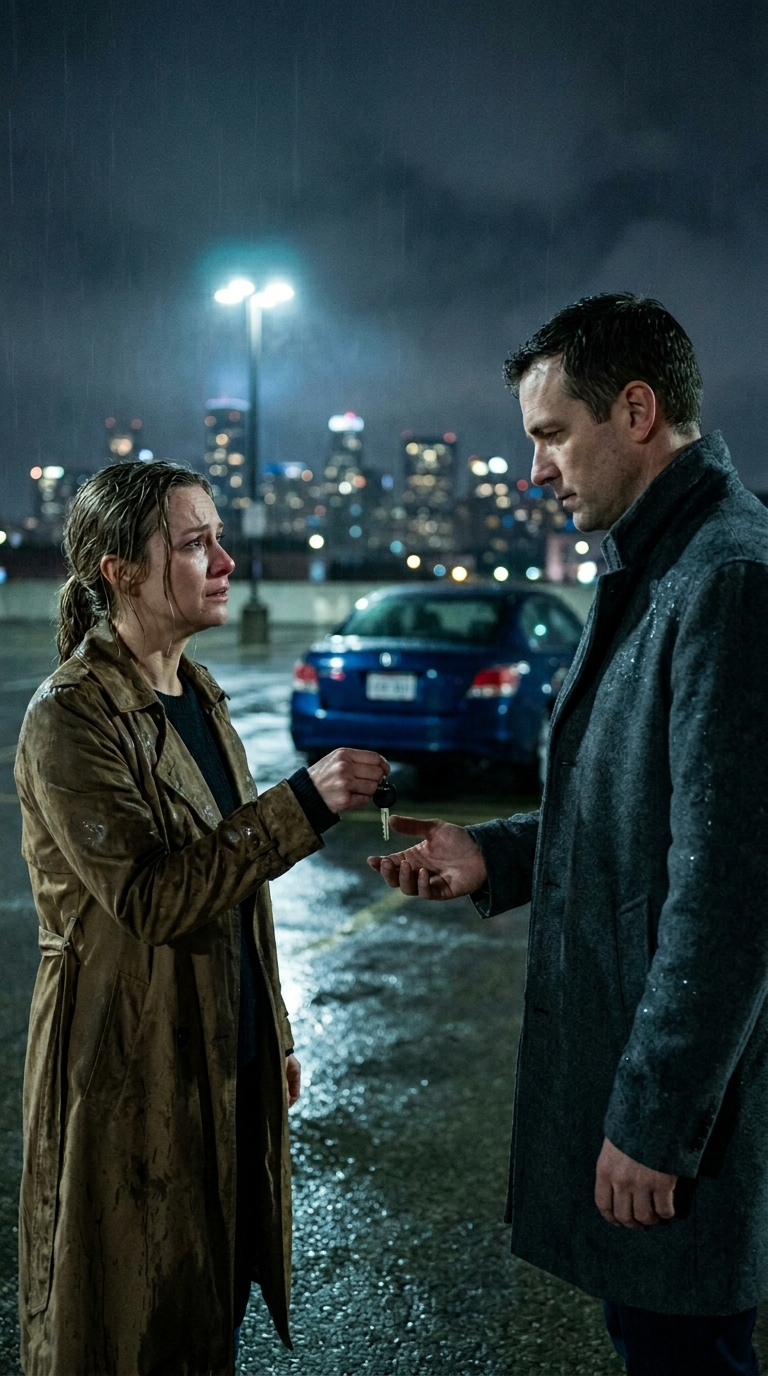
He held out his hand.
“Keys.”
Ava stared at him. “What?”
“Give me your keys.”
“Roman, no. I don’t want anyone getting hurt.”
“No one innocent will.”
That should have scared her.
Instead, it steadied something in her chest that had been shaking for months.
Ava placed the keys in his hand.
Roman opened the driver’s door of her Subaru, set the tracker back where Mason expected it to be, and slid behind the wheel like he was climbing into a confession booth for someone else’s sins.
Before he shut the door, he looked at her through the rain.
“He wants to follow you?” he said. “Good. Let him follow me into hell.”
CHAPTER 1: THE GIRL EVERYONE TOLD TO BE QUIET
Before Mason Caldwell became the man watching Ava from parked cars, he had been the man everyone told her she was lucky to have.
He was handsome in a polished, believable way—blond hair always combed back, blue eyes that looked honest in photographs, perfect teeth, expensive watch, clean white shirts. He came from a family with a last name on hospital wings and scholarship plaques. His father had once run for attorney general. His mother chaired charity galas. Mason himself worked in public relations for a private law firm that represented half the wealthy people in Boston.
He knew how to shake hands.
He knew how to kneel in front of old ladies and make them laugh.
He knew how to say “I’m worried about her” in a voice that made people look at Ava like she was the problem.
When they first met, Ava was twenty-four and working early mornings at Harbor & Honey, a small bakery near the water in South Boston where the air always smelled like cinnamon, butter, and roasted coffee beans. She had flour on her cheek and her hair twisted into a messy knot when Mason walked in during a rainstorm and ordered a black coffee he barely touched.
He came back the next day.
And the next.
By the end of the week, he knew her favorite song, her lunch break, her mother’s name, and the fact that she dreamed of opening her own bakery one day with blue-painted walls and a lemon tree by the window.
At first, Ava thought it was romantic that he remembered details.
Later, she understood he had been collecting them.
Mason did not become frightening all at once. Men like Mason rarely do. They arrive as shelter. They become weather.
He started with concern.
“Are you sure you want to wear that?”
“Why didn’t you answer my text?”
“You know Sienna doesn’t really support us, right?”
“I just worry when I don’t know where you are.”
Then came the rules, disguised as love.
He hated when she worked closing shifts.
He hated when she went out with coworkers.
He hated when she did not share her location, because “couples don’t hide things.”
The first time Ava broke up with him, he cried so hard she took him back.
The second time, he stood outside Harbor & Honey for four hours holding roses.
The third time, he called her mother and said Ava was having a breakdown.
The fourth time, Ava changed her locks.
That was when the real Mason stepped forward.
He sent flowers to her job with cards that said, I’ll always find you.
He made fake social media accounts to comment under bakery posts.
He sent her photos of her own apartment window at night.
Then he started appearing.
At the gas station in Dorchester.
Outside her yoga class.
Across from her mother’s physical therapy clinic.
Once, in the frozen food aisle of the grocery store, wearing a navy coat and a smile so calm it made Ava’s blood turn cold.
“You’re making this ugly,” he told her, while a little boy nearby begged his mother for ice cream. “It doesn’t have to be ugly.”
Ava went to the police with screenshots, voicemails, pictures of his car.
The first officer was kind but tired.
“Has he threatened you directly?”
“He said he’ll always find me.”
“But did he say he’d hurt you?”
Ava stared at him. “Isn’t finding me the threat?”
The officer sighed like she was making paperwork complicated.
The second officer suggested a restraining order.
The third asked if Mason had ever hit her.
When Ava said no, his face changed. Not enough for her to accuse him of dismissing her. Just enough for her to know he had placed her in the category of women who were scared too early.
Women who should wait until a bruise made things easier to understand.
Mason understood that category, too.
That was why he never raised a hand.
He raised doubt instead.
He called her boss, Denise, and said Ava was struggling emotionally after the breakup.
He told their mutual friends she had become paranoid.
He sent Ava long emails full of apologies, then shorter texts full of rage, then voicemails where his voice was soft enough to sound wounded.
“You’re scaring me, Ava. I don’t know what you’ll do next.”
It was brilliant in the worst way.
By the time Ava told people Mason was stalking her, Mason had already told them she was unstable.
That was how she ended up losing friends before losing sleep.
That was how she started parking under streetlights.
That was how she stopped wearing headphones.
That was how she learned to walk with her keys between her fingers and still feel helpless.
Roman DeLuca entered her life because of cannoli.
It was a ridiculous beginning for a man with his reputation.
One Friday morning in October, Roman walked into Harbor & Honey with two men behind him and ordered twelve boxes of cannoli for a retirement party at the old Italian social club in the North End. Denise nearly swallowed her pen when she saw him.
Ava knew his name before he said it.
Everybody did.
The DeLucas had been a Boston rumor for decades. Restaurants. Construction. Private security. Old money with older shadows. Men in tailored coats. Women who wore pearls to Sunday mass and knew where every body was buried, metaphorically or not.
But Roman did not swagger.
He waited in line.
He tipped fifty dollars.
And when a drunk customer snapped his fingers at Ava and called her “sweetheart” in a way that made her jaw tighten, Roman turned his head just slightly.
The drunk man stopped smiling.
He apologized to Ava without Roman saying a word.
After that, Roman came in every Monday.
Always black coffee.
Always exact change.
Always a brief nod.
Never flirting. Never pushing. Never asking personal questions.
That was why Ava trusted him before she meant to.
He was one of the few men who did not seem to believe access to a woman was a reward for being kind.
One morning, after Mason had left twenty-six missed calls overnight, Ava’s hands shook so badly she dropped a tray of blueberry scones.
The crash silenced the bakery.
Denise hurried over, but Roman was closer. He crouched beside Ava, picking up broken pieces of pastry and glass.
“You hurt?” he asked.
Ava shook her head too quickly.
Roman looked at the cuts of fear beneath her eyes.
“Who is he?”
The question was quiet.
Ava should have lied.
Instead, maybe because she was exhausted, maybe because fear makes truth fall out of the body, she whispered, “My ex.”
Roman’s face did not change.
But the room did.
It was almost impossible to explain. The air around him seemed to settle, as if something heavy had entered and everything reckless had decided not to move.
“Does he come here?” Roman asked.
“Sometimes.”
“Does Denise know?”
Ava looked toward the office.
Roman followed her gaze.
Five minutes later, Denise banned Mason from Harbor & Honey and installed a second camera above the front door. She did it with shaking hands because Roman DeLuca had stood in her office and explained, politely, that businesses had a responsibility to protect employees from harassment.
He never threatened her.
That was the terrifying part.
He sounded like a man discussing weather while everyone else heard thunder.
For a week, Mason stayed away.
Ava almost slept.
Then the messages changed.
You think he can protect you?
Ava’s stomach flipped when she read it.
Another message appeared.
You have no idea what kind of man he is.
Then another.
Maybe I should tell everyone what you’re doing with him.
She blocked the number.
A new one appeared within minutes.
You don’t get to leave me and run to a gangster.
Ava dropped her phone onto the bakery counter.
Roman came in that morning and found her staring at it like it had teeth.
She told him everything.
Not dramatically. Not all at once. Just pieces, because speaking the whole thing felt like dragging broken glass out of her throat.
Roman listened.
He did not interrupt.
When she was done, he asked, “Do you want my help?”
Ava laughed once, bitter and small. “What does that mean?”
“It means you decide what happens next. Not him.”
It was the first time anyone had said that.
Not be careful.
Not maybe don’t provoke him.
Not keep records.
You decide.
Ava wanted to believe it so badly she hated him for saying it.
“I don’t want revenge,” she said.
“Good,” Roman replied. “Revenge is messy. Evidence is cleaner.”
That surprised her.
She looked up.
Roman slid a plain business card across the counter. DeLuca Security Consulting. A phone number. No title.
“My company handles private protection, surveillance audits, digital threats. Most of what scares people leaves fingerprints.”
Ava stared at the card.
“Why would you help me?”
Roman’s answer came too fast to be invented.
“Because men like him count on women being tired.”
Ava tucked the card into her apron.
For three days, she did not call.
Pride stopped her.
Fear stopped her.
The old belief that asking for help meant surrendering stopped her.
Then she came out of her apartment one morning and found a single white rose tucked under her windshield wiper.
No note.
Mason’s favorite kind of cruelty was knowing she would know.
That night, Ava called Roman.
CHAPTER 2: THE THING UNDER THE BUMPER
Roman did not arrive with an army.
He sent a woman named Nora first.
Nora Kline was twenty-seven, sharp-eyed, freckled, and dressed in a hoodie under a leather jacket. She carried a backpack full of equipment and spoke with the dry calm of someone who had seen every stupid thing a dangerous man could do with a smartphone.
“I used to work cybercrime,” she told Ava, kneeling beside the kitchen table in Ava’s apartment. “Now I work for Roman, which is basically the same thing, except the coffee is better and fewer people lie to me.”
Ava almost smiled.
Nora checked Ava’s phone, laptop, email accounts, doorbell camera, car Bluetooth, even the cheap digital photo frame Mason had given Ava’s mother the previous Christmas.
She found spyware on Ava’s old tablet.
A tracking link hidden in an email Mason had sent pretending to return a recipe.
A second Instagram account he used to watch Ava’s bakery posts.
“He’s not talented,” Nora said, clicking through logs on her laptop. “He’s just persistent. Dangerous men don’t need to be geniuses. They only need people to underestimate them.”
Ava stood by the sink, arms wrapped around herself.
“Can you prove it’s him?”
Nora looked up.
“Some of it, yes. Enough to build pressure. Not enough to make the system move fast unless he escalates.”
“He always escalates,” Ava whispered.
Nora’s face softened.
“Then we document everything before he does.”
For the first time in months, Ava felt like someone had put a floor beneath her.
Roman paid for the audit without asking. When Ava tried to argue, he said, “Consider it a community safety expense.”
“That’s not a thing.”
“It is now.”
Ava should have been afraid of owing him.
She was afraid of many things.
But Roman never treated help like a leash.
He did not call unless necessary. He did not show up uninvited. He did not ask where she was unless she offered. He sent her a list of steps: change passwords, file updated reports, keep logs, tell trusted people, avoid being alone in predictable places, let the cameras record.
He was not gentle exactly.
He was careful.
That mattered more.
Mason, meanwhile, grew bolder.
One night, Ava’s best friend Sienna called crying because Mason had shown up at her apartment building and told the doorman Ava had stolen money from him.
Another morning, Denise found a one-star review online accusing Harbor & Honey of employing “violent unstable staff.”
Then came the envelope.
It arrived at Ava’s apartment with no return address.
Inside were printed photos.
Ava entering her building.
Ava carrying groceries.
Ava hugging her mother outside the clinic.
Ava standing beside Roman’s black car outside the bakery.
On the back of the last photo, Mason had written:
You’re embarrassing yourself.
Ava sat on the floor for forty minutes, unable to move.
Then she called the police again.
This time, she brought Roman.
The officer behind the desk recognized him and immediately sat up straighter.
Ava noticed.
Roman did too.
He hated it. She could tell by the way his jaw tightened.
It took a man with a dark reputation standing beside her for the officer to treat her fear like evidence.
Ava filed the report.
The officer promised to “look into it.”
Nothing happened.
Mason sent flowers the next day.
Twenty-four red roses.
The card read:
See? No one is coming.
That was the first time Ava thought she might not survive him.
Not because Mason would necessarily kill her in one violent burst, though that possibility had begun moving around the edges of every day.
But because he was erasing her slowly.
Her confidence.
Her friendships.
Her sense of privacy.
Her ability to walk into a room without scanning exits.
Her faith that truth mattered if the liar had better posture.
That Thursday night, after a double shift at Harbor & Honey, Ava drove to the grocery store for milk, cereal, and the cheapest bottle of white wine she could find. She walked through the aisles like a ghost, hood up, checking reflections in freezer doors.
Nothing.
No Mason.
No blond head near the produce.
No navy car at the far end of the lot.
Just rain, cold, and fluorescent lights.
She paid and carried her bags outside.
Then her keys fell.
The discovery of the tracker broke something open in her.
There was fear, yes.
But beneath it, hotter and cleaner, came rage.
Mason had not just followed her.
He had invaded every ordinary moment and made it his.
He had turned her commute into a cage. Her car into a collar. Her life into a map he owned.
Ava gripped the device so tightly its edges bit her skin.
Her first instinct was to smash it.
Her second was to run.
Her third was to call Roman.
She did not remember dialing.
She only remembered his voice answering on the second ring.
“Ava?”
She tried to speak.
Nothing came out.
“Ava,” Roman said again, and now his tone changed. “Where are you?”
“Market Basket,” she whispered. “Southie. Parking lot.”
“What happened?”
“I found something.”
“What kind of something?”
She looked at the blinking light.
“A tracker.”
Silence.
Then: “Don’t move.”
Less than eight minutes later, Roman was there.
Not alone.
His black SUV pulled in two rows over, headlights cutting through rain. Nora stepped out of the passenger side with an umbrella. A broad-shouldered man named Vince stayed near the SUV, scanning the lot with the bored focus of a guard dog pretending to nap.
Roman crossed to Ava without hurrying.
He did not ask if she was sure.
He did not tell her to calm down.
He looked at the device.
Then at her car.
Then at every exit in the parking lot.
“Mason’s watching the signal,” Nora said, taking a quick photograph of the tracker with her phone. “Maybe live, maybe pinging intervals.”
Ava felt cold all the way through.
“So he knows I’m here?”
“He knows your car is here,” Nora said. “That distinction is about to matter.”
Roman held out his hand for the tracker.
Ava gave it to him.
He examined it like a judge reading a sentence.
Then he asked for her keys.
Ava resisted because some deep part of her still believed the right thing to do was to be small and safe and quiet. Not provoke. Not escalate. Not let men handle things in ways that became more frightening than the original harm.
Roman saw the hesitation.
“I’m not going to hurt him,” he said.
She searched his face.
“Promise me.”
Roman’s expression did something strange then.
For one second, the polished danger vanished, and Ava saw a tired young man carrying an old family name like a debt.
“I promise you,” he said. “He leaves tonight with all his bones and none of his lies.”
Nora opened the rear door of the SUV.
“You’re coming with me,” she told Ava. “We’re going somewhere safe with cameras and witnesses.”
“Where?”
“Roman’s mother’s restaurant.”
Ava blinked. “His mother?”
Roman gave her the faintest look. “She’s scarier than I am.”
Under any other circumstances, Ava might have laughed.
Instead, she handed over her keys.
Roman crouched by her Subaru and returned the tracker to its hiding place. He did not disable it. He did not throw it away.
He gave Mason exactly what Mason wanted.
A signal.
The old Subaru’s engine coughed once, then started.
Roman rolled down the window.
Rain ran silver across his face.
“He wants to follow you?” he said. “Good. Let him follow me into hell.”
Then he drove away in Ava’s car.
And somewhere in Boston, Mason Caldwell looked at his phone and smiled.
CHAPTER 3: LET HIM FOLLOW ME
Mason had three screens open when the dot began moving.
He sat in his apartment on Commonwealth Avenue, blinds half-closed, wearing sweatpants and a white dress shirt he had not bothered to button all the way. On one screen was a spreadsheet for work. On another, a message thread where Ava had stopped replying months ago. On the third, the tracking dashboard he had checked more often than he checked the weather.
The blue dot that represented Ava’s car pulled out of the grocery store lot and turned toward the waterfront.
Mason leaned back.
“There you are,” he murmured.
He had told himself he installed the tracker because Ava was unstable.
That was the story he liked best.
It made him feel responsible instead of pathetic.
Protective instead of predatory.
A man forced into extremes by a woman too emotional to understand what was good for her.
But the truth, buried under layers of entitlement, was simpler.
Ava had left him.
And Mason Caldwell did not believe women like Ava were allowed to leave men like him.
At first, following her had been about control.
Then Roman DeLuca appeared.
Roman with his black cars and quiet menace.
Roman with his old-world family name.
Roman looking at Ava like she was not crazy.
That was when the situation became intolerable.
Mason’s jealousy had teeth, but his fear had claws.
Because Roman was connected to something Mason wanted buried.
Ava did not know that.
Roman probably did.
Three years earlier, Ava’s father, Peter Mercer, had worked as a forensic accountant. Quiet man. Gray hair. Bad jokes. Too honest for the rooms he was hired to enter.
Peter had discovered something while reviewing shell companies tied to a charity foundation run by Mason’s father.
Money moving where it should not.
Donations becoming payments.
Payments becoming favors.
Favors becoming sealed records.
Before Peter could testify, he died in a car crash on I-93 during a snowstorm.
The police called it an accident.
Mason’s father called it a tragedy.
Roman DeLuca called it convenient.
Mason had only learned the full extent of it later, after overhearing his father on a late-night call, drunk and furious, asking someone whether “Mercer’s files” were truly gone.
Then Mason met Ava at Harbor & Honey.
At first, he told himself it was coincidence.
Then he searched her apartment while she slept.
He found nothing.
He dated her for eight months.
Still nothing.
Eventually, he realized Ava might not know what her father left behind.
That made her both useless and dangerous.
If Peter Mercer had hidden copies of his work, Ava might stumble into them. She might give them to someone like Roman. She might destroy the Caldwell family without ever understanding the match in her hand.
So Mason stayed close.
Then Ava left.
Then Roman appeared.
Now the blue dot was moving toward the Seaport.
Mason opened another app and watched Ava’s phone location.
Nothing.
He cursed.
Her phone was off.
Or wrapped.
Or with someone else.
His fingers tightened.
The car turned again, heading toward an old strip of warehouses near the water, an area where new luxury condos stood beside buildings that still looked like they remembered blood on concrete.
Mason’s pulse lifted.
Was she meeting Roman there?
Was she hiding something?
Was this where they kept the files?
He grabbed his coat.
On the way out, he took the small pistol from the locked box in his closet.
He told himself it was for protection.
Men like Mason always did.
Across town, Ava sat in a corner booth at Lucia’s, a warm, crowded North End restaurant where the walls were covered in family photographs and the air smelled of garlic, basil, and simmering tomato sauce.
Roman’s mother, Celia DeLuca, placed a bowl of soup in front of Ava with the authority of a woman who considered refusal a personal insult.
“Eat,” Celia said.
“I’m not hungry.”
“That’s not what I said.”
Ava picked up the spoon.
Nora sat across from her, laptop open, tracking Roman’s route through a secure feed from a tiny camera clipped inside the Subaru.
Vince stood near the door.
Two other men lingered outside pretending to smoke.
No one said the word Mafia.
No one needed to.
The restaurant was full of ordinary Thursday night life: couples sharing wine, college students laughing too loud, an older man arguing with the television above the bar. Yet beneath it all was a current of quiet readiness.
Ava hated that she needed it.
She also wanted to cry because it existed.
Celia slid into the booth beside her.
“You look like you haven’t slept in a year.”
“It feels like longer.”
Celia nodded.
“My sister had a husband like that.”
Ava looked at her.
Celia’s face hardened with memory.
“Everybody loved him. Good job. Good smile. Opened doors in public. Closed fists in private.”
“I’m sorry.”
“So was everyone after she was dead.”
Ava’s spoon stopped halfway to her mouth.
Celia reached across the table and covered Ava’s hand.
“Men like Mason do not stop because women ask nicely. They stop when the world stops protecting them.”
Ava looked down at her soup.
“My world protected him.”
“Then we make a bigger world.”
On Nora’s screen, the blue dot turned into the warehouse district.
Roman had chosen the place carefully.
The building belonged to DeLuca Holdings on paper and to old Boston history in every rumor. It had once been a meatpacking warehouse. Now it sat empty most nights, waiting for permits to become expensive lofts with exposed brick and river views.
But tonight every camera worked.
Every light could be turned on from a switchboard upstairs.
And every entrance had someone watching.
Roman drove Ava’s Subaru through the open gate and parked in the middle of the lot.
Then he waited.
He did not sit in the car.
He leaned against the hood in the rain, hands in his coat pockets, looking almost bored.
Inside his pocket, his phone buzzed once.
Nora’s text:
He’s coming.
Roman replied with one word.
Good.
Eight minutes later, headlights appeared at the end of the street.
Mason’s silver Audi slowed near the gate.
Roman could practically feel the moment Mason saw him instead of Ava.
The Audi stopped.
For ten seconds, nothing moved.
Then Mason got out.
He looked different without an audience. Less polished. Smaller. His blond hair was damp from the rain, his coat half-buttoned, his face tight with the rage of a man whose toy had bitten him.
“Where is she?” Mason called.
Roman did not answer.
Mason stepped closer.
“I asked you a question.”
Roman looked at the tracker beneath Ava’s bumper, then back at Mason.
“You should take better care hiding your toys.”
Mason’s eyes flickered.
Only for a second.
But Roman saw it.
“You have no idea what you’re involving yourself in,” Mason said.
“That’s funny,” Roman replied. “I was going to tell you the same thing.”
Mason laughed once, sharp and false.
“Is this your act? The quiet gangster routine? Does it work on girls with daddy issues?”
Roman’s face remained still.
That bothered Mason more than anger would have.
He stepped closer.
“She belongs nowhere near you.”
“She belongs to herself.”
Mason sneered.
“You don’t know her.”
“I know she’s afraid of you.”
“She’s dramatic.”
“She has pictures.”
“She’s unstable.”
“She has police reports.”
“She’s obsessed with me.”
Roman tilted his head.
“Then why were you under her car?”
The words landed harder than a punch.
Mason’s mouth tightened.
“I was protecting myself.”
Roman let the silence stretch.
From the shadows above, cameras recorded every angle.
In the restaurant, Ava watched the feed with both hands over her mouth.
Nora’s fingers hovered over the keyboard.
Celia stood behind Ava’s booth, expression carved from stone.
On screen, Roman took one step forward.
Mason took one step back before he could stop himself.
“You put a tracker on a woman’s car,” Roman said. “You photographed her home. You contacted her employer. You harassed her friends. You lied to police. And you think the problem is that she finally found someone who didn’t shrug.”
Mason’s face twisted.
“You think you’re the hero here?”
“No,” Roman said. “I’m the witness.”
That was the first twist Mason did not see coming.
The warehouse lights exploded on.
White light flooded the lot.
Mason threw up one hand, blinded.
Doors opened.
Not men with guns.
Not criminals.
Witnesses.
A private investigator hired by Ava’s lawyer.
A retired judge who sat on the board of a domestic violence nonprofit Roman funded.
Two uniformed officers from a special unit not connected to the precinct that had dismissed Ava.
A local investigative reporter with a camera crew, invited only after Ava gave permission.
And Nora’s feed, recording everything.
Mason looked around, panic breaking through his face.
Roman’s voice remained calm.
“You were right about one thing. People should know what kind of man I am.”
He stepped closer, rain dripping from his coat.
“I’m the kind who brings lights.”
Mason’s hand moved toward his coat.
Roman’s eyes dropped.
“Don’t.”
The word cracked through the lot.
Mason froze.
The officers saw it too.
One of them drew his weapon.
“Hands where I can see them,” the officer shouted.
Mason lifted his hands slowly, face draining of color.
The pistol was found in his coat pocket.
At Lucia’s, Ava stopped breathing.
Nora whispered, “Got him.”
But Roman did not look satisfied.
Because the gun was not the biggest threat.
It was only the loudest.
The real weapon had always been Mason’s story.
And Roman was not done killing it.
CHAPTER 4: THE WAREHOUSE WITH EVERY LIGHT ON
Mason Caldwell had never been arrested before.
He had been escorted out of college parties by campus security with apologies.
He had been pulled over twice and sent home with warnings.
He had crashed his father’s Mercedes into a mailbox at nineteen and watched the report call it “property damage caused by icy road conditions,” though it had happened in June.
Consequences, for Mason, had always been something other people experienced.
So when the officer ordered him to turn around, Mason did not obey at first.
He looked offended.
“Do you know who my father is?”
Roman almost smiled.
There it was.
The family prayer of cowards.
The officer did not care.
“Turn around.”
“This is insane. He set me up.”
Roman said nothing.
Mason pointed at him.
“He’s a criminal. His whole family is criminal.”
The reporter’s camera kept rolling.
The retired judge folded his arms.
The private investigator took notes.
The officer repeated, “Turn around.”
Mason finally did.
When the cuffs clicked around his wrists, Ava heard the sound through Nora’s laptop speakers and burst into tears.
Not delicate tears.
Not movie tears.
The kind that come from a body realizing it has survived something before the mind catches up.
Celia put an arm around her shoulders and pulled her close.
“There,” Celia whispered. “There you are.”
But Ava’s victory lasted only seconds.
Because Mason looked straight into one of the cameras and smiled.
“You think this ends anything?” he said. “Ask Roman about Peter Mercer.”
The restaurant went silent around Ava.
Her father’s name hit her like a door slamming open inside her chest.
Roman’s face changed on the screen.
Barely.
But Ava saw it.
So did Mason.
He laughed, wild now, cruel with desperation.
“She doesn’t know, does she? You didn’t tell her.”
Ava stood so fast the spoon fell from the table.
“Nora,” she said. “What is he talking about?”
Nora did not answer quickly enough.
Ava turned to Celia.
“What is he talking about?”
Celia closed her eyes.
That was answer enough.
Ava backed away from the booth.
“No.”
Nora stood.
“Ava, listen—”
“No. My father died in a car accident.”
Celia’s voice was gentle and terrible.
“Yes.”
“Then why did Mason say his name?”
No one spoke.
On the laptop, Mason was being placed into the back of a patrol car, still talking.
“Tell her, Roman!” he shouted. “Tell her why you really cared!”
Ava’s entire body went cold.
For months, she had been afraid Mason was watching her.
Now she wondered who else had been watching, and why.
Roman returned to Lucia’s forty minutes later.
By then, the restaurant had closed to the public. Chairs were stacked on tables. The staff had been sent home. Rain streaked the front windows like trembling lines.
Ava stood near the bar with her arms crossed so tightly her nails dug into her sleeves.
Roman came in alone.
No coat drama. No cinematic entrance.
He looked soaked, tired, and older than thirty-two.
Ava did not let him speak first.
“What did my father have to do with you?”
Roman stopped several feet away.
His mother watched from the kitchen doorway.
Nora stood near the back hall, pale and silent.
Roman looked at Ava like he knew this was the moment he lost the fragile trust he had been trying not to want.
“Your father was hired to audit a foundation connected to the Caldwell family,” he said.
Ava’s throat tightened.
“What foundation?”
“The Brighton Children’s Relief Fund.”
Ava knew the name.
Everyone in Boston knew the name. It hosted galas with gold balloons and auctioned off vacation homes while smiling politicians held sick children for photographs.
“My dad worked for charities,” she said.
“He worked for truth,” Roman replied.
Ava flinched.
“Don’t make him sound noble to soften whatever you’re about to say.”
Roman accepted that.
“He found money moving through the foundation into shell companies. Some connected to judges. Some to contractors. Some to people tied to my family from years ago.”
Ava’s eyes burned.
“Your family?”
“Yes.”
“So Mason was right.”
“No.”
The answer came sharp.
Roman took a breath and lowered his voice.
“My father used DeLuca companies for things I spent years cleaning out. By the time your father found the transfers, I had already started cutting ties, shutting doors, turning over records quietly where I could without getting people killed.”
“That sounds convenient.”
“It is. That doesn’t make it false.”
Ava laughed, but it broke halfway.
“My father died.”
“I know.”
“Did your family have something to do with it?”
“No.”
She stared at him.
Roman did not look away.
“No,” he said again. “But I think the Caldwells did. Or someone protecting them.”
The room seemed to tilt.
Ava gripped the edge of the bar.
“My dad’s accident—”
“May not have been an accident.”
Ava shook her head slowly.
“No. No, I can’t— You don’t get to walk into my life and decide my grief has a secret door.”
Roman’s face tightened with pain he had no right to show.
“I’m sorry.”
“How long have you known?”
“That Peter Mercer had files? Years.”
“That I was his daughter?”
Roman hesitated.
Ava’s stomach dropped.
“How long?”
“Since the first week I came into the bakery.”
She stepped back like he had touched her.
“You knew.”
“Yes.”
“The cannoli order?”
“Real.”
“But you came because of him.”
“At first.”
The words were honest.
That made them worse.
Ava’s voice went thin.
“Mason used me to find something. Did you use me too?”
“No.”
“But you watched me.”
“I checked if you were in danger.”
“That’s a polished way to say yes.”
Roman looked down.
For the first time since she had known him, he looked ashamed.
Ava wanted to slap him.
She wanted to scream.
She wanted her father back.
She wanted one man in her life not to have a hidden reason for standing close.
“What files?” she asked.
Roman looked at Celia, then back at Ava.
“Your father made copies before he died. We never found them. Mason must believe they’re with you.”
“They’re not.”
“Maybe not knowingly.”
Ava hated the word knowingly.
It turned every memory into a suspect.
Her father’s old storage boxes. His books. His watch. The ugly ceramic lighthouse he kept on his desk. The recipe card he once tucked into her birthday present because he said lemon cake solved most heartbreak.
Ava went still.
The recipe card.
She had framed it.
It hung in her kitchen.
Her father’s handwriting across the top:
When life gives you lemons, don’t make lemonade. Make something people will pay for.
Under the joke was his lemon cake recipe.
Ava had looked at it a thousand times.
Never closely.
Her pulse began to pound.
Without a word, she grabbed her coat.
Roman moved toward her.
“Ava—”
“Don’t.”
He stopped.
“I’m going home,” she said.
“It isn’t safe.”
“Nothing about my life has been safe since men started deciding what I was allowed to know.”
Celia stepped forward.
“I’ll take you.”
Ava shook her head.
“No. Nora can take me.”
Nora grabbed her keys immediately.
Roman looked like he wanted to argue.
His mother’s voice cut across the room.
“Let her go.”
Roman’s jaw flexed.
But he obeyed.
Ava walked past him without looking back.
Outside, Boston smelled like rain and exhaust and old secrets.
Nora drove in silence until they reached Ava’s apartment building.
Two DeLuca security men waited outside, discreet but visible.
Ava almost told them to leave.
Then she remembered Mason’s gun.
She swallowed her pride and went upstairs.
Her apartment looked exactly the same.
That made the fear worse.
The yellow lamp by the couch. The chipped mug in the sink. The blanket her mother had knitted. The framed recipe card hanging beside the kitchen window.
Ava took it down with both hands.
The frame was cheap, bought from Target on sale. She turned it over and pried back the cardboard.
At first, nothing.
Just the card.
Ava’s breath shook.
She almost laughed at herself.
Then Nora said, “Wait.”
Between the recipe card and the backing was a second layer of paper, thin as tissue, folded perfectly.
Ava pulled it out.
It was not a confession.
It was a list.
Names.
Dates.
Account numbers.
Initials.
And at the bottom, in her father’s careful handwriting:
Ava, if you find this, trust the woman who brings you lemon trees. Not the men who bring you roses.
Ava sat down on the kitchen floor.
The woman who brings you lemon trees.
Her mother.
Not because her mother knew everything.
Because her father had hidden the rest with her.
CHAPTER 5: THE NIGHT THE TRUTH LEARNED TO SPEAK
Ava’s mother, Margaret Mercer, lived in a small white house in Quincy with blue shutters, a stubborn herb garden, and a Meyer lemon tree in a pot by the kitchen window.
Ava had bought her that tree for Mother’s Day two years earlier.
Or so she thought.
Now, standing in her mother’s kitchen at one in the morning, Ava learned the truth.
Peter had bought the tree.
He had asked Margaret to say it was from Ava if anything happened to him.
Margaret sat at the table in her robe, hands wrapped around a mug of tea she had not touched. She looked older than she had the day before. Secrets do that. They age people in sudden weather.
“I wanted to tell you,” Margaret said.
Ava stood across from her, arms folded, eyes swollen from crying.
“Then why didn’t you?”
“Because your father made me promise.”
“Dad is dead.”
Margaret flinched.
Ava regretted it immediately, but the words had already landed.
Her mother’s voice trembled.
“He was afraid, Ava. Not for himself. For you. For me. He said if we knew too much, we’d behave differently. We’d be easier to read.”
“So you let me date Mason Caldwell?”
“I didn’t know who Mason was at first.”
“And when you did?”
Margaret covered her mouth.
That answer destroyed Ava more than any confession.
“You knew.”
“After the gala,” Margaret whispered. “When I met his father. I recognized his voice.”
Ava frowned through tears.
“His voice?”
“The night before your father died, Peter received a call. I heard shouting from his office. A man said, ‘You have a daughter, Mercer. Remember that before you become brave.’”
Ava could not move.
“I never forgot the voice,” Margaret said. “At the gala, when Howard Caldwell introduced himself, I almost dropped my glass.”
Ava pressed a hand to her chest.
“You didn’t tell me.”
“You were smiling for the first time in months. Mason was standing right there. Howard was watching us. I panicked.”
“You should have told me.”
“Yes,” Margaret said, crying now. “I should have.”
The lemon tree stood between them by the window, small and glossy-leaved, holding its impossible little fruit beneath the kitchen light.
Nora examined the pot.
At the bottom, taped inside a plastic drainage tray, she found a waterproof packet containing a flash drive and three microSD cards.
Ava did not touch them.
She was afraid they would feel like her father’s hand.
Nora looked at Ava.
“This is enough to reopen everything.”
Roman arrived at Margaret’s house just before dawn, but he did not come inside.
He stood on the porch, under the pale blue beginning of morning, waiting for permission.
Ava watched him through the window.
For a long time, she let him wait.
Then she opened the door.
He looked like he had not slept. His black shirt was wrinkled. His hair was damp from mist. In the soft morning light, he seemed less like a rumor and more like a man trying to stand still while history swung at him.
“Did you know it was in the tree?” Ava asked.
“No.”
“Did you know my mother had something?”
“I suspected Peter would hide the important files with someone no one would search.”
Ava nodded slowly.
“My mother says Howard Caldwell threatened my father.”
Roman’s eyes darkened.
“Then we move fast.”
“We?”
He accepted the correction before she made it.
“You move. I help only if you ask.”
That mattered.
Not enough to erase the lies.
But enough to let her breathe.
Ava looked back at her mother, who sat at the kitchen table with Nora, both of them reviewing copied files on Nora’s encrypted laptop.
“What happens if this goes public?” Ava asked.
“People with power get scared.”
“And scared people do stupid things.”
“Yes.”
“Mason’s in custody?”
“For now.”
“For now?”
“His father will try to bury the charges by noon.”
Ava believed that.
She hated that she believed that.
Roman reached into his coat and took out a folder.
“I had my lawyers prepare options. You can give the files to federal investigators. You can give them to the reporter. You can do both. You can wait. You can walk away.”
“Walk away?”
“If you choose peace over war, that’s not weakness.”
Ava looked at him sharply.
“Don’t make me softer than I am.”
Roman almost smiled.
“I wouldn’t dare.”
Ava took the folder.
Her fingers brushed his.
There was no romance in the touch.
Not yet.
Maybe not ever.
There was something better for that moment.
Respect.
By eight that morning, Howard Caldwell’s office released a statement calling Mason’s arrest “a misunderstanding involving a distressed former partner and a politically motivated private security contractor.”
By nine, three news sites had repeated the phrase distressed former partner.
By ten, anonymous sources suggested Ava had a history of emotional instability.
By ten-thirty, the story had begun turning against her exactly the way Mason had trained the world to turn.
Ava watched it happen from Nora’s laptop.
Her name blurred across screens.
Her face from old social media photos.
Her bakery.
Her apartment building.
People who had never met her began deciding whether she deserved to be afraid.
That was when something inside Ava went quiet.
Not numb.
Focused.
She had spent months trying to convince people privately.
Now she understood the game.
Private truth could be smothered.
Public truth needed oxygen.
At noon, Ava Mercer walked into the federal courthouse in Boston wearing a navy dress, her late father’s watch, and a coat Celia had insisted was “too good for crying in.”
Roman did not walk beside her.
He walked behind her.
That was Ava’s request.
She would not be carried into justice by another powerful man.
She would enter on her own feet.
Nora carried the copied drives.
Ava’s mother carried the original handwritten note.
A lawyer named Rebecca Shaw, who looked like she ate men like Howard Caldwell for breakfast and flossed with their excuses, met them at the entrance.
“You’re sure?” Rebecca asked.
Ava looked at the cameras already gathering outside.
For a moment, she saw herself the way Mason wanted the world to see her: small, shaken, emotional, easy to dismiss.
Then she remembered his tracker blinking under her bumper.
She remembered the roses.
She remembered the officer asking if Mason had said he would hurt her.
She remembered her father writing: Not the men who bring you roses.
“I’m sure,” Ava said.
The files went to federal investigators first.
Then, with legal guidance, portions went to the reporter.
Not rumors.
Not revenge.
Documents.
Bank records.
Shell companies.
Threatening emails.
Archived voicemails.
Photos Mason had taken.
The tracker report.
The police reports that had gone nowhere.
The recording from the warehouse.
By evening, Boston had a new story.
Not “distressed ex-girlfriend.”
Not “family misunderstanding.”
A system.
A pattern.
A powerful family.
A young woman nobody believed.
A dead accountant who had tried to tell the truth.
A son who stalked the daughter of the man his family had threatened.
A tracker under a bumper.
A gun in a coat pocket.
A lie brought into the light.
The internet did what the internet does.
At first, it fed.
Then it caught fire.
People shared Ava’s story with captions like:
SHE FOUND THE TRACKER AND TURNED IT INTO EVIDENCE.
HE CALLED HER CRAZY UNTIL THE CAMERAS TURNED ON.
THIS IS WHY WOMEN DON’T REPORT.
And, inevitably:
STALKER GETS REVERSE-TRACKED BY A MAFIA KING.
Ava hated that last one.
Then she laughed for the first time in weeks, because it was absurd and ridiculous and not entirely wrong.
The video clip that went viral was only twelve seconds long.
Mason in the warehouse, rain shining on his coat.
Roman’s voice calm as a blade.
“She belongs to herself.”
That line went everywhere.
People printed it on shirts.
Denise wrote it on the chalkboard at Harbor & Honey.
Sienna sent it to Ava with fifteen crying emojis and the message: YOU HAVE A CATCHPHRASE NOW, BABE.
But virality was not justice.
Justice came slower.
Messier.
With paperwork and hearings and men in suits saying “allegedly” until the walls got tired.
Mason’s bail was denied after prosecutors presented evidence that he had tracked, harassed, and attempted to confront Ava while carrying a weapon.
Howard Caldwell resigned from three boards within forty-eight hours.
Within a week, federal agents executed search warrants.
Within a month, the Brighton Children’s Relief Fund was under investigation.
Within two months, charges expanded.
Stalking.
Illegal surveillance.
Witness intimidation.
Obstruction.
Extortion.
Financial crimes tied to the foundation.
And then, finally, the old case.
Peter Mercer’s fatal crash was reopened.
The night Ava heard that, she went to the harbor alone.
Not completely alone.
Roman stood fifty feet behind her near the street, because she had said, “I don’t want company, but I don’t want to be stupid.”
He respected the distance.
The water was black and restless. City lights shattered across it in gold pieces. Wind moved Ava’s hair across her face.
For years, she had carried her father’s death like a sealed room.
Now someone had unlocked it, and everything inside hurt.
Roman approached only when she turned.
“Did you ever want revenge?” she asked.
He stood beside her, leaving space between them.
“Yes.”
The honesty did not surprise her anymore.
“What stopped you?”
“My mother.”
Ava glanced at him.
“What did she say?”
“She said if I used my father’s methods to punish my father’s sins, I’d only become a better-dressed version of him.”
Ava looked back at the water.
“Celia’s terrifying.”
“Yes.”
“Good.”
Roman’s mouth curved slightly.
For a while, they stood in silence.
Then Ava said, “I’m still angry at you.”
“I know.”
“You should have told me about my father.”
“Yes.”
“I don’t know if I can trust you.”
“I know.”
“But you helped me when nobody else would.”
Roman looked at the harbor.
“You shouldn’t have needed a man like me to be believed.”
“No,” Ava said. “I shouldn’t have.”
That was the cleanest truth between them.
No romance could soften it.
No viral video could fix it.
No arrest could give Ava back the months Mason stole or the years her father lost.
But justice, Ava realized, was not a magic spell.
It was a door.
Someone still had to walk through.
So she did.
KINDLING AFTER THE FIRE
The trial did not happen quickly.
Real justice rarely moves at the speed pain deserves.
There were motions, delays, hearings, sealed documents, press conferences, and days when Ava felt like she had traded one kind of surveillance for another. Instead of Mason watching her from the shadows, strangers watched her from comment sections.
Some loved her.
Some doubted her.
Some twisted every detail into entertainment.
But this time, Ava was not alone and silent.
She had a lawyer who taught her how to answer questions without apologizing for existing.
She had Nora, who became both evidence wizard and emergency taco companion.
She had Sienna, who threatened to fight the entire internet despite being five-foot-three and afraid of geese.
She had Denise, who renamed the lemon cake at Harbor & Honey “The Mercer” and donated a portion of sales to a local stalking survivor fund.
She had her mother, with whom healing came slowly, painfully, honestly.
And she had Roman, though the shape of him in her life changed.
He did not push.
He did not ask for gratitude.
He did not appear unless invited.
Sometimes weeks passed without seeing him.
Then Ava would find a message from him with no emotional pressure, only useful information:
Court moved to 9 a.m.
Reporter confirmed correction.
Nora says change your email recovery question.
My mother made too much lasagna. This is not optional.
Ava kept telling herself she should cut him off completely.
But trust, she learned, was not a light switch.
Neither was betrayal.
People could hurt you and help you.
People could lie and still tell the truth when it mattered.
People could come from darkness and choose, again and again, not to drag you into it.
That did not mean they were owed forgiveness.
It meant Ava got to decide.
The first time she returned to Harbor & Honey after the story broke, the line stretched out the door.
Ava nearly turned around.
Denise grabbed her hand.
“Absolutely not. You are not letting TikTok scare you after surviving an actual psycho.”
“I hate attention.”
“Then pretend they’re all here for croissants.”
“They are not all here for croissants.”
“No, but the croissants are excellent, so emotionally they should be.”
Ava laughed, and the whole bakery heard it.
People turned.
For one terrifying second, the room froze.
Then an older woman near the counter began clapping.
Not loudly. Not theatrically.
Just a steady, firm clap.
Another person joined.
Then another.
Soon the whole bakery was applauding, not like Ava was a celebrity, but like she had come home from a war nobody should have sent her into.
Ava stood in the doorway, tears running down her face, and let herself be seen.
Not as Mason’s ex.
Not as Peter Mercer’s daughter.
Not as Roman DeLuca’s rescued girl.
As Ava.
Just Ava.
That spring, the trial began.
Mason arrived in a gray suit with his hair neatly combed and his face arranged into remorse. His lawyers tried to make him look young. Misguided. Heartbroken. A good man who had made poor choices under emotional stress.
Ava watched him from the witness stand.
For months, she had imagined this moment would feel like fear.
Instead, it felt like clarity.
The prosecutor asked her to describe finding the tracker.
Ava did.
The courtroom listened.
This time, no one sighed.
No one asked if he had hit her.
No one told her to calm down.
When Mason’s attorney stood for cross-examination, he smiled in the same polished way Mason used to smile.
“Ms. Mercer,” he said, “would you describe yourself as emotional?”
Ava looked at him.
Then at the jury.
Then at Mason.
“Yes,” she said.
The attorney blinked, surprised.
Ava continued, “I was emotional when I found a tracking device under my car. I was emotional when I realized my ex-boyfriend had been following me for weeks. I was emotional when I learned he had photographed my home and contacted my job and carried a gun to meet who he thought was me.”
She leaned slightly toward the microphone.
“I think fear is an appropriate emotion when someone is hunting you.”
The courtroom went still.
The attorney tried again.
“But you were angry too, correct?”
“Yes.”
“So this case is personal.”
Ava almost smiled.
“Yes,” she said. “Being stalked usually is.”
A juror looked down to hide her expression.
Mason’s attorney shifted.
Ava did not.
For the first time, she understood that Mason had never been powerful because he was fearless.
He had been powerful because he taught everyone else to fear the mess he made.
Ava was no longer afraid of mess.
She told the truth plainly.
And plain truth, under oath, was a beautiful weapon.
The verdict came three weeks later.
Guilty on the stalking charge.
Guilty on illegal surveillance.
Guilty on witness intimidation.
Guilty on obstruction.
The financial charges tied to Howard Caldwell and the foundation would continue separately, bigger and uglier and full of names Ava had never heard.
But Mason’s part was no longer a whisper.
It was record.
When the judge read the verdict, Mason did not look at Ava.
That was fine.
She was no longer waiting for him to see her.
Outside the courthouse, cameras crowded the steps.
Reporters shouted questions.
Ava held her mother’s hand.
Roman stood at the bottom of the steps beside Celia, watching but not intruding.
A reporter called out, “Ava, what do you want people to remember about your story?”
Ava stopped.
For months, other people had captioned her life.
Stalker gets reverse-tracked.
Mafia king saves woman.
Viral justice.
But Ava knew the real story was quieter and far more dangerous.
A man had counted on being believed more than the woman he harmed.
A system had almost let him.
A woman survived long enough to prove both wrong.
Ava faced the cameras.
“I want people to remember that fear is evidence,” she said. “When someone tells you they’re being watched, followed, threatened, or controlled, don’t wait for blood before you believe them.”
The crowd went silent.
Ava swallowed.
Then she added, “And I want every person who has been called dramatic for trying to stay alive to know this: you are not crazy. You are not overreacting. You belong to yourself.”
The clip went viral before sunset.
But this time, Ava did not watch the numbers.
She went home.
She took down the curtains Mason had once photographed.
She opened the windows.
She baked lemon cake from her father’s recipe and burned the first one because she cried too hard reading his handwriting.
Then she baked another.
A week later, Ava visited Roman at Lucia’s.
The restaurant was closed between lunch and dinner, the chairs tucked in, sunlight pouring across the checkered tablecloths.
Roman sat at the back table with paperwork spread around him.
He looked up when she entered.
For a moment, neither of them spoke.
Ava placed a white bakery box on the table.
“What’s this?” he asked.
“Cake.”
“I gathered that.”
“It’s my father’s recipe.”
Roman’s expression softened carefully, like he did not want to touch something sacred without permission.
Ava sat across from him.
“I’m not here to say everything is fine.”
“I didn’t think you were.”
“I’m not here to forgive you completely either.”
Roman nodded.
“But I am here to say thank you for bringing lights.”
He looked down.
“You saved yourself, Ava.”
“Maybe,” she said. “But you handed me a flashlight when everyone else kept telling me it wasn’t dark.”
Roman was quiet for a long time.
Then he said, “For what it’s worth, your father would be proud of you.”
Ava’s eyes stung.
“Don’t say that unless you mean it.”
“I mean it.”
She believed him.
Not because he was charming.
Not because he was dangerous.
Not because he had driven her car into the dark and made Mason follow.
She believed him because he said it simply, with no attempt to own the comfort it gave her.
Ava opened the bakery box.
Inside was a lemon cake dusted with powdered sugar.
Roman looked at it.
“My mother is going to be furious you brought dessert from another kitchen.”
“Your mother can fight me.”
From behind them, Celia’s voice rang out from the kitchen.
“I heard that.”
Ava smiled.
It felt strange on her face.
Good strange.
Like sunlight returning to a room that had forgotten it had windows.
CONCLUSION: WHAT SHE BUILT AFTER
One year later, Harbor & Honey had blue-painted walls, a lemon tree by the front window, and a line out the door every Saturday morning.
Ava owned half the business now.
Denise claimed she had planned to offer partnership all along, but Ava knew the truth: survival had made her braver, and bravery had made other people stop underestimating her.
The best-selling item was still The Mercer, a lemon cake bright enough to taste like summer.
Beside the register sat a small framed sign:
If you feel unsafe, ask for the lemon box. We will help you call someone, wait with you, or walk you to your car. No explanations required.
Ava had written those words herself.
Not every story ended with cameras and verdicts.
Not every stalker carried a gun into a warehouse full of witnesses.
Not every frightened woman had a Roman DeLuca, a Nora Kline, a Celia with soup, a Sienna with rage, a lawyer with teeth.
But Ava could make one corner of the world safer.
So she did.
Mason went to prison.
Howard Caldwell’s empire cracked slowly, then publicly, then all at once.
The investigation into Peter Mercer’s death did not give Ava every answer she wanted, but it gave her enough truth to stop calling a wound an accident.
Roman remained a complicated chapter in her life.
Some days, he was a friend.
Some days, almost more.
Some days, simply the man who had stood in the rain and understood that a blinking green light under a bumper was not just a device.
It was a message.
You are not free.
Ava answered that message with evidence, witnesses, courage, and a life Mason could no longer reach.
On the first anniversary of the night she found the tracker, Ava closed the bakery late.
Rain fell softly over Boston, turning the streetlights gold.
She stepped outside carrying a bag of trash and paused beside her blue Subaru, now repaired, cleaned, and stubbornly alive.
For a second, the old fear moved through her.
Memory in the body.
A shadow under the bumper.
A phone buzzing with a number she had blocked.
A man smiling in a grocery store aisle, certain the world would take his side.
Ava breathed in.
Then she crouched and looked under the car.
Nothing.
No tracker.
No blinking light.
No hidden leash.
Only rainwater shining on metal.
She stood, wiped her hands on her apron, and laughed once into the quiet street.
Not because it had been funny.
Because she was free.
Across the road, Roman waited beside his black car, holding a small potted lemon tree with a ribbon tied around it.
Ava raised an eyebrow.
“Roses would’ve been easier,” he said.
Ava walked toward him, smiling despite herself.
“Roses are overrated.”
Roman handed her the tree.
She took it with both hands.
Behind her, Harbor & Honey glowed warm and bright in the rain, full of sugar, light, and second chances.
For the first time in a long time, Ava did not look over her shoulder.