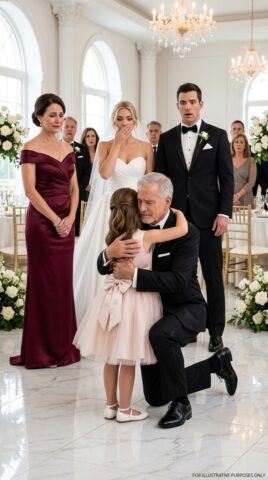
It means sometimes the wish gets where it’s going, but not the way you expected.”
Grant looked at Claire then.
He should not have. There was something dangerous in the ease of her, in the way she made Lily feel seen without trying too hard, in the way she spoke as if ordinary things could still be magical.
When Claire came back with dessert, she looked at Vanessa and said, “And for your wife, sir? We have lemon pie that once made a retired Navy captain cry.”
Silence fell.
Grant’s hand tightened around his glass.
“She’s not my wife,” he said quickly.
The words landed harder than they should have. Four simple words, but he had not said them out loud in months. He had avoided every situation that required explaining what Emily was not anymore.
Claire’s face changed instantly.
“I’m sorry,” she said softly. “I didn’t mean to assume.”
“We’re still getting to know her,” Lily announced.
Grant closed his eyes.
Vanessa smiled, but it had edges. Claire pressed her lips together as if trying not to laugh.
“Is that right?” Claire asked Lily.
Lily nodded with grave importance. “I’m helping.”
“I can see that,” Claire said. “You’re very professional.”
After lunch, Vanessa invited Grant to dinner the next night. He tried to decline. Lily volunteered Claire to babysit her before Grant could speak.
Claire looked startled, then amused. “I’m off tomorrow.”
“I know,” Lily said.
Grant turned to his daughter. “How do you know that?”
“I listen.”
Claire laughed. “That is terrifying and impressive.”
Grant should have refused. He should have said it was too much to ask a stranger. Instead, somehow, the next afternoon Lily was walking through Cape Harbor with Claire, eating cinnamon sugar doughnuts from the pier, learning how to tell fishing boats apart, and hearing a story about how the fountain had been built by a sailor who waited thirty years for a woman who never came home.
“Did his wish come true?” Lily asked.
Claire looked toward the square. “Maybe. Maybe the wish wasn’t what he thought it was.”
That evening, Grant went to dinner with Vanessa at a restaurant with white tablecloths, tiny portions, and a wine list thick enough to be a legal document. Vanessa spoke for forty minutes about a handbag named after someone French.
When Grant returned to the rented cottage a little after eleven, he found the living room dim, the television playing an animated movie on mute. Lily was asleep with her head in Claire’s lap. Claire had one bare foot tucked under her, a paperback open facedown beside her, and a blanket around Lily’s shoulders.
She looked up.
“That bad?” she whispered.
Grant loosened his collar and sank into the chair across from her. “The handbag had a name.”
Claire covered her mouth.
“Don’t laugh. It was apparently important.”
“What was the name?”
“Celeste.”
Claire tried to hold it in. She failed.
Her laugh was quiet, warm, and helpless. Lily stirred but did not wake. Grant heard himself laugh too. Not politely. Not for business. Not because someone expected it.
Because something was funny.
Claire carried Lily to bed before he could object. When she came back, Grant opened a bottle of wine left by the cottage owner.
“It’s cheap,” he warned.
Claire took the glass. “I’m a waitress in a tourist town. I’ve seen rich people cry over parking. Cheap wine doesn’t scare me.”
They talked until nearly dawn.
At first, they talked about nothing. The harbor in winter. Boston traffic. Lily’s determination. The orange cat. Then the conversation deepened, as conversations sometimes do when two tired people stop performing.
Claire told him her father had gotten sick when she was nineteen, and she had left college to help pay bills. She had wanted to open a small bakery café one day, nothing fancy, just hers.
Grant told her about Emily.
Not everything. Not the worst parts. But enough.
When Claire finally fell asleep on the sofa with her hand still around an empty glass, morning light touched her face. Grant stood there longer than he meant to. Her hair had slipped across her cheek. He wanted, absurdly, to brush it away.
He did not.
Instead, he found a blanket and covered her carefully.
Then he stood in the pale blue dawn with a feeling he did not have a name for yet.
For the first time in a year, he wanted to take care of someone who was not his daughter.
And that scared him more than any boardroom ever had.
Part 2
Over the next several days, Cape Harbor rearranged Grant’s life without asking permission.
Mornings began with coffee on the porch while Lily talked nonstop about Claire. She had learned where the best tide pools were, why gulls were criminals with wings, and how Captain Pickles had once stolen an entire shrimp skewer from a tourist named Greg.
Grant pretended to read emails. Mostly, he watched his daughter come alive.
Vanessa tried to compete in the only way she knew how. She bought Lily a pale pink dress from a boutique where the saleswoman spoke in whispers. Lily thanked her politely and never wore it. Vanessa arranged a private boat tour. Lily spent most of it drawing Captain Pickles on her napkin. Vanessa showed her photos of parties in Palm Beach and told her, “When you’re older, you’ll understand why these people matter.”
That night, while Grant attempted another crooked braid before bed, Lily said, “Daddy, I think the fountain might have sent the wrong lady.”
Grant’s fingers stopped.
“What makes you say that?”
“Vanessa came right after the coin, so I thought she was the wish. But you don’t smile with her like you smile with Claire.”
Grant was silent.
Lily turned around. “Maybe the fountain wasn’t wrong. Maybe we understood it wrong.”
He looked at his daughter and felt the room shift beneath him.
The next afternoon, Vanessa proved Lily’s point without meaning to.
They were on the deck at The Salt Porch. The lunch crowd was loud, the sky bright, and Claire was moving between tables with a tray balanced on one hand. When she stopped to refill Lily’s lemonade, Vanessa tilted her head.
“You’re lucky, Claire,” she said, loud enough for nearby tables to hear. “Some people are born to sit at tables, and some people are born to serve them.”
The deck went quiet.
Claire’s smile stayed in place, but Grant saw the flash behind her eyes. Hurt. Not surprise. She had heard words like that before.
Claire set the pitcher down.
“You’re right,” she said evenly. “And some people can sit at the most expensive table in the world and still have nothing worth saying.”
Someone coughed to hide a laugh.
Vanessa’s face hardened.
Grant placed his napkin on the table. His voice, when he spoke, was low and calm.
“Claire isn’t here for you to measure, Vanessa.”
Vanessa blinked.
It was the first time Grant had taken a side in public for something that could not affect stock price, reputation, or strategy. He had defended a waitress with flour on her wrist and sun in her hair because something in him refused to let the moment pass.
Claire looked at him. Just once.
But that look stayed with him for the rest of the day.
That night, Lily created what she later called her greatest plan.
She claimed she was too tired to go to the night market. She said Mrs. Alvarez, the older woman who owned the cottage next door, had invited her to watch a movie. Then she mentioned, with suspicious innocence, that Claire needed to buy supplies for the restaurant and should not walk alone.
Grant looked at Claire.
Claire lifted one shoulder. “You don’t have to come.”
“I’ll come,” Grant said too quickly.
Lily hid a smile behind her glass of milk.
The night market stretched down Main Street under strings of lights. There were spice stalls, bread stands, handmade jewelry, old men playing fiddle near the curb, and the smell of salt and fried dough moving through the crowd.
Claire knew everyone.
She knew which fisherman had become a grandfather, which baker had burned his first batch that morning, and which teenager was secretly saving money to leave town. Grant watched her belong to the place in a way he had never belonged anywhere. Not Boston. Not his glass-walled office. Not even the house he had shared with Emily after her death turned every room into a museum.
At a spice stall, Claire picked up a jar of smoked paprika.
“This,” she said, “is the best in Maine. But you have to tell Hank that every time or he gets moody.”
Grant smiled. “Every time?”
“Every time. Men are fragile.”
“I run a company with six thousand employees.”
“Exactly.”
He laughed again, easier now.
They talked as they walked. Claire told him about the café she had once imagined opening, with blue shelves, mismatched mugs, and a window full of pies. She said it lightly, as if it no longer mattered.
But Grant heard the ache beneath it.
“Why didn’t you?” he asked.
“Life got expensive,” she said. “Dreams are patient, but rent is not.”
Before he could answer, a man shouted from across the street.
“Claire Morgan!”
A tall, sun-browned man with windblown hair crossed toward them and swept Claire into a hug that lifted her off the ground.
“Brady!” Claire laughed, smacking his shoulder. “Put me down.”
Grant’s body went still.
Brady set her down, grinning. “You missed my mom’s cookout.”
“I was working.”
“You’re always working.”
“You’re always dramatic.”
Brady finally noticed Grant and extended his hand. “Hey. Brady Collins. I run the boat rentals at the end of the pier.”
Grant shook his hand. “Grant Whitaker.”
Brady looked between them with open curiosity. “Friend from out of town?”
Claire hesitated for half a second. “Yes. He’s here with his daughter.”
Friend.
The word should not have bothered Grant. It did.
Brady kissed Claire quickly on the cheek before leaving. “Saturday dinner at Mom’s. Don’t forget the lemon cake or she’ll disown you.”
When he disappeared into the crowd, Claire turned back to Grant.
“You okay?”
“Perfectly.”
“You look like you just reviewed bad quarterly numbers.”
“He seems friendly.”
“He is. We’ve known each other since kindergarten. He’s like a brother.”
“You don’t have to explain.”
Claire studied him. Then, slowly, she smiled. “I think I do.”
Grant looked away toward the harbor, annoyed at himself. He had no claim on Claire. None. Yet jealousy had moved through him sharp and unfamiliar, embarrassing in its simplicity.
They ended the night in the square, where a local band played beneath the lights. Couples danced on the cobblestones. Claire grabbed his sleeve.
“Come on.”
“I don’t dance.”
“I know. It’s visible from space.”
“I’m serious.”
“So am I.”
She pulled him into the music anyway.
At first, he was terrible. Stiff, careful, too aware of his hands. Claire laughed when he stepped on her foot.
“Stop thinking,” she said.
“I always think.”
“That’s your problem.”
He looked down at her. She was close enough that he could see the gold flecks in her brown eyes. Her hand rested on his shoulder. His hand settled at her waist. The music softened, or maybe the world did.
Claire smelled like coconut lotion, sea air, and sugar.
Grant forgot the next step.
She looked up at him, laughter fading.
For one suspended second, there was no grief, no Vanessa, no Boston, no future to fear. There was only Claire in his arms and the unbearable fact that he wanted to kiss her.
He leaned closer.
She did not pull away.
Then Emily’s face rose in his mind with such sudden tenderness that he stopped.
He stepped back.
“I’m sorry,” he said, voice rough. “I should get back. Lily.”
Claire’s expression closed, but gently. “Of course.”
They walked home in a silence that was no longer comfortable.
Grant did not sleep. At six in the morning, he canceled an investor call for the first time in his adult life and walked to the beach.
Claire was already there, sitting in the sand with her arms around her knees, watching the horizon.
“Couldn’t sleep?” she asked without turning.
“No.”
“Yeah,” she said. “That happens when something messes up the furniture inside your heart.”
He sat beside her.
For a while, they listened to the waves.
“About last night,” he began.
“You don’t have to explain.”
“I do.” He rubbed both hands over his face. “It wasn’t because I didn’t want to kiss you.”
Claire went still.
“It was because I did,” he said. “And sometimes wanting to be happy feels like betraying my wife.”
Claire did not rush to comfort him. She did not give him one of those neat phrases people offered at funerals because silence frightened them.
Instead, she said, “Maybe loving someone new doesn’t mean leaving her behind. Maybe it means carrying forward what she taught you.”
Grant closed his eyes.
Something loosened in his chest, not enough to heal him, but enough to let him breathe.
Then Claire told him about a man from New York who had spent summers in Cape Harbor years ago. She had loved him. He had loved the idea of her. When summer ended, he told her she would not fit into his real life.
“He didn’t say it cruelly,” Claire said. “That almost made it worse. He said it like weather. Like I was a fact he couldn’t change.”
Grant looked at her.
“I’m not him.”
“I know,” she said. “But I remember how it felt to be someone’s vacation.”
He reached out and placed his hand over hers in the cold sand.
“I’m scared too,” he said.
For the first time, Claire did not joke. She simply turned her hand beneath his and held on.
Part 3
Lily noticed the change before either adult admitted it.
Grant smiled more. Claire lingered longer. Their eyes found each other across rooms. Sometimes they said ordinary things like “Pass the salt” or “It might rain later,” and somehow those words seemed to carry entire conversations underneath.
Lily should have been thrilled.
At first, she was.
She had wished for this. She had asked the fountain for someone to make her father happy. But one afternoon, while sitting behind The Salt Porch with Captain Pickles in her lap, she heard two waitresses talking through the open kitchen window.
“Claire looks happy,” one said.
“She does,” another answered. “And that little girl already loves her like…”
The woman stopped.
She did not need to finish.
Like a mother.
Lily held the cat tighter.
Suddenly, the wish felt different. Not magical. Not exciting. Dangerous.
That night, Claire was making pasta in the rented cottage while Grant ran to the market. Lily stood in the kitchen doorway clutching a stuffed rabbit she had not touched in months.
“Claire?”
Claire turned. “What’s up, sweetheart?”
Lily swallowed. “If Daddy loves you, does Mommy disappear?”
The wooden spoon froze in Claire’s hand.
The question was so honest it shattered every clever answer Claire had ever had. She opened her mouth, but nothing came out fast enough.
Lily’s face changed.
“It’s okay,” she whispered. “I was just asking.”
She backed away and disappeared into her room.
When Grant returned, he found Claire alone on the porch, arms wrapped around herself though the night was warm.
“What happened?” he asked.
“I need to go home.”
“Claire.”
“I’m sorry.” Her voice trembled. “I can’t be the thing that hurts her.”
She left before he could stop her.
For two days, Claire became polite. Professional. Distant.
She smiled at Lily, but did not stay. She spoke to Grant, but only about menus, weather, and whether he wanted more coffee. Grant had built his life solving impossible problems, yet he had no idea how to solve a hurting child and a frightened woman.
Then he realized he had been solving the wrong problem.
That evening, he sat on Lily’s bed while she pretended to organize seashells.
“We need to talk about Mom,” he said.
Lily’s hands stopped.
Grant picked up a shell and turned it over in his palm. “I haven’t done a good job talking about her.”
“You get sad,” Lily whispered.
“I do.”
“So I stopped asking.”
The words broke him quietly.
He pulled in a breath. “That was my mistake. I made you think missing her was something we had to hide.”
Lily’s eyes filled.
“If you love Claire,” she said, “where does Mommy go?”
Grant moved to the floor in front of her. “Nowhere. Your mom is not a chair someone else can sit in. She is not a picture we take down to hang another one. She is your mother. She is part of you. She is part of me.”
Lily’s chin trembled.
“Then why do you laugh with Claire?”
“Because your mom taught me how,” Grant said. “Emily loved my laugh. She used to say I kept it locked in a bank vault and she had the only key.”
A tiny smile moved through Lily’s tears.
Grant took her hand. “Claire doesn’t erase Mom. Nobody could. But maybe Mom would not want us to spend the rest of our lives proving we loved her by being lonely.”
Lily began to cry then, not the small controlled crying she had learned after the funeral, but the messy kind that shook her shoulders. Grant held her and cried too.
They talked for an hour. About Emily’s pancakes that always burned on one side. About the way she sang in the car. About how she smelled like lavender and coffee. About the terrible Christmas sweater she wore every year because Lily had picked it out when she was four.
The next morning, Lily asked to visit the fountain.
Grant took her.
She stood before the water for a long time, then threw in a coin.
“What did you wish?” Grant asked.
“That Claire knows Mommy can stay,” Lily said.
Grant had to look away.
That afternoon, he went to The Salt Porch during the slow hour before dinner. Claire was wiping tables that were already clean.
“We need to talk,” he said.
“I’m working.”
“Claire.”
She put the cloth down.
“Lily asked if I would erase her mother,” she said, voice tight. “And I stood there like an idiot. I didn’t know what to say.”
“I talked to her.”
Claire looked up.
“I should have done it months ago,” Grant said. “She didn’t need me to find someone. She needed permission to grieve. So did I.”
Claire’s eyes softened, but fear remained.
“That’s good,” she said. “That’s really good.”
“There’s something else.”
“Grant…”
“I look for you when I enter a room,” he said. “I try not to. I fail. I think about you when I should be working, which is inconvenient because people keep expecting me to run a company.”
A laugh escaped her despite herself.
“I know this is complicated,” he continued. “I know I’m complicated. But I don’t want you to think you are a season of my life. You are not a vacation, Claire.”
Her face changed.
Before she could answer, the front bell rang.
Vanessa walked in with four well-dressed friends, all of them carrying the brittle energy of people ready to be entertained by someone else’s humiliation.
“There she is,” Vanessa said brightly. “The famous waitress.”
Claire went still.
Grant turned.
One of Vanessa’s friends looked around the restaurant. “My God, people actually live here all year?”
Another laughed. “I suppose every town needs local color.”
Vanessa’s eyes slid to Claire. “Some people dream small. It’s sweet, really.”
Claire’s face went pale.
Grant’s voice cut through the room.
“Leave.”
Vanessa blinked. “Excuse me?”
“I said leave.”
“Grant, don’t be dramatic.”
“No,” he said, stepping closer. “Dramatic was following me around for a week because you thought my grief made me available. Cruel was insulting a woman who has shown my daughter more kindness in ten days than you managed with all your gifts. Pathetic was thinking money made you superior in a room where you are the least impressive person standing.”
The room fell silent.
Vanessa’s mouth opened, but no sound came.
Grant held the door.
“Goodbye, Vanessa.”
She left with her friends trailing behind her.
Outside, thunder rolled over the harbor.
Claire rushed into the back to close the kitchen windows before the storm hit. Grant followed. Rain began falling hard, slanting silver through the alley behind the restaurant.
“I don’t need you to rescue me,” Claire said, struggling with a wooden shutter.
“I know.”
She turned, rain already soaking her hair.
“That’s what scares me,” Grant said. “You don’t need me. You choose. And I want you to choose me anyway.”
Claire stared at him.
“I’m not asking you to fix me,” he said. “I’m not asking you to replace anyone. I’m asking if I can stand beside you while we figure out what comes next.”
Rain hammered against the tin awning.
Claire’s voice shook. “And when you go back to Boston?”
“Then we talk about Boston. And Cape Harbor. And Lily. And your café. And my mess of a life. But I’m done making decisions out of fear.”
He stepped closer, slowly enough for her to stop him.
She did not.
Their first kiss tasted like rain and relief.
It was not perfect. It was too long delayed, too full of everything they had not said. Claire clutched his wet shirt like she had not decided whether to push him away or pull him closer. Then she chose.
She pulled him closer.
When they finally parted, she rested her forehead against his chest.
“I’m still scared,” she whispered.
“So am I.”
“Good,” she said shakily. “Then don’t act like you’re not.”
He laughed, and she did too.
Three weeks later, Grant returned to Boston.
But he did not disappear.
He called every night. Not polished calls squeezed between meetings, but real ones. He put Lily on video so she could show Claire her homework, her missing tooth, and the framed photo of Emily they had moved from the hallway into the living room where everyone could see it.
Claire visited Boston in September. She brought lemon pie for Lily and flowers for Emily’s grave.
At the cemetery, Claire stood back, giving them space. Lily noticed and reached for her hand.
“You can come,” she said.
Claire’s eyes filled, but she came.
Grant stood between his daughter and the woman he loved, in front of the woman he would always love, and for the first time the two truths did not destroy each other.
They simply stood together.
By spring, Claire opened a small café in Cape Harbor with blue shelves, mismatched mugs, and a window full of pies. She did not let Grant buy it for her. She let him invest, with a contract she made him rewrite twice because she said rich men needed supervision.
The café was called The Scenic Route.
On opening day, Lily placed a small jar beside the register labeled Fountain Fund. Customers dropped coins into it for wishes. Captain Pickles slept under the front window as head of emotional supervision.
Vanessa sent no congratulations.
Nobody missed them.
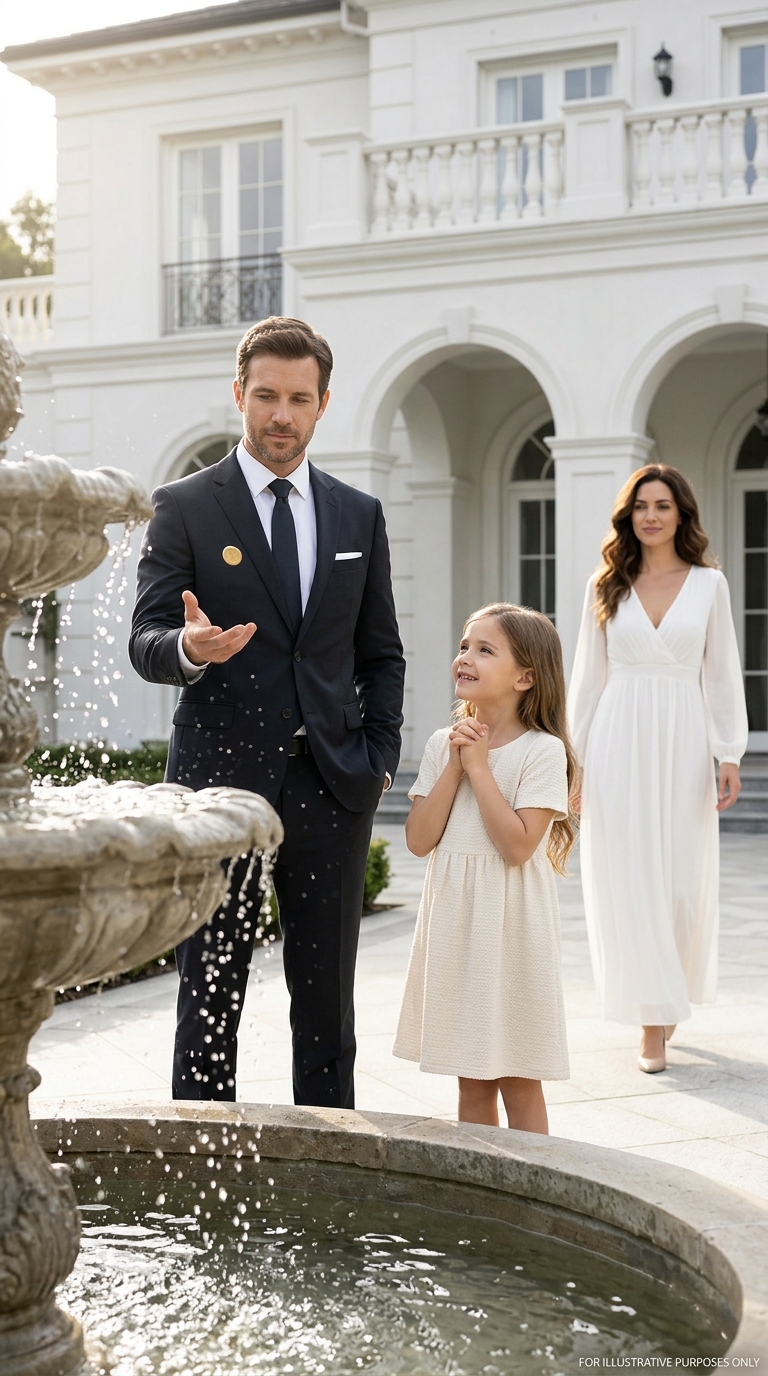
One year after the coin, Grant, Claire, and Lily returned to the fountain in the town square. The harbor shone beyond it. The water trembled with pennies, nickels, quarters, and impossible little hopes.
Lily held out a coin to Claire.
“Your turn.”
Claire smiled. “What should I wish for?”
Lily looked at Grant, then at the café down the street, then at the sky as if checking with someone only she could feel.
“Nothing,” Lily said. “Just say thank you.”
Claire closed her fingers around the coin.
Grant’s arm rested gently around her shoulders. Lily leaned into his side.
Together, they tossed the coin into the water.
It flashed once in the sunlight before sinking to the bottom.
No voice called Grant’s name this time. No elegant woman appeared. No thunder rolled. No sign announced itself.
But Claire laughed, Lily smiled, and Grant felt the kind of happiness that did not erase grief, did not deny loss, and did not pretend life could ever return to what it had been.
It was new.
It was imperfect.
It had taken the scenic route.
And it had arrived.