PART 1
Mia Donovan was counting the newspapers she had left when the woman in a white fur coat dropped a ten-dollar bill in the slush and told her to pick it up.
Mia had eleven papers left.
She had been standing outside the gold-lettered entrance of The Anchor Room for five hours, long enough for her feet to have gone from cold to numb to a specific tingling absence that told her sensation would hurt more when it returned than the cold had. Her gray canvas jacket had a broken zipper. She had safety-pinned it closed three days ago. The safety pin had held, more or less.
The bill hit the wet pavement and floated for a moment on the surface of a shallow puddle before the woman’s friend — a man in a cashmere overcoat that probably cost more than Mia’s monthly rent had before she stopped having monthly rent — looked at Mia with the particular amusement of someone who had never once had to calculate the value of a moment’s dignity against the value of a dollar.
“It’ll still spend,” the man said.
Mia looked at the bill.
She thought about her sister, Cass, who was seventeen and sitting right now in a room at the Harbor View Motor Lodge with a cough that had not improved in two weeks and a space heater that made a sound like an argument every time it cycled on. She thought about the $47 she had in the small zippered pocket of her jacket, which was everything, and about what $47 looked like against two nights of the motor lodge and something warm for Cass to eat and the over-the-counter medicine that wasn’t enough but was what they could afford.
She bent to pick up the bill.
A hand caught her shoulder before she could touch it.
Not a grab. A stop.
She looked up.
The man standing there was not the cashmere overcoat man. He was taller, darker-suited, and wore the quality of stillness that Mia associated with people who had decided long ago that hurrying was for other people. He was perhaps thirty-seven, perhaps forty, with the kind of face that made it very hard to determine whether he had been that age for a long time or had simply arrived at it early.
He was looking at the ten-dollar bill in the puddle, then at the woman in the fur coat, then back at the bill, with an expression so neutral it was almost insulting to everyone in the vicinity.
He took out his wallet.
Removed a bill and held it out to Mia.
“For your paper,” he said.
Mia looked at the bill. It was a hundred.
“The papers are two dollars,” she said.
“Then I owe you ninety-eight in change.”
Mia looked at him.
He looked at the pile of papers under her arm.
Mia gave him a paper and fished for change with fingers that moved slowly from the cold. She counted it out correctly — she always counted it correctly — and held it out.
He didn’t take it.
“Buy another paper,” he said. “Keep going until you’re out.”
The woman in the fur coat made a sound of impatience.
Mia watched the man’s gaze move to her briefly. It was not a threatening look. It was the look of someone who had decided to stop paying attention to a particular person, which was, if anything, the more complete form of dismissal.
“Mr. Saracen,” said the man beside him — shorter, watchful, with the air of someone who managed details on behalf of someone who did not manage details — “we’re expected inside.”
“We have a few minutes,” the man said.
He had not looked away from Mia.
“I’m Mia,” she said, because she wasn’t sure why she said it and because it seemed wrong not to.
“I know,” he said. “You’ve been here since two.”
She stared at him.
“I walked past at two-fifteen,” he said. “You were here then.”
He said it without particular inflection, as though this were an observable fact with no implications attached to it.
Which somehow made it worse, because it meant he had simply noticed. Without agenda. Without the performance of noticing.
“Well,” Mia said. “Now you know who I am.”
“Marco Saracen,” he said.
Mia knew the name.
You did not live in Chicago for two years and sell papers outside establishments like The Anchor Room without learning which names meant what. Marco Saracen owned The Anchor Room and three other establishments along the river and several other things that were harder to enumerate because they were not in the papers she sold. His name appeared in the Tribune in connection with a foundation that provided scholarships and in connection, occasionally, with federal investigations that seemed to regularly produce no charges and move on.
He was precisely the kind of man she had no interest in being in debt to.
“Thank you,” she said. “For the paper purchase.”
She tucked the remaining bills into her jacket.
He had not moved.
“You should go inside,” he said.
“I’m fine.”
“You’re not,” he said.
Not unkindly. Just accurately.
“I’m fine enough,” she said.
His shorter companion had moved to stand slightly to the side in the way of someone creating space for a conversation they were not meant to be part of.
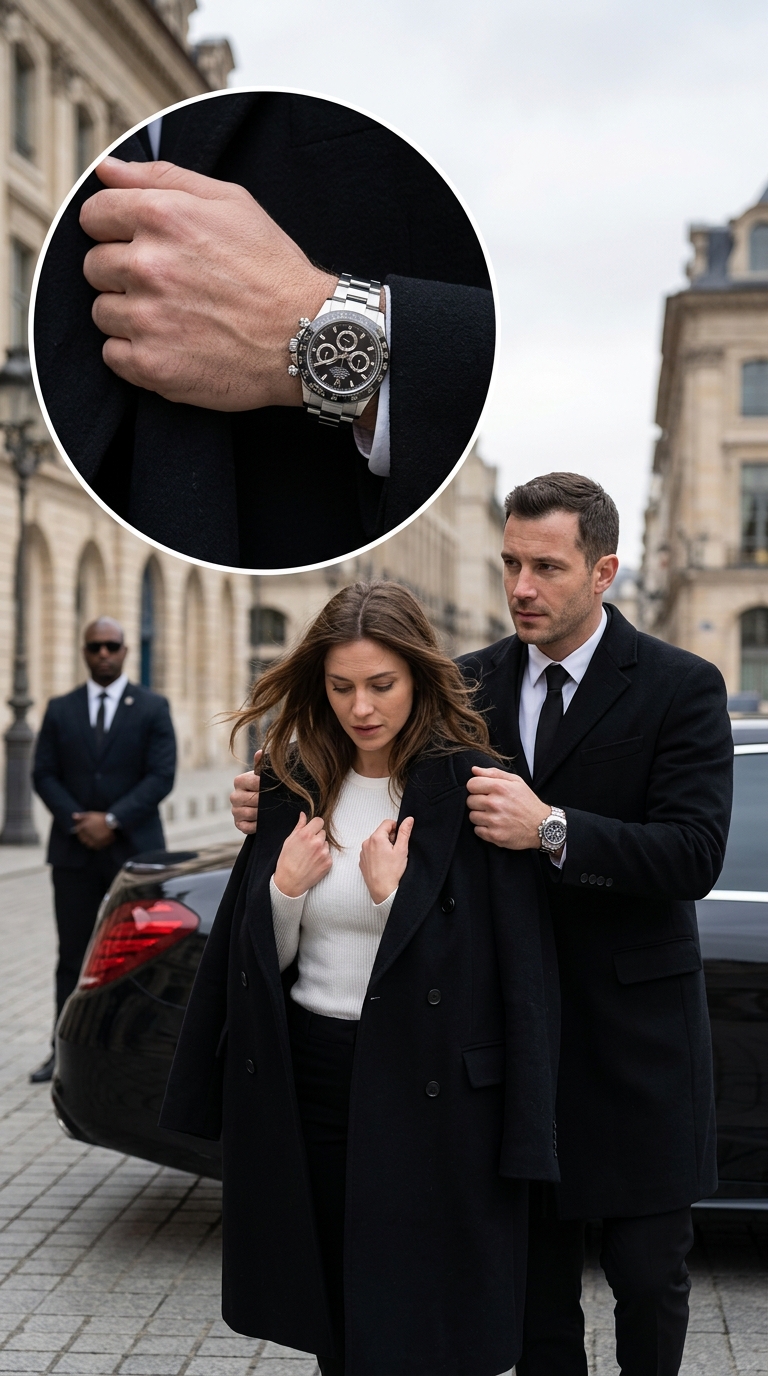
Marco Saracen removed his coat.
It was charcoal wool, well-made, thoroughly warm, the kind of coat that had not been purchased with future resale value in mind.
He held it out.
Mia looked at it.
“I don’t take coats from strangers,” she said.
“We’ve exchanged names.”
“We’ve exchanged fifty words.”
“The coat will keep you warmer than the words,” he said.
She almost laughed. The cold stopped it.
“I’m not staying,” she said. “I have maybe a dozen more papers and then I’m done.”
“The coat goes back with whoever you send it with,” he said. “Or you keep it. Either way, it serves more purpose here than inside a building with a working heating system.”
Mia looked at him for a long moment.
He waited, which was something people with power either never learned to do or learned so well it became its own kind of pressure. She couldn’t tell yet which kind this was.
“Fine,” she said.
She took the coat.
The warmth of it was immediate and humiliating in how much it helped. She pulled it closed with both hands and felt, for the first time in hours, the specific relief of her core temperature stabilizing.
“Thank you,” she said, more quietly this time.
He nodded once and went inside.
She sold the remaining papers in forty minutes because people kept stopping to ask why she was wearing a coat that was clearly not hers, and stopping meant proximity, and proximity meant buying a paper to justify the stop, or at least that was how Mia interpreted the sequence.
She was down to her last two when a man appeared out of the shadow of a parking structure entrance, hands in his pockets, and she felt her stomach drop before she fully registered his face.
Danny Cress.
Her ex-boyfriend. Her bad year. The specific shape of her worst judgment about who to trust with her trust.
He was smiling.
“Mia,” he said. “Thought that was you.”
She kept her hands steady on the papers.
“Danny.”
“You look cold,” he said, and then registered the coat and his smile changed quality. “Whose is that?”
“Mine,” she said.
“No, it’s not.” He stepped closer. “Whose is it?”
“Someone I sold a paper to.”
Danny tilted his head.
“You been making friends outside The Anchor Room?”
Mia said nothing.
He studied her.
“I need to talk to you,” he said. “About the key.”
Mia’s hands tightened on the papers.
The key was a small brass thing, old and specific, with an unusual head that her mother had pressed into her palm in the hospital three months ago, two days before she died, with the instruction: Don’t give it to anyone who asks for it. Don’t use it until you know what it opens. And don’t let Danny anywhere near it.
She had thought at the time that her mother was confused from the medication.
Then Danny had showed up at the funeral wanting to talk about stuff Mom kept, and Mia had understood.
“There’s nothing to talk about,” Mia said.
“She had something in a safe deposit box,” Danny said. “I know she did. The key goes to First Metropolitan. Jory branch.”
Mia’s face remained still.
“I don’t know anything about that,” she said.
“Mia.”
“I should go.”
“I know where you’re staying,” Danny said. “I know your sister is sick.”
Everything in Mia went cold for a different reason.
“Her name doesn’t come out of your mouth,” she said.
Danny spread his hands in a gesture of helplessness that had always been performance and that she could now see clearly as performance.
“I’m not threatening anybody,” he said. “I just want to talk.”
“We talked,” she said. “A year ago. I said leave me alone. That was the whole conversation.”
“Things changed.”
“For you,” she said. “Not for me.”
She gathered the last two papers and walked away from him in the direction of the motor lodge, because going back inside The Anchor Room was not something she would do, and because the road between here and there was lit and she would trust the lit road.
Danny did not follow.
She checked twice.
She was two blocks from the motor lodge when her phone buzzed.
A number she didn’t recognize.
She answered because her sister had been alone for five hours and sick people called from numbers sometimes.
“Ms. Donovan,” said a voice. “This is Felix Carano. I work for Marco Saracen. He’d like to offer you the kitchen entrance if you want to return the coat and eat something before you head home.”
“How do you have this number?” she said.
A brief pause.
“Mr. Saracen makes it his business to know the names of people who stand outside his doors,” Felix said. “He had your number from a press credential application you filed last spring.”
“That application was rejected,” she said.
“Yes,” Felix said. “He’s reconsidering that decision.”
Mia stopped walking in the middle of the sidewalk.
“I’m not interested in favors from—”
“It’s soup,” Felix said. “And a coat return.”
Mia thought about Cass. About the $47 and the space heater and the medicine. About Danny two blocks behind her with whatever he was about to do next.
“Is this going to cost me something?” she said.
“He said you’d ask that,” Felix said. “He said to tell you: the soup is soup.”
Mia exhaled.
“Five minutes,” she said.
“I’ll meet you at the service entrance on Dusable Street.”
The kitchen was warm in the specific way of professional kitchens — functional, relentless, indifferent to the weather outside. A woman named Esther handed Mia a bowl of something that turned out to be beef stew with actual vegetables, and a roll that was still warm, and then stood near the prep counter doing things with her hands that required her eyes and left Mia to eat without being watched.
Marco Saracen appeared ten minutes later from a different direction than she’d expected, wearing a dark shirt and no jacket, which suggested he had come from inside the restaurant rather than from the street.
He stopped at a respectful distance.
Mia had her hands around the bowl.
“Thank you for the coat,” she said. “And the stew.”
“Are you leaving?” he said.
“When I finish.”
He nodded.
He sat down, which she had not expected, at a small table near the service window, not across from her but at an angle — present without crowding.
“You filed a press credential application,” he said.
“It was for a freelance piece about restaurant supply chains,” she said. “The Tribune killed the story.”
“The Tribune kills a lot of things,” he said. “What did you find?”
She looked at him.
“Why?”
“Because a writer stands outside in the cold selling papers to fund a freelance piece,” he said. “That suggests the piece mattered to her and that someone made it difficult.”
Mia ate a bite of stew.
“It was about food distribution in low-income neighborhoods,” she said. “Specifically about a supply routing company that was charging community kitchens and food pantries inflated rates while receiving city subsidies.”
Marco’s expression didn’t change, but something behind it did.
“What company?” he said.
“Harvest Distribution Partners,” she said. “Registered in Delaware, principal offices in Evanston.”
He was quiet for a moment.
“Who owns it?”
“The registered agent is a man named Curtis Lane,” Mia said. “But the financial beneficiary structure runs through two LLCs before you get to an actual human name.”
“Did you get to the name?”
Mia looked at the stew.
“The Tribune’s legal department got nervous before I did,” she said.
Marco said nothing for a moment.
Then: “I know the name.”
Mia set down the spoon.
“Who is it?” she said.
“Someone who has been making things difficult for a number of people,” he said. “And who has recently developed an interest in things left behind by people who are no longer around to protect them.”
Mia heard the particular quality of that sentence.
“Did you know my mother?” she said.
The question arrived without her planning it.
Marco looked at her directly for the first time since they had sat down.
“I knew of her,” he said. “She worked at the county assessor’s office for fourteen years.”
Mia went still.
“Property records,” she said.
“Yes.”
“And you think she found something.”
“I think,” Marco said carefully, “that a woman who spent fourteen years looking at property records and then died three months after leaving her daughter a specific key had probably found something.”
Mia’s stew went cold in the bowl.
“Danny Cress was outside,” she said. “He mentioned First Metropolitan Bank. The Jory branch.”
Marco’s expression did not change, but something in his posture did.
“Felix,” he said.
Felix, who had been near the refrigeration units doing something Mia couldn’t see, appeared immediately.
“Get someone to the Jory branch of First Metropolitan,” Marco said. “Tonight. And find out who Danny Cress has been speaking to in the last month.”
Felix left.
Mia looked at Marco.
“I didn’t say you could investigate my life,” she said.
“No,” he said. “You didn’t.”
“Then why—”
“Because Danny Cress works for a man named Gerald Marsh,” Marco said. “And Gerald Marsh owns Harvest Distribution Partners.”
The kitchen was very quiet.
“The company from my story,” Mia said.
“Yes.”
“And you think he’s after the key because my mother found something about him.”
“I think,” Marco said, “that your mother found a great deal about Gerald Marsh in fourteen years of looking at property transfers, tax assessments, and zoning modifications. And I think she kept it somewhere she believed was safe.”
Mia looked at her hands.
Her mother had been methodical. Careful. The kind of woman who kept records of records, who double-copied documents, who trusted physical materials more than digital ones because she had grown up watching digital things disappear.
“She trusted paper,” Mia said.
“So did your father,” Marco said.
Mia looked up.
PART 2
What Marco Saracen knew about her father came out in pieces, over the next thirty minutes, in the kitchen of The Anchor Room while Esther moved diplomatically between stations and Felix communicated in occasional doorway appearances.
Her father, Thomas Donovan, had been a building inspector who died in a construction accident when Mia was nine and Cass was three. The official record called it a fall from an unsecured scaffold at a site in Bridgeport.
What Marco knew, through his own research conducted years later for unrelated reasons, was that the Bridgeport site belonged to a development company with documented ties to Gerald Marsh’s family business, and that three weeks before the accident, Thomas Donovan had filed an internal memo questioning the load certifications on the site’s main structural supports.
The memo had been removed from the public record.
Marco had found a copy in a sealed archive six years ago.
He had not known, until tonight, that Thomas Donovan had a daughter who sold newspapers outside his restaurant and a key her mother had told her not to give to anyone who asked for it.
Mia listened to this without interrupting.
When he finished, she set both hands flat on the table.
“Why are you telling me this?” she said.
“Because you have a right to know it,” he said.
“And because you want the key,” she said.
He did not deny it the way someone denies something to be polite.
“Yes,” he said. “Whatever your mother put in that box is probably evidence your journalism story was already pointing toward. If it’s what I think it is, it should be in the hands of someone who can use it correctly.”
“And you’re that person.”
“No,” he said. “You are.”
She looked at him.
“I’m a freelance writer with no publication and $47.”
“You’re a woman who spent six months building a story about a supply company that scared a major newspaper’s legal department,” he said. “That’s not a person who doesn’t know what to do with evidence.”
Mia thought about this.
“What do you get out of it?” she said.
“Gerald Marsh has been a problem,” Marco said. “He’s moved into neighborhoods I’m responsible for and used the system you were investigating to extract money that was supposed to feed people. I’d like him to stop.”
“So it’s business.”
“It’s also right,” he said.
“Those aren’t the same thing.”
“They don’t have to be mutually exclusive,” he said.
Mia looked at the key in her pocket. She could feel the shape of it even through the fabric.
“I want to see it first,” she said. “Whatever’s in the box. Before you see it.”
“Of course.”
“And I want my sister safe.”
“Where is she?”
Mia gave him the address of the motor lodge.
She watched him take out his phone.
She watched him make a call.
She watched two things happen in the next three minutes: a message indicating that people were being sent to the motor lodge to make sure the room was secure and undisturbed, and a text from Felix confirming that Danny Cress had been making calls to a number registered to a legal entity connected to Marsh.
Danny had not appeared outside her life by coincidence.
He had been sent.
“He was at my mother’s funeral,” Mia said.
“I know,” Marco said.
“He said he wanted to be there for me.”
“He was looking for the key,” Marco said. “He didn’t know if she had passed it to you yet.”
Mia pressed her lips together.
She did not cry.
She had learned that grief did not require an audience and that anger was often more useful in the moment, and right now she was very precisely angry in a way she intended to do something with.
“I want the story,” she said.
Marco looked at her.
“The full story,” she said. “My father’s death. The memo. The Marsh connection. The distribution company. Everything that’s in that box. I want to write it and I want it published and I want my name on it.”
“That will make you a target,” he said.
“I’m already a target,” she said. “I’ve been a target since my mother died and Danny came to the funeral. I’d rather be a target who did something than one who hid.”
Marco was quiet for a moment.
“I know three editors,” he said.
“I want to choose the publication.”
“You can choose.”
“And I work independently. You don’t edit. You don’t influence the framing.”
“Agreed.”
“And my sister gets somewhere warm tonight that doesn’t involve me owing you something I can’t pay back.”
Marco looked at her with an expression she was beginning to identify as the one he wore when something surprised him without his permission.
“Your sister gets somewhere warm because she’s sick and it’s cold,” he said. “That has nothing to do with what you owe me.”
“Men say that before they start counting,” Mia said.
“I don’t count that way,” he said.
“How do you know what way I think you count?”
“Because you told me,” he said. “Four minutes ago. You’ve been telling me since we met how this works and what your concerns are. I’m choosing to take it at face value.”
Mia studied him.
“Why?”
He looked at the coat she’d been wearing, now folded over the back of her chair.
“Because you gave me exact change,” he said. “Most people don’t bother when they’re struggling. You did. That tells me something about how you operate.”
Mia felt something loosen in her chest that she had not known was tight.
“I’m still angry,” she said.
“You should be.”
“At you specifically.”
“For what?”
“I don’t know yet,” she said. “But I think I will by morning.”
His mouth moved in something that was not quite a smile but was adjacent to one.
“That seems fair,” he said.
First Metropolitan’s Jory branch had a safety deposit room that smelled like climate control and careful decisions.
Mia went in alone.
Marco waited in a car on the street. Felix waited in the lobby. She had been offered both as escorts into the building and had declined both. She had been offered reassurance about safety and had declined that too.
She sat at the small table in the privacy room with the box in front of her.
Her mother had rented the box eleven years ago, according to the records. The year Mia started high school. The year her mother had gone from working regular assessor hours to working late, coming home with the particular tiredness of someone who has found something they wish they hadn’t.
The box contained:
A manila envelope.
A second envelope, smaller, addressed to Mia in her mother’s handwriting.
A USB drive.
A printed list of property transaction records spanning fourteen years.
And a photograph, old, slightly faded, of her father and mother standing in front of a building Mia didn’t recognize, both of them young and smiling in the way people smiled when they were still at the part of their life where things were going well.
Mia picked up the small envelope.
Her mother’s handwriting on the front: For Mia. Open when you know it’s time.
She opened it.
The letter was two pages, handwritten, and began: My love, if you’re reading this, I didn’t make it to the other side of what I was doing, and I need you to know what your father knew and what I found and why it matters. The property records are in the big envelope. Don’t let anyone sit on them. Don’t let anyone buy them away from you. The list is what was moved, where it went, and who signed off. It’s enough. Your father thought so. I think so too. I’m sorry I couldn’t just give this to you at the kitchen table. I kept hoping I wouldn’t have to.
Mia read the letter twice.
Then she carefully photographed every document with her phone.
Then she put everything back in the box, locked it, and returned the key to her pocket.
She went back to the lobby.
Marco was there.
He had come inside — not to press her, but to stand near the door in the way of someone who had decided that waiting in the car was acceptable except that it wasn’t.
“Well?” Felix said.
Mia looked at Marco.
“My mother spent fourteen years documenting property transfers that shouldn’t have been approved,” she said. “Zoning variances that went through without proper review. Tax assessments that were undervalued in ways that benefited specific buyers. And a pattern of building code violations that were reported and then removed from the public record.”
Marco was very still.
“All connected to Marsh?” he said.
“To Marsh and to four other entities,” she said. “Some of which I think are the same entity dressed in different names.”
“How many years of records?”
“Fourteen,” she said. “My mother started the day after my father died.”
The lobby was quiet.
“She knew,” Marco said.
“She was sure enough to spend fourteen years making a case,” Mia said. “She just never trusted anyone enough to hand it over.”
Marco looked at her.
“Until she handed it to you.”
Mia looked at the key in her palm.
“She trusted me to find the right person to give it to,” she said.
“Did you?”
She looked at him for a long moment.
“I’ll decide that by morning,” she said.
PART 3
Cass was awake when Mia arrived at the motor lodge.
Not awake in the alert way — awake in the way of sick people who have reached the part of being sick where sleep doesn’t quite take, where you drift and surface repeatedly without fully achieving either state. She was propped against the pillows with the blanket pulled to her chin and a half-eaten packet of crackers on the nightstand.
There was also a thermos of something warm on the table, and a bag from a pharmacy that had not been there before.
Mia picked up the pharmacy bag.
Inside: a cough suppressant. Throat lozenges. Ibuprofen. Vitamin C packets.
“Some guy brought it,” Cass said, her voice rough. “He said his boss sent him. He showed me ID.”
“Was his name Felix?” Mia said.
“Yeah.” Cass studied her. “Whose boss?”
Mia sat on the edge of the bed.
“Someone I met tonight,” she said.
Cass looked at the coat Mia was still wearing.
“Is that yours?”
“Temporarily.”
Cass’s eyes narrowed with the specific perceptiveness of someone who had grown up learning to read situations quickly.
“Mia,” she said.
“I’m fine,” Mia said.
“Your fine face looks like your something-happened face.”
Mia put the pharmacy bag on the nightstand and took out her phone.
She showed Cass the photographs of the documents.
She did not explain everything. Some of it would come later, when Cass was better, when there was more distance. But the broad shape of it — the property records, their mother’s fourteen years, their father’s memo, what Gerald Marsh had done — she gave her enough to understand.
Cass was quiet when she finished.
“She knew all that time,” Cass said.
“She was building something,” Mia said. “She didn’t want to show it to anyone until it was solid.”
“But she couldn’t finish it.”
“She left us enough to finish it.”
Cass looked at the ceiling.
“Danny,” she said. “He was there because of this.”
“Yes.”
“He was never really your boyfriend.”
Mia kept her face still.
“He was, for a while,” she said. “Then he found out about the key and it turned into something else.”
Cass was quiet.
“I always hated him,” she said.
“I know,” Mia said. “You told me.”
“You didn’t listen.”
“I wasn’t ready.”
Cass looked at her. Her eyes were tired but her voice was steady. “You’re ready now?”
“I’m going to write the story,” Mia said. “The real one. With everything Mom found and everything I found before the Tribune pulled it. It’ll take time to publish somewhere that can handle it. But I’m going to do it.”
Cass was quiet for a moment.
“And the man whose coat you’re wearing?”
Mia looked at the coat.
“He’s complicated,” she said.
“Most things worth anything are.”
Mia looked at her sister.
“That was very wise for someone with a fever.”
“I’ve been lying here thinking for hours,” Cass said. “Some things clarify.”
She called Marco from the parking lot.
He answered on the first ring.
“The documents are real,” she said. “All of it. My mother was thorough.”
“I had no doubt,” he said.
“I want to meet with the editors you mentioned,” she said. “Not as your introduction. As my own introduction. You give me the names and I contact them independently.”
“Understood.”
“And I need you to answer a question honestly.”
A pause.
“Ask,” he said.
“Gerald Marsh,” she said. “What does he have on you?”
The silence lasted exactly long enough to be meaningful.
“Nothing directly,” he said. “But his operation has been eroding something I’ve spent ten years building. Community relationships. Supplier agreements. Trust, basically. He’s been using city resources to undercut organizations that serve neighborhoods I care about.”
“You care about neighborhoods,” she said.
“Yes.”
“That’s not a business reason.”
“I grew up in one of them,” he said. “I moved out. I sent money back. Eventually I came back with more money and tried to do something with it. People like Marsh make that harder.”
Mia leaned against the cold exterior wall of the motor lodge.
“You could have dealt with him in other ways,” she said. “You have the capacity.”
“Yes,” he said. “I also have a preference for things that last. Courts last longer than fear.”
“Most people in your position don’t think that way.”
“Most people in my position stopped thinking about what lasts a long time ago,” he said. “I haven’t.”
Mia looked at the sky.
It had stopped snowing. The parking lot lights made the wet pavement look like it was holding light rather than reflecting it.
“You need to know something about me,” she said.
“What?”
“I’m going to write the story the way it is,” she said. “Including the parts where your organization is adjacent to things the public might find concerning. I’m not going to leave out context that makes this more complicated just because you helped me.”
“I know that,” he said.
“You’re comfortable with it?”
“I’d rather the story be true than convenient,” he said. “If some of what I’ve done ends up in it, then it ends up in it.”
She pressed the phone against her ear.
“Why?”
“Because the alternative is a story with gaps in it,” he said. “And stories with gaps are how people like Marsh survive.”
Mia exhaled.
“I’m going to take Cass somewhere warmer tomorrow,” she said. “I’ll call the editors next week.”
“The coat,” he said.
“I’ll return it.”
“Keep it through winter,” he said. “Return it in spring.”
“That’s too long to borrow something that expensive.”
“It’s too cold to give it back now,” he said. “That’s the whole reason.”
Mia looked down at the coat.
It was, she had to admit, very warm.
“Fine,” she said. “Through winter.”
“Thank you,” he said.
“For borrowing your coat?”
“For calling,” he said. “You didn’t have to.”
She was quiet for a moment.
“No,” she said. “I didn’t.”
The story took four months.
Mia worked from a sublet apartment she shared with Cass in a neighborhood two miles from where The Anchor Room was. She wrote in the mornings and researched in the afternoons and sometimes called the three editors whose names Marco had provided, in the sequence she had chosen, for conversations she conducted entirely on her own terms.
The second editor, a woman named Petra who ran an investigative outlet that had won two national prizes in the previous three years, said: “This is the kind of piece we exist to publish. But I need sources I can verify independently.”
“I have twelve,” Mia said.
“I need the property records chain-of-custody documentation.”
“I have that too.”
Petra was quiet for a moment.
“When can you have a draft?”
“Six weeks,” Mia said.
“I need four.”
“Five,” Mia said.
“Done.”
She did not tell Marco about the publication until after Petra’s legal team had reviewed the draft.
She told him by text, simply: Petra Lindqvist at the Civic Record. They’re running it in three weeks.
He replied: Congratulations.
She stared at that for a moment.
Then: I included the restaurant supply relationships and the property holdings in the south loop.
A longer pause.
Then: I know. I read the draft.
She sat up straight.
You read the draft.
Petra forwarded it for factual verification. She said you knew.
Mia called Petra immediately.
“You didn’t tell me you were showing it to him,” Mia said.
“He asked for factual verification, not editorial input,” Petra said. “And he found one date wrong and corrected it without touching anything else. I thought you’d want to know the date was wrong.”
“What date?”
“The filing date on the Bridgeport variance,” Petra said. “He had the original city document. The year was off by one.”
Mia stopped.
Her father’s case. The variance that had let Marsh’s family company build the site where her father died. The date had been wrong in her own records.
Marco had found it and corrected it without calling her. Had let Petra tell her. Had not made it about himself.
“Fine,” she said.
“Are you angry?” Petra said.
Mia thought about it.
“No,” she said.
“I thought you might be.”
“I thought I would be,” Mia said. “But it was a date. He didn’t change anything else.”
“He didn’t,” Petra confirmed. “I checked.”
The story ran on a Thursday.
By Friday morning, Gerald Marsh had retained three attorneys.
By Friday afternoon, two of the city officials named in the records had placed calls to the mayor’s office.
By Friday evening, the Tribune had run a follow-up under someone else’s byline, which Mia found annoying and then decided was not worth the energy.
Cass texted her a photograph of the headline on her phone screen.
Then: Mom would have thought this was exactly right.
Mia sat with that for a long time.
She was at the sublet, at the kitchen table, with documents spread around her and coffee going cold and her phone showing seventeen missed calls from numbers she did not recognize. She had expected the calls. She had prepared what she would and would not say.
What she had not prepared for was the quiet inside the apartment after Cass went to sleep, the particular quiet of something that had been in motion for months finally landing.
Her mother had spent fourteen years building a record.
Her father had written a memo that disappeared.
She had sold newspapers outside a gold-lettered entrance in the cold.
And now a story existed in the world that had not existed before, with her name on it and her mother’s fourteen years in it and her father’s memo restored to the public record where it had always been supposed to be.
She thought about Marco Saracen.
She had not seen him since the night in the kitchen.
They had talked six times by phone, all of them direct, all of them focused on specific verifiable questions. He had not asked about her life. She had not offered it. He had not made any move that required her to decide something she wasn’t ready to decide.
She picked up her phone.
The story is out, she typed. Thank you for the date correction.
His reply came quickly.
Thank you for getting it right.
She looked at that.
Can I return the coat? I know it’s not spring.
Why?
Because I want to return it in person, she wrote. And I don’t want to wait until spring for that.
A longer pause than usual.
Tomorrow evening, he replied. Seven o’clock. The back entrance on Dusable Street.
She set the phone down.
Outside, the city was doing its November thing — the particular quality of cold that arrived after the drama of first-snow had passed and the practical reality of a long winter had been accepted. Streetlights reflected in wet pavement. Somewhere a few blocks north, The Anchor Room would be filling up, the way it did every evening, with people who thought they understood what kind of place it was.
Mia went to the closet and took out the coat.
She held it for a moment.
It had kept her warm for four months. Through the sublet, through the reporting, through the evenings when the story felt too big and the source documents too complicated and the possibility of publishing it somewhere real too remote to touch.
Through Cass getting better and Daniel Cress pleading guilty to a misdemeanor and Gerald Marsh’s attorneys discovering that fourteen years of documented records were, in fact, fourteen years of documented records.
The coat had been there for all of it.
She folded it carefully over her arm.
She thought about what her mother had written in the letter: I kept hoping I wouldn’t have to. I kept hoping someone else would do the right thing first and I could stop carrying it.
Her mother had carried it for fourteen years.
Mia had been carrying versions of things since she was nine.
She thought about what Marco had said: You owe me nothing.
She thought about the exact change she had counted out in the cold, with fingers that barely worked, because it was the correct amount and she had never been interested in being beholden to anyone in amounts that had not been agreed upon.
She thought about the woman in the fur coat dropping a bill in the puddle.
She thought about picking it up anyway because her sister needed medicine.
She thought about all the things that had happened between that moment and this one.
She arrived at seven.
Felix was at the service entrance.
He led her through the kitchen — the same warm, efficient kitchen — and to a small room off the main corridor that turned out to be a comfortable office with bookshelves and a window that looked onto the river.
Marco was standing at the window when she came in.
He turned.
She held out the coat.
He looked at it.
“It’s not spring,” he said.
“I know,” she said. “I want to give it back because I want to, not because the loan term expired.”
He crossed the room and took the coat. Their hands didn’t quite touch.
He laid it over the back of the chair.
“I read the full story,” he said.
“I know,” she said. “Petra told me.”
“You included everything,” he said.
“Yes.”
“Including things that weren’t flattering to my family’s history.”
“Yes.”
He nodded once.
“Good,” he said.
She looked at him.
“You keep saying that,” she said.
“It keeps being true,” he said.
Mia looked at the window.
The river was dark and specific in the November evening, doing the thing rivers did — moving with complete indifference to everything happening on its banks, which was either comforting or infuriating depending on your current relationship with indifference.
“My mother trusted a box,” she said. “She didn’t trust people. She kept everything in a box and gave me the key and told me to find someone.”
“Did you find someone?” he said.
“I found a story,” she said. “And along the way I found the person whose coat I borrowed.”
Marco was quiet.
“Those aren’t the same thing,” he said.
“No,” she said. “They’re separate.”
She turned from the window to face him.
“The story is done,” she said. “The box is empty. The key is just a key now.”
“And the coat?” he said.
“The coat is yours,” she said.
He looked at it on the chair.
“I meant what I said that night,” he said. “About owing each other nothing.”
“I know you did.”
“I still mean it.”
“I know that too,” she said. “But I’ve been thinking about what it means to owe nothing versus what it means to want to.”
He looked at her.
“There’s a difference?” he said.
“A significant one,” she said. “Owing is obligation. Wanting is choice.”
The office was very quiet.
“What is it you want, Ms. Donovan?” he said.
She looked at him.
“Dinner,” she said. “Not soup. Not the kitchen. Actual dinner, like two people who have had a very unusual four months and might like to talk about something that isn’t evidence records.”
His expression moved through several things in quick succession before arriving at something she had not seen on him before.
“Tomorrow?” he said.
“Tonight,” she said. “If you’re not busy.”
He looked at the coat on the chair.
He looked at her.
“I’m not busy,” he said.
Mia picked up the coat.
“You should bring this,” she said. “It’s cold out.”
He took it from her hands.
This time their fingers touched briefly, and neither of them made anything of it, which was its own kind of answer.
She went ahead of him through the kitchen and out through the main entrance onto Dusable Street, where the city was doing all its ordinary November things around them, indifferent and continuous, holding everything that had happened inside itself the way cities did — the newspapers, the cold night, the woman who had stood outside in a too-thin jacket counting change with careful fingers, and the man who had seen her and decided that warmth was not a thing to be rationed.
She stood on the sidewalk.
He came out behind her.
She looked up at the sign above the entrance, gold-lettered and permanent.
“You’re going to have to tell me eventually,” she said.
“Tell you what?” he said.
“What it was like,” she said. “Being the person who saw me out here and decided it mattered.”
He stood beside her on the sidewalk, coat in hand, the city around them.
“It mattered,” he said, “because you were counting change for a stranger in the cold.”
“That’s nothing,” she said.
“No,” he said. “That’s everything.”
She looked at him.
He held the coat out.
She put it on — not because she needed to borrow it again, but because he was offering it and she was choosing to accept, which was different, and which he seemed to understand was different, and which felt, for the first time in a very long time, like the beginning of something she had not seen coming and was no longer interested in preparing against.
They walked.
THE END