PART 2: The File on the Table
My mother had always been a terrible actress.
When I was thirteen, she tried to convince me she liked the lopsided birdhouse I made in shop class. She smiled so hard her left eye twitched. When I was twenty-two and home from my first training exercise, she pretended she hadn’t spent the entire week worrying. I found her sitting at the kitchen table at two in the morning, a cold cup of tea in front of her and my childhood photo album open beside it.
So when I told her to act confused, I expected effort.
I did not expect brilliance.
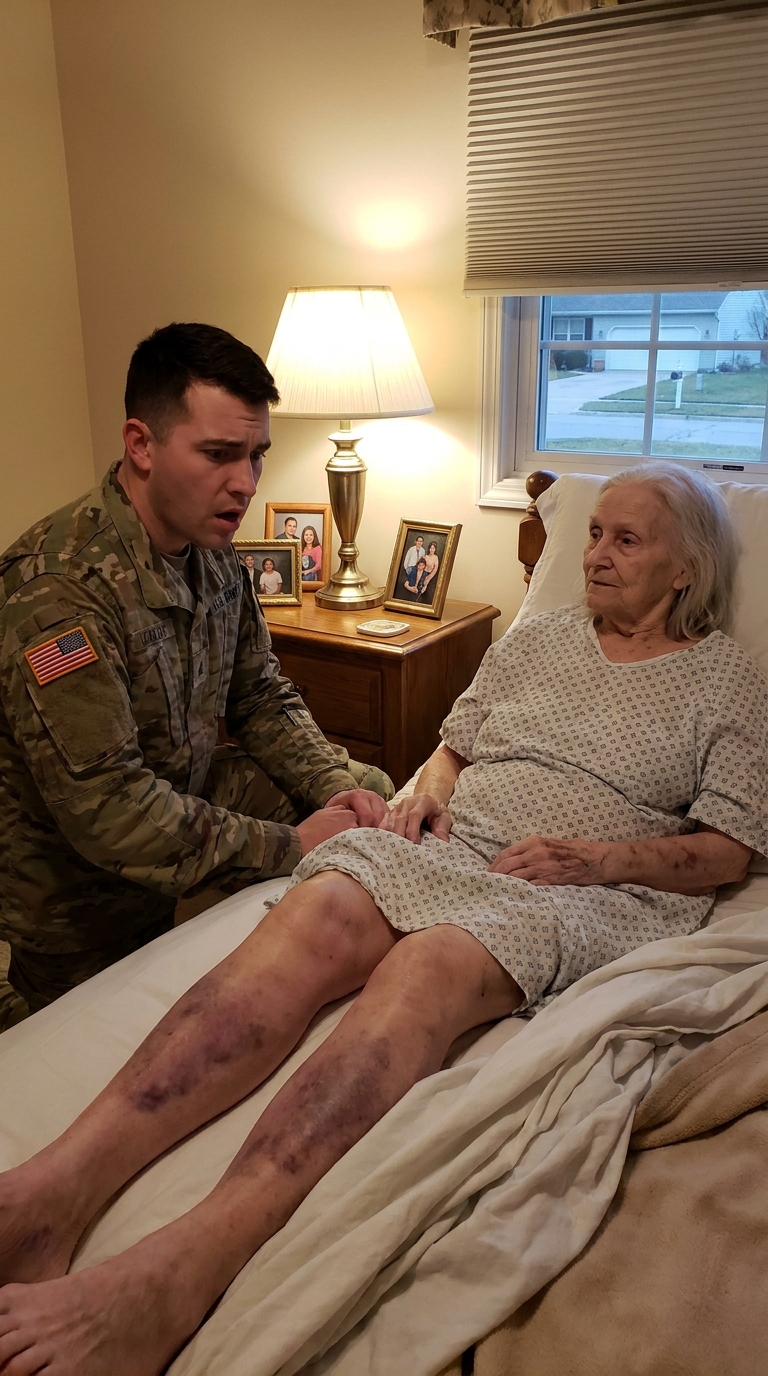
The next morning, she shuffled into the kitchen wearing one of Vanessa’s floral scarves tied loosely around her shoulders, her gray hair uncombed in a way that looked wild but not careless. Her eyes, sharp and steady the night before, drifted from the refrigerator to the sink to the window as if each object had wandered into the room without permission.
Vanessa stood at the stove, stirring oatmeal she had not asked anyone whether they wanted.
“Oh,” Mom said softly, stopping in the doorway. “Is this… is this Margaret’s house?”
Vanessa turned so quickly the spoon clattered against the pot.
I sat at the table with a mug of coffee in my hands, letting the steam rise between us.
“Good morning, Mom,” I said carefully.
She looked at me, blinked twice, and gave me a fragile smile.
“Ethan,” she whispered. Then her eyes filled with a kind of practiced uncertainty. “You look so much like your father.”
For one second, grief moved through me without warning.
My father had been gone nine years. A heart attack in the garage on a bright Saturday afternoon. Mom still kept his favorite jacket on the hook by the back door, even after Vanessa complained that it made the entryway look cluttered.
Vanessa’s expression changed.
Not sadness. Not concern.
Opportunity.
She set the spoon down and crossed the kitchen, her voice softening into the careful tone people used around strangers’ children.
“Diane, sweetheart, you’re home. Remember? This is your house.”
Mom looked at her blankly.
“My house?”
“Yes.” Vanessa placed a hand on her shoulder.
Mom flinched.
It was small, barely visible, but I saw it. Vanessa saw it too. Her fingers tightened just slightly before she let go.
“I made breakfast,” Vanessa said. “You should sit.”
Mom moved toward the table slowly, pausing at the chair nearest mine. I pulled it out for her.
Her hand brushed mine as she sat.
Three taps against my knuckle.
A signal.
She was calm.
She was ready.
Vanessa returned to the stove, but her gaze kept sliding toward me. She wanted me to react. She wanted me worried. Maybe she wanted me grateful that she had carried such a burden while I was gone.
So I gave her what she wanted.
I lowered my voice. “Has she been like this every morning?”
Vanessa sighed, and I could almost see her deciding how much sorrow to put into it.
“Most mornings now. Some afternoons too.” She poured oatmeal into three bowls. “It’s getting harder to manage alone.”
Mom stared at her bowl as if it were full of stones.
“Did Edward call?” she asked.
My father’s name.
Vanessa closed her eyes.
“Oh, Diane.”
I kept my face still.
Mom turned toward me. “He promised he’d fix the porch railing before the rain.”
The porch railing had been repaired five years ago.
I looked down into my coffee.
Vanessa reached across the table and covered my hand with hers. Her skin was cool, her wedding ring bright beneath the kitchen light.
“I know this is a lot to come home to,” she murmured. “That’s why I didn’t tell you everything while you were deployed. You had enough to worry about.”
That sentence landed like a pebble dropped into a deep well.
I hadn’t told her much about deployment. Not the difficult parts. Not the long stretches of boredom. Not the moments that kept other men awake. But she had always liked saying it that way—while you were deployed—as if my absence created a noble space for her sacrifices.
“I appreciate that,” I said.
Her shoulders relaxed.
Mom lifted her spoon upside down and tried to scoop oatmeal with the handle.
Vanessa watched for a beat, then gently took it from her.
“See?” she whispered to me. “This is what I mean.”
I nodded.
Beneath the table, the recorder captured every word.
The appointment was at ten.
Vanessa had arranged everything with impressive efficiency. She had scheduled the evaluation with Dr. Harold Whitcomb, our longtime family physician, who had known my mother since before my father died. The paperwork sat inside a cream-colored folder on the kitchen counter. Vanessa had labeled each section with sticky notes.
Medical history.
Caregiver observations.
Financial safety concerns.
Legal recommendations.
It looked thorough.
It looked responsible.
That was the danger of people like Vanessa. They understood the shape of goodness. They could fold their voices into it. They could wrap selfishness in concern so neatly that from a distance it looked like love.
At nine thirty, I helped Mom into the back seat of Vanessa’s car.
Vanessa insisted on driving.
“I know the details,” she said. “You’re still catching up.”
I let her.
Mom sat behind Vanessa, quiet and small, hands folded in her lap. The bruises on her wrists were covered by the sleeves of her cardigan. Once, when Vanessa glanced in the rearview mirror, Mom turned her head toward the window and hummed a melody from a church hymn she had sung every Sunday of my childhood.
I watched Vanessa watch her.
There was impatience behind my wife’s polished concern.
Not fear exactly.
Urgency.
Dr. Whitcomb’s office occupied the first floor of a brick medical building near the center of town. I remembered sitting in that waiting room with scraped knees, school physical forms, and a stomach flu so bad Mom had driven through a thunderstorm to get me there before they closed.
The receptionist, Carla, recognized me immediately.
“Ethan?” She rose from her chair with both hands over her heart. “My goodness, look at you. Welcome home.”
“Thank you, ma’am.”
She came around the desk and hugged me, smelling faintly of peppermint gum and hand lotion.
Then she saw Mom.
Her smile wavered.
“Diane,” she said gently.
Mom blinked at her.
“Do I know you?”
Carla looked at Vanessa.
Vanessa’s expression was sorrowful and composed.
“She has good days and bad days,” she said.
Carla’s eyes softened. “Of course.”
We sat in the waiting room beneath a wall of faded landscape prints. Vanessa took the chair beside Mom and opened the cream folder on her lap. I sat across from them.
Mom picked up a magazine, turned it upside down, and stared at a perfume advertisement with great seriousness.
Vanessa leaned close to me.
“I think you should let me do most of the talking,” she whispered. “You only got home yesterday. Dr. Whitcomb will need a full picture.”
“That makes sense,” I said.
She squeezed my knee.
It might have looked affectionate to anyone else.
To me, it felt like a reminder.
Stay in your place.
A few minutes later, Carla called us back.
Dr. Whitcomb’s examination room smelled like paper, disinfectant, and old coffee. He entered with a tablet tucked beneath one arm and reading glasses perched low on his nose. He was in his early sixties, with thinning silver hair and the patient exhaustion of a man who had listened to every kind of family worry.
“Ethan,” he said warmly, shaking my hand. “Glad to see you home safely.”
“Good to be home, Doctor.”
He turned to Mom. “Diane.”
Mom looked at him and smiled vaguely.
“Edward?” she asked.
Dr. Whitcomb paused.
Vanessa lowered her face.
I watched the doctor’s eyes. Not his mouth. Not his hands. His eyes.
They narrowed slightly.
Not in suspicion.
In thought.
He pulled up a chair and sat in front of Mom.
“Diane, can you tell me where you are today?”
She looked around the room. “Church?”
Vanessa inhaled quietly.
Dr. Whitcomb made a note.
“And what year is it?”
Mom opened her mouth, closed it, then whispered, “I don’t want to be wrong.”
Vanessa reached for the cream folder.
“This is exactly what I’ve been documenting,” she said. “There’s been significant decline. Confusion, agitation, wandering at night. She’s unsafe alone. I included examples going back several months.”
Dr. Whitcomb accepted the folder, flipping through the pages.
Vanessa spoke smoothly. “I’ve tried to manage it at home, but it’s become impossible. Ethan was away, and I didn’t want to overwhelm him. Diane has resisted help, which is common, I know, but I’m worried about her safety. I’ve researched care facilities. There’s one with an opening, but they’ll need documentation of incapacity.”
The room felt very still.
Dr. Whitcomb glanced at me.
“And you, Ethan? What have you observed since coming home?”
Vanessa’s hand tightened around her purse strap.
I looked at my mother.
She stared at the floor.
Then I looked at my wife.
“I’ve observed enough to be concerned,” I said.
Vanessa’s lips parted in relief.
“I brought something too,” I added.
The relief vanished.
I reached into my jacket and removed a navy-blue folder.
Not thick. Not dramatic. Just clean, organized, and plain.
Vanessa stared at it.
“What is that?”
“Context.”
I handed it to Dr. Whitcomb.
He opened it slowly.
The first page was a timeline.
Not accusations. Not conclusions.
Dates.
On April 3, my mother paid the electric bill by check in her own handwriting.
On April 9, she spoke with her church book club for forty-seven minutes.
On April 15, she emailed a recipe to my aunt in Oregon with a note about the weather.
On April 28, a bank password reset was requested from Vanessa’s laptop.
On May 2, Mom’s statements were redirected to an email account I did not recognize.
On May 19, a home security camera was disabled at 8:14 p.m.
On May 20, a deleted file log showed footage removed from the hallway camera outside Mom’s room.
On June 6, a transaction request for eighty thousand dollars was initiated but not completed.
Dr. Whitcomb’s face changed as he read.
Vanessa stood.
“Ethan.”
Her voice was soft, but there was steel under it.
I did not look at her.
“I also included photographs I took this morning of bruising on my mother’s wrists,” I said. “She refused to explain them in front of Vanessa. I included screenshots from the security system deletion logs and financial account alerts. I’m not asking you to draw legal conclusions. I’m asking that you not certify incompetence based solely on caregiver statements.”
Dr. Whitcomb looked at Vanessa.
For the first time since I had come home, my wife seemed unable to find the right expression.
Then she laughed once, quietly.
Not amusement.
Disbelief.
“This is absurd,” she said. “You’ve been home less than twenty-four hours, and you’re accusing me? After everything I’ve done?”
“I haven’t accused you of anything,” I said. “I documented concerns.”
“That’s the same thing.”
“No,” I said. “It’s not.”
Mom lifted her head.
For one second, the fog in her eyes disappeared.
Vanessa saw it.
Her face drained of color.
Dr. Whitcomb closed both folders and placed them on the desk.
“I think we need to slow this process down,” he said.
Vanessa turned to him. “Doctor, with all due respect, delaying could put Diane at risk.”
“I agree that safety matters,” he replied. “That’s why I’m not comfortable signing anything today.”
“She needs help.”
“Then we’ll arrange appropriate evaluation. A neutral one. Neuropsychological testing. Social work involvement. A private conversation with Diane.”
Vanessa’s jaw tightened. “Private?”
“Yes.”
“She becomes agitated when I’m not with her.”
Mom looked down at her hands.
I saw her fingers tremble.
Dr. Whitcomb noticed too.
“Mrs. Parker,” he said to Vanessa, “I appreciate your concern. But as her physician, I need to speak with my patient alone.”
Vanessa did not move.
For a long moment, no one did.
Then she smiled.
It was astonishing how quickly she found it. Soft, wounded, reasonable.
“Of course,” she said. “I only want what’s best.”
She gathered her purse and walked out.
I followed.
In the hallway, she turned on me the moment the examination room door closed.
“What are you doing?” she whispered.
“Protecting my mother.”
“From me?”
I held her gaze.
Her eyes shone with tears that had not yet decided whether to be real.
“You don’t understand what it’s been like,” she said. “You left me here with everything. The house, the bills, your mother, all her moods, all her demands. You got to be the hero overseas while I was trapped.”
The word trapped settled between us.
I thought of Mom behind the locked bedroom door.
“No one asked you to trap her,” I said.
Vanessa recoiled as if I had raised my voice, though I hadn’t.
“You have no idea,” she said. “None. She hated me from the beginning.”
“That isn’t true.”
“She smiled at me and judged me behind my back.”
“She tried to welcome you.”
Vanessa’s mouth twisted. “You think because she bakes pies and writes thank-you notes that she’s a saint?”
“No.”
“Then stop looking at me like I’m the only one with secrets.”
That stopped me.
Vanessa saw it, and some part of her steadied.
“She never told you everything,” she said.
“About what?”
The examination room door opened before she could answer.
Dr. Whitcomb stepped into the hall.
His expression was professional, but his eyes were alert.
“Ethan, I’d like to speak with you. Vanessa, Carla will help you schedule a follow-up appointment.”
Vanessa stared at him.
Then at me.
Then she gave a small, brittle nod and walked toward the front desk.
Inside the exam room, Mom sat upright on the paper-covered table. She looked tired, older than she had the night before, but the wandering confusion was gone. Her hands were clenched in her lap.
Dr. Whitcomb closed the door.
“Diane has asked me to include you in this conversation,” he said.
Mom looked at me.
“I should have told you sooner.”
My throat tightened.
“About Vanessa?”
She shook her head.
“About the money.”
I sat in the chair beside her.
Dr. Whitcomb leaned against the counter, silent.
Mom stared at her hands. “After your father died, there were bills you didn’t know about. Medical bills first. Then debts. Edward had taken loans against the house.”
I frowned. “Dad?”
“He was trying to keep the business alive before it closed. He didn’t want you to know. He didn’t want anyone to know.”
My father had run a small hardware store for thirty years. I remembered shelves of paint cans, coffee-stained invoices, his laugh echoing from the back room. I remembered the day he closed it, how he said big box stores had swallowed everything around us.
I did not remember debts.
“How much?” I asked.
Mom looked away.
“Enough.”
The word seemed to cost her something.
“I sold what I could. Used savings. Took in sewing jobs, then bookkeeping work for Mr. Adler after his stroke. I managed. Mostly.” She swallowed. “Then Vanessa offered to help organize things while you were away. She said it would be easier if she could see the accounts.”
I closed my eyes.
Mom touched my sleeve.
“I thought I was being fair to her. She was living in this house. She was your wife. I wanted to trust her.”
“What happened?”
“At first? Nothing. She paid bills. She found errors. She was helpful.” Mom’s voice grew quieter. “Then she started asking questions about the deed. About your father’s life insurance. About what would happen to the house if I needed care.”
Dr. Whitcomb folded his arms.
Mom continued, “I told her the house would eventually go to you. Your father and I agreed on that years ago. But there was something else.”
She looked at the doctor, then back at me.
“What else?” I asked.
“A trust.”
I stared at her.
“The house is in a trust?”
“Not the house.” She took a slow breath. “Your grandfather left land outside Mill Creek. Forty acres. Mostly woods. Your father never wanted to sell it. Developers have been calling for years.”
I remembered that land vaguely. Summer afternoons. Ticks. Pine trees. Dad teaching me to use a compass.
“I thought it was worthless.”
“It was,” Mom said. “Until the county approved the new access road.”
Pieces began shifting.
“Vanessa knew?”
“I don’t know how much at first. But she found something. An old letter. Maybe tax papers.” Mom rubbed her wrist absently, then stopped when she saw me notice. “After that, everything changed.”
“Why didn’t you tell me?”
“You were overseas.”
“I’m still your son.”
Her eyes filled. “And I wanted you alive. Focused. Not distracted by trouble at home.”
The anger in me had nowhere to go.
It was not clean anger. It was tangled with love, fear, guilt, and the old reflex of a child wanting his mother to be stronger than pain.
“What did she do to your wrists?” I asked.
Mom looked toward the door.
“She said I was wandering. She said if I fell down the stairs while she was asleep, it would be my fault for refusing care.” Her voice thinned. “She used those soft medical restraints. The kind they sell online for elderly patients. She said it was temporary.”
My hands curled into fists.
Dr. Whitcomb spoke gently. “Diane, we discussed this. We can document injuries, and we can bring in Adult Protective Services. There are processes.”
Mom nodded, but her gaze remained on me.
“I need you calm,” she said.
It was strange, hearing my own plan returned to me.
I exhaled slowly.
“I am calm.”
“No,” she said. “You’re quiet. That’s different.”
She was right.
Dr. Whitcomb arranged for photographs to be taken, notes added to her chart, and a social worker contacted. He did not call Vanessa back into the room. Instead, he walked us through a side hallway normally used by staff.
“She may react poorly,” he said. “Diane should not return home with her.”
“She won’t,” I said.
Mom squeezed my arm.
Outside, the June sunlight hit hard and white. Vanessa’s car was still parked near the entrance, but Vanessa was not inside it.
My phone buzzed.
A message from her.
We need to talk at home. Alone.
I read it twice.
Mom watched my face.
“What does she want?”
“Time,” I said.
But I was not sure that was true.
I drove Mom to my aunt Linda’s house across town. Aunt Linda was my father’s older sister, a retired librarian with a gravel driveway, a sunroom full of plants, and an ability to make even police officers feel they had overdue books.
She opened the door before we reached the porch.
“Diane,” she breathed.
Mom stepped into her arms and, for the first time since I had unlocked that dark bedroom, she broke.
Not loudly.
That would have been easier.
She simply folded into my aunt’s shoulder, and all the strength she had used to survive the house seemed to leave her at once.
Aunt Linda held her without asking questions. Her hand moved slowly over Mom’s back.
I stood in the doorway, useless with my car keys in one hand and the navy folder in the other.
Linda looked at me over Mom’s shoulder.
Her eyes sharpened.
“What happened?”
“Vanessa,” I said.
That was all I needed to say.
Something old and unsurprised passed across her face.
She guided Mom inside.
I followed them into the sunroom, where light spilled through sheer curtains and a ceiling fan turned lazily above wicker chairs. Mom sat on the sofa. Aunt Linda brought tea no one drank.
When I explained what I had found, Linda listened without interruption.
Only once did she speak.
“When did the bank transfer happen?”
“Pending yesterday,” I said. “I blocked it.”
Linda closed her eyes briefly.
“Thank God.”
“You knew about the land?”
“Yes.”
“Why didn’t I?”
“Because your mother didn’t want your father’s mistakes to become your inheritance.”
Mom flinched.
Linda sat beside her. “I’m sorry, Di. But we’ve tiptoed around this family too long.”
Mom looked down.
I felt suddenly like a boy standing outside a room where adults had been speaking in low voices for years.
“What else don’t I know?” I asked.
Aunt Linda and Mom exchanged a look.
The kind that meant there was more.
Before either could answer, my phone rang.
Vanessa.
The room went quiet.
I answered and put it on speaker.
“Ethan,” she said, breathless. “Where are you?”
“With Mom.”
“Where?”
“She’s safe.”
A pause.
Then her voice changed.
Careful again.
“Good. I’m glad. I was worried after the appointment. Everything got so emotional.”
“No,” I said. “It got honest.”
She was silent for a moment.
Then, softly, “I never wanted it to happen this way.”
Aunt Linda looked at me.
I kept my eyes on the window.
“What way?”
“You coming home and misunderstanding everything.”
“I understand enough.”
“No, you don’t. You saw paperwork and logs and bruises, and now you’ve decided I’m some villain in a story your mother has been telling herself for years.”
Mom’s face tightened.
“She hasn’t told me any stories,” I said.
“That’s the problem.” Vanessa’s voice trembled. “She leaves out the parts that make people stop pitying her.”
Linda leaned forward as if she wanted to speak, but Mom touched her wrist.
“Come home,” Vanessa said. “Please. Just you and me. We need to talk before lawyers and doctors turn this into something none of us can fix.”
I thought of the house. The deleted footage. The pending transfer.
“What do you want to tell me?”
“Not over the phone.”
“No.”
“Ethan.”
“If you have something to say, say it.”
Her breathing grew uneven.
Then she said, “Ask your mother about the letter from Edward.”
Mom went very still.
Vanessa continued, “Ask her why she hid it. Ask her what your father knew before he died.”
The call ended.
For several seconds, no one moved.
The fan turned overhead.
A car passed outside.
Aunt Linda whispered, “Diane.”
Mom’s face had gone pale.
“What letter?” I asked.
She closed her eyes.
“Mom.”
Her voice came out barely audible.
“Your father wrote it the week before he died.”
“To me?”
She nodded.
“And you hid it?”
Her eyes opened, wet and pleading. “I was going to give it to you when you were ready.”
“I’m thirty-eight.”
“I know.”
The hurt arrived before the anger.
It opened quietly inside me.
“Where is it?”
“At the house,” she whispered. “In the attic. In the cedar chest.”
I stood.
Aunt Linda rose too. “Ethan, think.”
“I am thinking.”
“No,” she said, stepping between me and the doorway. “You are reacting.”
Maybe she was right. Maybe all the women in my life had learned to name my silence better than I could.
But the letter pulled at me.
My father’s handwriting. His last words. Something hidden from me for nine years.
Vanessa knew about it.
Which meant she had been in the attic.
Which meant whatever was inside that cedar chest mattered.
“I’m going home,” I said. “Not to talk to Vanessa. To get the letter.”
Aunt Linda studied me.
Then she went to the hall closet and returned with her car keys.
“You’re not going alone.”
The house looked different when we pulled into the driveway.
Not from the outside. The porch still had hanging baskets Vanessa watered religiously. The lawn was trimmed. The front windows reflected the afternoon sun.
But now the place seemed staged.
A room prepared for visitors.
A lie with shutters.
Vanessa opened the door before I reached it.
She had changed clothes. The white dress was gone, replaced by jeans and a pale blue sweater that made her look younger. More vulnerable. Her makeup had been washed away or softened. Her hair fell loose around her face.
She saw Aunt Linda behind me, and her expression faltered.
“Linda.”
“Vanessa.”
The two names met in the air like opposing signatures.
“I came for the letter,” I said.
Vanessa stepped back.
“Of course you did.”
I moved past her into the foyer. The house smelled of lemon cleaner. Too strongly. Like she had scrubbed not dirt, but evidence.
The hook by the back door was empty.
Dad’s jacket was gone.
I stopped.
“Where is it?”
Vanessa followed my gaze.
“Oh.” She looked almost sorry. “I put it away. It was dusty.”
My aunt’s voice hardened. “That jacket hung there for nine years.”
“It’s a jacket, Linda.”
“No,” I said. “It wasn’t.”
Vanessa looked at me, and for a moment her face cracked.
Something real appeared beneath the performance.
Exhaustion.
Resentment.
Maybe grief of her own, though I did not know what shape it had.
“You always made room for ghosts in this house,” she said. “But never for me.”
I wanted to dismiss it.
Part of me knew I shouldn’t.
A marriage does not unravel in one day. It frays invisibly first. Threads loosen under ordinary conversations, missed chances, old loyalties, silence mistaken for peace.
But no loneliness could explain a locked door.
No resentment could excuse bruises.
“The attic,” I said.
Vanessa’s eyes flashed.
“Fine.”
She followed us upstairs but stopped at the landing. Aunt Linda came with me.
The attic stairs groaned beneath our weight. Heat pressed down from the roof. Dust hung in the light of a single bare bulb. Boxes lined the walls, labeled in Mom’s neat handwriting.
Christmas.
Tax records.
Ethan school.
Edward store.
The cedar chest sat beneath a slanted beam, its brass latch tarnished. I knelt before it and lifted the lid.
The smell hit me first.
Cedar, paper, time.
Inside were quilts, photo albums, a shoebox of my father’s old receipts, and beneath them, a bundle of letters tied with faded green ribbon.
My hands were clumsy as I untied it.
Aunt Linda knelt beside me.
There were letters from my father to my mother during their early marriage. Birthday cards. Notes from the hardware store written on invoice paper.
Then I found an envelope with my name on it.
Ethan.
My father’s handwriting was unmistakable.
Strong downward strokes. Slightly crooked capital E.
I sat back on my heels.
Aunt Linda touched my shoulder.
“You don’t have to read it here.”
But I had already opened it.
The paper inside had yellowed at the edges.
My son,
If you are reading this, then I failed to say things plainly while I had the chance. That was always my weakness. I could fix a hinge, balance a ledger, patch a roof, but I never learned how to sit across from someone I loved and tell the truth without dressing it up as protection.
There are debts. Your mother knows. I am ashamed of them. I made decisions I thought would save the store and spare the family worry. Instead, I handed worry to the people I loved most.
I am sorry.
The land at Mill Creek is not to be sold quickly, no matter who pressures you. There is value there, but not only money. Your grandfather placed restrictions in the trust that will matter if the county road ever comes through. Speak to Harold Whitcomb. He witnessed the amendment. Speak to Linda. She knows where the documents are.
And Ethan, there is one more thing.
I stopped reading.
My eyes blurred.
Aunt Linda whispered, “Keep going.”
Your mother will try to carry blame that belongs to me. Don’t let her.
There is a child I helped years ago. Not mine by blood, but mine by promise. Her mother worked for us at the store. When she died, I made arrangements quietly because I thought it was the decent thing to do and because I owed her mother more kindness than I gave while she was alive.
I should have told Diane everything sooner. I should have told you, too. Secrets grow teeth.
If that child ever comes looking, do not turn her away for my cowardice.
Her name was Vanessa Cole.
For a moment, the attic disappeared.
The heat.
The dust.
The slanted roof.
All of it fell back.
Only the page remained.
Her name was Vanessa Cole.
My wife’s maiden name.
A sound came from the attic stairs.
I turned.
Vanessa stood halfway up, one hand on the railing, her face pale and unreadable.
“You found it,” she said.
Aunt Linda slowly stood.
“Vanessa,” I whispered.
She looked at the letter in my hand. Then at me.
“I didn’t marry you for the money,” she said.
The words should have answered something.
Instead, they opened a darker door.
“Then why did you?” I asked.
Vanessa’s eyes filled, but no tears fell.
From downstairs, my phone began to ring again.
Once.
Twice.
Three times.
Aunt Linda glanced at the screen lying beside the cedar chest.
“It’s Dr. Whitcomb,” she said.
I answered.
His voice was low.
“Ethan, I need you to listen carefully. I found the old trust amendment your father mentioned.”
I looked at Vanessa.
She did not blink.
Dr. Whitcomb continued, “The Mill Creek land cannot transfer to you, your mother, or any outside buyer until one missing beneficiary signs a release.”
My hand tightened around the phone.
“What missing beneficiary?”
A pause.
Then he said, “Vanessa.”