PART 2
“Ma’am…”
Gunnery Sergeant Marcus Reed said the word quietly, but it changed the shape of the afternoon.
Tyler’s grin faltered.
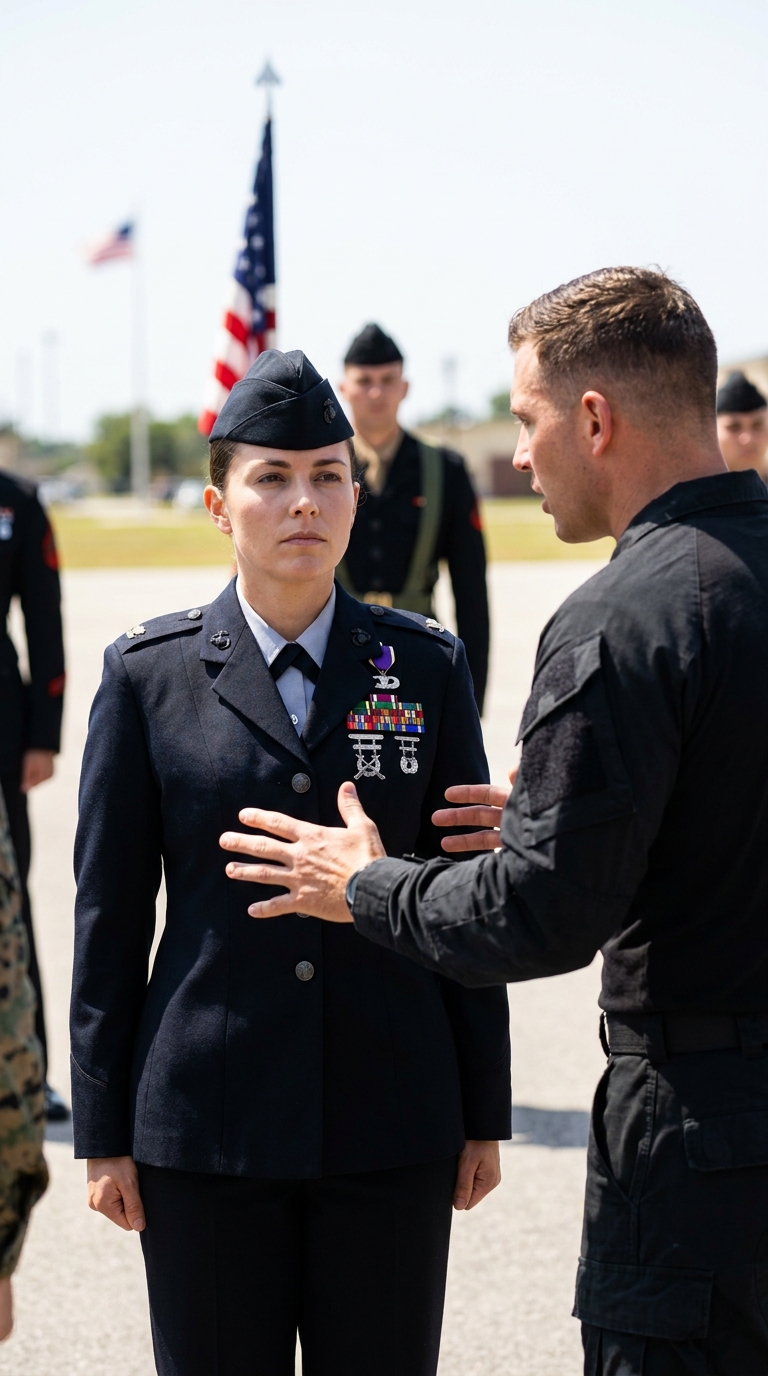
Around us, the bright noise of Family Day kept moving at the edges—children laughing near the armored vehicles, a vendor calling out about lemonade, flags snapping against the wind—but inside our little circle, everything had gone still.
I looked at Reed, then at my brother.
“There’s no need for that,” I said.
Reed swallowed. “Yes, ma’am.”
Tyler gave a sharp laugh. “Okay, what is happening right now?”
No one answered him.
That silence bothered him more than any insult could have. Tyler had built his entire personality around being certain of the room. He knew when people admired him. He knew when they were amused. He knew how to turn attention into approval.
But now the attention had shifted.
And he didn’t know why.
One of the older Marines behind him leaned toward another and murmured, “Fury Ten?”
The second Marine shook his head slightly, eyes fixed on me.
Tyler heard it. His jaw tightened.
“You all serious?” he asked. “She says two words and everybody acts like the President walked in?”
“Tyler,” my father said quietly.
It was the first thing he had said since my badge hit the dirt.
Tyler turned on him. “What? You know something too?”
Dad’s face looked older than it had that morning. The sun caught the silver in his hair and the worry at the corners of his eyes.
“I know enough to suggest you stop talking,” he said.
That stunned me almost as much as Reed’s reaction.
My father had spent years smoothing over Tyler’s rough edges. Making excuses. Saying things like, “He doesn’t mean it that way,” or “You know how your brother is.” He loved us both, but Tyler’s noise had always filled the house faster than my silence.
For Dad to correct him in public meant something had shifted.
My mother reached for my wrist. Her fingers were cool despite the heat.
“Ellie,” she whispered, “what is going on?”
I wanted to tell her nothing.
I wanted to pick up my badge, walk to the parking lot, and drive until the base disappeared behind me.
But Marcus Reed was still staring at me like the past had stepped out of the sunlight and stood in front of him wearing a blazer.
“Gunnery Sergeant,” I said, “may I speak with you privately?”
Reed nodded immediately.
Tyler stepped between us. “Hold on. No. You don’t get to do that.”
I looked at him.
He was still my little brother in certain ways. Even in uniform, even with broader shoulders and a sharper voice, I could see the boy who once hid my school projects because he wanted our parents to watch his baseball game instead. The boy who was frightened of being ordinary, so he made everyone else smaller.
“I do get to do that,” I said.
My voice was calm. Not cold. Just final.
Reed turned to Tyler. “Corporal Hayes, stand down.”
The words landed hard.
Tyler’s face flushed. “Gunny, with respect—”
“With respect,” Reed interrupted, “you are embarrassing yourself.”
No one laughed then.
That was the strange mercy of the moment. The crowd did not cheer. No one pulled out a phone. The Marines nearby looked away as if granting Tyler the privacy he had refused me.
My mother tightened her grip on my wrist, then released it.
“Ellie?” she asked.
“I’ll explain what I can,” I told her.
That was the first honest answer I had given her in years.
Reed led me toward a shaded area near a row of administrative buildings. We stopped beneath a canvas awning where the noise of Family Day became muted and distant.
He removed his cover, held it in both hands, and looked down for a moment before speaking.
“I never knew your real name,” he said.
“That was the point.”
“I heard your voice for six hours.”
I looked past him toward the line of eucalyptus trees swaying beyond the fence.
Six hours.
Some memories do not arrive as pictures. They return as sounds.
Static. Breath. Rain against metal roofing. A man praying under his breath. Coordinates repeated until they became part of my pulse.
“You were Echo Four,” I said.
Reed’s eyes lifted. “Yes, ma’am.”
I almost smiled. “You sounded younger.”
“I was younger.”
“So was I.”
He studied me carefully. “Does your family know?”
“No.”
“None of it?”
“My father knows fragments. My mother knows less. Tyler knows nothing.”
Reed nodded slowly. “That explains today.”
I let out a quiet breath. “Does it?”
His expression softened. “Not all of it.”
There it was. The kindness I had not expected.
For years I had told myself silence was easier. Silence protected people. Silence kept classified work classified. Silence prevented my mother from imagining danger she could not control. Silence spared my father the conflict of having one child celebrated and another hidden behind sealed reports.
But silence also leaves empty space.
And people like Tyler fill empty spaces with whatever story flatters them most.
Reed glanced toward the crowd. “He’s a good Marine when he remembers he’s part of a team.”
“That sounds like a carefully worded sentence.”
“It is.”
Despite myself, I laughed softly.
For a moment, the old weight lifted.
Then Reed’s face grew serious again. “Fury Ten saved my life.”
I did not answer.
“Not just mine,” he continued. “Eight of us. Maybe more.”
“You saved yourselves,” I said. “You followed instructions.”
“We were pinned down, cut off, and working with bad maps. Whoever was guiding us knew the terrain better than we did.”
“I had satellite overlays and a good linguist.”
“You had a calm voice when everything else was falling apart.”
I looked at him then, really looked at him.
There was a thin scar near his temple I did not remember seeing before. A line earned somewhere between then and now. He had the posture of a man who carried his memories carefully, not because they were fragile, but because they were heavy.
Tyler stiffened.
I turned to Reed. “It’s all right.”
“It isn’t,” he said.
The firmness in his voice silenced us all.
Reed faced my brother fully. “There are people whose names never appear at ceremonies. People who sit in windowless rooms and make decisions with incomplete information while lives depend on every word. Sometimes they are the reason Marines come home.”
Tyler’s face changed.
Not completely. Pride does not vanish in one afternoon. But something uncertain moved behind his eyes.
I saw him trying to fit me into a new shape.
Sister. Office worker. Ghost. Fury Ten.
None of the pieces matched the story he had told himself.
My mother stepped closer. “Ellie, why didn’t you tell us?”
Because I signed papers.
Because I was scared.
Because after the first operation went bad, I learned how easily pride can turn grief into questions no one is allowed to answer.
Because when I came home, Tyler was being praised for boot camp and Dad was smiling for the first time in months, and I could not bear to place my invisible service next to his visible one.
Because secrecy became habit.
Because habit became distance.
I said only, “Some things weren’t mine to share.”
My mother nodded, but tears spilled anyway.
Dad looked at me. “I should have asked better questions.”
That hurt more than Tyler’s mockery.
Because it was true.
And because I had wanted him to.
Before I could answer, a young lance corporal approached Reed and handed him a folded note.
“Gunny, Sergeant Alvarez said this just came through for you.”
Reed opened it.
His eyes moved across the page once.
Then again.
The color that had returned to his face drained away.
“What is it?” I asked.
He folded the paper slowly. Too slowly.
“Nothing for Family Day,” he said.
That was a lie.
I had heard enough lies from trained professionals to recognize the careful ones.
“Marcus,” I said.
His eyes met mine at the sound of his first name.
For a second, we were not on a sunny base in California. We were back in that dark room years ago, connected by radio static and consequence.
He lowered his voice. “There’s a briefing at sixteen hundred. Restricted attendees. Your name is on the authorization list.”
“My name?”
“Eleanor Hayes.”
My heartbeat changed.
Not faster.
Deeper.
Like someone had knocked from inside a locked room.
“That’s impossible,” I said. “I’ve been out for years.”
Tyler looked between us. “Out of what?”
Reed ignored him. “The message says your prior clearance verification was reactivated this morning.”
I stared at him.
This morning.
Before Tyler threw my badge.
Before I said Fury Ten.
Before Reed recognized me.
Someone knew I would be here.
My father stepped closer. “Ellie?”
I could barely hear him over the sudden rush of memory.
A sealed envelope arriving at my apartment three weeks earlier with no return address.
A single blank card inside.
A symbol embossed at the bottom corner, so faint I had almost missed it.
A lantern.
I had told myself it was junk mail. A strange mistake. Nothing.
Now Reed was watching me as if he already knew.
“What operation?” I asked.
He hesitated.
That hesitation answered before he did.
“Hollow Lantern,” he said.
The name moved through me like cold water.
My mother whispered, “What does that mean?”
No one answered her.
Because Hollow Lantern was the part I never spoke about.
Not to my family.
Not to former colleagues.
Not even to myself when sleep refused to come.
Tyler’s frustration returned, but softer now, tangled with confusion. “Can somebody please explain this in normal words?”
I looked at him.
“You wanted to know whether I had ever done anything meaningful,” I said. “Hollow Lantern is why I stopped wanting anyone to ask.”
His face fell.
For the first time that day, he looked less like a Marine performing for an audience and more like my brother standing at the edge of a room he did not understand.
Reed checked his watch. “We should move.”
“We?” I asked.
“You’re on the list. So am I.”
“And Tyler?”
Reed’s expression tightened.
The answer came from my father.
“Tyler is on it too.”
We all turned.
Dad had taken the folded note from Reed’s hand without anyone noticing. His eyes were fixed on the lower half of the page.
Tyler stared at him. “What?”
Dad read aloud, voice unsteady. “Required attendees: Gunnery Sergeant Marcus Reed. Eleanor Hayes. Corporal Tyler Hayes.”
My mother covered her mouth.
A gull cried overhead, sharp and lonely.
I looked at Tyler, then at Reed, then back to my father.
“Why would Tyler be on a Hollow Lantern briefing?” I asked.
Dad did not answer.
But his face had changed.
The worry was still there, but beneath it was something else.
Recognition.
“Dad,” I said carefully, “what do you know?”
He folded the note along its crease, buying himself a second he did not deserve.
“I was going to tell you,” he said.
Those six words can destroy more trust than a shout.
My mother turned to him. “Daniel?”
He looked at her, and something in his expression made her step back.
The sun, the flags, the families, the celebration—all of it seemed suddenly too bright for the conversation forming between us.
Tyler’s voice lowered. “Dad. Tell us what?”
My father closed his eyes briefly.
“When Eleanor left home,” he said, “I knew she wasn’t just working behind a desk.”
I stared at him.
“You said you only knew fragments.”
“I did only know fragments.”
“That is not an answer.”
“No,” he said. “It isn’t.”
Reed remained silent, but his posture had sharpened.
“You’re on the list. So am I.”
“And Tyler?”
Reed’s expression tightened.
The answer came from my father.
“Tyler is on it too.”
We all turned.
Dad had taken the folded note from Reed’s hand without anyone noticing. His eyes were fixed on the lower half of the page.
Tyler stared at him. “What?”
Dad read aloud, voice unsteady. “Required attendees: Gunnery Sergeant Marcus Reed. Eleanor Hayes. Corporal Tyler Hayes.”
My mother covered her mouth.
A gull cried overhead, sharp and lonely.
I looked at Tyler, then at Reed, then back to my father.
“Why would Tyler be on a Hollow Lantern briefing?” I asked.
Dad did not answer.
But his face had changed.
The worry was still there, but beneath it was something else.
Recognition.
“Dad,” I said carefully, “what do you know?”
He folded the note along its crease, buying himself a second he did not deserve.
“I was going to tell you,” he said.
Those six words can destroy more trust than a shout.
My mother turned to him. “Daniel?”
He looked at her, and something in his expression made her step back.
The sun, the flags, the families, the celebration—all of it seemed suddenly too bright for the conversation forming between us.
Tyler’s voice lowered. “Dad. Tell us what?”
My father closed his eyes briefly.
“When Eleanor left home,” he said, “I knew she wasn’t just working behind a desk.”
I stared at him.
“You said you only knew fragments.”
“I did only know fragments.”
“That is not an answer.”
“No,” he said. “It isn’t.”
Reed remained silent, but his posture had sharpened.
Dad looked at me with a grief I did not want from him. “After Hollow Lantern, someone came to the house.”
My mother’s face went pale. “No one came to the house.”
“You were visiting your sister in Oregon.”
She stared at him as if he had become a stranger.
I felt Tyler go still beside me.
Dad continued. “A woman. She never gave her name. She showed me a photograph of Ellie leaving a facility overseas. She said there had been a compromise.”
My mouth went dry.
“What kind of compromise?”
“She said a list existed. Names. Call signs. Family connections.”
Reed’s voice was quiet. “That should have been reported.”
“It was,” Dad said. “I called the number she gave me.”
Reed’s expression hardened. “What number?”
Dad looked lost. “I don’t remember.”
I did.
Not the number itself, but the old lesson every analyst learned early: when fear arrives with instructions, verify the source before obeying the voice.
“Dad,” I said, “what did she ask you for?”
He looked at Tyler.
That was when I understood something terrible had been living in our family for years, not as violence or hatred, but as a secret folded neatly and placed where no one thought to look.
“She asked whether Tyler had enlisted yet,” Dad said.
Tyler shook his head. “I was seventeen.”
“She said if he ever joined, his assignment requests should be monitored. She said certain units had been flagged after Hollow Lantern.”
Reed took the note back from Dad. “Flagged by whom?”
“I don’t know.”
“Daniel,” my mother said, voice trembling, “why would you keep this from me?”
Dad’s eyes filled. “Because I thought I was protecting both of them.”
I wanted to be angry.
I was angry.
But beneath anger was a worse feeling: the suspicion that my father, foolish and frightened as he had been, might have stepped into something larger than any of us.
Tyler spoke slowly. “Are you saying someone has been watching my career because of Ellie?”
“Not because of me,” I said.
They all looked at me.
I heard my own voice as if it belonged to someone still seated in a communications room twelve years earlier.
“Because of what happened during Hollow Lantern.”
Reed nodded once, grimly. “There were questions after the mission. Missing transmissions. Bad coordinates inserted into the channel. People assumed it was equipment failure.”
“It wasn’t,” I said.
The words left me before I could stop them.
Reed’s eyes narrowed. “You knew?”
“I suspected.”
“Why didn’t you say something?”
“I did.”
The silence returned.
This one was different.
Heavier.
I looked away, toward the families posing for pictures beside the vehicles. A little girl wearing oversized sunglasses saluted her father, and he laughed as he saluted back.
“I filed an internal discrepancy report,” I said. “Twice. The first disappeared. The second came back marked resolved.”
Reed’s jaw tightened. “Resolved how?”
“They said I had misread the sequence.”
“And had you?”
“No.”
Tyler’s voice was quieter than I had ever heard it. “Ellie, what happened?”
I looked at my brother.
The urge to protect him rose unexpectedly. Not because he had earned it that afternoon, but because he was my brother, and family is sometimes a locked door you keep knocking on even when your hand hurts.
I was guiding a convoy to an extraction point,” I said. “The route changed at the last minute. Someone fed alternate coordinates into the system under a valid authorization code. I caught the mismatch because the terrain didn’t make sense.”
Reed’s face had gone rigid. “You redirected us.”
“Yes.”
“You said the bridge was out.”
“It wasn’t.”
He understood.
I saw the moment it happened.
“You lied,” he said.
“To keep you from following the false route.”
“The false route led where?”
I swallowed. “Into an abandoned industrial yard with only one road out.”
Reed turned away.
Tyler looked sick.
My mother whispered my name.
For years, I had carried that choice alone. The lie over the radio. The accusation in the report. The supervisor who asked why I had exceeded my authority. The polite reassignment. The sudden end of meaningful work.
No charges. No recognition.
Just a quiet message: let it go.
So I did.
Or I tried.
Reed faced me again. “Who entered the coordinates?”
“I never found out.”
“But someone did.”
I nodded toward the note in his hand. “Maybe someone still is.”
The call for the four o’clock demonstration sounded over the loudspeakers, cheerful and completely wrong for the moment.
Families began drifting toward the viewing area.
We stayed where we were, five people caught outside the rhythm of the day.
Then Tyler bent down.
For a strange second I thought he was tying his boot.
Instead, he picked up my visitor badge from where I had clipped it badly to my blazer after brushing off the dirt. It must have fallen again during the conversation.
He wiped the plastic with his thumb.
Then he handed it to me.
“I’m sorry,” he said.
There was no performance in it this time.
No audience.
No joke hiding behind the words.
I accepted the badge.
“Thank you.”
He nodded once, ashamed and uncertain.
It did not fix anything.
But it was a beginning, and beginnings are often smaller than people expect.
Reed looked toward the administrative buildings. “The briefing room is this way.”
My mother grabbed Dad’s arm. “Daniel, what else?”
He seemed to fold inward. “There’s an envelope.”
My breath caught. “What envelope?”
“At home. In the safe.”
“What is in it?”
“I don’t know. I never opened it.”
“Who gave it to you?”
Dad looked toward the building where we were supposed to go.
“The woman who came after Hollow Lantern.”
Reed’s voice sharpened. “Why didn’t you mention that first?”
“Because she told me to open it only if both my children were ever summoned together.”
Tyler stared at him. “That’s insane.”
Dad’s eyes found mine.
“She wrote something on the front,” he said. “A phrase.”
I already knew.
Somehow, before he said it, I knew.
Dad’s voice dropped almost to a whisper.
“Fury Ten was not alone.”
The wind lifted the edge of the note in Reed’s hand.
And from somewhere inside the administrative building, a secure phone began to ring.