They widened in terror.
She looked at him like he was a monster.
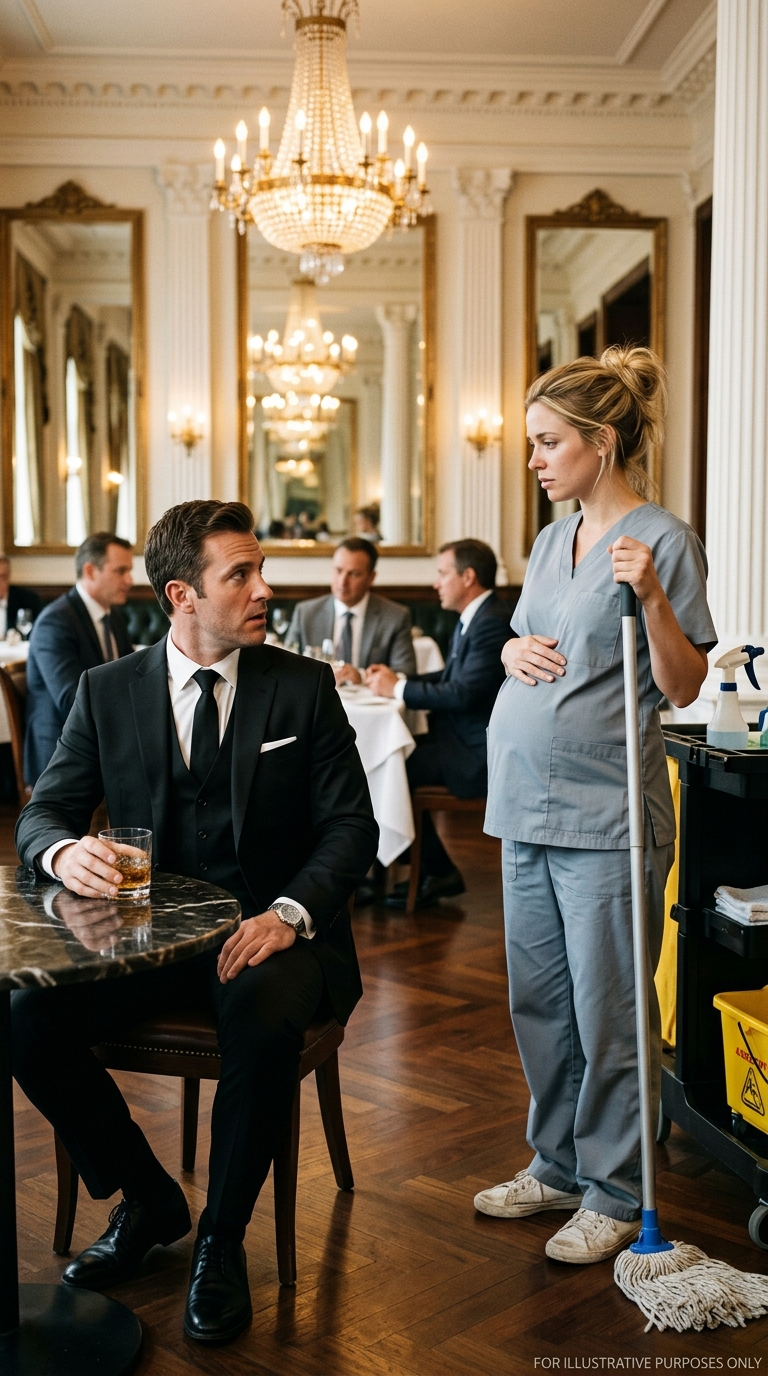
“Clara,” he breathed.
The name broke out of him like a prayer.
Chloe scrambled backward, dragging the dustpan with her. Glass scattered again. Her back hit the brick wall.
“Don’t touch me,” she cried.
Arthur reached toward her cheek, then stopped inches away, his hand shaking.
Behind him, Tommy stood. “Arthur.”
Arthur did not turn.
His eyes dropped.
That was when he saw her stomach.
The world split open.
Chloe pressed both hands over the curve of her belly, protecting the child from him.
Arthur stared at it, unable to make sense of time.
The explosion had been six months ago.
She was six months pregnant.
His mind tried to protect him from the conclusion, but it came anyway, brutal and shining.
She had been carrying his child when the car exploded.
A sound moved through the room. Maybe it came from Arthur. Maybe it came from the walls.
Tommy stepped closer. “Boss, listen to me. This isn’t possible.”
Arthur’s eyes stayed on Chloe. “Where have you been?”
“I don’t know you,” she whispered.
“Where have you been?”
“I said I don’t know you.”
His grief twisted. For one terrible second, it became rage.
He grabbed her shoulders and pulled her upright. Not enough to hurt her, but enough to make her gasp.
“Why?” he demanded. “Why would you do this? You let me bury you. You let me think you were ash in that car. You let me tear this city apart looking for someone to blame.”
Tears spilled down Chloe’s face. “Please stop. My name is Chloe. I woke up in Gary. I don’t remember anything before that. I swear to God, I don’t know you.”
“Don’t lie to me.”
“I’m not lying.”
“Arthur,” Tommy said, sharper now. “Let her go.”
Rosa ran from the kitchen, both hands raised. “Mr. Gallagher, please. Please, she’s just a girl from the shelter.”
Arthur turned his head slowly.
Rosa’s voice trembled, but she kept talking. “She has amnesia. She came from St. Jude’s. She barely knows how to sign her own name some days. She’s pregnant and scared, and she doesn’t know who she is.”
The word struck Arthur harder than any bullet.
Amnesia.
He looked back at Chloe.
Not Clara pretending.
Not Clara hiding.
Clara erased.
Her fear was real. Her confusion was real. She was trembling so violently that he could feel it through his hands.
He released her at once.
Chloe stumbled back and clutched her stomach.
Arthur stood frozen, staring at the woman he had mourned and the child he had never known existed.
Tommy moved beside him. “This is a setup. It has to be. Russo’s dead, but his people could still be playing games. We saw the report. We buried her.”
Arthur’s gaze shifted slowly to Tommy.
Something cold stirred beneath the shock.
Dr. Aris Mitchell had confirmed Clara’s identity.
Mitchell answered to the Gallagher family.
More specifically, Mitchell had always handled medical issues through Tommy.
Tommy, who had encouraged Arthur’s revenge.
Tommy, who had fed him names.
Tommy, who had taken meetings Arthur was too drunk or broken to attend.
Tommy, who had gained more power in six months than he had in the previous ten years.
Across the room, Chloe made a faint choking sound.
Arthur turned.
Her face had gone gray. One hand gripped the wall. The other pressed against her belly.
“I can’t breathe,” she whispered.
Then her eyes rolled back.
Arthur caught her before she hit the floor.
The room erupted.
“Call Keller,” Arthur ordered.
Tommy grabbed his arm. “Arthur, think. You can’t just take a random pregnant woman out of here.”
Arthur looked down at Tommy’s hand until Tommy removed it.
“She is not random.”
“Arthur—”
“She is my wife.”
Tommy’s face hardened. “Your wife is dead.”
Arthur lifted Clara into his arms. She weighed too little. Even pregnant, she felt fragile, breakable, like the world had been starving her slowly.
Arthur’s voice dropped. “Lock the doors.”
The guards moved at once.
Tommy stared at him. “What are you doing?”
Arthur carried Clara toward the rear exit.
“Finding out who buried my wife while she was still alive.”
Tommy took one step after him. “You’re making a mistake.”
Arthur stopped at the door and looked back.
“If you try to stop me,” he said calmly, “you’ll be the first one I question.”
For the first time in years, Tommy Callahan had nothing to say.
Outside, winter air slapped Arthur’s face. Snow blew sideways through the alley. His armored SUV idled near the back entrance, exhaust curling into the dark.
Arthur laid Clara carefully across the leather seat and buckled her in like she was made of glass. He brushed a loose strand of hair from her cheek.
Her eyelids fluttered.
For half a second, she looked peaceful.
Alive.
Arthur pressed his forehead to the cold edge of the door frame and closed his eyes.
“I found you,” he whispered.
Then he opened his eyes, and whatever softness had appeared there vanished.
He looked at Dominic Fisher, his head of security.
“Wake Dr. Keller. Bring him to Lake Forest. Quietly.”
“Yes, boss.”
“And Dom?”
Dominic paused.
Arthur looked through the snow toward the glowing back door of Cobalt, where Tommy’s silhouette stood watching from inside.
“Nobody leaves my circle until I know who lied to me.”
Part 2
The gates of the Gallagher estate opened like the jaws of some enormous iron animal and swallowed the SUV whole.
Lake Forest slept under a sheet of freezing rain. Beyond the long private drive, Arthur’s home rose from the trees in glass, steel, and pale stone. Clara used to hate when people called it a mansion.
“It sounds like something with dusty curtains and dead animals on the walls,” she had said when they first moved in.
“It has twenty-two rooms,” Arthur had replied.
“It has bad lighting.”
“You redesigned the lighting.”
“And saved us both from living like vampires.”
Now every window looked dark.
Arthur carried her through the front doors, past the marble entryway, past the floating staircase, past the framed black-and-white photographs Clara had taken during one of her “I’m going to make this house feel like humans live here” phases.
A photo of Arthur in the garden, pretending to be annoyed.
A photo of Lake Michigan in winter.
A photo of Clara’s own hand holding a coffee mug with chipped blue paint because she liked ugly things if they had stories.
Arthur refused to look at them.
He carried her into the primary bedroom and laid her on the bed.
The room still belonged to her.
No one had moved her books from the nightstand. No one had taken the cream cardigan from the chair by the window. No one had touched the small ceramic dish where she used to drop earrings at night.
Arthur had forbidden it.
He had told himself it was because nobody touched what belonged to a Gallagher.
The truth was worse.
He had been waiting for a dead woman to come home.
Twenty minutes later, Dr. Harrison Keller arrived with a leather medical bag, wet hair, and the exhausted expression of a man who had once been respected before cards, horses, and debt made him useful to criminals.
Keller had been chief of surgery at Rush before he lost his license. Arthur had paid off enough people to keep him out of prison. Keller repaid him by appearing whenever the Gallagher family needed medical care that could not involve hospitals.
Tonight, the doctor’s hands were steady.
Arthur paced near the foot of the bed while Keller checked Clara’s pulse, blood pressure, pupils, reflexes, and the baby’s heartbeat with a portable Doppler.
The sound filled the room.
Fast.
Strong.
Alive.
Arthur stopped moving.
Keller glanced at him. “That’s a good heartbeat.”
Arthur’s throat worked. “The baby?”
“Strong. Better than I expected, given her history.”
“What history?”
Keller hesitated.
Arthur’s eyes sharpened. “Say it.”
“I accessed the clinic records from Gary. Charity clinic. Poor documentation, but enough.” Keller removed his glasses and rubbed the bridge of his nose. “She was brought in five months ago with a traumatic brain injury, fractured wrist, burns along her shoulder, and extensive bruising consistent with blast force or a high-speed impact.”
Arthur gripped the back of a chair.
“She didn’t remember her name,” Keller continued. “They listed her as Jane Doe for two weeks. Eventually the shelter helped her choose Chloe Reeves for paperwork.”
“That’s not her name.”
“I understand.”
“No,” Arthur said. “You don’t.”
Keller looked at Clara, then at the untouched cardigan on the chair, then back at Arthur. His voice softened.
“Memory loss after trauma can be deep, especially when the brain is protecting itself. If she witnessed or experienced something catastrophic, the mind may have sealed it off.”
“How do we get it back?”
“You don’t force it.”
Arthur stepped toward him. “That wasn’t my question.”
“It’s my answer.” Keller did not raise his voice, which was brave or foolish. “If you shove her old life at her too quickly, especially your life, you could break what’s left of her stability. She believes she is a homeless pregnant woman named Chloe. She woke up in a world where nobody claimed her. Tonight, a feared man grabbed her in a bar and called her by another name. Her nervous system is already in crisis.”
Arthur looked at the bed.
Clara’s lashes rested against her cheeks. Her face was pale, thinner than before. She had survived the explosion, survived whoever took her, survived five months of poverty while carrying his son or daughter.
And when she woke, she would be afraid of him.
The thought cut deeper than betrayal.
“What do I tell her?” Arthur asked.
“As little as she can handle. The truth, but not all at once.”
Arthur almost laughed. Truth had never been delivered gently in his world.
Keller packed his bag. “She needs rest, nutrition, prenatal care, and safety. Not interrogation.”
Arthur nodded once. “Stay in the house.”
“I assumed.”
When Keller left, Arthur sat in the chair beside the bed.
For several minutes, he just watched her breathe.
He remembered the last morning he had seen her.
Clara had stood barefoot in their kitchen wearing one of his old Northwestern sweatshirts, though she had never gone there and had no loyalty to any school except “whichever one isn’t playing too loudly on television.” She was making toast badly. She was always burning toast.
Arthur had come in after a call that left blood on his cuff.
She had noticed.
She always noticed.
“You promised me you were moving more of the business clean,” she said.
“I am.”
“When?”
“Soon.”
“Arthur.”
He hated when she said his name that way. Like she could see the boy under the boss. Like she refused to be impressed by the monster everyone else feared.
He had walked over, wrapped his arms around her, and placed his hand low on her stomach.
She had gone still.
He felt it. The secret in her body. The fear and hope.
“You’re late,” he said.
Her eyes filled. “Three weeks.”
He had forgotten how to breathe then too.
They had planned to see a doctor after lunch.
She never made it.
A soft sound pulled him back.
Clara stirred.
Her eyes opened.
For one breath, she looked at the ceiling with confusion.
Then she saw him.
Panic flooded her face. She jerked backward and hit the headboard, both hands flying to her stomach.
“Where am I?”
Arthur stood slowly and lifted his hands, palms out. “You’re safe.”
“No.” Her gaze darted around the room. “No, no, I don’t know this place. Why am I here?”
“You fainted.”
“You brought me to your house?”
“I brought you somewhere private so a doctor could check you and the baby.”
“I need to leave.”
“You shouldn’t stand yet.”
“I said I need to leave.”
Arthur forced himself not to move closer. Every instinct in him screamed to hold her, to tell her she was home, to crush the world for what it had done. But Keller’s warning rang in his head.
She does not know you.
“My name is Arthur,” he said quietly.
“I know what you said.”
“You were working at Cobalt when you collapsed.”
“You grabbed me.”
His jaw tightened. “I did.”
“You called me Clara.”
Arthur said nothing.
“Why?”
Because you are my wife.
Because I loved you before you vanished.
Because I became something worse when I thought you died.
Because I buried a stranger and kissed your name into stone.
Instead, he said, “You look like someone I lost.”
Her fear flickered into something else. Unease. Curiosity. Maybe pity.
“I’m not her.”
“I know you don’t remember being her.”
She stared at him.
The room seemed to hold its breath.
“My name is Chloe,” she said, but there was less certainty in it now. “That’s what people call me.”
“What do you remember before Gary?”
“Nothing.”
“Nothing at all?”
Her eyes filled with tears of frustration. “Do you think I haven’t tried? I wake up every morning reaching for something that isn’t there. I don’t know my birthday. I don’t know if my parents are alive. I don’t know why I can speak French when a shelter volunteer played a song in it, or why I hate black SUVs, or why I cry every time I smell rain on hot pavement.”
Arthur closed his eyes briefly.
Lake Shore Drive.
Rain.
Fire.
“I don’t know who did this to me,” she whispered. “And you look at me like I did it to you.”
That broke something in him.
Arthur sat on the edge of a chair, still keeping distance. “I’m sorry.”
She looked startled, as though men like him did not apologize in her experience.
Maybe they didn’t.
He tried again. “I scared you. I shouldn’t have grabbed you. I was wrong.”
Clara studied him. Her hands remained on her stomach, but her breathing slowed.
“The doctor said the baby is okay?”
“Yes.”
“You’re sure?”
“He said the heartbeat was strong.”
A tear slipped down her cheek. She wiped it angrily, embarrassed by needing reassurance from him.
Arthur looked toward the fireplace because seeing her cry made violence rise in him like a second heartbeat.
“Can I go back to the shelter?” she asked.
“No.”
Her face tightened.
Arthur lifted a hand. “Not because I’m keeping you prisoner. Because whoever made you disappear may still be looking for you. Cobalt wasn’t safe. The shelter isn’t safe. Until I know who hurt you, you stay somewhere protected.”
“I don’t trust you.”
“You shouldn’t.”
That surprised her again.
Arthur met her eyes. “Not yet.”
She swallowed. “Are you a criminal?”
The question landed between them with clean, brutal innocence.
Arthur could have lied.
He had lied to senators, judges, police captains, grieving widows, and men who died believing him. But Clara had always hated lies more than violence.
“I have done criminal things,” he said.
“That’s not an answer.”
“It’s the only one I can give you tonight.”
She looked away, one hand moving slowly over her belly. “I don’t want my baby near dangerous people.”
“I know.”
“Then why would I stay near you?”
Arthur stood. The answer was simple, impossible, and useless to a woman who did not remember loving him.
“Because dangerous people are coming,” he said. “And I am worse than they are.”
He left before she could reply.
In the hallway, his expression changed.
The man who walked down the stairs was not the broken husband from the bedroom. He was Arthur Gallagher, and the house seemed to recognize him. Guards straightened. Doors opened. Phones appeared. Men lowered their voices.
Dominic waited in the basement conference room, where the walls were soundproof and the lights were too bright.
Dr. Aris Mitchell sat strapped to a steel chair.
His shirt was soaked with sweat. His eyes were red. He started crying the moment Arthur entered.
“Mr. Gallagher, please. I didn’t have a choice.”
Arthur removed his cuff links and placed them on the table.
Mitchell sobbed harder.
Arthur rolled up his sleeves.
“I haven’t asked a question yet.”
“He threatened my family.”
Arthur picked up a metal wrench from the table. He did not raise it. He did not need to.
“Who?”
Mitchell shook his head violently. “I can’t.”
Arthur stepped closer. “You certified my wife dead.”
Mitchell whimpered.
“You let me bury a stranger.”
“I didn’t know she was pregnant.”
Arthur went still.
Mitchell realized too late what he had admitted.
Dominic shifted by the door.
Arthur’s voice was barely audible. “Start at the beginning.”
The story came out in pieces.
A woman from the county morgue. Unclaimed. Similar height and build. No family to ask questions.
Dental records altered before the fire investigation completed.
A body burned beyond recognition in Clara’s vehicle.
A false report filed.
A payment of two million dollars through a Cayman account.
And Clara.
Alive after the initial blast because she had not been inside the SUV when it detonated. She had stepped away to retrieve an earring near the curb. The explosion knocked her unconscious. Men dressed as paramedics loaded her into an ambulance that was not dispatched by the city.
Arthur listened without moving.
Inside him, Chicago burned all over again.
“Who paid you?” Arthur asked.
Mitchell bent forward as far as the restraints allowed. “Tommy Callahan.”
Dominic’s face hardened.
Arthur closed his eyes.
Not because he doubted it.
Because some part of him had known from the moment Tommy told him to let the girl go.
“He said she was making you weak,” Mitchell blurted. “He said the baby would make you leave the business. He said you were talking about moving money into legal companies, cutting off routes, shutting down old arrangements.”
Arthur remembered.
Clara at the kitchen island, holding a pregnancy test in both hands.
“I don’t want our child raised inside a fortress,” she had whispered.
“Then I’ll build something else,” he had said.
He had meant it.
Tommy must have heard enough to believe it.
“Where was she taken?” Arthur asked.
“A private clinic outside Gary. Tommy had men there. They were supposed to…” Mitchell gagged on the words. “They were supposed to finish it after the explosion. But she woke up confused and escaped during a shift change. They searched, but with the amnesia, she didn’t use her real name. She vanished into shelters.”
Arthur looked at the wrench in his hand.
For six months, he had destroyed the Russo family, believing they had killed Clara. Tommy had pointed him toward them. Tommy had fed the fire. Tommy had stood beside him at the funeral with one hand on his shoulder.
Tommy had been best man at his wedding.
Arthur placed the wrench back on the table with careful precision.
Dominic waited.
“What do you want done with him?” Dominic asked.
Arthur looked at Mitchell, who shook in the chair.
Six months ago, Arthur would have chosen pain.
Tonight, Clara was asleep upstairs with their child under her heart.
Arthur heard her voice from years earlier.
You always think revenge is justice because revenge obeys you.
Arthur stepped back.
“Record his confession,” he said. “Every detail. Accounts, names, dates, locations.”
Mitchell looked up, stunned.
Dominic nodded. “And after?”
“Keep him alive.”
Dominic’s eyebrow twitched.
Arthur’s eyes stayed on Mitchell. “He’s going to testify when I decide which court deserves the truth.”
Mitchell sagged with relief.
Arthur leaned close enough for the doctor to smell the smoke on his jacket.
“But if one word leaves this house before I’m ready, no court in Illinois will ever find enough of you to bury.”
Mitchell began crying again.
Arthur walked out.
At dawn, rain streaked the windows of his study. The sky over Lake Forest was the color of old steel.
Arthur sat behind his desk, staring at the phone.
On the wall across from him hung a photograph Clara had taken of Tommy and Arthur years earlier outside Wrigley Field. They were younger. Laughing. Before power had turned friendship into hunger.
Arthur called Tommy at 7:15.
“Port issue,” Arthur said. “Lake Forest. Nine sharp.”
Tommy arrived at 8:58 wearing a charcoal overcoat and the easy confidence of a man who believed he understood every room before he entered it.
Arthur did not stand.
Tommy shook rain from his coat. “You look like hell.”
Arthur poured whiskey into two glasses.
“It’s morning,” Tommy said.
“It’s been morning before.”
Tommy smiled faintly and took the glass. “How’s the pregnant janitor?”
Arthur watched him carefully.
“Resting.”
“Good. Then maybe you’ve had time to realize last night was a trauma response.”
Arthur said nothing.
Tommy took a drink. “You loved Clara. We all did. Seeing someone who looks like her—”
“I spoke to Aris Mitchell.”
The glass stopped halfway to Tommy’s mouth.
It was only a second.
But Arthur saw the mask fall.
Under the charm, under the loyalty, under twenty-five years of brotherhood, there was calculation cold enough to freeze blood.
Then Tommy smiled.
“Aris is a pill addict with a gambling problem.”
“He told me about the woman from the morgue.”
Tommy’s hand shifted slightly toward his coat.
Arthur continued. “He told me about the dental records. The Cayman transfer. The clinic in Gary. The men dressed as paramedics.”
The study became silent except for rain tapping against the glass.
Tommy set down his drink.
When he spoke, he did not bother denying it.
“She was going to end you.”
Arthur stood slowly.
Tommy laughed once, bitter and low. “Don’t look at me like that. She had you talking about solar companies and real estate trusts. You were going to turn the Gallagher name into something clean enough for PTA meetings.”
Arthur’s voice was flat. “She was my wife.”
“She was a leash.”
“She was carrying my child.”
Tommy’s expression flickered. “I didn’t know that at first.”
“But you knew before the clinic.”
Tommy looked away.
Arthur felt the last living piece of their friendship die.
“You ordered a hit on my pregnant wife.”
“I saved the family.”
“You destroyed mine.”
Tommy’s face hardened. “No, Arthur. I preserved what your father built. What we built. You think men follow you because you’re noble? They follow you because they’re afraid. Clara made you forget that.”
Arthur stepped around the desk.
Tommy’s hand went inside his coat.
Arthur had expected it.
Two suppressed shots cracked through the study.
Tommy’s gun fell from his hand before he could raise it. He staggered back, eyes wide with disbelief, blood spreading dark across his shirt.
Arthur caught him as he fell, because some old instinct, some memory of boys fighting together in alleys, still lived in the body even after the heart rejected it.
Tommy gripped Arthur’s sleeve.
“You’ll lose everything,” he rasped.
Arthur looked down at the man who had stood beside him at his wedding and plotted his wife’s murder.
“No,” Arthur said. “I already did.”
Tommy’s eyes went empty.
Arthur lowered him to the rug.
For a long moment, he remained crouched beside the body.
He felt no victory.
Only exhaustion.
Dominic entered quietly, took in the scene, and waited.
Arthur stood. “Call everyone.”
“Everyone?”
“Captains. Accountants. Lawyers. All of them.”
Dominic studied him. “What are we doing?”
Arthur looked toward the ceiling, toward the bedroom where Clara slept without knowing the war being fought beneath her.
“We’re ending the part of this family that tried to kill mine.”
Part 3
Five weeks passed before Clara remembered the song.
It happened in the kitchen at midnight.
Arthur found her there barefoot, wearing one of his old sweaters over maternity leggings, standing by the stove with a piece of burned toast in her hand and tears streaming down her face.
For one impossible second, time folded.
She looked exactly as she had the morning of the explosion.
Arthur stopped in the doorway.
“Clara?”
She did not correct him.
That alone made his chest ache.
She looked at the toast as if it had betrayed her. “I hate this.”
“The toast?”
“No.” She laughed through the tears, small and broken. “Yes. Maybe. I don’t know.”
He approached slowly. Over the past five weeks, he had learned how to move around her like a man approaching a wild bird.
Not because she was weak.
Because she had been wounded by a world that used his face as the first symbol of danger it gave back to her.
He had given her the east wing of the house and told her every door would open from the inside. He had assigned guards to the property line, not her hallway. He had hired a licensed obstetrician from Northwestern under a discreet private contract. He had arranged therapy with a trauma specialist who knew nothing about the Gallagher empire and everything about memory.
He had not forced her to call herself Clara.
He had not touched her without permission.
He had told her pieces of the truth in careful order.
Her name.
Their marriage.
The explosion.
The false death.
Not everything.
Not yet.
The first time he showed her a wedding photo, she stared at it for ten minutes and then locked herself in the bathroom to throw up.
The second time, she asked why she had looked so happy.
Arthur told her, “Because you were.”
She asked, “With you?”
He answered, “I hope so.”
Now she stood in their kitchen crying over burned toast.
“What happened?” he asked.
“There was a song.” She wiped her cheek with the heel of her hand. “I was humming it. I didn’t know I knew it. Then I remembered rain.”
Arthur’s body went cold.
“What kind of rain?”
“Warm rain. In New Orleans, maybe? There were balconies. Music outside. I had red shoes.” She looked at him, frightened by her own mind. “You were there.”
Arthur nodded once, unable to speak.
Their first anniversary. A last-minute trip to New Orleans because Clara said Chicago winters were “personally disrespectful.” She had bought red shoes from a little shop on Magazine Street and danced with him in a hotel courtyard during a storm.
“What was the song?” he asked.
She hummed three notes.
Arthur had to grip the counter.
Clara saw it. “You know it.”
“Yes.”
“Did we dance to it?”
“Yes.”
She pressed both hands to her face. “I can feel it, but I can’t see it. It’s like standing outside a lit house in the snow. I know I belong inside, but I can’t find the door.”
Arthur wanted to say he would break the door down.
Instead, he said what her therapist had taught him to say.
“You don’t have to force it.”
She laughed bitterly. “You hate not forcing things.”
He looked at her.
For the first time since Cobalt, there was something almost teasing in her expression.
A fragment of the woman he knew.
“Apparently,” Arthur said, “I’m learning.”
Her smile faded, but not into fear.
Into sadness.
“Were you very terrible?”
Arthur did not pretend not to understand. “Yes.”
“Because of me?”
“No.” He held her gaze. “Because of losing you. There’s a difference, but not an excuse.”
She looked down at her stomach. The baby shifted under her hand.
“I don’t want him born into blood.”
“Him?”
She froze.
Arthur went still too.
Clara’s lips parted. Her eyes filled with confusion, then wonder.
“I don’t know why I said that.”
Arthur’s voice softened. “Maybe you know more than you think.”
A contraction hit three days later.
It was early evening, and the first real thunderstorm of spring rolled across Lake Michigan with enough force to rattle the windows. Clara was in the library, sorting through old photographs. Arthur was in the study with lawyers, signing documents that moved clubs, warehouses, and shipping companies into a trust that federal prosecutors would someday call surprisingly clean and former associates would call unforgivable.
The old Gallagher empire did not die in one dramatic fire.
It died in paperwork, bank transfers, arrests, severed alliances, and men discovering that Arthur Gallagher was far more terrifying when sober and protective than he had ever been drunk and grieving.
Dominic opened the study door without knocking.
Arthur looked up.
“It’s time.”
Arthur was out of the chair before the lawyers could stand.
By the time he reached the bedroom, Clara was gripping the edge of a dresser, breathing hard. Dr. Keller and the obstetrician, Dr. Elaine Morris, had already been called. Rain lashed the windows. Thunder rolled over the house.
Clara looked up when Arthur entered.
For once, she did not look relieved and frightened at the same time.
She looked furious.
“You,” she snapped.
Arthur stopped. “Me?”
“You did this.”
He blinked.
Then, despite everything, he almost smiled.
“Yes,” he said carefully. “I was involved.”
She pointed at him. “Do not be charming. I am in pain.”
The smile vanished. “What do you need?”
“I don’t know. Fix it.”
“I can’t.”
“Then why are you rich?”
Keller, arriving behind Arthur with his bag, made the mistake of coughing into his hand.
Clara glared at him too. “You’re also on my list.”
Keller raised both hands. “Understood.”
Labor lasted fourteen hours.
Arthur had seen men shot, stabbed, drowned, and broken. He had ordered things that stained the soul. He had believed he understood pain.
He knew nothing.
Clara endured each contraction with a kind of primal courage that humbled him. She cursed him, crushed his hand, cried, apologized for crying, then cursed him again when he told her she did not need to apologize.
At 3:42 in the morning, while rain hammered the roof and dawn waited somewhere beyond the storm, their son came into the world screaming.
The sound destroyed Arthur more completely than grief ever had.
Dr. Morris lifted the baby, slick and furious and alive.
“It’s a boy,” she said.
Clara sobbed.
Arthur sank to his knees beside the bed.
Not because he meant to.
Because his legs stopped obeying him.
The baby was wrapped in a warm blanket and placed against Clara’s chest. He had Arthur’s dark hair, Clara’s mouth, and the fierce offended expression of someone who had been removed from comfortable housing without proper notice.
Clara laughed through tears.
“Oh,” she whispered. “Hi. Hi, sweetheart.”
Arthur pressed his fist against his mouth.
Clara looked at him. “Are you crying?”
“No.”
“You are.”
“Yes.”
She looked back at the baby, touching his cheek with one trembling finger. “He’s beautiful.”
“He is.”
The room softened around them.
For a few minutes, there was no empire. No betrayal. No blood. No false grave. Only rain, breath, a newborn’s cries, and a woman holding the future against her heart.
“What should we name him?” Arthur asked.
Clara’s hand stilled.
The question seemed to move through her like a key turning in a lock.
Her brow furrowed. She looked down at the baby, then toward the rain-streaked windows, then at Arthur.
A strange, distant light entered her eyes.
“William,” she whispered.
Arthur stopped breathing.
Clara looked startled by the sound of the name in her own mouth.
“William,” she said again, and tears spilled fresh down her face. “We said if it was a boy, we’d name him after your father.”
Arthur gripped the side of the bed.
The room blurred.
Clara stared at him, terrified and hopeful. “Did we say that?”
Arthur nodded. “Yes.”
“I remembered?”
“Yes.”
She began to cry harder.
Arthur leaned forward, then stopped. Waiting.
Clara saw him stop.
For several seconds, she looked at his face as though reading a letter written in a language she used to know by heart.
Then she reached for him.
Arthur went to her.
He wrapped one arm around her shoulders and the other around the tiny bundled weight of their son, careful not to hold too tightly, careful not to make a cage out of love.
Clara rested her head against him.
“I don’t remember everything,” she whispered.
“You don’t have to.”
“What if I never do?”
“Then I’ll meet you again.”
She closed her eyes.
Arthur pressed his lips to her hair.
Two weeks later, Clara asked to see the grave.
Arthur did not want to take her.
That was why he knew he had to.
The cemetery sat beneath a pale April sky, the grass still damp from morning rain. Arthur carried William in a dark blue blanket while Clara walked beside him slowly, one hand tucked through his arm.
She had gained a little strength. Color had returned to her face. She still woke from nightmares. She still sometimes called herself Chloe when startled. She still looked at Arthur with confusion when a memory surfaced and vanished too quickly to catch.
But she had begun choosing pieces of herself.
She wore her own wedding ring on a chain around her neck.
Not on her finger.
Not yet.
Arthur accepted that.
The headstone stood beneath an oak tree.
Clara Davis Gallagher.
Beloved wife.
The dates were wrong.
That was the first thing Clara said.
“The dates are wrong.”
Arthur looked at the stone. “Yes.”
“Who is buried there?”
“An unknown woman who deserved a name and got yours instead.”
Clara’s eyes filled.
Arthur shifted William gently in his arms. “I’m having the records corrected. She’ll be identified if possible. If not, she’ll be buried properly. Under her own marker.”
Clara touched the stone with trembling fingers.
“You mourned me here.”
“Every day for a while.”
“What did you say?”
Arthur looked at the grass.
“Mostly things I should have said while you were alive.”
Clara waited.
Arthur swallowed. “That I was sorry. That I should have left the business sooner. That I should have taken you to the doctor that morning instead of answering a call. That I didn’t know how to be good without you watching.”
The wind moved through the oak branches.
Clara turned toward him. “You can’t make me your reason to be good.”
“I know.”
“Do you?”
He met her eyes. “I’m learning that too.”
She looked at him for a long time.
Then William made a small, impatient noise in his blanket.
Clara smiled and took him from Arthur’s arms. She held their son against her chest and looked back at the grave bearing her name.
“I don’t want to be buried twice,” she said.
Arthur’s throat tightened.
“I want to live once. Properly. With choices. With the truth. With no locked doors unless I lock them myself.”
“You have that.”
“I mean it, Arthur.”
“So do I.”
She looked toward the cemetery road where Dominic waited beside the car, far enough away to give privacy, close enough to protect.
“No more hiding behind fear,” Clara said. “No more men whispering in basements. No more deciding who deserves mercy based on whether you’re angry.”
Arthur nodded.
“And if I remember everything and decide I can’t love you anymore?”
The question hit him cleanly.
He deserved it.
He looked at the woman he had found on a bar floor, the wife he had buried, the stranger he had tried to earn trust from one careful day at a time.
“Then I’ll still make sure you and William are safe,” he said. “And I’ll let you go.”
Her eyes searched his face.
“You would?”
“It would kill me.”
“That isn’t what I asked.”
“Yes,” he said. “I would.”
Clara looked down at their son.
When she spoke again, her voice was softer.
“I don’t know if I love you the way she did.”
Arthur nodded once.
“But I know you’re trying to become someone she could have stayed for.”
Arthur closed his eyes.
For a moment, he could almost hear the old Clara in that sentence. Not fully. Not perfectly. But enough.
The following months did not turn into a fairy tale.
Memory returned in fragments, not miracles.
A song in a grocery store made Clara remember dancing in New Orleans.
The smell of basil made her remember planting herbs and yelling at Arthur for letting the gardener overwater them.
A thunderclap made her collapse in the hallway, shaking so hard Arthur sat ten feet away for forty minutes because she could not bear to be touched.
She remembered their first kiss before she remembered their wedding.
She remembered the explosion before she remembered telling him she was pregnant.
That memory came one summer evening while William slept in a bassinet near the open terrace doors.
Clara was looking through a box of photographs when she found one Arthur had never seen before. It was a blurry image of two pregnancy tests on the bathroom counter, both positive, with a yellow sticky note beneath them.
Tell him after breakfast if you don’t chicken out.
Clara laughed once.
Then she went silent.
Arthur watched from across the room as the color drained from her face.
“Clara?”
She pressed the photo to her chest.
“I was happy,” she whispered.
Arthur stood slowly.
“I was scared, but I was happy. I was going to make toast.” She looked up at him, eyes wide with returning pain. “You came into the kitchen with blood on your sleeve.”
Arthur nodded.
“I told you I couldn’t raise a baby like that.”
“Yes.”
“You said you’d build something else.”
His voice broke. “I meant it.”
She stared at him as six months of lost life, five months of fear, and years of love fought their way through her eyes.
“I remember your hand on my stomach.”
Arthur could not move.
“I remember thinking,” she said, crying now, “that our baby would know the good part of you first.”
Arthur crossed the room only when she reached for him.
This time, when she held him, she held him like a wife.
Not fully healed.
Not untouched by fear.
Not magically restored.
But present.
Alive.
Choosing.
By fall, the Gallagher name had changed in Chicago.
Some men vanished from Arthur’s circle because prison was safer than Arthur’s disappointment. Some turned state’s witness. Some tried to challenge him and discovered that dismantling an empire did not make a king defenseless.
Arthur kept the legal businesses.
The rest he burned carefully, deliberately, and permanently.
A foundation appeared under Clara’s name, though she insisted on adding the unknown woman from the morgue once her identity was found. Her name was Denise Walker. She had been forty-one years old, a former nurse from Peoria, lost to addiction, forgotten by most, used in death by men who thought the poor could be erased without consequence.
Clara made sure Denise was not erased.
The foundation funded shelters, trauma clinics, legal aid, and safe housing for pregnant women without names, papers, or families.
At the opening of the first shelter, a reporter asked Clara why she cared so much.
Arthur stood off to the side holding William, who was chewing the edge of his own blanket with deep concentration.
Clara looked at the cameras.
“Because once, I had no name,” she said. “And a woman with nothing still deserves to be found.”
That night, after the event, Arthur found her in the nursery.
William was asleep. The room glowed with soft lamplight. A mobile of tiny wooden stars turned above the crib.
Clara stood beside it, touching the ring on her finger.
She had put it back on two days earlier without announcement.
Arthur had noticed but said nothing, afraid that speaking would break the spell.
“You’re staring,” she said.
“Yes.”
“That used to annoy me, didn’t it?”
“Constantly.”
She smiled.
He walked to stand beside her.
For a long time, they watched their son sleep.
Then Clara said, “I remember the first time you told me you loved me.”
Arthur looked at her.
“It was snowing,” she said. “You were bleeding from your eyebrow because you got into a fight with a man outside my apartment and then tried to pretend you slipped on ice.”
“He was following you.”
“You still lied badly.”
“I was younger.”
“You were thirty.”
“I was emotionally younger.”
She laughed softly, and the sound filled the nursery like light under a door.
Arthur felt it settle into the places grief had hollowed out.
Clara turned toward him.
“I remember loving you,” she said.
Arthur’s face changed before he could stop it.
She touched his cheek.
“But I also love you now. Differently. More carefully. With my eyes open.”
He covered her hand with his.
“That’s more than I deserve.”
“Yes,” she said.
He almost smiled.
Then she stepped closer.
“You’re supposed to say you’ll spend the rest of your life deserving it anyway.”
Arthur bent his forehead to hers.
“I’ll spend the rest of my life deserving it anyway.”
Outside, Chicago glittered beyond the trees, a city of old sins and new chances. Arthur Gallagher had once ruled it through fear. He had once believed power meant making the world kneel.
But his wife had returned to him with no memory, no protection, and a child under her heart, and she had taught him the one thing no enemy ever could.
A man could survive losing everything.
But he could not become worthy until he chose what to save.
In the quiet nursery, Clara slipped her hand into his.
Arthur held it gently.
Not like something he owned.
Like something he had been trusted with.
And for the first time since the night the world exploded, the house did not feel like a fortress.
It felt like home.